
I. What Is BOME? Why Does a “Meme Coin” Become a Market-Watched Asset?
Many newcomers searching for BOME for the first time have a direct question: What exactly is BOME? Is it just a worthless “air coin”? Why would an exchange list a Meme coin, and why does it become a market-watched asset?
To understand BOME, you first need to understand the unique nature of Meme Coins.
A Meme Coin is not a “technology project” in the traditional sense. Its value rarely comes from revenue, cash flow, protocol fees, or complex technology. Instead, it derives from community culture, viral spread, market consensus, trading liquidity, and speculative cycles. In other words, the core of a Meme Coin is not “how complex a technical problem does it solve?” but “can it consistently attract attention and convert that attention into market consensus?”
BOME, full name Book of Meme, is a Meme Token on the Solana ecosystem. As OKX Learn notes, Book of Meme is a Meme Coin built on Solana, created by crypto artist Darkfarms1, aiming to combine Meme culture, decentralized storage, and community participation.
So, BOME is not an AI project token, not a DeFi yield token, and not a layer‑1 infrastructure asset. It is closer to an internet culture asset—an on‑chain experiment around Meme culture preservation, distribution, and community consensus.
In one sentence:
BOME is the ecosystem token of Book of Meme, one of the more representative community‑culture assets in the Solana Meme ecosystem.
To check BOME’s live price, you can visit Hibt’s BOME/USDT market page for price, candlesticks, trading data, and market trends.
1.1 What Is the Basic Definition of BOME (Book of Meme)?
BOME stands for Book of Meme. Its positioning is not a traditional application protocol but an experimental project around Meme culture, on‑chain recording, and decentralized storage.
The Book of Meme official website describes the project as a digital collection of Meme culture, aiming to preserve the ever‑evolving Meme culture on‑chain, using Solana’s BOME Token, Arweave, IPFS, and other decentralized storage solutions to give Meme content more permanent preservation.
This description highlights three key points.
First, BOME is a Solana‑native Token.
Solana’s advantages—fast transaction speeds and low fees—make it ideal for high‑frequency, small‑amount, community‑driven trading. Solana’s network is built for low‑cost, high‑performance use cases, and Solana Pay emphasizes fast settlement and low fees. Meme coins often require heavy trading, rapid dissemination, and community interaction, which makes Solana one of the most active ecosystems for Meme projects.
Second, BOME is a Meme‑culture asset.
It is not supported by protocol revenue, lending, staking, or trading fees. Instead, its value fluctuates with Meme culture diffusion, community identity, and market attention.
Third, BOME carries the concept of an “on‑chain Meme archive.”
While many Meme coins rely solely on an avatar, slogan, and hype, BOME attempts to combine Meme content, NFT culture, decentralized storage, and on‑chain records. This gives it more than just a symbolic Meme Token—it also has an experimental flavor of preserving internet culture.
For newcomers, here’s a simple way to distinguish BOME:
- BOME is not a layer‑1 infrastructure asset.
- BOME is not a DeFi protocol asset.
- BOME is not an AI or compute‑focused token.
- BOME is a Meme‑culture token within Solana, driven primarily by community consensus, viral potential, and market sentiment.
1.2 What Problem Does Book of Meme Aim to Solve?
The problem Book of Meme addresses is not a traditional business problem—it’s an internet culture problem.
Memes are one of the most important forms of cultural transmission on the internet. A single meme, image, catchphrase, or character can go global in hours. But Memes also have clear drawbacks: short lifecycles, content loss, difficulty tracing origins, and poor cultural preservation.
Many once‑viral Memes fade quickly, replaced by new trends. Their content scatters across social media, forums, image boards, chat groups, and short‑video platforms, lacking a unified preservation mechanism.
BOME’s idea: can we turn Meme culture into an on‑chain archive? Can Meme content be preserved long‑term through decentralized storage? Can communities collectively record and spread Meme culture?
So, Book of Meme is more like an “on‑chain Meme cultural archive” than a conventional software protocol.
This is also what differentiates BOME from average Meme Tokens. A typical Meme project might only need a mascot and a story, while BOME at least attempts to connect Meme culture, decentralized storage, NFT narratives, and Solana’s trading ecosystem.
Of course, that doesn’t mean BOME has stable commercial value. Its core remains cultural experimentation and market consensus, not a traditional revenue model.
1.3 Why Do Meme Coins Generate Market Value?
Many newcomers find it strange: why would anyone buy a Meme coin with no cash flow, no corporate profits, and no real product revenue?
The answer: Meme coins trade attention, emotion, and consensus.
Traditional assets typically derive value from revenue, cash flow, user growth, reserves, technological moats, and market share. Stocks reflect company profits; layer‑1 networks reflect usage; DeFi protocols reflect fees and TVL.
Meme assets operate differently. They are hybrids of internet culture and financial markets. Their prices are driven by community size, viral speed, social media buzz, KOL interest, exchange listings, market sentiment, and liquidity.
Reuters has noted that Meme coins are highly speculative and often driven by attention cycles. That observation fits BOME perfectly: BOME’s price is not purely determined by technology—it depends on whether Meme culture can sustain market attention.
Thus, BOME’s investment logic is not traditional value investing—it is attention‑asset logic.
- The more concentrated the attention, the easier capital flows in.
- The more active the community, the more short‑term price support.
- The more manic the market, the faster Meme coins can rally.
But conversely, once attention fades, liquidity shrinks, and community engagement cools, BOME’s price can drop just as quickly.
II. BOME Project Background: Why Did It Explode Within the Solana Meme Ecosystem?
BOME gained market attention quickly—not just because it’s called Book of Meme, nor because the Meme concept is new, but because it aligned with several important market conditions.
First, the Solana Meme ecosystem has been highly active in recent market cycles.
Solana’s low fees and high throughput make it ideal for rapid issuance, trading, and dissemination of Meme projects. Meme coin trading is typically high‑frequency, small‑size, and user‑heavy—high on‑chain fees would raise barriers for retail participation. Solana’s low‑cost environment naturally suits Meme asset diffusion.
Second, BOME has a clear cultural label.
Many Meme coins have only an animal image or a slogan, but BOME’s concept—Book of Meme, “preserving Meme culture”—offers a richer narrative than average avatar coins.
Third, BOME launched during a phase of high Meme market sentiment.
Meme coin breakouts often require a risk‑on environment. When BTC, ETH, and major assets rise, retail capital looks for higher‑beta plays, and the Meme sector typically benefits. BOME gained traction precisely when Solana Meme热度 was rising and interest in high‑volatility assets was strong.
Fourth, BOME secured exchange liquidity support.
For a Meme coin to move from a community on‑chain asset to mainstream market attention, it usually requires centralized exchange listings, on‑chain liquidity pools, KOL amplification, and community consensus. As BOME became visible to more users, liquidity increased, market depth improved, and price swings amplified.
2.1 Why Did BOME Choose the Solana Ecosystem?
Meme coins are highly dependent on trading experience.
If every trade costs high gas fees, small‑capital users face significant friction. If confirmation is slow, chasing or cutting losses becomes frustrating. If the trading ecosystem is inactive, Meme spread slows.
Solana’s characteristics fit Meme coin development perfectly: fast transactions, low fees, active on‑chain users, mature DEX ecosystems, and relatively user‑friendly wallets.
That’s why Solana tends to produce Meme hotspots across multiple market cycles. Projects like BOME, BONK, and WIF all illustrate the strong alignment between Meme culture and Solana.
For BOME, choosing Solana was not just a technical decision—it was also a market decision. Solana users are more accustomed to high‑frequency on‑chain trading, and Meme communities spread faster, increasing the likelihood that BOME gets discovered.
2.2 What Is BOME’s Development Path?
BOME’s development can be viewed in four phases.
Phase 1: Meme culture experiment.
Initially, the core was not to build a complex financial protocol but to combine the Book of Meme concept with Meme culture, decentralized storage, and a Solana Token.
Phase 2: Community propagation.
A Meme project’s success hinges on whether the community is willing to spread it. BOME’s name, concept, artist background, and Solana ecosystem label gave it a strong foundation for virality.
Phase 3: Trading‑market recognition.
As more traders notice BOME and it appears on more exchanges or market pages, it transitions from a community asset to a market asset. At this stage, price, volume, market cap, holder counts, and social chatter all amplify.
Phase 4: Potential ecosystem expansion.
If BOME can further expand around Meme archives, NFTs, decentralized storage, community creation, and cultural content, it might evolve from a purely speculative Meme asset into a more culture‑centric ecosystem asset.
But note: Phase 4 is not a guaranteed outcome—it’s a possibility. Investors need to continuously watch whether the project actually rolls out new features, applications, content, and user growth, not just slogans.
2.3 How Does BOME Differ from DOGE and SHIB?
BOME, DOGE, and SHIB are all Meme assets, but their market positioning differs.
DOGE is one of the earliest widely known Meme coins, built around the Shiba Inu image, internet joke culture, community spread, and long‑term brand recognition. DOGE’s strength is its history, strong consensus, and broad awareness, but its ecosystem expansion is relatively limited.
SHIB leans more toward an ecosystem‑oriented Meme. It started with a Meme narrative and later expanded around Shibarium, DEX, NFTs, and applications, trying to move from community asset to application ecosystem asset.
BOME is more of a Meme‑culture experiment. It didn’t start with a payments story, nor did it build a full DeFi ecosystem first. Instead, it revolves around the “Book of Meme” concept, emphasizing Meme culture preservation, decentralized storage, and Solana community transmission.
So, the differences can be summarized as:
- DOGE = historical representative of Meme coins.
- SHIB = representative of Meme ecosystem expansion.
- BOME = representative of Solana Meme culture experimentation.
That’s why BOME’s investment logic cannot be copied from DOGE or SHIB. DOGE relies on long‑term brand consensus; SHIB on ecosystem building; BOME depends more on Solana Meme hype, community spread, and whether its cultural narrative can endure.
III. What Value Does the BOME Token Have? Why Do People Buy It?
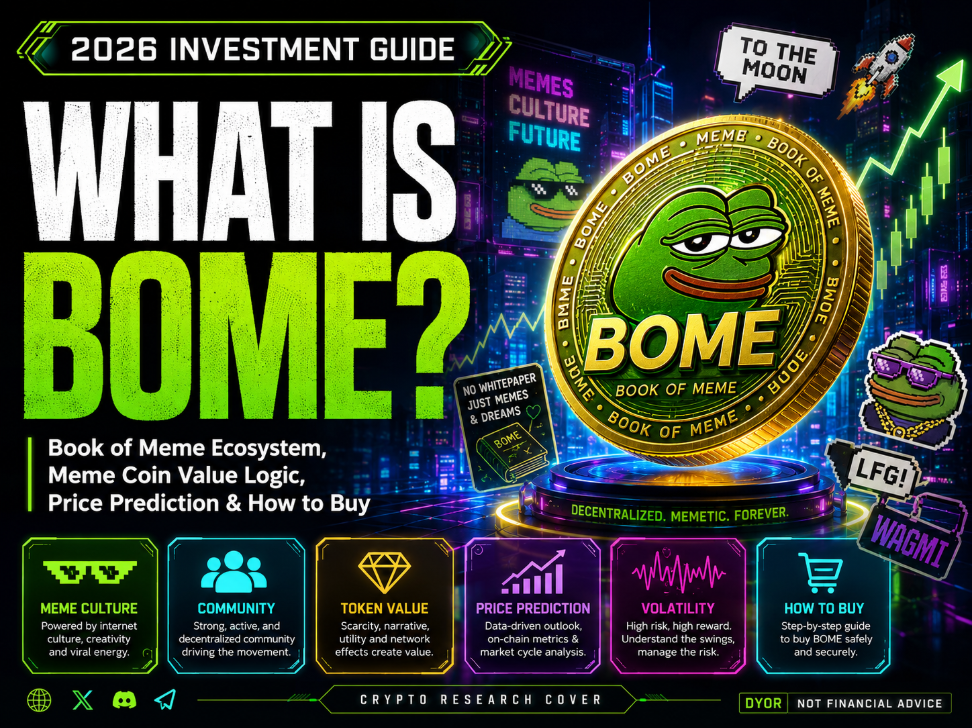
BOME’s value does not come from traditional business revenue, but from three aspects: community participation, cultural collectibility, and market trading.
3.1 What Are the Main Uses of the BOME Token?
The most important use today is community participation.
Holding BOME is not just about price speculation—it can also be a way to participate in Book of Meme’s community culture. Meme project community participation often includes holding, sharing, discussing, creating Meme art, joining events, following project updates, and driving virality.
The second use is Meme‑culture collectibility.
BOME’s Book of Meme narrative gives it a cultural‑collectible flavor. It’s not about collecting a single image but about establishing an on‑chain symbol around Meme culture as a whole. For some users, BOME represents an on‑chain cultural identity.
The third use is as a tradable market asset.
BOME has become a tradable Meme Token that users can buy and sell on trading platforms. For traders, the appeal lies in high volatility and high beta—when prices rise, returns can be swift; when they fall, losses can be equally fast.
That’s the dual nature of Meme coins: opportunities come from high volatility, and so do risks.
3.2 What Makes BOME Different from Ordinary Meme Coins?
Most Meme coins rely on an image, a story, a community, and short‑term hype.
Compared to ordinary Meme coins, BOME adds three additional concepts.
First, the Meme archive concept.
Book of Meme isn’t just telling a joke—it attempts to preserve Meme culture as a digital archive. This gives BOME a more culture‑recording narrative.
Second, the NFT‑culture direction.
Memes are naturally related to NFTs, because Memes themselves are images, art, memes, and community spread. BOME’s narrative more easily connects with NFTs, digital collectibles, and on‑chain content provenance.
Third, the decentralized‑storage narrative.
The project’s website mentions using Arweave and IPFS as primary storage for Book of Meme, and exploring more permanent storage like Bitcoin inscriptions. This makes BOME more than just “issuing a coin”—it links Meme culture preservation with on‑chain immutability.
However, investors must be clear: these narratives do not equal stable revenue, deterministic demand, or guaranteed price appreciation. They are merely the cultural and narrative foundation that distinguishes BOME from generic Meme projects.
3.3 Does BOME Have Real Commercial Value?
From an EEAT (Experience, Expertise, Authoritativeness, Trustworthiness) and investment‑credibility standpoint, this question must be answered objectively.
BOME’s strengths: it has a clear cultural positioning, a Solana Meme ecosystem background, a community‑spread foundation, and concepts around decentralized storage and Meme archiving. These factors make it easier to articulate its narrative than many purely avatar‑based Meme coins.
BOME’s weaknesses are also evident:
- It lacks a traditional commercial revenue model.
- It does not generate stable fee income like DeFi protocols.
- It does not have underlying network usage demand like a layer‑1 blockchain.
- Its token demand relies primarily on market consensus, community heat, and trading liquidity.
Therefore, BOME is best understood as a high‑risk Meme cultural asset, not a stable‑cash‑flow asset. Before buying BOME, you should not evaluate it using the same framework as stocks, bonds, or blue‑chip layer‑1 assets.
IV. How Does BOME Differ from Other Crypto Assets?
Before investing in BOME, you must first establish an asset‑classification mindset.
Many losses come from one mistake: treating all tokens as the same type of asset. In reality, ETH, BOME, INDEX, PHA, BANK, and STONKBROKER have completely different value sources.
4.1 BOME vs. ETH: Meme Asset vs. Infrastructure Asset
ETH is the foundational asset of the Ethereum ecosystem, with value primarily derived from smart‑contract networks, gas demand, DeFi, stablecoins, NFTs, Layer‑2, and on‑chain application growth. For those interested in ETH’s long‑term outlook, you can refer to Hibt’s ETH price prediction.
BOME is not an infrastructure asset. Its value does not come from network usage fees, but from community culture, Meme transmission, and market attention.
So, ETH is more like the infrastructure asset of Web3, while BOME is more like a cultural‑sentiment asset within crypto.
ETH carries relatively mature risks but is still affected by market cycles. BOME has higher beta but also higher uncertainty and risk.
This is why beginners should not treat BOME as a substitute for ETH—they are fundamentally different tiers of assets.
4.2 BOME vs. INDEX: Cultural Asset vs. Financial Asset
To learn about INDEX, you can read Hibt’s what is INDEX.
INDEX leans toward financial indices, RWA, or portfolio‑oriented assets. The key questions are: what is the index rule? What are the underlying assets? Does it reflect a certain market sector?
BOME’s core question is entirely different. BOME is not a financial index, does not track a basket of assets, and does not represent any traditional financial exposure. It is closer to an internet culture asset, with price derived from Meme spread, community consensus, and trading heat.
Simply put:
- INDEX trades financial portfolio logic.
- BOME trades internet culture consensus logic.
4.3 BOME vs. STONKBROKER: Meme Trading vs. Financial Innovation
To learn about STONKBROKER, you can read Hibt’s what is STONKBROKER.
STONKBROKER leans more toward equities, financial markets, or TradFi narratives—focusing on how traditional financial assets enter on‑chain trading environments or how financial products are tokenized.
BOME, on the other hand, does not connect to stocks or traditional securities markets. It connects to Meme culture, community spread, and Solana’s trading ecosystem.
STONKBROKER is about financial innovation. BOME is about cultural dissemination.
These two assets operate on completely different investment logics—you cannot analyze them in the same framework just because both are tradable.
4.4 BOME vs. PHA: Application Value vs. Community Value
To learn about PHA, you can read Hibt’s what is PHA.
PHA falls into privacy computing, AI infrastructure, and decentralized compute. Its value assessment focuses on technical capabilities, compute demand, ecosystem applications, and developer adoption.
BOME is a Meme cultural asset. Its value assessment focuses on community size, spread speed, social heat, trading liquidity, and market sentiment.
PHA is more technology‑demand‑driven. BOME is more community‑sentiment‑driven.
That doesn’t mean PHA is necessarily better, nor that BOME is worse—they belong to different investment frameworks. Technology projects are judged by products and applications; Meme projects are judged by consensus and propagation.
4.5 BOME vs. BANK: Financial Protocol Token vs. Meme Token
To learn about BANK, you can read Hibt’s what is BANK.
BANK leans toward DeFi or financial protocol directions, with investors typically focusing on protocol mechanisms, capital flows, yield models, user scale, and financial use cases.
BOME is not a financial protocol token. It has no stable protocol revenue, nor is it centered on lending, stablecoins, yield, or liquidity management. BOME’s core is Meme culture and community consensus.
For BANK, the key question is whether the protocol creates financial value. For BOME, the key question is whether the community can sustain attention.
V. What Drives BOME’s Price? Key Influencing Factors
When users search “why is BOME rising,” they are really asking a deeper question: what are BOME’s price drivers?
BOME price increases typically come from four factors: Meme market cycles, Solana ecosystem heat, community virality, and trading liquidity.
5.1 How Do Meme Market Cycles Affect BOME?
Meme coins tend to perform better during bull markets or risk‑on phases.
After major assets like BTC and ETH rally, capital in the market looks for higher‑beta opportunities. At that point, Meme coins—due to low prices, high volatility, and fast spread—easily attract retail attention.
But Meme cycles can also be brutal.
Hype comes quickly and fades just as fast. A Meme might be trending one week and replaced by a new one weeks later. For BOME to sustain price support, it must maintain community activity and cultural propagation.
Academic research also warns that the Meme coin ecosystem has extreme volatility and manipulation risks. One study analyzing 34,988 Meme coins across multiple chains found that many Meme projects have extremely short lifecycles and high‑risk characteristics, with some high‑return tokens exhibiting fake growth, wash trading, and liquidity manipulation.
This suggests that the Meme market is not just “community fun”—it may also involve whale manipulation, short‑term pumps, and sentiment harvesting.
5.2 How Does Solana Ecosystem Development Affect BOME?
BOME is a Solana‑native Meme Token, so Solana’s ecosystem heat directly impacts BOME.
If Solana network activity rises—on‑chain volume increases, DEX trading is active, and Meme‑oriented capital flows in—BOME may gain more attention.
If Solana enters a cooldown phase, on‑chain trading declines, Meme capital exits, and BOME’s visibility and liquidity may drop.
Solana’s low fees and high throughput make it suitable for Meme trading, but that does not guarantee every Meme project on Solana will succeed long‑term. Solana provides the soil, but BOME still needs its own community and narrative to keep users engaged.
5.3 Why Are Community and Virality So Important?
For Meme assets, the core metric is not earnings reports—it’s propagation.
When analyzing BOME, investors can watch several signals:
- Is there ongoing discussion on Twitter/X?
- Is the community still creating Meme content?
- Are KOLs consistently paying attention?
- Is there stable liquidity on exchanges and market platforms?
- Are holder counts growing?
- Is the project releasing new cultural content or ecosystem moves?
If these indicators remain active, BOME is more likely to sustain market attention. If the community goes silent, trading volume drops, and KOLs stop mentioning it, price support may gradually erode.
Meme coins are, at heart, an attention game. Whoever can consistently capture market attention may earn a temporary premium.
VI. BOME Price Prediction: How to Analyze Future Moves?
Many users search for “BOME price prediction” or “BOME price prediction 2026,” hoping for a clear answer: will BOME go up? How high?
But with Meme coins, simple price‑target shouting is the most dangerous approach. Because BOME’s price is highly dependent on market sentiment and liquidity, forecasting is far more difficult than for mature assets.
A more sensible approach is to build an analytical framework.
6.1 Short‑Term Price Analysis Methods for BOME
For short‑term analysis, look at four aspects.
First, trading volume.
If price rises with expanding volume, short‑term participation is increasing. If price rises but volume shrinks, it may be a low‑liquidity pump—watch for reversals.
Second, market cap changes.
Lower market‑cap Meme coins usually have higher beta, but also higher risk. As market cap grows, further significant upside requires more capital inflow.
Third, holder count and on‑chain activity.
If holder count grows, community diffusion may still be underway. If holdings are highly concentrated, whale‑selling risk increases.
Fourth, market sentiment.
Since BOME is a Meme asset, social‑media sentiment has a large short‑term impact. When discussion spikes, price may rally quickly; when discussion fades, buying support may weaken.
You can refer to Hibt’s BOME price prediction, but always remember: price predictions are only supplementary—they cannot replace your own research and position management.
6.2 Long‑Term Value Assessment for BOME
For long‑term judgment, don’t just ask “will it rise?”—ask three questions.
Question 1: Will Meme culture persist?
The answer is likely yes. Internet culture will not disappear, and Memes remain a key way for global users to express emotions, opinions, and identity.
Question 2: Can BOME sustain community heat?
This is the critical one. Meme culture will persist, but which specific Meme Token survives long‑term is highly uncertain. BOME needs continuous content creation, community engagement, and market awareness.
Question 3: Can BOME generate new ecosystem utility?
If BOME remains purely a trading asset, long‑term value will heavily depend on sentiment. If it can build clearer utility around Meme archives, NFTs, decentralized storage, community creation tools, or cultural‑content platforms, the long‑term narrative becomes stronger.
Therefore, BOME’s long‑term price is not determined by “Solana Meme sector is hot”—it is determined by whether BOME can consistently occupy a position in Meme culture.
VII. How to Invest in BOME? Buying and Trading Strategies for Beginners
When users search “how to buy BOME,” they are usually at the decision stage. But before buying, newcomers should complete four steps.
Step 1: Confirm token details.
The Meme market is full of fakes, copycats, and same‑name tokens. Always verify the contract address, trading pair, platform information, and liquidity—never click random links from social media.
Step 2: Understand price volatility.
BOME is a Meme Token, so its volatility can be far higher than major assets. Accept the possibility of large price swings—both up and down—before buying.
Step 3: Assess risk.
Confirm whether you can afford to lose your investment. Never use living expenses, borrowed funds, or capital that must be preserved.
Step 4: Size your position.
Meme coins suit small‑position participation, not heavy all‑in bets. Even if bullish, scale in gradually and control risk.
You can first check Hibt’s BOME/USDT market data to review price trends, then decide based on market conditions.
7.1 BOME Spot Trading Logic
Spot BOME is more suitable for those who are bullish on the Solana Meme ecosystem and internet‑culture assets.
The advantage of spot trading is no liquidation risk—as long as you don’t use borrowed funds, price declines won’t trigger forced closure like futures. But spot is not “safe” either; Meme coins can see prolonged downtrends or liquidity drains.
A more prudent approach: small positions, scale in gradually, and avoid chasing spikes.
If BOME has already surged sharply, do not FOMO in just because of social media hype. A common loss pattern for Meme coins is buying at peak social buzz and peak price, then getting trapped as sentiment cools.
A more rational strategy:
- Observe the market cycle first.
- Look for pullback opportunities in BOME.
- Monitor community activity and volume simultaneously.
- Finally, enter with a small position that you can afford to lose.
7.2 What to Watch When Trading BOME Futures (Contracts)
BOME futures trading carries even higher risk.
Futures allow both long and short positions. If you expect a short‑term rise, you can go long; if you expect a drop, go short. But leverage amplifies volatility.
Meme coins are especially unsuitable for high‑leverage, long‑term holdings.
The reason is simple: BOME’s price can change very quickly—sharp spikes or drops within short periods are common. With high leverage, even if your directional view is ultimately correct, interim volatility may liquidate you.
When trading BOME futures, pay special attention to three points:
- Always set a stop‑loss.
- Keep position size modest.
- Do not chase extremes during euphoric or panic phases.
If you are new and don’t yet understand funding rates, liquidation prices, or the difference between isolated and cross margin, it’s best not to trade BOME futures at all.
VIII. What Are the Risks of Investing in BOME?
BOME is a high‑risk Meme asset. Investors must not only look at upside stories—they must also understand the risk landscape.
8.1 The Biggest Meme Coin Risk: Value Dependent on Market Sentiment
BOME is not like a stock with corporate profits. BOME is not like a DeFi protocol with stable fee income. BOME is not like ETH with underlying gas demand.
Its price relies mainly on market consensus, community heat, and capital inflows.
This means that as soon as market sentiment weakens, the price can tumble quickly. The biggest risk for Meme coins is not that the project suddenly “goes bad,” but that the market simply stops paying attention.
8.2 Liquidity Risk
Liquidity changes are critical for Meme coins.
When market heat is high, trading is active, volume is large, and entries/exits are easy. But when heat fades, volume shrinks, bid‑ask spreads widen, and large exits can make it difficult for ordinary users to sell at desirable prices.
As liquidity drops, prices also become more susceptible to small capital flows. One whale selling can cause notable declines; a short pump can create false prosperity.
8.3 Hot‑Topic Lifecycle Risk
Meme culture changes very quickly.
A trending meme today may be forgotten in months. A Meme coin that captures the internet’s attention today may be replaced by a new one in the next cycle.
BOME’s long‑term challenge: how to avoid becoming a one‑time fad.
If it can continue expanding around Book of Meme, decentralized storage, NFT culture, community creation, and the Solana Meme ecosystem, its heat may persist. Without ongoing content and community activity, it may fade like many Meme coins before it.
8.4 Market Manipulation Risk
The Meme coin market is susceptible to whales and short‑term capital.
Some Meme projects may have concentrated early supply, pump‑and‑dump schemes, wash trading, fake volume, social‑media shilling, and emotional hype. Academic research on Meme coin market manipulation also indicates that many high‑return Meme tokens show signs of artificial growth and price manipulation.
This means you cannot rely solely on gainers’ lists or KOL calls. Before every purchase, conduct independent research on holder distribution, liquidity, volume, and genuine community activity.
8.5 Regulatory and Platform Risk
Meme coins typically lack clear business models, and regulatory environments may change. Different jurisdictions have different rules on high‑risk crypto assets, exchange listings, advertising, and retail investor protection.
Additionally, trading platforms may adjust trading pairs, leverage limits, margin rules, or risk parameters. If you use futures, you need to stay alert to platform rule changes.
IX. Is BOME Worth Investing In? What Type of Investor Is It For?
Whether BOME is worth investing in cannot be answered with a simple “yes” or “no.”
It suits three types of people:
- Those who understand Meme market logic—knowing BOME’s value comes mainly from community, spread, and sentiment, not traditional cash flow.
- Those who can tolerate high volatility—BOME can rise fast and fall fast; you must be able to handle price swings.
- Those who follow the Solana ecosystem—if you regularly track Solana Meme activity, on‑chain capital flows, and community hotspots, you may better judge BOME’s opportunistic moments.
BOME is NOT suitable for three types:
- Those seeking stable returns—BOME is not a stable‑yield product and not for conservative investors.
- Those unfamiliar with market cycles—if you don’t understand how Meme cycles and crypto bull/bear cycles affect price, you’re likely to buy at peaks.
- Those using high leverage—Meme coins + high leverage is a dangerous combination; short‑term price swings can trigger liquidation.
If you are a beginner, a more sensible approach is not to go heavy into BOME directly. First, check BOME market data, then review BOME price prediction, while also observing ETH, Solana, and overall Meme market sentiment.
X. Summary: What Is the Core Investment Logic of BOME?
BOME is not a traditional value‑investment asset.
It is not priced by corporate profits, nor by protocol revenue, but by Solana ecosystem dynamics, Meme culture propagation, community consensus, and market liquidity.
BOME’s core logic can be summarized in four sentences:
- BOME is a Meme‑culture asset within the Solana ecosystem.
- Book of Meme’s distinctiveness lies in its Meme archive, decentralized storage, and internet‑culture preservation narrative.
- BOME’s price is highly dependent on market sentiment, community activity, social media virality, and trading liquidity.
- BOME’s risks come from the same sources: sentiment ebbing, liquidity drying up, hot‑topic expiration, and whale influence.
For newcomers, before investing in BOME, the most important questions to ask yourself are:
- Do I understand that Meme coins are not traditional value assets?
- Can I stomach large price swings?
- Do I have a clear position plan, rather than chasing based on emotion?
If the answer is no, learning and observing are more important than buying.
If the answer is yes, still participate with small positions, gradual scaling, and strict stop‑losses—don’t treat BOME as a guaranteed winner.
BOME’s opportunity comes from Meme culture and Solana ecosystem; its risk comes from sentiment cycles and high volatility. The truly rational way to invest is to understand its asset nature, then participate with manageable risk—not to trade impulsively because of hype.
FAQ: BOME Frequently Asked Questions
What coin is BOME?
BOME is the ticker for Book of Meme, a Meme Token on Solana centered around internet Meme culture, on‑chain recording, decentralized storage, and community spread. OKX Learn also describes BOME as a Meme Coin built on Solana by Darkfarms1.
What is Book of Meme?
Book of Meme is a Web3 experimental project focused on preserving and disseminating Meme culture. The project aims to use Solana, Arweave, IPFS, and other technologies to record Meme culture on‑chain in a more permanent way.
Is BOME worth buying?
Whether BOME is worth buying depends on your risk tolerance, understanding of Meme markets, judgment of the Solana ecosystem, and your personal position strategy. BOME is a high‑volatility Meme asset and is not suitable for investors seeking stable returns.
Where can I buy BOME?
You can trade BOME on platforms that support it. You may also first check BOME/USDT live market data on Hibt to observe price, volume, and trends before deciding.
Will BOME go up in the future?
BOME’s future price depends on market sentiment, community growth, Solana ecosystem heat, Meme sector cycles, trading liquidity, and overall crypto market conditions. No price prediction can be guaranteed accurate.
What is the difference between BOME and ETH?
ETH is the foundational infrastructure asset of Ethereum, with value derived from smart contracts, gas demand, DeFi, stablecoins, Layer‑2, and on‑chain applications. BOME is a community‑culture Meme Token, with value mainly from Meme propagation, community consensus, and market attention.
Is BOME suitable for long‑term investment?
Whether BOME suits long‑term investment depends on whether it can consistently maintain community activity, cultural narrative, trading liquidity, and ecosystem expansion. If it remains a short‑term fad, long‑term risk is high.
Is BOME suitable for beginners?
BOME can serve as a case study for beginners to understand Meme markets, but it is not suitable for beginners to hold large positions or trade with high leverage. Beginners are better off learning Meme coin logic, reviewing market data, sizing positions carefully, and then deciding.
Where can I check BOME price predictions?
You can view Hibt’s BOME price prediction and combine it with volume, market cap, community heat, Solana ecosystem, and overall market cycles for a comprehensive judgment.