
Risk Warning: This article is for informational and risk education purposes only and does not constitute investment advice. PROS is a newly launched Layer-1 asset with high price volatility, a long unlock cycle, and ecosystem adoption that remains to be verified. Please verify market data, contracts, on-chain data, liquidity, unlock schedules, and local regulatory requirements before investing.
1. Why Must Crypto Newcomers in 2026 Pay Attention to the "Real World Assets On-Chain" Sector, and Who is PROS?
In recent years, the crypto narrative has constantly evolved: DeFi, NFT, GameFi, Meme, AI Agent, RWA. For newcomers, the hardest thing to judge isn't "which concept is the hottest," but which concept can actually connect with real-world money.
RWA, short for Real World Assets, is commonly referred to as "real-world assets" in the industry. It refers to the process of mapping real-world assets such as government bonds, real estate, private credit, fund shares, gold, energy assets, accounts receivable, and carbon assets onto the blockchain through compliant structures, custody arrangements, and blockchain credentials. Simply put, RWA isn't about creating assets out of thin air in crypto; it's about moving real financial assets onto the chain so they can circulate more transparently, composably, and efficiently.
Why is this sector important? Because it attempts to bridge the gap between traditional finance and Decentralized Finance (DeFi). Traditional finance has real assets, compliance frameworks, and institutional capital, but it suffers from slow settlement, high barriers to entry, and fragmented liquidity. DeFi offers global liquidity, Smart Contracts, and 24/7 trading, but it lacks a sufficient number of high-quality, sustainable-yield real-world assets. The vision of RWA is to bring real assets into the on-chain financial system.
Regarding the RWA market size, industry forecasts vary widely. In a 2022 report, BCG and ADDX predicted that asset tokenization opportunities could reach $16.1 trillion by 2030. McKinsey's 2024 forecast was more conservative, estimating that the tokenized market (excluding cryptocurrencies and stablecoins) would reach about $2 trillion by 2030, with an optimistic scenario of about $4 trillion. Roland Berger also predicted at least $10 trillion by 2030. Therefore, the "$10 trillion RWA market" is not a certainty, but a mid-to-high-range scenario among multiple institutional forecasts.
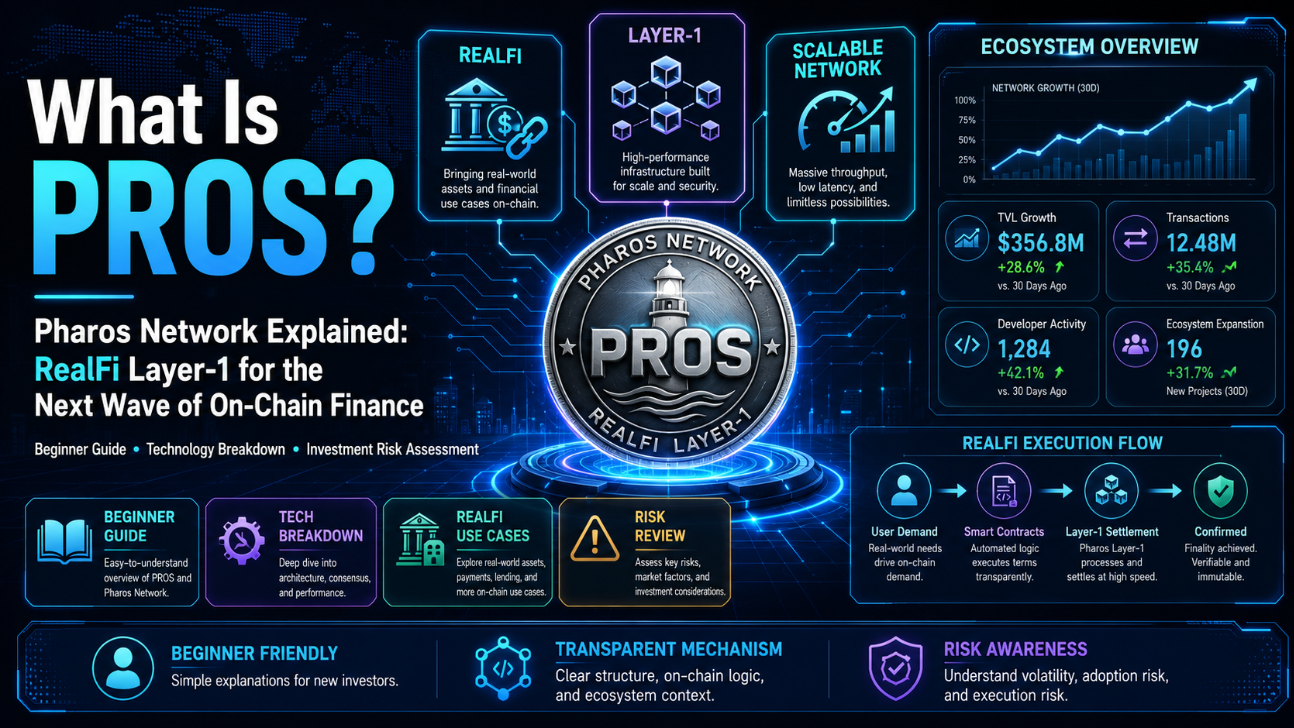
PROS is the native Token of Pharos Network. Pharos positions itself as a financial Layer-1 for RealFi, serving as the underlying public chain for real assets, stablecoins, compliant finance, AI Agents, and institutional-grade on-chain applications. The Pharos website emphasizes that it is a "RealFi & AI" Layer-1, featuring a modular architecture, deep parallel execution, and built-in compliance modules, founded by former Ant Group-related leadership and engineering teams.
Why Is It Difficult to Bring Traditional Financial Assets On-Chain?
Newcomers might easily wonder: since Ethereum and Solana are already so powerful, why is a new chain like Pharos needed?
The reason is that RWA isn't simply about issuing a Token. It requires at least five things to be handled simultaneously:
First, the asset itself must have legal ownership. For example, does a government bond Token on-chain actually correspond to an off-chain government bond? Who custodies it? Who audits it? Who is responsible for redemption?
Second, user identity may require compliance verification. Many institutional-grade assets cannot be fully and anonymously open to all wallets; they require KYC, AML, whitelists, geographic restrictions, or investor suitability assessments.
Third, settlement speed must be fast. If RWA is to support payments, clearing, collateralization, financing, and cross-border circulation, every operation cannot wait for a long time.
Fourth, it must be easy for developers to migrate. EVM compatibility is still a highly valued capability for institutional and DeFi teams, because the tooling ecosystem for Solidity, MetaMask, Hardhat, ethers.js, and viem is already very mature.
Fifth, on-chain liquidity must not be fragmented. If RWA is confined to an isolated chain or a closed system, it becomes difficult to combine with stablecoins, DeFi lending, DEXs, yield products, and AI Agents.
Pharos's entry point is that it doesn't just advertise "higher TPS," but attempts to address the issues of "speed, compliance, EVM compatibility, and modular financial scenarios" simultaneously. The website describes its vision as the "Borderless Digital Financial City," a programmable financial network where tokenized assets, stablecoins, AI agents, builders, users, and institutions coexist.
Why Does the Ant Group Background Matter?
A label often associated with the Pharos team is the "Ant Group / AntChain / ZAN background." This does have significance for the RWA sector, but it cannot be simplistically understood as "backed by Alibaba, so it is guaranteed to succeed."
The real advantage lies in the fact that RWA requires more than just the ability to write Smart Contracts; it requires experience in financial infrastructure, payment systems, compliance systems, institutional client relationships, and large-scale engineering. Public information from Pharos shows that its strategic investors and partners include Sumitomo Corporation, Flow Traders, SNZ, Hack VC, and Faction VC. The project has also disclosed cooperation with Ant Digital Technologies and related RWA pipelines.
But newcomers must also stay sober: team background is a plus, but it does not mean the project has already achieved large-scale institutional adoption. What truly determines the long-term value of PROS is the scale of real assets on the mainnet, TVL, trading volume, number of users, number of SPNs, ecosystem protocol revenue, and the actual launch of compliant products.
2. What Is the PROS Token Actually Worth? — The Truth About Current Price, Market Cap, and Circulating Supply
Many newcomers look at a new coin and only see the price at first glance: "Is $0.38 cheap?" "It was close to $1 before, is now a good time to buy the dip?" This way of thinking is very dangerous.
Whether a Token is cheap or not cannot be judged by its single-unit price alone. One must look at the circulating market cap, fully diluted valuation, unlock rhythm, real revenue, ecosystem adoption, and token distribution structure.
As of the July 15, 2026 query, CoinGecko shows the PROS price at approximately $0.382, with a circulating market cap of about $51.8 million, an FDV of about $382 million, a 24-hour trading volume of about $2.55 million, a circulating supply of about 135.6 million Tokens, and a total supply of about 1 billion Tokens. CoinMarketCap also shows a PROS price of about $0.378, a circulating market cap of about $51.28 million, and a circulating supply of about 135.6 million Tokens during the same period.
This illustrates a key fact: **The "$400 million level" is closer to the FDV, not the current circulating market cap.** If readers mistake the FDV for the circulating market cap, they will misjudge the project's scale; if they only look at the $0.38 unit price, they will ignore the dilution pressure from the large number of future Token releases.
Natural internal link: Check PROS Real-Time Market Data for the latest price, order book depth, and liquidity changes.
What Does the Drop from Nearly $1 to $0.38 Indicate?
PROS reached nearly $1 or even higher shortly after its launch. CoinGecko shows that PROS's all-time high was about $1.15, and its all-time low was about $0.3739. The current price has clearly retraced from its peak.
This has two implications for newcomers.
First, those who bought in at the early highs are likely already at a loss. The early period of a new coin's listing often features a combination of "high valuation, low circulation, airdrop selling pressure, and market maker volatility," making it easy for the price to spike and then fall back.
Second, the current pullback does not automatically mean it is cheap. It could be a valuation correction, or it could reflect market doubts about unlocks, ecosystem adoption, and real revenue. What you need to judge is: for a newly launched RealFi L1, is the current FDV of around $380 million undervalued, reasonable, or still too high?
What Does Low Circulating Supply Mean?
PROS has a total supply of 1 billion Tokens, but the current circulating supply is about 135.6 million, with a circulation ratio of about 13%–14%. The advantage of low circulating supply is that early selling pressure is relatively limited, and the market is easier to move with a small amount of capital. The disadvantage is that future unlocks will continuously increase the supply. If ecosystem growth cannot keep up with the release pace, the price may face long-term pressure.
Pharos's official Tokenomics shows that PROS has a genesis supply of 1 billion Tokens. Both the team and private investor shares adopt a 12-month cliff plus 36-month linear release. Some Treasury and Incentive allocations are extended to 48–60 months. The official documentation also states that only a limited portion entered circulation at TGE, with subsequent unlocks following the release schedule.
Team and Investors Hold 40% — Good or Bad?
According to the public Tokenomics breakdown, the PROS allocation roughly includes: 20% team, 20% investors, 16% foundation, 9% Labs Treasury, 21% ecosystem and community, and 14% nodes and liquidity incentives. The community airdrop includes the initial TGE release portion. Third-party compilations and announcements from multiple trading platforms also show a similar structure.
The combined 40% for the team and investors cannot be simplistically labeled as good or bad.
On the good side, if the lock-up is long enough, the team and investors have an incentive to build for the long term rather than selling everything in the short term.
On the bad side, after the 12-month cliff ends, if market liquidity is insufficient and ecosystem growth is not fast enough, the linear unlocks may create sustained psychological pressure. Newcomers need to focus on the first major unlock window, the monthly unlock quantity, and whether the receiving wallets are transferring to exchanges.
How to View 0% Inflation and 5% Annual Inflation?
Pharos's official documentation states that after mainnet launch, the Staking inflation is 0% for the first 6 months, and the annual inflation rate is set to 5% starting from the 7th month, which can be dynamically adjusted thereafter based on network conditions. The official explanation is to reduce dilution in the early stage and provide sustainable incentives for validators, security budgets, and ecosystem growth in the later stage.
The impact on price has two sides.
In the short term, 0% inflation is beneficial for stabilizing the early supply and reducing the selling pressure from immediate post-listing inflation.
In the long term, 5% annual inflation is not necessarily bad in itself, but it requires the network to generate enough real demand to absorb the new supply. If on-chain revenue, Gas consumption, Staking lock-ups, RWA adoption, and ecosystem incentives cannot form a positive cycle, inflation will become additional selling pressure.
3. What Does the Pharos Tech Stack Mean for Newcomers? — From "Dual Virtual Machines" to "Modular Compliance"
Pharos's technical narrative is dense: EVM + WASM dual virtual machines, 30,000 TPS, sub-second finality, AsyncBFT, SPN, ZK-KYC, AML, x402, AI Agent. For newcomers, you don't need to understand all the underlying terms from the start. You only need to figure out: what is the actual impact of these technologies on user experience, developer migration, institutional adoption, and PROS demand?
EVM Compatibility + WASM Dual Virtual Machine: What Do Users and Developers Experience?
EVM compatibility means that Pharos can be compatible with the Ethereum ecosystem tools. For ordinary users, the most direct benefit is a more familiar wallet experience: EVM wallets like MetaMask can theoretically add the Pharos network. For developers, the migration cost for Solidity contracts, Hardhat, Foundry, ethers.js, and viem is lower. The Pharos website and documentation both emphasize its dual VM (EVM + WASM) and EVM compatibility.
WASM provides another type of execution environment, suitable for more complex or higher-performance applications. For ordinary investors, WASM will not directly affect your buying and selling of PROS, but it may influence the richness of future ecosystem applications.
Simple understanding: EVM is responsible for "compatibility with the existing DeFi world," while WASM is responsible for "leaving room for more complex applications in the future."
30,000+ TPS and Sub-Second Finality: Where Is the Experience Gap?
The Pharos website claims it supports 30,000 TPS, 2 Gigagas, block times of less than 1 second, and achieves high throughput and sub-second finality through AsyncBFT, dual VM, and speculative parallel execution.
In comparison, Ethereum mainnet finality usually takes about 15 minutes. Solana's theoretical TPS is often cited as 65,000, but the actual TPS varies with network conditions, statistical methodology, and whether vote transactions are included.
For ordinary users, the speed difference is reflected in:
Faster transfer confirmations;
Less waiting for DeFi interactions;
More feasible high-frequency calls for AI Agents;
RWA settlement and micropayments approaching a real-time experience;
Large-scale institutional transactions are less likely to queue up due to single-thread congestion.
But note: official performance metrics and long-term performance under real mainnet stress are not the same thing. A truly reliable judgment depends on long-term mainnet transaction volume, peak stress tests, node stability, downtime records, and actual Gas costs.
SALI Parallel Execution Engine: Why Do Financial Scenarios Need Parallel Processing?
Traditional blockchains are like a single-lane highway: if one transaction is processed before the next, congestion is likely during peak hours. The idea of parallel execution is more like a multi-lane highway: as long as transactions do not have state conflicts, they can be processed simultaneously.
For example, if there are 1,000 bond transactions, stablecoin settlements, AI Agent micropayments, and DeFi collateralization operations happening at the same time. If these transactions do not conflict with each other, theoretically they should not have to queue up one by one. Pharos's deep parallel execution and speculative parallel execution aim to improve processing capacity in complex financial scenarios. The official technical introduction explicitly mentions Adaptive Consensus & Execution, AsyncBFT, dual VM, and speculative parallel execution.
For PROS investors, the significance of this technical point is: if Pharos truly undertakes RWA and high-frequency AI Agent interactions in the future, performance can be translated into real demand; if the ecosystem does not have large-scale applications, these performance metrics are more like "potential capabilities."
SPN: Why Put Different Financial Applications on Different Subnets?
SPN, short for Special Processing Networks, can be understood as Pharos's application-specific networks. Pharos documentation explains that SPNs are specialized, customizable blockchain environments that can serve different application needs, such as AIoT private networks, multi-party privacy computing, TEE, MEV optimization, ZKML, FHE, MPC, and LLM scenarios. Each SPN can have its own execution engine, validator requirements, governance, and incentives, while maintaining interoperability with the Pharos mainnet.
Why is this important for RWA?
Because different financial assets have different compliance requirements. Government bond products may require whitelists and institutional custody; real estate assets may require geographic restrictions, legal documents, and income distribution; DeFi applications may lean more towards openness; AI Agent micropayments may prioritize low cost and high-frequency calling.
If all applications are squeezed into the same execution environment, either performance will be insufficient or compliance requirements will conflict. The benefit of SPNs is to give different businesses their own customizable space, while maintaining composability through cross-SPN communication and bridging mechanisms. Pharos documentation mentions that the SPN Manager, Registry, Mailbox, Bridge, and SPN Network Hub are used to manage SPN creation, message communication, and asset transfers.
Built-in zk-KYC and AML: What Does This Mean for Ordinary Users?
The Pharos website explicitly mentions Digital ID, zk-KYC, and programmable AML at the protocol layer, with the goal of enabling compliant finance to run on-chain while maintaining openness.
This is a plus for institutions, because what institutional capital worries about most is often not Gas fees, but regulation, anti-money laundering, customer identity, asset compliance, and audit liability.
But for ordinary users, this also means that certain RWA products in the future may not be fully anonymous and open. You might be able to use ordinary DeFi applications anonymously, but if you want to enter institutional RWA vaults, bond products, yield products, or compliant financial services, you may need to complete some form of identity verification or face geographic restrictions.
So Pharos's "compliance-first" approach is both an advantage and a barrier to user experience.
4. What Can the $PROS Token Actually Do in the Ecosystem? — Gas, Staking, Governance, and RWA Utility Scenarios
To judge whether a Token is an "air coin," you can't just look at what the whitepaper says. You have to look at whether it has an irreplaceable function in the network.
Pharos's official Tokenomics explicitly lists the core utilities of PROS: transaction fees and on-chain execution costs, PoS Staking, validator participation and delegation, governance, ecosystem incentives, and future potential RWA-specific uses such as stablecoin collateralization, priority access to financial primitives, or using RWA Staking for network security.
PROS as Gas Fee
PROS is the native Token of the Pharos network. Users need to pay on-chain execution costs when transferring, calling contracts, participating in DeFi, or interacting with RWA applications on the Pacific Ocean Mainnet. ChainList shows that the Pharos Mainnet Chain ID is 1672, the currency is PROS, and the explorer is Pharos Explorer. Safe-related GitHub issues also record the Pharos Mainnet Chain ID 1672 and RPC URL.
This means that the base demand for PROS comes from network usage. The more on-chain transactions there are, the higher the Gas demand, and the more real the use case for PROS becomes.
But newcomers should note that the Hibt listing announcement shows that the PROS/USDT trading pair's "Token Type/Network" is BASE, and provides a Token explorer address on BaseScan. Therefore, when depositing and withdrawing on an exchange, you must strictly follow the network supported by the Hibt page. Do not casually confuse the Pharos mainnet with the Base network, as this could lead to loss of assets.
Staking and Validators
PROS adopts a PoS mechanism. Staking is used to secure the network, and validators and delegators can earn rewards by participating in the network. The official Tokenomics states that the Staking inflation is 0% for the first 6 months, and 5% annual inflation starting from the 7th month, which can be dynamically adjusted thereafter.
For newcomers, Staking is not a "guaranteed profit." It has at least three types of risks:
First, lock-up liquidity risk. After Staking, you may not be able to sell immediately, and you cannot exit immediately during a sharp downturn.
Second, validator risk. If a validator misbehaves or goes offline, it may affect your earnings, and in severe cases, there is a slashing risk.
Third, yield source risk. If Staking yields mainly come from inflation rather than real on-chain revenue, it may simply be distributing newly minted Tokens to stakers, which does not mean the ecosystem is actually making money.
Governance Rights
PROS holders can participate in governance such as network upgrades, parameter changes, and ecosystem initiatives. The official documentation states that the governance scope includes network upgrades, parameter changes, and ecosystem initiatives.
The impact of governance rights on Token value is indirect. If the Pharos ecosystem is large enough, governance may determine the allocation of important resources, such as SPN approval, foundation fund usage, ecosystem incentives, inflation adjustments, and RWA compliance module strategies. Conversely, if the ecosystem scale is not large enough, the actual value of governance rights will also be limited.
RWA Collateral and Priority Access: Delivered or Roadmap?
The official documentation describes RWA-specific utilities as "potential," and explicitly states that functions such as stablecoin collateralization, priority access to financial primitives, and RWA Staking for network security are subject to future governance.
This statement is very important. It means these functions are not all fully mature and launched, but may be gradually implemented through governance and ecosystem development in the future.
Therefore, newcomers cannot evaluate PROS by treating "future potential" as "already generating revenue." A more reasonable way to judge is:
Current confirmed functions: Gas, Staking, validators, governance, ecosystem incentives.
Future potential functions: RWA collateralization, RWA vault priority access, RWA security Staking, and more institutional financial product entry points.
x402 and AI Agent Micropayments: Narrative or Technical Layout?
Pharos documentation introduces x402: based on the HTTP 402 Payment Required concept, it allows a client requesting a protected resource to first receive a payment request, then initiate a micropayment through a wallet, and upon successful verification, gain access to content, APIs, data streams, or services. Pharos documentation states that x402 can be used for AI Agents, automated services, IoT devices, and other scenarios, and supports Agent Commerce, including AI Agents automatically subscribing to content services, paying per-call for AI capabilities, and peer-to-peer payments between Agents.
This is not pure rhetoric, because the documentation already includes developer guides and example code. But it is still a long way from large-scale commercialization. True adoption requires solving issues such as wallet authorization, payment experience, content service supply, Agent identity, billing disputes, failure retries, compliance, and user habits.
So for investors, x402 can be viewed as Pharos's AI Agent direction infrastructure, but it cannot be directly equated with short-term revenue.
5. From Registration to First Trade — A Practical Path for Newcomers to Buy and Hold PROS on Hibt
For ordinary newcomers, the simplest way to participate in PROS is not to bridge directly to the Pharos mainnet, but to buy PROS/USDT spot on an exchange. Hibt launched PROS/USDT on May 14, 2026. The announcement shows that deposits are open, trading opened at 12:00 on May 14, 2026 (UTC+8), and withdrawals opened at 12:00 on May 15, 2026 (UTC+8).
Natural internal link: Refer to PROS Price Prediction for technical analysis, support levels, and trend analysis to help judge entry timing.
Hibt PROS/USDT Spot Purchase Process
Step 1: Register and log in to your Hibt account. New users typically need to register with an email or phone number, and set a login password, fund password, and two-factor authentication.
Step 2: Complete KYC. Generally, you need to prepare identification documents, real-name authentication information, and facial verification. Requirements may vary by region, so please refer to the actual Hibt page.
Step 3: Deposit USDT. Newcomers must pay special attention to the deposit network, such as TRC20, ERC20, BEP20, or other networks. Different networks have different fees and arrival speeds, and choosing the wrong network may result in unrecoverable assets.
Step 4: Enter the PROS/USDT trading page. You can find the spot trading pair by searching for PROS.
Step 5: Choose a limit order or a market order. Newcomers are advised to use limit orders to avoid being affected by slippage from market orders when liquidity is insufficient.
Step 6: After buying, check your asset balance. Confirm the average transaction price, fees, holding quantity, and record your own buying rationale and stop-loss plan.
Common Beginner Mistakes
First, thinking something is cheap just because the "price is low." Whether PROS is cheap depends on FDV, unlocks, ecosystem, and real adoption, not the single-unit price.
Second, choosing the wrong deposit or withdrawal network. The Hibt announcement shows that the PROS network on Hibt is BASE, so you must confirm the supported deposit and withdrawal network on the current platform before operating.
Third, using a market order for a large purchase. Small-cap coins have limited depth, and large market orders can cause significant slippage.
Fourth, treating a short-term position as a long-term investment. New coins are highly volatile, and short-term trading and long-term allocation strategies are completely different.
Fifth, not looking at the unlock cycle. Low-circulation assets are most afraid of the combination of unlock expectations and insufficient market liquidity.
How to Add the Pharos Network to MetaMask?
If users wish to experience Pharos mainnet applications, they can add the Pharos Mainnet to an EVM wallet. Public information shows that the Pharos Mainnet Chain ID is 1672, the currency symbol is PROS, and the explorer is Pharos Explorer. The Safe GitHub issue records the RPC URL as https://rpc.pharos.xyz.
But here is another reminder: the PROS deposit and withdrawal network supported by the exchange may differ from the Pharos native mainnet. When depositing and withdrawing on Hibt, you should follow the network displayed on the official Hibt page; when interacting on-chain, you should verify with official documentation, ChainList, PharosScan, and other sources.
Be Cautious with Contract and Leverage Trading
If the platform offers PROS/USDT Perpetual Futures, newcomers should not treat it as a tool to "make money faster." Perpetual Futures involve Leverage, Margin, funding rates, liquidation prices, and liquidation risk. Third-party derivatives data platforms show that PROS Perpetual Futures are traded on multiple venues, with cross-platform OI and 24-hour trading volume changing in real time.
Newcomer advice:
Do not use high Leverage;
Prioritize 1–2x simulation or small-scale trial runs;
Set stop-losses;
Do not chase orders during periods of intense news-driven volatility;
Do not use long-term holding logic for high-Leverage contracts;
Do not double down on contract positions to recover spot losses.
6. Where Does Pharos Stand in the RWA and AI Agent Sectors? — Horizontal Comparison with Competitors and Similar Projects
Pharos's positioning is unique: it is not a simple public chain, nor a simple RWA protocol, nor a simple AI Agent project. It wants to be the underlying Layer-1 for RealFi + AI.
The advantage of this positioning is a large narrative space; the disadvantage is that it is also difficult to deliver.
Compared to Ethereum L2s: Is Native Compliance an Advantage or Over-Engineering?
The advantages of Ethereum L2s like Arbitrum and Base are obvious: mature ecosystem, many users, many developers, deep DeFi liquidity, strong wallet compatibility, and a strong Ethereum security narrative.
Pharos's advantage is that it is "designed from the ground up around RealFi, RWA, built-in compliance, and high-performance financial scenarios." It is not adding a compliance module on top of an existing DeFi public chain, but writing Digital ID, zk-KYC, programmable AML, and SPN architecture into its core narrative.
The question is: will institutions really choose a new L1 for native compliance, rather than a mature L2, a private chain, a consortium chain, or a chain owned by a traditional financial giant?
This is what Pharos must prove.
Compared to Solana: Performance Is Not the Only Answer
Solana's strengths are high performance, low fees, a mature trading experience, and an active ecosystem. For high-frequency DeFi, Meme, payments, and consumer-grade applications, Solana has already established a strong user mindshare.
Pharos also emphasizes high performance, but it emphasizes EVM compatibility, built-in compliance, RWA, and financial modularity more. For some institutional DeFi teams, EVM compatibility may be easier to migrate than Solana native development; for RWA issuers, compliance modules may be more important than pure speed.
So Solana puts pressure on Pharos, but they are not necessarily in the exact same track. Solana is more like a "high-performance open ecosystem," while Pharos is more like a "compliance-first finance and RealFi native chain."
Compared to Avalanche Subnets, Cosmos App-Chains, and Polymesh
Avalanche Subnets emphasize subnet customization, Cosmos App-chains emphasize application-chain sovereignty, and Polymesh emphasizes security Token compliance. Pharos's SPN narrative is similar to these solutions: they all want different applications to have their own customized execution environments.
Pharos's difference is that it attempts to combine SPN, EVM/WASM, built-in compliance, RWA, AI Agent, and x402 micropayments into a single RealFi architecture. The documentation mentions that SPNs can support dedicated hardware, TEE, ZKML, FHE, MPC, LLM, and other complex scenarios, and maintain communication and asset transfers through cross-SPN interoperability.
But whether this is technological innovation or conceptual integration depends on subsequent real-world mainnet applications. Complex architectures are only valuable when there is enough real business volume; otherwise, they may become over-engineering.
Compared to Concept Coins Like CASHCAT and SKHYB
Community-driven projects like CASHCAT derive their core value more from community virality, leaderboard popularity, and short-term capital attention. PROS, on the other hand, emphasizes a product-driven approach: mainnet, Gas, Staking, SPN, RWA, AI Agent, x402, and institutional partnerships.
SKHYB is more oriented towards AI semiconductor / RWA asset exposure, with an investment logic related to SK Hynix, HBM, and the AI chip industry chain. PROS is an underlying public chain asset, and its value depends on whether the Pharos network can attract real assets, stablecoins, DeFi protocols, AI Agents, and institutional users. Both can be classified under the "AI / RWA concept," but the underlying risks are completely different.
Natural internal link: Learn about What is CASHCAT and What is SKHYB to compare the positioning differences and risk characteristics of different concept projects.
Is Pharos's AI Agent Layer a Real Layout or Just Following the Trend?
Pharos is not just writing "AI" on its website. It has already conducted developer incentives around x402, Agent Commerce, Anvita Flow, and Agent Carnival. Pharos's official blog shows that the "Create Like a PRO · Agent Carnival" event ran from June 8, 2026, to July 21, 2026, with a prize pool of 150,000 PROS, of which 100,000 PROS was for developers and 50,000 PROS was for users and creators.
In addition, the x402 documentation also explicitly lists use cases such as AI Agent automatic subscriptions, per-call AI API payments, and inter-Agent payments.
So it is not entirely following the trend. But it is still in the early validation stage. What really matters is: after the event ends, are there sustainably used Agents, reusable Skills, real payments, on-chain call volumes, and a continuous developer ecosystem, or does the heat disappear after a one-time incentive ends?
7. The 8 Risks You Must Face Before Investing in PROS — From Low Circulating Supply to Uncertainty in Institutional Adoption
A credible PROS analysis cannot only talk about the trillion-dollar RWA market, the Ant Group background, 30,000 TPS, and AI Agents. What truly affects investment outcomes is often risk.
Risk 1: Low Circulating Supply and Unlock Pressure
PROS's current circulation ratio is about 13%–14%, and a large number of Tokens will be gradually released in the future. The team and investors each hold 20%, with a 12-month cliff plus 36-month linear release. Some Treasury and Incentive allocations are extended to 48–60 months.
This means that PROS's real supply pressure does not end on TGE day, but will continue for several years. Historically, many low-circulation, high-FDV projects have come under pressure around large unlocks, because the market will price in potential selling pressure in advance.
Risk 2: Mainnet History Is Too Short
The Pharos Pacific Ocean Mainnet launched at the end of April 2026, so it is still a very new mainnet. The Pharos website showcases a large amount of testnet data and performance metrics, but testnet performance cannot be completely equated with long-term mainnet stability.
New chains need to go through real stress tests: high concurrency, extreme market conditions, RPC failures, node synchronization, MEV attacks, contract vulnerabilities, bridge failures, governance disputes, and validator offline incidents. A new chain that has not gone through a full cycle is definitely riskier than a mature chain.
Risk 3: Institutional Adoption May Fall Short of Expectations
Pharos has disclosed strategic investments related to GCL New Energy and a valuation close to $1 billion, and has also mentioned cooperation with Ant Digital Technologies and RWA pipelines.
But investors must distinguish between three things:
Partnership announcements;
Asset pilots;
Real on-chain asset scale and sustained revenue.
The data that should truly be tracked includes: how much RWA assets have been brought on-chain? What is the TVL? How many holders are there? Are there redemption records? Are there audit reports? Is there real protocol revenue? Is there sustained institutional usage? If this data is not transparent, institutional adoption remains at the vision stage.
Risk 4: Regulatory Risk
The closer RWA gets to real-world finance, the less likely it is to completely bypass regulation. Government bonds, funds, private credit, real estate, and energy assets all involve legal ownership, investor suitability, anti-money laundering, cross-border issuance, income distribution, and tax issues.
RWA system studies also point out that current RWA designs typically rely on off-chain legal structures, custody arrangements, compliance processes, and verification mechanisms, while on-chain Tokens are only part of asset representation, transfer control, redemption processes, and composability.
This means that if the SEC, MiCA, Hong Kong, Singapore, or other jurisdictions tighten RWA rules, a compliance-first chain like Pharos may benefit from compliance demand, but may also face stricter scrutiny.
Risk 5: Competition from Traditional Financial Giants
Pharos's competitors are not just other public chains, but also traditional financial giants. BlackRock's BUIDL, JPMorgan's private chains and institutional networks, the Canton Network, and digital asset pilots by central banks and exchanges in various countries could all divert institutional RWA demand.
Institutions may not choose an open public chain. They may choose private chains, consortium chains, permissioned chains, custodian bank infrastructure, or existing financial networks. Pharos must prove that an open chain + compliance module + high performance is more attractive than traditional financial private networks.
Risk 6: Excessive Technical Complexity
SALI parallel execution, dual VM, SPN, cross-SPN communication, Restaking, ZK-KYC, AML, x402, AI Agent — these modules look strong, but every additional layer of complexity adds a potential point of failure.
SPNs need to solve security, governance, bridging, message passing, and liquidity fragmentation issues. AI Agents need to solve authorization, payment, identity, and abuse issues. RWA needs to solve the mapping problem between off-chain law and on-chain execution. The more complex the technical roadmap, the higher the requirements for engineering capability, auditing capability, and ecosystem coordination.
Risk 7: Valuation Risk
The GCL New Energy investment announcement mentioned a Pharos valuation close to $1 billion, while PROS's current FDV is about $380 million, which has clearly retraced from its early highs.
This does not mean it is necessarily cheap. For a new L1, whether the valuation is reasonable depends on whether it can secure real TVL, trading volume, protocol revenue, and institutional asset scale in the future. Without real adoption, a high valuation becomes pressure; if the ecosystem grows rapidly, the current pullback may also be a stage before a repricing.
Risk 8: Macro Market and ETH Cycle Impact
PROS is a Layer-1 asset. Although its narrative leans towards RWA and AI, its capital flows are still affected by the overall crypto market. In a bull market, the market is willing to give new L1s high valuations; in a bear market, capital flows more towards BTC, ETH, stablecoins, and top-tier projects, and small-cap L1s often see larger drawdowns.
Natural internal link: Combine with ETH Price Prediction to assess the impact of the macro market environment on the capital flows of Layer-1 Tokens like PROS.
8. Summary — Who Is PROS Suitable For, and Who Is It Not? A Self-Assessment Checklist
PROS's core narrative can be summarized as: Pharos wants to build a high-performance, EVM-compatible, compliance-built-in, RWA and AI Agent-supporting Layer-1 for RealFi, and PROS is the Gas, Staking, Governance, and ecosystem incentive Token of this network.
Its strengths are clear: the RWA sector has large potential, the team background is strong, the funding and partnership resources are good, the technical narrative is complete, the mainnet is already live, PROS has been listed on multiple trading platforms, and the AI Agent and x402 directions have developer activities.
But its risks are equally clear: the mainnet has been live for a short time, real institutional adoption still needs to be verified, the circulating supply is low but future unlocks are large, the FDV is not low, the technical complexity is high, RWA compliance uncertainty is strong, and market liquidity cannot be compared with top-tier assets.
Who Is PROS Suitable For?
If you believe that RWA will become one of the most important growth directions for blockchain in the next 5 years, and are willing to take on the early risks of a new public chain, you can treat PROS as an "RWA + RealFi Layer-1" observation position.
If you are familiar with DeFi, can read on-chain data, and track TVL, trading volume, active addresses, unlocks, and ecosystem protocols, PROS is an early-stage asset worth studying.
If you value institutional finance on-chain, compliant assets, stablecoin settlement, AI Agent micropayments, and EVM compatibility, Pharos's roadmap does have differentiation.
Who Is PROS Not Suitable For?
If you only want to buy the dip because "the price fell from $1 to $0.38," PROS is not for you.
If you do not understand FDV, unlocks, circulating supply, Staking inflation, and new-chain risks, PROS is not suitable for a heavy position.
If you only do short-term trading without setting stop-losses, low-circulation assets can be both an opportunity and a trap.
If you cannot withstand a 30%–60% short-term drawdown at all, do not treat PROS as a stable asset.
How to Consider Allocation Ratios?
For ordinary newcomers, PROS is more suitable for a "thematic observation position" rather than a core position. A more prudent approach is:
Keep core positions in BTC, ETH, or stablecoins;
Allocate a small proportion to RWA / AI / L1 thematic assets;
Keep early-stage coins like PROS within 1%–5% of total portfolio;
Define stop-losses and holding periods before each purchase;
Re-evaluate positions before large unlocks.
The Most Critical Observation Metrics for the Next 6–12 Months
First, whether Pharos mainnet TVL is growing.
Second, whether real RWA asset scale is on-chain, rather than just staying at the partnership announcement stage.
Third, whether the number and quality of SPNs are improving.
Fourth, whether x402 and AI Agents are generating sustained on-chain calls, rather than falling silent after the event ends.
Fifth, what the PROS Staking participation rate and validator decentralization degree are.
Sixth, whether CEX/DEX liquidity is improving and whether the 2% depth is increasing.
Seventh, whether there are abnormal transfers from team, investor, and foundation wallets before and after unlocks.
Eighth, whether more audits, institutional clients, RWA vaults, stablecoin settlement, and protocol revenue data are disclosed.
A Final Word
PROS is not a simple "AI concept coin," nor is it an ordinary Meme. It represents Pharos's bet on a RealFi Layer-1: putting real assets, compliant finance, stablecoin settlement, AI Agents, and the EVM ecosystem into the same financial network.
But the grander the narrative, the more it needs real data to validate.
For newcomers, the most important thing when researching PROS is not to ask "will it go back to $1," but to ask four questions:
Can Pharos really attract institutional assets on-chain?
Will PROS's Gas, Staking, and Governance demand strengthen as the ecosystem grows?
Can future unlocks and inflation be absorbed by real usage demand?
Can the RWA + AI Agent narrative turn from events and announcements into long-term revenue and on-chain activity?
If these questions are gradually answered positively, PROS may evolve from a new-chain narrative to a RealFi infrastructure asset. Conversely, if ecosystem growth is slow, RWA adoption is weak, unlock pressure is high, and AI Agent activities are unsustainable, then PROS will fall back into the most common risk for early Layer-1s: a big story, hard to verify, and even bigger volatility.