
Data verification date: July 9, 2026 (UTC+8)
This article is for informational research and risk education purposes only and does not constitute investment advice. WDCB is a tokenized stock-like asset. Although its price is pegged to the Western Digital WDC underlying stock, it still carries platform risk, liquidity risk, premium/discount risk, custody risk, regulatory risk, on-chain transfer risk, and single-stock volatility risk. Readers should verify all information against Hibt, CoinMarketCap, CoinGecko, BscScan, Yahoo Finance, Western Digital earnings reports, bStocks official materials, and applicable local laws and regulations before taking any action.
1. What Is WDCB, Exactly? Is It the Same as Western Digital (WDC) on Nasdaq?
Many crypto newcomers mistake WDCB for "just another altcoin" the first time they see it, while others assume it is an on-chain stock directly issued by Western Digital itself. Neither understanding is accurate.
The full name of WDCB is Western Digital Tokenized bStocks. The name can be deconstructed into three layers:
First, Western Digital refers to the US-listed company Western Digital Corporation;
Second, Tokenized means it is an on-chain tokenized version;
Third, bStocks means it belongs to the bStocks tokenized security series issued by BTech Holdings Limited.
According to official bStocks documentation, bStocks are tokenized securities issued by BTech Holdings Limited, a Binance Group-affiliated company; bStocks represent economic exposure to the underlying securities but do not constitute direct ownership of the underlying company's shares, nor do they confer direct share ownership in the listed company.
1.1 Is WDCB the Same as the WDC Underlying Stock?
No.
WDC on Nasdaq is the common stock of Western Digital Corporation. When you buy WDC through a traditional broker, you hold equity in a US stock within your brokerage account.
WDCB is a tokenized security on-chain. It provides economic exposure to the price of the WDC underlying stock, but it does not register you directly as a shareholder on Western Digital's shareholder ledger.
A more precise framing:
WDC is the traditional US stock; WDCB is a bStocks tokenized security with the WDC underlying stock as its reference asset.
1.2 Is WDCB Officially Issued by Western Digital?
No. WDCB is not an on-chain stock issued by Western Digital Corporation itself, nor does it represent an official endorsement by Western Digital of this tokenized product. The official bStocks disclaimer also explicitly states that bStocks do not represent an affiliation with the issuer of the underlying asset.
This point is crucial for newcomers. When you buy WDCB, you are not participating in a direct on-chain fundraising round by Western Digital, nor are you buying a "Western Digital official coin." You are purchasing a tokenized security product whose price is mapped to WDC through the bStocks mechanism.
1.3 How to Verify the WDCB Contract Address?
The CoinGecko page shows the contract address for Western Digital bStocks Tokenized Stock as:
0xebe29695f8047c13d36e7a790ca8c1b239ffad1c
CoinGecko also shows that WDCB can be traded on centralized exchanges and that the contract address can be imported into MetaMask. Bitget's WDCB page also shows its contract is on BNB Smart Chain, abbreviated as 0xebe2...9ffad1c.
Newcomers can follow these steps to confirm they are not buying a counterfeit token:
Open CoinGecko or CoinMarketCap and search for WDCB;
Confirm the name is "Western Digital Tokenized bStocks" or "Western Digital bStocks Tokenized Stock";
Verify the contract address is 0xebe29695f8047c13d36e7a790ca8c1b239ffad1c;
Then go to BscScan, paste the contract address, and review the token name, symbol, holders, transfer history, and contract details;
Finally, search for WDCB/USDT in the Hibt spot trading zone and confirm the trading page matches the official domain.
If you access via the in-article link, you can open Hibt's WDCB page and click "Trade." Always refer to the trading status, order book, contract description, and risk disclosures shown on the live Hibt page before executing any trade.
1.4 Who Provides the "1:1 Backing" Behind Each WDCB?
According to official bStocks announcements, each bStock is backed 1:1 by real US stocks held by a regulated custodian, and this can be verified through the Proof of Collateral page. The announcement also clarifies that bStocks are not stocks or shares, and holders do not directly own the common stock of the underlying listed company.
Therefore, the role of WDCB can be understood as follows:
BTech Holdings Limited: tokenized security issuer;
Regulated custodian: holds the corresponding underlying WDC shares;
BNB Smart Chain: the on-chain token runtime and transfer environment;
Hibt: provides users with the WDCB/USDT trading gateway, account asset display, deposits, withdrawals, and matching services.
Whether a user can redeem WDCB for actual WDC shares depends on whether the platform supports conversion, whether the user's jurisdiction qualifies, whether KYC is passed, and whether the bStocks conversion rules apply. Do not assume that all Hibt users can convert WDCB into WDC shares in a traditional brokerage account at any time.
2. Western Digital Fundamental Breakdown: Why Has This Storage Giant Surged in 2026?
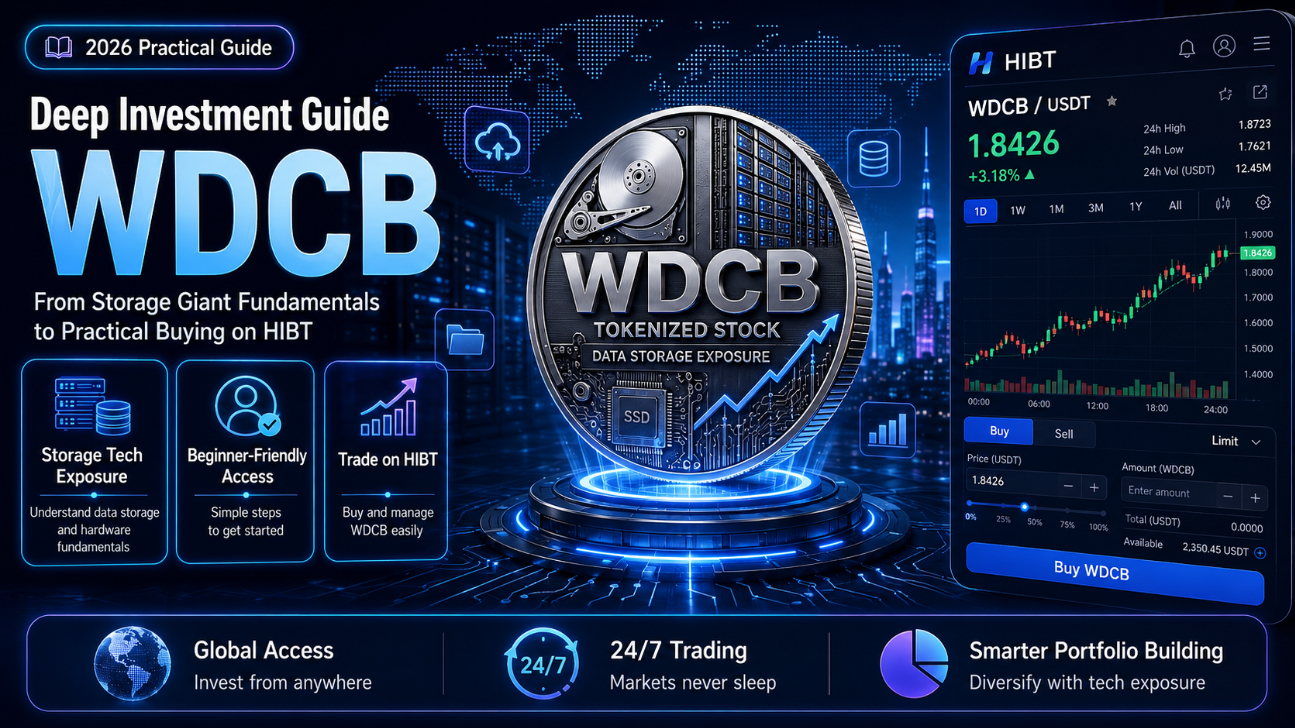
WDCB's price is not determined by crypto sentiment alone. Its core anchor is the Western Digital WDC underlying stock, and the key driver behind WDC's rally in 2026 is the explosion in storage demand driven by AI data center buildouts.
2.1 What Is Western Digital's Core Business Today?
Many people's outdated impression of Western Digital is "HDD + SSD + memory cards." But that is no longer the full picture in 2026.
Western Digital completed the spin-off of its Flash business in February 2025, with Sandisk becoming an independent company. Western Digital's 2026 earnings reports also explicitly state that Sandisk is no longer consolidated into WDC's continuing operations. Reuters also reported that after the spin-off, Western Digital is streamlining its business to become a more HDD-focused company.
So, today's WDC is closer to an AI data center HDD infrastructure company rather than the diversified storage conglomerate of the past that covered HDD, NAND Flash, SSD, and consumer storage.
This is critical for WDCB: WDCB's price movements should no longer be judged simply by consumer hard drive sales, but rather by focusing on the demand cycle for cloud service providers, hyperscale data centers, AI data storage, and high-capacity nearline HDDs.
2.2 Why Does AI Drive HDD Demand?
AI is not just about GPUs. Every large-model training run, inference job, log record, data cleaning pipeline, video generation task, vector database, and enterprise knowledge base build-out continuously generates massive amounts of data. Not all of this data can reside in the most expensive high-speed storage; vast amounts of cold data, warm data, and long-term archival data still require low-cost, high-capacity, scalable HDDs.
Western Digital stated in its Q3 FY2026 earnings report that AI workloads generate data requiring durable, low-cost storage, and HDDs are a key part of that infrastructure. The company reported quarterly revenue of $3.337 billion, up 45% year-over-year, with GAAP gross margin reaching 50.2% and non-GAAP gross margin reaching 50.5%.
This shows that the market's interest in WDC is not simply a bet on an "AI concept," but rather a trade on a more specific logic:
AI data center expansion → explosive data generation → increased demand for high-capacity HDDs → HDD supply-demand tightness → improved pricing and gross margins → expanded earnings leverage for WDC → WDCB gains price anchor by tracking WDC.
2.3 What Does "2026 Capacity Sold Out" Mean?
Public reports indicate that Western Digital's long-term HDD capacity has been booked through 2026, with AI and hyperscaler data center demand being one of the core drivers. This supply-demand dynamic has two potential implications for the company:
First, improved revenue visibility. Customers locking in capacity ahead of time suggests short-term demand is not one-off spot orders.
Second, enhanced pricing power. When supply is tight, Western Digital can more easily maintain prices and may even capture higher per-TB value on high-capacity products.
However, sold-out capacity also carries downside risk: if customers have front-loaded orders and pulled forward future demand, or if AI CapEx subsequently slows, the market will reassess whether "high prosperity is sustainable."
2.4 Where Does WDC's Current Valuation Stand?
As of the verification date of this article, WDC's current price is approximately $550.30, with a market cap of approximately $189.68 billion and a P/E ratio of approximately 32.9x. The Robinhood stock page also shows WDC's 52-week high at $799.87, 52-week low around $64.16, market cap around $189.8 billion, and P/E around 31.76.
This data tells us two things:
First, WDC is no longer a low-valuation, under-the-radar stock;
Second, the market has already priced in AI storage demand, capacity tightness, and margin improvement to a significant degree.
This does not mean WDCB has no opportunity, but it does mean latecomers cannot justify their purchase with the word "cheap." You are buying exposure to a storage cyclical stock that has already been substantially repriced.
2.5 The 40TB Drive and Long-Term Margin Narrative
Tom's Hardware reported that Western Digital plans to launch a 40TB UltraSMR HDD in the second half of 2026, with HAMR drives planned for 2027 and a long-term target of offering 100TB HAMR drives by 2029.
This technology roadmap has three layers of implications for WDC's long-term margins:
High-capacity products increase per-drive value;
Customers care more about cost-per-TB and power efficiency, not just per-drive price;
If the cost curve continues to decline while prices hold or rise, gross margins have a chance to stay elevated.
But newcomers should also see the other side: HDD is a classic cyclical industry. Profit leverage is substantial during upcycles, but valuation compression can be equally rapid during downturns. As WDC underlying exposure, WDCB will also bear this cyclicality.
2.6 Business Cycle Differences Between WDCB and QCOMB
WDCB and QCOMB are both single-stock tokenized assets, but their business cycles are completely different. WDCB is driven by the storage cycle, AI data centers, and nearline HDD supply-demand; QCOMB is driven more by communication chips, smartphone cycles, AI edge devices, automotive chips, and licensing revenue.
If you want to compare the risk drivers between chip stocks and storage stocks, you can read What is QCOMB. In short, WDCB leans more toward the "data center storage bottleneck" thesis, while QCOMB leans more toward the "communication and edge chip platform" thesis. You cannot apply the same valuation framework just because both touch AI.
3. Tokenized Stock Mechanics: How Does WDCB "Represent" the Western Digital Underlying Stock on BSC?
The most important thing for newcomers to understand about WDCB is this: 1:1 backing does not equal zero risk.
3.1 What Is the Issuance Logic Behind bStocks?
According to official bStocks documentation, bStocks are tokenized securities that represent 1:1 economic exposure to US-listed stocks, with the underlying stocks held in a regulated custody account. Eligible direct stock positions can be converted into corresponding bStocks at a 1:1 ratio, and vice versa.
In the WDCB scenario, this can be simplified to:
Users see WDCB as an on-chain token;
WDCB's economic anchor is Western Digital Corporation's WDC stock;
WDCB's price should fluctuate around the price of the WDC underlying stock;
But the actual traded price is also influenced by exchange liquidity, order book depth, market makers, USDT price, and expectation changes during market closures.
3.2 Can Users Redeem for Actual WDC Shares?
The bStocks mechanism includes conversion and redemption design, but actual availability depends on many conditions. The official announcement mentions that stocks and bStocks can be converted at a 1:1 ratio with no conversion fee; but the disclaimer also emphasizes that tokenized securities are only available to qualified users in permitted jurisdictions, and conversion back to the CSD environment requires meeting certain conditions.
For Hibt users, a more prudent understanding is:
You primarily buy and sell through the WDCB/USDT trading pair;
You see a WDCB balance in your Hibt account;
Whether on-chain withdrawal, conversion to WDC shares, or entitlement to certain corporate actions is available depends on the rules of Hibt and bStocks at the time;
Do not equate the WDCB in your Hibt account directly with WDC shares in a traditional brokerage account.
3.3 What Is the WDCB Premium/Discount?
WDCB should theoretically track the WDC underlying stock, but because crypto markets trade 24/7 while US stocks have fixed trading hours, the two can deviate in the short term.
Calculation formula:
WDCB premium/discount rate = WDCB current price ÷ WDC underlying reference price - 1
For example:
WDCB current price is 541 USDT;
WDC underlying reference price is 550 USD;
Assuming USDT ≈ USD;
Premium/discount rate = 541 ÷ 550 - 1 = -1.64%.
This means WDCB is trading at approximately a 1.64% discount to the WDC underlying stock.
If WDCB trades above the WDC underlying stock price, it is at a premium; if below, it is at a discount.
3.4 Why Do US Market Closures Distort WDCB Pricing?
Normal US stock trading hours are 9:30–16:00 ET, while WDCB can trade 24/7 in crypto markets. This time difference introduces several risks:
During US market closures, WDCB may pre-price post-market earnings, macro data, or AI industry news;
If after-hours news is misinterpreted by the market, WDCB may first rise then fall, or vice versa;
When the WDC underlying stock opens, prices may re-anchor, causing WDCB premium or discount to correct rapidly;
If WDCB order book is thin, even small orders can cause significant deviation.
For example, if Western Digital releases earnings after the market close showing 40TB drive shipment progress beating expectations, WDCB may rally first in crypto markets; but if institutional investors deem the valuation already too rich after the US market opens and the WDC underlying stock falls, WDCB could pull back.
Therefore, trading WDCB requires not just watching the WDC stock price, but also checking "whether WDCB is currently overpriced relative to WDC."
4. Why Should Crypto Users Buy WDCB on Hibt Instead of Opening a Traditional Brokerage Account?
There is no absolute answer to this question. Hibt and traditional brokerages are two different paths suited to different users.
4.1 The Traditional Brokerage Path for Buying WDC Shares
If you buy WDC through traditional brokers such as Interactive Brokers, Futu, or Tiger Brokers, you typically need to:
Register a brokerage account;
Submit identity proof, address proof, and tax documentation;
Wait for account approval;
Deposit USD or local currency;
Possibly convert currency;
Place orders during US trading hours;
Hold WDC shares in your brokerage account after execution.
The advantage of traditional brokerages is that the legal ownership structure is closer to traditional securities accounts, with more standardized shareholder rights, dividends, tax documents, trading depth, and price anchoring.
The downsides are longer onboarding processes, higher barriers for users in certain regions, complex deposit and currency conversion procedures, and the restriction that US stocks can only be traded during designated hours.
4.2 The Path to Buying WDCB on Hibt
If you already hold USDT, the path to buying WDCB through Hibt is shorter:
Register on Hibt;
Complete KYC;
Deposit USDT;
Go to the spot trading zone and search for WDCB;
Select WDCB/USDT;
Place a buy order with USDT;
View your position on the assets page.
Hibt's WDCB page provides the WDCB/USDT trading gateway, but page data and trading status should be verified against the live display.
For crypto users who already hold USDT, the advantage of this path is speed, familiarity, and no need to first complete traditional brokerage deposits and currency conversion. But the trade-off is that you additionally assume Hibt platform risk, WDCB premium/discount risk, USDT stablecoin risk, and tokenized security compliance risk.
4.3 How Do Hibt Trading Fees Compare to Traditional Brokerage Costs?
Hibt's Help Center shows spot maker fees at 0.2%, taker fees at 0.2%, with a minimum order amount of approximately 5 USDT, subject to the live page display.
Traditional brokerage costs typically include:
Trading commissions;
Bid-ask spreads;
Currency conversion costs;
Cross-border deposit and withdrawal costs;
Tax processing costs;
Potential account maintenance or third-party fees.
If you are only making a small test allocation and already hold USDT, Hibt may be more convenient.
If you are making a long-term, large, serious allocation to WDC shares, the traditional brokerage path is usually more suitable as a core securities account.
4.4 What Do You Actually Own When Holding WDCB Through Hibt?
You own WDCB assets recorded in your Hibt account, or on-chain WDCB tokens that can be transferred to a BNB Smart Chain wallet if the platform allows withdrawals. This is materially different from WDC shares in a traditional brokerage account:
You do not necessarily have traditional shareholder voting rights;
You cannot by default attend shareholder meetings directly;
How dividends, stock splits, and corporate actions are handled depends on bStocks and platform rules;
You rely on the issuer, custodian, trading platform, and on-chain contract to jointly maintain the product's operation;
If the platform suspends trading, deposits, withdrawals, or initiates a risk control review, your liquidity will be affected.
The bStocks announcement mentions that corporate actions such as dividends and stock splits are automatically processed through the Multiplier mechanism, with net dividend value reflected in token value via on-chain adjustments after applicable US withholding tax deductions. But whether this equally applies to Hibt users specifically should still be verified against the rules of Hibt and bStocks at the time.
5. Step-by-Step Tutorial: How to Complete WDCB Registration, Deposit, and Trading on Hibt
This chapter provides newcomers who have never bought tokenized stocks with a complete walkthrough. The core principle is simple: start small, use limit orders first.
5.1 Register on Hibt and Complete KYC
Go to the Hibt website or app and register with a long-term stable email or phone number. Do not use a temporary email, as subsequent login verification, withdrawal confirmations, account recovery, and risk control notifications may all depend on email access.
After registration, it is recommended to immediately complete:
Set a strong password;
Enable two-factor authentication (2FA);
Bind email and phone number;
Complete identity verification (KYC).
Hibt's KYC guide shows that identity verification typically requires users to submit official identification documents such as a national ID, passport, or driver's license, and may require facial recognition or liveness detection.
Mainland China users should pay special attention: WDCB involves an offshore trading platform, crypto assets, and tokenized securities—three categories of risk. Policies in different regions may change; do not equate "the platform is accessible" with "local law permits." If uncertain, you should first verify local laws, fund transfer restrictions, and tax obligations.
5.2 How to Deposit USDT?
Hibt's deposit tutorial shows that depositing digital assets typically involves four steps: select deposit currency, select deposit network, obtain deposit address, and complete the transfer from an external platform or wallet. For USDT, Hibt supports multiple networks with varying speed and fee structures.
Common options include:
TRC20: fees are typically low and settlement is fast, commonly used by many users;
ERC20: Ethereum network, strong compatibility, but on-chain fees are typically higher;
BEP20: BNB Smart Chain network, lower fees, suitable for the BSC ecosystem, but you must confirm platform support.
The most common mistake newcomers make is network mismatch. Hibt's tutorial explicitly warns that if you select USDT-TRC20 on Hibt, you must also select TRC20 on the external platform; selecting a different network may result in a failed deposit, and in some cases assets may be unrecoverable.
5.3 How to Search for the WDCB/USDT Trading Pair?
After USDT arrives in your account, go to the spot trading page and search for WDCB or WDCB/USDT.
When verifying, check:
Whether the trading pair is WDCB/USDT;
Whether the asset name is "Western Digital Tokenized bStocks";
Whether the page is from an official Hibt domain;
Whether the external contract address matches CoinGecko/BscScan;
Do not access the trading page through unfamiliar links from community groups.
You can also enter the trading page from Hibt's WDCB market page.
5.4 Limit Order vs. Market Order: Which to Choose?
For your first trade, a limit order is recommended over a market order.
The advantage of a limit order is that you can specify the price at which you are willing to execute, avoiding unfavorable fills when the order book is thin. Market orders execute faster but will immediately take liquidity from the order book. If WDCB trading depth is insufficient, market orders may experience significant slippage.
Before placing an order, observe at least three things:
The spread between the best bid and best ask;
The order book depth within 1%–2% of the mid price;
Whether WDCB is currently trading at a premium or discount to the WDC underlying stock.
If you are unsure, start with a 10–20 USDT test trade rather than committing a large amount at once.
5.5 How to Calculate Actual Costs?
Assume you buy 1 WDCB at 540 USDT, with Hibt's fee at 0.2%.
Buy fee = 540 × 0.2% = 1.08 USDT
Actual cost ≈ 541.08 USDT
If you later sell at 560 USDT:
Sell fee = 560 × 0.2% = 1.12 USDT
The rough net profit is not 20 USDT, but rather:
560 - 540 - 1.08 - 1.12 = 17.80 USDT
If you further account for withdrawal fees, bid-ask spread, minor USDT/USD deviation, and WDCB premium/discount changes, actual returns will be even lower.
5.6 How to Withdraw USDT After Selling WDCB?
After selling WDCB, you will receive USDT. The withdrawal process is typically:
Go to the assets page;
Select USDT;
Click withdraw;
Select withdrawal network;
Enter external wallet address;
Enter withdrawal amount;
Verify fees, minimum withdrawal amount, and destination network;
Complete email, SMS, or 2FA security verification.
Hibt's withdrawal tutorial states that when withdrawing, you must confirm that the receiving platform supports the same network; fees are shown on the withdrawal page, with specific costs subject to the live page display; some currencies also have minimum withdrawal amount limits.
5.7 How to Read Hibt's WDCB Price Prediction Page?
Hibt's WDCB Price Prediction page shows that all price predictions are generated based on user feedback. The page also displays long-term predictions for WDCB in 2027, 2028, 2029, 2030, 2040, 2050, and explicitly states "for reference only, not investment advice."
These prediction pages are suitable for scenario reference, not as a basis for trading decisions. WDCB's real price anchor still depends on the WDC underlying stock, bStocks liquidity, and the platform order book.
6. WDCB Price Trend and Forecast Reference: Is Now a Good Entry Point?
This question cannot be answered with a simple "buy" or "don't buy." WDCB analysis requires looking at three layers simultaneously:
WDC underlying stock fundamentals;
WDCB premium/discount relative to WDC;
Hibt trading pair order book depth and trading activity.
6.1 How Should You Read RSI, MACD, and MA?
Since WDCB is a newly issued tokenized stock with limited historical K-line data, using WDCB's own RSI, MACD, and MA directly may have insufficient sample size. A more reasonable approach is:
Short-term: look at WDCB/USDT order book, spread, and trading volume;
Mid-term: look at WDC underlying stock daily RSI, MACD, 20-day and 50-day moving averages;
Long-term: look at AI data center demand, HDD supply-demand, company gross margins, and valuation.
If the WDC underlying stock is still running above its short-to-medium-term moving averages and WDCB is not trading at a significant premium, the trend is relatively healthy.
If the WDC underlying stock breaks below key moving averages while WDCB continues to trade at a high premium during US market closures, be alert for a pullback after the market opens.
6.2 How to View Support and Resistance Levels?
As of the verification date of this article, WDC's current price is approximately $550.30, with a 52-week high around $799.87 and a 52-week low around the $64 range.
From a technical perspective:
Around $550: current market repricing zone;\ Around $500: short-term psychological support;
560–600 range: if broken with volume, it indicates the market is willing to assign a higher valuation to the AI storage thesis;
$799.87: 52-week high, representing the previous extreme optimism level;\ If it breaks below $500 with expanding volume, it may signal that the storage bull cycle expectations are starting to cool.
For WDCB, you should not just stare at the WDCB K-line. What matters more is: whether WDCB is showing an abnormal premium or discount of more than 1%–3% relative to the WDC underlying stock.
6.3 How to Estimate a Reasonable Price Range for the Second Half of 2026?
A simple framework can be used:
WDCB reasonable reference price ≈ WDC underlying stock price × (1 ± reasonable premium/discount range)
Assuming the WDC underlying stock fluctuates between 500–600 and WDCB premium/discount is controlled within ±2%:
When WDC = $500, WDCB reasonable reference range is approximately 490–510 USDT;\ When WDC = $550, WDCB reasonable reference range is approximately 539–561 USDT;
When WDC = $600, WDCB reasonable reference range is approximately 588–612 USDT.
This is not a price prediction, but an anchoring judgment framework. What will truly drive the second half of 2026 is Western Digital's subsequent earnings reports, 40TB drive shipments, AI data center CapEx, gross margin guidance, and the market's valuation tolerance for the storage cycle.
6.4 What Does the Divergence Between Analyst Price Targets and Current Price Indicate?
The Yahoo Finance page shows significant disagreement among WDC analyst price targets, with a wide range between the average, low, and high targets. This indicates a large divergence of opinion in the market: bulls believe the AI storage cycle is just beginning, while bears worry the storage cycle has already been fully priced into the stock.
If the current stock price is already near or above most analyst targets, latecomers chasing the move need stronger fundamental justification; if the stock price is substantially below targets, that does not automatically mean it is undervalued, as analyst targets may lag behind industry cycle shifts.
6.5 How to Reference Hibt's WDCB Price Predictions?
Hibt's WDCB price prediction page provides long-term price ranges for 2026–2030, 2040, and 2050, and notes that predictions are based on user feedback and for reference only.
For tokenized single stocks like WDCB, long-term predictions should be treated with particular caution. Because prices in 2040 or 2050 depend not only on Western Digital, but also on:
Whether the bStocks mechanism will exist long-term;
Whether Hibt will continue to support WDCB/USDT;
Whether tokenized securities regulation will change;
Whether BNB Smart Chain and the custody mechanism remain stable;
Whether Western Digital itself will undergo stock splits, M&A, business transformation, or cyclical decline.
Therefore, prediction pages can help users with scenario analysis, but they cannot replace fundamental research and risk management.
6.6 Will WDCB React Faster or Slower During Major Events?
If the event occurs during US stock trading hours, the WDC underlying stock typically reacts first, with WDCB following.
If the event occurs during US market closures, after-hours, weekends, or Asian trading hours, WDCB may price in market expectations before the WDC underlying stock.
Typical events include:
Western Digital earnings reports;
40TB drive mass production or customer validation progress;
AI data center CapEx slowdown;
Major cloud providers cutting capital expenditure;
HDD price declines;
Competitors announcing more aggressive capacity plans;
Federal Reserve interest rate changes affecting tech stock valuations.
Newcomers should not simplistically view this time difference as an arbitrage opportunity. In actual trading, fees, order book depth, slippage, platform risk controls, and information lag can all turn what looks like arbitrage into chasing momentum and getting stopped out.
7. WDCB vs. QCOMB vs. XEM: A Comparison Framework for Three Completely Different Asset Types
Many newcomers tend to treat every asset on an exchange as a "coin" and apply the same crypto trading logic. WDCB, QCOMB, and XEM are actually three completely different types of assets.
7.1 WDCB's Pricing Logic
WDCB is a tokenized stock for a storage company, with its core anchor being the WDC underlying stock. Its main drivers are:
AI data center demand;
High-capacity HDD shipments;
Cloud service provider capital expenditure;
HDD supply-demand cycle;
Western Digital gross margins;
WDC underlying stock valuation;
WDCB's own liquidity and premium/discount.
It is not a meme coin and is not suitable for a "double-and-take-principal-out" holding strategy.
7.2 QCOMB's Pricing Logic
QCOMB is a tokenized stock for a communication chip company, with its core anchor being Qualcomm's underlying stock. Qualcomm is more influenced by smartphone replacement cycles, AI edge devices, automotive chips, communication patent licensing, and semiconductor valuations. You can compare the cycle differences between chip stocks and storage stocks through What is QCOMB.
WDCB and QCOMB both touch AI, but WDCB leans more toward "data storage infrastructure," while QCOMB leans more toward "communication and edge chip platforms." You cannot buy both indiscriminately just because they share an AI narrative.
7.3 XEM's Pricing Logic
XEM is the native token of the NEM public blockchain. It is neither a tokenized stock nor pegged to a US-listed company. XEM's price is driven more by public chain ecosystem development, crypto market cycles, community activity, exchange liquidity, and market risk appetite. You can understand the difference between legacy public chain tokens and tokenized stocks through What is XEM.
7.4 How to Allocate Across the Three Asset Types?
If you are observing all three assets on Hibt, you can categorize them as follows:
WDCB: thematic position, expressing a view on AI storage and the WDC underlying stock;
QCOMB: thematic position, expressing a view on communication chips and AI edge devices;
XEM: crypto-native observation position, studying the cycle of a legacy public chain;
Meme coins: speculative position, only suitable for a very small allocation.
Different position attributes require different take-profit and stop-loss logic. WDCB and QCOMB require watching earnings and valuation; XEM requires watching crypto cycles and on-chain ecosystem; meme coins depend more on liquidity and sentiment.
8. If You Decide to Invest in WDCB, How Should You Manage Position Sizing and Mindset?
WDCB has more fundamental anchoring than typical altcoins, but it is still a single-stock exposure held through a tokenized path. Risk should not be underestimated.
8.1 WDCB Should Not Exceed 5%–10% of Total Assets
For average crypto newcomers, tokenized stocks should not occupy too high a share of the overall crypto portfolio. As a single-stock exposure, WDCB is even less recommended to exceed 5%–10% of total assets.
The reasons are simple:
WDC is a cyclical stock;
WDCB carries platform and custody risk;
WDCB may trade at a premium or discount;
WDCB trading depth may be inferior to the US stock underlying;
The AI storage narrative has already been substantially priced in by the market;
Mainland China users face additional compliance risks.
If you are a newcomer, it is best to start with a small test allocation rather than treating it as a core position.
8.2 Is WDCB Suitable for Dollar-Cost Averaging?
WDCB is not a broad-based index and is not suitable for blind dollar-cost averaging. A single stock is better suited to "buying on dips" rather than mechanical DCA.
A more reasonable approach is:
Set a maximum position size first;
Only add to the position in batches when WDC pulls back to key support zones;
Re-evaluate earnings and valuation before each addition;
Do not keep chasing higher just because the price has risen;
Do not treat the AI narrative as a reason for perpetual upside.
If you want a more robust way to gain US tech exposure, broad-based index products are usually more suitable for long-term dollar-cost averaging than single stocks.
8.3 If the WDC Underlying Stock Drops 30%, How Much Will WDCB Drop?
In theory, if the WDC underlying stock drops 30%, WDCB should drop close to 30%. But reality could be worse:
If the market panics, WDCB may trade at a discount;
If Hibt's order book thins, sell-side slippage may amplify;
If bad news breaks during US market closures, WDCB may fall before the underlying stock;
If the platform suspends withdrawals or trading, liquidity will be further constrained.
Therefore, position management should start from "maximum acceptable loss amount," not just the stop-loss price.
For example, if your maximum acceptable loss is 300 USDT and you believe WDCB could drop 30% in an extreme scenario, your position should not exceed 1,000 USDT. That way, even if your thesis is wrong, it won't affect your daily life or overall portfolio.
8.4 Besides WDCB, What Other Ways Can Crypto Users Gain Exposure to US Storage or Semiconductors?
Crypto users can gain related exposure through several paths:
SPYB: broad-based index exposure, higher diversification but smaller WDC weighting;
QCOMB: communication chip single-stock exposure, suitable for users bullish on Qualcomm fundamentals;
WDCB: storage single-stock exposure, more concentrated volatility;
Buying WDC directly through traditional broker: clearer legal ownership structure, suitable for long-term large allocations;
Semiconductor ETF or tech ETF: higher diversification, but requires traditional brokerage or corresponding tokenized product support.
If you are simply bullish on "AI," you don't necessarily have to bet on WDCB. The AI industry chain is long—GPU, memory, storage, networking equipment, data center power, and cloud service providers may all benefit, but with different risk drivers.
9. Final Words: Three Sober Reminders for Crypto Newcomers
9.1 "WDC Surged in 2026" Does Not Mean You Can Replicate Those Gains by Buying WDCB
The narrative most likely to tempt newcomers is: "This stock has already gone up several times, so it will keep going up." But investing is not about looking back at historical returns; it is about judging whether future expectations have already been fully priced in.
WDC's rally has already reflected AI storage demand, HDD supply tightness, gross margin improvement, and business focus. When you buy WDCB now, you are facing an already-repriced asset, not the WDC of the past at lower levels.
In addition, the tokenized path adds extra costs:
Hibt spot trading fees;
Bid-ask spread;
WDCB premium over the WDC underlying stock;
Minor USDT/USD deviation;
Withdrawal fees;
Platform and custody risk;
Regulatory uncertainty.
All of these will erode final returns.
9.2 Single Stock, High Volatility, Overheated AI, Off-Hours Trading, Reliance on Market Makers—Defense First
If a tokenized stock simultaneously meets the following criteria:
Single-stock exposure;
High volatility;
Overheated AI narrative;
Trades during US market closures;
Relies on the platform and market makers to maintain price anchoring;
Then seasoned market participants typically will not go all-in from the start. Instead, they first observe price anchoring, liquidity, premium/discount, and earnings validation.
WDCB's underlying logic can be studied, but it is not a reason for mindless momentum chasing.
9.3 Mainland China Users Must Pay Extra Attention to Compliance Risk
WDCB simultaneously involves an offshore trading platform, crypto assets, tokenized securities, and US stock single-stock exposure. For Mainland China users, participation in such products may involve uncertainties around account usage, fund transfers, trading restrictions, tax reporting, and regulatory policy changes.
If you are unsure whether you are suitable to participate, the safest approach is not to trade first, but to first confirm the legal, compliance, and capital safety boundaries.
FAQ: Frequently Asked Questions About WDCB for Newcomers
Q1. What is WDCB?
WDCB is Western Digital Tokenized bStocks, a tokenized security with the Western Digital WDC underlying stock as its reference asset, operating in the BNB Smart Chain ecosystem.
Q2. Is WDCB the Same as the WDC Underlying Stock?
No. WDC is the common stock of Nasdaq-listed company Western Digital Corporation; WDCB is an on-chain tokenized security that provides economic exposure to the WDC price, but is not equivalent to WDC shares in a traditional brokerage account.
Q3. Is WDCB Officially Issued by Western Digital?
No. WDCB is not an on-chain stock directly issued by Western Digital. The bStocks mechanism is issued by BTech Holdings Limited, and the official disclaimer also states that bStocks do not represent an affiliation with the issuer of the underlying asset.
Q4. What is the WDCB Contract Address?
CoinGecko shows the WDCB contract address as:
0xebe29695f8047c13d36e7a790ca8c1b239ffad1c
Always re-verify through CoinGecko, CoinMarketCap, BscScan, and the Hibt page before trading.
Q5. Does WDCB Pay Dividends?
According to official bStocks documentation, corporate actions such as dividends and stock splits are automatically processed through the Multiplier mechanism, with net dividend value reflected in token value after applicable US withholding tax deductions. But how this specifically applies to Hibt users should be verified against the platform's rules.
Q6. Is KYC Required to Buy WDCB on Hibt?
Hibt's KYC guide shows that identity verification typically requires submitting official documents such as a national ID, passport, or driver's license, and completing liveness detection. Whether KYC is strictly required for deposits, trading, or withdrawals should be verified against Hibt's current page prompts.
Q7. Is WDCB Suitable for Long-Term Holding?
This depends on whether you are bullish on the WDC underlying stock, whether you understand the storage industry cycle, and whether you can accept the risks of the tokenized security path. WDCB can serve as a small thematic position for observation, but should not be treated as a simple, risk-free long-term allocation.
Q8. Which Is More Suitable for Newcomers: WDCB or QCOMB?
Both are single-stock tokenized assets and are not low-risk products. WDCB leans more toward AI storage and the HDD cycle; QCOMB leans more toward communication chips and AI edge devices. Newcomers should not chase both just because of the "AI concept," but should first understand each one's fundamentals.
Q9. Are WDCB Price Predictions Credible?
Hibt's WDCB price prediction page explicitly states that all price predictions are generated based on user feedback and are for reference only, not constituting investment advice. Predictions can be used for scenario analysis but cannot replace your own research.
Q10. Is Now a Good Time to Buy WDCB?
Whether to buy depends on your risk tolerance, entry price, WDC underlying stock valuation, WDCB premium/discount, Hibt order book depth, and compliance conditions. Newcomers are better suited to small test allocations rather than chasing highs with an all-in approach.
About the Author
The author has long focused on crypto exchange products, tokenized stocks, on-chain data, US stock fundamentals, SEO content strategy, and newcomer investment education. He specializes in dissecting the opportunities and risks of novel crypto-financial products from the perspectives of contract addresses, bStocks mechanics, earnings data, platform announcements, technical indicators, and user operational workflows. The goal of this article is not to predict whether WDCB will definitely rise or fall, but to help newcomers establish the fundamental habit of "understand the asset first, then decide to trade."
Disclaimer
This article is for informational compilation and investment education purposes only and does not constitute investment advice, securities recommendation, legal advice, tax advice, or financial planning advice. WDCB is a tokenized security asset. Although its price is anchored to the Western Digital WDC underlying stock, it is not equivalent to holding WDC shares in a traditional brokerage account. Users may face multiple risks including market volatility, platform operations, smart contract, custody, liquidity, premium/discount, regulatory policy, regional compliance, and single-stock fundamental changes.
All data in this article reflects publicly available information as of July 9, 2026, and may change subsequently. Readers should independently verify information through Hibt, CoinGecko, CoinMarketCap, BscScan, Western Digital's investor relations page, Yahoo Finance, bStocks official materials, and applicable local laws and regulations before executing any trade.
Please always remember: DYOR, do not invest money you cannot afford to lose, and do not simplistically interpret "strong AI storage demand" as "buying WDCB at any price is safe."