
If you're researching CETUS, the first questions you need to answer aren't "can it reach $1" — they're three more foundational ones:
Is Cetus Protocol genuinely core DeFi infrastructure for the Sui ecosystem?
After the $223 million hack in 2025, has it actually rebuilt trust?
Can the CETUS token capture long-term value from protocol trading volume, governance, staking, and ecosystem growth?
CETUS is not a pure meme coin, nor is it a freshly launched nothing-burger project. Behind it is Cetus Protocol — a concentrated liquidity DEX built for the Sui and Aptos ecosystems. But it's also not a risk-free "cheap value play." The 2025 hack triggered the most severe trust crisis in Cetus's history and knocked CETUS's price sharply lower from its prior highs.
As of June 30, 2026, CoinGecko shows CETUS trading in the $0.016–$0.018 range, with a circulating supply of approximately 950 million tokens, a maximum supply of 1 billion, and a market cap of approximately $16–17 million — still more than 90% below its all-time high of around $0.49.
That gap implies substantial recovery potential on paper, but it also comes with real historical baggage. This article covers eight angles — Cetus's protocol positioning, tokenomics, the hack, the rebuild, price history, 2026–2030 medium-term forecasts, 2030–2050 long-range scenarios, and how to buy CETUS on HiBT — to answer one central question systematically: is now a good time to buy CETUS?
1. What Is CETUS? What Role Does It Play in the Sui Ecosystem?
CETUS is the native token of Cetus Protocol. Cetus Protocol is a decentralized exchange and concentrated liquidity protocol built on Sui and Aptos, primarily serving on-chain trading, liquidity provision, aggregated routing, and DeFi application integration across the Move ecosystem.
For a newcomer, think of Cetus as the "on-chain swap and liquidity hub" of the Sui ecosystem. Users can swap tokens on Cetus, liquidity providers can deposit assets into liquidity pools to earn fees, and developers can plug into Cetus's liquidity and aggregator capabilities to power trading within their own applications.
Cetus's official homepage positions it as "where On-Chain Trading happens," citing over $90 billion in cumulative trading volume, 17 million accounts, and 183 million historical transactions. This is not a protocol running on empty — Cetus has genuinely played a critical trading infrastructure role within the Sui ecosystem.
How Is Cetus Different from a Typical DEX?
The most common model for a typical DEX is an AMM — an Automated Market Maker. When you trade, you're not matched directly against another person; you're trading against a liquidity pool. Liquidity providers deposit two assets into the pool, and traders swap one for the other.
Cetus uses a CLMM — a Concentrated Liquidity Market Maker model. The core advantage of a CLMM is that it allows liquidity providers to concentrate their capital within a specific price range, rather than spreading it uniformly from zero to infinity.
A simple example: if SUI/USDC is currently trading around $3, a standard AMM spreads liquidity across a very wide price band — most of which sits idle and never gets used. A CLMM lets LPs concentrate their liquidity between, say, $2.50 and $3.50. As long as the price stays in that band, capital efficiency is higher and trading slippage can be lower.
That's Cetus's core advantage: it's not just a token swap tool — it's a liquidity protocol built for capital efficiency.
Binance Academy's Cetus overview also notes that Cetus is a decentralized trading and liquidity protocol on Sui and Aptos, using the CLMM model to improve liquidity efficiency.
What's the Relationship Between CETUS and xCETUS?
Cetus operates a dual-token system: CETUS and xCETUS.
CETUS is the tradable native token. Users can buy and sell CETUS on exchanges or on-chain markets, or convert it into xCETUS.
xCETUS is a non-transferable, escrowed governance token. When users convert CETUS into xCETUS, they gain governance rights, the ability to vote on protocol parameters, and access to platform revenue sharing, Launchpad allocations, or other ecosystem incentives. Cetus's official documentation consistently emphasizes that xCETUS represents long-term governance and incentive participation in the protocol.
The core purpose of this design is to reduce short-term speculators' influence on governance and give more weight to participants who are genuinely committed to the protocol long-term.
One thing for newcomers to note: holding CETUS doesn't automatically earn you governance rewards. You typically need to convert or stake CETUS into xCETUS to access deeper ecosystem benefits. Specific yields and rules are subject to change with protocol updates — always check the official platform for current terms.
Is Cetus to Sui What Uniswap Is to Ethereum?
The analogy is helpful for orientation, but it shouldn't be taken too literally.
Uniswap is Ethereum's most iconic DEX, with exceptional brand strength, deep liquidity, and a long development track record. Cetus plays a somewhat similar role on Sui — it's a primary gateway through which users access DeFi trading, provide liquidity, and tap into on-chain assets.
But the differences are significant:
- Uniswap operates within the Ethereum ecosystem and its vast network of EVM Layer 2s
- Cetus's primary home is Sui and Aptos — the Move ecosystem
- Uniswap has more history, stronger brand recognition, and higher institutional awareness
- Cetus is younger, carries more upside elasticity, but also needs more time to prove its security and ecosystem maturity
DefiLlama describes Cetus as a pioneering DEX and concentrated liquidity protocol for Move-based ecosystems like Aptos and Sui — a piece of ecosystem infrastructure serving traders, LPs, upstream applications, and DeFi users simultaneously.
The more accurate framing: Cetus is one of the most important DEXes and liquidity infrastructure providers in the Sui ecosystem — but it hasn't yet reached the industry-wide dominance Uniswap holds.
Who Backs Cetus?
Cetus's institutional backing is one of its important trust anchors. Cetus officially announced a seed round led by OKX Ventures and KuCoin Ventures, with participation from Animoca Ventures, NGC Ventures, Comma3 Ventures, IDG Capital, Coin98 Ventures, and others.
Institutional backing doesn't guarantee CETUS will go up, and it doesn't mean the protocol is risk-free. But it does establish that Cetus is not an anonymous, resource-less, isolated project. For an infrastructure protocol, early investors, ecosystem partners, and on-chain integration depth all affect whether it can survive long-term.
2. CETUS Tokenomics: Behind the 1 Billion Token Supply, Who Is Selling and Who Is Locked?
Many newcomers see CETUS trading at a few cents — or under two cents — and instinctively think "it's cheap." But a low token price doesn't mean a low market cap, and it definitely doesn't mean upside is guaranteed. Evaluating whether a token deserves research requires understanding the supply structure, circulating supply, vesting schedule, and real demand.
How Much CETUS Exists? How Much Is Circulating?
CETUS has a maximum supply of 1 billion tokens. CoinGecko currently shows a circulating supply of approximately 950 million, with a maximum supply of 1 billion. Crypto.com similarly shows approximately 947.8 million in circulation out of a 1 billion max supply.
This means CETUS is approaching full circulation. Compared to newer tokens where only 10–20% is circulating and large unlock events still loom, CETUS faces relatively limited conventional unlock pressure.
But that doesn't mean CETUS has no sell pressure. Its single most significant wildcard is the compensation token release following the 2025 hack.
What Do Hack Compensation Tokens Mean for Price?
After the serious exploit in May 2025, Cetus needed to compensate affected LPs. Public reporting shows that when Cetus relaunched, it introduced a 15% total supply CETUS compensation plan — 5% unlocked immediately, with the remaining 10% released linearly over 12 months.
This creates two layers of price impact.
The first is near-term sell pressure. Affected users who received compensation tokens may choose to sell to recoup their losses. Particularly for impacted LPs, receiving CETUS isn't necessarily a long-term hold decision — it may just be a recovery mechanism.
The second is trust rebuilding. If the compensation mechanism is executed transparently and user losses are partially offset, and if the protocol relaunches and sustains stable operation, this can also become a starting point for the market to reassess Cetus.
As of June 2026, the 12-month linear vesting window for compensation tokens is theoretically approaching its end. If this source of sell pressure gradually gets absorbed by the market, CETUS's price will increasingly depend on real protocol usage, Sui ecosystem activity, and recovered buy-side demand — rather than ongoing compensation releases.
Can xCETUS Sustain Long-Term Holding Demand?
Long-term CETUS demand comes primarily from three types of users:
The first group is traders — they may not need to hold CETUS long-term; it's just a trading asset.
The second group is governance and yield participants — they convert CETUS into xCETUS to gain governance rights, revenue sharing, and ecosystem benefits.
The third group is ecosystem believers — they're constructive on Sui and Cetus's long-term growth and are willing to hold CETUS waiting for a valuation reset.
xCETUS's value lies in converting short-term circulating tokens into long-term protocol participation rights. When users convert CETUS into xCETUS, those tokens can't be freely transferred — which reduces circulating supply to a degree.
But whether it can genuinely underpin the price depends on two questions:
Is protocol revenue high enough? And are xCETUS benefits compelling enough?
If trading volume is weak, revenue sharing is limited, and governance influence is thin, users have little incentive to lock CETUS long-term. Conversely, if Cetus trading volume keeps growing and xCETUS delivers real yield and ecosystem rights, CETUS holding demand becomes more durable.
3. CETUS's Biggest Crisis: A Complete Breakdown of the $223 Million Hack
You can't research CETUS without addressing the 2025 hack. This wasn't an ordinary footnote — it's the defining event that created Cetus's long-term valuation discount.
On May 22, 2025, Cetus Protocol suffered a major exploit. Analysis from multiple security firms and media outlets puts the scale of the attack at approximately $223 million, with around $60 million rapidly bridged to Ethereum and approximately $162 million remaining on Sui, subsequently frozen by validators.
How Did the Attacker Get In? What Is a u256 Integer Overflow Vulnerability?
For a newcomer, here's an intuitive way to understand it:
Cetus's CLMM protocol needs to calculate "how much liquidity credit does a user receive for depositing a given amount of assets." This calculation relies on complex math. If a boundary check in that math is wrong, an attacker might be able to use a tiny amount of assets to fabricate an abnormally large liquidity position.
Dedaub's technical analysis of the vulnerability found that the attacker exploited an incorrect overflow check in Cetus's AMM. When the attacker set extreme parameters while opening an LP position, the mathematical computation in the protocol overflowed — but the flawed check function failed to intercept it correctly. This allowed the attacker to use a minimal input to manufacture a massive liquidity position and drain large amounts of assets from the pools.
A real-world analogy: you walk into a bank and deposit $1. The system should give you a receipt worth $1. But because of a calculation bug, the system mistakenly gives you a receipt worth $100 million. You then use that receipt to redeem assets — and clean out the vault.
That's what made the Cetus vulnerability so dangerous: it wasn't a leaked private key or a phishing-based approval. It was a boundary error in the protocol's core math library.
What Impact Did the Hack Have on Prices and the Sui Ecosystem?
After the attack, Cetus's liquidity pools were drained at scale, and multiple assets within the Sui ecosystem experienced violent price swings in a very short period. Cyfrin's post-mortem noted that the incident created a liquidity vacuum — USDC liquidity essentially vanished, and many Sui ecosystem assets saw extreme drops within minutes.
For CETUS, the damage wasn't just a price decline — it was a trust discount. The core promise of a DEX is liquidity safety: LPs deposit assets into a protocol trusting that the smart contracts won't be easily broken. Once a core liquidity protocol suffers a $200+ million exploit, the market naturally demands a higher risk premium.
Sui Validators Froze Assets — Why Did That Spark Controversy?
One of the most contested aspects of the Cetus incident is that Sui validators froze approximately $162 million in stolen assets.
From a user protection standpoint, this was clearly beneficial. Freezing the funds helped prevent further losses and made subsequent compensation and relaunch possible.
From a decentralization standpoint, it triggered a serious debate. If validators can freeze funds in an emergency, how decentralized is the chain really? Where are the limits of emergency intervention? Who gets to decide when to freeze or move assets?
These are the questions Sui's ecosystem had to face head-on after the Cetus incident: how do you balance security recovery with the principles of decentralization?
How Did the Relaunch Play Out?
Cetus's recovery was remarkably fast. The Block reported that Cetus relaunched on June 8, 2025 — just 17 days after the May 22 attack. Through a combination of approximately $162 million in recovered funds, a $30 million loan from the Sui Foundation, and $7 million from Cetus's own reserves, the protocol restored 85–99% of original liquidity across affected pools.
The Defiant also reported that following the relaunch, Cetus recovered approximately 50% of its peak TVL — around $120 million — and re-established itself as the leading DEX on Sui.
This shows that the Cetus team didn't disappear after the incident, and didn't simply push the losses onto users. They chose to relaunch, compensate, and rebuild. Whether "full trust has been restored," however, is a question that only long-term operating data can answer.
4. Cetus's Rebuild After the Hack: Has the Code Been Audited and Security Upgraded?
The hack itself isn't the endpoint. What truly determines CETUS's long-term value is how the team repaired the protocol, improved transparency, and rebuilt its security architecture afterward.
Why Do Security Fixes and Code Transparency Matter?
A DeFi protocol's most important asset isn't TVL — it's trust. After a hack, users want to know:
- Has the vulnerability been fixed?
- Has the code been re-audited?
- Can the community scrutinize risks more transparently?
- Is the team willing to be accountable?
Cetus emphasized restoring functionality, compensating users, repairing affected pools, and advancing more transparent security governance following the incident. Cetus's Q2 2025 recap described that quarter as one of the most difficult in the protocol's history, emphasizing that the relaunch wasn't just about restoring functionality — it was about rebuilding trust.
For investors, these statements can't stand alone as a buy thesis. What actually matters is: have there been any further major exploits since? Is TVL recovering? Are traders and LPs coming back? Are third-party applications continuing to integrate Cetus?
What Does the Sui Foundation's $10 Million Security Commitment Mean?
Following the Cetus incident, the Sui ecosystem also moved to strengthen its security posture. BeInCrypto reported that Sui announced a $10 million investment in ecosystem security improvements, including smart contract audits, bug bounties, formal verification tools, and developer collaboration.
For Cetus, this carries two layers of significance.
First, the Sui Foundation explicitly treated this as an ecosystem-level security event — not just one protocol's individual problem.
Second, for the Move ecosystem to attract more DeFi capital, it needed to demonstrate the capacity to raise overall security standards in the wake of a major incident.
That said, it's important to be clear-eyed: a security fund can't guarantee there won't be future exploits. The complexity of DeFi means every protocol carries smart contract risk. Security investment can reduce the probability — it can't eliminate the risk.
Do Cetus's Product Updates Show It's Still Building?
Following the hack, Cetus didn't stop shipping. Official pages and developer documentation show Cetus continuing to expand around its aggregator, trading tools, and liquidity infrastructure.
Cetus's aggregator developer documentation was updated in June 2026, describing it as a high-speed on-chain aggregator for Sui that integrates multiple leading DEXes to give users better prices and lower slippage. The Cetus Aggregator on GitHub also describes itself as a fast, easy-to-integrate aggregated trading solution for Sui.
In April 2026, Cetus also announced that the aggregator added support for Bolt Liquidity, expanding execution pathways further. These updates signal that Cetus's positioning is evolving — from a standalone DEX toward "trade routing + liquidity aggregation + developer interface."
This matters for CETUS's long-term value. If Cetus were only a standalone DEX, it would face head-on competition from each chain's native DEX powerhouse. But if it can become Sui's liquidity aggregation infrastructure layer, the value proposition expands significantly.
Is the Sui Network Itself Healthy?
CETUS's long-term value is highly correlated with Sui. When the Sui ecosystem is strong, Cetus captures more trading volume. When the Sui ecosystem weakens, Cetus can't flourish on its own.
In May 2026, Sui officially announced the launch of gasless stablecoin transfers — enabling stablecoin transactions with zero gas fees. According to the announcement, supported stablecoins can be transferred for $0 in fees, and users don't need to hold SUI to pay gas.
This is highly significant for the Sui ecosystem, because it lowers the barrier to stablecoin payments and on-chain transfers. If stablecoin activity grows, it could theoretically drive more swaps, routing demand, liquidity needs, and DeFi activity — and Cetus, as Sui's primary DEX and aggregator, stands to benefit.
The Defiant later reported that Sui's gasless stablecoin design drove approximately $65 billion in stablecoin transfer volume in June 2026. If this kind of data sustains — rather than representing a one-time activity spike — it meaningfully strengthens Cetus's long-term narrative.
5. CETUS Price History: From $0.49 to $0.017 — How Did the Price Get Here?
Historical prices don't tell you everything about the future, but they do reveal an asset's risk boundaries.
Coinbase shows CETUS's all-time high at approximately $0.4873; CoinGecko's data also shows the historical peak approaching $0.49. At a current price of around $0.017, CETUS remains more than 90% below its all-time high.
That kind of drawdown has two interpretations.
Optimists say: price is extremely depressed — if Cetus recovers, the upside is enormous.
Pessimists say: the market assigned it such a low valuation because trust was damaged, competition is fierce, and the token's value-capture mechanics are weak.
Neither interpretation can be dismissed.
Why Did CETUS Fall From Its Peak?
Four main reasons:
First, the Sui ecosystem moved from an early hype cycle into a real-usage validation phase, and many ecosystem tokens de-rated accordingly.
Second, DeFi tokens broadly experienced valuation compression during 2024–2026, with the market shifting focus toward revenue, fees, and real users rather than pure TVL.
Third, the 2025 Cetus hack imposed a severe trust discount — LP and user standards for protocol security rose sharply.
Fourth, compensation token releases added incremental sell pressure, making price recovery harder.
What Does the Current Market Cap Tell Us?
As of late June 2026, CETUS's market cap is approximately $16–17 million, with FDV at a similar level given that circulating supply is approaching the total supply cap.
This is materially different from many newer tokens, where the stated market cap looks small but FDV is in the hundreds of millions or billions — with ongoing unlocks continuously diluting holders. CETUS's structure is more transparent: FDV and circulating market cap are closely aligned.
The catch is that a low FDV doesn't automatically mean undervaluation. CETUS is only genuinely undervalued if Cetus can recover TVL, trading volume, and protocol revenue. Without that, the low valuation may simply reflect the market's rational pricing of elevated risk.
Where Is CETUS's Next Bull Market Window?
CETUS's next meaningful move is unlikely to come from a standalone pump. It's more likely to require three cycles aligning simultaneously:
First, BTC and the broader market entering a new phase of elevated risk appetite.
Second, Sui ecosystem TVL, stablecoin transactions, and DeFi user counts continuing to grow.
Third, Cetus demonstrating safe operation post-hack and re-establishing itself as the primary liquidity gateway in Sui DeFi.
If only a BTC bull market arrives but the Sui ecosystem doesn't grow, CETUS may rally but only in line with the broader market.
If the Sui ecosystem grows but Cetus gets replaced by another DEX or order book protocol, CETUS won't recover meaningfully regardless.
Only when market cycle, Sui ecosystem, and Cetus's own rebuild all align simultaneously does a genuine medium-to-long-term CETUS move become possible.
6. CETUS Price Predictions 2026–2030: What Are Reasonable Medium-Term Targets?
Predicting CETUS shouldn't be reduced to a single number. Its future depends on Sui ecosystem health, protocol security, TVL recovery, trading volume growth, and token demand. A multi-scenario framework is the right approach.
2026 Price Forecast: A Recovery Year — Sell Pressure Absorption and Trust Rebuilding Are the Keys
CETUS's core 2026 variables: whether compensation token releases have largely concluded, and whether Cetus can sustain safe operation.
Bear case: If the broader market stays weak, Sui ecosystem trading volume doesn't grow materially, and compensation token sell pressure continues to weigh on sentiment, CETUS may consolidate in the $0.01–$0.03 range. In this scenario, price doesn't naturally recover just because it's already fallen far.
Base case: If Sui's gasless stablecoin transfers drive more stablecoin activity, Cetus's aggregator and LP functionality keeps recovering, CETUS has a path toward the $0.05–$0.10 range. This would represent the market beginning to re-price Cetus — but not yet fully restoring bull market confidence.
Bull case: If the BTC market strengthens, Sui ecosystem TVL rises meaningfully, and Cetus re-establishes itself as Sui DeFi's core liquidity layer, CETUS could challenge the $0.12–$0.20 range during 2026. This scenario requires clear catalysts and shouldn't be treated as a conservative expectation.
2027–2028 Price Forecast: If a DeFi Bull Market Opens, Can CETUS Reclaim Its Highs?
2027–2028 is the critical phase for CETUS's medium-term recovery. If crypto enters a new bull cycle, DeFi protocol tokens tend to catch up after BTC, ETH, and major Layer 1s lead.
Bear case: CETUS may trade only in the $0.03–$0.08 range. This implies the protocol continues operating but hasn't rebuilt market trust or developed strong value capture.
Base case: CETUS could return to the $0.15–$0.40 range. This requires Cetus's TVL and trading volume to recover meaningfully, the Sui ecosystem to keep growing, and the market to be willing to treat it as Sui's core DEX again.
Bull case: CETUS could challenge the historical high near $0.50 — or push toward $1. To reach this, Cetus would need to simultaneously deliver safe operation, TVL recovery, heavy aggregator integration across applications, enhanced xCETUS benefits, and Sui maturing into one of the leading Layer 1s.
2030 Price Forecast: Why Do the Bull and Bear Models Diverge So Dramatically?
CETUS 2030 predictions will vary enormously, because different models make completely different assumptions about where Sui and DeFi end up.
Conservative algorithmic models tend to project only moderate CETUS recovery — extrapolating from historical price and volatility without assuming any fundamental breakout for the protocol. Binance's price prediction page uses a more conservative growth framework, with short-to-medium-term projections anchored close to current prices.
More optimistic research frameworks incorporate Sui ecosystem expansion, Cetus TVL recovery, aggregator revenue, and xCETUS lock-up demand into their valuation, producing significantly higher targets.
From this article's independent scenario analysis:
Conservative 2030: CETUS at $0.05–$0.15. This implies Cetus is still operating but is just an ordinary DEX within Sui, receiving no premium valuation from the market.
Base 2030: CETUS at $0.30–$0.80. This requires Sui to become an active, established chain, Cetus to maintain its core liquidity position, and the market to have largely moved past the hack discount.
Bull 2030: CETUS at $1–$3. This requires Sui DeFi entering mainstream awareness, Cetus functioning as a liquidity base layer for the Sui ecosystem, xCETUS developing genuine lock-up demand, and protocol revenue and trading volume growing substantially.
For a focused, dedicated price projection, check out HiBT's CETUS Price Prediction 2030 to compare how different models approach the valuation logic heading into 2030.
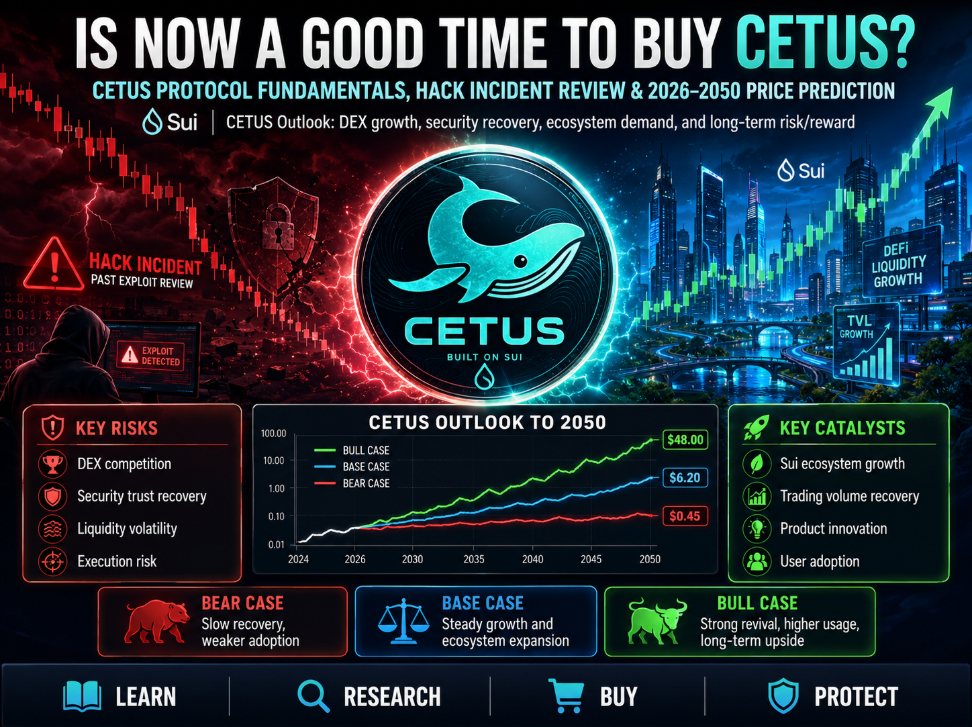
7. CETUS Price Predictions 2030–2050: Will This Protocol Even Exist in 24 Years? What Would It Be Worth?
2050 predictions demand genuine caution. From 2026 to 2050 is 24 years — long enough for a blockchain to rise, and long enough for one to disappear; long enough for a DEX to become infrastructure, and long enough for the AMM model to be entirely replaced.
So CETUS 2050 predictions shouldn't be read as "this is what the price will be." They're better understood as possible ranges under different world scenarios.
2035: Is Cetus Still Sui's Liquidity Base Layer?
By 2035, if Sui remains one of the leading smart contract platforms, the Move language ecosystem keeps growing, and Cetus maintains its core liquidity provision, aggregation, and developer access capabilities — then CETUS could be redefined by the market as a "Move ecosystem DeFi infrastructure token."
In that scenario, CETUS's reasonable price may no longer be a few cents. It could enter the $0.50–$2 range.
But if Sui's ecosystem growth slows, or gets displaced by EVM Layer 2s, Solana, next-generation parallel chains, or AI-native chains — Cetus might continue operating as a niche protocol. In that world, CETUS's long-term value may stay in the $0.05–$0.30 range.
2040: The Fork in the Road Across Three Scenarios
The defining question for 2040 is: has DeFi become part of mainstream finance?
If DeFi by 2040 is still primarily a within-crypto trading venue, Cetus's value ceiling is constrained. Even if Sui keeps running, CETUS can't reach extreme valuations.
If DeFi by 2040 is handling stablecoin payments, RWA trading, cross-border settlement, on-chain market-making, and AI agent financial execution — then liquidity protocols like Cetus may be fundamentally revalued.
Conservative 2040: CETUS at $0.10–$0.40. This assumes Cetus hasn't disappeared but growth is limited, and Sui remains a mid-sized chain.
Base 2040: CETUS at $1–$4. This assumes Sui becomes a significant chain, Cetus maintains its core DEX and aggregator position, and protocol revenue and xCETUS lock-up demand persist.
Optimistic 2040: CETUS at $10–$40. This requires DeFi to genuinely go mainstream, Sui to become important on-chain financial infrastructure, and Cetus's liquidity capabilities to be called upon by large numbers of dApps, wallets, payment applications, and AI agents.
Three Deep Scenarios for 2050
Conservative scenario: CETUS at $0.20–$0.60.
This assumes DeFi continues to exist but growth has clearly slowed; Sui has been partially displaced by a new generation of Layer 1s or modular chains; Cetus still has users but no longer has strong growth capacity; xCETUS benefits offer limited appeal; and protocol revenue can't support a high valuation. Under this scenario, CETUS doesn't necessarily go to zero, but it doesn't become a breakout asset either. It looks more like a legacy ecosystem protocol token — sustained by existing users and limited fee revenue.
Base scenario: CETUS at $1–$5.
This assumes Sui continues to grow through the 2030s and becomes one of the world's mainstream smart contract platforms; Cetus maintains its position as core Sui DeFi infrastructure; CLMM, aggregator, stablecoin swap, and RWA liquidity demand keep growing; and xCETUS functions as an effective long-term lock-up and governance tool. This scenario is the most realistic optimistic target for long-term CETUS investors. It doesn't require Cetus to dominate global DeFi — just to maintain a leading position within the Sui ecosystem long-term and continuously translate protocol growth into token demand.
Optimistic scenario: CETUS at $10–$70.
This requires DeFi in the 2040s to genuinely enter the global financial infrastructure layer; Sui to become one of the operating systems for on-chain finance; and Cetus to become Sui's default liquidity and trade routing layer. Large volumes of wallets, payment apps, RWA protocols, AI agents, and institutional-grade DeFi applications call on Cetus liquidity, with CETUS capturing value through governance, yield, lock-ups, and ecosystem rights. The execution bar for this scenario is extremely high.
Extreme bull scenario: CETUS above $100.
This can only exist as an upper bound thought experiment — not an investment thesis. It requires global DeFi user adoption to reach hundreds of millions to a billion users, Sui to become a pillar of global financial infrastructure, Cetus to hold near-monopoly status in Sui's liquidity layer, and CETUS to develop extremely strong protocol revenue capture capacity. For ordinary investors, this scenario belongs in the imagination box, not the portfolio plan.
Five Unknown Variables Shaping the 2050 Outlook
First: Sui's long-term competitiveness. Whether the Move language ecosystem can continue attracting developers is the foundational variable underpinning CETUS's long-term value.
Second: DeFi regulatory direction. If decentralized exchanges face serious restrictions in major markets, Cetus's frontend and liquidity growth will both be constrained.
Third: Protocol security reputation. The 2025 hack will remain in investors' memory for a long time. Cetus needs years of clean operation to rebuild that trust.
Fourth: Token value capture. CETUS and xCETUS need stronger binding to protocol revenue, governance, and ecosystem rights — otherwise protocol growth may not translate into token price.
Fifth: AI and DeFi convergence. Future on-chain trading may be automatically routed and executed by AI agents. Whether Cetus can become infrastructure for these intelligent trade flows will significantly affect its competitiveness in the 2030s.
8. Is Now the Right Time to Buy CETUS? A Complete Mid-2026 Entry Decision Framework
Whether now is a good time to buy CETUS can't be answered with a simple yes or no. The more accurate assessment: CETUS is currently a high-risk, recovery-stage DeFi asset, suited for investors who are willing to research the Sui ecosystem, can absorb high volatility, and understand the historical risks stemming from the hack — not suitable for complete beginners going in heavy.
From a Valuation Standpoint, Is CETUS Undervalued?
CETUS's current market cap is approximately $16–17 million, with FDV at a similar level. Compared to many newer tokens where FDV is bloated while circulating supply is low, CETUS's valuation structure is more transparent.
But whether it's undervalued depends entirely on your view of Cetus's future.
If you believe Cetus is still Sui's core DEX and has completed its post-hack rebuild, the current market cap does carry meaningful recovery potential.
If you believe the trust damage from the hack is too deep to heal, or that Sui ecosystem growth disappoints, the current low market cap may simply be the market's rational pricing of elevated risk.
What Upside Catalysts Could Drive CETUS?
First catalyst: Compensation token vesting concludes. The 10% linear compensation release that began in June 2025 over 12 months is theoretically approaching its end by June 2026. With less sell pressure, the market can more clearly observe real buy-side activity.
Second catalyst: Sui gasless stablecoin transfers. If stablecoin payment and transfer activity continues growing, Cetus should benefit from increased swap and routing demand.
Third catalyst: Cetus Aggregator integrating more liquidity sources. If Cetus evolves from a standalone DEX into Sui's trade aggregation layer, the valuation logic improves significantly.
Fourth catalyst: Sui ecosystem TVL and user base recovering. If Sui DeFi re-expands, Cetus is typically one of the first infrastructure providers to benefit.
Fifth catalyst: xCETUS benefits getting enhanced. If governance, revenue sharing, and ecosystem incentives become more compelling, CETUS's long-term lock-up demand improves.
What Downside Risks Could Weigh on CETUS?
- Another major security incident in the Sui ecosystem would directly hit confidence in both Cetus and CETUS
- A further Cetus exploit would cause the market to completely reassess its security credibility
- Concentrated selling by compensation token holders could suppress price recovery
- When BTC enters bear market conditions, small-cap DeFi tokens typically suffer deeper declines
- Cetus being displaced by other Sui DEXes, DeepBook, aggregators, or cross-chain routing protocols could undermine CETUS's value proposition
What Makes CETUS Unique Compared to Other DeFi Protocol Tokens?
CETUS's distinctive combination is: ecosystem-core infrastructure + post-hack recovery + high-elasticity small cap. It's not a mature large-cap DeFi token.
Its upside comes from low market cap and Sui ecosystem growth. Its risk comes from its security history, ecosystem dependency, and small-cap volatility.
For a side-by-side comparison with another fundamentals-backed DeFi protocol token, check out the RPL Price Prediction 2030. RPL represents the Ethereum liquid staking infrastructure thesis; CETUS represents the Sui liquidity infrastructure thesis — entirely different DeFi verticals with different risk profiles.
Differentiated Strategies for Three Types of Investors
If you're a short-term trader: CETUS is better traded around events and technical levels. Watch for Sui ecosystem partnership announcements, Cetus aggregator updates, volume changes, and whether the $0.015–$0.020 range holds as stable support. Short-term trades require stop-losses — CETUS's liquidity and market cap are both limited, and swings can be extreme.
If you're a medium-term holder with a 1–3 year time horizon: use a phased entry strategy. Monitor closely whether TVL recovers back above $200 million, whether trading volume sustains its rebound, whether xCETUS lock-ups are growing, and whether Sui stablecoin activity is translating into real Cetus trading demand.
If you're a long-term believer with a 5+ year horizon: you have to accept a fundamental reality — CETUS could deliver outsized multiples on its recovery, or it could stagnate for years due to technological displacement, ecosystem decline, or insufficient security credibility. Long-term holding requires discretionary capital, and CETUS belongs in a high-risk allocation bucket, not a core position.
9. How to Buy CETUS on HiBT: A Complete Beginner's Guide from Zero to Done
If you've worked through the risks and decided to take a small position, you can buy CETUS through HiBT's CETUS/USDT spot trading pair. Compared to operating directly on a Sui wallet through a DEX, the exchange route is far more beginner-friendly — you don't need to manage a Sui wallet yourself, find contract addresses, configure slippage, or assess whether a liquidity pool is legitimate.
That said, trading services, KYC requirements, and deposit methods may vary by region — always use what's displayed on HiBT's platform as your reference.
Step 1: Register a HiBT Account
Go to the HiBT website or app and sign up with your email or phone number. After registering, immediately set up account security: login password, withdrawal password, two-factor authentication, and an anti-phishing code.
Don't skip security setup to chase a price move. With a small-cap DeFi token, prices can move fast — but your account security always takes priority over getting in a few minutes earlier.
Step 2: Complete KYC Verification
Go to the identity verification page and submit your personal information and ID documentation as prompted. You'll typically need a government-issued ID, facial recognition, and basic identity information. Processing times vary — follow the platform's prompts for current timelines.
Once KYC is complete, your account will typically unlock full deposit, trading, and withdrawal functionality.
Step 3: Deposit USDT
CETUS's main spot trading pair is CETUS/USDT, so you'll need USDT in your account first.
You can purchase USDT through a fiat on-ramp if available in your region, or transfer USDT from another exchange or wallet. When doing on-chain transfers, always verify network consistency — TRC20, ERC20, BEP20, Sui, and other networks are not interchangeable.
Before depositing, confirm three things:
- The deposit address is completely accurate
- Your chosen network matches on both sides
- Whether a Memo or Tag is required
Sending a small test transfer first is a good habit for newcomers to reduce operational risk.
Step 4: Search for the CETUS/USDT Trading Pair
Once your deposit clears, go to the spot trading section and type CETUS to find the CETUS/USDT pair.
Before placing an order, check three things:
- Whether the current price is near a short-term support zone
- Whether the bid-ask spread looks normal
- Whether 24-hour trading volume is adequate
CETUS has a relatively small market cap and can experience significant swings. During high-volatility periods, don't chase with market orders.
Step 5: Default to Limit Orders
Limit orders let you set the price you're willing to pay, avoiding getting filled at an inflated price during a short-term spike.
For example, if the current price is around $0.017 and you don't want to chase, consider layering orders closer to support levels. Limit orders don't guarantee a fill, but they help you control your entry cost.
A beginner-friendly approach:
- First tranche: small starter position near current price
- Second tranche: wait for a confirmed pullback before adding
- Third tranche: consider adding only after a confirmed break above key resistance
Don't go all-in at once, and don't size up just because the price looks low.
Step 6: Set Price Alerts and Define Your Stop-Loss After Buying
After buying CETUS, immediately record:
- Your average entry price
- Total capital invested
- Maximum loss you're willing to accept
- Your planned stop-loss level
- Phased take-profit targets
For example, if you're willing to absorb a maximum 20% loss, set your stop level in advance — don't talk yourself into averaging down when it actually gets there.
After Buying: Keep on HiBT or Move to a Sui Wallet?
If you're a short-term or medium-term trader, keeping CETUS on HiBT is more convenient for placing orders and managing stops and targets.
If you're familiar with Sui wallets, Cetus's native protocol, and the xCETUS mechanism, you can consider withdrawing to a Sui wallet to participate more deeply in the on-chain ecosystem. But this requires you to correctly manage your private key, identify contracts accurately, and understand on-chain authorization risks.
For most newcomers, starting with exchange-based trading is the right call. Get comfortable with Sui first, then explore on-chain participation.
Appendix A: CETUS Quick-Reference Data Sheet
As of June 30, 2026:
Full token name: Cetus Protocol Ticker: CETUS Protocol type: DEX, CLMM, aggregator, Sui liquidity infrastructure Primary blockchain: Sui, with Aptos ecosystem support Maximum supply: 1 billion CETUS Current circulating supply: Approximately 950 million CETUS Current price: Approximately $0.016–$0.018 Current market cap: Approximately $16–17 million All-time high: Approximately $0.487–$0.497 (varies slightly by platform) 2025 hack scale: Approximately $223 million Assets frozen and recovered by Sui validators: Approximately $162 million Relaunch date: June 8, 2025 — approximately 17 days after the attack Affected pool recovery rate: Approximately 85–99% of original liquidity Compensation token scale: 15% of total supply — 5% immediately claimable, 10% linearly vested over ~12 months Key backers: OKX Ventures, KuCoin Ventures, Animoca Ventures, and others HiBT trading pair: CETUS/USDT Core strengths: Leading Sui DEX, CLMM model, aggregator capabilities, low market cap recovery potential Core risks: Hack history, ecosystem dependency, thin liquidity, small-cap volatility, long-term competitive displacement
Appendix B: CETUS Investment Decision Checklist
Before buying CETUS, confirm that you can answer yes to the following:
- Do I know that Cetus suffered approximately a $223 million hack in 2025?
- Do I know that while the protocol has relaunched, trust rebuilding requires long-term validation?
- Do I understand that CETUS is a high-risk, small-cap DeFi token — not a stable yield product?
- Do I know that CETUS's future is highly correlated with the Sui ecosystem's growth?
- Do I understand the difference between CETUS and xCETUS?
- Am I only investing capital I can afford to lose without affecting my life?
- Have I set a clear stop-loss level?
- Am I avoiding a lump-sum all-in entry?
- Will I continue tracking Cetus TVL, trading volume, aggregator updates, and Sui stablecoin activity over time?
- Am I buying based on research and conviction — not because I saw a "low price" and "high return prediction"?
Conclusion: Is Now a Good Time to Buy CETUS?
CETUS right now is not a low-risk asset. It's a high-risk, high-elasticity, ecosystem-dependent, recovery-stage DeFi token.
If you're a complete newcomer who doesn't know Sui and hasn't worked through the 2025 hack — a heavy position is not appropriate.
If you're a short-term trader: watch CETUS's behavior in the $0.015–$0.020 support range and look for volume-confirmed breakouts — but always with a stop-loss in place.
If you're a medium-term investor: treat CETUS as a Sui DeFi ecosystem recovery observation play, build positions in phases, and don't go all-in.
If you're a long-term holder: the real question isn't whether CETUS goes up tomorrow. It's whether Cetus will still be operating as Sui's core liquidity infrastructure after 2030. If you believe the answer is yes, the current price level genuinely warrants serious study. If you don't believe Cetus can survive as a core protocol long-term, a low price alone is not a buy thesis.
One-sentence summary: CETUS is worth researching and worth a small, phased allocation — but not a blind heavy position. Its long-term value hinges on three things: whether Sui can sustain growth, whether Cetus can fully rebuild its security credibility, and whether CETUS can develop stronger value capture from real protocol usage.