
Risk Disclosure: This article is compiled from public materials, project documentation, and market data for educational and research purposes only. It does not constitute investment advice. Cryptocurrency prices are highly volatile, and newly listed tokens are especially prone to sharp swings, liquidity shortages, unlock-driven sell pressure, and information gaps. Always do your own research before investing.
When many people first encounter the name "NES coin," their first thought probably isn't an AI blockchain — it's Nintendo's classic NES console. Let's get this out of the way upfront: the NES discussed here is the native token of the Nesa project, and has nothing to do with the Nintendo Entertainment System. It's purely a name collision.
NES has suddenly been trending for two main reasons:
First, Nesa became one of the higher-profile new listings on Binance Alpha on June 24, 2026, generating a notable short-term traffic and attention spike.
Second, NES has shown extremely sharp price swings since launch — surging, pulling back, then bouncing — a classic pattern of "first-day liquidity battles" for new tokens. For beginners, this kind of action tends to trigger two opposite reactions: either "did I just miss the next big opportunity," or "is buying now just catching a falling knife."
So rather than telling you outright whether you should buy NES, this article aims to give you a clearer framework for thinking it through: What exactly is Nesa? What does the NES token actually do? Where does the price currently stand? What might the 2026–2030 trajectory look like? And if a beginner decides to buy, how should they go about it — and what risks absolutely need to be considered first?
I. What Nesa Actually Does: What Real Pain Point in AI Is It Solving?
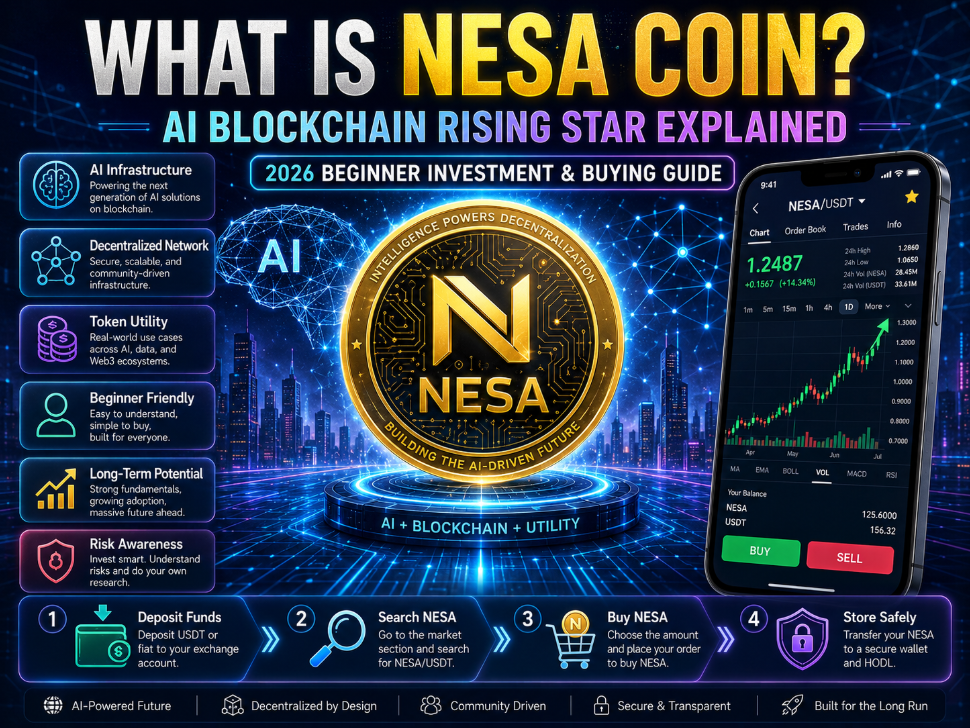
Over the past two years, "AI + blockchain" has become one of the easiest narratives to pitch in crypto. The problem is that many projects simply slap an AI label on for marketing purposes, without a clear answer to "why does this actually need blockchain in the first place."
Nesa's positioning is relatively clear: it isn't trying to build an AI chatbot, nor is it just issuing an AI-themed token for the sake of it. Instead, it's attempting to build a decentralized execution network specifically for AI inference.
In plain terms, Nesa is trying to address three problems:
First, centralized AI models carry data privacy risk.
When a business or user calls a centralized AI service, they typically have to hand their data over to a centralized provider for processing. For casual chat, writing, or translation, this usually isn't a big deal — but when the data involves financial transactions, medical records, internal corporate documents, customer identity information, or trade secrets, businesses tend to get a lot more cautious.
Nesa is trying to let users complete AI inference tasks without needing to fully trust a single centralized provider.
Second, AI inference results need to be verifiable.
In many future scenarios, it won't be enough for AI to simply spit out an answer — people will need to know whether that answer actually followed the rules, whether it was tampered with, whether it came from the specified model, and whether it ran through a trusted computing environment. This matters especially in finance, smart contracts, on-chain automation, and AI agents executing tasks autonomously.
Nesa's emphasis on "verifiable AI inference" is about giving the AI inference process and its outputs stronger, more trustworthy verification.
Third, large model inference costs and compute distribution are imbalanced.
Large AI models typically depend on high-performance GPUs and centralized cloud services, which drives up cost and raises the barrier to entry, making it hard for many smaller developers to plug in flexibly. Nesa's proposed approach — model sharding, distributed node execution, and on-chain coordination — aims to split inference tasks across multiple nodes to improve overall compute efficiency.
From a technical standpoint, Nesa emphasizes three main approaches:
Trusted Execution Environments (TEE) A TEE can be thought of as a hardware-level "secure isolation chamber." Data and models run inside a protected environment, so outside nodes participating in computation can't easily see the full sensitive data, even while contributing to it.
Zero-Knowledge Machine Learning (ZKML) The core idea behind ZKML is proving that an AI inference process actually happened and that its result genuinely follows the rules — without exposing the full underlying data or model details. This space is still in its early innings industry-wide, but the long-term potential is significant.
Model Sharding and Distributed Inference Large models don't necessarily need to run on a single server all at once — in theory they can be split into parts and processed collaboratively across multiple nodes. Nesa hopes this approach will draw more nodes into participating in the AI inference network.
So why wouldn't an ordinary user or business just call the OpenAI API, Claude API, or Gemini API directly instead of paying attention to Nesa?
The answer isn't that "Nesa is necessarily better" — it's that they solve different problems.
Centralized AI APIs offer maturity, stability, strong performance, and a simple developer experience. Decentralized AI execution networks like Nesa are better suited for use cases centered on privacy, verifiability, on-chain coordination, and trustless computing. In other words, if you're just writing articles, doing translations, or generating images, a centralized AI tool is probably more convenient — but if you're working with on-chain finance, private data, enterprise AI workflows, or autonomous AI agents, an architecture like Nesa's is where the real discussion starts to matter.
This is also the key to judging NES's long-term value: don't just look at the "AI" label — look at whether Nesa can actually get privacy-preserving AI inference, enterprise applications, and on-chain settlement up and running for real.
II. What Does the NES Token Actually Do Within the Network?
Many beginners buying tokens only watch the price go up and down without understanding what the token is actually for. This creates two problems: when it rallies, you don't know why; when it drops, you can't tell if the fundamentals have actually deteriorated — you're just along for the emotional ride.
NES is Nesa's native token, and its core functions fall into five categories.
Gas Fees
As an on-chain network built around AI inference, Nesa requires users to pay network fees for initiating transactions, calling services, and executing related operations. NES functions as the base gas token.
This means that if Nesa's ecosystem eventually generates significant AI inference requests, dApp activity, and on-chain settlement volume, NES becomes the base consumable asset for network usage.
AI Inference Staking
Nodes participating in AI inference don't do so cost-free or without constraints. In Nesa's design, miners or compute nodes need to stake a certain amount of NES to demonstrate they have skin in the game.
This staking mechanism is meant to reduce malicious behavior. If a node acts dishonestly, returns incorrect results, or provides unreliable service, it's theoretically subject to penalties or loss of rewards.
Validator Staking
If Nesa operates as a Layer 1 network, it needs validators to maintain network security. NES also serves as the validator staking asset, similar to the native tokens of many PoS chains.
For long-term holders, staking may generate passive yield — but that yield isn't risk-free. It comes from network inflation, fee distribution, or ecosystem incentives, and ultimately depends on actual network usage.
Miner and Model Provider Rewards
The Nesa network may involve multiple types of participants:
- Miners or nodes contributing compute
- Model owners providing models
- Users or applications initiating inference requests
- Network participants responsible for verification and settlement
NES serves as the incentive-distribution currency among these roles. Put simply, if you contribute compute, models, or verification services to the network, you may earn NES rewards.
Governance
As the network develops, NES may also be used for governance voting — things like parameter adjustments, incentive allocation, ecosystem fund usage, and protocol upgrades. Whether governance actually carries real value will depend on whether the project genuinely opens up key decisions to the community, rather than leaving it as whitepaper language.
From a tokenomics standpoint, here's what's worth paying attention to with NES:
- Total supply: approximately 1 billion tokens
- Initial circulating supply: approximately 140 million tokens, roughly 14% of total supply
- Current FDV: estimated at $250–300 million based on a $0.25–0.30 price range
- Inflation mechanism: public materials indicate a relatively high initial inflation rate that gradually declines toward a lower long-term annual rate
- Key things to watch: the pace of future unlocks, the release schedule for team and investor allocations, and the speed of ecosystem incentive distribution
One important caution here: low-circulation new tokens are especially prone to a situation where "market cap looks small, but FDV is actually not low at all."
For example, a token might show a circulating market cap of only $30–40 million, which looks like a "small-cap opportunity" — but if total supply is large and a substantial amount is still set to unlock over time, that incoming supply will create ongoing downward pressure on price. When looking at NES, beginners shouldn't just look at circulating market cap — they need to look at FDV and the unlock schedule too.
III. A Sharp Pump and Dump at Launch: Is This a High or a Low Right Now?
NES's price action since launch has been very typical: a rapid spike in a short window, followed by a quick pullback, then a bounce and consolidation. Public price feeds show NES touching highs near $0.33–0.36 shortly after launch, pulling back to around $0.24, and currently fluctuating in the $0.25–0.30 range.
This kind of pattern isn't unusual — especially for new tokens that get concentrated attention from Binance Alpha listings, airdrops, initial listings, and short-term trading flows. These tokens commonly go through a few phases:
Phase one: Opening land grab. Early users, airdrop recipients, short-term traders, and bots all pile in at once, pushing the price up quickly.
Phase two: Profit-taking release. Holders who got tokens cheap via airdrop start selling, and short-term capital takes quick profits, causing a sharp pullback.
Phase three: Market repricing. Once the first wave of emotional trading settles, the price enters a consolidation range, and the market starts reassessing fundamentals, circulating supply, trading depth, and upcoming catalysts.
So judging whether NES is currently high or low isn't just about how far it's fallen from its peak — it comes down to three indicators.
First, is the circulating market cap and FDV reasonable?
At $0.26, with a total supply of 1 billion tokens, NES's FDV comes out to roughly $260 million. With circulating supply around 140 million tokens, that puts circulating market cap at roughly $36 million. For a newly launched AI blockchain project, that valuation isn't outrageous, but it's not exactly cheap either — its real commercial execution still needs time to play out.
Second, is trading volume mostly driven by short-term speculation?
High volume right after launch doesn't necessarily reflect strong long-term demand — it could just be frequent short-term churn. What's actually worth watching is whether volume holds up weeks later, whether holder addresses are diversifying, and whether the ecosystem is seeing real user growth.
Third, what's the pace of unlocks and new supply?
Current circulating supply is only about 14% of total supply, meaning a large amount of tokens have yet to enter the market. If new supply gets released faster than the ecosystem grows, the price will face pressure.
By comparison, an established chain like SOL — which has already been through multiple bull and bear cycles — has price action that reflects market sentiment, ecosystem progress, on-chain activity, institutional flows, and macro cycles combined, rather than pure new-listing liquidity dynamics. If you're also wondering whether now is a good time to buy SOL, our deep-dive analysis covers that question at — and you'll see that the logic for evaluating new tokens versus established ones is really two completely different frameworks.
A token like NES is better approached with a "high volatility, high uncertainty, strict position sizing" mindset, rather than applying the same valuation logic you'd use for a major established coin.
IV. NES Price Predictions for 2026–2030: Three Scenarios
The projections below are based purely on public data, current valuation, sector sentiment around AI, comparable project valuations, and token supply structure. They do not constitute investment advice. Forecasting error for new tokens is extremely high, and any specific number here should be read as a scenario assumption, not a firm conclusion.
1. Bear Case: AI Narrative Cools, Unlock Pressure Hits
If the following conditions play out:
- The broader AI + crypto sector cools off overall
- Trading volume drops sharply once the Binance Alpha attention fades
- Nesa's technical execution lags behind market expectations
- Team, investor, or ecosystem incentive unlocks create sustained sell pressure
- The broader market enters a risk-off phase
Then NES could break below its post-launch lows and settle into an extended period of low-range consolidation.
Bear case price ranges:
- 2026: $0.08–0.18
- 2027: $0.06–0.15
- 2028: $0.08–0.20
- 2029: $0.10–0.25
- 2030: $0.12–0.30
In this scenario, NES doesn't go to zero — the market simply concludes "good story, not enough delivery," and the valuation gets compressed into a more conservative range.
2. Base Case: Nesa Makes Steady Progress, But Doesn't Become a Leading AI Chain
If the following conditions play out:
- Nesa's mainnet, nodes, model marketplace, and AI inference services continue developing steadily
- Some developer and enterprise adoption occurs, but without explosive growth
- The AI + crypto sector maintains moderate-level interest
- Unlock pressure exists but is partially absorbed by ecosystem growth
- NES settles into a mid-tier AI infrastructure project valuation range
Then NES could trace out a "choppy uptrend" base-case path.
Base case price ranges:
- 2026: $0.20–0.45
- 2027: $0.30–0.70
- 2028: $0.45–1.00
- 2029: $0.60–1.30
- 2030: $0.80–1.80
In this scenario, NES's gains aren't driven by short-term pumps — they're supported gradually by actual network usage, ecosystem partnerships, real revenue, or inference demand.
3. Bull Case: Enterprise AI Adoption Takes Off, Nesa Becomes a Flagship AI Infrastructure Project
If Nesa genuinely delivers clear use cases, for example:
- Deep partnerships with enterprise AI, privacy computing, on-chain finance, or AI agent platforms
- ZKML, TEE, and model-sharding solutions gaining broader developer adoption
- Real AI inference revenue showing up on the network
- Growing staking and gas demand for NES
- AI infrastructure becoming a core narrative in a new crypto bull cycle
Then NES has a shot at being repriced from a "small-cap AI token" into an "AI infrastructure asset."
Bull case price ranges:
- 2026: $0.50–0.90
- 2027: $0.80–1.60
- 2028: $1.20–2.50
- 2029: $1.80–4.00
- 2030: $2.50–6.00
But this scenario rests on a very strong precondition: not only does the market need to assign AI infrastructure a high valuation multiple, but Nesa itself needs to actually deliver products, users, revenue, and ecosystem growth. Otherwise, the "AI blockchain" label alone won't be enough to sustain a high valuation long-term.
This same scenario-based forecasting approach applies to other small-cap emerging tokens too. For example, our earlier 2030 price prediction analysis for LFI coin at takes the same bear/base/bull breakdown approach, rather than offering a falsely precise single number.
V. How Should a Beginner Actually Buy NES? A Step-by-Step Walkthrough Using HiBT
If you understand NES's basic logic and risks and still want to participate, you can use any exchange that supports the NES/USDT trading pair. Here, we'll walk through the general process — from signup to executing a buy order — using HiBT, a global digital asset exchange, as the example.
Step 1: Check Security and Compliance Information Before Choosing an Exchange
The most common mistake beginners make is focusing only on where they can buy, without checking whether the platform is actually trustworthy.
Before choosing an exchange, check at minimum for:
- Publicly available company registration information
- Disclosed compliance or licensing information
- A basic KYC process
- Support for standard security features like 2FA, email verification, and a funds password
- Clear rules around deposits, withdrawals, and trading
- Sufficient trading depth to avoid excessive slippage
As an example, HiBT's public materials highlight its Canadian incorporation, US/Canada MSB-related compliance disclosures, and a Dubai-based operations center. Beginners should still independently verify the latest disclosures on the platform's official site, along with any regional restrictions and terms of service.
Step 2: Register an Account and Complete KYC
The typical signup flow includes:
- Registering with an email or phone number
- Setting a strong password
- Enabling two-factor authentication
- Completing identity verification (KYC)
- Uploading ID documents, facial verification, or proof of address as required
KYC review time depends on the platform's processing speed and how clear your submitted documents are — it can take anywhere from a few minutes to a few hours, sometimes longer. Beginners should never use someone else's identity documents, never buy a pre-verified account, and never share a verification code with anyone.
Step 3: Deposit Funds
There are generally two deposit methods.
Fiat channels — better suited for beginners without existing USDT, but check whether the platform supports your region, your preferred payment method, the fees involved, and processing time.
On-chain USDT transfer — if you already hold USDT in another wallet or exchange, you can deposit on-chain. When doing so, always confirm:
- The deposit currency is actually USDT
- You've selected the correct network (e.g., TRC20, ERC20, BEP20)
- The deposit address has been copied in full
- You've done a small test transfer before sending a larger amount
- You haven't mixed up networks across different chains
For beginners, the biggest risk with on-chain transfers isn't market volatility — it's sending to the wrong address or wrong network and losing access to funds permanently.
Step 4: Search for the NES/USDT Trading Pair
Once your deposit has cleared, search for "NES" or "NES/USDT" in the trading section.
There are two main order types:
Market orders fill quickly at the best available current price — good for beginners who prioritize speed of execution. But if trading depth is thin, you may experience slippage, meaning your actual fill price ends up worse than what you saw on screen.
Limit orders let you set your own buy price. For example, if you think $0.25 is a reasonable entry, you can place a limit order at that price. The upside is price control; the downside is it might not fill.
For newly listed, highly volatile tokens, it's generally better for beginners to use limit orders rather than chasing a market order during a sharp price spike.
Step 5: Keep It on the Exchange or Move It to a Wallet?
This depends on your habits and your comfort level with self-custody.
Keeping funds on the exchange is simpler, easier to sell quickly, and well-suited to short-term trading — you don't need to manage private keys yourself. The downside is that you're taking on platform risk: account compromise could lead to losses, and in extreme cases you could face withdrawal restrictions.
Moving to a self-custody wallet gives you full control of your private keys, suits long-term holding better, and lets you participate in on-chain activity. The downside is that losing your private key or seed phrase means permanent loss of access, the risk of sending to the wrong chain or address is higher, and the learning curve is steeper for beginners.
If you're a complete beginner taking a small short-term position, it's reasonable to keep funds on the exchange with all security features enabled. If you plan to hold long-term and are comfortable with wallet management, consider a small test transfer before moving larger amounts to self-custody.
VI. The Risk Checklist You Need Before Investing in NES
NES carries a number of strong narratives — AI, blockchain infrastructure, Binance Alpha exposure, new-listing hype — but the risks are just as real. Any responsible analysis has to lay those out clearly.
1. Unlock Sell-Pressure Risk
Current circulating supply is only around 14% of total supply, meaning a large amount of tokens have yet to enter circulation.
Beginners should pay close attention to:
- When team allocations unlock
- When investor allocations unlock
- Whether ecosystem incentives continue to be released
- How large each unlock is relative to circulating market cap
- Whether trading volume can absorb the unlock when it happens
If a single unlock equals 5%, 10%, or more of circulating supply without a corresponding increase in demand, the price is likely to come under pressure.
2. Commercialization Uncertainty
Nesa's key technical concepts — TEE, ZKML, model sharding, decentralized AI inference — are all cutting-edge, but cutting-edge also means uncertain.
Things to keep in mind:
- ZKML as a field is still in its early stages overall
- TEE has real-world applications, but its hardware trust model remains debated
- Distributed AI inference has to simultaneously solve for performance, latency, cost, privacy, and verification
- Whether enterprise customers are actually willing to migrate to decentralized AI networks still needs to be proven over time
So Nesa shouldn't be judged on "the tech sounds advanced" alone — what matters is whether it can deliver real, working use cases.
3. New-Listing Liquidity Risk
Trading volume can be high right after a new token launches, but that doesn't guarantee stable long-term liquidity.
Risks include:
- Volume dropping sharply once short-term capital exits
- Thinning order books, making prices more vulnerable to large orders
- Wider slippage on market orders
- Difficulty exiting positions during extreme volatility, or only being able to sell at a steep discount
Beginners participating in NES shouldn't just watch the upside — they need to watch order book depth and trading structure too.
4. Team and Investor Concentration Risk
If team members, early investors, advisors, and the ecosystem fund collectively hold a large share of supply, the future release schedule becomes critically important.
Team or investor holdings aren't inherently a problem. What matters is:
- Whether there's a meaningful long-term lockup
- Whether release is linear and gradual
- Whether the schedule is publicly transparent
- Whether wallet addresses are traceable on-chain
- Whether unlocks are tied to development milestones
If you start seeing concentrated transfers to exchanges, unusually large transactions, or frequent unlocks, that's a signal to be more cautious.
5. AI Narrative Fading Risk
Crypto markets move in narrative cycles. AI tokens might be hot in one phase, and capital might rotate to memecoins, RWA, DePIN, Layer 2, gaming, or macro assets in the next.
If the AI narrative cools off, NES's price could decline due to sector-wide capital outflows — even if Nesa itself hasn't done anything wrong.
6. Position-Sizing Risk
For the average investor, a newly listed, highly volatile token isn't suitable as a core, heavily weighted holding.
A more prudent approach:
- Only commit capital you can afford to lose entirely
- Don't borrow or use leverage
- Don't chase the price after a sharp rally out of FOMO
- Buy in stages, take profit in stages
- Set a maximum acceptable loss threshold
- Don't dress up short-term speculation as long-term conviction
If you can't stomach a drawdown of 50% or more, NES isn't a token you should be heavily positioned in.
VII. Conclusion: A Decision Framework for Beginners — Not Just a Yes-or-No Answer
What makes NES compelling is that it touches on AI, privacy computing, decentralized inference, Layer 1 infrastructure, and Binance Alpha hype all at once. But its biggest risks come from those same buzzwords: a strong story that's still early to verify, and high volatility without much certainty yet.
When facing NES — or any newly listed token — beginners can work through this checklist:
First, is the technical narrative real?
Don't just take "AI + blockchain" at face value. Ask:
- What specific problem does it solve?
- Why does it actually need blockchain?
- Who's the target user?
- Is there a real product or testnet?
- Is the technical approach backed by official documentation and visible development progress?
Second, is the tokenomics structure healthy?
Look closely at:
- Total supply
- Initial circulating percentage
- FDV
- Team and investor allocation
- Unlock schedule
- Inflation mechanism
- Whether the token genuinely captures network value
Third, what's the liquidity and trading structure?
Don't just watch the percentage gain — check:
- 24-hour trading volume
- Number of exchange listings
- Order book depth
- Whether holdings are concentrated among a few large wallets
- Whether volume holds up after the initial launch period
Fourth, how strong is the team's execution?
Long-term price ultimately comes down to execution, not whitepaper promises. Watch for:
- Whether the team continues shipping updates
- Whether the roadmap is actually being delivered
- Whether a developer ecosystem is forming
- Whether there are real enterprise partnerships
- Whether there are real users and real revenue
Fifth, what's your own risk exposure?
NES means something different depending on who you are.
If you're a short-term trader, what matters is entry point, stop-loss, liquidity, and sentiment cycles.
If you're a long-term investor, what matters is technical delivery, ecosystem growth, unlock pressure, and the valuation ceiling.
If you're a beginner, the goal isn't to nail the exact top — it's to avoid going all-in on a single position out of FOMO.
The bottom line: NES is a worth-watching new entrant in the AI blockchain space, but it's still early-stage. Its long-term value depends on whether Nesa can actually combine privacy-preserving computation, verifiable AI inference, model sharding, and real commercial use cases. In the short term, NES's price will mostly be driven by new-listing hype, exchange liquidity, airdrop sell pressure, and market sentiment. Long term, it comes down to product delivery, ecosystem growth, and the token's ability to capture real value.
For beginners, the right question isn't "will NES definitely go up" — it's:
Do I actually understand its technical narrative? Do I understand its unlock risk? Can I handle the kind of volatility a new token brings? Do I have a clear plan for entry, stop-loss, and take-profit? Am I only using money I can afford to lose?
If you can answer all of these clearly, you'll be in a much better position to decide whether to participate in NES — far more rational than simply chasing the hype.