
If you only look at the news, XRP should be one of the assets most "destined to rise" in the crypto market over the past few years.
The reason is simple: the SEC vs. Ripple lawsuit that had plagued XRP for years finally concluded in 2025, clarifying XRP's status in secondary market trading as "not a securities transaction"; multiple XRP-related ETF products have successively emerged, allowing institutional funds to enter through more compliant channels; and Ripple continues to advance its commercialization narrative around cross-border payments, the RLUSD stablecoin, and institutional settlement networks.
But if you only look at the price, the reality is far from ideal.
XRP reached an all-time high of approximately $3.65 in July 2025, but subsequently continued to decline. By June 2026, XRP was fluctuating roughly in the $1.1–$1.4 range, down about 60%–65% from its historical peak.
This creates a stark contrast that is highly instructive for beginners:
Why is it that major legal victories have been achieved, ETF funds are flowing in, yet XRP's price has not continued to rise?
This article is not about simply telling you "buy now" or "don't buy." It is about helping you build a framework for evaluating XRP.
Because XRP is different from typical altcoins.
It is not a typical high-performance Layer 1 narrative, nor is it a value-storage narrative like Bitcoin, nor is it a short-term asset driven purely by meme sentiment. XRP's core narrative has always revolved around cross-border payments, settlement networks, institutional liquidity bridging, and compliant infrastructure.
For this very reason, judging XRP requires more than just looking at the charts; you must also examine:
- Whether regulatory risk has truly declined;
- Whether Ripple's payment network has genuine adoption;
- Whether the RLUSD stablecoin can expand its usage;
- Whether XRP truly plays a core role in settlement and liquidity bridging;
- Whether ETF inflows can translate into sustained buying demand;
- Whether insider selling and custody releases create persistent supply pressure;
- Whether the ultra-long-term narrative for 2050 still holds.
This article is for cryptocurrency research and investment education purposes only and does not constitute any investment advice. XRP is a highly volatile crypto asset, and its price may rise or fall significantly in a short period. Before investing, please independently verify exchange announcements, regulatory policies, on-chain data, and your personal risk tolerance.
I. Why "Buy the Rumor, Sell the News" Is the First Lesson in Understanding XRP's Current Situation
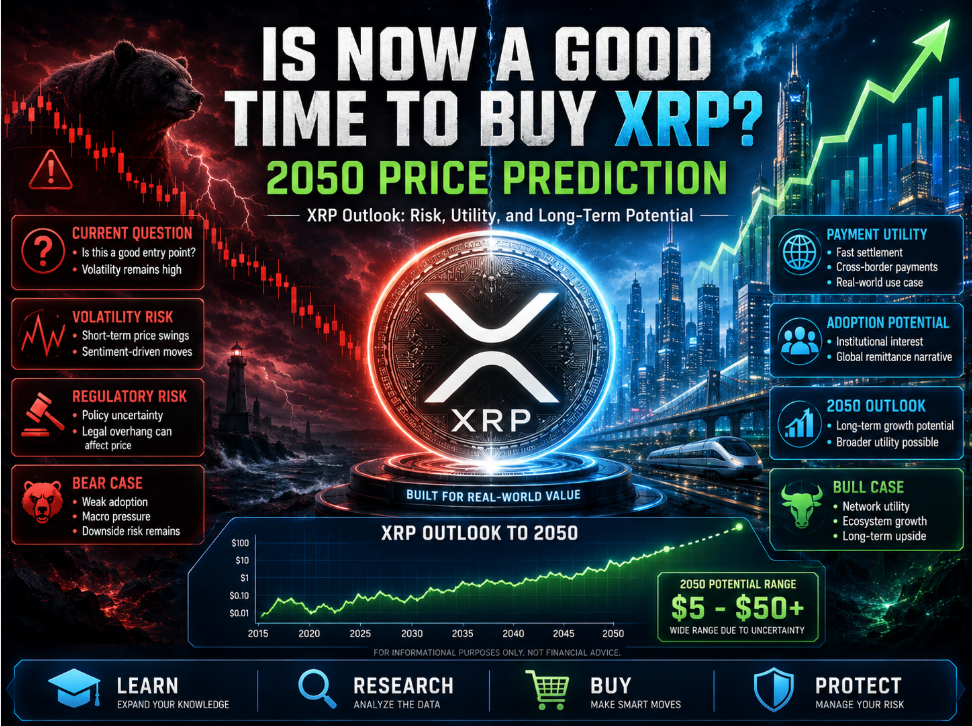
Many beginners assume that major positive news will inevitably lead to price increases.
But XRP's price action tells us exactly the opposite: positive news does not guarantee price appreciation.
The SEC vs. Ripple lawsuit, which began in 2020 and lasted for years, was one of the most closely watched regulatory cases in the entire crypto industry. It affected not only Ripple and XRP but also how U.S. regulators view the issuance, trading, institutional sales, and secondary market circulation of crypto assets.
For XRP, this lawsuit long suppressed its valuation.
Before the lawsuit was resolved, the market remained concerned about several issues:
- Whether XRP would be fully classified as a security;
- Whether U.S. exchanges would continue to delist or restrict XRP;
- Whether institutions would dare to participate in XRP;
- Whether Ripple's business would be significantly impacted;
- Whether other countries' regulators would follow the U.S. stance;
- Whether XRP's long-term liquidity would be undermined.
Therefore, when the lawsuit gradually moved toward resolution, the market naturally viewed it as a major positive catalyst.
In theory, the removal of this level of regulatory risk should lead to a valuation re-rating.
But the reality is more complex.
XRP had already risen in advance during the expectation phase, with some funds positioning themselves before the official announcement. When the final outcome was revealed, the market instead experienced a "sell the news" reaction.
This is the classic "buy the rumor, sell the news" pattern.
In other words, the price does not react only at the moment of the announcement; it had already priced in the news during the expectation phase.
If you wait until everyone knows the good news before buying in, what you are buying may not be an opportunity, but rather a position where others are taking profits.
1. Why Haven't ETF Inflows Supported the Price?
The emergence of XRP ETFs and related products has indeed provided a more convenient entry point for traditional capital.
But ETF inflows do not guarantee price increases.
There are several reasons.
First, ETF buying may be offset by spot selling pressure.
If there is a large amount of selling from insiders, early holders, short-term traders, or unlocked tokens at the same time, ETF inflows can only partially absorb supply and may not be sufficient to drive prices higher.
Second, ETF inflows may fall short of market expectations.
The market's most common mistake is applying the success of Bitcoin ETFs to all crypto assets.
But XRP is not Bitcoin.
Bitcoin has the strongest scarcity narrative, institutional consensus, global liquidity, and macro asset attributes. XRP, despite its regulatory clarity and payment narrative, has far weaker institutional consensus than BTC.
Third, ETF funds are not necessarily long-term holding funds.
Some ETF flows may come from short-term arbitrage, leveraged trading, or event-driven trading, rather than long-term allocation.
Fourth, the overall market environment can suppress high-beta assets.
If Bitcoin, Ethereum, and the broader crypto market are weak, XRP—even with its own positive catalysts—will struggle to sustain an independent bull run.
Therefore, beginners must establish one key understanding:
Positive news is just one variable in price movement, not a guarantee of price appreciation.
What truly determines price is: expectation gaps, fund flows, supply-demand dynamics, the macroeconomic environment, and long-term fundamentals.
II. What Exactly Is XRP? How Is It Different from Typical Altcoins?
XRP is the native asset of the XRP Ledger.
The XRP Ledger (XRPL) is an earlier blockchain network, with a goal not to become a general-purpose smart contract platform like Ethereum, nor to focus on digital gold like Bitcoin, but rather to focus more on payments, settlement, transfers, and liquidity bridging.
Put simply:
XRP's core narrative is cross-border payments and settlement networks.
This is completely different from many altcoins.
The narratives of many altcoins are:
- Faster blockchains;
- Lower fees;
- AI concepts;
- Gaming ecosystems;
- Meme communities;
- DeFi yields;
- RWA assets;
- Layer 2 scaling;
- Social finance.
XRP's narrative, by contrast, has long revolved around:
- Bank cross-border payments;
- Payment institution settlement;
- Liquidity bridging;
- Low-cost settlement;
- RippleNet;
- ODL (On-Demand Liquidity);
- RLUSD stablecoin;
- Institution-grade compliant infrastructure.
1. The Difference Between XRP Ledger, Bitcoin, and Ethereum
Bitcoin's design goal is decentralized value storage and a peer-to-peer electronic cash system. Over time, the market has increasingly recognized its "digital gold" properties.
Ethereum's design goal is a general-purpose smart contract platform. It allows developers to build various applications such as DeFi, NFTs, DAOs, RWA, stablecoins, and Layer 2 solutions.
XRP Ledger's design goal leans more toward payments and settlement.
It emphasizes:
- Fast confirmation;
- Low transaction costs;
- Suitability for cross-border transfers;
- Suitability as a bridge asset between different currencies;
- Settlement efficiency improvements for financial institutions.
Therefore, XRP's valuation logic cannot be simply applied using BTC or ETH frameworks.
BTC is valued based on scarcity, macro reserves, and long-term value storage.
ETH is valued based on its smart contract ecosystem, DeFi, Layer 2, stablecoins, and on-chain economic activity.
XRP is valued based on its payment network, institutional adoption, settlement demand, and regulatory certainty.
2. What Is the Relationship Between Ripple and XRP?
This is key to understanding XRP.
Ripple is a fintech company that has long promoted blockchain-based cross-border payment solutions. XRP is the native asset of the XRP Ledger; the two are not entirely synonymous.
But Ripple and XRP are very closely intertwined.
Ripple once held a large amount of XRP and used XRP in business promotion, ecosystem development, institutional partnerships, and liquidity solutions. It is precisely because of this relationship that the SEC sued Ripple, alleging that some of its XRP sales constituted unregistered securities offerings.
This is one of the biggest differences between XRP and Bitcoin.
Bitcoin does not have a single company behind it driving adoption, nor does it have a company holding large amounts of BTC and conducting commercial business around it.
The relationship between XRP and Ripple is more complex:
- Ripple promotes the adoption of the XRP ecosystem;
- Ripple's business success may benefit XRP;
- Ripple's holding and release of XRP may also create selling pressure;
- Ripple's regulatory situation affects XRP market sentiment;
- Ripple's institutional partnerships affect the strength of XRP's narrative.
Therefore, investing in XRP is essentially not just about looking at an on-chain asset, but also about Ripple as a company and its ability to commercialize.
3. What Can You Do with XRP?
Ordinary users holding XRP have several main uses:
- Buying and selling on exchanges;
- Using it as an investment or trading asset;
- Paying transaction fees on the XRP Ledger;
- Conducting fast transfers;
- Gaining exposure to cross-border payments and liquidity bridging;
- Participating in some XRPL ecosystem applications;
- Long-term betting on Ripple's payment network and the XRPL ecosystem.
From an ordinary investor's perspective, the most important thing about XRP is not "whether it can pay fees," but whether it can truly play a role in cross-border payments and institutional settlement.
If XRP can become a bridge asset for large-scale institutional payments, foreign exchange settlement, stablecoin liquidity, and cross-border settlement, its long-term value logic becomes stronger.
If Ripple's payment network primarily uses stablecoins, fiat channels, or other settlement methods, and XRP's role is limited, then XRP's price may not directly benefit from Ripple's growth.
This is where many beginners get confused:
Ripple's growth does not necessarily equal XRP's price appreciation.
The key is whether XRP plays an irreplaceable value-capture role in the business.
III. The Five-Year Legal Battle with the SEC: What Was the Outcome?
XRP's compliance story is its core differentiator from most altcoins.
But this story must be understood accurately, not simplified as "XRP is completely legal, therefore it will certainly rise."
1. The Partial Victory in July 2023
In July 2023, a U.S. court issued a key ruling in the SEC vs. Ripple case.
This ruling was not a simple total victory for Ripple, nor for the SEC, but rather distinguished between different sales scenarios.
Broadly speaking:
- XRP itself is not inherently a security;
- Programmatic sales on exchanges and secondary market transactions do not constitute securities transactions;
- However, some of Ripple's XRP sales to institutional investors were found to have violated securities laws;
- Institutional sales and public market transactions were differentiated in the legal analysis.
This ruling was highly significant.
Because it provided a clearer compliance foundation for XRP secondary market trading, and also created room for subsequent exchange relistings, institutional product design, and investor confidence recovery.
But it did not say that all of Ripple's actions were without issue.
The court still found that some institutional sales violated securities laws, which was the basis for the subsequent $125 million fine and related injunctions.
2. What Does the August 2025 Case Conclusion Mean?
In August 2025, the SEC and Ripple officially ended the lawsuit, with both sides withdrawing appeals, and the case entering its legal and procedural final stages.
This means XRP's biggest U.S. regulatory uncertainty has significantly decreased.
But note: what was established is that:
XRP in secondary market trading is not deemed a securities transaction.
Not that:
XRP in any scenario, any jurisdiction, or any sales method is forever free of regulatory risk.
The difference is significant.
If ordinary users buy and sell XRP on exchanges, the regulatory clarity is indeed higher than for many altcoins that have not undergone regulatory scrutiny.
But if Ripple or other institutions sell XRP to institutions in certain ways in the future, they could still be affected by securities laws, commodities laws, payment regulations, anti-money laundering rules, or other financial regulations.
3. What Precedent Does This Set for Other Altcoins?
The Ripple case has important implications for the entire crypto industry.
It shows that regulators and courts may distinguish between:
- The token itself;
- The method of token issuance;
- Institutional sales;
- Secondary market trading;
- Project promotion;
- Investor expectations;
- Use of funds;
- Whether buyers rely on the issuer's efforts for profit.
This is an important reference for other altcoins, but it is not a universally applicable template.
Each project has different issuance methods, team control, fundraising purposes, token distribution, marketing methods, and trading scenarios. So one cannot simply say "XRP secondary market is not a security, therefore all altcoins are also not securities."
XRP's advantage is that it has undergone years of regulatory stress testing.
But this also means that many of its positive catalysts have already been priced in by the market.
IV. After the Positive Catalysts Landed, Where Did the Money Go? Three Real Reasons Explained
If the lawsuit is over, ETFs are listed, and institutions are positioning, why can't XRP still rally?
This is the most important question in this article.
1. Selling Pressure from Insiders and Early Holders
The XRP market has long had a supply-side issue: selling pressure is quite noticeable.
Ripple, early participants, co-founders, and related entities have long held large amounts of XRP. Even if these tokens are not dumped into the market all at once, the market continuously monitors their release, transfers, and selling behavior.
When XRP surged past $3 near its 2025 highs, profit-taking naturally occurred.
If insiders, early holders, whales, or long-dormant addresses sold at the highs, it would create downward pressure on the price.
The impact on ordinary investors is direct:
You see "positive catalysts realized," but others see "finally, a chance to sell."
For early holders, the end of the SEC lawsuit and the listing of ETFs may not be a buying signal, but rather a window of improved exit liquidity.
This is the cruelest part of the market.
The same positive catalyst has different meanings for different participants:
- Beginners see it as a buying signal;
- Early holders see it as a selling opportunity;
- Institutions see it as a product launch window;
- Short-term capital sees it as an event trade;
- Market makers see it as a volatility opportunity.
2. Does ODL Business Truly Support Market Expectations?
Ripple's ODL (On-Demand Liquidity) is an important part of XRP's long-term narrative.
In theory, ODL allows cross-border payment institutions to avoid pre-funding large amounts of capital in accounts across different countries, instead using XRP as an intermediate bridge asset for more efficient capital flow.
This story is very compelling.
Because traditional cross-border payments do have pain points:
- High costs;
- Slow speed;
- Many intermediary banks;
- High capital tie-up;
- Lack of transparency;
- Poor small-value cross-border payment experience.
If XRP can solve these problems on a large scale, its long-term value would naturally be very high.
But the market is now more concerned about:
What is the actual usage volume?
Questions that need to be observed include:
- How many banks and payment institutions truly use XRP, not just in pilot programs;
- Whether trading volume is sustainable;
- Whether ODL necessarily requires XRP;
- Whether RLUSD stablecoin will replace some of XRP's bridging demand;
- Whether payment volume growth creates sustained demand for XRP;
- Whether XRP's fee burn is sufficient to affect supply;
- Whether institutions are just using Ripple's technology rather than XRP itself.
This is also one of XRP's biggest valuation debates.
A stronger Ripple payment network does not automatically equal stronger XRP demand. The key is whether XRP's role in the network is irreplaceable.
3. The Impact of Market-Wide Liquidation Events on XRP
Although XRP has its own narrative, it remains a high-beta asset within the crypto market.
When the broader market experiences large-scale liquidations, XRP finds it hard to escape unscathed.
High-beta assets are characterized by:
- Rising fast in bull markets;
- Falling deep in bear markets;
- Leveraged contracts amplifying volatility;
- Reacting sharply to changes in market sentiment;
- Often being sold off alongside BTC when it drops.
The broad market liquidation events of 2025 had a significant impact on assets like XRP.
Reasons include:
- Long futures positions being liquidated;
- Declining liquidity;
- Capital flowing back from altcoins to BTC or stablecoins;
- Market makers reducing risk exposure;
- Leveraged capital retreating;
- Retail investor confidence being damaged.
Even if XRP's fundamentals haven't suddenly deteriorated, a decline in overall market risk appetite can still lead to its being sold off.
Therefore, evaluating XRP requires not only following Ripple news but also understanding the broader crypto market cycles.
V. The Current State of ETFs and Institutional Positioning: Genuine Commitment or Mostly Waiting?
The emergence of XRP ETFs is an important step in XRP's institutionalization process.
But different types of ETFs have different implications for ordinary investors.
1. What Is the Difference Between Spot ETFs and Leveraged ETFs?
A spot XRP ETF aims to track the spot price of XRP as closely as possible.
Investors buy the ETF through securities accounts, without needing to register on crypto exchanges, manage wallets, or handle private keys.
It is suitable for:
- Traditional investors;
- Those unfamiliar with on-chain operations;
- Those who only want price exposure;
- Those who need compliant account management.
But it also has drawbacks:
- Cannot use XRP directly;
- Cannot transfer on-chain;
- May have management fees;
- Trading hours are limited by securities markets;
- May have some tracking error relative to the spot price.
Leveraged XRP ETFs are more suitable for short-term traders.
They may provide 2x or higher intraday price exposure, but with greater risk.
Beginners should be particularly cautious with leveraged ETFs.
Because leveraged ETFs often suffer from path dependence and volatility decay. If the underlying asset fluctuates wildly, even if the long-term price doesn't change much, the leveraged ETF may still lose money.
So, for beginners:
If you must participate in ETFs, it's better to start with spot ETFs rather than jumping straight into leveraged products.
2. What Does Grayscale XRP Trust's Potential Conversion Path to ETF Mean?
Grayscale previously accumulated significant assets through its Bitcoin Trust and later pushed for GBTC's conversion to a spot Bitcoin ETF.
If the XRP Trust follows a similar path, it would indicate that XRP is transitioning from a "crypto exchange asset" to a "traditional finance-packaged asset."
This helps:
- Increase institutional accessibility;
- Add compliant investment tools;
- Improve market liquidity;
- Enhance asset visibility;
- Attract more wealth management platforms.
But the differences between XRP and BTC are also evident.
Bitcoin's narrative is that of a global reserve digital asset, making institutional allocation logic simpler.
XRP's narrative is a payment and settlement network; whether institutions allocate depends on their assessment of Ripple, XRPL, the regulatory environment, and payment adoption.
Therefore, one cannot simply assume:
Bitcoin ETF succeeded, so XRP ETF will replicate the same performance.
3. How Should the Absence of BlackRock and Other Top Asset Managers Be Interpreted?
If top asset managers like BlackRock are not actively applying for an XRP ETF, it suggests that the most elite institutions may still be cautious about XRP.
Possible reasons include:
- Insufficient client demand;
- Regulatory details still needing observation;
- XRP's narrative being less clear than BTC's;
- Liquidity and market depth not matching BTC and ETH;
- The Ripple-XRP relationship still being contested;
- The payment narrative's conversion into token value still requiring verification.
But this absence should not be overinterpreted as "XRP has no value."
Institutional product rollout naturally follows an order.
BTC is the first tier, ETH is the second, while assets like SOL and XRP are further down the risk spectrum. Whether top-tier institutions enter depends on market demand, regulation, product strategy, and the competitive landscape.
The signal ordinary investors can read is:
XRP has entered the institutionalization channel, but has not yet reached the high level of consensus seen with BTC.
This means it has both upside potential and greater uncertainty.
VI. What Framework Should Beginners Use to Evaluate XRP Instead of Just Reading Headlines?
Evaluating XRP cannot be based solely on "Ripple partnered with someone new," "some ETF inflow amount," or "some lawyer said XRP is positive."
You need to look at more specific data.
1. Look at Genuine Adoption by Banks and Payment Institutions
XRP's most important narrative is cross-border payments.
So you should observe:
- Which new banks or payment institutions Ripple has partnered with;
- Whether the partnership is a pilot or formal commercial use;
- Whether XRP is actually being used;
- How large the transaction volumes are;
- Whether they are growing sustainably;
- Whether they cover multi-country payment corridors;
- Whether they involve enterprise-level clients;
- Whether partners publicly confirm usage scenarios.
Many partnership announcements only indicate "technical collaboration" or "exploring applications," not that XRP is being used at scale.
You need to be wary of marketing-style partnership announcements.
What truly matters is sustained transaction volume, settlement volume, liquidity demand, and revenue growth.
2. Look at RLUSD Stablecoin Circulation
RLUSD is a USD stablecoin launched by Ripple, issued on networks such as XRP Ledger and Ethereum.
RLUSD has a dual significance for XRP.
On the positive side:
- It strengthens Ripple's compliant payment infrastructure;
- It helps institutions use on-chain USD;
- It can drive stablecoin liquidity on XRPL;
- It facilitates cross-border payment and settlement applications;
- It may expand the financial use cases of XRP Ledger.
On the negative side:
- If stablecoins directly handle settlement functions, XRP's bridging demand could be weakened;
- Institutions may prefer holding stablecoins rather than volatile XRP;
- RLUSD growth may not automatically boost XRP's price;
- XRP's fee burn is very small and may not be sufficient to create significant supply contraction.
So, observing RLUSD requires more than just looking at market cap growth; you also need to examine its relationship with XRP.
Key things to watch:
- How much RLUSD is issued on XRPL;
- RLUSD trading volume on XRPL;
- Whether RLUSD drives XRP Ledger activity;
- Whether institutional payments simultaneously require XRP liquidity;
- Whether XRP remains a cross-currency bridge asset.
3. Look at On-Chain Active Addresses and Real Transaction Volume
On-chain data can help determine whether XRP is truly being used.
You can focus on:
- Number of active addresses;
- Number of new addresses;
- Number of transactions;
- Number of large transfers;
- Proportion of payment-type transactions;
- DEX or AMM activity;
- Stablecoin settlement volume;
- Institutional address activity;
- Exchange inflows and outflows.
But note:
Transaction count does not equal real adoption.
Much on-chain activity may come from bots, internal transfers, exchange wallet consolidation, or short-term speculation.
More valuable is:
Whether activity is growing sustainably and whether it aligns with core narratives like payments, stablecoins, and institutional settlement.
4. Key Technical Support and Resistance Levels
From a trading perspective, the $1.0 level is an important psychological support for XRP.
If the price maintains above $1 for a long time, it suggests the market is still willing to give XRP a certain valuation base.
If it breaks below $1 decisively, it could undermine market confidence and trigger more stop-losses and panic selling.
The 1.3–1.4 range is a key resistance area in the current phase.
If XRP can reclaim and stabilize above $1.4, it indicates some recovery in short-term buying interest.
If it repeatedly fails to break through, it suggests selling pressure remains heavy.
But beginners must understand:
Technical levels are not guarantees.
Support levels can be broken, and resistance levels can be breached. Technical levels only help you plan your positions and risk, not replace fundamental judgment.
5. Short-Term Traders and Long-Term Holders Have Different Logics
Short-term traders should focus on:
- Price support;
- Resistance levels;
- Trading volume;
- Funding rates;
- Liquidation data;
- Daily ETF inflows;
- BTC trends;
- Market sentiment;
- Breaking news.
Long-term holders should focus on:
- Regulatory clarity;
- Ripple's commercial progress;
- RLUSD scale;
- Whether XRP undertakes genuine bridging demand;
- Insider selling pressure;
- Custody release schedule;
- Long-term institutional fund flows;
- The competitive landscape of cross-border payments.
If you are a short-term trader, don't use the 2050 story to justify short-term losses.
If you are a long-term investor, don't frequently change your view based on daily price fluctuations.
VII. How to Buy XRP Through HiBT?
If, after your research, you still want to participate in XRP, it is advisable to start with small spot orders rather than going straight into large positions or leverage.
1. Register a HiBT Account
Visit the HiBT official website or App, and register using your email or phone number.
When registering, it is recommended to:
- Use an email address you can access long-term;
- Set a strong password;
- Enable two-factor authentication;
- Avoid clicking on unfamiliar registration links;
- Confirm the official website URL and App source;
- Never share your verification code with anyone.
Account security is the first step.
2. Complete KYC Verification
Most trading platforms require KYC.
You will typically need to prepare:
- ID card, passport, or driver's license;
- Facial recognition;
- Proof of address;
- Possibly a risk assessment questionnaire.
KYC verification usually takes anywhere from a few minutes to a few hours. If the documents are unclear, it may take longer.
After completing KYC, you can typically use fiat on-ramps, C2C trading, withdrawals, and higher limits.
3. Choose a Fiat Deposit Method
Common deposit methods include:
- Buying crypto with a bank card;
- C2C trading;
- Third-party payments;
- On-chain USDT transfers;
- Transferring stablecoins from other exchanges.
For users in Singapore and Southeast Asia, C2C is often more flexible, but you need to pay attention to counterparty credit, exchange rates, settlement time, and the platform's risk control policies.
If you are using HiBT for the first time, it is recommended to test the process with a small deposit first.
4. Search for the XRP/USDT Trading Pair
Go to the HiBT spot trading page and enter in the search box:
XRP
or:
XRP/USDT
After entering the trading page, you will see:
- Current price;
- K-line chart;
- Order book depth;
- Recent trades;
- Limit order;
- Market order;
- Available balance;
- Fee notification.
5. Limit Order vs. Market Order: Which to Choose?
The advantage of a market order is fast execution.
But the downside is possible slippage, especially when prices are highly volatile; the actual execution price may be worse than the latest price you saw.
The advantage of a limit order is that you can control the buy price.
The downside is that if the price doesn't reach your limit, the order may not be executed.
In XRP's current environment of repeated price fluctuations, beginners are better suited to using limit orders to buy in batches.
For example:
- Only buy a small portion of your planned capital in the first order;
- Consider a second order if the price pulls back to a support area;
- Pause adding positions if it breaks key support;
- Reassess if it breaks resistance and holds.
Don't go all in at once.
6. Why Is a Small Test Order Necessary?
XRP's network experience differs from some other blockchains; transfers are generally fast, but there are also some unique mechanisms.
For your first XRP purchase, it is recommended to place a small test order to confirm:
- Whether the trading pair is correct;
- Whether the order execution is smooth;
- Whether the fees are as expected;
- Whether the assets are credited;
- Whether the withdrawal address is correct;
- Whether a Destination Tag is required;
- Whether you are familiar with the transfer speed and crediting process.
Many XRP transfer errors are related to the Destination Tag.
When you transfer XRP from one exchange to another, the receiving party usually requires a Destination Tag or Memo to identify your account. If omitted, the funds may not be automatically credited and you may need to manually appeal, with a risk of loss.
So, definitely test with a small amount on your first transfer.
7. Do You Need to Know About the XRP Ledger Minimum Reserve Requirement?
If you transfer XRP to a self-custodial wallet, you need to understand the XRP Ledger's minimum reserve requirement.
Simply put, an XRPL account needs to maintain a certain amount of XRP as a base reserve for account activation and resource usage.
This means:
- New wallet addresses are not completely free to use;
- The account must keep a certain amount of XRP;
- This portion of XRP cannot be fully withdrawn like a normal balance;
- If you frequently create new wallets, you need to be aware of the cost;
- Beginners should confirm wallet rules before transferring.
Exchange accounts usually handle these details for you.
But if you use a self-custodial wallet, you must understand these mechanisms yourself.
8. Should You Keep XRP on the Exchange or Transfer to a Wallet?
Keeping on the exchange is suitable for:
- Beginners;
- Small holdings;
- Short-term trading;
- Those wanting to buy or sell anytime;
- Those unfamiliar with private key management;
- Those who don't want to deal with Destination Tags and wallet setup.
Risks include:
- Exchange account security;
- Platform risk controls;
- Withdrawal suspensions;
- Exchange-specific risks.
Transferring to a self-custodial wallet is suitable for:
- Long-term holding;
- Those familiar with private key management;
- Those who want full control of their assets;
- Those wanting to participate in the XRPL ecosystem;
- Those with larger holdings;
- Those who don't want to fully rely on an exchange.
Risks include:
- Lost private keys cannot be recovered;
- Wrong address or missing Tag can cause issues;
- Malicious app approvals could result in asset loss;
- You are solely responsible for security.
Beginners can start by holding a small amount on an exchange, then consider transferring out once they are familiar with XRP transfers and wallet mechanisms.
VIII. XRP 2050 Price Prediction: Ultra-Long-Term Scenario Analysis
To predict XRP's price in 2050, we must first clarify the methodology.
2050 is nearly 25 years away.
This span is too long, and many changes could happen in between:
- Global regulatory frameworks could be completely rewritten;
- Stablecoins could become mainstream settlement tools;
- CBDCs could be deployed at scale;
- Cross-border payment networks could be restructured;
- Ripple as a company could pivot;
- XRP Ledger could undergo upgrades;
- Banking systems could become more on-chain;
- More efficient alternatives could also emerge.
Therefore, a 2050 XRP prediction is not an exact number, but a scenario analysis.
1. Optimistic Scenario: XRP Becomes a Key Bridge Asset for Global Cross-Border Settlement Networks
In the optimistic scenario, Ripple truly builds network effects in cross-border payments and institutional settlement.
This scenario requires several conditions:
- Ripple establishes substantial commercial partnerships with many banks, payment companies, and financial institutions;
- XRP plays a core role in cross-currency liquidity bridging;
- RLUSD stablecoin continues to grow in scale;
- XRP Ledger becomes an important network for compliant stablecoins and institutional asset transfers;
- Multiple jurisdictions recognize XRP and XRPL's role as payment infrastructure;
- XRP ETFs and institutional products continue to attract long-term capital;
- Ripple's ODL or similar business experiences significant growth in real transaction volume;
- XRP's liquidity depth is sufficient to support large-scale cross-border settlement;
- Competitors cannot easily replace XRP's network effects.
If this scenario materializes, XRP's long-term value logic would shift from a "post-lawsuit rebound asset" to a "global payment and settlement infrastructure asset."
In this case, by 2050, XRP could potentially reach several tens of dollars.
If global cross-border payments, stablecoin settlement, institutional clearing, and XRPL asset transfers grow massively, with XRP playing an irreplaceable bridging role, in an extremely optimistic scenario, even hundreds of dollars is not entirely out of the question.
But this scenario has very high requirements.
It demands that XRP is not just held, but truly used.
Mid-term checkpoints:
By 2030, we need to observe:
- Whether RLUSD has become a mainstream compliant stablecoin;
- Whether stablecoin and payment transactions on XRP Ledger are growing sustainably;
- Whether Ripple has a substantial number of formal commercial banking clients;
- Whether ODL or similar businesses disclose clearer transaction scale;
- Whether XRP ETFs maintain net inflows;
- Whether XRP breaks through its all-time high and holds.
By 2040, we need to observe:
- Whether XRP remains an important asset in cross-border payments;
- Whether CBDCs and stablecoins have not fully replaced XRP;
- Whether XRPL still has active developers and institutional users;
- Whether Ripple remains a significant company in the global payments network;
- Whether XRP maintains sustained real liquidity demand.
If these signals are absent by 2030 and 2040, the optimistic 2050 projection would need to be significantly downgraded.
2. Neutral Scenario: Regulatory Clarity, but Slow Application Penetration
In the neutral scenario, XRP's regulatory risk declines significantly, but real application growth does not reach the most optimistic expectations.
It may become a mainstream crypto asset with clear regulatory status, institutional investability, and a defined payment narrative, but it does not truly become the core network for global cross-border settlement.
In this case, XRP's characteristics might be:
- Having ETF products;
- Having institutional allocations;
- Having a certain level of XRPL activity;
- RLUSD continues to exist and grow;
- Ripple still has financial institution partnerships;
- But XRP's irreplaceability in actual settlement is limited;
- Stablecoins and CBDCs take a large share of payment demand;
- XRP serves more as a marginal allocation asset rather than a core infrastructure asset.
In the neutral scenario, by 2050, XRP might be in the single-digit to low-double-digit dollar range.
If the overall crypto market grows, XRP may also rise; but if it cannot prove its core role in the payment network, its price ceiling will be constrained.
By 2030, we need to observe:
- Whether XRP can stably hold above its all-time high;
- Whether institutional funds continue to flow in;
- Whether RLUSD is expanding noticeably;
- Whether XRPL shows real growth in payments and asset issuance;
- Whether Ripple partnerships translate from announcements to actual transaction volume.
By 2040, we need to observe:
- Whether XRP remains in the mainstream asset rankings;
- Whether there is stable on-chain revenue and usage scenarios;
- Whether it is still included in institutional products;
- Whether the cross-border payment space still requires XRP as a bridge asset.
If XRP is still primarily driven by news speculation rather than real adoption by 2030, the neutral scenario becomes more likely.
3. Pessimistic Scenario: XRP's Payment Narrative Is Replaced
In the pessimistic scenario, XRP's biggest risk is not litigation, but being replaced.
Alternatives that could replace it include:
- Direct stablecoin settlement;
- Bank internal blockchain networks;
- CBDC cross-border bridges;
- SWIFT upgrades;
- Other more compliant institutional settlement networks;
- New RWA and payment blockchains;
- Real-time payment systems from traditional fintech companies.
If the cross-border payment market ultimately chooses stablecoins or CBDCs over XRP as a bridge asset, XRP's core narrative will be weakened.
In this case, even if Ripple as a company continues to grow, the XRP token may not capture sufficient value.
In the pessimistic scenario, by 2050, XRP could linger in the low single-digit dollar range, or even fall lower in extreme cases.
This does not necessarily mean XRP will go to zero.
But it could mean a regression from the "global payment infrastructure asset" imagination to a legacy crypto asset with a long history, relatively clear compliance status, but limited growth.
By 2030, we need to watch for:
- RLUSD growing but XRP demand not growing;
- Many Ripple partnerships but little use of XRP;
- XRP price unable to break through its all-time high long-term;
- ETF inflows stalling or turning negative;
- Active addresses and on-chain transactions persistently declining;
- CBDCs or stablecoins directly replacing XRP settlement at scale.
By 2040, we need to watch for:
- XRP's ranking among mainstream assets declining significantly;
- XRPL developer activity decreasing;
- Ripple's business relationship with XRP weakening;
- Institutional product scale shrinking;
- Users treating XRP only as a short-term trading asset, not a payment network asset.
4. Why Must 2050 Predictions Be Viewed Within a Broader Asset Landscape?
Ultra-long-term predictions like 2050 cannot look at XRP in isolation.
You must place it within the competitive landscape of BTC, BNB, ETH, SOL, stablecoins, CBDCs, and the traditional financial system.
If you want to explore mid-term predictions with a relatively more manageable time frame, you can refer to two other analyses: Bitcoin Price Prediction 2030 and BNB Price Prediction 2030
The logic of the three is completely different:
- Bitcoin is a value storage and digital gold narrative;
- BNB is an exchange ecosystem and platform asset narrative;
- XRP is a cross-border payment and settlement network narrative.
Different narratives correspond to different risks.
Bitcoin's biggest issue is valuation cycles and macro liquidity.
BNB's biggest issue is platform dependency and exchange regulation.
XRP's biggest issue is whether payment adoption can translate into token demand.
So, don't use Bitcoin's scarcity logic to predict XRP, nor use BNB's platform revenue logic to predict XRP.
IX. What Are the Core Positioning Differences Between XRP, BTC, and BNB?
When building a portfolio, beginners' most common mistake is treating all coins as "crypto assets that will rise."
But the appreciation logic of different assets is completely different.
1. The Difference Between XRP and BTC
BTC's core is scarcity.
Its total supply is fixed, issuance rules are clear, no company controls it, and it does not rely on any single commercial payment network.
BTC's long-term logic is:
- Digital gold;
- Inflation hedge;
- Institutional reserve;
- Macro safe haven;
- Scarcity;
- Decentralized security network.
XRP's core is not scarcity, but use cases.
XRP's long-term logic is:
- Cross-border payments;
- Institutional settlement;
- Liquidity bridging;
- Ripple commercialization;
- RLUSD and XRPL ecosystem;
- Regulatory clarity.
So, BTC's risks come mainly from macro cycles, regulatory restrictions, and market risk appetite.
XRP's risks come more from insufficient adoption, competition from alternatives, and a mismatch between Ripple's business and XRP's value capture.
2. The Difference Between XRP and BNB
BNB is an exchange ecosystem token.
Its value is highly correlated with the Binance ecosystem.
BNB's logic includes:
- Trading fee discounts;
- Launchpad;
- BNB Chain;
- Platform user growth;
- Exchange revenue;
- Ecosystem applications;
- Burn mechanisms;
- Platform brand and regulatory status.
XRP does not depend on a single exchange ecosystem.
It depends on Ripple and XRPL's adoption in the global payment and settlement market.
So, BNB is more of a platform asset.
XRP is more of a payment infrastructure narrative asset.
Their risks differ:
- BNB's risk is concentrated on the exchange platform and regulation;
- XRP's risk is concentrated on payment adoption and token value capture;
- BNB's value is more easily tied to platform business;
- XRP's value needs more proof that "payment network growth translates into XRP demand."
3. The Difference Between Betting on a Single Narrative and Diversified Allocation
If you only buy XRP, you are essentially betting on one core narrative:
XRP will become an important asset for global cross-border payments and institutional settlement.
If this narrative succeeds, the returns could be very high.
But if it fails, the risk is also highly concentrated.
A more robust approach is to diversify across assets with different logics.
For example:
- BTC: Value storage;
- ETH: Smart contracts and DeFi;
- SOL: High-performance application chain;
- BNB: Exchange ecosystem;
- XRP: Cross-border payments and settlement;
- Stablecoins: Cash position and opportunity capital.
This way, even if one narrative fails, the overall portfolio does not entirely depend on a single direction.
For beginners, a portfolio mindset is more important than betting on a single story.
X. Risk Checklist to Consider Before Investing in XRP
XRP has compliance advantages, but risks have not disappeared.
1. Concentration Risk
Ripple and related parties still have a close relationship with XRP supply.
The market needs to continuously monitor:
- Ripple's custody release schedule;
- Changes in whale addresses;
- Insider selling;
- Transfers to exchanges;
- Ecosystem incentive releases;
- Whether there is persistent supply pressure.
If market demand cannot absorb new supply, prices will be under pressure.
2. Competition Risk
XRP's biggest long-term risk is that cross-border payments may not require XRP.
Competing solutions include:
- Direct settlement using stablecoins like USDC, USDT, RLUSD;
- CBDC cross-border payment networks;
- Bank real-time payment systems;
- SWIFT upgrades;
- Other blockchain payment networks;
- Traditional fintech companies;
- Central bank-level settlement systems.
If future cross-border payments are primarily handled by stablecoins and CBDCs, demand for XRP as a bridge asset could decline.
3. Regulatory Risk
The end of the U.S. lawsuit does not mean the end of all global regulatory issues.
Different jurisdictions may have different rules for XRP, stablecoins, payment tokens, exchange products, and institutional settlement.
Points to watch:
- Asian regulatory attitudes;
- The impact of Europe's MiCA framework;
- Subsequent U.S. crypto legislation;
- Stablecoin regulation;
- Exchange listing rules;
- ETF and leveraged product regulation;
- Compliance requirements for banks using digital assets.
XRP's U.S. regulatory clarity is an advantage, but it is not a global "get out of jail free" card.
4. Narrative Risk
One of XRP's most typical patterns is to rise during the expectation phase and fall after the news is confirmed.
This pattern may repeat in the future.
Examples:
- New ETF approval;
- New bank partnership;
- New country license;
- New stablecoin developments;
- New institutional product;
- New Ripple acquisition;
- New XRPL upgrade.
These news items may stimulate prices in the short term, but if not accompanied by real usage data, the market may once again "sell the news."
5. Three Most Common Mistakes Beginners Make
The first mistake: Equating a legal victory with a price guarantee.
Reduced regulatory risk is positive, but it does not ensure price appreciation.
The second mistake: Ignoring insider and supply pressure.
Whether an asset can rise depends not only on buy-side demand but also on sell-side supply.
The third mistake: Using short-term news to predict long-term trends.
News can affect short-term prices, but 2050 value depends on real adoption, competitive dynamics, and token value capture.
XI. Frequently Asked Questions (FAQ)
1. The SEC Lawsuit Is Over—Why Is XRP Still Not Rising?
Because the end of the lawsuit only removed a major uncertainty; it did not create sustained buying demand.
Reasons XRP may not be rising include:
- The positive news was already priced in;
- Early holders are selling to take profits;
- ETF inflows are not enough to offset selling pressure;
- Ripple's business growth has not fully translated into XRP demand;
- Overall market risk appetite has declined;
- Investors are starting to focus on real adoption data rather than just the lawsuit outcome.
So, the lawsuit's conclusion is a necessary condition, but not a sufficient one for price appreciation.
2. What Is the Difference Between XRP Spot ETFs and Leveraged ETFs, and Which Should Beginners Choose?
Spot ETFs primarily track the spot price of XRP and are suitable for investors who want XRP exposure through securities accounts.
Leveraged ETFs amplify daily price movements and are suitable for experienced short-term traders.
Beginners are advised not to prioritize leveraged ETFs.
Because XRP itself is already highly volatile; adding leverage and volatility decay significantly increases risk.
If your goal is long-term participation in XRP, it is more appropriate to research spot purchases, spot ETFs, or small batch buying, rather than using leveraged products to bet on direction.
3. Can XRP Really Reach Several Tens or Even Hundreds of Dollars by 2050?
Theoretically possible, but requiring very strong prerequisites.
A several-tens-of-dollars scenario would require XRP to play a significant role in cross-border payments, institutional settlement, stablecoin liquidity, and the XRPL ecosystem.
A hundreds-of-dollars scenario would require XRP to become part of a global-scale settlement infrastructure with sustained strong real demand.
But this is not the default outcome.
If XRP merely has regulatory clarity and institutional tradability but limited real payment adoption, the price could be far below extremely optimistic projections.
4. Are Banks Really Using XRP for Cross-Border Settlement, or Is It Just Marketing?
This must be examined on a case-by-case basis.
Some institutional partnerships may involve Ripple technology but not necessarily use XRP.
Some partnerships may be pilot programs rather than large-scale commercial deployments.
Some payment channels may use stablecoins or fiat rather than XRP.
So, to determine whether banks are truly using XRP, you need to check:
- Whether they publicly state they are using XRP;
- Whether there is sustained transaction volume;
- Whether there are payment channel data;
- Whether there is on-chain verifiable activity;
- Whether there is real settlement demand from institutional clients;
- Whether it brings liquidity growth to XRP.
Don't just read the partnership headlines.
XII. Conclusion: A Decision Checklist for Beginners
Is now a good time to buy XRP?
A more accurate answer is:
XRP's regulatory risk has significantly decreased, but price appreciation still requires genuine adoption and sustained fund flows to support it.
For beginners, the most important thing is to separate three things.
First, separate "declining regulatory risk" from "certain price appreciation."
The end of the SEC lawsuit is a major positive catalyst for XRP. But it mostly removed a roadblock rather than automatically creating demand.
Second, focus on real adoption data, not just isolated headlines.
You need to continuously monitor:
- RLUSD circulation;
- XRP Ledger active addresses;
- Payment transaction volume;
- Genuine bank and payment institution partnerships;
- ODL or similar business usage scale;
- ETF net inflows;
- Ripple custody releases;
- Whether whale addresses are transferring to exchanges.
Third, build positions in batches and avoid emotional buying.
If you are long-term optimistic about XRP, you can participate through small amounts, batch purchases, and long-term tracking.
It is not recommended to:
- Go all-in;
- Chase prices at news peaks;
- Buy blindly just because you see ETF inflows;
- Ignore insider selling pressure;
- Use high leverage to bet on short-term rebounds;
- Treat the 2050 optimistic scenario as a guaranteed outcome.
XRP's biggest opportunity lies in its having a clearer compliance foundation and a more defined payment/settlement narrative than most altcoins.
XRP's biggest risk also lies in the fact that it must prove this narrative can truly translate into long-term demand for XRP itself.
If Ripple's payment network continues to expand, RLUSD and XRPL ecosystem grow, and XRP plays an irreplaceable role in cross-border liquidity bridging, then XRP's long-term potential remains worth watching.
But if the future of cross-border payments is dominated by stablecoins, CBDCs, or traditional financial system upgrades, with XRP merely remaining a "legacy compliant asset," then its long-term ceiling will also be repriced.
So, for XRP, the key question for 2050 is not simply "how high can it go," but a more fundamental one:
Does the future global payment system truly need XRP?
If the answer is yes, XRP still has long-term room for imagination.
If the answer is no, then no matter how much historical good news there is, it can only serve as short-term fodder for price volatility.