
Over the past few years, NVIDIA has become almost synonymous with the "AI era." Whether it's the compute demands behind ChatGPT or the relentless data center expansion by cloud giants, everything eventually traces back to a single core question: who's supplying the critical AI chips and compute infrastructure that makes it all possible?
The answer points overwhelmingly to NVIDIA.
The problem is that not everyone has easy access to a US brokerage account, and not every investor is comfortable navigating traditional securities platforms. Out of that gap, a new asset category has emerged: tokenized stocks.
NVDAB is a product built specifically for that gap.
It isn't a regular cryptocurrency, and it isn't direct ownership of NVIDIA shares — it's a tokenized securities receipt that gives you price exposure to NVIDIA stock through a crypto platform. For many crypto users, NVDAB's significance isn't just "buying NVIDIA." It's the first time they can use assets like USDT to participate in the price movement of a leading global tech company on a 24/7 trading basis.
That said, NVDAB's opportunity and its risks are equally pronounced. It makes NVIDIA more accessible to non-US users, but it isn't the stock itself, and it doesn't carry NVIDIA shareholder rights. Understanding that distinction is the most important prerequisite before getting involved.
I. What NVDAB Actually Is — Different From "Buying Stock" or "Buying Crypto" as You Know Them
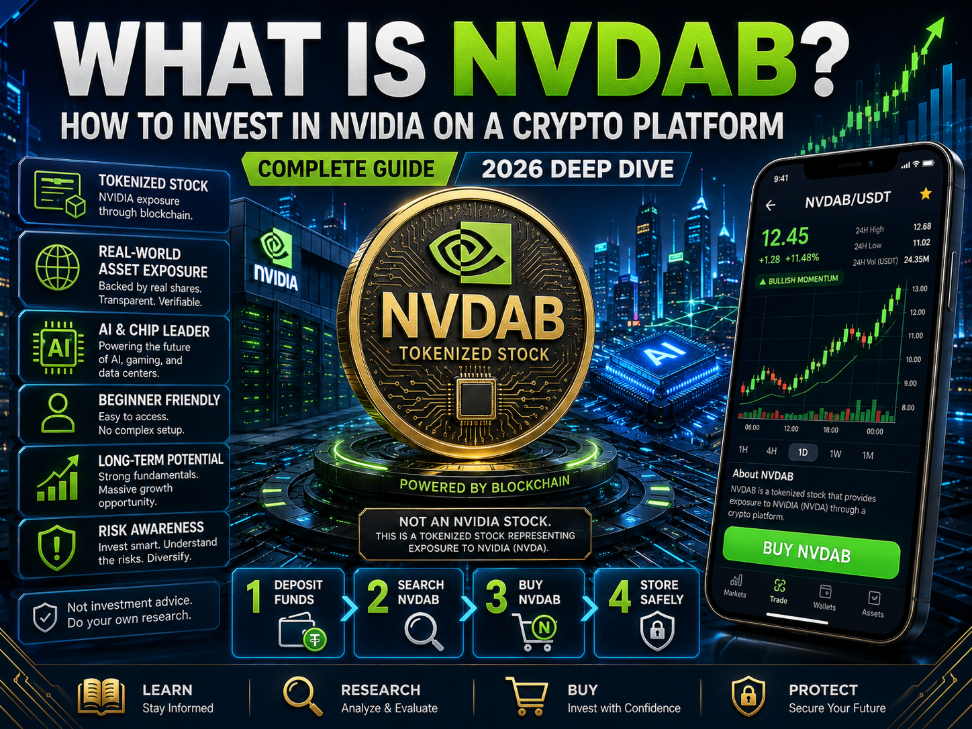
When most people see the ticker NVDAB for the first time, it's easy to mistake it for an AI-themed coin, a meme token, or some crypto project loosely associated with NVIDIA.
In reality, NVDAB's positioning is something else entirely.
NVDAB is one of the tokenized stock products in Binance's bStocks lineup, issued by BTech Holdings Limited, and officially launched alongside the bStocks product line on June 11, 2026. Its underlying asset is NVIDIA Corporation — the NASDAQ-listed company trading under the ticker NVDA.
Put simply, NVDAB isn't "a coin issued by NVIDIA," and it isn't "some AI project token." It's:
A tokenized securities receipt pegged to the price of NVDA stock.
What is bStocks?
bStocks is Binance's tokenized securities product line, designed to give eligible users access to traditional equity-market assets through a crypto platform.
The initial bStocks lineup includes:
- NVDAB: tracking NVIDIA stock
- TSLAB: tracking Tesla stock
- CRCLB: tracking Circle stock
- MUB: tracking certain US stock or ETF-type assets
- SNDKB: tracking SanDisk-related stock assets
NVDAB stands out within this lineup because its underlying asset is NVIDIA — currently the most closely watched AI chip leader globally. Compared to some tech companies still in early-stage narrative phases, NVIDIA already has exceptionally strong revenue, profitability, and pricing power within its industry.
How is NVDAB different from buying NVDA stock directly?
This is one of the most important questions in this entire article.
Buying NVDA stock directly means you hold the actual shares through a brokerage account, and in theory you carry standard shareholder rights.
Holding NVDAB, by contrast, gives you a financial instrument tied to NVDA's price — it does not make you a direct NVIDIA shareholder.
The key differences:
- Direct NVDA stock: you hold the actual underlying share
- NVDAB: you hold a tokenized securities receipt pegged to NVDA's price
- Direct shareholders may carry voting rights
- NVDAB holders typically do not carry voting rights
- Direct shareholders can have dividends processed through their broker
- NVDAB's treatment of dividends, splits, and rights offerings is typically adjusted by the issuer according to the product's own rules
- Direct stock ownership is governed by the regulatory jurisdiction of your brokerage account
- NVDAB is jointly constrained by the bStocks issuance jurisdiction, the trading platform, and the regulations applicable to your own region
So the most accurate way to think about NVDAB isn't "I bought NVIDIA stock." It's:
"I've obtained investment exposure correlated to NVIDIA's stock price performance through a tokenized securities product."
Is NVDAB a security or a cryptocurrency?
Although NVDAB is issued on-chain and can be traded and transferred like a crypto asset, its legal nature isn't that of an ordinary cryptocurrency.
It's closer to a securitized certificate — under the ADGM/FSRA framework, it's a certificate evidencing that the holder has a corresponding interest in a specific financial instrument.
This is the key distinction from typical tokens.
The value of an ordinary cryptocurrency usually derives from: its blockchain ecosystem, tokenomics model, user consensus, on-chain use cases, and market narrative.
NVDAB's core value source, by contrast, is: NVDA's stock price, NVIDIA's underlying business fundamentals, whether the issuer genuinely holds the backing asset, whether the custody and redemption mechanisms are stable, and whether the trading platform has sufficient liquidity.
In other words, NVDAB isn't priced on "crypto narrative" — it's heavily dependent on NVIDIA's actual real-world business performance.
Is the underlying asset behind NVDAB real stock, or a synthetic derivative?
Under the bStocks product mechanism, NVDAB's core selling point is 1:1 physical backing — meaning the issuer purchases and holds the corresponding real NVDA shares to back the on-chain issuance of NVDAB.
This differs from a purely synthetic derivative.
A purely synthetic product might simulate stock price exposure entirely through contracts, price-difference settlement, or an internal ledger, without necessarily corresponding to any real underlying stock. bStocks, by contrast, emphasizes real stock backing, mapped to the chain through a custody and issuance structure.
That said, this doesn't mean zero risk. Investors should still pay attention to:
- Whether the issuer continuously discloses proof of reserves
- Whether the custodied assets are independently segregated
- Whether the redemption mechanism is clearly defined
- Whether the regulatory framework remains stable
- Whether price deviations could occur during extreme market conditions
So NVDAB's essential nature can be summarized in one sentence:
NVDAB is a tokenized securities receipt backed by real NVDA stock and traded through a crypto platform — it is neither an ordinary token nor direct equity ownership.
II. What Kind of Company Is NVIDIA — What Is NVDAB's Underlying Asset Actually Worth?
Understanding NVDAB requires looking beyond the trading pair and the price chart, because its core long-term value isn't on-chain at all — it's rooted in NVIDIA the company.
NVIDIA was originally known to the broader public for graphics cards.
But today's NVIDIA is far more than "a company that sells GPUs." It has become a global AI infrastructure provider — the core hardware platform behind data centers, AI training, AI inference, autonomous driving, robotics, cloud computing, and high-performance computing.
Why is NVIDIA described as an AI infrastructure company?
Training and running AI models requires enormous compute power.
Large language models, image generation models, autonomous driving models, and robotics models all depend on high-performance GPUs, networking systems, software ecosystems, and data center solutions.
NVIDIA's advantage isn't just the chip itself — it's the entire ecosystem surrounding it: GPU chips, the CUDA software ecosystem, data center accelerator cards, high-speed networking, AI server reference designs, a developer ecosystem, and deep partnerships with cloud providers.
This means NVIDIA isn't simply selling hardware — it's effectively providing the "power grid" of the AI era.
If AI is a new industrial revolution, NVIDIA is supplying the infrastructure that revolution runs on.
What does NVIDIA's latest financial data tell us?
Based on publicly disclosed financials and market data, NVIDIA's full-year revenue for FY2026 reached approximately $215.9 billion, representing year-over-year growth of approximately 65%. Entering FY2027, first-quarter revenue reached approximately $81.6 billion, representing year-over-year growth of approximately 85%.
The most critical factor here is the data center business.
Data center revenue now accounts for nearly 87% of the total, which tells us NVIDIA's core growth driver is no longer traditional gaming GPUs — it's AI servers, cloud computing, enterprise computing, and hyperscale data centers.
These figures point to three things.
First, NVIDIA has transformed from a hardware-cycle stock into the leading AI infrastructure company. Graphics card companies used to be heavily influenced by gaming cycles and PC cycles. Today, NVIDIA's revenue core comes from cloud providers and enterprise-grade AI demand.
Second, demand remains exceptionally strong. Sustaining this kind of growth rate at this scale suggests AI chip demand has not yet peaked.
Third, future valuation pressure is also higher. Higher growth invites higher market expectations. If growth decelerates below expectations in any given quarter, the stock could see meaningful volatility.
Is NVIDIA's current stock price expensive?
As of June 2026, NVDA's stock price is around $208, with a market cap of approximately $5.13 trillion and a P/E ratio of approximately 31x.
Looking purely at absolute market cap, this is already one of the most valuable companies in the world. But when weighed against NVIDIA's revenue growth, margin profile, and market position, a 31x P/E isn't necessarily an extreme bubble valuation in the traditional sense.
The key point is that the market isn't pricing today's NVIDIA — it's pricing the expectation of continued AI infrastructure expansion over the next three to five years.
If AI data center investment keeps growing, a 31x P/E may still be defensible. If cloud provider capital expenditure slows, or AI application monetization underdelivers relative to expectations, the current valuation could start to look stretched.
So what NVDAB investors really need to assess is: can NVIDIA sustain high growth and high margins over the coming years?
What's the significance of Grace Blackwell and Vera Rubin?
NVIDIA's stock price doesn't just track current earnings — it also tracks product roadmap execution.
New-generation chips and platforms like Grace Blackwell and Vera Rubin are critical to NVIDIA maintaining its leadership position.
The significance of these product lines:
- Improving AI training efficiency
- Lowering energy consumption per unit of compute
- Enhancing overall data center performance
- Driving cloud providers to continuously upgrade their hardware
- Extending NVIDIA's leadership window in the AI chip market
If these products ramp successfully, NVIDIA's data center revenue could maintain its strong growth trajectory. If product delivery faces delays, supply chain constraints, or customers shift toward in-house chip development, NVIDIA's stock price could come under pressure.
Is NVIDIA's $20 billion corporate bond issuance good or bad news?
A corporate bond issuance on its own can't simply be categorized as bullish or bearish.
The positive side:
- The company can deploy low-cost capital to expand production capacity
- Strengthens supply chain positioning
- Supports R&D and infrastructure investment
- Optimizes the capital structure
- Preserves cash flexibility during a high-valuation period
The side that warrants caution:
- Rising debt levels increase financial costs
- If growth slows in the future, the market may re-examine leverage risk
- Large-scale financing could signal significant future capex pressure
For NVDAB holders, debt isn't a core risk factor, but it's a reminder that competing in AI infrastructure isn't a capital-light game — it requires continued, substantial investment going forward.
Why is Wall Street still bullish on NVIDIA?
Currently, most analysts maintain a strong buy rating on NVIDIA, with an average price target around $298 — representing meaningful upside from current levels.
Wall Street's core bullish thesis rests on a few points:
- AI chip demand continues to grow rapidly
- Data center revenue's share of the business keeps rising
- NVIDIA's gross and net margins remain strong
- The CUDA ecosystem forms a powerful competitive moat
- Cloud providers can't fully replace NVIDIA in the near term
- The next-generation chip roadmap continues to reinforce its lead
But investors need to understand that an analyst price target isn't a guarantee of returns — it's a forecast based on currently available information. When market conditions, earnings growth, regulatory policy, or the competitive landscape shift, those targets get revised too.
III. How Binance bStocks Actually Works — What's the Technical and Compliance Architecture Behind NVDAB?
For the average user, the most important question about NVDAB isn't "will it go up?" It's: Where does my money actually go? Where is the underlying asset held? If the platform or issuer runs into trouble, what protections do I have?
This is also the biggest structural difference between tokenized stock products and ordinary spot crypto tokens.
How is 1:1 physical backing actually implemented?
NVDAB's core mechanism is 1:1 physical backing. In plain terms:
- A user buys NVDAB on the platform
- The issuer, BTech Holdings Limited, holds the corresponding NVDA shares according to defined rules
- The underlying shares are held by a designated custodian
- NVDAB circulates on-chain as the corresponding rights certificate
- Users trade NVDAB on the platform and, indirectly, gain exposure to NVDA's price
The key to this structure isn't "whether a token exists on-chain" — it's whether real assets exist off-chain to back it.
So the points investors should focus on include: whether the issuer has a clearly defined legal entity, whether it operates under a clear regulatory framework, whether the underlying asset is independently custodied, whether there are periodic proof-of-reserve or audit disclosures, and whether a clear redemption mechanism exists.
What do ADGM and FSRA mean for investors?
ADGM is the Abu Dhabi Global Market, and FSRA is its financial services regulator.
bStocks products issued under this framework generally need to comply with specific requirements covering financial instruments, custody, disclosure, and compliance.
For the average user, the significance of this regulatory framework is:
- The product isn't issued in a completely unregulated environment
- The issuer must comply with certain regulatory rules
- The underlying assets and issuance structure are more subject to scrutiny
- The path to enforcing user rights is relatively clearer
- The platform can't simply treat a securities-type product the same way it treats an ordinary token
But this doesn't mean zero risk.
ADGM/FSRA regulation cannot substitute for investment judgment, and it doesn't guarantee principal protection. It can only improve the transparency and compliance of the product structure — it cannot guarantee NVDA's stock price will rise, and it cannot fully eliminate issuer risk.
What role does Nest Trading Limited play?
Within the bStocks framework, Nest Trading Limited acts as the brokerage entity, primarily handling functions related to underlying stock trading, exchange, settlement, and execution.
In simple terms:
- BTech Holdings Limited is responsible for the issuance structure
- Nest Trading Limited is responsible for underlying market execution
- The custodian is responsible for safekeeping the real stock assets
- The trading platform handles secondary market trading and user access
When a user needs to redeem tokenized securities for actual shares, or when a product undergoes redemption or liquidation, the brokerage entity participates in executing that process.
It's worth noting that redeeming for real shares typically doesn't happen as instantly as an on-chain transfer — the underlying process still involves traditional securities market trading hours, settlement cycles, and compliance review.
What does it mean that NVDAB is issued on BNB Chain?
NVDAB is issued on BNB Chain using the BEP-20 standard, meaning it can be transferred and held like any other on-chain asset.
The benefits for users include:
- Ability to withdraw from an exchange account to a compatible wallet
- Ability to self-custody using wallets like Trust Wallet
- Ability to enhance private key security using a hardware wallet
- Relatively fast on-chain transaction confirmation
- Assets don't necessarily need to remain on an exchange account long-term
But self-custody comes with additional requirements:
- A lost private key cannot be recovered
- An incorrect address can result in permanent loss of funds
- Users need to be able to identify fake tokens and phishing sites
- On-chain transfers require BNB for gas fees
- Beginners unfamiliar with on-chain operations are more prone to mistakes
So beginners don't necessarily need to rush to move NVDAB on-chain. A more cautious approach is to first get familiar with the product, your position, and the trading process before deciding whether to self-custody.
How are stock splits, rights offerings, and dividends handled for NVDAB?
If NVIDIA undergoes a stock split, rights offering, dividend, or other corporate action, NVDAB's product rules generally have the issuer automatically adjust the token in line with the underlying stock's changes.
For example:
- In a stock split, NVDAB's quantity and price ratio would typically be adjusted proportionally
- In a cash dividend, the issuer may reflect this in token holder entitlements according to the rules
- In a major corporate action, trading may be temporarily suspended or adjusted
- Holders generally don't need to take manual action, but should monitor platform announcements
This mechanism is an important distinction between tokenized stocks and ordinary cryptocurrencies. Ordinary tokens rarely involve traditional corporate actions, but because NVDAB tracks a publicly listed company's stock, it must follow rule changes from the traditional securities market.
Why are US users excluded?
US securities regulation is extremely strict, and tokenized stocks typically touch on multiple issues including securities issuance, trading, brokerage, custody, and investor suitability.
As a result, many tokenized securities products explicitly exclude US users to avoid triggering US securities law risk.
Users able to participate in NVDAB generally need to satisfy:
- Their region permits trading in the relevant product
- The platform supports services in their region
- KYC identity verification has been completed
- They meet investor suitability requirements
- They are not a user from a restricted country or region
Before actually participating, users should rely on the platform's latest announcements and their local laws as the authoritative reference.
If you want a comparative understanding of the broader bStocks product family, you can also reference a related product in the same series: TSLAB (tokenized Tesla stock). It uses the same type of compliance architecture and issuance mechanism as NVDAB, which is useful for understanding the entire product line.
IV. NVDAB vs. Other Ways to Access NVIDIA — Which Approach Fits Your Situation?
NVDAB isn't the only way to get exposure to NVIDIA.
The real comparison users need to make is between buying NVDA directly, buying an AI ETF, buying related concept tokens, and participating through NVDAB — and who each of these actually suits.
NVDAB vs. buying NVDA stock directly
Advantages of buying NVDA directly:
- You hold the actual share
- The rights structure is the clearest
- You can participate in the traditional brokerage ecosystem
- You can use mature tools like options and margin
- Maximum market depth and the tightest spreads
Disadvantages of buying NVDA directly:
- Requires opening an offshore brokerage account
- The funding process can be complex
- Not user-friendly for residents of certain countries and regions
- Can only be traded during standard US market trading hours
- Currency conversion may carry costs and restrictions
Advantages of NVDAB:
- Can be purchased directly with crypto assets like USDT
- Supports 24/7 trading
- Doesn't require a traditional US brokerage account
- Better suited for users who already hold funds on a crypto platform
- More convenient for non-US users to access leading US tech stocks
Disadvantages of NVDAB:
- Not direct equity ownership
- No NVIDIA shareholder voting rights
- Cannot directly participate in the NVDA options market
- Carries issuer and platform risk
- Less liquid than NVDA shares themselves
So if you already have a mature US brokerage account and place a higher priority on shareholder rights, options strategies, and maximum market depth, buying NVDA directly is the better fit. If most of your capital is on a crypto platform and you want to quickly gain exposure to NVIDIA's price movement using USDT, and you accept the structural risks of tokenized securities, NVDAB is more convenient.
NVDAB vs. AI ETFs
The advantage of an AI ETF is risk diversification.
Rather than concentrating on NVIDIA alone, it spreads exposure across chip companies, cloud computing companies, software companies, data center companies, robotics companies, and AI application companies simultaneously.
AI ETFs suit users who don't want to bet on NVIDIA exclusively.
But their drawbacks include: returns may be diluted across holdings, NVIDIA's weighting may not be high enough, ongoing management fees apply, and they can't precisely express a "bullish on NVIDIA specifically" view.
NVDAB, by contrast, is far more concentrated. If NVIDIA continues outperforming the broader market, NVDAB's elasticity to that outperformance is likely higher than a generic AI ETF. But if NVIDIA pulls back on its own, NVDAB will absorb that downside more directly as well.
NVDAB vs. AI-themed crypto tokens
Many AI-themed tokens in the crypto market derive their price primarily from market sentiment and narrative cycles.
They can offer high upside elasticity, but the risks are also considerably greater: opaque project fundamentals, small actual revenue, valuations driven by narrative rather than earnings, high sensitivity to market hype cycles, and volatility far exceeding that of equities.
NVDAB's underlying asset is NVIDIA — an extremely profitable, globally significant public company. Compared to most AI-themed tokens, its fundamentals are far clearer and more transparent.
But this also means NVDAB is unlikely to deliver the kind of explosive, multi-fold short-term gains that small-cap AI tokens sometimes do. It's better suited as a form of tech-stock exposure rather than a purely speculative instrument.
Where does NVDAB's liquidity come from?
NVDAB's liquidity comes from three primary layers.
Platform order book liquidity: users posting bid and ask orders on the NVDAB/USDT trading pair, forming the secondary market price.
Market maker liquidity: market makers provide bid/ask quotes for NVDAB based on NVDA's real share price, exchange rates, market demand, and inventory management.
Underlying stock arbitrage mechanism: if NVDAB's price diverges meaningfully from NVDA's actual share price, institutions can use redemption, creation, or hedging mechanisms to arbitrage the gap, gradually pulling the price back into alignment.
In practice, however, the spread can be affected by time of day: prices typically track NVDA more closely during US market trading hours; order book depth tends to be better during active crypto market hours; spreads may widen during late-night or quiet trading periods; and slippage can increase noticeably during extreme market conditions.
What are the costs of holding NVDAB?
Participating in NVDAB involves more than just trading fees.
Things you need to factor in include: spot trading fees, whether an initial zero-maker-fee promotion continues, taker execution costs, bid-ask spread, on-chain withdrawal fees, USDT deposit or currency conversion costs, slippage costs during extreme market conditions, and potential price tracking deviation costs.
Many beginners focus only on "how much is the fee," but what actually affects your returns is the combined total trading cost. If you trade frequently, bid-ask spread and slippage may matter more than the headline fee itself.
V. Step-by-Step: How to Buy NVDAB on HiBT — From Registration to Building a Position
If you've already understood NVDAB's nature, mechanism, and risks, and you've decided to give it a try, the next thing to figure out is the practical execution.
The following walkthrough uses HiBT as an example to demonstrate how to buy NVDAB.
What is HiBT?
HiBT is a digital asset trading platform. Per the platform's public disclosures, it is registered in Canada, holds relevant US and Canadian MSB compliance credentials, and is headquartered in Dubai. The platform supports spot, derivatives, and various digital asset trading, and emphasizes security measures including 90% cold wallet storage and a multi-signature security architecture.
For users looking to buy NVDAB, the key things to check when choosing a platform include: whether it lists an NVDAB/USDT trading pair, whether it supports your country or region, whether KYC is required, whether deposits and withdrawals run smoothly, whether order book depth is sufficient, and whether there's a clear risk control and announcement mechanism.
Step 1: Register an account and complete KYC
The typical process includes:
- Registering with an email or phone number
- Setting a login password
- Enabling two-factor authentication
- Submitting an ID card, passport, or other identity document
- Completing facial recognition or address verification
- Waiting for platform review
KYC processing time depends on the platform's processing speed and the completeness of the user's submitted information. In most cases, if the documents are clear and the information is consistent, the review process goes relatively smoothly.
New users should also check whether the platform offers welcome incentives, such as new-user task rewards, deposit bonuses, trading fee discounts, spot trading vouchers, derivatives trial vouchers, or specific campaign airdrops.
That said, don't let incentives distract you from the underlying risk. Rewards are just a bonus — what genuinely matters is whether you understand NVDAB itself.
Step 2: Deposit funds
Before buying NVDAB, you need to prepare your trading capital.
Common deposit methods include: USDT deposit, depositing BTC and converting to USDT, depositing ETH and converting to USDT, platform-supported fiat deposits, and third-party payment channels.
If your target trading pair is NVDAB/USDT, the most direct route is depositing USDT.
When depositing, be sure to: confirm the deposit network (e.g., TRC20, ERC20, BEP20), confirm the platform supports that network, send a small test amount before depositing a large sum, avoid sending assets from one chain to an address meant for another, and keep the transaction hash for reference.
The most common beginner mistake is selecting the wrong chain — for example, sending BEP20 USDT to an address that only supports ERC20, which can result in lost funds.
Step 3: Search for the NVDAB/USDT trading pair
After depositing, go to the spot trading page and search for NVDAB.
Once you find the NVDAB/USDT trading pair, enter the trading page. You'll see: the latest traded price, best bid/ask prices, the price chart, order book depth, trade history, and the option to choose between market and limit orders.
Step 4: Choose between a market order and a limit order
Market orders suit:
- Wanting fast execution
- Smaller trade sizes
- Fast-moving markets
- Not wanting to wait for an order to fill
The downside of market orders is potential slippage — especially when depth is thin, your actual execution price could differ noticeably from the displayed price.
Limit orders suit:
- Wanting to control your entry price
- Not in a rush to execute
- Larger trade sizes
- Wanting to build a position gradually
For beginners, limit orders are generally the more advisable choice — especially while NVDAB's liquidity is still maturing.
Step 5: How should you set stop-loss and take-profit levels after entering a position?
Buying is just the first step — position management is what actually matters.
Beginners should follow a few principles: limit any single trade's potential loss to 5–10% of your total position, don't go all-in on a single entry, build and exit positions in tranches, avoid blindly adding leverage around earnings releases, and don't let a short-term trade quietly turn into an unintentional long-term bag-hold.
For stop-loss reference points, consider: 8–12% below your entry price, below a key support level, a quick exit point if earnings disappoint, and the maximum loss your overall account can tolerate.
For take-profit reference points, consider: a first target around 15–20% gain, a second target near the analyst price target range, and a third target of taking partial profits after a major positive catalyst plays out.
Don't aim to sell exactly at the top. For a new product category like tokenized stocks, where liquidity and volatility can both amplify emotional decision-making, scaling in and out in tranches is more robust than going all-in at a single point.
Step 6: Continuously track NVIDIA's fundamental events
Once you hold NVDAB, you can't just watch the price on the crypto platform.
You should be tracking NVIDIA's key events more closely, including: NVIDIA's quarterly earnings releases, the next earnings window — roughly in August 2026, CEO Jensen Huang's public appearances, the GTC conference and product announcements, Grace Blackwell shipment progress, Vera Rubin product line developments, data center revenue growth, changes in China market restrictions, major cloud providers' capital expenditure plans, and ADGM custody or proof-of-reserve disclosures.
NVDAB's price ultimately comes back to NVDA's fundamentals. If you're only watching crypto market sentiment, you can easily misjudge the underlying direction.
VI. NVDAB's Price Logic and Key Drivers — When Does It Rise, and When Does It Fall?
NVDAB's price logic can be summarized in one sentence:
NVDAB's core price driver is NVDA stock — not general crypto market sentiment.
Of course, crypto market liquidity also affects NVDAB's trading volume and spread, but its long-term direction is determined by NVIDIA's fundamentals.
1) NVDA's stock price is the core anchor
In theory, NVDAB tracks NVDA's stock price through oracles, market makers, and arbitrage mechanisms.
So assessing NVDAB's trajectory means focusing not on on-chain active addresses or crypto KOL calls, but on: NVIDIA's revenue growth rate, data center business performance, margin trends, new chip delivery status, cloud provider order demand, competitor progress, regulatory restrictions, and the overall valuation of US tech stocks.
If NVDA's stock rises, NVDAB typically rises alongside it. If NVDA undergoes a significant pullback, NVDAB is unlikely to remain independently strong.
2) Data center and AI chip demand is the biggest variable
NVIDIA's most important business today is its data center segment.
Data center revenue primarily comes from Microsoft, Google, Amazon, Meta, Oracle, AI cloud service providers, and enterprise-grade AI customers.
Expanding capital expenditure from these customers directly drives NVIDIA's revenue growth.
If cloud providers continue ramping up AI infrastructure investment, NVIDIA's order book should remain strong. If cloud providers start cutting capital expenditure, or if AI application monetization underdelivers relative to expectations, the market will start worrying about chip demand having peaked.
3) China market restrictions are a long-term suppressing factor
The China market was historically an important component of NVIDIA's data center business.
But due to US export controls, sales of NVIDIA's high-end AI chips to the China market have been restricted. The company has also explicitly indicated in its FY2027 Q1 outlook that China data center revenue is not included in its forecast.
For investors, this means: near-term revenue may lose a portion of what would otherwise be a growth contributor, domestic chip substitution within China may accelerate, policy uncertainty will continue weighing on valuation over time, and if restrictions are eased in the future, that could form an additional upside catalyst.
So the China market shouldn't be viewed as simply bearish — it's a long-term, ongoing uncertainty variable.
4) Can competitors challenge NVIDIA in the near term?
NVIDIA's main competition comes from three directions: AMD, Intel, and cloud providers developing their own in-house chips.
AMD continues to close the gap in AI accelerator cards, and Intel is attempting to re-establish itself in the high-performance computing market. Meanwhile, cloud providers like Microsoft, Google, and Amazon are advancing in-house chip development to reduce their dependence on NVIDIA.
In the near term, however, NVIDIA's advantages remain clear: a deep CUDA ecosystem moat, high software migration costs, deeply entrenched developer habits, high switching costs for data center customers, fast product iteration cycles, and strong supply chain coordination capability.
Competition will compress NVIDIA's valuation premium over time, but fully dislodging its market position in the near term is far from straightforward.
5) How does crypto market liquidity affect NVDAB?
Although NVDAB's long-term anchor is NVDA, it still trades on a crypto platform, so it's also affected by crypto market liquidity conditions.
When BTC and major crypto assets rally: user risk appetite increases, USDT liquidity strengthens, bStocks trading volume rises, bid-ask spreads may narrow, and NVDAB more easily trades at a premium.
When BTC drops sharply: users tend to de-risk and reduce positions, platform liquidity contracts, market makers quote more cautiously, bid-ask spreads may widen, and NVDAB may experience a temporary discount.
So NVDAB investors need to watch two markets simultaneously: the US equity market, which determines the core direction, and the crypto market, which influences trading liquidity and short-term price deviation.
If you're also tracking SPCXB (tokenized SpaceX stock) — another asset in the tech and high-growth category — you can use this same framework for a side-by-side comparison. Both represent forward-looking tech narratives, but NVIDIA is already highly profitable, while SpaceX remains in a heavy capital-investment phase, giving the two completely different risk-reward profiles.
VII. Five Risks Every NVDAB Holder Must Confront — Not Meant to Scare You, Meant to Help You Avoid the Pitfalls
NVDAB's opportunity is clear, but its risks need to be just as clearly stated.
Any investment-related content that only writes about the upside case while leaving out the risks is irresponsible — and this is especially true for a new product category like tokenized stocks. Investors should understand the risks first, then decide whether to participate.
Risk 1: Valuation risk
NVDA's current P/E is approximately 31x, and the stock has already delivered substantial gains over the past year. While this valuation isn't necessarily unreasonable relative to its growth rate, the market has already priced in significant expectations of continued AI-driven high growth.
If any of the following materialize, the stock could be repriced lower: data center revenue growth decelerates, cloud providers cut capital expenditure, new chip deliveries underdeliver relative to expectations, gross margins decline, AI application monetization underperforms expectations, or US tech stock valuations broadly compress.
Because NVDAB tracks NVDA, it would absorb the same valuation correction risk.
Risk 2: The receipt-not-equity structural risk
This is the most important structural risk specific to NVDAB.
What you hold is a financial instrument certificate — not NVIDIA stock itself.
This means: you are not a direct NVIDIA shareholder, you typically have no voting rights, your rights depend on the issuer's rules being honored, your recourse path differs from that of a direct shareholder, and you take on issuer and custody structure risk.
If BTech Holdings Limited were to experience a liquidity crisis, custody problems, or compliance issues, the resolution path for NVDAB holders would be considerably more complex than for direct shareholders.
Risk 3: Platform and regulatory risk
NVDAB straddles both securities and crypto asset domains, so its regulatory risk is more complex than that of an ordinary spot token.
Potential risks include: a country suddenly restricting tokenized securities trading, the platform adjusting its serviceable regions, policy changes in a user's home jurisdiction, regulators requiring the platform to suspend trading, product rules being forced to change, or cross-border redemption processes being disrupted.
Major markets in particular — the United States, mainland China, and others — don't have a fully consistent regulatory stance on this type of product. Users must confirm whether trading is permitted in their own region before participating.
Risk 4: Price tracking deviation risk
In theory, NVDAB should track NVDA's price closely. But during extreme market conditions, temporary deviations can occur.
For example: a fast crash in US equities, sharp volatility following an NVDA earnings release, oracle price feed delays, insufficient crypto platform liquidity, market makers pulling their quotes, or large orders impacting the order book.
Under these conditions, you might find NVDAB's traded price briefly diverging from NVDA's actual share price. If you execute a large market order during such a window, you could end up filling at an unfavorable price.
Risk 5: Liquidity risk
NVDA is one of the most actively traded stocks in the world, with extremely deep market liquidity.
NVDAB, by contrast, is a newly launched tokenized securities product with far less market depth than NVDA's actual shares.
This means: large buy orders may push up the execution price, large sell orders may cause slippage, spreads may widen during quiet trading periods, exiting quickly may be difficult during extreme conditions, and changes in market maker liquidity can directly affect your trading experience.
For these reasons, beginners shouldn't participate with oversized positions, and definitely shouldn't use market orders during periods of thin liquidity.
Is now a good time to participate in NVDAB?
There's no universal answer to this question.
If you believe NVIDIA will remain a core AI infrastructure company over the long term, and you've genuinely understood the tokenized securities structure, NVDAB can serve as a more convenient way to participate.
Users who are generally well-suited to consider NVDAB typically share these traits: already holding crypto assets like USDT, not having easy access to a US brokerage account, wanting exposure to NVIDIA's price movement, being able to accept the absence of shareholder voting rights, being able to understand issuer and platform risk, being willing to test the product with a smaller position, and not chasing short-term get-rich-quick outcomes.
Users who are generally not well-suited to participate in NVDAB include: those with no understanding of NVIDIA's fundamentals at all, those chasing price purely because of AI hype, those who can't tolerate 20%+ volatility, those who don't understand the tokenized securities structure, those who want genuine shareholder rights, those planning to go all-in for short-term speculation, and those in a region where trading this type of product isn't permitted.
A more prudent approach is to start with a small position to observe liquidity, spreads, and tracking deviation, then gradually adjust your position size based on NVIDIA's earnings, industry trends, and your own risk tolerance.
FAQ: Common Questions About NVDAB
1. Is NVDAB issued officially by NVIDIA?
No. NVDAB is not a stock or token issued officially by NVIDIA. It's a bStocks tokenized securities product issued by BTech Holdings Limited, with its underlying exposure tracking NVDA's stock price.
2. Does buying NVDAB mean I've bought NVIDIA stock?
No. Buying NVDAB gets you a tokenized securities receipt pegged to NVDA's stock price — it does not mean you directly hold NVIDIA stock itself.
3. Does holding NVDAB come with voting rights?
Generally, no. NVDAB holders are not equivalent to NVIDIA common shareholders, and therefore don't carry the traditional shareholder voting rights that come with direct stock ownership.
4. Will NVDAB always exactly match NVDA's stock price?
In theory, it will closely track NVDA. But during extreme market conditions, periods of low liquidity, or oracle delays, temporary premiums or discounts can occur.
5. Can NVDAB be traded 24/7?
Yes — this is one of NVDAB's major advantages compared to traditional US equity trading. Users can trade NVDAB on crypto platforms through pairs like NVDAB/USDT without being restricted to standard US market trading hours.
6. Is NVDAB suitable for long-term holding?
This depends on whether you're a long-term believer in NVIDIA's fundamentals, and whether you're comfortable with the structural risks of tokenized securities. If your goal is to hold NVIDIA long-term while obtaining full shareholder rights, a traditional US brokerage account may be the better fit.
7. What's NVDAB's biggest risk?
The biggest risks fall into three categories: the risk of NVDA's stock price declining, the structural risk of holding a receipt rather than equity, and platform and regulatory risk. It is not a risk-free yield product, and it is not a stablecoin.
8. How should beginners approach buying NVDAB?
Beginners are better served by starting with a small position, building it in tranches, using limit orders, and setting a stop-loss in advance. Going in heavy or using high leverage on a first trade is not advisable.
9. What's the difference between NVDAB and AI-themed crypto tokens?
AI-themed tokens derive their price largely from crypto market narrative, whereas NVDAB's underlying asset is NVIDIA stock — its core price logic comes from NVIDIA's actual business performance and US equity market valuation.
10. Can US users trade NVDAB?
Generally, no. Due to US securities regulatory restrictions, tokenized securities products typically explicitly exclude US users. The actual rules should be confirmed against the platform's announcements and applicable local law.
About the Author
Author: HiBT Research
This article was compiled by the HiBT Research team based on the mechanics of tokenized securities products, NVIDIA's company fundamentals, AI chip industry trends, and crypto market liquidity structure, with the goal of helping users understand NVDAB's product characteristics, participation methods, and potential risks.
Disclaimer
This article is for informational and educational purposes only. It does not constitute investment advice, financial advice, legal advice, or tax advice.
NVDAB is a tokenized securities product. Its value is correlated with the price of the underlying NVDA stock, while also being affected by issuer risk, custodian risk, trading platform risk, regulatory policy, market liquidity, and on-chain technical risk. Both tokenized securities and crypto assets carry significant volatility and may result in loss of principal — in extreme scenarios, asset value could decline sharply or even fall to zero.
Before participating, investors should fully understand the product's rules, confirm whether trading this type of product is permitted in their country or region, and make independent decisions based on their own risk tolerance.