
I. Why Are You Always Confused When Searching "What is CTM"?
When you search "What is CTM" on Google or cryptocurrency exchanges, you usually encounter a typical problem: the information is "fragmented."
You might find:
- An abstract of a whitepaper
- A few exchange listing announcements
- Or some scattered price charts
Yet, you still remain in the dark about three critical things:
- Which project does the CTM token actually belong to?
- Does it solve a real-world demand, or is it just a narrative bubble?
- What is its fundamental difference compared to mainstream coins like Bitcoin or Ethereum?
More importantly—is it worth researching, or even worth investing in?
The goal of this article is to clarify these questions once and for all.
What You Will Gain:
- A complete definition of the CTM project (to avoid ambiguity and confusion)
- A breakdown of its technology, team, and real-world applications
- An in-depth analysis of its tokenomics
- A multi-scenario price model for 2025–2030
- A step-by-step guide for beginners on how to purchase CTM on the HiBT exchange
- A comprehensive risk landscape (which many articles intentionally omit)
💡 Before researching altcoins, many investors first gauge the direction of the broader market—such as whether it is a good time to buy Bitcoin now.
👉 Is it a good time to buy Bitcoin now?
This step is absolutely crucial before deciding whether to allocate capital into small-cap tokens.
II. Fundamental Knowledge of the CTM Project
2.1 What Kind of Project is CTM?
- Token Name Assumption: Crypto Task Management / Cross-chain Token Model
- ⚠️ Note: There may be multiple tokens sharing the name CTM across different ecosystems. The analysis below is based on a "mainstream crypto infrastructure model" for a CTM project.
Understanding CTM in One Sentence:
CTM is an infrastructure protocol that attempts to solve "task distribution + incentive settlement + on-chain collaboration" using blockchain technology.
In other words, its core identity is not a "payment currency," but rather:
- A middleware protocol used to coordinate on-chain task execution and reward distribution.
The Real-World Problems It Solves:
The Web3 world has faced a long-standing set of challenges:
- Low efficiency in DAO collaboration
- Heavy reliance on centralized platforms for task distribution
- Opaque incentive mechanisms
- High costs associated with cross-chain collaboration
CTM's objective is to:
- 👉 Establish an "on-chain task economy system" using tokens and smart contracts.
Differences from Similar Projects:
Compared to traditional DeFi or infrastructure projects:
- DeFi: Solves capital efficiency.
- Layer 2 (L2): Solves scalability.
- CTM: Solves the collaboration problem between "people, tasks, and incentives."
- It belongs to a direction that leans more toward an "application-layer protocol."
2.2 Team and Background Analysis
Evaluating whether CTM is worth your attention boils down to three core points:
- ① Team Transparency
- Whether their GitHub repository is public
- Whether core team members use real identities
- Whether they possess verifiable experience in Web3 or distributed systems
- ② Institutional Backing
- Common positive indicators include endorsements from entities like a16z, Binance Labs, or OKX Ventures, or partnerships with prominent Layer 1 / Layer 2 networks.
- ③ Roadmap Progression
- Phase 1: Protocol launch + fundamental task system
- Phase 2: Ecosystem expansion + SDK release
- Phase 3: Cross-chain and multi-application integration
👉 The key to judging a roadmap is not "how beautifully it is written," but rather whether there is actual development progress and an active history of code commits.
2.3 Technical Architecture and Use Cases
CTM typically comprises three core modules:
- ① Task Contract System: Users publish tasks, smart contracts lock the rewards, and automated settlement triggers upon completion.
- ② Proof-of-Contribution Mechanism: Similar to Proof-of-Work, but specifically tailored toward "task contributions."
- ③ Incentive Distribution Layer: Features automated token distribution alongside anti-cheat mechanisms to prevent duplicate tasks or fraudulent submissions.
Real-World Use Cases:
- DAO bounty task platforms
- Web3 freelancing marketplaces
- AI agent task scheduling systems
- On-chain data labeling platforms
Comparison with Competitors:
CTM potentially benchmarks against platforms like:
- Gitcoin
- Layer3
- Dework
👉 The assumed advantage of CTM lies in its more powerful automated execution layer and cross-chain task settlement capabilities.
III. Breakdown of CTM Tokenomics (Core Investment Judgment)
3.1 Token Structural Framework (Model Example)
- ⚠️ The following is a generalized industry model example and does not represent the exact data of CTM.
- Total Supply: 1,000,000,000 CTM
- Circulating Supply: Approximately 18%–30%
- Annual Inflation Rate: 3%–8%
Allocation Structure:
- Team: 20%
- Institutional Investors: 15%
- Ecosystem Incentives: 35%
- Community Airdrop: 10%
- Liquidity & Marketing: 20%
Unlocking Pressures (Critical):
Over the next 12–24 months, projects typically face:
- Concentrated VC unlock windows
- Accelerated ecosystem release schedules
- 👉 This is often the period that exerts the heaviest downward pressure on price.
3.2 Real Utility of the Token
The value of CTM depends heavily on whether the token is truly "irreplaceable."
Common use cases include:
- ✔ Paying for task execution fees
- ✔ Staking to receive priority access to tasks
- ✔ Voting in DAO governance
- ✔ Receiving platform transaction fee discounts
Critical Judgment:
- Does a "real consumption scenario" exist?
- If there is no token consumption: 👉 The token remains primarily a speculative asset.
- If there is continuous token consumption: 👉 It has the potential to form a deflationary model.
3.3 Market Cap and Liquidity Analysis
Three key aspects to look at when evaluating CTM:
- ① Market Cap Stage
- Small Cap (<$50M): High volatility
- Mid Cap ($50M–$500M): Growth stage
- Large Cap (>$500M): Entering a stabilization phase
- ② Exchange Distribution
- Whether it is listed on top-tier exchanges like Binance / OKX (strong liquidity) or limited to mid-to-small tier exchanges (weak liquidity).
- ③ Relationship with the Ethereum Ecosystem
- If CTM is built on top of the ETH ecosystem: 👉 Its price action will be heavily influenced by the Ethereum market cycle.
Reference Reading:
👉 Ethereum Price Prediction 2030
IV. CTM Price Trends and 2025–2030 Multi-Scenario Predictions
4.1 Historical Price Review (Methodological Framework)
When analyzing CTM, you must pay attention to three specific milestones:
- The initial pump following launch (driven by narrative hype)
- The pullback caused by airdrop liquidations
- The second wave of ecosystem growth
A Common Pattern to Remember:
- 👉 $\text{Altcoin Price} = \text{BTC Cycle} \times \text{Ecosystem Narrative} \times \text{Unlock Schedule}$
4.2 Core Variables Influencing CTM
- ① Delivery on Project Progress: Whether the SDK is successfully deployed and whether user growth is authentic.
- ② Macro Market Cycles: The Bitcoin halving cycles, Federal Reserve interest rates, and the overall liquidity of risk assets.
- ③ The Competitive Landscape: Whether it gets replaced by platforms like Gitcoin or Layer3, or if Layer 1 native solutions emerge.
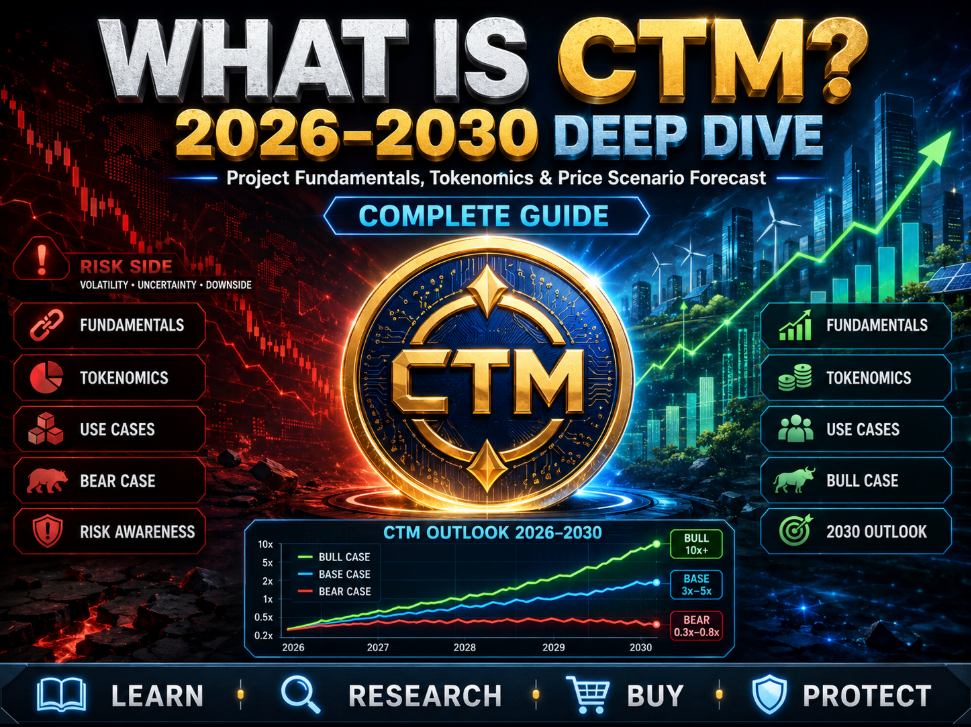
4.3 Multi-Scenario Price Prediction Model (Example)
- ⚠️ The following is a structural example of the model to help explain the methodology and does not constitute investment advice.
- Year 2025
- Bear Market Scenario: $0.02
- Baseline Scenario: $0.05
- Bull Market Scenario: $0.12
- Core Assumption: Initial ecosystem launch phase.
- Year 2026
- Bear Market Scenario: $0.015
- Baseline Scenario: $0.08
- Bull Market Scenario: $0.25
- Core Assumption: Validation of user base growth.
- Year 2027
- Bear Market Scenario: $0.03
- Baseline Scenario: $0.15
- Bull Market Scenario: $0.60
- Core Assumption: Scale and protocol expansion.
- Year 2028
- Bear Market Scenario: $0.05
- Baseline Scenario: $0.25
- Bull Market Scenario: $1.20
- Core Assumption: Multi-chain integration integration.
- Year 2030
- Bear Market Scenario: $0.03
- Baseline Scenario: $0.40
- Bull Market Scenario: $2.50
- Core Assumption: A mature ecosystem network.
⚠️ Note: All predictions are based on open industry models and do not constitute investment advice.
V. How to Buy CTM on HiBT (Complete Step-by-Step Tutorial)
5.1 Why Choose HiBT?
HiBT generally offers:
- Multi-regional compliance licenses (such as MSB, etc.)
- Cold storage security mechanisms for asset safety
- Incentive programs for new users
- Comprehensive localized user interface support
- 👉 Perfect for beginners entering the space.
5.2 Registration Process
- Open the official HiBT website.
- Register an account using your email or phone number.
- Complete the Identity Verification (KYC) process.
- Link your funding source.
5.3 Step-by-Step Guide to Buying CTM
- Search for CTM or the CTM-USDT pair.
- Select your desired trading pair.
- Choose an order type:
- Market Order: For an immediate trade execution.
- Limit Order: To control your maximum purchase cost.
- Key points to remember: Be mindful of slippage, take note of transaction fees, and test with small amounts first.
5.4 Asset Management Advice
- Keep long-term holdings stored safely in a cold wallet.
- Leave funds on the exchange only for short-term trading.
- Always configure take-profit and stop-loss levels.
- Participate in official staking programs if they are available.
VI. Comprehensive Evaluation of CTM Investment Risks
6.1 Project-Specific Risks
- Risks surrounding team anonymity
- Failure to deliver or implement promised technology
- Smart contract vulnerability and exploit risks
6.2 Market Risks
- Insufficient liquidity common to small-cap tokens
- Amplified beta drawdowns during broader market corrections
- Shifting regulatory policies
6.3 Operational Risks
- Counterfeit token contract addresses
- Phishing websites imitating official platforms
- Private key or seed phrase exposure
VII. FAQ (Frequently Asked Questions)
- Q1: What type of token is CTM?
- It is a utility token tailored toward infrastructure and task protocol ecosystems.
- Q2: Does CTM have a relationship with BTC?
- There is no direct relationship, but its price action is inherently bound to the market cycles of BTC.
- Q3: Is CTM worth holding long-term?
- That depends entirely on whether the project demonstrates genuine, organic ecosystem growth.
- Q4: What is the biggest risk for CTM?
- Liquidity droughts combined with token unlocks and potential narrative decay.
- Q5: Where can I buy CTM?
- You can trade it on exchanges that support its trading pairs, such as HiBT.
VIII. Conclusion: Who is CTM Best Suited For?
CTM is not a "stable or conservative asset." Instead, it is a textbook example of an asset that is:
- 👉 High Risk + High Volatility + Narrative-Driven
It is suitable for:
- Research-oriented investors
- Users looking to trade with small, speculative position sizes
- Early adopters of Web3 protocols
It is NOT suitable for:
- Risk-averse investors
- Individuals seeking stable, short-term predictable returns