
If you have recently seen OPN Coin on an exchange, market data website, or in a crypto community, your first reaction was likely: What exactly is this coin? Is it an AI project? A prediction market? Or just another token chasing trends?
The answer is: The OPN discussed in this article refers to Opinion (OPN), a blockchain token launched by Opinion Labs. It serves an AI-driven on-chain prediction trading platform called Opinion.Trade.
Simply put, the sector OPN operates in is Prediction Markets + AI Oracles + InfoFi (Information Finance). Its goal is to turn "your judgments about future events" into tradable on-chain assets.
For example:
- Will the Federal Reserve cut interest rates?
- Will the US CPI be higher than expected?
- Can Bitcoin break a specific price by the end of the month?
- Will a specific macroeconomic event occur?
- Who will win the World Cup?
- Will a certain policy be implemented by a specified time?
In the past, if ordinary people wanted to express these judgments, the most they could do was post, comment, or share on social media. However, Opinion wants to turn these judgments into financial assets that can be wagered on, traded, and settled.
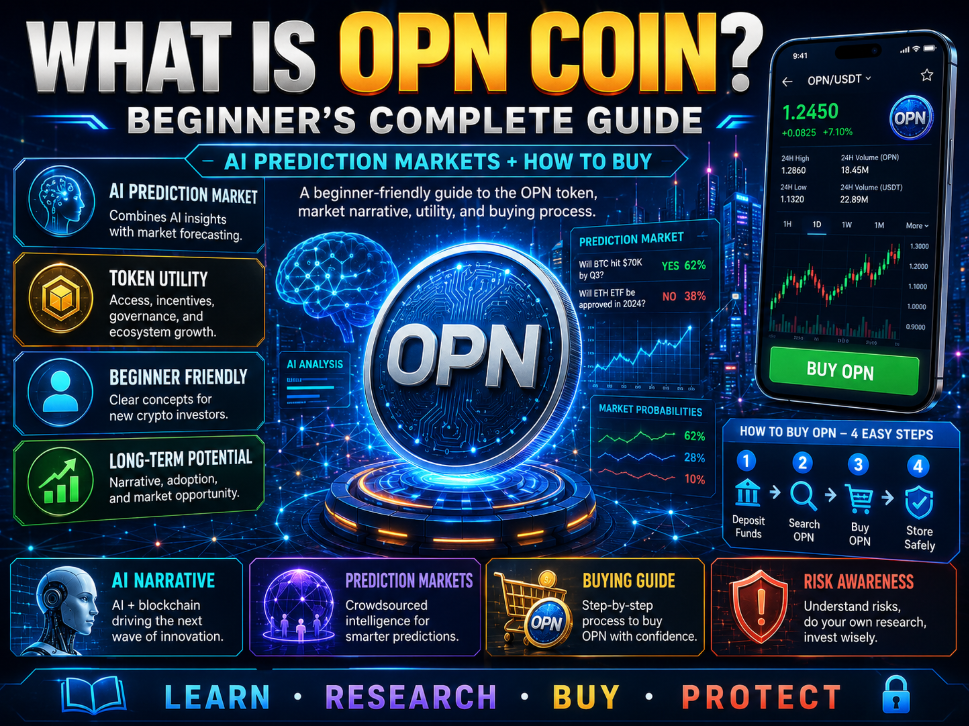
This is the core logic behind OPN.
However, OPN is not a risk-free "AI concept coin." It involves prediction markets, AI Oracles, tokenomics, Launchpool unlock mechanics, regulatory restrictions, platform usage risks, and secondary market volatility. For a beginner, before buying, you must understand: what exactly are you buying, where does its value come from, and what are the hidden pitfalls?
This article will comprehensively explain:
- Which project is OPN exactly?
- Why are there multiple OPNs in the market, and how can you avoid buying the wrong one?
- What are prediction markets and InfoFi?
- What are the characteristics of the Opinion Stack technical architecture?
- How does the OPN tokenomics model work?
- What does the backing from institutional funding and Binance Launchpool mean?
- How do you buy OPN on HiBT?
- What risks must you understand before buying OPN?
- How does OPN differ from Polymarket, Kalshi, and Augur?
I. Which "OPN" Did You Find? Clarify These Three Identical Tickers
1. The Protagonist of This Article: Opinion (OPN)
The OPN analyzed in this article is Opinion (OPN).
Developed by Opinion Labs, it serves the AI-driven on-chain prediction trading platform Opinion.Trade. The project's core directions are prediction markets, macroeconomic event trading, AI oracles, and InfoFi.
Simple understanding: Opinion (OPN) = a crypto project built around prediction markets and information trading.
It is not a payment coin, a meme coin, or a standard Layer 1 public chain token. Instead, it is a utility token serving an on-chain prediction market ecosystem.
2. What is Open Source Network (OPN)?
There is another easily confused OPN in the market called Open Source Network (OPN).
This is not the Opinion we are discussing. Open Source Network is a different crypto project that has appeared on some market websites and has no direct relationship with Opinion.
The most common mistake beginners make is only looking at the ticker "OPN" without checking the full project name, contract address, and blockchain.
3. What is OPEN Ticketing Ecosystem (OPN)?
Another confusing project is the OPEN Ticketing Ecosystem (OPN).
This project focuses on ticketing, event passes, and on-chain ticket verification. Its token also uses the OPN ticker, making it very easy to mix up with Opinion on search engines, market platforms, or when importing to a wallet. Ticketing ecosystems and prediction markets are entirely different tracks.
Remember: The same ticker does not mean the same project.
4. How to Identify the Correct OPN via Contract Address and Chain
The first step to identifying OPN is not looking at the logo or community screenshots, but the contract address.
For Opinion (OPN), mainstream market platforms show its contract address as:
0x7977bf3e7e0c954d12cdca3e013adaf57e0b06e0
Before buying, cross-verify through reliable channels such as CoinGecko, CoinMarketCap, Binance announcements, Opinion's official documentation, or block explorers (Etherscan/BscScan). Never trust screenshots in Telegram groups or "contract addresses sent privately by customer service."
5. Confirming You Are Buying the Right OPN on Exchanges (e.g., HiBT, Binance)
When searching for OPN on a centralized exchange, confirm the following:
- Full Name: It should display Opinion or Opinion Labs.
- Trading Pair: Typically OPN/USDT.
- Announcements: Look for an official listing announcement for OPN.
- Price and Circulation: Compare it with CoinGecko or CoinMarketCap to avoid buying an asset with completely abnormal pricing.
- Deposit/Withdrawal Network: Ensure the network and contract address match the official ones.
II. What Real-World Problems Does OPN Solve?
1. Proxy Trading vs. Direct Event Trading
Traditionally, if you wanted to bet on a macroeconomic event (like the Fed cutting interest rates), you would have to make a "proxy trade." You might buy gold, Bitcoin, or tech stocks, assuming they would benefit. However, you are introducing variables. The Fed might cut rates, but gold might not rise. You could be right about the macro event but lose money because you bought the wrong proxy asset.
2. Direct Trading on Event Outcomes
Opinion allows you to bypass proxy assets and directly trade the outcome of the event itself. Markets can be created for questions like "Will the Fed cut rates in June?" or "Will the next CPI be below 3%?". You trade the result directly. This turns information and judgment into a financial price. If the market believes an event has a 70% chance of happening, the share price will hover around $0.70.
3. What Does a $0 to $1 Contract Price Mean?
The most common mechanism in prediction markets is Yes/No shares.
- $0.10: The market believes there is roughly a 10% probability.
- $0.50: The market believes there is roughly a 50% probability.
- $0.80: The market believes there is roughly an 80% probability.
- Upon expiration, if the event occurs, the correct side settles at $1, and the incorrect side goes to $0.
4. How is This Different from a Lottery?
- Market-driven odds: Odds are formed by buyers and sellers, not fixed by a platform.
- Research matters: Understanding macro data, policies, or on-chain metrics gives you a competitive edge.
- Early exit: You can sell your shares before the result is finalized.
- Information value: Market prices reflect collective intelligence and probabilities.
- Hedging tool: Enterprises and traders can use it to hedge against macroeconomic risks.
5. What is InfoFi?
InfoFi stands for Information Finance. Just as DeFi brings financial services on-chain, InfoFi turns information, viewpoints, predictions, and judgments into tradable assets. In the traditional internet, your opinion is just content (posts, likes, comments). In InfoFi, your opinion becomes a financial position.
III. Opinion Stack Technical Architecture
1. What is the Opinion Stack?
The Opinion Stack is the core on-chain infrastructure for building prediction markets, consisting of four layers.
2. Opinion.Trade: The Prediction Exchange
This is the front-end market layer where users participate in trading. You can view various prediction markets (macro data, sports, politics), check Yes/No prices, trading volumes, and settlement times.
3. Opinion AI: The AI Oracle
The most critical issue in a prediction market is who decides the outcome. Opinion AI uses a multi-agent AI system to understand, verify, and rule on event outcomes, moving beyond simply feeding off-chain data (like traditional oracles) to handling complex, ambiguous real-world resolutions and dispute mechanisms.
4. Opinion Metapool: Unified Liquidity Pool
A major issue with prediction markets is fragmented liquidity. Opinion Metapool aims to improve capital efficiency across different prediction markets through a unified liquidity design, ensuring markets have baseline trading depth and reducing slippage.
5. Opinion Protocol: Interoperable Token Protocol
This standardizes prediction shares into on-chain assets, allowing them to circulate, combine, and integrate with other DeFi protocols (wallets, DEXs, lending platforms) rather than just remaining as internal platform points.
6. The Importance of Dynamic Fees
Opinion utilizes dynamic fees: when an event's probability is near 50% (maximum uncertainty and divergence), fees might be higher to capture trading value. When probabilities approach 0% or 100%, fees lower to help users adjust positions or exit.
7. Geographic Restrictions
According to official terms, the platform restricts users from the US, Mainland China, Hong Kong, Taiwan, and several EU/EEA regions. Note: Buying the OPN token on a secondary market and legally using the Opinion.Trade platform are two different things.
IV. OPN Tokenomics: Where is the Value?
1. Core Utilities of OPN
- Payment: Paying for advanced data services and AI Oracle queries.
- Discounts & VIP Perks: Frequent traders can hold OPN for lower fees, higher limits, or premium features.
- Governance: Voting on protocol parameters, fee models, oracle oversight, and market rules.
- If the platform fails to grow its user base, governance value alone will struggle to support the price long-term.
2. Total Supply and Distribution
The maximum supply is 1 billion tokens. Allocations generally cover airdrops, community incentives, investors, core team, liquidity, marketing, and ecosystem development. The investor and team allocations represent a significant portion, meaning they hold strong influence over the token supply.
3. Evaluating Unlock Risks
Team and investor tokens usually have lock-up periods followed by linear vesting (e.g., locked for 12 months, then released linearly over 24 months). Watch out for unlock amounts relative to trading volume, the profit motives of early investors, and whether platform revenue is growing fast enough to absorb the new supply.
4. What Does a TGE Day-One Drop Mean?
Like many Binance Launchpool projects, OPN experienced significant volatility upon listing. This is common because Launchpool users have a near-zero cost basis and tend to secure profits immediately, airdrop hunters flip for short-term gains, and initial FDVs are often priced highly before real user growth catches up.
V. The Team and Funding Behind OPN
1. Opinion Labs' Funding Background
Opinion Labs secured early funding from YZi Labs, Amber Group, and Animoca Brands, followed by a larger round involving Hack VC and Jump Crypto. Institutional backing means the project survived initial due diligence, has development capital, and possesses strong industry connections.
2. What Does YZi Labs Leading the Investment Mean?
YZi Labs has ties to the Binance Labs ecosystem. Support from them usually signals strong exchange resource potential and higher community attention, though it does not guarantee secondary market profitability.
3. Hack VC and Jump Crypto
Hack VC focuses on Web3 infrastructure, while Jump Crypto specializes in market making and liquidity. Their involvement is highly relevant to a prediction market, which deeply relies on trading depth, risk pricing, and liquidity management.
4. The Impact of Binance Launchpool
Being on Launchpool grants massive initial exposure, brand credibility, and liquidity. However, the side effects include rapid sell-offs from miners, extreme initial volatility, and inflated FDVs driven by short-term hype.
5. What the Airdrop Controversy Revealed
Early disputes over airdrop allocations revealed issues with community expectation management. If early contributors feel shortchanged compared to investors, it damages trust and increases short-term selling pressure.
VI. Practical Guide: How to Buy OPN on HiBT?
Note: Platform interfaces change; please refer to the current HiBT display for actual operations.
6.1 Why Choose HiBT?
For beginners, navigating DEXs, wallets, and gas fees is complex. Centralized exchanges like HiBT are more user-friendly, offer native language support, and are ideal for learning the basics of spot trading with small amounts. You can also explore mainstream assets here. For instance, read the HiBT LTC Analysis before comparing it to emerging tokens like OPN.
6.2 Understanding HiBT's Security
HiBT utilizes multi-signature cold wallets, risk control, and real-time monitoring. While secure, no centralized platform is absolute. Best practice: keep trading funds on the exchange, but diversify long-term holds and enable all security settings (like 2FA).
6.3 Registering an Account
Access the official HiBT website or App, register via email/phone, set a strong password, complete verification, and immediately enable Two-Factor Authentication (2FA) and an anti-phishing code.
6.4 Completing KYC
KYC (Know Your Customer) is essential for compliance, anti-money laundering, and account security. Beware of platforms claiming "No KYC required for unlimited withdrawals."
6.5 Depositing USDT
Go to Assets > Deposit > Select USDT > Choose the Network (e.g., TRC20, ERC20, BEP20) > Copy the address. Crucial: Ensure the network you select matches the network you are sending from, or your funds will be lost.
6.6 Getting USDT if You Don't Have Crypto
You can buy USDT on a compliant exchange and transfer it, use P2P trading (be mindful of counterparty/frozen card risks), or use OTC. Regulated pathways are highly recommended for beginners.
6.7 Searching and Buying OPN
Go to Spot Trading > Search "OPN" > Verify the project is Opinion (OPN/USDT) > Check the order book > Choose a Limit or Market order > Enter the amount > Confirm the purchase.
6.8 Market Orders vs. Limit Orders
Market orders execute immediately at the current price (risking high slippage). Limit orders execute at your set price. For a volatile new token like OPN, Limit Orders are highly recommended to control your entry price.
6.9 Post-Purchase Management
Record your purchase date, price, logic, maximum acceptable loss, and planned holding period. Many lose money not because they bought badly, but because they had no plan.
6.10 Withdrawing OPN
If you wish to withdraw to a personal wallet, verify the supported chain, ensure your wallet matches, check fees, and always run a small test transaction first.
6.11 Ongoing Asset Management
Keep tracking Opinion.Trade's daily active users, OPN unlock schedules, FDV gaps, and platform updates. Adjust your strategy based on fundamentals, not just daily price swings.
VII. Top 5 Risks You Must Know Before Buying OPN
- Unlock Selling Pressure: With 1 billion tokens, unreleased allocations (team, investors, incentives) will inflate the supply. Watch the unlock schedule closely.
- Post-TGE Crash Patterns: Launchpool projects often face heavy initial dumping from low-cost miners and airdrop hunters.
- Platform Usage Risks: If you trade on the platform, you risk losing your principal if your predictions are wrong. Prediction markets are not guaranteed yield products.
- Regulatory Uncertainty: Prediction markets face strict global regulations and are often classified as gambling, derivatives, or unlicenced exchanges. Ensure you are legally allowed to use the platform in your jurisdiction.
- Liquidity and FDV Risks: A massive gap between Circulating Market Cap and Fully Diluted Valuation (FDV) means future unlocks require aggressive fundamental growth to sustain the price.
VIII. Competitive Landscape: OPN vs. Polymarket, Kalshi, and Augur
- Polymarket: The undisputed leader in crypto prediction markets, boasting massive brand recognition and volume. OPN must differentiate to survive.
- OPN's Differentiation: Focuses heavily on macroeconomic events, integrates AI Oracles for complex settlement, and positions itself as InfoFi infrastructure rather than just a betting site.
- Kalshi: A fully regulated US platform. While legally safe, it lacks the borderless, crypto-native appeal that OPN targets.
- Augur: An early decentralized pioneer that struggled with complex UX, low liquidity, and slow dispute resolution—pitfalls OPN must actively avoid.
IX. Who is OPN Suitable For? Three Investor Frameworks
- Short-Term Traders: Attracted by high volatility and narratives. Must watch exchange volumes, unlock dates, and maintain strict stop-losses. Highly risky.
- Long-Term Value Investors: Focused on fundamentals. Must track Opinion.Trade's real user growth, trading volume, AI Oracle effectiveness, and how well it differentiates from Polymarket.
- Platform Participants: Users who leverage their information edge (macroeconomics, sports, politics) to trade Yes/No shares on the platform, profiting from accurate predictions rather than token price swings.
Who Should NOT Buy OPN?
- Those who do not understand Yes/No prediction market mechanics.
- Those who cannot tolerate massive drawdowns (50%-80% is common).
- Those seeking stable, passive income.
- Those who buy simply because it was listed on Binance.
- Those who ignore FDV and unlock schedules.
X. 3-Minute Quick Recap: Is OPN Worth Your Attention?
Summary: OPN is the ecosystem token of Opinion Labs, serving the AI-driven on-chain prediction platform Opinion.Trade. It focuses on macroeconomic events, AI Oracles, and InfoFi.
Core Value: Turning real-world judgments into tradable assets.
Main Risks: High FDV, token unlocks, regulatory restrictions, and fierce competition.
Before buying, ask yourself: Are you chasing a short-term pump, or are you betting on the long-term trend of InfoFi and prediction markets? Treat it as a high-risk, high-volatility observation target in an emerging sector.
Pre-Entry Self-Checklist:
- Did I verify I am buying Opinion (OPN) and not a similarly named token?
- Do I understand how Yes/No contracts work?
- Am I aware of the token unlock schedule and FDV risks?
- Does my geographic location legally permit the use of Opinion.Trade?
- Am I only investing money I can completely afford to lose?
FAQ: OPN Frequently Asked Questions
1. What is OPN Coin?
OPN is the ecosystem token launched by Opinion Labs, serving the AI-driven on-chain prediction market Opinion.Trade. It operates in the Prediction Market, InfoFi, and AI Oracle sectors.
2. Are OPN and OPEN Ticketing Ecosystem the same project?
No. They may share the OPN ticker, but they are completely different projects. Always verify the full name and contract address before buying.
3. Is OPN an AI coin?
OPN has an AI narrative because it uses an AI Oracle to determine event outcomes, but it is primarily a prediction market ecosystem token, not a standalone AI tool coin.
4. Will I definitely make money buying OPN?
There are no guarantees. The price is influenced by platform growth, unlocks, regulations, and broader market sentiment. You face the risk of total principal loss.
5. Can beginners buy OPN on HiBT?
If HiBT currently supports the OPN/USDT trading pair, beginners can register, complete KYC, deposit USDT, and buy via limit orders. Please check HiBT's live platform for current availability.
Extended Reading
If you are new to crypto, learn about mainstream assets before diving into new tracks like OPN. You can read:
Comparing mature assets like LTC and DOT with emerging narratives like OPN helps clarify different risk tiers and value sources.
Disclaimer: This article does not constitute investment, legal, tax, or financial advice. OPN is a highly volatile crypto asset, and investors risk losing their principal. Prediction markets face varying global regulations; please ensure compliance with your local laws and platform terms of service. All investment decisions are at your own discretion and risk.