
Intro: Why Is AAOIB Gaining Attention in 2026?
In 2026, a clear trend in crypto is that users are no longer focused solely on BTC, ETH, memecoins, and DeFi tokens. More and more people are searching for "what is AAOIB," "how to buy AAOIB," "AAOIB price prediction," and "AAOIB USDT."
The core reason for this interest is that AAOIB is not a typical "new coin." It stands for Applied Optoelectronics Tokenized bStocks – a tokenized stock asset tied to Applied Optoelectronics, Inc. (NASDAQ: AAOI) .
Binance’s AAOIB/USDT page describes AAOIB as a tokenized bStock that provides economic exposure to Applied Optoelectronics Tokenized bStocks, with the right to convert into the underlying security.
To understand AAOIB, you need to look at four dimensions:
- Underlying asset: Exposure to Applied Optoelectronics stock.
- Tokenization mechanism: Traditional stock expressed via blockchain tokens.
- Market environment: Influenced by U.S. equities, AI data centers, RWA, and crypto markets.
- Risk factors: Not equivalent to directly holding the stock; not a risk-free asset.
Check the AAOIB real-time quote for current price, volume, and market movements.
In short: AAOIB is not a regular cryptocurrency. It’s a tokenized asset that gives exposure to Applied Optoelectronics stock, falling under RWA / Tokenized Stock.
1. What Exactly Is AAOIB?
AAOIB typically refers to Applied Optoelectronics Tokenized bStocks.
It is not a memecoin, DeFi token, or layer-1 coin. Its proper classification is:
- RWA Token
- Tokenized Stock
- On-chain exposure to Applied Optoelectronics stock
Binance Academy explains bStocks as tokenized securities issued by BTech Holdings Limited, each 1:1 backed by actual U.S. stocks held by a regulated custodian. They are BEP-20 tokens on BNB Smart Chain, tradeable on Binance spot, and withdrawable to compatible wallets.
So AAOIB is not a "project coin" – it's bringing a traditional stock like AAOI into crypto markets.
Key caveats:
- AAOIB ≠ directly owning AAOI stock.
- May not carry voting rights.
- Trading, conversion, and custody depend on issuer and platform rules.
- Price is influenced by both the underlying stock and crypto market conditions.
2. How Is AAOIB Different from BTC and ETH?
Newcomers often mistakenly treat any USDT-tradeable asset as a "coin."
- BTC is native digital gold – value from consensus, scarcity, global adoption.
- ETH is a foundational blockchain asset – value from Ethereum’s ecosystem, DeFi, L2s, and settlement.
- AAOIB derives value from:
- Applied Optoelectronics stock performance
- AI data center optical communication demand
- RWA tokenized stock sector momentum
- AAOIB/USDT liquidity
- Issuer and custody mechanisms
- Crypto market risk appetite
So AAOIB is not a BTC alternative or ETH competitor. It’s a tokenized expression of stock exposure.
3. Why Is RWA a Hot Topic in 2026?
RWA (Real World Assets) means bringing off-chain assets onto blockchains via tokens, smart contracts, or custodial structures.
Common RWAs include stocks, gold, Treasuries, real estate, commodities, private credit, ETFs, and money market funds. AAOIB falls under stock-based RWA / tokenized stocks.
Traditional path: securities account → buy stock via broker → trade during market hours → settled in traditional systems.
Tokenized stock path: real stock → custodian/tokenization → users trade via crypto platforms or wallets with USDT, often with 24/7 access.
Binance notes bStocks are 1:1 backed, regulated, and approved by ADGM’s FSRA. This explains AAOIB’s appeal – it bridges traditional and crypto markets, lets users get U.S. stock exposure via USDT, and ties into AI/data center narratives.
But RWA hype doesn't mean all RWA tokens rise. Always assess underlying asset quality, liquidity, issuance mechanics, and regulatory risks.
4. What Are You Actually Buying with AAOIB?
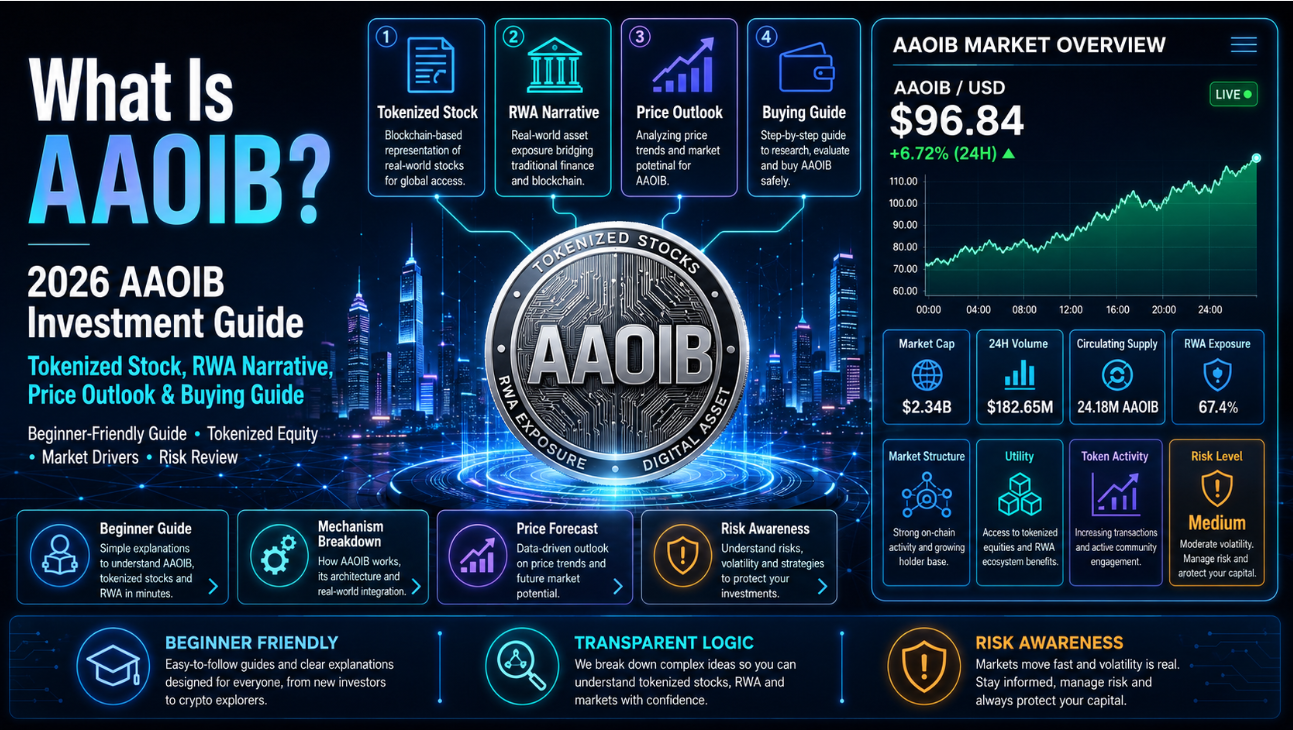
Buying AAOIB means getting price exposure to Applied Optoelectronics via crypto markets, not buying a "new project token."
Applied Optoelectronics supplies optical communication products for CATV, data centers, telecom, and FTTH. Key drivers:
- AI data centers
- Optical modules
- High-speed optical comms
- Cloud infrastructure
- Hyperscale customers
- 800G / 1.6T transceivers
- AI workload bandwidth needs
Traditional investors look at revenue, orders, margins. AAOIB investors must also track:
- Whether AAOIB tracks AAOI stock closely
- AAOIB/USDT volume
- Platform support for deposits, withdrawals, conversions
- Custody transparency
- Regional eligibility
So AAOIB is a blend of traditional fundamentals + tokenization + crypto trading.
5. Why Do AI Data Centers Impact AAOIB?
Applied Optoelectronics is closely tied to AI data center expansion. AI model training/inference demands massive compute, which needs high-speed networking, switches, and optical modules.
In March 2026, AAOI received its first 1.6T data center transceiver volume order from a major hyperscaler to boost AI workload bandwidth. In April, it announced a $71M order for 800G single-mode transceivers.
Thus AAOI is not just "AI buzz" – it’s directly serving AI network scaling.
Impact chain: AI adoption → more data centers → bandwidth demand → 800G/1.6T demand → potential revenue growth for AAOI → AAOIB price moves.
But AI stocks are volatile. If expectations exceed reality (e.g., weak earnings or delays), both AAOI and AAOIB can correct sharply.
6. What Are the Sources of AAOIB’s Value?
Layer 1 – Underlying asset performance: AAOI stock fundamentals – revenue, orders, margins, profitability, customer concentration, industry cycles, and tech sector valuation. As of current quotes, AAOI is around $109.09 (intraday high $128.59, low 106.16, market cap ~8.29B) – always check live data.
Layer 2 – RWA market development: Broader adoption of tokenized stocks, more platform support, deeper liquidity, institutional participation, clearer regulation, and the long-term trend of on-chain assets.
Binance blog: bStocks allow eligible users to convert supported U.S. stock positions into 24/7 tradeable tokens; 44% of bStock volume occurs outside regular U.S. trading hours, showing demand for round‑the‑clock exposure.
Layer 3 – Crypto market environment: BTC cycles, ETH ecosystem heat, USDT liquidity, exchange risk appetite, and overall bull/bear sentiment. A strong crypto market boosts RWA attention; a contraction may dampen AAOIB even if AAOI performs well.
7. How Does AAOIB Differ from Traditional Stock?
Traditional: buy AAOI via broker, trade during market hours, settled in securities account, governed by securities rules.
AAOIB: buy token via crypto exchange or on-chain, trade with USDT, possibly 24/7, but adds token issuance, custody, platform, and regulatory risks.
AAOIB is suitable for:
- Crypto-savvy users wanting U.S. stock exposure via USDT
- Those who understand RWA and tokenized stocks
- Those comfortable with illiquidity and regulatory uncertainty
Not suitable for:
- Those thinking it’s equivalent to direct stock ownership
- Those seeking stable returns
- Those unable to handle high volatility
- Those unwilling to research the underlying company and token mechanics
8. Which RWA Sub‑Sector Does AAOIB Belong To?
AAOIB is in the stock token / tokenized stock category. Unlike protocol tokens (revenue, users), memecoins (community hype), or L1s (network value), AAOIB’s value is driven by underlying stock, RWA mechanics, liquidity, and market cycles.
9. AAOIB vs. SKHYB – What’s the Difference?
Both are RWA tokenized stocks, but:
- AAOIB – Applied Optoelectronics, AI data centers, optical comms, 800G/1.6T transceivers, hyperscalers.
- SKHYB – SK Hynix, HBM memory, AI server memory, NVIDIA supply chain, memory chip cycles.
Choose based on which segment you favor. Always compare liquidity, valuation, and your risk tolerance.
10. What Factors Influence AAOIB’s Price?
Four‑layer model:
- Underlying stock price – AAOI moves, earnings, orders, margin, guidance.
- AI/tech sector cycle – data center capex, 800G/1.6T demand, competition.
- RWA market sentiment – overall interest in tokenized stocks, platform support.
- Crypto environment – BTC/ETH trends, USDT liquidity, exchange sentiment.
11. How Does ETH Affect AAOIB?
AAOIB is not an ETH project, but ETH influences it indirectly:
- ETH is a foundational asset for Web3 finance; when ETH rises, RWA narratives gain attention.
- ETH reflects overall risk appetite.
- RWA is a cross‑chain narrative.
But ETH rising does not guarantee AAOIB rises – AAOI stock remains the primary driver.
12. AAOIB Price Prediction – How to Gauge Future Upside?
Instead of a fixed price target, use a framework:
- Fundamentals: Revenue growth, data center share, 800G/1.6T order fulfillment, hyperscaler stability, margin improvement, profitability.
- Industry: Data center buildout, optical module demand, cloud capex, competitive landscape.
- Market: AAOIB/USDT volume, order book depth, spread, premium/discount vs. AAOI, additional exchange support.
- Macro: Fed policy, tech sector valuation, Nasdaq trend, liquidity, regulation.
Use AAOIB price prediction as a supplementary tool.
13. When Could AAOIB Rise?
Upside typically requires:
- Sustained RWA market growth
- Strong AAOI fundamentals (orders, earnings)
- Continued AI data center demand
- Bullish crypto cycle
- Improved AAOIB liquidity and depth
14. What Are the Risks of AAOIB?
- Underlying asset risk: AAOI drops due to weak earnings, order delays, customer concentration, demand slowdown, margin pressure, competition.
- Liquidity risk: Thin order books, wide spreads, slippage, price deviation from stock.
- Issuance/custody risk: Unclear 1:1 backing, unreliable custodian, unclear conversion rules.
- Regulatory risk: Restrictions by jurisdiction; platform may limit access.
- Cognitive risk: Mistaking AAOIB for a speculative altcoin.
15. How to Buy AAOIB – Step‑by‑Step for Beginners
Preparation: Choose a platform supporting AAOIB/USDT, register, complete KYC, obtain USDT, check live quotes at AAOIB real‑time quote, and set a loss limit.
Steps:
- Log in to exchange.
- Search for AAOIB.
- Select AAOIB/USDT pair.
- View price and order book.
- Choose market or limit order.
- Enter amount.
- Confirm.
- Check balance.
Order types: Market for speed (watch slippage); limit for controlled price (may not fill). For new RWA tokens, use small size, limit orders, and scale in.
Risk control: Don’t chase, don’t go all‑in, don’t use leverage, don’t borrow. Instead: small position, scale in, set max loss, track AAOI and liquidity, monitor platform rule changes.
16. AAOIB vs. SKHYB – Which AI Semiconductor RWA to Choose?
- AAOIB – optical networking, 800G/1.6T, hyperscalers.
- SKHYB – HBM memory, AI server storage, NVIDIA supply chain.
Your choice depends on which segment you favor. Both require tracking underlying stocks, industry cycles, token liquidity, issuance mechanics, and regulation.
17. AAOIB vs. VEX – RWA vs. Web3 Project Token
AAOIB is an RWA tokenized stock – value from AAOI stock, AI data centers, optical comms, RWA mechanisms. VEX is a Web3 project token – value from protocol adoption, user growth, token utility.
Don’t compare solely by price or recent performance – use the appropriate analytical framework.
18. Who Is AAOIB For?
Suitable: RWA enthusiasts, believers in traditional asset digitization, those following AI/data center/optical chains, those who understand tokenized stock mechanics, USDT traders, those who can handle volatility and do ongoing research.
Not suitable: Short‑term speculators, those who don’t understand tokenization, those seeking stable income, those unable to stomach drawdowns, those unwilling to research fundamentals.
For beginners, AAOIB is a learning case for RWA tokenized stocks, not a heavy bet.
19. AAOIB FAQ
Q1: What is AAOIB?
Tokenized bStock for Applied Optoelectronics, an RWA/tokenized stock asset.
Q2: Is AAOIB a coin?
No – it’s a tokenized expression of AAOI stock exposure.
Q3: Is AAOIB a stock?
No – it’s a tokenized asset; not direct stock ownership.
Q4: How to buy AAOIB?
On platforms offering AAOIB/USDT – check live quote.
Q5: Will AAOIB rise?
Depends on AAOI, AI data center demand, RWA adoption, liquidity, and crypto cycles. Use price prediction as reference only.
Q6: Difference from ETH?
ETH is blockchain infrastructure; AAOIB is tokenized stock exposure.
Q7: Difference from BTC?
BTC is native digital gold; AAOIB is RWA stock token.
Q8: Risks? Yes – underlying stock drop, AI demand miss, illiquidity, opaque issuance, platform changes, regulation.
20. Summary – Is AAOIB Worth Watching?
AAOIB is a notable RWA tokenized stock in 2026, linking to Applied Optoelectronics, AI data centers, and optical networking. It represents the trend of bringing traditional equities on‑chain.
But it’s not a "new coin" – evaluate based on AAOI fundamentals, AI infrastructure trends, RWA market growth, AAOIB/USDT liquidity, issuance/custody transparency, and your own risk capacity.
For beginners: understand AAOIB → research AAOI → check live quote → review price prediction → then decide on small, staggered entries.
Bottom line: AAOIB’s opportunity lies in RWA tokenized stocks and AI data center optical comms; its risks stem from stock volatility, token mechanics, liquidity, and regulatory uncertainty.