
Newcomer Guide, Mechanism Breakdown, and Investment Risk Assessment
Risk Disclaimer: This article is for informational and risk education purposes only and does not constitute investment advice. AI Agents, on-chain trading, and small-cap tokens all carry high volatility, high technical barriers, and high loss risks. Before any trade, please independently verify contract addresses, liquidity, audit status, and local regulatory requirements.
I. Why Does "Letting AI Trade for You" Sound Great in Crypto, Yet Most People Hesitate to Hand Over Real Money?
Over the past two years, "AI Agent automated trading" has become a very hot narrative in the crypto market. It sounds enticing: AI can monitor markets 24/7, analyze on-chain data, execute arbitrage, track price ranges, and help you catch opportunities humans might miss. For ordinary investors, this imagination easily creates an illusion — that as long as you hand your wallet over to AI, you gain an "automatic money-making machine."
But the real problem is this: whether AI can analyze the market is one thing; whether AI has the authority to move your money is another.
Many newcomers, when first using AI trading tools, only focus on "yield," "signal accuracy," and "bot strategies," while overlooking the most critical security issue: does this tool touch your private keys? Can it bypass you and sign directly? Does it store trading logic, wallet permissions, API Keys, or seed phrases in the cloud? Once these core permissions are controlled by platforms, servers, bots, or malicious plugins, so-called AI automation becomes a capital risk entry point.
This is the pain point ProjectVex aims to address. VEX doesn't simply say "AI will trade for you"; instead, it tries to answer a more fundamental question: how can AI propose trading suggestions without arbitrarily moving your money? VEX official documentation summarizes it in one sentence: the model proposes, the Runtime executes rules, and the log records results. In other words, AI is not the final signer — before execution, every trade must pass through local rules and the Safety Gate.
Cloud-Hosted Private Keys vs. Local-Only Proposals Without Execution — What's the Difference?
Crypto trading bots can be roughly divided into two categories.
The first category is cloud-hosted tools. Users hand over API Keys, private keys, seed phrases, or trading permissions to servers, where AI or bots run in the cloud. The advantage of such tools is convenience — you can operate via mobile or web without maintaining a local environment. But the risks are equally direct: if servers are hacked, insiders act maliciously, dependency libraries are injected with malicious code, or databases leak, user funds can be compromised. In 2024, crypto hacking incidents resulted in approximately $2.2 billion in stolen funds, with private key and seed phrase leaks remaining a major attack vector.
The second category is local-first tools. AI can read market data, analyze opportunities, and propose trading intents, but when it comes to actual signing and transaction submission, private keys remain on the user's own device. VEX follows the second path. Official documentation explicitly states that VEX is a desktop application, not a cloud service; Runtime, memory, audit logs, and custody are all local; AI only proposes intents, and only the Runtime can sign and submit.
For newcomers, the biggest difference between these two modes is not "which is smarter," but who holds the final execution authority. The core of cloud bots is "I trust the platform won't have issues"; the core of local Runtime is "even if the platform has issues, it shouldn't naturally have access to my private keys."
Why Does ProjectVex Insist on Local-First?
VEX chose local-first primarily to mitigate three types of risks.
The first is private key leakage risk. VEX officially states that private keys are encrypted and stored locally, not transmitted over the network, and backup and recovery do not touch the internet.
The second is AI hallucination risk. Large models may misinterpret instructions, generate incorrect trades, misidentify wallets, or miscalculate position sizes. If AI itself has direct execution authority, hallucinations can turn into real losses. VEX's design ensures AI can only propose trading intents, and true execution must pass through the Safety Gate.
The third is copy trading industry trust risk. Traditional signal groups and copy trading platforms can easily showcase only profit screenshots while hiding loss records. VEX attempts to use local logs and content hashes to incorporate every execution, loss, and blocked attempt into a unified historical record, reducing the problem of "only showing wins, never showing losses."
II. Is VEX an App, a Token, or Trading Infrastructure? — Product Positioning Clarification
Many newcomers, upon seeing VEX, first ask: what exactly is it? Is it an AI App? A Token? Or an on-chain trading protocol?
A more accurate understanding is: VEX is first and foremost a locally running AI trading Runtime, and secondarily the $VEX token and future network built around this Runtime.
The VEX official homepage describes it as a "trading runtime running on your machine," emphasizing that it is not a chatbot, but a desktop Runtime that executes Missions according to rules in real markets. Every swap or bridge must pass through a fail-closed gate, and even in fully automatic mode, the safety gate cannot be bypassed.
How Is VEX Different from ChatGPT Plugins or Telegram Bots?
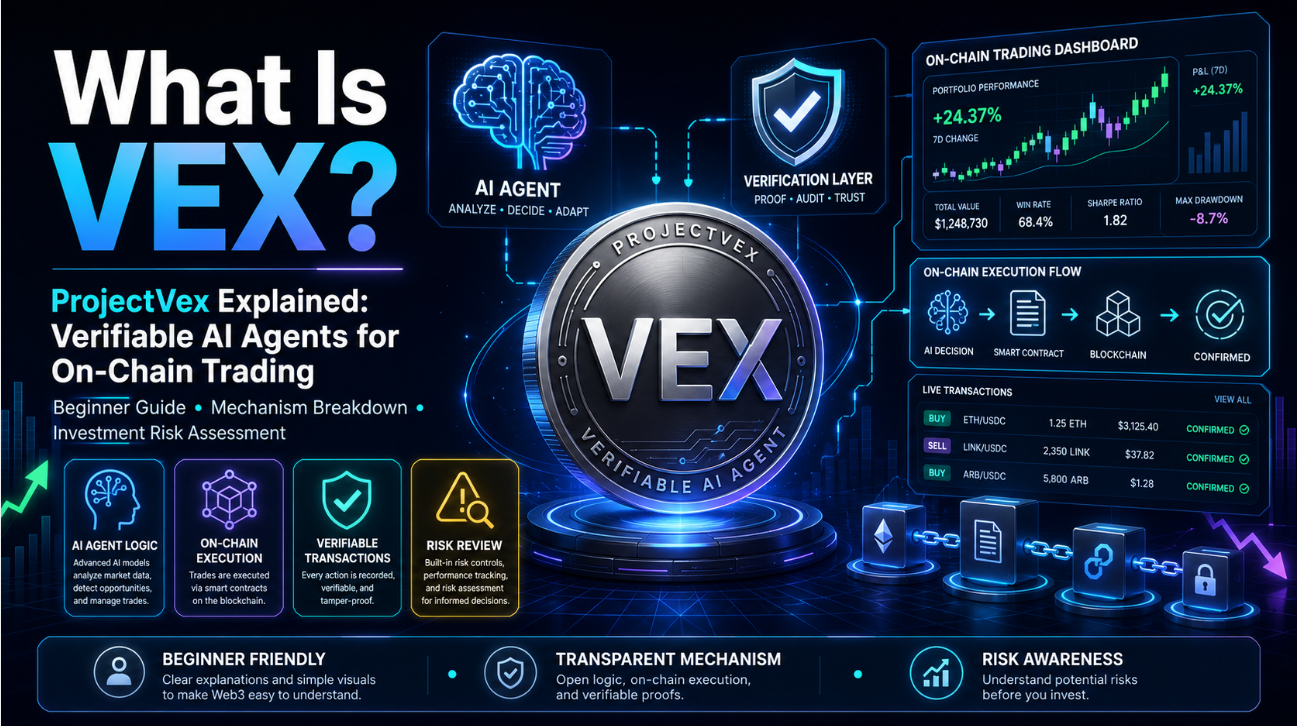
ChatGPT plugins or ordinary AI assistants are more like "analysis layers": they can explain market conditions, write trading plans, and generate strategy ideas, but typically should not directly hold your fund permissions.
Telegram Bots, on the other hand, usually function closer to "quick execution layers": they integrate buy, sell, snipe, copy trade, and limit order operations into a chat interface, offering a lightweight experience. However, the problem is that many Telegram trading bots require users to import private keys or authorize high-permission operations. Historically, security issues with Telegram bot trading tools have been a persistent concern, including user private key imports, permission centralization, and fund losses after bot compromises.
VEX's difference lies in placing AI in the "proposer" position, the Runtime in the "executor" position, and user rules in the "constraint layer" position. Official documentation explicitly states that VEX is neither a chatbot nor a cloud service; AI proposes intents, and only the Runtime is authorized to sign and submit.
Where Is the $VEX Token? How to Verify Authenticity?
As of the time of this article's verification, VEX official documentation shows that $VEX runs on Robinhood Chain, with Chain ID 4663, Gas paid in ETH, Launchpad on Virtuals Protocol, and contract address:
0x8Ff92566f2e81BDd68EDfAa8cde73942A723796b
Newcomers must be especially careful: AI Agent projects are easily counterfeited by fake tokens, fake contracts, and fake download links. VEX official channels also remind users to cross-verify contract addresses through official sites and @ProjectVEXai, and not to trust unsolicited private messages or unofficial links.
Natural internal link: Check VEX Real-Time Market Data for the latest price, order book depth, and liquidity changes.
What Do Current Trading Volume and Liquidity Indicate?
VEX remains a very early-stage, small-cap asset, and different data platforms may show discrepancies due to varying trading pairs, statistical methodologies, and update times. CoinGecko shows that ProjectVex can be traded on Uniswap V2, V3, and V4 on Robinhood Chain, with approximately $1.31 million in 24-hour trading volume, an FDV of approximately $7.51 million, and a maximum supply estimated at 1 billion tokens; CoinMarketCap shows approximately $2.15 million in 24-hour trading volume during the same period, with the same maximum supply of 1 billion tokens.
DexScreener's VEX/VIRTUAL pool shows that price, FDV, liquidity, and trading volume change in real time. For example, at one point it showed liquidity of approximately $322,000, FDV of approximately $6.2 million, and 24-hour trading volume of approximately $1.3 million, with about 25.74 million VEX and 275,000 VIRTUAL in the pool.
This indicates that VEX already has some on-chain trading activity, but it should not be understood as a "deep, large-cap asset." For small-scale users, trades of tens or hundreds of dollars may have controllable slippage; but for large amounts, it is essential to first observe pool depth, buy/sell walls, recent transactions, token concentration, and whether there is a risk of rapid liquidity withdrawal.
III. AI "Proposes" but "Cannot Execute" — How Does VEX's Safety Gate Mechanism Prevent Fund Theft at the Technical Level?
VEX's core product design can be summarized in one sentence: AI can propose, but cannot directly sign; Runtime can execute, but must first pass rules; logs must record, and not only successes.
The keyword in this logic is Safety Gate.
What Is a Fail-Closed Safety Gate?
Fail-closed can be understood as "default closed." When the system cannot determine whether an operation is safe, or when rule judgment encounters anomalies, the result is not "approve first and investigate later," but "do not execute."
In financial trading scenarios, this is extremely important. Because a single erroneous signature, erroneous transfer, or erroneous authorization usually cannot be reversed. If an AI model suffers from Prompt Injection — being induced by external information to execute incorrect instructions — the most dangerous outcome is not that it "says something wrong," but that it "moves money according to incorrect instructions."
VEX's approach places AI in the first half of the trading chain. AI can say: "I recommend buying this token," "I recommend bridging funds," or "I recommend shorting gold within a certain range." But every action that changes on-chain state must become an intent, pass through the Safety Gate for inspection, and only then may enter the signing boundary. Official documentation states that every swap and bridge in VEX passes through the same fail-closed safety check, and the safety gate is not relaxed even if the user selects fully automatic mode.
From AI Proposal to Runtime Signature — Where Is the Private Key Invoked?
VEX's chain can be broken down into five steps:
Step one: the user proposes a goal in natural language, for example, "short gold within this range, stop loss at 4170."
Step two: AI analyzes the goal, market conditions, venue, and wallet status, generating a trading intent rather than directly signing a transaction.
Step three: the Runtime converts the trading intent into a checkable rules object, such as asset, chain, wallet, amount, slippage, stop loss, maximum loss, deadline, etc.
Step four: the Safety Gate determines whether this trade conforms to user-defined rules. If not, it blocks and records; if yes, it proceeds to the next step.
Step five: the local Runtime invokes the private key at the signing boundary, signs, and submits the transaction.
The key point here is: private keys are not for the AI model to use, but for the local Runtime to use at the final signing boundary. VEX official FAQ explicitly states that private keys are stored on the user's machine and not transmitted to VEX; private keys are only used at the signing boundary after an action passes the safety gate.
What Is the Significance of AES-256-GCM and scrypt Local Encryption?
VEX officially states that private keys are encrypted locally using AES-256-GCM and protected by scrypt-derived keys; there is no cloud-hosted server and no remote key custody.
For ordinary users, there is no need to deeply understand cryptographic details — only to know that it solves two problems:
First, private keys cannot be stored in plaintext on the computer hard drive. Otherwise, if someone else gains access to the computer, or if malware scans files, the private key could be directly stolen.
Second, the user's password cannot be directly used as an encryption key. The role of key derivation functions like scrypt is to transform the user's input password into an encryption key that is much harder to brute-force.
But it must also be emphasized: local encryption is not a universal safeguard. If the user's computer is already infected, remotely controlled, or if a fake installer package was downloaded, attackers may still launch attacks when the user unlocks the wallet, signs transactions, or enters passwords. Therefore, VEX's local-first design reduces cloud custody risks, but cannot eliminate endpoint security risks.
Which Users Are the Four Operating Modes Suitable For?
VEX divides operating modes into two switches: Agent / Mission, and Restricted / Full. The official page shows that each session locks these two switches, and permissions cannot be expanded mid-run; unapproved requests expire after one hour, and the Mission will proceed to the next step or abandon the current action.
Agent · Restricted: Suitable for the vast majority of newcomers. AI completes one-time tasks, and user confirmation is required for any fund movement. The advantage is security; the disadvantage is slower speed.
Agent · Full: Suitable for users familiar with rules who are willing to sacrifice confirmation steps for speed. It still cannot bypass the Safety Gate, but no longer pauses for approval each time.
Mission · Restricted: Suitable for users who want AI to continuously monitor the market but do not want it to fully automate fund movements. For example, letting VEX monitor a certain price range, wallet change, or arbitrage opportunity, and pausing for user confirmation once a trade is needed.
Mission · Full: Suitable for more experienced users who have already set strict rules and can accept the risks of automatic execution. It can run continuously within a Mission cycle without popping up approval prompts, but must still pass the safety gate, and report reasons at the end, such as target achieved, time expired, funds depleted, maximum loss triggered, no viable opportunities, or emergency stop.
For newcomers, the default recommendation is: start with Agent · Restricted, then move to Mission · Restricted, and do not use Full mode right away.
IV. No Screenshots, No Curated Profits — How Does VEX's "Verifiable Logs" Solve the Trust Crisis in Copy Trading?
The biggest problem in the copy trading industry is not the absence of skilled traders, but the difficulty of determining who is truly skilled.
Many signal groups, KOLs, and copy trading platforms showcase profit screenshots, liquidation doubles, account curves, and partial trade records — but these materials can easily be selectively displayed. Winning trades are amplified, losing trades are deleted; short-term luck is packaged as stable strategy; demo accounts are disguised as real trading; and even screenshots themselves can be forged.
Therefore, a truly credible track record should not only answer "how much money was made," but also three questions:
First, are all trades counted?
Second, are losses and blocked trades also counted?
Third, can records be queried by users themselves, rather than only relying on platform explanations?
How Does VEX Record Every Decision?
VEX documentation states that every decision, whether executed or blocked, is written into the same local log; profits, losses, and blocked attempts all enter the same historical record, not just a highlight reel. Each decision also carries a content hash for deduplication, and users can query it in ordinary local logs.
The value of this design is that it does not merely prove "I made a profitable trade," but comes closer to proving "my trading history is continuous, complete, and inspectable."
For copy trading scenarios, this is crucial. Because what followers truly care about is not how spectacular a single trade was, but how the strategy performs over a complete cycle: what is the maximum drawdown? How many consecutive losses? Are there large numbers of abnormal trades blocked by the safety gate? Does the profit curve rely solely on one big surge?
How Do Content Hashes Reduce Tampering and Double-Counting?
Content hashes can be simply understood as a "digital fingerprint" of a record. The same content generates the same hash; different content generates different hashes. If a logging system generates content hashes for every trading decision, it becomes easier to identify duplicate records, missing records, or modified records.
VEX documentation emphasizes "hashed for deduplication," meaning hashes are used for deduplication rather than fully exposing strategy details.
This resolves a contradiction: excellent traders do not want to publicly disclose their complete strategy details, but followers want to see credible history. VEX's direction is to let others see results and record integrity, rather than directly exposing strategy logic.
Why Does a Copy Trading Network Need a Verified Track Record?
VEX official documentation mentions that Copy Trading is still in "coming soon" status. Its vision is: when records can be shared, followers can replicate human or Agent strategies within their own constraints, rather than handing funds over to the other party.
This adds a layer of protection compared to traditional copy trading. Traditional copy trading is essentially "I trust this trader"; what VEX wants to achieve is "I first examine this trader or Agent's verifiable record, then follow using my own wallet, rules, and constraints."
This does not mean copy trading is risk-free. On the contrary, copy trading can still result in losses, especially when market conditions change, strategy capacity is insufficient, liquidity deteriorates, or too many followers cause crowded trades. But if VEX's logging system truly delivers, it can at least evolve copy trading from "believing someone based on screenshots" to "evaluating strategies based on complete records."
V. $VEX Is Not a Pure Meme — Trading Fee Buybacks, Copy Trading Networks, and Token Utility Analysis
Evaluating $VEX cannot be based solely on whether it is an AI concept coin, nor solely on short-term price movements. A more reasonable approach is to split it into two layers: product-level adoption and token-level value capture.
VEX official documentation states it directly: the App is the product, and the Token powers the network around the Runtime; trading fees will be used to buy back $VEX, with verified copy trading to follow.
How Do Trading Fee Buybacks Create Buying Pressure?
If VEX's trading Runtime is genuinely used by real users, and users generate trading fees through it, then using a portion of those fees to buy back $VEX could create sustained buying pressure. The difference from pure Meme coins is that pure Meme coins primarily rely on sentiment, community propagation, and liquidity rotation, while VEX at least attempts to tie token demand to product usage.
But there is a prerequisite here: there must genuinely be users generating fees through the product.
If App downloads, active Mission counts, transaction volumes, and copy trading network participation do not grow, the buyback mechanism remains merely a narrative, not a fundamental. Therefore, investors cannot just look at the word "buyback" — they must also track real product metrics.
What Role Does $VEX Play in the Copy Trading Network?
From current official documentation, $VEX's explicit narratives include: trading fee buybacks, Runtime network, and verified copy trading. The official team has not yet fully disclosed whether $VEX serves as Gas, staking collateral, access credential, profit-sharing settlement asset, or multiple roles within the copy trading network.
So the more prudent phrasing is: $VEX currently has a direction for product usage and network value capture, but the specific economic model still needs to be observed through subsequent documentation, contracts, and product launches.
This point is very important for newcomers. Many projects use "future utility" to package their tokens early on, but whether they can truly capture value depends on three subsequent facts:
First, are users willing to use the VEX App long-term?
Second, are trading fees real, transparent, and verifiable?
Third, can the copy trading network attract strategy providers and followers?
How to Read Total Supply, Circulating Supply, and Holder Structure?
CoinMarketCap shows ProjectVex's maximum supply as 1 billion VEX, but circulating supply and real-time market cap were not fully displayed at the time; CoinGecko also notes that circulating supply is unreported, so FDV is a statistical estimate based on maximum supply.
OpenSea's VEX page shows a total supply of 1 billion tokens and approximately 3.74K holder addresses, but also notes that some information is AI-generated from online sources and may be outdated or unverified.
This means investors cannot assume something is "cheap" just because "FDV is low." Further verification is needed:
What are the allocation ratios for team, ecosystem, LP, market makers, airdrops, community, and foundation?
Are there lock-up and unlock schedules?
Is the top ten address concentration high?
Is LP locked? For how long?
Are there large wallets continuously selling or transferring?
If these questions lack clear answers, VEX's valuation certainty will decrease.
What Does the Price Volatility History Indicate?
CoinGecko data shows that VEX reached an approximate all-time high of $0.017 around July 10, 2026, and also hit a low around $0.00024 near July 9, 2026. In other words, the "0.00024" you mentioned is closer to an early low rather than the ATH.
This type of price action indicates that VEX is still in a very early price discovery phase. Early-stage tokens are most prone to violent swings of several-fold or even ten-fold, and also most prone to rapid pullbacks. If newcomers chase in at peak hype, they may face floating losses of over 50% in a short time; if they place large orders when liquidity is thin, the purchase itself may push the price up, and selling may then incur high slippage.
Natural internal link: Refer to VEX Price Prediction for technical analysis, support levels, and trend analysis to assist in timing entry decisions.
VI. From Download to First Mission — A Complete Beginner's Guide to Using VEX and Common Pitfalls to Avoid
VEX's experience differs from ordinary web wallets and exchange apps. It is a local desktop application, so before getting started, newcomers must accept one fact: greater self-management means greater operational responsibility.
Step 1: Download Only from Official Channels
The VEX official website shows that it currently supports macOS and Linux, with the Windows version coming soon. The GitHub repository shows VEX is a desktop self-custodial on-chain crypto agent, with macOS and Linux released first, and Windows to follow.
When downloading, it is recommended to cross-verify through three official channels:
Official website;
Official GitHub Releases;
Official X account @ProjectVEXai.
The GitHub README also warns that the team will not proactively DM users, will not ask for seed phrases or master passwords, and will not distribute Vex through other links. Any other source should be treated as a scam.
One detail worth noting: the VEX official website states "Free and open source," but the GitHub README states "source-available, not open-source" — meaning reading, auditing, and personal use are allowed, but redistribution, commercial use, or publishing forks are not.
This is not a minor issue. For security tools, license terms, auditability, whether community forks are allowed, and whether independent security reviews exist all affect trust. At the time of publication, it is recommended to write: VEX code is publicly viewable, but the specific open-source license boundaries should be confirmed against the GitHub LICENSE.
Step 2: Run Security Checks Before Creating or Importing a Wallet
Before creating a wallet or importing private keys in any local Agent tool, you should first confirm:
No unauthorized remote control software is installed on the computer;
No malicious browser plugins are present;
System and antivirus software are up to date;
The downloaded package comes from the official address;
The backup environment is offline, and no screenshots, cloud uploads, or sharing with anyone occurs.
VEX's local-first design can avoid cloud-hosted private key risks, but it cannot protect a computer already compromised by malware. For users with larger amounts, it is not recommended to directly import the main wallet; instead, create a separate trading wallet and only deposit small amounts that you can afford to lose.
Step 3: Create Your First Mission
VEX's Mission is a long-running objective, not an ordinary chat. An example from the official documentation:
"Short gold in this range, stop at 4170."
This instruction is understood as a goal: look for opportunities to short gold within a certain range, with 4170 set as the stop-loss boundary. A Mission can run for several days and retain state after reboot.
When creating a Mission as a newcomer, do not just write vague goals like "help me make money." Better instructions should include:
Trading asset;
Direction;
Trigger conditions;
Maximum committed amount;
Maximum loss;
Stop-loss conditions;
Deadline;
Whether manual approval is required.
For example:
"Monitor ETH; if the price pulls back to my set range and slippage is below 0.5%, attempt to buy with no more than 100 USDT; all trades must wait for my approval; stop if no opportunity arises within 24 hours."
This type of instruction is much safer than "buy ETH depending on the situation."
Step 4: Prioritize Restricted Mode
In Restricted mode, any action that moves funds requires user approval. Official documentation states that unanswered approvals expire after 1 hour, and the Mission will skip or continue, not wait indefinitely, and not execute by default.
For newcomers, this is very important protection. Because many losses do not come from market judgment errors, but from misclicks, erroneous authorizations, wrong wallets, wrong chains, or wrong amounts. Restricted mode sacrifices speed but gives users one more confirmation before signing.
Step 5: Backups and Recovery Must Be Handled Offline
VEX officially emphasizes that backup and recovery do not touch the internet, and private keys only move between the user's own disk and backup.
The correct approach is:
Close unnecessary software during backup;
Do not upload seed phrases, private keys, or backup files to cloud drives;
Do not transmit via WeChat, Telegram, or email;
Do not save as screenshots;
Do not place backups in network-shared folders;
When recovering, confirm the installer source and device security.
These details may seem tedious, but in the self-custody world, security is not a slogan — it is a set of operational disciplines.
Step 6: Understand Supported Wallets, Chains, and Trading Scenarios
VEX official documentation shows that it supports EVM and Solana, with up to three wallet sets per session, and separates address reading from signing. Current live venues include KyberSwap, Khalani, Jupiter, DexScreener, and Polymarket; coming venues include Ostium, o1 Exchange, and Hyperliquid.
This means VEX is not just a single-chain swap bot, but aims to be a cross-venue trading Runtime. In the future, if it integrates with platforms like Ostium and Hyperliquid, its scenarios may expand from spot swaps to more complex trades such as RWA, Perpetual Futures, and prediction markets. But the more complex the trading, the stricter the risk control and the clearer the user rules need to be.
VII. Where Does VEX Stand in the Virtuals Ecosystem and the Broader AI Agent Track?
VEX did not emerge in isolation. It sits at the intersection of two major trends: AI Agent tokenization and on-chain trading automation.
The Virtuals Protocol whitepaper defines itself as an on-chain ecosystem for AI agents, believing that in the future AI Agents will act as economic entities producing services, earning income, coordinating tasks, and managing resources, with tokenization enabling capital formation and incentive alignment.
Within this framework, VEX's positioning is not "yet another chatty Agent," but a financial execution-layer Agent Runtime.
How Is VEX Different from Other Virtuals AI Agent Projects?
Many AI Agent projects emphasize content production, social interaction, Meme propagation, automated posting, community operations, or on-chain identity. But VEX's differentiated selling point is: verifiable execution.
It does not simply say "AI is very smart," but emphasizes "AI should not have unlimited execution authority." This is extremely important in trading scenarios. Because the risks of a financial Agent are far greater than those of a content Agent. A content Agent making a mistake results in at most a wrong tweet; a trading Agent making a mistake can directly cause fund losses.
VEX's core value is not necessarily that its AI model is stronger than others, but that it attempts to build a layer of "execution constraints beyond the model": local Runtime, Safety Gate, content-hashed logs, Restricted/Full permission modes, and Mission stop reasons. These designs together form its differentiation.
How Is VEX Different from Community Hype Projects Like CASHCAT?
Projects like CASHCAT are closer to community hype and Meme propagation-driven assets, where prices typically depend heavily on topic trends, leaderboard heat, community sentiment, and short-term capital inflows.
Although VEX also has early hype and speculative attributes, it at least proposes a product-driven logic: users download the desktop App, run Missions, generate trading fees, form buybacks, and in the future enter the copy trading network through verified track records.
Natural internal link: Learn about What Is CASHCAT and What Is SKHYB to compare the positioning differences and risk characteristics of different AI concept projects.
Compared to AI Concept Assets Like SKHYB, Where Is VEX's Technical Moat?
SKHYB leans more toward RWA / AI semiconductor industry chain-related asset exposure, with core focus on underlying stocks, AI chip demand, HBM, NVIDIA supply chain, and tokenized security mechanisms. VEX, on the other hand, leans toward AI Agent + on-chain execution infrastructure.
The risk sources for the two are completely different. SKHYB's risks mainly come from stock exposure, issuer, custody, regulation, and underlying asset volatility; VEX's risks mainly come from product adoption rate, smart contracts, on-chain liquidity, endpoint security, AI decision errors, and Robinhood Chain ecosystem maturity.
VEX's potential moat is not "AI can chat," but "local runtime + verifiable logs + safety gate + copy trading network." If this system can truly be adopted by users and form a credible track record network, it has the opportunity to stand out from ordinary AI concept coins. But if users find the desktop application too heavy, the usage barrier too high, or strategy results too unstable, the moat could also become a growth obstacle.
Compared to Larger AI Tracks Like Fetch.ai and Bittensor, Is VEX an Advantage or a Limitation?
In the broader AI + crypto track, projects like Fetch.ai and Bittensor emphasize AI networks, model collaboration, computing power, data, incentives, and infrastructure. VEX is more vertical: it focuses on on-chain trade execution.
This verticalization has advantages and limitations.
The advantage is clear positioning and specific user demand: I need an AI to help me monitor, propose, and execute on-chain trades, but I don't want to hand my private keys to the cloud.
The limitation is that market size depends on how many people are willing to download a desktop app, learn local self-custody, configure rules, and bear AI trading risks. Compared to Telegram Bots or web SaaS, local desktop applications have a slower growth path, but potentially stronger trust foundations.
VIII. 7 Risks You Must Face Before Investing in VEX — From On-Chain Security to AI Decision Errors
Any VEX analysis article that only talks about AI, buybacks, copy trading, and early opportunities without addressing risks is irresponsible. VEX's narrative is new, but new narratives usually also mean new risks.
Risk One: Robinhood Chain Ecosystem Maturity Risk
Robinhood Chain official documentation shows that it is an Arbitrum Layer 2 based on Ethereum, using Ethereum blobs for data availability, with native Gas in ETH, and mainnet Chain ID 4663.
This indicates that Robinhood Chain is technically compatible with the Ethereum ecosystem, but it is still a younger ecosystem relative to Ethereum mainnet. Investors need to evaluate:
Node and infrastructure stability;
RPC reliability;
Bridge asset security;
Block explorer and data tool completeness;
Ecosystem liquidity sufficiency;
How unfinished transactions are handled during network congestion or outages.
The opportunity of young chains lies in early-mover advantages; the risk lies in infrastructure that has not yet undergone sufficient long-term stress testing.
Risk Two: Smart Contract Audit Uncertainty
As of the time of this article's public information verification, VEX official documentation and GitHub pages show contract addresses, product logic, and source code repositories, but no complete third-party smart contract audit report was found on major public pages. The official GitHub shows the project is in Pre-1.0, publicly released, and warns that the software may still have sharp edges.
This does not mean the contracts definitely have issues, but it means investors cannot treat it as a mature protocol. Before buying, at minimum verify:
Whether contract source code is verified;
Whether there is owner authority;
Whether supply can be minted;
Whether there are taxes or blacklist functions;
Whether LP is locked;
Whether there are pause, upgrade, or transfer permissions;
Whether there is a third-party audit report.
Risk Three: AI Agent Hallucination Risk
AI hallucination in ordinary Q&A may just mean a wrong answer, but in trading scenarios it can cause real losses. For example:
Misunderstanding user instructions;
Confusing stop-loss with take-profit;
Misjudging price units;
Misidentifying chains and wallets;
Ignoring slippage;
Overestimating liquidity;
Treating news noise as trading signals;
Executing overly large amounts in low-liquidity pools.
VEX's Safety Gate can reduce the probability of erroneous trades being directly executed, but cannot guarantee that AI's market judgment is always correct. It can prevent some "unauthorized operations," but cannot guarantee "every trade is profitable."
Risk Four: Local Running Does Not Equal Absolute Security
VEX's local-first architecture can reduce cloud leakage risks, but the user's computer itself may still become an attack target. Research and security incidents show that once private keys are obtained by attackers, attackers almost have full control over wallet assets.
Risk scenarios include:
Downloading fake installer packages;
Computer infected with trojans;
Remote control software being abused;
Clipboard addresses being replaced;
Malicious browser plugins stealing data;
Users entering backup information on phishing websites;
Physical device theft.
Therefore, VEX is more suitable for DeFi users with basic security awareness, rather than complete beginners with no self-custody experience.
Risk Five: Gas Costs and Small-Trade Economics
Robinhood Chain uses ETH as Gas. If ETH prices rise, or on-chain transaction costs increase, the execution cost of small Missions will become higher.
For example, if a Mission frequently monitors and executes small swaps, and each potential profit is only a few dollars, but Gas, slippage, protocol fees, and failure costs combined also approach a few dollars, then the strategy may not be economically viable on paper.
Natural internal link: Combine with ETH Price Prediction to evaluate Gas cost trends and assess the relationship between VEX usage economics and broader market conditions.
Risk Six: Regulatory Uncertainty
AI automated trading tools naturally sit at the intersection of multiple regulatory boundaries: they involve crypto asset trading, automated investment decision-making, and may also involve copy trading, strategy distribution, yield display, and cross-border services.
The U.S. SEC has warned investors to be vigilant against projects using AI as a cover for investment fraud; the EU's MiCA imposes unified rules on crypto asset issuance, trading, service provision, disclosure, and authorization; mainland China has long classified virtual currency-related business activities as illegal financial activities.
This means that products like VEX, if they involve public copy trading, strategy yield display, automated execution, and token incentives, may face different compliance requirements in different jurisdictions. Users should also confirm whether their location permits the use of related services.
Risk Seven: Liquidity and Slippage Risk
Current VEX daily trading volume across platforms shows a range of approximately $1.3 million to $2.15 million, and DexScreener at one point showed core pool liquidity of approximately $322,000.
For an early-stage project, this already shows some activity, but it is not sufficient to support very large funds entering and exiting without slippage. Investors need to closely observe:
Whether 24-hour real trading volume is sustained;
Whether buy and sell volumes are balanced;
Whether liquidity is concentrated in a few pools;
Whether large sell orders cause rapid price drops;
Whether trading volume has wash trading or abnormal volatility;
Whether there is concentrated holding by large wallets.
For newcomers, the safest principle is: do not replace "it looks like there is trading volume" with "I can safely exit."
IX. Summary — Who Is VEX Suitable For, and Who Is It Not? A Self-Assessment Checklist
VEX is a very representative early-stage AI + on-chain trading project. It has not stopped at the marketing level of "AI will help you make money," but has proposed more concrete product architectures: local-first, Safety Gate, verifiable logs, Mission, and copy trading networks.
But it is also not a risk-free asset. VEX is still in early stages: its product needs validation, its token economic model needs further disclosure, its contract audits and on-chain liquidity need continuous verification, and AI decision risks cannot be fully eliminated.
If You Just Want to "Buy a Coin and Wait for It to Go Up," Is VEX Suitable?
If you just want to buy a hot AI concept coin, then not care about the product, not look at on-chain data, not understand Runtime, and not track App adoption rates, then VEX may not be suitable for you.
Because $VEX's medium-to-long-term value should not rely solely on hype, but should be tied to product adoption rates, trading fees, buyback mechanisms, copy trading networks, and verifiable track records. If these metrics do not grow, the token price will likely be supported only by short-term sentiment.
If You Are Already Familiar with DeFi, Where Does VEX's Appeal Lie?
If you are already familiar with wallets, private keys, on-chain trading, DEX, slippage, authorization, and Gas, then VEX's most attractive features are:
Private keys stored locally;
AI only proposes, does not directly control funds;
Restricted mode requires manual approval;
Mission can monitor objectives over the long term;
Every execution and block is recorded;
Future verifiable track records may improve copy trading trust issues.
Such users more easily understand VEX's true value: it is not about taking risks for you, but about adding a controllable execution layer to AI trading.
If You Have Zero Technical Knowledge, Is VEX's Learning Curve High?
It will be higher than hosted bots.
The advantage of hosted bots is simplicity: open Telegram, import wallet, enter buy/sell commands, and go. VEX's advantage is greater emphasis on autonomy and local security, but this also means users must understand download verification, wallet backup, local running, Mission rules, approval modes, and chain and venue differences.
Therefore, complete beginners are not advised to commit large amounts of capital from the start. A more reasonable path is:
First read the official documentation;
Test with a small wallet;
Only use Restricted mode;
Start with observation-only Missions;
Confirm logging and approval workflows;
Then gradually increase complexity.
Key Milestones That Will Determine VEX's Success or Failure in the Next 6–12 Months
First, whether the Windows version can launch smoothly. Desktop applications that only cover macOS and Linux will face user growth limitations.
Second, whether the Mission experience is stable. Users will not ultimately pay just for "security architecture" — they will also judge whether it is truly usable.
Third, whether the copy trading network delivers. Verified track records are one of the cores of VEX's narrative; only when a truly followable network forms will token utility become clearer.
Fourth, whether trading fee buyback data is transparent. Buyback mechanisms need to be verifiable, otherwise they can easily become empty slogans.
Fifth, third-party audits and security incident records. If VEX can continuously publish security reviews, fix records, and audit reports, trust will increase; conversely, any fund security incident will cause major damage to the project.
Sixth, whether the Robinhood Chain ecosystem can expand. VEX runs on Robinhood Chain, and ecosystem activity, infrastructure, liquidity, and user entry points will all affect its development space.
Seventh, whether the AI Agent track shifts from narrative to real revenue. Virtuals Protocol believes AI agents will become on-chain economic entities, with tokenization enabling capital formation and incentive alignment. But the market will eventually shift from "who has the better story" to "who truly generates revenue, retains users, and reduces risk."
Final Word
What makes VEX worth watching is not that it shouts "AI automated trading," but that it attempts to confine AI within a local, controllable, recordable, and verifiable execution framework.
For newcomers, the key to understanding VEX is not asking "will this coin go up," but asking four more specific questions:
Is its product genuinely being used?
Can its security mechanisms withstand real-world testing?
Can its logs and copy trading network build trust?
Can its token capture value from real usage?
If these questions gradually receive positive answers, VEX may evolve from a short-term AI hotspot into a more distinctive on-chain trading infrastructure project. Conversely, if product adoption is insufficient, contract and endpoint security are not fully verified, liquidity cannot be sustained, or the token economic model lacks transparency, then VEX will still fall back into the most common risk for early-stage small-cap tokens: strong narrative, even stronger volatility.