
Introduction: OP at $0.10 — A Bottom-Fishing Opportunity or a Value Trap?
During the 2024 bull run, Optimism was one of the brightest stars in the Ethereum Layer 2 space.
Back then, the market narrative was all about "Ethereum scaling," "L2 explosion," "OP Stack one-click chain deployment," and the "Superchain ecosystem." Many believed OP would become one of the most important foundational assets of the Ethereum scaling era.
But by July 2026, OP's price trajectory tells a very different story.
As of July 2, 2026, OP is trading around $0.0969, with intraday lows near $0.0929. CoinGecko data shows OP's all-time high at approximately $4.84 and its all-time low around $0.08888. The current price is roughly 98% below its peak, with a market cap of about $205 million and a circulating supply of around 2.2 billion OP.
This raises a very practical question:
A project once considered a leading Ethereum L2, down 98% from its highs — is it a bargain-hunting opportunity after being oversold, or a value trap following fundamental and tokenomic deterioration?
When crypto newcomers see tweets like "OP hits a new all-time low," two extreme emotions often take over.
One is excitement: "It's down 98% — how much lower can it really go?" The other is fear: "If even a leader is crashing like this, is the project dead?"
Neither emotion is rational. What truly matters is breaking OP down into three layers:
First, is the Optimism chain and the OP Stack ecosystem still growing? Second, can the OP token actually capture the value of that ecosystem growth? Third, does the current price around $0.10 already fully reflect the risks ahead?
This article uses a "2050 Long-Range Forecasting Framework" to analyze OP. The 2050 prediction isn't about pretending to know the exact future price — it's about helping newcomers build a longer-term mental model: if Ethereum truly becomes the global settlement layer, how big will the L2 market be? What share can Optimism capture? How much value can the OP token accrue? And at today's price, is it actually cheap, or merely cheap-looking?
Bottom line up front: OP around $0.10 has entered an extreme low-valuation and extreme pessimism zone, but it is not suitable for newcomers to go all-in. It is better treated as a "high-risk L2 observation position" rather than a core, conviction holding.
Part I: What Exactly Is OP? 3 Core Questions Every Crypto Beginner Must Understand
1. Optimism Is Not a Standalone Blockchain — It's an Ethereum Layer 2
Many newcomers think of Optimism as "just another chain." That isn't accurate.
Optimism is more precisely an Ethereum Layer 2 scaling solution. It doesn't aim to replace Ethereum; instead, it moves a large volume of transactions from the Ethereum mainnet to a cheaper, more efficient Layer 2 network, then passes critical data and security back to Ethereum.
What does this mean for investors?
If you buy Layer 1 assets like SOL, SEI, or SUI, you are essentially betting that they will become independent execution layers and ecosystem hubs. If you buy OP, you are essentially betting that Ethereum remains the core settlement layer long-term, and that Optimism can secure a significant position within the Ethereum scaling ecosystem.
Optimism's official documentation describes the OP Stack as an open-source, modular Ethereum Layer 2 rollup tech stack for creating scalable blockchains. The official OP Stack docs further clarify that the OP Stack is a standardized, shared, open-source development stack that supports the Optimism ecosystem, making it easier for developers to deploy production-grade Layer 2 chains.
So, OP is not an "Ethereum killer" investment thesis. It's an "Ethereum scaling beneficiary" investment thesis.
2. What Is the Real Utility of the OP Token?
The most direct use case of the OP token is governance.
Optimism governance documents show that the OP Stack is released under the MIT open-source license, meaning anyone can freely use and fork it. The Superchain is a broader ecosystem of chains running on top of the OP Stack, including some major enterprise and application chains.
The core function of the OP token is to participate in Optimism Collective governance, covering protocol upgrades, ecosystem incentives, fund allocation, and public goods funding. Introductory materials from Uphold also note that OP is the governance token of the Optimism network, and the Optimism Collective is co-governed by the Token House and the Citizens' House.
But the problem lies here too.
If a token's only utility is governance, with no clear fee sharing, staking yield, buyback-and-burn, or mandatory usage scenarios, then its value accrual is questionable. Many L2 tokens face this same issue: the chain itself may be useful, but that doesn't mean the token necessarily captures strong value.
For OP to rise sustainably, it must answer one question: as the Superchain ecosystem becomes more prosperous, what do OP holders actually get?
In 2026, Optimism introduced an important change in this area. CoinDesk reported that Optimism governance has approved an OP buyback program tied to Superchain revenue: during a 12-month pilot period, the Optimism Foundation will use 50% of net Superchain sequencer revenue for periodic OP buybacks.
This mechanism won't solve everything immediately, but it at least shows that OP is trying to shift from a "pure governance token" toward an "asset linked to Superchain economic performance."
3. OP Stack and Superchain: Value Accrual Engine or Just Technical Narrative?
The OP Stack is Optimism's biggest strategic asset.
Simply put, the OP Stack is like an "open-source toolbox for launching L2s." Developers, projects, enterprises, exchanges, and application teams can build their own Layer 2 or application chains quickly based on the OP Stack.
The Superchain is Optimism's grander vision: not just one OP Mainnet, but many chains built on the OP Stack, ultimately sharing security, a communication layer, development standards, and governance coordination.
Official documentation notes that Bedrock is the current iteration of the OP Stack, providing tools to launch production-grade Optimistic Rollups; the ecosystem goal is to support a group of L2 networks sharing security, a communication layer, and a common development stack.
This sounds powerful, but there's a counterintuitive risk: the more open-source the OP Stack becomes, the more easily others can use it — and the more successful others become, the less that success necessarily flows to OP Mainnet itself.
The most typical example is Base. Built on the OP Stack, Base's user count, transaction volume, and ecosystem buzz have often exceeded OP Mainnet's. DeFiLlama data shows that Base has approximately 344.5K 24-hour active addresses, 8.65 million 24-hour transactions, and $867 million in 24-hour DEX volume — all significantly higher than OP Mainnet.
This is the most critical point in the OP investment thesis:
- If Superchain revenue and governance eventually flow back to OP, then the more successful the OP Stack becomes, the more valuable OP becomes.
- If the Superchain merely lets others use the technology for free while the OP token fails to capture value, then OP could become "the weak token behind great infrastructure."
Therefore, investing in OP isn't just about technology — it's about whether the value accrual mechanism actually works.
Part II: Is Now a Good Time to Buy OP? A July 2026 Market Breakdown
1. OP Price Is Approaching Historically Extreme Low Levels
From a price perspective, OP is indeed very low right now.
As of July 2, 2026, OP is trading around $0.0969. CoinGecko data shows an all-time high of approximately $4.84 and an all-time low of roughly $0.08888. The current price is down about 98% from its peak and very close to its all-time low.
In technical terms, this is no ordinary pullback — it's a complete valuation collapse.
But crypto newcomers must understand: down 98% doesn't mean it can't fall further; hitting $0.10 doesn't mean it's necessarily cheap.
An asset dropping from $4.80 to $0.10 can have three underlying causes:
- Market overreaction — short-term panic selling and mispricing.
- Continuous tokenomic dilution — sustained supply pressure from ongoing unlocks.
- Fundamental and value accrual repricing — a market reassessment of the project's core value.
OP may currently involve all three factors.
- Short-term: OP is in an extreme low-price and extreme pessimism zone, making a potential oversold rebound possible.
- Medium-term: OP still faces challenges from unlocks, competition, user flow erosion, and insufficient value accrual.
- Long-term: Whether OP can re-emerge as a strong asset depends on whether the Superchain can truly channel revenue, governance, and ecosystem value back to OP.
So, "Is now a good time to buy OP?" My answer is:
It can be researched and tested with a small position, but it is not suitable for newcomers to go all-in.
2. On-Chain Fundamentals: OP Mainnet Is Still Running, but Competitive Pressure Is Intense
OP Mainnet is not a dead chain.
DeFiLlama data shows that OP Mainnet currently has approximately 270 million in DeFi TVL**, **544 million in stablecoin market cap, 16.38 million in 24-hour DEX volume**, and **110 million in 7-day DEX volume, with a market cap of roughly $208 million.
These figures indicate that the Optimism ecosystem still has capital, trading activity, and applications — it is not completely abandoned.
But the problem lies in horizontal comparison.
Arbitrum currently has approximately 139 million in 24-hour DEX volume**, **1.059 billion in 7-day DEX volume, and 120.9K 24-hour active addresses, with notably stronger depth in derivatives and DeFi.
Base's numbers are even stronger. Base has approximately 344.5K 24-hour active addresses, 8.65 million 24-hour transactions, 867 million in 24-hour DEX volume**, and **6.196 billion in 7-day DEX volume.
This means OP Mainnet is no longer the uncontested L2 traffic leader. Its core narrative is shifting from "OP Mainnet growth" to "Superchain aggregate growth."
This is both an opportunity and a risk.
- Opportunity: If Base, World Chain, Mode, Zora, Unichain, and other OP Stack chains all contribute to Superchain economic value, then OP's upside is larger than that of a single OP Mainnet.
- Risk: If these chains grow strong but fail to channel value back to OP effectively, the market will continue to question the OP token.
3. Tokenomics Alert: Unlocks and Dilution Remain Core Pressures
OP's tokenomics have long been a market concern.
CoinGecko data shows that the current OP circulating supply is approximately 2.2 billion tokens. Tokenomist data indicates that Optimism's unlock schedule covers Retroactive Public Goods Funding, user airdrops, core contributors, investors, ecosystem funds, governance funds, partner funds, and seed funds, with the full unlock schedule extending to 2029.
This means that even at these already depressed prices, sustained supply pressure may continue into the future.
Crypto newcomers must understand one logic: Price declines don't only come from selling pressure — they can also come from continuously increasing supply.
If a project's circulating supply keeps rising while demand doesn't grow in tandem, the price per token will remain under pressure. This is a common problem for many L2 tokens: the chain has usage, but token unlocks are too fast, and ultimately the price performance suffers.
For OP to turn this around, two conditions are needed:
- Sustained growth in Superchain revenue and ecosystem activity.
- Stronger value accrual mechanisms for the OP token, such as governance, buybacks, incentive optimization, and protocol revenue bonding.
The 2026 buyback pilot is a positive signal, but it still needs time to prove its impact on price and long-term valuation.
4. Sentiment Indicators: The Market Has Entered a Clear Fear Zone
Current market sentiment is not optimistic.
Binance Square's Crypto Fear & Greed Index shows a current reading of 20, in the Extreme Fear zone; last week's reading was 16, also in Extreme Fear. TradingView's technical summary for OP indicates a "sell" rating, with weekly and monthly timeframes still in a bearish signal environment.
This shows that OP is not being chased during market euphoria — it is being abandoned during market pessimism.
For investors, this means two things:
- Short-term rebound potential may exist because the market is already extremely pessimistic.
- Medium-to-long-term risks remain because the trend has not truly reversed.
Crypto newcomers should not automatically treat "fear" as a "buy signal." Fear can be an opportunity, but it can also be an early reflection of fundamental deterioration. Whether OP is worth buying must be judged not only on sentiment but also on on-chain data, token unlocks, Superchain revenue, and the competitive landscape.
Part III: 2050 OP Price Forecast: Quantifying Three Scenarios
1. Why Can a 2050 Forecast Only Be a Thought Experiment?
From 2026 to 2050, there are 24 years in between.
In crypto, 24 years is almost several eras. In 2013, people were still debating whether Bitcoin was a scam; 2017 brought the ICO mania; 2020 saw DeFi Summer; 2021 featured NFTs and the L1 wars; 2024 brought ETFs and L2 scaling; by 2026, RWA, AI, Superchain, modularity, and account abstraction have become the new narratives.
So any "2050 price prediction" cannot be understood as an accurate prophecy.
It is more like a thought experiment: we set a few underlying assumptions, then work backward to estimate possible price ranges.
This model focuses on five variables:
- Whether Ethereum remains one of the world's most important smart contract settlement layers by 2050.
- Whether the Layer 2 market can accommodate global large-scale on-chain transaction volume.
- What share Optimism and the Superchain can capture in the L2 market.
- Whether the OP token can truly capture Superchain value.
- What OP's effective circulating supply and valuation multiples will be in 2050, and what the market is willing to assign.
All projections below are not investment advice — they are designed to help newcomers understand the market cap logic behind price.
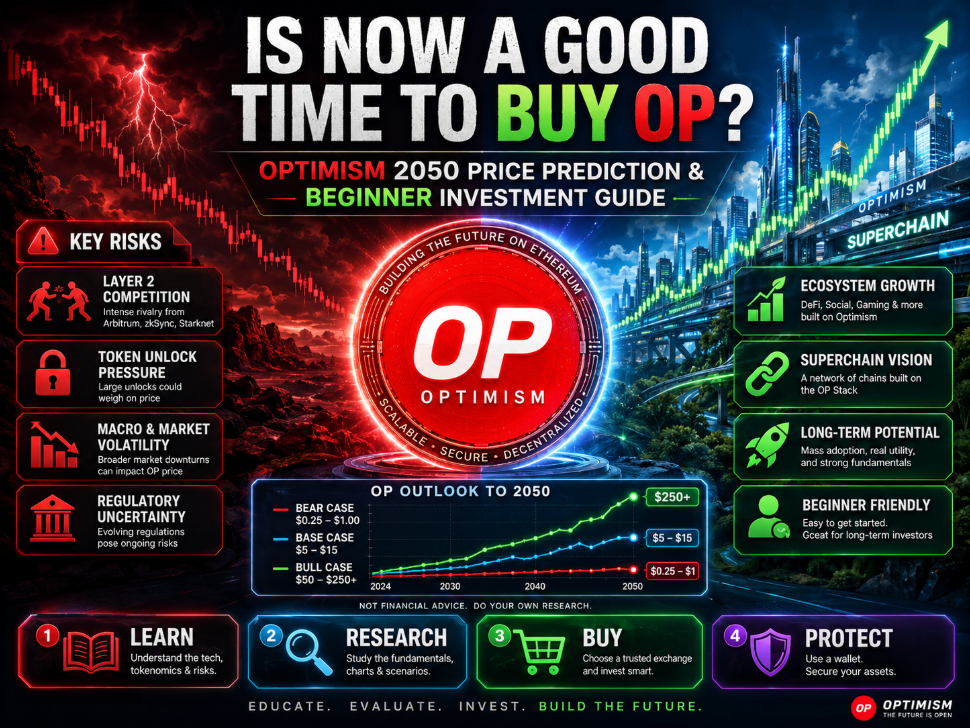
2. Conservative Scenario: OP Becomes a Marginal Governance Token
In the conservative scenario, Ethereum still exists, the L2 market continues to develop, but Optimism is gradually marginalized.
Several things might happen:
- Base continues to grow strongly, but its value is primarily captured by the Coinbase ecosystem.
- Arbitrum maintains leadership in DeFi and derivatives.
- zkSync, Starknet, and other ZK-based routes achieve technical breakthroughs.
- The OP Stack is heavily forked, but the OP token fails to receive sufficient value回流.
- OP governance participation declines, and the token becomes a low-liquidity governance asset.
- Continuous unlocks and incentive dilution suppress the price.
If this happens, by 2050 OP may retain only symbolic governance value and minimal ecosystem revenue expectations.
In the conservative scenario, the OP 2050 price range can be set at $0.05 to $0.50. Assuming a long-term effective circulating supply of 2 billion to 4.3 billion tokens, the corresponding market cap would range from roughly $100 million to just over $2 billion.
The core judgment in this scenario: Optimism's technology remains useful, but the OP token's value accrual fails.
In other words, the project may not disappear, but the token could consistently underperform ETH, BTC, and other stronger assets.
3. Neutral Scenario: Superchain Matures, OP Becomes a Moderate Value-Accrual Asset
In the neutral scenario, Ethereum continues to hold its core settlement layer position, and L2 becomes the mainstream entry point for on-chain applications. Optimism may not be the largest L2, but the Superchain ecosystem develops steadily.
In this scenario, several things might happen:
- The OP Stack continues to be adopted by Base, World Chain, Mode, Zora, Unichain, and other chains.
- Superchain revenue continues to grow.
- OP buybacks, governance, incentives, and public goods funding mechanisms mature gradually.
- The OP token is no longer merely a governance symbol but develops a certain connection to Superchain economic activity.
- Optimism maintains a 10% to 15% market share in the L2 sector.
- OP price is supported not just by narrative but by some revenue and ecosystem data.
If this scenario holds, the OP 2050 price range can be set at $5 to $20. Assuming a long-term effective circulating supply of 2 billion to 4.3 billion tokens, the corresponding market cap would range from roughly $10 billion to $86 billion. This range is not small, but under the premise of "Ethereum becoming a global on-chain settlement layer and L2s carrying large-scale applications," it is not entirely unimaginable.
The key in this scenario is not whether OP Mainnet reclaims the sole top spot, but whether the Superchain as a whole grows large enough and whether the OP token can capture some portion of that value.
4. Optimistic Scenario: Ethereum Becomes Global Infrastructure, Optimism Becomes the Enterprise-Grade L2 Standard
In the optimistic scenario, Ethereum becomes a global on-chain settlement layer. Stablecoins, RWA, payments, gaming, social, enterprise settlement, AI agents, and supply chain finance all enter the on-chain world at scale.
L2 is no longer just a cheap network for DeFi users; it becomes the on-chain infrastructure for global enterprises and applications.
In this case, Optimism may leverage the OP Stack to become one of the mainstream standards for enterprise-grade L2 and application chains. Base, World Chain, Zora, Mode, Unichain, and others form a vast Superchain network. Superchain revenue continues to grow, and the OP token captures stronger value through governance, buybacks, ecosystem allocation, and protocol coordination mechanisms.
If this optimistic scenario holds, the OP 2050 price range can be set at $50 to $200. Assuming a long-term effective circulating supply of 2 billion to 4.3 billion tokens, the corresponding market cap would range from roughly $100 billion to $860 billion. This is an extremely aggressive figure and is only possible if the following conditions are met simultaneously:
- Ethereum becomes one of the global core settlement layers.
- The L2 sector carries trillions of dollars in on-chain economic activity.
- Optimism maintains its core coordinator position within the Superchain.
- The OP token has a clear, sustained, and verifiable value accrual mechanism.
- The market is willing to assign OP a premium valuation similar to "on-chain infrastructure governance assets."
This scenario is not impossible, but its probability should not be overestimated. It requires technology, regulation, ecosystem development, governance, and commercial adoption to all align.
5. How Should You Interpret These Three Predictions?
Many newcomers, when they see price predictions, tend to focus only on the highest number.
For example, seeing **"optimistic scenario $200 by 2050"** and starting to fantasize about a 2,000x return from $0.10.
This is a very dangerous way to read it.
The correct reading is:
- The conservative scenario tells you that OP may suffer a long, slow decline toward irrelevance.
- The neutral scenario tells you that if value accrual improves, OP still has significant room for recovery.
- The optimistic scenario tells you that only if both Ethereum and the Superchain succeed simultaneously can OP enter an ultra-long-term high-valuation zone.
In other words, OP is not "cheap, so you must buy it." It is "high reward, but also high probability of failure."
Similar ultra-long-term forecasting methodologies can also be applied to other Layer 1 assets. If you are interested in the long-term value of parallel EVM and next-generation public chains, you can refer to this analysis using the same prediction framework: SEI Price Prediction 2050.
Part IV: Practical OP Investing: From Exchange Selection to Position Management
1. What Channels Should Beginners Use to Buy OP?
Crypto newcomers typically have three types of channels to buy OP.
The first is centralized exchanges (CEXs), such as HIBT, Binance, and OKX. The advantages of CEXs are simple operation, beginner-friendly interfaces, and direct trading with USDT. The disadvantages are platform risk, account风控 restrictions, and deposit/withdrawal limitations.
HIBT's page shows that it provides OP price quotes, USD conversion, price charts, and a "Trade OP" entry. Related HIBT articles also mention that you can search for the OP/USDT trading pair in the trading terminal and execute trades with market or limit orders.
The second is decentralized exchanges (DEXs), such as Uniswap and Velodrome. The advantage is on-chain self-custody of assets. The disadvantages are that newcomers can easily send funds to the wrong chain, buy fake tokens, or authorize phishing contracts — the operational barrier is higher.
The third is on-chain bridges and ecosystem applications. This is suitable for advanced users already familiar with the Optimism network, wallets, cross-chain bridges, and gas fees. It is not suitable for someone buying OP for the first time.
For newcomers, the safest path is: start by buying a small amount on a centralized exchange, get familiar with trading and withdrawal logic; only after truly understanding wallets and on-chain operations should you consider self-custody.
2. Spot Buying vs. Contract Leverage: Why Should Beginners Avoid Leverage?
OP's price is very low now, so many people get a dangerous illusion: "A $0.10 coin, what's wrong with 10x leverage?"
This is an extremely dangerous thought.
Low price does not equal low risk. A drop from $0.10 to $0.08 is only $0.02, but that's a 20% decline. If you use 5x leverage, you are close to liquidation; if you use 10x leverage, a single small move can wipe you out.
A high-volatility L2 token like OP is best suited for spot trading, not contracts.
Spot buying means that as long as you don't use borrowed funds, don't use leverage, and don't go all-in, even if the price drops short-term, you won't be forcibly liquidated. You still have time to wait for the market to recover, reassess fundamentals, and adjust your position.
The problem with contracts is that they turn a long-term judgment into a short-term life-or-death game.
So, if you truly believe in OP, don't rush to open leveraged positions. Using spot, small positions, and dollar-cost averaging is more suitable for newcomers than high-leverage gambling on a rebound.
3. If You Decide to Allocate to OP, How Should You Design a DCA Strategy?
OP is not suitable for a one-time lump-sum investment; it is better suited for batch DCA or event-driven buying.
Three approaches can be considered:
First, fixed-amount DCA. For example, buy a fixed amount every week or every month, without trying to predict short-term highs and lows. Suitable for newcomers who don't want to watch the market constantly.
Second, drawdown grid buying. For example, divide your planned OP investment into 5 to 10 portions, and buy one portion each time the price drops by a certain percentage. Note: this method must have a total budget cap — you cannot keep adding funds indefinitely.
Third, fundamental-triggered adding. For example, consider increasing your position only when Superchain revenue shows clear growth, the OP buyback mechanism is consistently executed, OP Stack chains like Base show clearer value回流 to OP, or OP Mainnet TVL and trading volume show a clear rebound.
Don't do "emotional DCA":
- Buying because you see others shilling it.
- Chasing because you see a green candle on the chart.
- Constantly adding because it's down.
- No total budget and no stop-loss line.
True DCA is planned buying. Unplanned adding is just enlarging your losses.
4. What Percentage of Your Portfolio Should OP Represent?
For most crypto newcomers, OP should not exceed 5% to 10% of your crypto portfolio.
If you are conservative, OP can be just 1% to 3%, as an L2 sector observation position.
If you already hold ETH and are bullish on the Ethereum L2 sector, consider keeping L2 assets like OP, ARB, and STRK combined within 10% of your portfolio.
If you are already heavily invested in altcoins, you should not be buying OP in large size. Even though OP is one of the leading L2 tokens, it remains a high-volatility, high-uncertainty asset.
A more reasonable portfolio structure would be:
- BTC and ETH as core holdings.
- Stablecoins as defensive reserves.
- OP, ARB, STRK as small L2 sector positions.
- High-risk altcoins and memes in an even smaller proportion.
- Always keep some cash or USDT ready for extreme market conditions.
The essence of position management is: even if OP ultimately fails, it won't affect your long-term survival; if OP ultimately succeeds, a small position can still generate substantial returns.
Part V: OP's "Relatives": An Ethereum Ecosystem Asset Allocation Perspective
1. If You're Bullish on the L2 Sector, Why Not Just Buy OP?
If you are bullish on the Ethereum L2 sector, you don't have to buy only OP.
Several directions are worth watching:
ETH itself is the foundational asset of the entire Ethereum ecosystem. Regardless of how OP, ARB, Base, zkSync, or Starknet compete, most of them still rely on Ethereum as the settlement layer or security anchor.
ARB represents the Arbitrum ecosystem. Arbitrum has stronger liquidity and application depth in DeFi, derivatives, GMX, Pendle, and Aave. DeFiLlama data shows that Arbitrum's DEX and derivatives trading volumes are significantly higher than OP Mainnet's.
STRK represents Starknet's ZK route. Its logic is not Optimistic Rollup but the long-term scaling path of ZK technology maturation.
OP represents the Optimism and Superchain route. Its core is not a single OP Mainnet, but whether the OP Stack can become a common standard for a cluster of L2s and application chains.
So, the truly mature allocation approach is not to bet everything on OP, but to understand the value accrual of each asset type:
- ETH captures Ethereum settlement layer value.
- OP captures Superchain governance and potential revenue回流 value.
- ARB captures Arbitrum ecosystem governance and DeFi depth value.
- STRK captures the long-term technical value of the ZK scaling route.
2. Why Do Many Veteran Players Choose "Buy ETH Instead of L2 Tokens"?
This is a very important question.
Many veteran investors are bullish on L2 but choose to buy ETH directly rather than L2 tokens.
The reason is that the better L2s develop, the more they may reinforce ETH's position as the settlement layer, gas asset, collateral asset, and store of value. But whether L2 tokens themselves can capture value depends on specific tokenomics.
Tokens like OP, ARB, and STRK are often primarily governance tokens. Governance is important, but it doesn't necessarily equate to cash flow.
If an L2 has a large user base, but transaction fees mainly go to sequencers, ecosystem projects, or Ethereum's data availability layer, and the governance token has no clear revenue share, then the token price may not keep up with the chain's growth.
This is the hardest part of L2 investing:
- Being bullish on L2 technology doesn't mean you have to buy L2 tokens.
- Being bullish on the Optimism ecosystem doesn't mean OP will outperform ETH.
- Being bullish on the Superchain doesn't mean OP's value accrual mechanism is fully mature.
3. What Is the Relationship Between the Staking Sector and the L2 Sector?
The Ethereum ecosystem can be broken down into several layers.
- The base layer is ETH itself, responsible for security, settlement, and value foundation.
- The staking layer handles validators, liquid staking, restaking, and yield structures.
- The L2 layer handles scaling, execution, and application hosting.
- The application layer handles DeFi, gaming, social, payments, and RWA.
The staking layer and the L2 layer are not in competition — they are an upstream-downstream relationship.
If ETH staking yields rise, ETH itself becomes more attractive, potentially drawing some funds away from L2 tokens. If the L2 ecosystem thrives, demand for ETH as a settlement layer and security asset may also increase.
In the Ethereum ecosystem's value capture chain, the staking layer and L2 layer are upstream and downstream. If you want to understand the cycle predictions for the staking sector, you can refer to this analysis of Rocket Pool: RPL Price Prediction 2030.
4. Has the Fat Protocol Thesis Failed in the L2 Sector?
Early crypto markets often discussed the "fat protocol thesis": blockchain protocol layers would capture most of the value, while application layers would be relatively thin.
But in the L2 era, this thesis has become more complex.
In the Ethereum ecosystem, ETH as the base protocol asset may still capture a large share of value. L2 networks handle execution and scaling, but L2 tokens may not capture all transaction value the way L1 tokens do.
OP's challenge lies here:
- The Optimism network can be very useful.
- The OP Stack can be widely adopted.
- The Superchain can grow and thrive.
- But the OP token must prove it is not a bystander — it is a value capturer.
This is why we cannot look only at the technical narrative; we must also examine tokenomics and revenue mechanisms.
Part VI: Risk Radar: 5 Fatal Risks You Must Know Before Buying OP
Risk 1: Technology Gets Forked, but Value Doesn't Flow Back to OP
The OP Stack is open-source. This is an advantage, but also a risk.
The advantage is that more projects can use the OP Stack, driving Superchain expansion. The risk is that if everyone can use the OP Stack for free without sufficient value flowing back to OP, then the OP token could become a "free giveaway of public infrastructure."
Base is the most typical double-edged sword.
Base's success proves the OP Stack technical route is attractive, but Base's dominance also makes the market ask: Why focus on the OP ecosystem when you could just focus on Base?
If more OP Stack chains grow strong in the future but the OP token's value accrual mechanism remains weak, OP's price may continue to be undervalued by the market.
Risk 2: Intense Competitive Pressure
Optimism is not facing one opponent — it is facing a group of opponents.
- Arbitrum has depth in DeFi and derivatives.
- Base has Coinbase traffic, user onboarding, and a compliant brand.
- Starknet and zkSync represent the long-term technical vision of the ZK route.
- Other modular chains, appchains, and alt-DA solutions are also competing for developers and users.
Eco's 2026 Arbitrum vs. Optimism comparison notes that Arbitrum remains the L2 with the largest single TVL, while Optimism's advantage lies more in the Superchain shared sequencer alliance and the OP Stack ecosystem.
This means Optimism's differentiation is no longer "I am a cheaper L2," but "I am a standard that can scale into a multi-chain network."
If the Superchain succeeds, OP has a chance to revalue. If the Superchain is siphoned by stronger entry points like Base, OP will remain in an awkward position.
Risk 3: Tokenomic Dilution
OP's unlock schedule extends to 2029, covering investors, core contributors, ecosystem funds, governance funds, partner funds, and other categories.
This means supply pressure is not a short-term issue — it is a multi-year issue.
Even though the price is already very low, as long as market demand is insufficient, new circulating supply can still suppress the price.
Newcomers must understand that tokenomics is not an abstract concept — it directly affects price. A project can have decent fundamentals, but if the token keeps being released, the price can still weaken long-term.
To judge whether OP can withstand the unlock pressure, watch:
- Whether Superchain revenue is growing.
- Whether OP buybacks are being consistently executed.
- Whether ecosystem incentives are attracting real users, not just short-term airdrop farmers.
- Whether long-term holders are willing to continue locking or participating in governance.
- Whether the market is willing to revalue L2 governance tokens.
Risk 4: Regulatory Black Swan
OP is a crypto asset and remains subject to the global regulatory environment.
In March 2026, the U.S. SEC issued a clarification on the applicability of federal securities law to crypto assets and continued to push for clearer boundaries in digital asset regulation. The SEC Crypto Task Force page also noted that its goal is to delineate the boundary between securities and non-securities, and to establish clearer disclosure and registration pathways for crypto assets and market intermediaries.
This shows regulation is becoming clearer, but it does not mean there is no risk.
If regulators in the future impose stricter definitions on certain governance tokens, L2 tokens, staking yields, sequencer revenue, or buyback mechanisms, assets like OP could be affected.
For users in mainland China, additional local virtual currency regulatory risks must be considered. Participating in virtual asset trading itself involves compliance, on/off-ramp, and legal risks — these cannot be judged from price alone.
Risk 5: Liquidity Risk in Extreme Market Conditions
OP is a mainstream L2 token, and under normal conditions its liquidity is not bad. But in extreme market conditions, all altcoins face liquidity discounts.
When markets panic, buy orders thin out quickly and sell orders cluster. If your position is too large, you may not be able to sell at your desired price. If you are using leverage, a sudden price swing can trigger liquidation. If an exchange has risk control measures, withdrawal congestion, or on-chain network issues, you may not be able to execute your plan.
So, the risk of OP is not "can you buy it?" but "how much to buy, how to buy, what to do if it drops, and what to do if you can't sell."
Newcomers must write down the worst-case scenario in advance, not comfort themselves with long-term bullishness after they have already bought.
Conclusion: 3 Actionable Recommendations for Crypto Beginners
OP at around $0.10 is indeed in a very special position right now.
It is not a hot asset — it is a post-abandonment low-priced asset. It is not without fundamentals, but the transmission between fundamentals and token price remains unclear. It is not without opportunity, but the opportunity is backed by high failure probability and high uncertainty.
If you are still interested in OP after reading this article, here are three things you can do in the next 7 days.
First, observe first — don't rush into a heavy position. Open OP price charts, DeFiLlama, Token Terminal, Dune, and the Optimism governance forum. Observe for at least a week. Focus on OP Mainnet TVL, Superchain revenue, Base vs. Arbitrum comparisons, OP unlock schedules, and buyback execution. Token Terminal data shows that OP Mainnet's 30-day fees are approximately $58.7K, with monthly active users around 278.9K — these metrics reflect real usage far better than short-term candlestick charts.
Second, test the trading process with a small amount. If you decide to buy, don't start with a heavy position. You can first buy a very small amount of OP/USDT on HIBT or another centralized exchange, and get familiar with limit orders, market orders, fees, the portfolio page, and the withdrawal process. The first time you buy OP, the goal is not to make money — it is to understand the process.
Third, write down your position discipline. Before buying, clearly write down: what is the maximum amount you will invest? At what drawdown do you stop adding? At what price levels do you take profits in batches? If OP breaks below its all-time low, will you continue holding? If Superchain value accrual does not improve, will you exit?
If you ultimately decide not to buy OP, this article is not a waste of time.
What it gives you is not a single-coin answer, but a framework for analyzing the L2 sector:
- First, check whether the technology is real.
- Then, check whether the ecosystem is growing.
- Then, check whether the token captures value.
- Then, check whether supply is continuously diluting.
- Finally, check whether the price is cheap.
For crypto newcomers, this framework matters more than getting lucky on one OP trade.
Because in the future, you will also encounter ARB, STRK, ZK, MANTA, METIS, LINEA, BASE ecosystem assets, and many more L2 and modular projects. What will truly help you survive long-term is not one lucky bottom-fish, but whether you can distinguish the difference between a "good project" and a "good token."
OP may be a high-reward opportunity, or it may be a value trap. Before the answer is revealed, the most rational approach is not to go all-in, but to use small positions, long time horizons, and strong discipline.
This article is for informational and educational purposes only and does not constitute investment advice, legal advice, or tax advice. OP, Optimism, L2 tokens, and all crypto assets carry risks of price volatility, liquidity, compliance, technology, governance, and loss of principal. Before making any trades, please make prudent decisions based on the legal requirements of your jurisdiction, your personal risk tolerance, and independent judgment.