
If you're researching whether CAKE is still worth buying in 2026, start with one core reality: CAKE is no longer the token it was in 2021 — the one that soared purely on high APY, yield farming hype, and BNB Chain tailwinds.
It once ran from under $0.20 to over $40, and it also fell more than 90% from its all-time high. For years, CAKE's biggest structural problem was high emissions, persistent inflation, and an incentive model overly dependent on mining yields. But heading into 2025–2026, PancakeSwap has been clearly shifting its narrative — from "high-yield farm" toward "multi-chain DEX + deflationary tokenomics + on-chain trading infrastructure."
As of June 30, 2026, CAKE is trading around $1.32, still deeply below its all-time high. CoinGecko shows CAKE's historical peak at approximately $43.96, meaning the current price is roughly 97% below that level. Circulating supply sits at approximately 320 million tokens, with a hard cap of 400 million.
What does this mean in practice?
On one hand, CAKE isn't a forgotten ghost coin — it still powers one of the most active DEXes in crypto. On the other hand, it's not a risk-free "deep value" play either, because DEX competition, regulatory pressure, BNB Chain ecosystem cycles, and evolving fee models all have the potential to shape CAKE's price trajectory over the next two-plus decades.
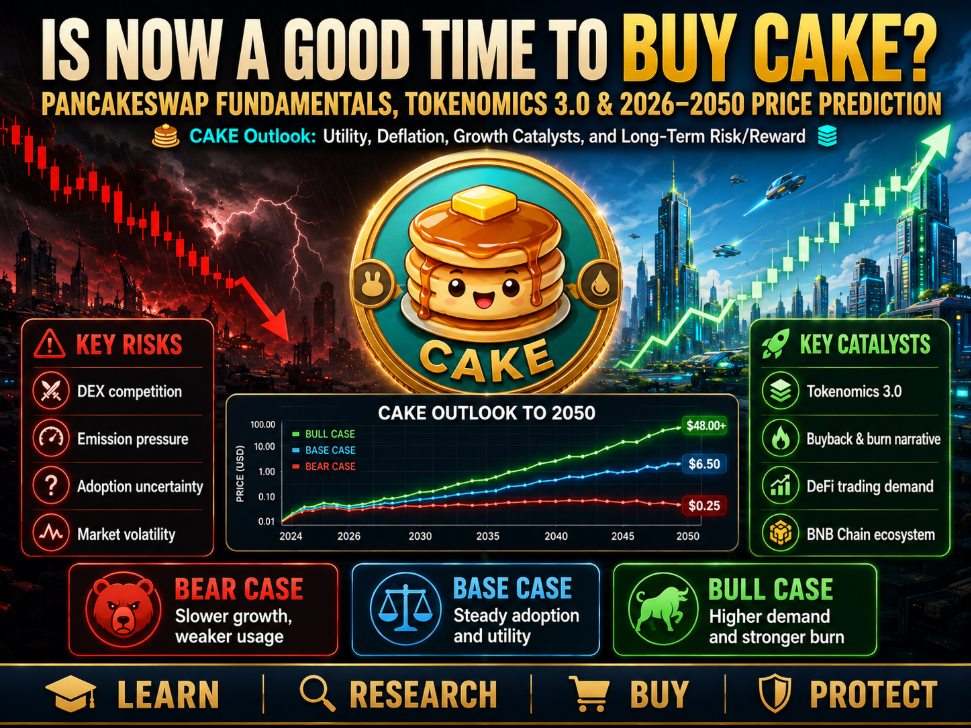
This article covers seven angles — CAKE's project fundamentals, tokenomics, competitive moats, price history, 2026–2030 medium-term forecasts, 2030–2050 long-range scenarios, and how to buy CAKE on HiBT — to give you a systematic answer to the central question: is now a good time to buy CAKE?
1. What Is CAKE? Why Is It Back on Investors' Radar in 2026?
CAKE is the native token of PancakeSwap. PancakeSwap is a decentralized exchange, or DEX. Unlike centralized exchanges like Coinbase or Binance, PancakeSwap doesn't custody user assets — users interact directly with smart contracts via their wallets. And unlike traditional order book exchanges, PancakeSwap primarily uses an Automated Market Maker (AMM) model, where trades are executed against liquidity pools rather than matched between buyers and sellers placing orders.
A quick comparison to frame it:
Coinbase is more like a regulated online crypto brokerage — users hold assets in platform accounts and trade through the platform.
Uniswap is the most iconic DEX in the Ethereum ecosystem and the protocol that defined the AMM model.
PancakeSwap started as a Uniswap fork on BNB Chain but has since evolved into a multi-chain DEX covering trading, liquidity provision, yield farming, prediction markets, limit orders, cross-chain swaps, RWA trading, and more.
According to official documentation, PancakeSwap is now a multi-chain decentralized trading platform available on ten chains including BNB Chain, Ethereum, Solana, Base, Arbitrum, Aptos, ZKsync, Linea, Monad, and opBNB. The platform's core use cases are summarized officially as "Trade, Earn, Win" — covering trading, yield generation, and gamified products.
What Is CAKE Actually Used For?
CAKE is not required to use PancakeSwap. You can swap tokens on the platform without holding any CAKE. It functions more as a governance and incentive token within the PancakeSwap ecosystem.
CAKE's primary use cases include:
- Voting in PancakeSwap ecosystem governance
- Participating in certain yield programs, incentive campaigns, and ecosystem product activities
- Serving as a core asset in liquidity mining, IFOs, lotteries, and prediction markets
- Connecting to platform trading volume through the burn mechanism
Binance Academy's PancakeSwap overview also notes that CAKE is the native utility and governance token of the PancakeSwap ecosystem, used for yield farming, governance voting, lotteries, and prediction markets — while the platform continuously runs a CAKE burn mechanism to reduce circulating supply.
So CAKE's long-term value doesn't come from "users needing to buy CAKE to trade." It comes down to two questions:
First: Will PancakeSwap continue to generate enough trading volume and ecosystem influence to matter?
Second: Can CAKE's burn, emission, and governance mechanisms effectively translate platform growth into token value?
Why Is CAKE Getting Attention Again in 2026?
CAKE's return to investor attention in 2026 isn't primarily about a sudden price spike — it's about a shift in PancakeSwap's fundamental narrative.
Change one: AI tools. In March 2026, PancakeSwap launched PancakeSwap AI Skills, a toolkit designed to help AI agents plan token swaps, liquidity positions, and yield farming strategies. The toolkit includes a Swap Planner, Liquidity Planner, and Farming Planner, operating across multiple chains.
Change two: Stablecoin and liquidity incentives. From June 19 to July 18, 2026, Binance Wallet and WLFI launched a USD1 ecosystem incentive program with a total reward pool of 16 million WLFI, with PancakeSwap's sUSD1+/USD1 liquidity pool eligible to share 800,000 WLFI in LP rewards.
Change three: StableSwap and RWA. PancakeSwap documentation shows that Infinity StableSwap, built on PancakeSwap's latest Infinity architecture, is designed to deliver lower-slippage trading for assets with near-pegged prices like stablecoins and liquid staking tokens. Meanwhile, PancakeSwap X already supports trading of over 100 tokenized stocks, bonds, and ETFs through Ondo Finance, placing PancakeSwap squarely in the RWA trading infrastructure narrative.
These developments position CAKE less as a legacy DeFi token and more as a DEX platform coin attempting a genuine valuation reset.
2. CAKE's Tokenomics Overhaul: What Did Tokenomics 3.0 Actually Change?
If you only look at CAKE's current price, it looks weak. But looking at price alone means missing PancakeSwap's most important development over the past year: Tokenomics 3.0.
CAKE's earliest and biggest structural flaw was excessive emissions. To attract liquidity, PancakeSwap rewarded LP providers and farm participants heavily with CAKE. This model worked well in bull markets — high yields pulled in capital. But in bear markets, it created relentless sell pressure. The more CAKE that got mined, the more buy-side demand was needed to absorb it.
This is a problem that hit many legacy DeFi tokens: the protocol has users, but the token gets continuously diluted; the platform has trading volume, but the token doesn't necessarily benefit.
Why Was the Old veCAKE Model Scrapped?
The veCAKE design aimed to boost governance participation and long-term alignment through token locking. But for ordinary users, lock-up models are complex, carry a high barrier to entry, restrict liquidity, and tend to be dominated by large holders and professional strategy operators.
Tokenomics 3.0 moves toward reducing the complex lock-up system and repositioning CAKE as a simpler, more direct token with a stronger emphasis on supply contraction.
The April 2025 CAKE Tokenomics Proposal 3.0 explicitly called for reducing daily emissions, improving burn efficiency, and targeting approximately a 20% reduction in CAKE's total supply over the following five years. The proposal planned to cut daily total emissions from approximately 40,000 CAKE to approximately 22,250 CAKE — reducing annual emissions from roughly 14.6 million tokens to roughly 8.1 million.
This isn't a minor tweak. It's a structural inflection in CAKE's supply curve.
Three Core Changes Under Tokenomics 3.0
First: Emissions reduction.
Daily CAKE emissions dropping from 40,000 to 22,250 tokens means significantly less new supply pressure going forward. For long-term holders, the bigger fear isn't short-term price swings — it's the protocol continuously inflating the token. Cutting emissions at least addresses part of the "too much new CAKE" problem.
Second: Ongoing burns.
PancakeSwap aims to continuously burn CAKE through trading fees, prediction markets, lotteries, IFOs, and ecosystem revenue. The official 2025 annual recap showed approximately 8.19% annualized deflation, with net burns of approximately 31.6 million CAKE across 2025. The recap also noted 28 consecutive months of net supply reduction since September 2023, with approximately 37.6 million CAKE permanently destroyed in total.
Third: Hard cap compression.
PancakeSwap's official documentation shows the hard cap has been set at 400 million CAKE. A supply cap adjustment proposal introduced on January 16, 2026 reduced the maximum supply from 450 million to 400 million tokens — and passed successfully.
This matters to ordinary holders. The clearer the maximum supply, the easier it becomes to build a long-term valuation framework. This doesn't make CAKE moon immediately, but it reduces long-term dilution uncertainty.
What Does "Ultrasound CAKE" Actually Mean?
"Ultrasound CAKE" is PancakeSwap's branding for its deflationary tokenomics direction. The term borrows from the post-EIP-1559 Ethereum "ultrasound money" narrative — the idea that fee-driven burns can shift an asset from long-term inflationary to low-inflation or even deflationary.
PancakeSwap's goal is for CAKE burns to consistently exceed new emissions. Official documentation states the team's intention to embed deflationary mechanics across PancakeSwap products so that the amount of CAKE leaving circulation exceeds the amount being created.
But there's a critical prerequisite: the burn mechanism only works if there's real usage. If PancakeSwap's trading volume declines, fee revenue shrinks, and ecosystem products go quiet, burn pressure drops too.
CAKE's deflation is not a static guarantee — it's a dynamic mechanism.
3. PancakeSwap's Competitive Moat: Why Is It Still Standing in the DEX Wars?
Predicting CAKE's price in 2030, 2040, or 2050 requires more than studying tokenomics. The more important question is: will PancakeSwap still be a mainstream DEX by then?
If PancakeSwap gets displaced by Uniswap, Aerodrome, Hyperliquid, Raydium, or a new cross-chain trading protocol, no amount of elegant tokenomics will sustain CAKE's long-term price.
PancakeSwap's First Moat: Volume and Brand Mindshare
PancakeSwap staged a notable recovery in 2025. The official 2025 annual recap showed four consecutive quarters of record trading volume — Q1 at $205 billion, Q2 at $529 billion, Q3 at $772 billion, and Q4 at $856 billion — finishing 2025 as the number one DEX by total market share at 37.84%.
The Block also reported that PancakeSwap recorded $151 billion in spot trading volume in June 2025, capturing over 43% of all spot DEX volume, with July volume reaching $188 billion — roughly double Uniswap's $94 billion.
This shows PancakeSwap is no longer just a BNB Chain incumbent. It's demonstrated the capacity to lead total DEX volume during key market windows.
Second Moat: Multi-Chain Expansion
PancakeSwap's multi-chain push isn't simply "deploying contracts everywhere." The real significance is that users are no longer tied to one chain, and liquidity is no longer confined to a single ecosystem.
Binance Academy notes that PancakeSwap has expanded from a BNB Smart Chain DEX in 2020 to operating across Ethereum, Base, Arbitrum, Polygon zkEVM, zkSync Era, Linea, opBNB, Aptos, Solana, and more.
This creates three structural advantages:
- It can follow users as they migrate to new chains and Layer 2s
- It can capture long-tail token trading across different ecosystems
- It can replicate its brand, routing logic, liquidity, and incentive architecture across chains
But multi-chain expansion carries real risks too. Every chain has its own native DEX powerhouse — Aerodrome on Base, Raydium and Orca on Solana, Uniswap and Curve in the Ethereum ecosystem. Deploying on more chains doesn't automatically mean winning deep liquidity. PancakeSwap has to continuously earn users' business through better pricing, lower slippage, and stronger incentives.
Third Moat: PancakeSwap Infinity and Trading Experience Upgrades
PancakeSwap Infinity is the protocol's most significant technical upgrade in years. Public reporting shows Infinity launched on BNB Chain and Arbitrum in April 2025, introducing hooks, dynamic fee tiers, customizable liquidity pool parameters, and on-chain limit orders. Reports also noted the upgrade cut pool creation costs by up to approximately 99% and enabled more flexible liquidity strategies.
This matters for CAKE's long-term value because DEX competition ultimately comes down to three things:
- Who delivers better execution prices
- Who minimizes slippage and gas costs
- Who makes it easier for LPs to earn real yield
If Infinity consistently improves the trading experience, PancakeSwap's volume, fee revenue, and CAKE burn rate all have room to improve.
Where Does PancakeSwap's Biggest Threat Come From?
First, Uniswap remains the strongest brand competitor. CoinGecko research showed Uniswap reclaiming the top DEX position in August 2025 with approximately 35.9% market share, while PancakeSwap held approximately 29.5% in the same month. DEX rankings shift quickly based on on-chain capital flows, incentive programs, and market hot spots — PancakeSwap's lead is not permanent.
Second, Layer 2-native DEXes are rising. Base, Arbitrum, and Solana each have their own core liquidity hubs, making it genuinely difficult for PancakeSwap to capture meaningful share in those ecosystems.
Third, regulatory and compliance risk could weigh on DEX token valuations. If regulators require frontend restrictions, KYC, geoblocking, or stricter definitions of governance tokens, CAKE's valuation logic takes a hit.
Fourth, governance centralization risk deserves attention. Even in a decentralized protocol, voting power concentration among large holders can effectively dictate critical proposals. Long-term investors can't just check "community vote passed" — they need to assess whether voting power distribution is actually healthy.
4. CAKE Price History: From $0.19 to $43.96, Back to $1 — What History Tells Us
CAKE's price history is a perfect case study in one of crypto's most important lessons: DeFi tokens can rally extraordinarily fast — and fall just as far.
CoinGecko shows CAKE's historical low at approximately $0.1944 and its all-time high at approximately $43.96, reached in April 2021. Anyone who bought near the bottom and sold near the top made extraordinary returns. Anyone who bought near the 2021 high and held long-term is still sitting on a massive drawdown.
Why Did CAKE Rally to $40+ in 2021?
Four main drivers:
- 2021 was the height of the DeFi bull market and BNB Chain's explosive growth phase, with large numbers of retail traders fleeing Ethereum's high gas fees.
- PancakeSwap offered extremely high yield farming APYs at the time, pulling in substantial liquidity.
- CAKE, as the platform's core token, captured dual tailwinds: BNB Chain ecosystem growth and yield farming narratives.
- In a bull market, investors were willing to pay premium multiples for "platform token + yield farm + ecosystem leader" positioning.
Why Did It Fall So Hard Afterward?
The reasons are equally clear:
- DeFi yield rates declined during the bear market, triggering capital outflows
- High emissions kept sustained sell pressure on CAKE
- DEX competition intensified as users migrated across chains
- The 2021 peak embedded an enormous bull market premium
- Once yield farming hype faded, the market began reassessing CAKE's actual value-capture capability
This is also why Tokenomics 3.0 matters so much. It's not an incremental upgrade — it's an attempt to fix CAKE's most fundamental structural problems of recent years: excess supply pressure and insufficient value capture.
Where Is CAKE in Its Cycle Right Now?
In terms of price positioning, CAKE is clearly in a historically low range — far from any bull market overvaluation zone. From a technical standpoint, CoinCodex data updated June 29, 2026 shows CAKE trading around $1.34, with a 14-day RSI of approximately 49.11 — squarely in neutral territory. The 50-day moving average sits around $1.38 and the 200-day moving average around $1.55, indicating price hasn't yet completed a strong trend reversal.
This suggests CAKE is more in a "low-level recovery observation phase" than a confirmed bull impulse.
Short-term traders are watching whether the $1.40–$1.55 resistance zone can be broken on volume.
Medium-term investors are tracking whether weekly burn data, trading volume, and BNB Chain activity show sustained improvement.
Long-term holders are working through the key question: will PancakeSwap maintain a mainstream DEX position by 2030?
5. CAKE Price Predictions 2026–2030: Where Could It Go Over Three to Four Years?
Predicting CAKE shouldn't be reduced to a single number. The right approach uses a multi-scenario framework: bear case, base case, and bull case each grounded in different assumptions.
2026 Price Forecast: A Recovery Year, Not a Confirmation Year
CAKE's three core variables in 2026:
- Whether Tokenomics 3.0 continues to deliver net burns
- Whether BNB Chain and PancakeSwap trading volumes stay elevated
- Whether AI tools, RWA, StableSwap, and Binance Wallet incentives drive real users — not just short-lived campaign traffic
Bear case: If the broader crypto market remains depressed, CAKE may consolidate in the $1.10–$1.60 range. In this scenario, tokenomics reform can slow sell pressure but won't catalyze a strong rally.
Base case: If BTC and BNB Chain activity stays stable and PancakeSwap volume holds at higher levels, CAKE has a path back toward the $2.00–$3.50 range. This would represent a valuation reset rather than a bubble rerun.
Bull case: If BNB Chain re-establishes itself as the go-to chain for retail on-chain activity, PancakeSwap maintains high DEX volume, and CAKE burns build a compelling deflationary narrative, reaching $5–$14 by end of 2026 isn't completely out of the question. But this scenario requires multiple catalysts aligning simultaneously — it shouldn't be treated as a base case.
CoinCodex's algorithmic model (updated June 29, 2026) projects CAKE at approximately $3.30 by end of 2026, $3.64 by 2030, $5.12 by 2040, and $8.70 by 2050. This model skews conservative — it reads more as a historical volatility and technical extrapolation than a bull scenario projection.
2027–2028 Price Forecast: If a Bull Market Returns, What's the Realistic Target?
The pivotal factor for 2027–2028 is whether crypto enters a new liquidity expansion cycle. If BTC, ETH, BNB, and Solana enter a broad bull market, DeFi platform coins tend to play catch-up with a lag.
Bear case: CAKE may trade between $1.50–$2.50. This implies PancakeSwap is still alive but the market isn't willing to award legacy DeFi any premium.
Base case: CAKE has a path into the $4–$8 range. This requires PancakeSwap to sustain strong trading volumes, CAKE net burns to keep advancing, and the market to accept the "DEX revenue + deflationary platform coin" narrative again.
Bull case: CAKE could challenge the $15–$30 range. This doesn't require CAKE to fully reclaim its all-time high, but it does require DeFi narratives to regain mainstream mindshare and PancakeSwap to hold its position near the top of multi-chain DEX rankings.
2030 Price Forecast: Can CAKE Reclaim Its ATH?
2030 is the pivotal medium-term milestone for CAKE, because PancakeSwap has set a stated goal of reducing total CAKE supply by approximately 20% by 2030. The official 2025 annual recap explicitly cited Tokenomics 3.0's targets as approximately 4% annualized deflation and approximately 20% supply reduction by 2030.
Bear case for 2030: CAKE in the $2–$4 range. This implies PancakeSwap is still operating but multi-chain competition is fierce, and CAKE only receives a modest valuation recovery.
Base case for 2030: CAKE in the $7–$15 range. This requires PancakeSwap to maintain mainstream DEX status, CAKE deflation to execute consistently, and RWA plus stablecoin trading to generate incremental fee revenue.
Bull case for 2030: CAKE in the $30–$85 range. This means CAKE doesn't just recover — it re-enters the DeFi blue-chip asset narrative and potentially approaches or challenges the previous cycle's high. To get there, PancakeSwap must prove it's not just BNB Chain's DEX, but cross-chain financial infrastructure.
For a dedicated medium-term model breakdown, check out HiBT's CAKE Price Prediction 2030 to compare different forecasting approaches to the 2030 price range.
6. CAKE Price Predictions 2030–2050: What Could CAKE Be Worth in 24 Years?
2050 predictions require genuine caution. From 2026 to 2050 is 24 years — enough time for regulatory frameworks to completely transform, DEX technology to be replaced, BNB Chain to rise or fade, and PancakeSwap to potentially evolve into something unrecognizable from what it is today.
2050 predictions shouldn't be read as "this is what the price will be." They're better understood as "what valuation range might CAKE occupy under different world scenarios."
2035: Does DeFi Enter a Mature Phase?
If by 2035, DeFi has become part of the global financial fabric — where DEXes are no longer just venues for retail traders to trade altcoins, but infrastructure for stablecoins, RWAs, tokenized stocks, bonds, on-chain funds, and derivatives — then PancakeSwap still has a plausible path to maintaining an important position.
In that scenario, CAKE's valuation anchor may no longer just be "platform coin," but "on-chain trading infrastructure token."
But if by 2035, DEX frontends face strict regulation, volume migrates to more compliant institutional-grade platforms, or new trading models replace AMMs — CAKE's long-term valuation faces meaningful headwinds.
2040: Is PancakeSwap Even the Same Platform?
By 2040, PancakeSwap almost certainly won't look like it does today. It may have evolved into an on-chain RWA trading network, a stablecoin liquidity layer, a multi-chain trading aggregator, or even some form of AI agent financial execution infrastructure.
For CAKE to be trading above $50 by 2040, several conditions would need to hold:
- PancakeSwap remains one of the world's largest DEXes or on-chain trading networks
- Total CAKE supply has continued to fall, with circulating supply meaningfully below current levels
- Platform trading fees, RWA volume, and stablecoin swap revenue keep growing
- CAKE has developed a stronger link to protocol revenue rather than serving mainly as a governance token
- BNB Chain hasn't been materially undermined by regulatory risk or technological displacement
If only some of these conditions are met, CAKE's 2040 price may represent modest appreciation. If all are met, it has a genuine shot at re-challenging the tens-of-dollars range or higher.
Three Scenarios for 2050
Conservative scenario: CAKE at $8–$25.
This scenario assumes DeFi still exists but growth has slowed; PancakeSwap retains a meaningful market share but is no longer an undisputed leader; regulation has placed constraints on DEX frontends; CAKE's deflationary mechanism continues functioning but trading volume isn't sufficient to drive aggressive burns. Under this outcome, CAKE outperforms its current price, but doesn't revisit peak bull market valuations.
Base scenario: CAKE at $50–$150.
This scenario assumes BNB Chain and multi-chain DeFi continue expanding through the 2030s; PancakeSwap becomes an important platform for stablecoin, RWA, and long-tail asset trading; CAKE supply keeps declining, potentially dropping below 250 million tokens in circulation; platform fee revenue and ecosystem products create a stable burn pipeline. Under this outcome, CAKE is no longer just a legacy DeFi token — it's a multi-chain financial infrastructure token.
Optimistic scenario: CAKE at $200–$800.
This scenario requires global DeFi user adoption to reach hundreds of millions or even a billion users; DEXes to become a significant trading network alongside traditional finance; PancakeSwap to maintain long-term leadership within that ecosystem. CAKE would also need to complete a highly successful value-capture reform, creating a closed loop between trading volume, fee revenue, burns, and token demand. Not impossible — but the execution bar is extremely high. This shouldn't be any ordinary investor's baseline assumption.
Extreme bull scenario: CAKE above $1,000.
This requires very aggressive macro assumptions: crypto assets become an important component of the global reserve asset system, DeFi displaces meaningful portions of traditional financial infrastructure, PancakeSwap becomes a cross-chain trading standard, CAKE supply gets dramatically compressed, and CAKE acquires something resembling exchange equity or protocol revenue certificate-level value capture. For ordinary investors, the extreme bull scenario belongs in the "upper bound imagination" box — not an investment thesis.
Five Unknown Variables That Shape the 2050 Outlook
- How global regulation defines DEXes and governance tokens. If future regulators classify DEX governance tokens as securities or impose stringent compliance requirements, CAKE's valuation logic changes significantly.
- BNB Chain's long-term vitality. If BNB Chain sustains high active user counts and a low-cost trading environment, PancakeSwap benefits. The reverse would drag CAKE down with it.
- Whether AMMs get replaced by new trading models. More efficient on-chain order books, intent-based trading networks, AI market-making systems, or cross-chain settlement layers could all emerge.
- Whether CAKE governance is sufficiently decentralized. If major decisions are consistently driven by a small number of large holders, the market may assign CAKE a lower governance premium.
- Whether PancakeSwap can make CAKE genuinely capture platform value. If platform volume is strong but the token only serves a thin governance function, upside is limited.
7. Is Now the Right Time to Buy CAKE? A Mid-2026 Entry Decision Framework
Whether now is a good time to buy CAKE isn't a question with a universal answer. More precisely: CAKE is currently in a low-level recovery phase, and it holds medium-to-long-term observation value — but it's not something to go heavy into blindly.
Technically, CAKE Is Waiting for Directional Confirmation
CAKE is currently trading around $1.32–$1.34. CoinCodex data shows a 14-day RSI of approximately 49 — neutral, not significantly overbought or oversold. The 50-day moving average sits around $1.38 and the 200-day around $1.55, meaning price hasn't yet reclaimed either key trend line.
Short-term traders should focus on:
- Whether $1.31–$1.33 consistently holds as support
- Whether $1.40–$1.41 can be broken on meaningful volume
- Whether $1.55–$1.57 becomes a confirmed trend reversal level
If CAKE breaks below $1.30 on elevated volume, the short-term structure has weakened. If CAKE breaks above $1.55 on strong volume and holds, that's more consistent with a medium-term recovery getting underway.
How Does CAKE's Risk/Reward Compare to Other DeFi Tokens?
CAKE's advantages: PancakeSwap has real trading volume, tokenomics is shifting toward deflation, the hard cap has been compressed to 400 million tokens, and multi-chain plus RWA narratives provide new growth optionality.
CAKE's disadvantages: DEX competition is fierce, CAKE has underperformed for an extended period, market confidence in legacy DeFi tokens is low, and PancakeSwap's fortunes are closely tied to the BNB Chain ecosystem.
If you want to compare the long-term prediction logic for another DeFi protocol token, check out the RPL Price Prediction 2030. RPL represents the Ethereum liquid staking infrastructure thesis, while CAKE represents the DEX trading infrastructure thesis — completely different risk sources, but worth examining side by side across the same time horizon.
Strategy Frameworks for Three Investor Types
If you're a short-term trader: CAKE is better approached by waiting for a confirmed breakout rather than buying just because it looks cheap. Watch key resistance levels at $1.40 and $1.55 — look for volume to confirm any move through those levels. Short-term trading requires a stop-loss, because CAKE's price history makes clear it's anything but a low-risk asset.
If you're a medium-term investor with a 1–3 year time horizon: consider a phased entry strategy. Don't deploy your full position at once. Add to it gradually when price pulls back to support, when weekly burn data improves, and when PancakeSwap trading volume trends up. Medium-term investors should focus on whether fundamentals actually materialize — not on watching candles every day.
If you're a long-term holder with a 5+ year time horizon: the real question isn't whether CAKE goes up tomorrow. It's whether PancakeSwap will still be mainstream on-chain trading infrastructure after 2030. If you believe the answer is yes, CAKE's current low level deserves serious study. If you don't believe PancakeSwap can survive and thrive in the long-run DEX wars, low price alone isn't a buy thesis.
What Near-Term Catalysts Could Move CAKE?
- The WLFI incentive program could boost short-term liquidity in PancakeSwap's stablecoin pools
- AI Skills and AI agent tools, if actually adopted by developers and users, could strengthen PancakeSwap's product narrative
- If RWA trading keeps growing, PancakeSwap gains a new source of fee revenue
- If CAKE's weekly burns consistently exceed emissions, the deflationary thesis gets reinforced in the market
- If BTC, BNB, and the broader DeFi sector enter a relief rally cycle, CAKE could attract catch-up capital
What Risk Events Could Weigh on CAKE?
- BNB Chain activity declining
- PancakeSwap trading volume being overtaken by Uniswap, Aerodrome, Hyperliquid, or other platforms
- CAKE burn rate declining and the deflationary narrative breaking down
- Regulatory restrictions on DEX frontends or RWA trading
- Governance proposals triggering market concern over centralized decision-making
- The broader crypto market entering a deep bear cycle
8. How to Buy CAKE on HiBT: A Complete Beginner's Guide from Registration to Holding
If you've worked through the risks and decided to take a small position, you can buy CAKE through HiBT's CAKE/USDT spot trading pair. Compared to going directly on-chain to a DEX, an exchange path is more beginner-friendly — you don't need to configure wallet networks, copy contract addresses, adjust slippage, or assess whether a liquidity pool is legitimate.
That said: platform services, KYC requirements, deposit options, and trading rules may vary by region. Always use what's displayed on the HiBT platform as your reference.
Step 1: Register a HiBT Account
Go to the HiBT website or app and sign up with an email or phone number. After registering, set up account security right away: login password, withdrawal password, two-factor authentication, and an anti-phishing code.
Don't skip security setup to chase a price move. Protecting your account before you buy is the most basic layer of risk management.
Step 2: Complete KYC Verification
Go to the identity verification page and follow the prompts to submit your ID documentation and facial recognition. You'll typically need a government-issued ID, basic personal information, and a biometric scan.
Once KYC is complete, your account will generally unlock full deposit, withdrawal, and trading permissions. Processing times vary by region — follow the platform's prompts for current timelines.
Step 3: Deposit USDT
CAKE is most commonly traded against USDT, so you'll need USDT in your account first.
You can purchase USDT through a fiat on-ramp if HiBT supports that in your region, or transfer USDT from another exchange or wallet via on-chain transfer. When doing an on-chain transfer, always verify that your network selection is consistent — TRC20, ERC20, BEP20, and other networks are not interchangeable.
If you're withdrawing USDT from an external platform to HiBT, confirm three things:
- The deposit address is exactly correct
- The selected network matches on both sides
- Whether a Memo or Tag is required
An error on any one of these can result in funds that can't be recovered.
Step 4: Search for the CAKE/USDT Trading Pair
Once your deposit clears, go to the spot trading section and search for CAKE to find the CAKE/USDT pair.
Before placing an order, check three things:
- Whether the current price is near a short-term support or resistance level
- Whether the bid-ask spread in the order book looks normal
- Whether 24-hour trading volume is sufficient
If price is in the middle of a rapid pump, don't chase it with a market order. CAKE isn't an extreme micro-cap meme coin, but it can still see meaningful slippage during volatile periods.
Step 5: Use Limit Orders and Build In Phases
For beginners, limit orders are better suited for CAKE than market orders.
For example, if the current price is around $1.32 and you want to be cautious, consider spreading your entry across multiple orders:
- A small initial position near the current price as a starter
- A second add when price pulls back to support
- A third entry after price confirms a break above key resistance on volume
This approach might mean you miss a straight-up rally, but it reduces the risk of buying into a temporary spike.
Step 6: Set Price Alerts and Define Your Stop-Loss Logic After Buying
After buying CAKE, don't just sit back and wait for gains. Immediately record:
- Your average entry price
- Total capital invested
- Maximum loss you're willing to accept
- Your planned stop-loss level
- Phased take-profit targets
For example, if you're willing to accept a maximum 15% loss, execute your stop plan when price hits that level — don't talk yourself into averaging down in the moment.
After Buying: Keep on HiBT or Move to a Wallet?
If you're a short-term or medium-term trader, keeping your CAKE on HiBT is more convenient for placing orders and managing stops and targets.
If you're a long-term holder and comfortable with private key management, you can consider withdrawing to a self-custody or cold wallet. Just make sure you've confirmed the withdrawal network, destination address, and that CAKE is supported correctly.
For most beginners, avoiding operational mistakes should take priority over pursuing maximum on-chain autonomy.
Appendix A: CAKE Quick-Reference Data Sheet
As of June 30, 2026, here are the key facts:
Token name: PancakeSwap Ticker: CAKE Core platform: PancakeSwap Project type: Multi-chain decentralized exchange, AMM, DeFi trading infrastructure Primary ecosystem: BNB Chain, plus Ethereum, Base, Arbitrum, Solana, Aptos, ZKsync, Linea, opBNB, and more Current price: Approximately $1.32–$1.34 All-time high: Approximately $43.96 (CoinGecko, April 30, 2021) All-time low: Approximately $0.1944 (CoinGecko, November 3, 2020) Hard cap: 400 million CAKE Current circulating supply: Approximately 320 million CAKE (verify against live market data) Daily emissions post-Tokenomics 3.0: Approximately 22,250 CAKE Official deflation target: 4% annualized deflation, targeting 20% supply reduction by 2030 HiBT trading pair: CAKE/USDT Key bullish factors: Trading volume foundation, deflationary mechanics, multi-chain expansion, RWA and stablecoin trading narratives Key risks: DEX competition, regulatory pressure, BNB Chain dependency, governance concentration, long-term technological displacement
Appendix B: CAKE 2050 Investment Decision Checklist
Before deciding to buy CAKE, ask yourself these questions:
- Do I understand that CAKE is a high-risk crypto asset, not a capital-protected product?
- Do I know that CAKE once fell from $40+ to around $1?
- Do I understand PancakeSwap's DEX model, AMM mechanics, and liquidity pool risks?
- Do I understand that CAKE's price appreciation requires sustained PancakeSwap trading volume and burn mechanics?
- Do I understand that 2050 price forecasts are highly uncertain and cannot be treated as guaranteed returns?
- Have I set a stop-loss and take-profit plan?
- Is my capital for this purchase discretionary — money I can afford to lose without affecting my life?
- Am I using a phased entry strategy rather than going all-in at once?
- Will I continue to track CAKE's weekly burns, PancakeSwap trading volume, and BNB Chain activity over time?
- Am I buying based on research and conviction — not because I saw someone else's profit screenshot?
Conclusion: Is Now a Good Time to Buy CAKE?
If you're a complete newcomer: CAKE shouldn't be a heavy position. It has more fundamental backing than a pure meme coin, but it's still a high-volatility DeFi token.
If you're a short-term trader: Right now is better suited for waiting on a confirmed breakout — particularly watching whether the $1.40 and $1.55 resistance levels can be cleared on meaningful volume.
If you're a medium-term investor: CAKE can be treated as a "low-level DeFi recovery candidate," with a phased entry approach rather than going all-in.
If you're a long-term holder: The real judgment call isn't whether CAKE goes up tomorrow. It's whether PancakeSwap will still be mainstream on-chain trading infrastructure after 2030. If you believe it will, CAKE's current level genuinely warrants research. If you don't believe PancakeSwap can survive the long-run DEX wars, price alone isn't a reason to buy.
One-sentence summary: CAKE is worth watching, worth a small phased position for research purposes — but it's not something to go heavy into blindly. Its future depends on whether PancakeSwap can convert real trading volume, sustained burns, multi-chain expansion, and the emerging RWA narrative into durable long-term value for CAKE holders.