
If you are searching for "IDOL coin" for the first time, the biggest pitfall you'll encounter isn't price volatility—it's finding the wrong project.
This is because there is more than one token called IDOL on the market. Besides MEET48 (IDOL), which this article covers, there are other projects with the same or similar names, such as IDOLVERSE. If newcomers only look at the ticker symbol without verifying the contract address and the project entity, they can easily confuse different tokens, or even buy an asset that is completely unrelated to what they intended to research.
The IDOL discussed in this article specifically refers to the IDOL token of the MEET48 ecosystem.
It is an application token that combines AIUGC, idol fan economy, Web3 voting, and virtual idol scenarios. Simply put, MEET48 is not trying to build a public blockchain or a simple DeFi protocol. Its goal is to connect the "idol industry + fan voting + AI virtual content + token economy," allowing fans to use IDOL for idol rankings, virtual interactions, content consumption, AI idol incubation, and community governance.
This type of project has tremendous imaginative potential, but the risks are also extremely high.
On one hand, IDOL is backed by MEET48, a real entertainment product ecosystem that has attracted attention from institutions like YZi Labs and is connected to real-world idol IPs such as SNH48, giving it a compelling "Web3 mass-market entertainment application" narrative.
On the other hand, it is still a small project with a market cap in the tens of millions of dollars. Token liquidity, unlock pressure, security incidents, narrative hype, and actual user conversion can all significantly impact its price.
Therefore, the real questions a newcomer should be asking are not "Will IDOL go up?" but:
- Which project's token is IDOL, exactly?
- What is its real utility within the MEET48 ecosystem?
- What tokenomics and security risks should I understand before buying?
- If I want to participate, how can I buy and hold IDOL more safely on HiBT?
This article will provide a complete breakdown from several angles: project identity, token utility, tokenomics, an investment decision framework, a step-by-step purchasing guide, and risk disclosure.
The data snapshot for this article is June 2026. Cryptocurrency prices and circulating supply data change rapidly; please refer to real-time market data and platform pages when reading.
I. Which Project's Token is IDOL? Clearing Up the Name Confusion
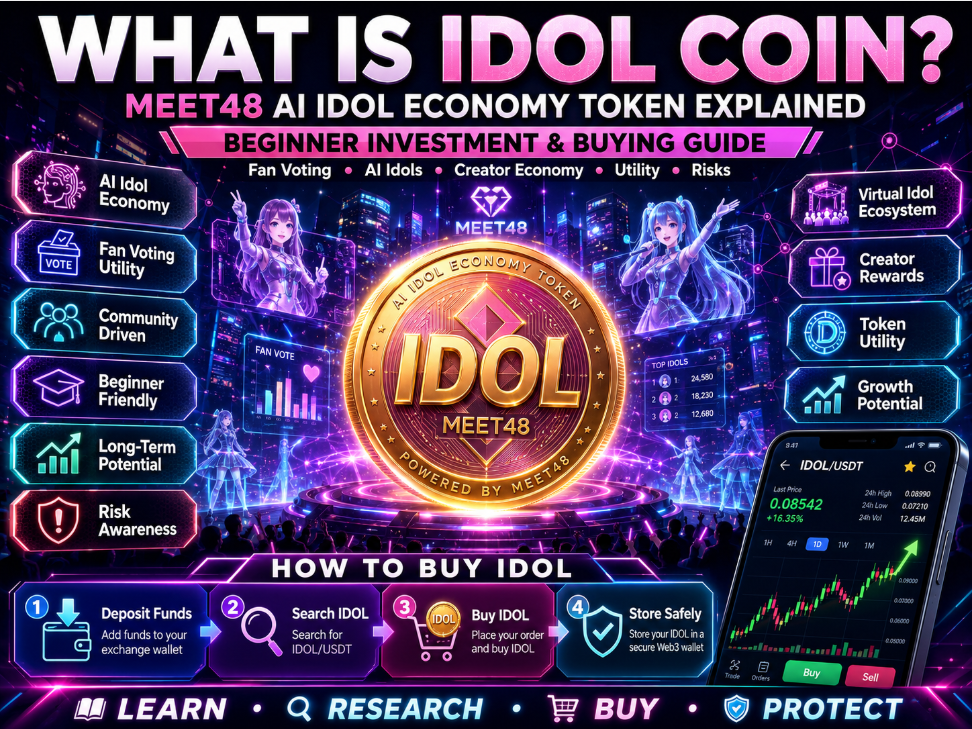
The first step for newcomers researching IDOL is not to look at the K-line chart or follow hype, but to confirm which IDOL they are actually looking at.
This article specifically refers to the MEET48 IDOL token, whose contract address is:
0x3b4de3c7855c03bb9f50ea252cd2c9fa1125ab07
The chain is BNB Chain, meaning it is a BEP-20 token.
If you search for IDOL on CoinGecko, CoinMarketCap, BscScan, HiBT, or other trading platforms, you must check the following:
- Does the project name appear as MEET48?
- Is the token symbol IDOL?
- Is the chain BNB Chain?
- Does the contract address match the one above (
0x3b4de3c7855c03bb9f50ea252cd2c9fa1125ab07)? - Are the circulating supply, total supply, and trading pairs consistent with mainstream data platforms?
If any of these items do not match, do not rush to buy, as you might be looking at another project with the same name.
1. What is the Difference Between MEET48 (IDOL) and Other Tokens like IDOLVERSE?
MEET48 (IDOL) is a project built around AI idols, fan economy, Web3 voting, virtual content, and entertainment social interactions.
Its core use cases are:
- Fans using IDOL to vote for idols.
- Users interacting with AI virtual idols.
- Content creators using AI tools to generate virtual avatars, performances, videos, and entertainment content.
- Mars Protocol allowing community meme tokens to be launched around idol IPs.
- IDOL serving as a functional token in live streaming, virtual meet-and-greets, voting events, virtual goods, and community governance.
Other projects with the same IDOL name could have entirely different token systems, blockchains, teams, and use cases. They are not necessarily related to MEET48.
Therefore, the most reliable way to determine if it is the IDOL discussed in this article is never by name, but always by the contract address.
2. What is MEET48's Project Positioning?
MEET48 can be understood as an "AIUGC + Idol Fan Economy + Web3" entertainment ecosystem.
There are three key terms here.
The first keyword is AIUGC. AIUGC refers to AI-generated content. MEET48 aims to lower the barrier to creating virtual idols, music, dance, interactive content, and digital avatars through AI technology. Users are no longer just passive viewers of idols; they can participate in content co-creation, character incubation, and dissemination.
The second keyword is idol fan economy. The traditional idol industry inherently relies on fan voting, chart ranking, support activities, concerts, handshake events, meet-and-greets, merchandise sales, and community operations. MEET48 attempts to bring these activities on-chain, making voting, ranking, interaction, and consumption more transparent and traceable.
The third keyword is Web3. Web3's role is to tokenize fan participation. Users don't just "spend money to vote"; they can also participate in the value distribution of the idol ecosystem through tokens, NFTs, community governance, virtual assets, and content contributions.
This is what differentiates MEET48 from a regular entertainment app.
It is not just about content display; it tries to embed fan participation, ranking mechanisms, and content consumption within the idol economy into a token-driven system.
3. What Roles Do SNH48 and BNB Chain Play Respectively?
A significant reason MEET48 has gained attention is that it is not building virtual idols entirely from scratch; it connects with the real-world idol industry.
SNH48 is a well-known Chinese female idol group system with a large base of real fans, member resources, stage experience, and offline event infrastructure. By leveraging this real idol IP, MEET48 can bring traditional fan economy users into Web3 interactive scenarios.
BNB Chain provides on-chain infrastructure support. As a token on BNB Chain, IDOL can leverage the chain's low cost, high throughput, ecosystem traffic, and wallet infrastructure to support high-frequency voting, interaction, trading, and application scenarios.
These two roles are very different:
- SNH48 is more about content and fan entry points.
- BNB Chain is more about on-chain infrastructure and the traffic ecosystem.
MEET48 aims to combine the two, using real idol IP to lower the psychological barrier for users entering Web3, and using on-chain token mechanisms to deepen fan engagement.
4. How to Verify You Are Looking at the Correct MEET48 IDOL?
Newcomers can follow this checklist:
- Open CoinGecko or CoinMarketCap and search for MEET48 or IDOL.
- Check if the project name is MEET48.
- Verify the contract address is:
0x3b4de3c7855c03bb9f50ea252cd2c9fa1125ab07 - Confirm the chain is BNB Chain.
- Go to BscScan and query the contract address to see if the token name, holder addresses, and transaction records match.
- Before placing an order on a trading platform, double-check the trading pair name, deposit network, and contract address.
This may seem tedious, but it is crucial for small-cap, newer projects.
Because many tokens with the same name, copycats, and phishing contracts exploit the habit of newcomers looking only at the ticker symbol. If you buy the wrong contract, the project's future performance becomes irrelevant to you.
II. What is the Real Utility of the IDOL Token in the Ecosystem?
Many newcomers buy coins focusing only on "will it go up?" But to truly judge if an application token has long-term value, you must first see if it has real utility within its ecosystem.
The core utilities of IDOL can be divided into four categories:
- Voting.
- Content Interaction.
- Idol IP Tokenization.
- Staking and Ecosystem Incentives.
These utilities determine that IDOL is not just a trading symbol, but a functional entry point to the MEET48 ecosystem.
1. Vote-to-Earn: Fans Use IDOL to Participate in Idol Rankings
One of MEET48's core use cases is fan voting.
In the traditional idol industry, fan voting, chart ranking, and support activities are a very important business model. Fans support their idols by purchasing albums, voting tickets, membership benefits, offline event tickets, etc. Idol rankings affect exposure, resources, performance opportunities, and commercial value.
MEET48 brings this logic on-chain.
Fans can use IDOL to participate in idol ranking votes. Voting data is public and transparent, and on-chain records can reduce controversies surrounding opaque operations. The token consumption generated by voting can also become part of the ecosystem's revenue.
This mechanism addresses three issues.
First, fan participation becomes more transparent. Once voting behavior is on-chain, ranking data is easier to verify than on traditional platforms.
Second, fan behavior can be assetized. User participation in voting, content dissemination, and community building is no longer just internal platform points but is linked to the token economy.
Third, idol value can be co-shaped by the community. Fans are not just consumers; they can become participants and drivers in the idol's growth path.
However, it's also important to note:
Whether the voting mechanism can generate long-term demand depends on whether the idol IP has sustained appeal. If activity hype decreases, voting demand will naturally decline.
2. Mars Protocol: How Can Virtual Idols Launch Their Own Meme Coins?
Mars Protocol is a very important part of the MEET48 ecosystem.
It can be understood as a token launchpad focused on idol IP and AI Agents. Through Mars Protocol, virtual idols, AI avatars, community characters, or entertainment IPs can issue their own meme tokens, forming independent miniature economic systems around that character.
How is this different from regular meme coins?
- Regular meme coins typically rely on community sentiment, meme culture, and short-term viral spread.
- Mars Protocol aims to combine meme coins with idol IP, AI content, fan communities, and virtual interactions.
For example, an AI virtual idol can have its own character setting, content output, fan community, and exclusive token. Fans holding that token might gain voting rights, content access, virtual meet-and-greet tickets, in-game benefits, or community governance participation rights.
IDOL plays the role of a foundational utility token in this process.
It may be used for launchpad participation, voting, trading, governance, interaction, or paying platform service fees. In other words, the more active the virtual idol economy on Mars Protocol, the more use cases IDOL will have.
However, this is also a high-risk part.
Because idol meme tokens themselves can be extremely volatile, and many character tokens may only have short-term hype. Whether IDOL, as the foundational ecosystem token, can benefit long-term depends on whether Mars Protocol can consistently incubate virtual IPs with real fans and content vitality, rather than just creating short-term speculative hotspots.
3. Live Streaming, Virtual Meet-and-Greets, and Metaverse Scenarios
IDOL is also designed for various entertainment and interactive scenarios.
For example:
- Virtual concert entry.
- AI idol live streaming interactions.
- Fans buying virtual gifts.
- Unlocking exclusive content.
- Participating in virtual meet-and-greets.
- Purchasing virtual real estate or virtual goods.
- Participating in social activities within the metaverse.
While these scenarios sound imaginative, investors cannot just look at concepts.
What you really need to assess is:
- Are users willing to consistently spend IDOL for these experiences?
- Is the idol content compelling enough?
- Can events be held long-term, rather than being one-off marketing gimmicks?
- Is the paying user base increasing?
- Is on-chain consumption data showing genuine growth?
If the answers to these questions are positive, IDOL can form real consumer demand. If IDOL is only consumed during short-term events and users stop using it afterward, then token demand will significantly weaken.
4. Does IDOL Support DeFi Staking?
IDOL has also had staking-related activities, where users lock up IDOL for a period to receive corresponding yields or event rewards.
Such staking has a certain impact on short-term circulating supply, as locking reduces the sellable tokens on the market.
However, newcomers must understand:
Staking yields do not come from nowhere.
It might come from:
- Project incentive pools.
- Ecosystem revenue.
- Event budgets.
- Or simply short-term subsidies.
Therefore, when you see a high APR, do not immediately interpret it as "risk-free profit." You need to check:
- What is the lock-up period?
- Is there a penalty for early withdrawal?
- In which token are the rewards paid?
- Is the revenue source sustainable?
- Is there a limit on the total staking amount?
- Has the staking contract been audited?
If the rewards primarily come from newly issued tokens, staking itself might also create future selling pressure.
So, for a new application token like IDOL, staking can be a way to participate in the ecosystem, but it should not be considered a low-risk investment product.
III. Tokenomics: Supply, Burn, and Unlock – Key Numbers Newcomers Must Understand
When newcomers buy small-cap tokens, the most overlooked aspect is tokenomics.
Many people only look at the low current price, small market cap, and new narrative, and assume there is massive upside. However, if a large number of tokens are waiting to be released in the future, or if early investors, team members, and ecosystem funds are continuously unlocking, the price could face sustained downward pressure.
IDOL's tokenomics require focusing on four key aspects:
- Total Supply.
- Circulating Supply Ratio.
- Burn Mechanism.
- Unlock and Early Investor Selling Pressure.
1. Total Supply of 4.8 Billion Tokens – What Does It Mean?
The total supply of IDOL is 4.8 billion tokens.
As of June 2026, different market data platforms show slightly varying statistics for the circulating supply, generally indicating the current circulating supply is over 1 billion tokens, with some platforms showing higher figures.
This means IDOL is still not fully circulating.
For investors, the most important questions are not "What is the current circulating supply?" but:
- How many more tokens will be unlocked in the future?
- Who do these tokens belong to?
- What is the unlock schedule?
- Are these tokens likely to be sold on the market after unlocking?
If the current circulating supply is only a fraction of the total, then the Fully Diluted Valuation (FDV) is often more important than the current market cap.
For instance, the current market cap might be in the tens of millions of dollars, which seems small. But if calculated based on the total supply of 4.8 billion tokens, the FDV could be significantly higher. Investors cannot only look at market cap; they must also consider FDV and the future release schedule.
2. Can Token Burns Improve Long-Term Supply?
MEET48 has previously implemented token burns related to voting revenue.
For example, during major voting events, a portion of the voting revenue would be used to burn IDOL. The goal is to reduce total supply, enhance token value capture, and signal to the market that "ecosystem consumption can benefit the token."
The logic of this design is:
- Users consume IDOL for voting.
- The project receives token revenue from the voting activity.
- A portion of that revenue is burned.
- Supply decreases.
If activity continues to grow, the burn mechanism could form long-term value support.
This mechanism itself is positive because it connects ecosystem activity with token supply management.
However, investors must also consider two issues:
- Is the burn scale large enough?
- Is the burn consistent?
If each burn represents only a tiny fraction of the total supply, and the activity frequency is unstable, the long-term impact of burning on price will be limited.
A truly valuable burn mechanism must be built on sustained user consumption, not occasional marketing events.
3. Security Incidents: A Serious Consideration for New Investors
IDOL has experienced real security incidents, with market reports and project announcements mentioning vulnerabilities, fund losses, buybacks, and security fund responses.
Such events are crucial for new investors because they demonstrate:
- The project is not without technical risk.
- Security incidents are not theoretical—they have already occurred.
- The team's emergency response, transparency, compensation plans, and subsequent security improvements will all affect market confidence.
If after an incident, the team can promptly identify the vulnerability, mitigate risks, publish transaction records, conduct buybacks, establish a security fund, and cooperate with audits and bug bounty programs, it suggests the team is actively addressing the issue.
However, even then, the risks cannot be ignored.
Security incidents leave lasting impacts:
- Some users will lose confidence.
- Prices may become highly volatile.
- Exchanges or market makers may lower their risk appetite.
- Subsequent audits and contract transparency will be subject to stricter market scrutiny.
Therefore, before buying IDOL, newcomers must incorporate security incidents into their risk assessment, rather than just looking at whether the team has "remedied" the situation.
4. Will Unlocks from Institutional Investors Create Selling Pressure?
MEET48 has attracted attention or investment from institutions like YZi Labs, HashKey Capital, Animoca Brands, which is positive for the project's credibility.
However, institutional investment does not guarantee that prices will only go up.
Institutional participation usually means the project has financial and resource support, but it also implies the existence of investor tokens, lock-up periods, and future unlock schedules.
Newcomers should pay attention to:
- What percentage of tokens are allocated to institutional rounds.
- How long they are locked.
- The duration of the linear unlock period.
- Whether a public vesting schedule exists.
- Whether the unlock timing coincides with major events, exchange listings, or market hotspots.
If early investors have a low cost basis, and a large number of tokens are set to unlock, it could create sustained selling pressure.
So, institutional backing can increase project credibility, but it cannot replace a thorough tokenomics analysis.
IV. Is IDOL Worth Paying Attention To? A Framework Newcomers Can Follow
Determining if IDOL is worth paying attention to cannot be answered with a simple "yes" or "no."
A more reasonable method is to create a checklist.
You can evaluate it from four dimensions:
- Fundamentals.
- Liquidity.
- Narrative Quality.
- Valuation Drivers.
1. Fundamental Check: Can Users Convert into Token Demand?
MEET48 has previously disclosed having millions of active users and a large number of Web3 wallet users. This data is very important for entertainment-focused Web3 projects because application tokens fear having no users the most.
However, investors need to dig deeper:
- Are these users one-time event participants or long-term active users?
- How many users actually purchase or consume IDOL?
- Is voting revenue growing consistently?
- Is there repeat consumption of virtual idol content?
- Can Mars Protocol consistently incubate new IPs?
- Are Web2 fans truly willing to enter the Web3 wallet and token ecosystem?
If users only register, claim airdrops, and participate in a single event without continuously consuming IDOL, the user count will have limited impact on token value.
If users are willing to consistently use IDOL for voting, interaction, content purchasing, and participating in the virtual idol ecosystem, then IDOL can form genuine demand.
2. Liquidity Check: Small Cap Means High Elasticity, But Also High Risk
IDOL is currently a small-to-mid cap token. Its market cap fluctuates with price and different data platforms, generally sitting in the tens of millions of dollars range.
Daily trading volume can sometimes reach millions to tens of millions of dollars, but this does not mean there is no liquidity risk.
Characteristics of small-cap tokens are:
- Rapid price increases.
- Rapid price decreases.
- Large buy orders can spike the price.
- Large sell orders can crash the order book.
- Market sentiment changes are amplified.
Therefore, when buying IDOL, newcomers should avoid placing large market orders at once.
A more rational approach is:
- Use limit orders.
- Buy in batches.
- Avoid chasing prices after a sudden surge.
- Observe the depth of the order book.
- Avoid large trades during periods of thin liquidity.
For small-cap tokens, the entry price isn't the only concern; being able to sell with low slippage is equally important.
3. Narrative Check: Is AI + Idol Economy + Web3 Real Demand or Just a Hype Mashup?
IDOL's narrative is very strong.
- AI is one of the most powerful tech narratives today.
- The idol economy has genuine paying users.
- Web3 can offer on-chain voting, virtual assets, community governance, and token incentives.
The combination of these three directions indeed holds potential for mass-market appeal.
However, precisely because the narrative is so strong, investors must be wary of a "hype mashup."
To distinguish real demand from a bundled concept, consider these questions:
- Are users coming for the idol content, rather than just for airdrops?
- Are fans willing to pay with IDOL for voting?
- Does the AI virtual idol produce content consistently?
- Does the Web3 mechanism genuinely enhance user experience?
- Is the project's revenue derived from real consumption, not just token trading?
If these questions are gradually answered positively, IDOL's narrative becomes more reliable. If the project mainly relies on buzzwords like "AI," "idols," and "Web3" to generate hype with limited real consumption scenarios, its price will likely be vulnerable to fading trends.
4. Compared to Other Token Types, How is IDOL's Valuation Logic Different?
IDOL is an application-layer narrative token.
Its core valuation drivers come from user growth, entertainment content, fan consumption, voting revenue, virtual idol IPs, event activity, and community spread.
This is fundamentally different from financial infrastructure tokens.
For example, you can refer to the 2030 price logic for financial infrastructure tokens like LFI at this link. The valuation of such assets depends more on financial service scale, protocol revenue, payment or lending demand, on-chain asset accumulation, and long-term infrastructure status.
IDOL, on the other hand, resembles a consumer application token. Its price is more susceptible to narratives, fan sentiment, activity cycles, content hype, and community spread.
Similarly, you can compare it with a cash-flow-backed infrastructure token like RPL, whose 2030 price prediction is discussed here. RPL's logic leans towards ETH staking revenue, TVL, fee switches, and protocol cash flow. IDOL's logic leans towards entertainment consumption, fan voting, and AI idol IP monetization.
These two valuation approaches are completely different.
- RPL depends on revenue and staking scale.
- LFI depends on financial infrastructure adoption.
- IDOL depends on whether users are willing to continuously pay for content, idols, and interactions.
Therefore, before buying IDOL, you must confirm that you are buying into "entertainment consumption ecosystem growth," rather than mistaking it for an infrastructure asset.
5. A Simplified Checklist for Newcomers
Before buying IDOL, ask yourself these eight questions:
- Have I confirmed the contract address?
- Do I know it is MEET48 IDOL on BNB Chain?
- Do I understand its core utilities (voting, interaction, Mars Protocol, ecosystem consumption)?
- Do I know its total supply is 4.8 billion, and that there will be future unlock pressure?
- Am I aware that it has experienced security incidents?
- Can I tolerate short-term price swings of over 30% in a small-cap token?
- Am I only risking capital I can afford to lose entirely?
- Do I have a plan to buy in batches rather than chasing a high and going all in?
If the answer to several of these questions is "no," it is not advisable to rush into buying.
V. How to Buy IDOL on HiBT?
Understanding the project is just the first step. For newcomers, the more critical aspect is how to safely buy the correct IDOL.
The following guide uses HiBT as an example to help you complete the process from registration to placing an order.
1. Register a HiBT Account
Go to the HiBT official website and register an account using your email or phone number.
When registering, it is recommended to:
- Use a long-term stable email or phone number.
- Set a strong password, different from other sites.
- Enable Two-Factor Authentication (2FA).
- Keep your account security information safe.
Cryptocurrency account security is crucial. If your account is compromised, recovering it is very difficult. This is especially important if you plan to hold small-cap tokens, participate in airdrops, or make deposits/withdrawals.
2. Complete KYC Identity Verification
Most compliant trading platforms require users to complete KYC.
KYC is used to confirm your identity, preventing money laundering, fraud, account theft, and illegal transactions.
Typically you will need to prepare:
- ID card or passport.
- Facial recognition.
- Phone or email verification.
- Some regions may require proof of address.
The processing time varies by region, document clarity, and platform verification speed. It's best for newcomers to complete KYC in advance, rather than waiting until they want to buy, to avoid missing trading opportunities.
3. Deposit Funds: Fiat or Stablecoin Deposit
After completing registration and KYC, you need to deposit funds.
There are two common methods.
The first is depositing USDT or USDC. If you already hold stablecoins in another wallet or exchange, you can deposit them into HiBT. Crucially, confirm the network, such as TRC20, ERC20, BEP20, etc., as different networks have different addresses and fees.
The second is using the platform's supported fiat channels. If HiBT supports fiat deposits in your region, you can buy stablecoins via bank card, third-party payment, or other channels, and then use them to buy IDOL. The specific methods, fees, and settlement times are subject to the platform's page.
When depositing, always pay attention to:
- Selecting the correct deposit currency.
- Selecting the correct network.
- Copying the address completely.
- Filling in the memo or tag if required.
- Testing with a small amount first before making large deposits.
Depositing on the wrong network can lead to loss of funds, so newcomers must not skip these verification steps.
4. Search for the IDOL or MEET48 Trading Pair
After depositing, go to the HiBT spot trading page and search for:
- IDOL
- MEET48
- IDOL/USDT
The specific trading pairs depend on the platform's actual support.
Once you find the trading pair, don't place an order immediately. First, confirm:
- Is the project name MEET48?
- Is the token symbol IDOL?
- Is the price close to that on mainstream data platforms?
- Is the trading volume normal?
- Does the order book have sufficient depth?
If the platform displays contract information, you can also verify if it matches the BNB Chain contract address.
5. Market Order vs. Limit Order – Which to Choose?
When buying IDOL, the least recommended approach for newcomers is using a large market order.
The reason is simple:
IDOL is a small-cap token with potentially unstable order book depth. A market order will execute against all sell orders in the book. If your buy amount is large, the final average execution price could be significantly higher than the price you see, resulting in slippage.
A more suitable method for newcomers is using limit orders.
For example, if IDOL's current price is fluctuating within a range, you can place a buy order slightly below the current price, waiting for a pullback to fill. You can also split it into three parts:
- First batch: small amount to test.
- Second batch: place a limit order when the price retraces to support.
- Third batch: consider adding after the price breaks out and stabilizes.
This helps avoid buying at a temporary peak in one go.
For small-cap new projects like IDOL, buying discipline is more important than buying speed.
6. Should You Withdraw Tokens to a Wallet After Buying?
After buying IDOL, you can choose to keep it on HiBT or withdraw it to a self-custody wallet.
Advantages of keeping on an exchange:
- Convenient for trading.
- Suitable for short-term buying/selling.
- No need to manage private keys yourself.
Disadvantages:
- Assets are custodied by the platform.
- You must trust the platform's security.
- Risk of theft if account security is insufficient.
Advantages of withdrawing to a self-custody wallet:
- You control the private keys.
- More suitable for long-term holding.
- Allows participation in on-chain applications, voting, or staking.
Disadvantages:
- Higher operational complexity.
- Need to manage seed phrases.
- Must confirm the BNB Chain network.
- Sending to the wrong address or leaking private keys can lead to permanent loss of assets.
If you are a beginner, start with a small amount for learning. Don't send a large amount of IDOL to an unfamiliar wallet or interact with unknown smart contracts right away.
VI. How to Hold IDOL Safely After Purchase? Key Details Newcomers Often Overlook
Many people think the process ends once they buy the coins.
Actually, for a small-cap application token like IDOL, buying is just the first step. How you hold it safely, track the project, and manage risk afterward is equally important.
1. Keep on Exchange or Withdraw to MetaMask?
- If you are short-term trading, it's more convenient to keep it in your HiBT account. You can sell, take profits, or set stop-losses anytime without dealing with on-chain gas fees, wallet authorizations, and contract interactions.
- If you are a long-term holder, or want to participate in MEET48 ecosystem voting, Mars Protocol, staking, or other on-chain activities, consider withdrawing to a self-custody wallet like MetaMask.
Remember, IDOL is a BEP-20 token on BNB Chain. You need to switch your wallet to the BNB Chain network, not Ethereum Mainnet.
2. How to Add IDOL to MetaMask?
If the wallet doesn't automatically display IDOL, you can manually add the token.
The steps are typically:
- Open MetaMask.
- Switch to the BNB Chain network.
- Click "Import Tokens" or "Add Custom Token."
- Enter the IDOL contract address:
0x3b4de3c7855c03bb9f50ea252cd2c9fa1125ab07 - Confirm that the token symbol and decimals are auto-recognized.
- Check your balance after adding.
Common pitfalls for newcomers include:
- Sending IDOL to the wrong network.
- Using a fake contract address.
- Connecting the wallet on a phishing site.
- Mistakenly authorizing unlimited spending to a malicious contract.
- Entering your seed phrase on a website or into a customer support chat.
Remember: Any site asking you to enter your seed phrase can almost certainly be considered a scam.
3. Should You Participate in Staking or Voting Activities?
If the project offers staking, voting, or activity rewards, you can research them, but don't participate blindly.
Before participating, confirm:
- Is the activity from an official source?
- Has the contract been audited?
- Is there a lock-up period?
- How long is the lock-up?
- Is there a penalty for early withdrawal?
- What is the source of the yield?
- Are rewards in IDOL or other tokens?
- Will participation affect your liquidity?
If you just want to hold and observe, you don't necessarily need to join every activity.
Especially for beginners, don't authorize unfamiliar contracts just for high APR yields. High yields often mean high risk, or they might just be short-term promotional subsidies.
4. How to Continuously Track IDOL Project Updates?
After holding IDOL, you cannot just look at the price.
You should consistently pay attention to four types of information.
First, official announcements. Including new activities, voting rules, partners, product updates, exchange support, burn records, etc.
Second, on-chain data. Including token burns, changes in holder addresses, large transfers, liquidity pool changes, and wallet movements related to unlocks.
Third, security audits. Including information from CertiK or other audit firms, vulnerability fixes, bug bounty programs, and changes in contract permissions.
Fourth, ecosystem data. Including voter numbers, activity revenue, number of Mars Protocol projects, user growth for AI idols, Dapp active addresses, community interactions, etc.
If you notice the price rising but ecosystem data isn't improving, be wary of pure speculation. If the price is depressed in the short term but real users, burns, voting, and ecosystem activity are consistently growing, it indicates the project has more fundamental strength worth tracking.
VII. Risk Disclosure
IDOL is a high-risk crypto asset and is not suitable for all investors.
Especially for newcomers, it is crucial to understand the following risks before buying.
1. Small Market Cap and Low Liquidity Risk
IDOL has a market cap in the tens of millions of dollars, classifying it as a small-cap project.
This means its price is highly susceptible to the impact of large buy or sell orders.
When market sentiment is good, the price can rise rapidly; but when sentiment is fearful, events end, unlocks approach, or large holders sell, the price can fall just as quickly.
Low liquidity also creates slippage risk. The price you see may not be the actual execution price for a large buy or sell order.
2. Smart Contract and Security Risk
IDOL has experienced real security incidents, proving that technical risks are not merely theoretical.
Even if the team takes remedial actions afterward, such as compensation, buybacks, fixing vulnerabilities, or establishing a security fund, historical security incidents can still erode market trust.
Future risks could still include:
- Contract vulnerabilities.
- Wallet authorization risks.
- Phishing sites.
- Cross-chain or frontend attacks.
- Misconfigured project permissions.
- Security risks in third-party DApps.
Therefore, caution is required when participating in on-chain activities.
3. Narrative Fade Risk
IDOL's narrative is AI + Idol Economy + Web3.
This narrative is compelling, but it relies heavily on market hype and trends.
If the AI virtual idol hype fades, fan activities decrease, Web3 users lose interest in entertainment applications, or the project fails to consistently produce appealing content, demand for the IDOL token could shrink rapidly.
Application tokens face the biggest fear: "No one uses it after the event ends."
So, always focus on real consumption data, not just the concept.
4. Unlock and Team Token Risk
The total supply of IDOL is 4.8 billion tokens, with a significant portion still not fully in circulation.
Future releases of tokens for the team, ecosystem, investors, activity rewards, airdrops, etc., could all create market selling pressure.
Especially when early investors have a low cost basis, there might be pressure to sell for profit upon unlocking.
Newcomers must research vesting and unlock information before buying.
5. Same-Name Token and Fake Token Risk
The name "IDOL" is not unique.
There are multiple tokens with the same or similar names on the market. If newcomers search for "IDOL" without verifying the contract address, they could easily buy the wrong token.
Always verify the MEET48 IDOL contract address:
0x3b4de3c7855c03bb9f50ea252cd2c9fa1125ab07
6. This Article is Not Investment Advice
This article is for informational and educational purposes only and does not constitute investment advice.
Small-cap crypto assets can result in significant losses. Newcomers should only invest capital they can afford to lose entirely.
Please DYOR (Do Your Own Research) and do not buy impulsively just because a project has institutional backing, celebrity IP, an AI narrative, or short-term price increases.
VIII. Frequently Asked Questions (FAQ)
1. Is IDOL coin the same project as IDOLVERSE?
No.
This article discusses the IDOL token of the MEET48 ecosystem, with the contract address:
0x3b4de3c7855c03bb9f50ea252cd2c9fa1125ab07
IDOLVERSE or other tokens with the same name may be entirely different projects with different chains, teams, use cases, and risks.
Always verify the contract address before buying.
2. Which chain is MEET48 (IDOL) on?
MEET48's IDOL is a BEP-20 token on BNB Chain.
If you withdraw tokens to a wallet, ensure your wallet supports BNB Chain and select the correct network.
Do not send IDOL to an address that does not support BNB Chain, and do not select a different network by mistake.
3. What is the minimum amount to buy IDOL on HiBT?
The specific minimum purchase amount is subject to the HiBT trading page.
Generally, newcomers can start with a small amount to test the entire process, including registration, KYC, deposit, searching for the trading pair, placing a limit order, and checking balances.
For small-cap tokens like IDOL, it is not recommended to invest a large amount initially.
4. IDOL has had security incidents before. Is it safe now?
The project team has publicly addressed the security incidents and stated they have implemented vulnerability fixes, buybacks, a security fund, and bug bounty measures.
However, this does not guarantee zero risk in the future.
The security incidents demonstrate that the project faces real technical risks. Investors should continuously monitor audit reports, official announcements, changes in contract permissions, and unusual on-chain transactions.
If you are a beginner, it is not advisable to casually connect to unknown DApps or authorize suspicious contracts.
5. Is IDOL suitable for long-term investment by beginners?
IDOL is more suitable for users with a certain risk tolerance who are willing to research small-cap application tokens.
It is not suitable as a core position for beginners.
If you are new to the crypto market, you should first understand BTC, ETH, stablecoins, wallet security, exchange operations, and basic risks before considering a small allocation to a high-volatility project like IDOL.
6. What is the core driver for IDOL's price increase?
The core driver for IDOL's long-term value appreciation is not just exchange listings, but real ecosystem usage.
Key variables include:
- Whether fan voting activities are growing consistently.
- Whether virtual idol content is appealing.
- Whether Mars Protocol can incubate popular idol IPs.
- Whether IDOL is continuously consumed in interactions, live streaming, content, and virtual assets.
- Whether the burn mechanism operates long-term.
- Whether users are willing to continuously pay for the AI idol economy.
If these variables improve, IDOL will have a more solid value foundation.
IX. Author & Data Source Statement
This article is compiled based on public market data, project materials, and industry reports as of June 2026. Major references include:
- Price, market cap, circulating supply, contract address, and historical data for MEET48 (IDOL) from CoinGecko and CoinMarketCap.
- On-chain information for the IDOL contract address from BscScan.
- Information on IDOL TGE, funding, and investors from platforms like CryptoRank and ICO Drops.
- Official website, documentation, and announcements from MEET48 regarding IDOL's utility, Mars Protocol, AIUGC, fan voting, and ecosystem scenarios.
- Public information from YZi Labs regarding its investment in MEET48.
- Official announcements from MEET48 regarding security incidents, buybacks, security funds, and vulnerability handling.
- Industry media reports on MEET48's burn mechanism, WIPA voting activities, user data, and ecosystem progress.
- Information on account registration, trading services, KYC, and compliance disclosures from HiBT's public materials.
This article will be updated when there are significant changes to IDOL's burn mechanism, security audits, token unlocks, exchange support, Mars Protocol progress, or MEET48 ecosystem data.
Conclusion: The Core of IDOL is Not the "AI Idol" Label, but Whether Real Fans Will Pay Consistently
IDOL is a very typical example of a new-generation Web3 application token.
It is not a traditional public blockchain, nor is it a DeFi revenue protocol. Instead, it connects AI, the idol economy, fan voting, virtual content, and Web3 assets.
This direction has potential because the entertainment and fan economy inherently have strong paying capacity.
However, it also carries significant risks. The stronger the narrative, the easier it is to be amplified by short-term speculation. The newer the project, the more it is tested by security, unlocks, liquidity, and user retention.
Therefore, determining whether IDOL is worth participating in should not be based solely on whether it's an AI concept or has institutional investment.
What you really should be looking at is:
- Are fans consistently using IDOL for voting?
- Are virtual idols consistently producing content?
- Can Mars Protocol incubate real IPs?
- Are voting revenue and burn mechanisms consistent?
- Has the team remained transparent after the security incident?
- Are future unlocks manageable?
If the answers to these questions gradually turn positive, IDOL could evolve from a small-cap application token into a Web3 entertainment asset backed by genuine consumption.
If these promises cannot be fulfilled, IDOL might merely be a short-term narrative within the AI + Idol + Web3 hype cycle.
For newcomers, the safest strategy is not impulsive heavy buying, but to:
- First verify the contract.
- Then understand the utility.
- Next, analyze the tokenomics.
- Finally, participate with a small amount, in batches, and with risk awareness.
IDOL's opportunity comes from genuine consumption in the fan economy.
IDOL's risk comes from the same place:
If fans stop paying, even the best narrative cannot sustain the token's value in the long term.
Note: This article is for informational reference only and does not constitute any investment advice. Cryptocurrency investment carries high risk. Please make decisions carefully based on your own risk tolerance.