
GMT was once one of the most talked-about Move-to-Earn tokens in the crypto market. It surged from a very low price to above $4 at its peak, and later fell back below $0.10 after the hype faded. For many beginners, GMT is a classic example of a “bull market myth + bear market crash”: it once made people believe that walking could generate income, while also teaching many late buyers the real risks of GameFi tokens.
So when we discuss GMT coin price prediction 2030 or GMT price prediction 2030, the key question is not simply “Will GMT go up?” Instead, we need to ask:
- What is the basis for predicting the price of a Move-to-Earn token all the way to 2030?
- Will STEPN still have real users by 2030?
- Where does the demand for GMT come from?
- Can the next Bitcoin halving cycle revive the GameFi narrative?
- Can GMT ever return to its previous all-time high?
This article will not use irresponsible phrases such as “guaranteed to rise,” “100x opportunity,” or “risk-free profit” to create hype. Instead, it builds a price prediction framework based on three analytical paths:
- Technical path: observing historical prices, support and resistance levels, trading volume, and market cycle structure.
- Fundamental path: tracking STEPN users, GMT supply, the GST economy, and ecosystem activity.
- Scenario model path: breaking 2025–2030 into bullish, base-case, and bearish outcomes.
Important reminder: all price ranges in this article are research-based projections derived from public data and historical market cycles. They are not financial advice. Cryptocurrencies are extremely volatile, and GMT is a high-risk small-cap token. It may rise significantly, but it may also continue to decline or become increasingly marginalized over time.
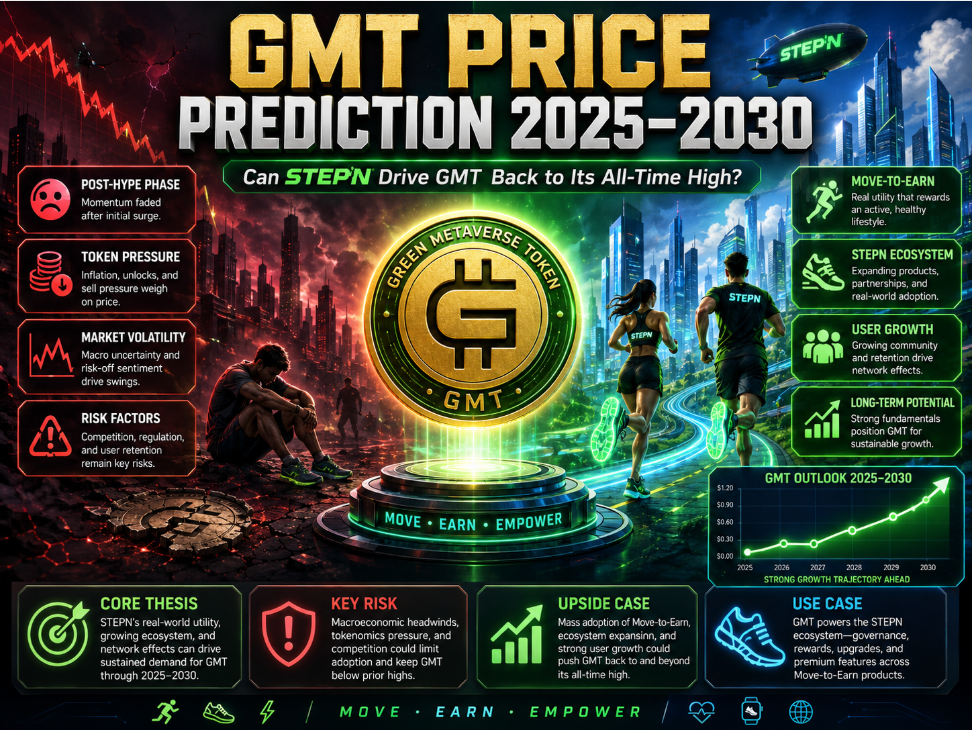
1. Before Predicting GMT’s Price, You Must Understand These Five Variables
Price prediction is not about making numbers out of thin air. This is especially true for GMT, a token that heavily depends on project ecosystem activity and market sentiment. Without understanding the key variables first, all later price targets are just noise.
1. STEPN User Scale
GMT’s long-term value ultimately depends on whether STEPN still has real users.
STEPN’s core model is Move-to-Earn, where users participate in the ecosystem by walking, jogging, or running. In theory, the larger the user base, the more likely it is to generate:
- Demand for NFT sneaker trading;
- Demand for GST consumption;
- Demand for advanced GMT-based features;
- Activity on the STEPN Marketplace;
- Community discussion and brand exposure;
- An ecosystem cycle driven by new users.
However, if STEPN’s user base continues to decline, the demand side for GMT will weaken.
The transmission path from user scale to GMT demand roughly looks like this:
- STEPN daily active users increase;
- Demand for NFT sneakers recovers;
- GST usage and consumption increase;
- Users demand more advanced features;
- GMT is used in more ecosystem scenarios;
- The market re-evaluates GMT’s value.
Conversely, if user numbers decline, GMT’s long-term price support will also weaken.
2. The Broader Crypto Market Cycle
GMT is not an isolated asset. It is heavily influenced by the broader crypto market cycle.
Historically, after a Bitcoin halving, the market often goes through several phases:
- Bitcoin rises first;
- ETH and major public chains follow;
- Capital flows into mid- and small-cap tokens;
- Narratives such as GameFi, Meme, AI, and RWA rotate;
- High-risk altcoins experience short-term explosive moves;
- After the bull market ends, prices fall sharply.
For GMT to perform strongly from 2025 to 2030, two conditions usually need to be met:
- The overall market must enter a risk-on phase;
- Move-to-Earn or GameFi must return to market attention.
If the broader market rises but the GameFi narrative does not recover, GMT may only experience a mild rebound.
If a broader market rally coincides with a STEPN ecosystem recovery, GMT could show much stronger upside potential.
3. GMT Token Unlocks and Supply Pressure
GMT has a maximum supply of 6 billion tokens, but not all tokens entered circulation from the beginning. For price performance, the most important factors are changes in circulating supply and the unlock schedule.
Key points to watch include:
- The current circulating supply as a percentage of total supply;
- Whether large unlocks remain in the future;
- Whether tokens allocated to the team, investors, or ecosystem fund may enter the market;
- Whether newly released GMT can be absorbed by sufficient demand;
- Whether staking, lockups, or ecosystem consumption can reduce circulating pressure.
If GMT supply continues to increase in the coming years while STEPN users and ecosystem demand fail to recover, the price may remain under pressure.
4. Whether the Move-to-Earn Sector Recovers or Disappears
GMT’s biggest narrative comes from Move-to-Earn.
This sector once exploded in popularity, but it also exposed serious problems:
- Users came for profit, not necessarily for the product;
- Reward tokens are prone to inflation;
- When new users slow down, the economic loop can become unstable;
- Falling NFT sneaker prices damage user confidence;
- Once “walking to earn” becomes less profitable, user retention pressure becomes obvious.
Therefore, whether GMT’s price can rise by 2030 depends largely on whether Move-to-Earn can evolve into a healthier model.
Possible future directions include:
- Combining sports and health data with Web3 identity;
- Combining AI fitness plans with on-chain incentives;
- Combining branded sportswear with NFT membership rights;
- Combining insurance, health management, sports communities, and token rewards;
- Turning Move-to-Earn from “earning money” into a “healthy lifestyle points system.”
If the sector completes this transformation, GMT may regain valuation support.
If the sector completely loses market interest, GMT may remain in a low-liquidity range for a long time.
5. The Macro Liquidity Environment
GMT is a high-risk asset and is highly sensitive to macro liquidity.
When market conditions are loose:
- Investors are more willing to take risks;
- Altcoins are more likely to rise;
- High-volatility narratives such as GameFi and Meme coins are more likely to attract capital;
- Small-cap tokens may outperform significantly.
When market conditions tighten:
- Capital tends to move toward the U.S. dollar, bonds, or BTC;
- Liquidity in small-cap tokens declines;
- High-risk narratives cool down;
- Assets like GMT are more likely to experience larger drawdowns.
Therefore, GMT’s 2025–2030 price prediction cannot only focus on STEPN itself. It must also consider global liquidity, the U.S. dollar cycle, Federal Reserve policy, and the overall risk appetite of the crypto market.
2. How This Article Predicts GMT’s 2025–2030 Price
1. Technical Analysis Path
Technical analysis cannot predict the future, but it can help evaluate market structure.
This article refers to the following technical factors:
- Historical highs and lows;
- Long-term support zones;
- Major resistance zones;
- Trading volume changes;
- Moving average direction;
- Whether RSI enters extreme overbought or oversold zones;
- Whether the price breaks out of a long-term downtrend;
- Whether GMT outperforms the broader market during rallies.
For GMT, technical analysis should focus on two questions:
- Is it still in a long-term downtrend?
- Is each rebound supported by trading volume?
If the price rises without a clear increase in volume, it is often only a short-term rebound.
If price rises are accompanied by volume growth, active addresses, exchange depth, and community attention, a more sustainable trend may be forming.
2. Fundamental Analysis Path
GMT’s fundamentals should not be judged by price alone. We also need to assess whether the STEPN ecosystem still has vitality.
Key data to track includes:
- STEPN daily active users;
- NFT sneaker floor price;
- GST price;
- GMT staking and lockup status;
- STEPN Marketplace trading volume;
- Whether Find Satoshi Lab launches new products;
- Whether STEPN GO or other ecosystem applications attract real users;
- Whether GMT gains new use cases.
If fundamentals improve, GMT’s price prediction range can be adjusted upward.
If fundamentals continue to deteriorate, GMT may underperform the market even if the broader crypto market rises.
3. Scenario Model Path
This article uses five scenarios to predict GMT’s price in 2030:
- Extreme bull case;
- Bull case;
- Base case;
- Bear case;
- Extreme bear case.
Each scenario is based on different assumptions.
The extreme bull case requires:
- Two halving cycles triggering a strong bull market;
- A clear recovery in STEPN users;
- Move-to-Earn becoming a popular narrative again;
- GMT gaining new use cases;
- Exchange liquidity recovering;
- The market being willing to assign high valuations to GameFi again.
The base case only requires:
- STEPN continuing to operate;
- GMT maintaining some liquidity;
- The broader market growing moderately;
- The project not clearly dying;
- But also not returning to mainstream attention.
The bear case means:
- Users continue to leave;
- GMT demand remains insufficient;
- The GameFi sector continues to be marginalized;
- Token liquidity declines;
- Price remains in a long-term low-volatility range.
4. Comparable Assets
GMT can be compared with several similar assets, but none of them can be used as an exact equivalent.
AXS
AXS represents the Axie Infinity ecosystem and was one of the flagship Play-to-Earn assets of the previous cycle. Its history shows that blockchain gaming tokens can rise dramatically in bull markets, but they can also suffer extreme drawdowns when user growth stops.
SLP
SLP is the reward token within the Axie ecosystem. Its price history shows that if an in-game reward token’s supply becomes uncontrolled, the price can remain under pressure for a long time. GST shares some similar logic with SLP.
SAND
SAND represents the metaverse and virtual land narrative. It reminds us that narrative-driven assets are heavily dependent on market imagination. Once the narrative fades, valuations can compress sharply.
GMT
GMT’s unique feature is that it is tied to Move-to-Earn and Web3 healthy lifestyle scenarios. This narrative is more closely connected to real-world behavior than pure blockchain gaming, but it also depends more heavily on user retention and the sustainability of the economic model.
3. GMT Current Fundamental Snapshot: Where Does the Forecast Start?
1. Price and Market Cap Status
At the time of writing, GMT is far below its 2022 all-time high and its market capitalization sits in the mid- to small-cap crypto asset range. Compared with its high valuation during the bull market, the market now prices GMT much more cautiously.
This tells us two things:
- The market has significantly compressed Move-to-Earn valuations;
- If the ecosystem does not recover meaningfully, low valuations may persist for a long time.
For price prediction, the current low price means both potential upside and high risk.
2. Circulating Supply and Supply Pressure
GMT has a maximum supply of 6 billion tokens, and the current circulating supply is roughly around half of the total supply. Future token releases still need to be monitored.
Supply-side pressure mainly comes from:
- Unreleased tokens gradually entering the market;
- Token unlocks for early investors or the team;
- Ecosystem reward emissions;
- Users selling GMT after receiving it;
- Sell pressure caused by weak market demand.
If STEPN cannot generate real demand from 2025 to 2030, supply releases may continue to pressure GMT’s price.
3. STEPN User and Ecosystem Status
STEPN is still operating, but it is no longer the viral, mainstream project it was in 2022.
Investors need to keep watching:
- Whether the STEPN app still attracts new users;
- Whether STEPN GO can bring in new users;
- Whether NFT sneakers still have trading activity;
- Whether GMT still has real consumption scenarios;
- Whether GST price remains stable;
- Whether the community still discusses the product rather than only the price.
If the user base consists mainly of existing users with little new-user growth, GMT’s upside will be limited.
4. Exchange Liquidity
GMT can still be traded on multiple trading platforms, which means it has not completely disappeared from the market.
However, investors should focus on:
- Whether trading volume is stable;
- Whether order book depth is sufficient;
- Whether trading volume is overly concentrated on certain platforms;
- Whether large trades cause obvious slippage;
- Whether prices on smaller platforms deviate from mainstream markets.
For a small-cap asset like GMT, liquidity itself is a risk.
4. GMT 2025 Price Review: Did the Halving Effect Truly Revive Move-to-Earn?
Since we are already in 2026, 2025 should no longer be written as a future prediction. It is more appropriate to treat it as a model backtest year.
2025 was the first year after the 2024 Bitcoin halving, and theoretically should have been an important phase for risk appetite recovery. But for GMT, whether the price rose depended not only on Bitcoin, but also on whether STEPN and Move-to-Earn could attract users again.
2025 Bull Case
Price range: $0.45–$0.65
Trigger conditions include:
- BTC reaching a new all-time high;
- Clear rotation of capital into altcoins;
- STEPN daily active users recovering significantly;
- STEPN or STEPN GO bringing in new users;
- GMT trading volume expanding clearly;
- GameFi and Move-to-Earn returning to market attention.
In this scenario, GMT would not merely follow the broader market. Its narrative would be reactivated.
2025 Base Case
Price range: $0.18–$0.30
Trigger conditions include:
- A moderate recovery in the crypto market;
- GMT following the general rebound in altcoins;
- STEPN maintaining basic operations;
- User scale not deteriorating significantly;
- But no explosive growth occurring.
In this scenario, GMT behaves more like a market beta asset rather than an independent alpha opportunity.
2025 Bear Case
Price range: $0.05–$0.12
Trigger conditions include:
- Macro conditions continuing to pressure risk assets;
- Move-to-Earn users continuing to leave;
- GST remaining weak;
- STEPN’s new products failing to bring meaningful growth;
- GMT liquidity declining.
In this scenario, GMT continues to trade at low levels, and the market treats it mainly as a leftover asset from the previous GameFi cycle.
5. GMT 2026 Price Prediction: Can the Ecosystem Build an Independent Bullish Narrative?
2026 is a key year. After the market has had time to digest the post-halving cycle, if GMT still fails to show user recovery or narrative repair, the market may further reduce its long-term expectations.
2026 Bull Case
Price range: $0.60–$1.10
Possible trigger conditions:
- STEPN launches an effective new product line;
- STEPN GO or the broader FSL ecosystem brings in new users;
- Capital flows back into GameFi;
- Web3 healthy lifestyle narratives regain attention;
- GMT gains new use cases;
- Trading volume and social attention recover together.
In this scenario, GMT may not necessarily return to its all-time high, but it could see a strong rebound from low levels.
2026 Base Case
Price range: $0.20–$0.40
Possible trigger conditions:
- STEPN operates steadily;
- User growth remains limited;
- GMT follows the broader market with moderate volatility;
- The overall market remains risk-on;
- No major negative event occurs.
In this case, GMT’s investment logic looks more like a “low-level rebound” than a true long-term trend reversal.
2026 Bear Case
Price range: $0.04–$0.10
Possible trigger conditions:
- The market enters another correction;
- STEPN users continue to decline;
- GMT trading volume shrinks;
- The GameFi narrative continues to lose attention;
- Ecosystem updates remain insufficient.
In this scenario, GMT may fall into a lower-liquidity long-tail asset range.
6. GMT 2027 Price Prediction: Can Move-to-Earn 2.0 Become a New Narrative?
By 2027, the market may begin positioning ahead of the next Bitcoin halving. If Move-to-Earn can evolve into a model combining “Web3 healthy lifestyle + AI fitness data + social incentives,” GMT may regain new narrative potential.
2027 Bull Case
Price range: $0.90–$1.60
Possible trigger conditions:
- Expectations for the next halving heat up;
- STEPN secures a major brand or platform partnership;
- Web3 healthy lifestyle applications show new growth;
- AI + Move-to-Earn becomes a real market narrative;
- GMT use cases expand significantly;
- The market gives GameFi higher valuations again.
If this scenario occurs, GMT would shift from “old project recovery” to “new narrative revaluation.”
2027 Base Case
Price range: $0.25–$0.55
Possible trigger conditions:
- The project continues to operate;
- The broader market strengthens moderately;
- STEPN users remain stable;
- No major breakout product appears;
- GMT moves with the broader altcoin market.
In this scenario, GMT still has rebound potential, but returning to its previous high would be difficult.
2027 Bear Case
Price range: $0.03–$0.08
Possible trigger conditions:
- The ecosystem continues to shrink;
- Development activity declines;
- Community attention falls;
- Exchange liquidity worsens further;
- The market views GMT as an outdated GameFi asset.
In this scenario, GMT’s long-term investment thesis is largely weakened.
7. GMT 2028 Price Prediction: The Next Bitcoin Halving Year — Will History Repeat?
2028 is expected to be the next Bitcoin halving year. Historically, Bitcoin halvings have been important market-cycle events, but different assets benefit to very different degrees.
Whether GMT benefits will depend on whether it still has enough ecosystem activity by 2028.
2028 Bull Case
Price range: $1.50–$2.80
Possible trigger conditions:
- The Bitcoin halving effect drives a new bull market;
- STEPN users recover clearly;
- Web3 gaming and health applications become more mainstream;
- GMT circulating supply pressure declines;
- The market searches again for established GameFi leaders;
- STEPN becomes a representative Web3 fitness project.
In this scenario, GMT could return above $1 and challenge higher valuation zones.
2028 Base Case
Price range: $0.40–$0.80
Possible trigger conditions:
- The broader market rises due to halving expectations;
- GMT rebounds with altcoins;
- STEPN does not explode, but continues operating;
- The market gives older projects some valuation recovery.
This is a moderate scenario and should be viewed more as “cycle-driven upside” rather than a strong fundamental recovery.
2028 Bear Case
Price range: $0.02–$0.06
Possible trigger conditions:
- The project becomes largely marginalized;
- User scale becomes extremely low;
- Move-to-Earn receives no market attention;
- Trading volume remains at minimum levels;
- Broader market capital is unwilling to enter old GameFi assets.
This scenario means GMT would struggle to gain any meaningful upside from the halving cycle.
8. GMT 2029 Price Prediction: Can It Approach Its Previous High During a Bull Market Peak?
If the 2028 halving triggers a new bull market, 2029 may become a more active year for altcoins. Many high-risk assets often experience capital rotation during this phase.
However, GMT returning to its previous all-time high would require very strong conditions.
2029 Bull Case
Price range: $2.20–$4.00
Possible trigger conditions:
- The bull market enters its peak phase;
- Altcoins rotate broadly;
- STEPN becomes one of the standard Web3 fitness applications;
- GMT ecosystem demand recovers clearly;
- The Move-to-Earn 2.0 narrative is accepted by the market;
- The FSL product matrix forms real synergy.
For GMT to approach its previous $4 high, it would need more than just a broad bull market. STEPN would need to prove itself again.
2029 Base Case
Price range: $0.50–$1.20
Possible trigger conditions:
- Bull market conditions are favorable;
- GMT rises with the GameFi sector;
- But user scale does not recover to peak levels;
- The market remains skeptical about Move-to-Earn sustainability;
- Sell pressure near higher price levels is obvious.
In this scenario, GMT could deliver a strong rebound, but returning to its all-time high would remain difficult.
2029 Bear Case
Price range: $0.02–$0.05
Possible trigger conditions:
- The project enters maintenance mode;
- Very few new users join;
- Community activity remains low;
- Trading volume shrinks severely;
- Market attention shifts to newer narratives.
In this scenario, GMT effectively becomes a leftover asset from the previous market cycle.
9. GMT 2030 Price Prediction: Three Possible Paths
2030 is the final forecast year in this article. By then, GMT may face three completely different outcomes.
Path One: STEPN Transforms Into a Web3 Healthy Lifestyle Platform
If STEPN successfully completes its transformation, it may no longer be just a “walk-to-earn” app. It could become a Web3 healthy lifestyle platform.
In this scenario, GMT’s value sources may include:
- Fitness data rights;
- NFT membership systems;
- Sports-based social networking;
- Brand partnerships;
- AI fitness plans;
- Health points;
- Web3 identity;
- Cross-application ecosystem rights.
If GMT becomes the core asset of this ecosystem, it may regain higher valuation support.
Path Two: STEPN Continues as a Niche Web3 Game
This is a more neutral outcome.
STEPN does not die, but it also does not explode again. It may retain a group of loyal users, while GMT continues to have some trading activity and limited use cases.
In this case, GMT may maintain a mid-to-low valuation:
- Some liquidity remains;
- Some community remains;
- Some product updates continue;
- But the market no longer gives it high-growth premiums.
Path Three: The Project Stops Major Development and GMT Becomes a Crypto Relic
This is the worst-case outcome.
If STEPN users leave in large numbers, FSL’s new products fail to create demand, and the Move-to-Earn narrative disappears completely, GMT may become a low-liquidity long-tail asset.
Possible signs include:
- Extremely low trading volume;
- Long-term community silence;
- Fewer official updates;
- Exchanges gradually reducing support;
- Price remaining in a long-term low range;
- Only a small number of old users still holding.
2030 Extreme Bull Case
Price range: $3.50–$6.00
Core assumptions:
- STEPN completes mainstream transformation;
- The Web3 healthy lifestyle sector explodes;
- Two halving-driven bull markets stack together;
- GMT becomes the representative Move-to-Earn asset;
- The market gives it high valuation again;
- Trading volume and user data recover significantly.
This is the most optimistic scenario, but it has a relatively low probability because multiple conditions must be met at the same time.
2030 Bull Case
Price range: $1.50–$3.00
Core assumptions:
- The broader market continues long-term growth;
- The STEPN ecosystem grows steadily;
- GMT use cases increase;
- GameFi and healthy lifestyle sectors partially recover;
- User scale becomes clearly higher than today.
This is a strong but less extreme bullish scenario.
2030 Base Case
Price range: $0.40–$1.00
Core assumptions:
- STEPN continues operating;
- GMT maintains liquidity;
- The project does not die;
- The broader market grows overall;
- But Move-to-Earn does not return to the mainstream.
This is a more realistic neutral scenario.
2030 Bear Case
Price range: $0.05–$0.15
Core assumptions:
- Users continue to leave;
- The sector becomes marginalized;
- GMT demand remains insufficient;
- The project still exists, but market attention is extremely low;
- Price mainly depends on short-term volatility.
This represents a situation where the project survives, but lacks growth.
2030 Extreme Bear Case
Price range: $0.01–$0.03
Core assumptions:
- The project effectively stops major development;
- Trading volume dries up;
- Most users leave;
- GMT becomes marginalized by exchanges;
- The market treats it only as an outdated asset.
This is the tail risk investors must watch carefully.
10. GMT 2025–2030 Full Forecast Roadmap
To make the forecast easier to understand, we can break 2025–2030 into a year-by-year roadmap.
2025: Post-Halving Market Validation Phase
Bull target: $0.45–$0.65
Base target: $0.18–$0.30
Bear target: $0.05–$0.12
Key variables:
- Post-halving BTC market liquidity;
- Whether altcoins rotate;
- Whether STEPN users recover;
- Whether Move-to-Earn becomes a topic again.
2026: Ecosystem Narrative Validation Phase
Bull target: $0.60–$1.10
Base target: $0.20–$0.40
Bear target: $0.04–$0.10
Key variables:
- Whether STEPN’s new products are effective;
- Whether the FSL ecosystem brings incremental growth;
- Whether GMT creates new demand;
- Whether user recovery is only short-term.
2027: Positioning Ahead of the Next Halving
Bull target: $0.90–$1.60
Base target: $0.25–$0.55
Bear target: $0.03–$0.08
Key variables:
- Whether the market begins pricing in the 2028 halving;
- Whether the healthy lifestyle narrative returns;
- Whether AI + Move-to-Earn becomes a new story;
- Whether STEPN secures important partnerships.
2028: Bitcoin Halving Year
Bull target: $1.50–$2.80
Base target: $0.40–$0.80
Bear target: $0.02–$0.06
Key variables:
- BTC halving effect;
- Altcoin risk appetite;
- Whether GMT supply pressure decreases;
- Whether STEPN still has real users.
2029: Potential Bull Market Peak
Bull target: $2.20–$4.00
Base target: $0.50–$1.20
Bear target: $0.02–$0.05
Key variables:
- Whether altcoins rotate broadly;
- Whether GMT approaches its historical high;
- Whether STEPN becomes a Web3 fitness representative;
- Whether sell pressure near higher levels becomes obvious.
2030: Long-Term Fate Split
Bull target: $1.50–$6.00
Base target: $0.40–$1.00
Bear target: $0.01–$0.15
Key variables:
- Maturity of the Web3 health sector;
- Whether STEPN completes its transformation;
- Whether GMT has real use cases;
- Whether the project still has growth potential.
11. Five Major Uncertainties That Could Affect GMT Forecast Accuracy
Any price prediction can fail. GMT’s uncertainty is especially high.
1. Regulatory Risk
If major markets impose stricter regulations on GameFi, Move-to-Earn, token incentives, NFT trading, or crypto yield products, GMT may be affected.
Possible consequences include:
- Exchanges delisting or restricting GMT;
- Higher barriers for user participation;
- Increased project operating costs;
- Lower market liquidity;
- Reduced investor risk appetite.
If GMT is classified as a security or high-risk investment product in some jurisdictions, the price forecast would need to be revised significantly downward.
2. STEPN Project Shutdown Risk
Early warning signs of project decline include:
- Long periods without official updates;
- A clear drop in app activity;
- NFT marketplace trading nearly stopping;
- Community discussion disappearing;
- Development activity declining;
- Exchange trading volume shrinking continuously;
- New products failing to launch;
- Users remaining only as price speculators.
If these signals persist, GMT’s long-term bullish scenario would be largely invalidated.
3. Systemic Crypto Market Collapse Risk
Events similar to LUNA or FTX can cause severe damage to the entire crypto market.
The impact on GMT would be even more obvious because small-cap assets usually:
- Fall more sharply;
- Have worse liquidity;
- Recover more slowly;
- Are more likely to be abandoned by capital;
- Struggle to gain attention in bear markets.
If another systemic crisis occurs, GMT’s bearish range may need to be revised even lower.
4. Competitive Replacement Risk
If Nike, Adidas, Apple, Strava, Fitbit, or other major sports and health brands launch their own Web3 incentive systems, STEPN could face strong competition.
Competitive threats may come from:
- Stronger brands;
- Larger user bases;
- More mature sports data;
- Lower user barriers;
- Stronger offline resources;
- Better user experience.
If traditional sports giants enter the Web3 healthy lifestyle sector, GMT could be marginalized. It could also benefit if the broader sector becomes hot again. The key question is whether STEPN can maintain differentiation.
5. Technical and Chain Ecosystem Risk
STEPN involves multiple chain ecosystems such as Solana and BNB Chain. Any major security incident, network congestion, wallet risk, or cross-chain problem could damage user confidence.
Technical risks include:
- On-chain security incidents;
- Wallet theft;
- Smart contract vulnerabilities;
- Cross-chain bridge risks;
- Network outages;
- Difficulty transferring user assets.
For beginners, these risks may not happen often, but when they do occur, the impact can be significant.
12. What Type of Investor Is Suitable for Holding GMT?
Price predictions eventually need to return to the investor. GMT is not suitable for everyone.
1. Opportunity Cost of Holding GMT Until 2030
If you hold GMT until 2030, it means you are giving up the opportunity to hold other assets.
You need to compare it with:
- Holding BTC;
- Holding ETH;
- Holding SOL;
- Holding stablecoins for lower-risk yield;
- Allocating to new narrative assets.
GMT’s advantage is high upside elasticity.
GMT’s disadvantage is high uncertainty.
If GMT succeeds, its upside may exceed major assets.
If GMT fails, it may underperform BTC and ETH for years, or even approach zero.
2. Investor Profile Suitable for GMT
GMT may be suitable for investors who:
- Understand the Move-to-Earn economic model;
- Can accept high volatility and uncertainty;
- Are willing to track STEPN data long term;
- Do not treat GMT as a core asset;
- Have a clear position size and exit plan;
- Can tolerate drawdowns of 70% or more;
- Do not use leverage;
- Do not invest living expenses.
These investors buy GMT not because it once reached $4, but because they believe it may still have ecosystem recovery or cycle rebound potential.
3. Investor Profile Not Suitable for GMT
The following users should be cautious about buying GMT:
- Crypto beginners;
- Investors seeking stable allocation;
- People who cannot tolerate large losses;
- People with no time to research projects;
- People who want to buy simply because the price is low;
- People who want to buy and ignore it for years;
- People investing borrowed money;
- People treating GMT as a main position;
- People who buy impulsively after seeing price predictions.
If you fall into these categories, you should first learn about BTC, ETH, stablecoins, wallet security, and exchange operations.
4. GMT Position Sizing Suggestions
Conservative Users
Suggested allocation: 0%–2%
Suitable conditions:
- Already hold BTC or ETH;
- Only want to research Move-to-Earn;
- Do not seek high-risk returns;
- Can accept small losses.
For conservative users, not buying GMT is also a reasonable choice.
Balanced Users
Suggested allocation: 2%–5%
Suitable conditions:
- Have some research on STEPN;
- Can accept high volatility;
- Are willing to track data;
- Have a clear stop-loss and take-profit plan.
These users may treat GMT as a satellite position rather than a core holding.
Aggressive Users
Suggested allocation: 5%–10%
Suitable conditions:
- Deeply understand GameFi cycles;
- Are optimistic about STEPN’s long-term transformation;
- Can tolerate large drawdowns;
- Have mature trading discipline;
- Clearly know when to exit.
This level of allocation is not recommended for ordinary beginners.
5. Is DCA Suitable for GMT?
DCA, or dollar-cost averaging, is more suitable for assets with stronger long-term certainty such as BTC and ETH. For a high-risk small-cap token like GMT, DCA requires extra caution.
The advantages of DCA into GMT include:
- Reducing the risk of buying all at a local high;
- Spreading out price volatility;
- Making it easier to observe project changes over time;
- Avoiding emotional FOMO buying.
The disadvantages include:
- If fundamentals deteriorate, repeated buying can worsen losses;
- Small-cap tokens may go to near zero;
- DCA does not solve project failure risk;
- It requires ongoing review and is not suitable for blind execution.
If you use DCA for GMT, two conditions are recommended:
- Keep the allocation very small;
- Review project data once per month.
6. Monthly Self-Check List
If you hold GMT, you can review the following questions every month:
- Is STEPN still updating?
- Is the STEPN app showing signs of user growth?
- Is GST price continuing to deteriorate?
- Is GMT trading volume stable?
- Is the NFT sneaker floor price stabilizing?
- Is there still real community discussion?
- Has FSL launched new products?
- Has GMT gained any new use cases?
- Is the broader market still in a risk-on phase?
- Is your original reason for buying still valid?
If the answers remain negative for several consecutive months, you should re-evaluate your position.
13. Comparing GMT With Other High-Risk Assets: How Are GMT, PEPE, and WIF Different?
GMT, PEPE, and WIF are all high-volatility assets, but their upside logic is completely different.
GMT’s core logic is:
- STEPN users;
- Move-to-Earn;
- GameFi;
- Web3 healthy lifestyle;
- Ecosystem use cases;
- Token economics.
PEPE’s core logic is:
- Meme culture;
- Community virality;
- Exchange liquidity;
- Market sentiment;
- Short-term capital rotation.
WIF’s core logic is:
- Solana Meme ecosystem;
- Community consensus;
- Meme cycles;
- Capital spillover from the SOL ecosystem;
- High-risk speculative sentiment.
If you want to compare the difference between Meme coins and GameFi tokens, you can read several related HiBT articles: What Is PEPE? A Complete Guide to Meme Coin Logic, Price Surges, Risks, and Buying Process, What Is WIF? A Complete Guide to dogwifhat, Solana Meme Coin Logic, Risks, and Buying Process, and WIF 2030 Price Prediction: From the Solana Meme Coin Cycle to 2026–2030 Scenario Analysis.
The differences between these three asset types are important:
- GMT depends more on product and users;
- PEPE depends more on meme virality and market sentiment;
- WIF depends more on the Solana Meme ecosystem and community attention.
Therefore, do not analyze GMT using the same method used for Meme coins. GMT requires project data analysis, not just community hype.
Conclusion: The Core Takeaway From the GMT 2030 Forecast
GMT is a high-risk, highly uncertain small-cap token, but it may still have upside potential under specific conditions.
If STEPN successfully transforms from a “walk-to-earn” app into a Web3 healthy lifestyle platform, if Move-to-Earn regains market attention in the next cycle, and if GMT gains more real use cases, then it could see a strong rebound between 2028 and 2030, potentially challenging the $3–$6 range in an extreme bull case.
However, if STEPN users continue to leave, if the GST economy cannot recover, and if the Move-to-Earn sector remains marginalized, GMT may stay in a low-price range for a long time and gradually become a low-liquidity long-tail asset.
The most important point is this: the wider the forecast range, the greater the risk. The gap between GMT’s 2030 bull case and bear case could be more than 100x. That means investors must judge the project’s direction more accurately than the average market participant to justify taking this risk.
All forecasts in this article are research-based projections built on public data, historical cycles, and scenario models. They do not constitute financial advice. Before investing, understand the project first, evaluate your position size, and only then consider execution.
FAQ: GMT Coin Price Prediction
What is the GMT coin price prediction for 2030?
In the base case, GMT may trade between $0.40 and $1.00 by 2030. In the bull case, it may reach $1.50–$3.00. In the extreme bull case, it could challenge $3.50–$6.00. However, if STEPN continues to lose users, GMT could fall to $0.05–$0.15 or even lower in a bearish scenario.
Will GMT coin rise in 2025?
2025 is now better viewed as a historical backtest year. In theory, after the 2024 Bitcoin halving, 2025 should have been a stronger year for risk assets. But whether GMT rose depended on STEPN user recovery, the return of the Move-to-Earn narrative, GMT liquidity, and broader market capital rotation.
What is the long-term value of STEPN GMT?
GMT’s long-term value mainly comes from the STEPN ecosystem. If STEPN can continue attracting users and expand Move-to-Earn into a Web3 healthy lifestyle platform, GMT may gain more use cases. Otherwise, GMT’s long-term value may be hurt by user loss and sector decline.
What is GMT coin’s all-time high?
GMT reached an all-time high above $4 in April 2022. That high was mainly driven by the Move-to-Earn boom, GameFi narrative, NFT sneaker demand, and bull market capital. However, a previous high does not guarantee that the price will return there in the future.
Is GMT coin worth holding long term?
GMT is not suitable for everyone as a long-term holding. It is more suitable for users who understand STEPN, GameFi, Move-to-Earn, and the Web3 healthy lifestyle sector, and who are willing to track it with a small position. If you are a conservative beginner or cannot tolerate large drawdowns, GMT should not be treated as a core holding.
What is the biggest factor affecting GMT price?
The biggest factors affecting GMT price include STEPN user scale, GST economic stability, GMT use cases, Move-to-Earn sector attention, token unlock pressure, Bitcoin halving cycles, and macro liquidity. Among them, whether STEPN can regain real users is the most important fundamental variable.
Can GMT return to its all-time high by 2030?
It is theoretically possible, but very difficult. For GMT to return to its all-time high by 2030, multiple conditions would need to happen at the same time: a strong bull market, a major recovery in STEPN users, Move-to-Earn becoming a popular narrative again, expanded GMT use cases, and stronger exchange liquidity. If these conditions do not align, GMT is more likely to remain below its previous high.