
Important Initial Disclaimer: This article does not constitute investment advice.
All PEPE price ranges in this article are deductions based on historical data, crypto market cycles, on-chain data, Meme coin sector patterns, and scenario models. They do not represent deterministic predictions, nor do they constitute any investment, financial, legal, or tax advice.
The cryptocurrency market is extremely volatile, and Meme coins are particularly high-risk, carrying the possibility of substantial or even total loss of principal. PEPE has no traditional cash flow, corporate profits, or stable fundamental support. Its price relies heavily on market sentiment, community consensus, liquidity, and speculative demand.
Readers should make independent judgments based on their own risk tolerance, financial situation, and local laws and regulations. Do not buy blindly because of any price prediction numbers, and never use borrowed funds, living expenses, or money you cannot afford to lose to trade high-risk assets.
Core Conclusions Upfront
If you just want to quickly grasp the viewpoints of this article, keep the following points in mind:
- PEPE's price prediction differs from BTC and ETH because it is not an infrastructure asset but a highly emotional Meme asset.
- Predicting PEPE requires looking beyond technical indicators to BTC cycles, Meme coin sector market share, community hype, holding addresses, exchange liquidity, and the behavior of on-chain whales.
- The year 2025 has already concluded; therefore, this article treats it as a historical review rather than a future prediction.
- The years 2026–2027 are more likely to be a stress-test period for PEPE. The focus is on whether it can survive the bear market and fading community hype.
- The year 2028 is the next Bitcoin halving year, which may restart the market's liquidity cycle.
- The year 2029 could be the core observation window for the next bull market. If historical cycles remain valid, Meme coins might regain spillover capital.
- PEPE's long-term value in 2030 depends on whether it can evolve from a "single bull-market Meme" into a "multi-cycle cultural asset."
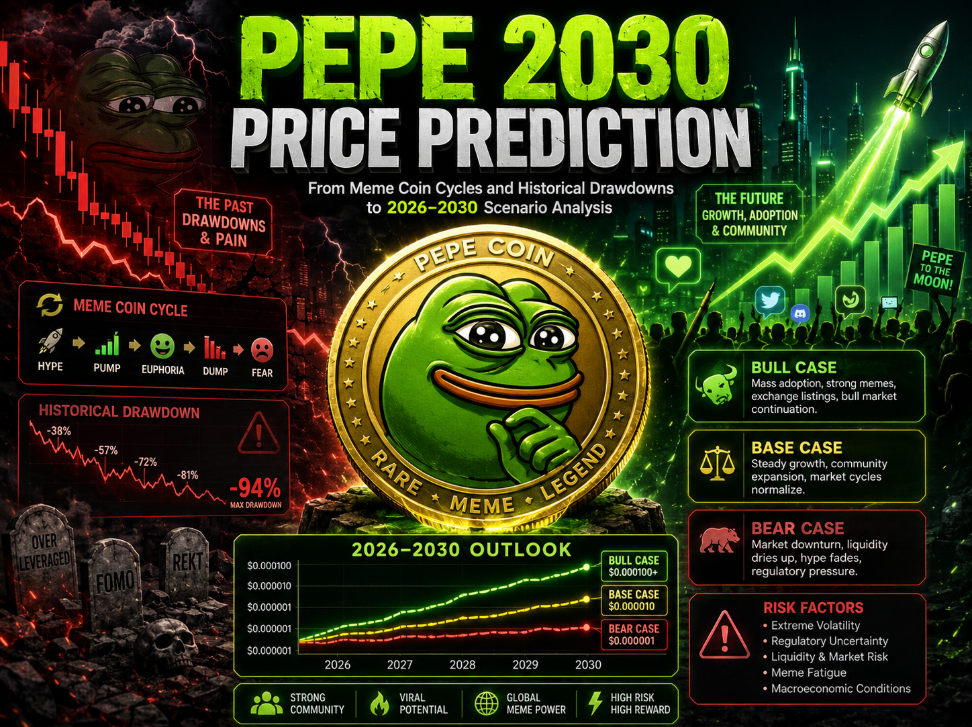
- The baseline scenario range given in this article for 2030 is $0.000008–$0.000030. The bullish scenario is $0.000030–$0.000080, and the bearish scenario falls below $0.0000005, potentially approaching zero.
- These numbers are not buy signals but a scenario framework to help you with position management and risk assessment.
I. Why is PEPE's Price Prediction Completely Different from Other Coins?
1.1 Bitcoin Has Halving Cycles, Ethereum Has Ecosystem Data, What Does PEPE Rely On?
Bitcoin price predictions usually reference:
- Halving cycles
- Miner costs
- ETF capital inflows
- Long-term holding addresses
- On-chain activity
- Macro liquidity
- Institutional allocation demand
Ethereum price predictions can reference:
- On-chain fee revenue
- DeFi Total Value Locked (TVL)
- Layer 2 activity
- Stablecoin settlement scale
- Developer ecosystem
- ETH staking rate
- Deflationary or inflationary status
But PEPE is different. PEPE does not have its own public chain. It has no stable protocol revenue, no clear cash flow, no staking yields, no rigid demand like ETH Gas, and it is not the equity of any company.
PEPE is a Meme coin, and its core price drivers are:
- Community consensus
- Attention
- Social media propagation
- Exchange liquidity
- Market risk appetite
- Whale capital momentum
- Retail FOMO
- The vitality of Meme culture
Therefore, you cannot use traditional valuation models to predict PEPE. You cannot use P/E ratios, P/S ratios, or protocol revenue multiples. The more appropriate method is "scenario deduction."
We are not asking, "What should PEPE's fair value be?"
Instead, we ask, "Under different market cycles and emotional environments, into what range might the market price PEPE?" This is the underlying logic for PEPE price predictions.
1.2 Three Valid and Three Invalid Variables for Meme Coin Predictions
When predicting Meme coins, the biggest trap is using the wrong variables.
Truly Valid Variables:
- Market Liquidity: Meme coins rely most on liquidity. When mainstream assets like BTC, ETH, and SOL rise, capital often spills over into high-risk assets, benefiting Meme coins.
- Community Hype: PEPE's value comes from community spread, not business revenue. If X, Reddit, Telegram, market platforms, and short-video apps are all discussing PEPE, it easily attracts new buying pressure.
- Exchange and On-Chain Capital Behavior: The more mainstream exchanges support it, the lower the barrier to trading PEPE. Whether on-chain whales are accumulating or moving funds to exchanges also impacts short- to medium-term prices.
Variables That Easily Mislead:
- Low Unit Price: Many newcomers think PEPE is "cheap" because its price has many zeros. This is false. Valuation depends on market capitalization, not the single-token price.
- "Shilled" Target Prices: Claims like "PEPE to $1" or "PEPE 100x" usually ignore supply and market cap constraints. PEPE has a massive supply; moving up a single order of magnitude requires an astronomical amount of capital.
- Short-Term Gains: A short-term surge of 50% or 100% is common for Meme coins, but it doesn't mean the trend is sustainable. Many retail investors lose money mistaking a short-term pump for a long-term trend.
1.3 Why Are Most PEPE 2030 Prediction Articles Unreliable?
The biggest problem with many "PEPE 2030 Price Prediction" articles is: They only give numbers, not conditions.
For example:
- PEPE will hit $0.001 in 2030.
- PEPE will 100x in the future.
- PEPE will be the next SHIB.
- Institutional funds will buy PEPE.
- PEPE will get an ETF.
The issue with these claims is that they fail to answer several critical questions:
- What market cap does this price correspond to?
- How large must the total crypto market cap be at that time?
- What market share must the Meme coin sector capture?
- Where does PEPE need to rank within the Meme coin sector?
- To what scale must holding addresses grow?
- Can trading volume support this valuation?
- If BTC enters a bear market, does the model still hold?
- If community hype drops, where is the price support?
If a prediction article merely slaps an exaggerated target price without stating these premises, it is marketing content, not research analysis. This article's core difference is that it explains under what conditions the 2030 numbers are valid, and under what circumstances they will fail.
1.4 The Prediction Methodology Used in This Article
This article employs a four-layer methodology:
- Layer 1: Historical Cycle Analogy. Referencing the historical price actions of DOGE, SHIB, and PEPE itself, as well as Meme coin performances during the 2017, 2021, and 2024 crypto cycles. We observe how Meme coins explode in bull markets, retrace in bear markets, how veterans survive cycles, and why most go to zero.
- Layer 2: On-Chain Data Framework. Observing PEPE's holding addresses, whale concentration, exchange inflows/outflows, active address changes, transfer frequencies, and smart money behavior.
- Layer 3: Market Scenario Modeling. Dividing the future into three scenarios: Bullish (BTC hits new highs, Meme coins gain capital), Baseline (moderate recovery, PEPE maintains mainstream status), and Bearish (long-term downturn, PEPE shrinks).
- Layer 4: Market Cap Reverse-Engineering. Because PEPE's supply is massive, predicting its price requires reverse-engineering its market cap to see if it's realistic based on total crypto market cap, Meme sector share, and PEPE's share within that sector.
II. PEPE's Historical Price Review: The Real Drivers Behind the Ups and Downs
2.1 April 2023: PEPE Goes from Zero to Mainstream
PEPE entered the market's radar around April 2023. It didn't gain fame through a complex product launch but spread rapidly by relying on the internet cultural symbol, "Pepe the Frog."
Early explosive growth happened because:
- The Pepe meme already had global recognition.
- The crypto community was deeply familiar with Meme culture.
- The early market cap was low, making it easy for capital to push the price.
- Social media spread was incredibly fast.
- On-chain traders were hunting for the "next SHIB."
- Expectations of exchange listings fueled speculative fervor.
When Binance listed PEPE in May 2023, it officially transitioned from an on-chain Meme coin to the mainstream trading market. This node was critical because it brought stronger liquidity, lower entry barriers, and higher market attention. However, an exchange listing is both a bullish catalyst and an exit window for early capital.
2.2 The Mid-2023 Massive Drawdown: Why Did PEPE Drop by Half Again and Again?
After its early surge, PEPE quickly experienced a massive drawdown. The reasons were straightforward:
- Early buyers sat on massive profits and had a strong motive to sell.
- New buying pressure could not sustainably absorb the sells.
- Social media hype cooled down.
- Meme coin capital rotated to other hot topics.
- Overall market liquidity was insufficient.
- Retail confidence collapsed after chasing the top.
This illustrates that PEPE's price does not grow linearly but relies heavily on emotional cycles. When Meme coins rise, the market screams "the community is invincible." When they fall, the market suddenly realizes "there are no fundamentals." This is a trial almost all Meme coins endure.
2.3 The 2024 Bull Market: Signals of PEPE Reaching All-Time Highs
In 2024, PEPE surged again alongside the broader crypto market recovery and Meme coin sector craze, hitting all-time highs near December 2024.
Drivers behind that run included:
- BTC ETFs bringing market confidence.
- The BTC halving narrative strengthening bull market expectations.
- An active altcoin and Meme coin sector.
- Enhanced mainstream exchange liquidity.
- A revitalized PEPE community.
- Veteran Memes like DOGE and SHIB driving sentiment.
- Retail investors seeking high-elasticity assets again.
2.4 What Does the Largest Historical Drawdown Indicate?
PEPE has previously retraced massively from its ATH, with drops exceeding 80% not being uncommon. This reveals a fundamental rule: Meme coins have massive upward elasticity and equally massive downward elasticity.
If you buy at the bottom, PEPE can offer astronomical returns. If you buy when emotions are hottest, PEPE can saddle you with long-term floating losses. The core of Meme coins isn't "can it go up?", but rather "where did you buy, how much did you allocate, and do you have an exit plan?"
For long-term predictions, historical drawdown data is vital. It reminds us that even if PEPE survives until 2030, it may undergo multiple 70%–90% drawdowns along the way.
2.5 Comparison with the Historical Trajectories of DOGE and SHIB
- The Inspiration of DOGE: DOGE proves a Meme coin can survive multiple cycles. It doesn't need strong fundamentals as long as the community is stable, recognition is high, and exchange liquidity is strong. But DOGE's success is hard to replicate due to its first-mover advantage and celebrity effects.
- The Inspiration of SHIB: SHIB proves a next-gen Meme coin can explode massively in a bull market. However, it also proves that post-bull market, the price will undergo a long drawdown, and the community must constantly create new narratives to maintain attention.
- PEPE's Reference Path: If PEPE wants to retain value in 2030, it must avoid being completely replaced by new Memes, maintain an active community and exchange liquidity, grow its holding addresses, re-enter the mainstream narrative in the next bull market, and avoid severe security or trust crises.
III. Five Core Variables Affecting PEPE's 2026–2030 Price
3.1 The Bitcoin Halving Cycle
Historically, the 12–18 months following a BTC halving are often the market's strongest window. While history doesn't simply repeat, the halving affects market psychology, miner supply, institutional narratives, and capital allocation pacing.
For PEPE, the halving's impact is indirect. The path is roughly: BTC Halving → BTC narrative strengthens → Mainstream capital enters → BTC rises → ETH/SOL follow → Risk appetite rises → Altcoins become active → Meme coins get capital spillover.
The year 2028 is the next Bitcoin halving year. Thus, 2028–2029 could be a crucial observation window for PEPE's next major market movement.
3.2 Total Crypto Market Cap Expansion
PEPE's ceiling depends on the entire crypto market's ceiling. If the total market cap expands to $5 trillion, $8 trillion, or even $10 trillion, Meme coins, as a high-risk sector, might see larger capital spillovers.
However, a larger total crypto market cap does not guarantee PEPE will rise. Capital might flow to BTC, ETH, SOL, Stablecoins, RWAs, AI tokens, DeFi, Layer 2s, or new generation Meme coins. PEPE must maintain its core position in the Meme coin sector amidst this competition.
3.3 PEPE Community and Holding Addresses
The most critical fundamental for a Meme coin is its community. For PEPE, community strength can be observed through:
- Whether holding addresses are continuously growing.
- Whether whale concentration is decreasing.
- Whether social media discussion remains stable across X, Reddit, and Telegram.
- Whether new derivative Meme content is being created.
- Whether it still attracts new users.
If PEPE maintains high holding addresses and activity through 2027–2028, its chances of surviving the cycle increase.
3.4 Mainstream Exchange and Financial Product Inclusion
Future financial products that could impact PEPE include more spot trading pairs, futures/options, index products, Meme coin baskets, structured products, and institutional custody support.
However, inclusion in financial products does not equal low risk or guaranteed long-term growth. Packaging Meme coins into financial products can bring in more capital but also amplify volatility.
3.5 Regulatory Environment
Regulation is the hardest variable to model. Favorable scenarios involve exchanges continuing to list it compliantly and no heavy restrictions on Meme coin marketing. Unfavorable scenarios involve multi-national restrictions on trading high-risk Meme coins, exchange delistings, and suppressed social marketing. Regulatory black swans cannot be accurately predicted, so a margin of safety must be preserved.
IV. 2025 PEPE Price Review: Why Is It No Longer Used as a Prediction?
Because the current year is 2026, 2025 can no longer serve as a future prediction year. However, 2025 remains a vital reference point for understanding PEPE's subsequent trajectory.
4.1 The Market Significance of 2025
The year 2025 was situated within the continuation cycle of the 2024 Bitcoin halving. Historically, the year after a halving is when market sentiment most easily heats up. For Meme coins, the key questions in 2025 were whether the altcoin season truly unfolded, if Memes remained a main theme, and if PEPE successfully recaptured capital attention after its 2024 highs without being entirely cannibalized by new Memes.
4.2 Inspiration from 2025 for Future Predictions
If PEPE performed strongly in 2025, it proved veteran Meme coins still possess cyclical elasticity. If it performed weakly, it signaled capital was leaning toward newer narratives. Therefore, 2025 serves as a model calibration year. By observing whether PEPE maintained its mainstream status, absorbed high-level bag holders, and sustained community spread in 2025, we can directly adjust our price deductions for 2026–2030.
V. PEPE 2026 Price Prediction: The Bear Market Stress Test Period
5.1 The 2026 Market Backdrop
The year 2026 is highly likely to be the cooling-off phase following the 2024 halving cycle. If 2025 completed a bull market peak, 2026 typically enters a harsher market environment. For Meme coins, bear markets are the most brutal tests. In a bull market, every Meme coin has a story. In a bear market, only a few retain liquidity, community, and volume. PEPE's core challenge in 2026 is transitioning from a "hot Meme coin" to a "cycle survivor."
5.2 Key Evaluation Criteria for PEPE in 2026
- Is it maintaining high volume on mainstream exchanges?
- Are holding addresses bleeding out?
- Are whales continuously transferring to exchanges?
- Has community discussion visibly cooled?
- Has it been replaced by new Meme coins?
- Have BTC and ETH entered a deep bear market?
5.3 Three Price Scenarios for 2026
- Bullish Scenario ($0.000006–$0.000012): If 2026 isn't a deep bear market but a high-level consolidation, and the PEPE community remains active, prices could hold relatively high.
- Baseline Scenario ($0.000002–$0.000006): If the market enters a normal cooling phase, PEPE may continue to retrace from highs but won't lose liquidity. Volume drops, and holding addresses slowly decrease.
- Bearish Scenario ($0.0000008–$0.000002): If the crypto market enters a deep bear and the Meme sector is abandoned, PEPE could plummet heavily, triggered by collapsing BTC and vanishing community hype.
VI. PEPE 2027 Price Prediction: Cycle Bottom and the Line of Survival
6.1 2027 May Be the Cycle Bottom Zone
If the four-year cycle holds, 2027 could approach the sluggish phase before the next halving. When market sentiment is cold, capital retreats to BTC, ETH, or stablecoins. Without continuous community support, Meme coins are easily forgotten. The core question for 2027 is: Is PEPE temporarily depressed, or has it entered a true death spiral?
6.2 Characteristics of a Healthy PEPE Community in 2027
If PEPE maintains its vitality, we will see: no cliff-edge drop in holding addresses; low but stable volume; continuous community Meme content; whales not entirely exiting; mainstream exchanges not delisting it; and PEPE bouncing alongside any broader market recoveries.
6.3 Assessing the Probability of PEPE Going to Zero
If mainstream exchanges begin delisting it, volume dries up long-term, community accounts go silent, whales relentlessly dump, and new Memes completely replace it, the optimistic model must be heavily revised downward.
6.4 Three Price Scenarios for 2027
- Bullish Scenario ($0.000005–$0.000010): PEPE survives the bear market as a mainstream Meme and anticipates the 2028 halving, forming a higher bottom.
- Baseline Scenario ($0.0000015–$0.000005): The market remains sluggish. PEPE survives but lacks strong catalysts, facing limited new buying pressure.
- Bearish Scenario ($0.0000003–$0.0000015): PEPE's community hype fades significantly, liquidity drops, and it enters a long-term depression as new narratives take over.
VII. PEPE 2028 Price Prediction: The Next Bitcoin Halving Year
7.1 Why is 2028 Important?
2028 is the next Bitcoin halving year. While the halving year itself doesn't guarantee an immediate bull market, it often reawakens market attention. If PEPE can survive until 2028 and retain high recognition, it could re-enter the market's radar. The key isn't "BTC halves so PEPE must rise," but whether PEPE is still qualified to be chosen by capital.
7.2 What Does a 5-Year-Old Meme Coin Mean?
By 2028, PEPE will have existed for about 5 years. In the Meme space, surviving 5 years while retaining liquidity is a massive filter. If it survives, it looks more like a cyclical Meme asset (like DOGE or SHIB) rather than a short-lived fad.
7.3 Three Price Scenarios for 2028
- Bullish Scenario ($0.000010–$0.000025): The BTC halving narrative kicks in, the PEPE community remains strong, and the Meme sector warms up, leading to a notable rebound.
- Baseline Scenario ($0.000003–$0.000010): The market recovers mildly, but Memes aren't the main theme. PEPE sees a moderate bounce as liquidity holds.
- Bearish Scenario ($0.0000008–$0.000003): The halving narrative fails to move the market, or PEPE has already lost its community to newer Memes. Volume stays suppressed.
VIII. PEPE 2029 Price Prediction: The Post-Halving Bull Market Window
8.1 Why Could 2029 Be a Strong Year?
If historical cycles hold, 2029 could be the major upward window following the 2028 halving. It would be PEPE's year to "prove itself again"—showing it wasn't just a 2023–2024 fad and can compete with the next generation of Meme coins.
8.2 Will Institutional Funds Buy Meme Coins?
Direct institutional allocation into Meme coins is highly unlikely. However, institutions buying BTC inflates the total crypto market cap, raising retail risk appetite and causing capital to spill over into altcoins and Memes. PEPE benefits indirectly from this liquidity expansion.
8.3 Three Price Scenarios for 2029
- Bullish Scenario ($0.000020–$0.000060): 2029 becomes a new bull market peak. PEPE recaptures its core Meme status, and the price challenges or approaches its historical highs.
- Baseline Scenario ($0.000006–$0.000020): The market rises, but PEPE isn't the strongest narrative. New Memes divert significant capital, leading to a moderate recovery without replicating past mania.
- Bearish Scenario ($0.0000015–$0.000006): PEPE is replaced by new Memes. Even if the market warms up, PEPE underperforms the broader market due to an aging community and whale exits.
IX. PEPE 2030 Price Prediction: The Ultimate Scenario Deduction
9.1 What Might the Crypto Market Look Like in 2030?
- Optimistic State: Crypto is a vital global financial component. Total market cap expands massively. Meme coins persist as high-risk cultural assets.
- Neutral State: Growth slows, but BTC/ETH are core assets. Meme coins still see action, but capital concentrates on a few top-tier Memes. PEPE could maintain its value here if it stays in the first tier.
- Pessimistic State: Tightened regulation, lack of new capital, and waning speculative zeal. Liquidity dries up for most altcoins. PEPE shrinks drastically or approaches zero.
9.2 The Market Position of Meme Coins in 2030
Meme coins could be viewed as "Cultural Assets" (like digital collectibles), "Speculative Tools" (for high volatility trading), or they might be completely replaced by new narratives (AI, RWAs, Tokenized Stocks). PEPE's classification here dictates its price ceiling and floor.
9.3 PEPE 2030 Extreme Bullish Scenario ($0.000030–$0.000080)
Requires a massive expansion of the total crypto market cap, sustained popularity of the Meme sector, PEPE maintaining its status just behind DOGE/SHIB, and no major regulatory roadblocks.
9.4 PEPE 2030 Baseline Scenario ($0.000008–$0.000030)
The market continues cyclical expansion. PEPE doesn't go to zero, but it doesn't surpass DOGE either. The community remains active, but not at peak bull-market levels. It holds a spot in the Meme sector but faces constant capital diversion from new Memes.
9.5 PEPE 2030 Bearish Scenario ($0.0000005–$0.000008)
Triggered by a general retreat from the Meme sector, declining community activity, shrinking volume, long-term whale selling, and regulatory restrictions. In extreme cases, PEPE approaches zero.
X. Overview of PEPE 2026–2030 Annual Price Predictions
- 2026 Prediction:
- Bearish: $0.0000008–$0.000002
- Baseline: $0.000002–$0.000006
- Bullish: $0.000006–$0.000012
- 2027 Prediction:
- Bearish: $0.0000003–$0.0000015
- Baseline: $0.0000015–$0.000005
- Bullish: $0.000005–$0.000010
- 2028 Prediction:
- Bearish: $0.0000008–$0.000003
- Baseline: $0.000003–$0.000010
- Bullish: $0.000010–$0.000025
- 2029 Prediction:
- Bearish: $0.0000015–$0.000006
- Baseline: $0.000006–$0.000020
- Bullish: $0.000020–$0.000060
- 2030 Prediction:
- Bearish: $0.0000005–$0.000008
- Baseline: $0.000008–$0.000030
- Bullish: $0.000030–$0.000080
XI. How to Use Price Predictions to Guide Actual Investment Decisions?
11.1 Prediction Numbers Are Not Buy Signals
This is the most critical point: Price predictions are not buy signals.
Even if you agree with the 2030 baseline scenario, it doesn't mean you should buy right now. You must consider if the current price is overheated, if BTC is in a risky phase, if your position size is too large, and if you can stomach a 70%+ drawdown.
Correct usage: Use predictions to judge long-term space, use market positioning to time entries, and use position sizing to control risk.
11.2 Phased Accumulation if You Agree with the Baseline
If you believe PEPE has potential through 2030 but want to mitigate entry risk:
- Phase 1 (Observation): Ideal for volatile periods like 2026. Watch BTC trends, PEPE volume, and community hype without rushing to size up.
- Phase 2 (Small Test Positions): If PEPE has drawn down significantly but liquidity remains, test with small capital you can afford to lose. Never use leverage or chase pumps.
- Phase 3 (Adding Post-Confirmation): If the market strengthens around the 2028 halving, gradually increase exposure, but keep total Meme allocations strictly controlled.
11.3 Set Your Own "Invalidation Assumptions"
Every model needs failure conditions. If PEPE is delisted from major exchanges, holding addresses plummet, volume dies, and whales permanently exit, do not comfort yourself with an outdated model. Mature investors know when to admit a thesis is invalidated.
11.4 The Opportunity Cost of Holding PEPE Long-Term
Buying PEPE is not your only choice. The same capital could buy BTC, ETH, SOL, DeFi blue-chips, or AI tokens. PEPE's advantage is high elasticity; its disadvantage is low certainty. It is best suited for small positions, high risk appetite, and disciplined profit-taking—acting as a satellite position, not a core holding.
If you want to research different types of crypto assets, check out these Hibt articles:
- 2030 1INCH Price Prediction: Long-Term Value Deduction for DEX Aggregator Tokens
- 2030 NFP Price Prediction: AI + Web3 Creator Economy Sector Analysis
XII. Conclusion: What Will Happen to PEPE by 2030?
PEPE's 2030 prediction cannot be answered with a single number.
If the crypto market expands long-term and Meme coins remain a key speculative sector, PEPE could retain high market value in 2030, provided it maintains its community and liquidity. If it survives the 2026–2027 bear market and regains attention in the 2028–2029 cycle, it could challenge its historical highs. Conversely, if community hype dies, new Memes take over, or regulations tighten, it could plunge toward zero.
Core 2030 Ranges:
- Bearish Range: $0.0000005–$0.000008
- Baseline Range: $0.000008–$0.000030
- Bullish Range: $0.000030–$0.000080
Again, these ranges are not promises or buy recommendations. The truly important thing is whether you can control your losses when wrong and rationally lock in profits when right.
FAQ: Common Questions About PEPE 2030 Price Predictions
1. Can PEPE reach $1 by 2030?
From a market cap perspective, reaching $1 requires an absurdly massive valuation that far exceeds realistic capacity assumptions for the crypto market. Unless there is a massive supply burn or hyperinflation in global finance, $1 is not a realistic baseline prediction.
2. Can PEPE reach $0.001 by 2030?
$0.001 is also an extremely aggressive target. It requires PEPE to capture a massive share of the Meme coin sector alongside a huge expansion in total crypto market cap. We treat this as an extreme speculative assumption, not a baseline.
3. What is the most likely price for PEPE in 2030?
This article's baseline scenario places it in the $0.000008–$0.000030 range, relying on it maintaining its mainstream Meme status, exchange liquidity, and active community.
4. Will PEPE go to zero by 2030?
It is possible. As a Meme coin, it lacks stable cash flow and fundamentals. If the community vanishes, volume dries up, and exchanges delist it, it could approach zero.
5. Is PEPE suitable for long-term holding until 2030?
Only for investors with high risk tolerance using small allocations. Ordinary newcomers should not treat PEPE as a core long-term asset and must be prepared for 70%–90% drawdowns.
6. Which is better for long-term holding: PEPE, DOGE, or SHIB?
DOGE has the longest history, SHIB has richer ecosystem narratives, and PEPE relies purely on Meme culture and hype. All are high-risk assets. You must evaluate them based on market cap, community, volume, and cycle positioning.
7. What indicators should I watch for PEPE price predictions?
Focus on the BTC cycle, total crypto market cap, Meme sector hype, PEPE holding addresses, volume, market cap ranking, whale behavior, exchange liquidity, and social media heat.
8. Is Dollar Cost Averaging (DCA) suitable for PEPE?
Not in the traditional sense. BTC and ETH are better suited for DCA. PEPE is better suited for small, phased, scenario-driven allocations rather than mindless long-term DCA.
9. Will the 2028 Bitcoin halving definitely drive PEPE up?
Not necessarily. While the halving might boost market sentiment, PEPE's rise depends on whether the Meme sector is active, if the PEPE community remains strong, and if new Memes divert capital.
10. What is the biggest risk when buying PEPE?
The most critical risks are extreme volatility, lack of fundamental support, fading community hype, whale dumping, liquidity drops, and retail FOMO chasing highs.
Author's Declaration
This article was compiled by the Hibt Content Research Team to help readers understand the logic behind PEPE price predictions, Meme coin cycle patterns, long-term scenario deductions, and risk boundaries.
This article is not investment advice, nor does it represent any promise by Hibt regarding PEPE's future price. All price ranges are research deductions based on public data and scenario models, which may become invalid as market conditions change.
Before engaging in any crypto asset trading, readers should fully understand the risks and make independent decisions based on their own financial situation, risk tolerance, and local regulatory requirements.