
In the crypto market, when many people see a coin drop 99%, their first reaction is often:
"Has it finally bottomed out?"
But reality is often crueler than imagination. Especially in the GameFi sector. Because it must contend not only with:
- token price issues
- macro cycles
- liquidity risks
but also simultaneously solve the ultimate question:
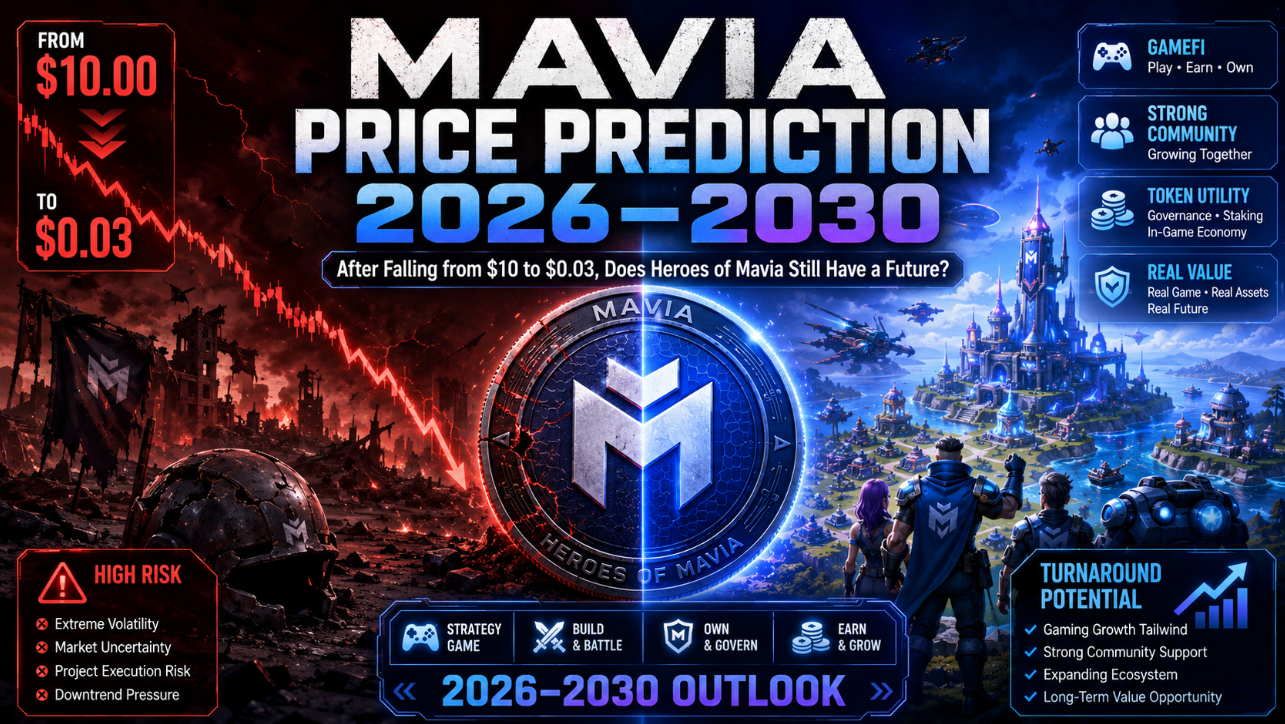
"Does anyone actually want to play the game?"
Heroes of Mavia and MAVIA represent precisely this most typical and dangerous type of case.
It once:
- Had an all-time high above $10
- Received investment from multiple top-tier institutions
- Enjoyed backing from Binance Labs
- Was hailed as the "Web3 version of Clash of Clans"
But now, the price lingers around $0.03 for extended periods, down over 99.7%.
So the question becomes:
- Is MAVIA severely undervalued?
- Or is it heading toward death?
- Does GameFi have a second chance?
- Will token unlocks permanently suppress the price?
This article will not give you "100x moonshot fantasies." Instead, it will comprehensively analyze, from the perspectives of:
- Game product
- User data
- Tokenomics
- Unlock pressure
- GameFi industry
- Macro cycles
whether MAVIA truly has any room to survive between 2026 and 2030.
If you are also following:
- Layer2 scaling
- AI Agent赛道
- Cross-chain infrastructure
- Web3 payment narratives
it is recommended to further read:
These projects, like MAVIA, belong to typical assets characterized by "high volatility + strong narrative + high risk."
Chapter 1: What Exactly Is Heroes of Mavia?
This is the most critical step in the entire analysis. Because many people buy MAVIA without ever having played the game, or even knowing what Heroes of Mavia actually is.
What is it essentially? The simplest way to understand it: a Web3 version of Clash of Clans. Players need to:
- Build bases
- Upgrade buildings
- Train troops
- Attack other players
- Gather resources
The core gameplay is actually very traditional.
Why was it once hyped by the market? Because during 2021–2022, the entire market believed that "Web3 gaming will reshape the mobile gaming industry." Back then, the market thought:
- NFTs would change game asset ownership
- Players could truly earn money
- Web2 games would be disrupted
Heroes of Mavia thus received massive attention.
But that's where the problems begin Because most GameFi projects eventually run into one question:
"Are players here to play the game or to make money?"
If the answer is "make money," then once the token price drops, players will quickly leave. This is the fundamental reason most GameFi projects collapse.
Chapter 2: Is the MAVIA and RUBY Dual-Token Model Really Sustainable?
This is the core of the game's economy.
What is MAVIA? MAVIA is a governance token, a long-term value token, and a voting token. In theory, it should represent the long-term value of the entire ecosystem.
What is RUBY? RUBY, on the other hand, is an in-game currency. Players earn RUBY through battles, completing tasks, and other in-game actions, then use it for upgrades, NFT enhancements, and in-game economic circulation.
Why do dual-token models tend to collapse? GameFi history has shown that most dual-token systems eventually fall into "infinite production → player selling → inflationary collapse," especially when new player growth stalls, the system quickly becomes unbalanced.
Why is Ruby 2.0 important? The Mavia team later launched the Ruby 2.0 upgrade, attempting to restructure the economic model, reduce the death spiral, and expand more game scenarios. They even plan to extend RUBY to be shared across multiple games.
That sounds good, but the real question is: are there real users? Because the most dangerous illusion in GameFi is that "mechanism optimization equals project revival." Without user growth, no economic model can sustain itself long-term.
Chapter 3: 1.1 Million Downloads – Why It Might Be "False Prosperity"
This is where many newcomers get deceived. Many projects tout "downloads exceeding 1 million!" But the problem is: downloads ≠ active users.
What data really matters? The metrics that truly determine GameFi value are:
- Daily Active Wallets (DAW)
- Active paying users
- On-chain transaction volume
- Retention rate
Not download numbers.
Why? Because many users download, try it for a few minutes, uninstall, or are just airdrop hunters – they don't truly participate in the economic system.
This is one of MAVIA's biggest problems: a huge gap exists between its download numbers/promotional hype and actual on-chain activity. This indicates weak user retention.
Chapter 4: Why Did MAVIA Fall from $10 to $0.03?
This is one of the most important questions in the entire article. Many people see a 99% drop and instinctively think, "Isn't that overdone?" But in reality, MAVIA's collapse resulted from multiple issues compounding simultaneously.
First reason: The GameFi narrative as a whole died This is the most fundamental reason. In 2021, the market believed in Play-to-Earn and the Web3 gaming revolution. But it turned out most players don't want "grinding for a paycheck." What they truly want is fun, not complex economic systems.
Second reason: The game itself isn't competitive enough Although Heroes of Mavia has decent visuals, its competitors aren't other GameFi projects – they are established mobile games like Clash of Clans, Clash Royale, and Brawl Stars. By comparison, the Web3 entry barrier becomes a liability.
Third reason: Token unlock pressure One of the most fatal issues. MAVIA's real problem isn't that the price is low – it's that a massive amount of tokens have yet to be released.
Chapter 5: MAVIA's Biggest Time Bomb – 80% of Tokens Still Locked
This is a core concept every newcomer must understand.
How low is the current circulating supply? As of 2026, only about 20% of MAVIA is in circulation. That means nearly 80% of the supply will enter the market in the future.
Why is this dangerous? Because the current $9 million market cap is a number under "low circulation." The real metric to watch is the fully diluted valuation (FDV).
Why will unlocks suppress the price? Each unlock adds new sellable tokens. Seed and private round investors, in particular, have very low costs; even after such a price crash, they may still be profitable. More dangerously, MAVIA unlocks will continue until 2029, meaning the market will face sustained selling pressure for years.
Chapter 6: Why "Low Price" Is Actually a Major Trap
This is a common mistake among retail investors. Many see $0.03 and instinctively think, "It's so cheap – wouldn't going back to $1 be a 30x gain?" But the problem is that price alone means nothing. What truly matters is market capitalization.
For example, MAVIA's all-time high of $10 occurred when the circulating supply was far lower than today. To return to $10 now would require a much larger capital inflow than in the past. Simply comparing prices is very dangerous.
Chapter 7: Why Is the Coinone Warning Extremely Dangerous?
In 2025, South Korean exchange Coinone issued a risk warning about MAVIA. Many newcomers underestimate the significance of this.
Why are exchange warnings important? Because GameFi relies most on liquidity. Once exchange support decreases, risk ratings rise, and liquidity shrinks, small-cap projects deteriorate rapidly.
What's the more serious issue? Coinone accused the project team of opaque rule changes and delayed information disclosure. This severely damages community trust – and GameFi fundamentally depends on players' long-term trust.
Chapter 8: Mavia Mini, Nexira, Chapter 2 – Are They Real Turning Points?
This is currently the biggest controversy in the market.
What is Mavia Mini? A derivative mini-game sharing the same account system and RUBY economy with the main game.
What's the theoretical benefit? The team hopes to expand the user base through a "multi-game shared economy."
But what's the real problem? The biggest risk of a shared economy is cannibalizing existing users, not necessarily attracting new ones.
What is Nexira? Nexira is a digital asset trading platform that the Mavia team aims to build, forming an integrated ecosystem of gaming, NFTs, trading, and economic systems.
But again, the question remains: are there users? Without real users, any ecosystem becomes an idle system.
Chapter 9: MAVIA Price Prediction 2026–2030
Finally, the most critical chapter. All predictions below are not "definitive answers" but probabilistic models based on unlock pressure, GameFi cycles, user growth, game updates, and exchange attitudes.
MAVIA 2026 Price Prediction: The Make-or-Break Year of Unlock Pressure 2026 is likely MAVIA's most dangerous year, combining mass token unlocks, a depressed GameFi cycle, stagnant user growth, exchange risks, and insufficient market liquidity.
*Bear scenario: *0.015–0.025 Triggered by a May unlock-induced selloff, further declining daily active users, reduced support from Binance or HTX, further delays to Chapter 2, and general bleeding in the GameFi sector.
*Base scenario: *0.05–0.12 Assumes unlocks create pressure but no crash, continued updates, basic community activity, and stable operation of Mavia Mini and Ruby 2.0.
*Bull scenario: *0.25–0.35
Requires successful launch of Chapter 2, clear recovery in daily active wallets, increased liquidity on BNB Chain, overall GameFi, and a strong BTC bull market.
Chapter 10: 2027 – The True "Recovery Validation Year" for MAVIA
Many GameFi projects don't die in the year they crash, but when they subsequently fail to restore user growth. Thus, 2027 is the real test of whether MAVIA still has a future.
If 2026's unlock pressure is absorbed, the game remains operational, and users haven't completely left, the market will start re-evaluating whether Heroes of Mavia can survive long-term.
Key metrics to watch: daily active wallets, RUBY consumption, player retention, NFT volume, new user growth, and Mavia Mini activity.
Bear scenario: $0.02* – Continued player loss, stagnant updates, RUBY economy imbalance. *Base scenario: $0.15–$0.27* – Basic operations maintained, slow user recovery, renewed market interest in GameFi. *Bull scenario: $0.40–$0.60 – Requires overall GameFi bull market, new exchange listings, genuine expansion of the Nexira ecosystem, and consecutive growth in daily active users.
Chapter 11: 2028 Halving Cycle – MAVIA's "Last Chance"?
Historically, after each Bitcoin halving, the market enters a risk-appetite phase, and GameFi, as a high-beta sector, tends to explode later in bull markets. However, even if GameFi rises overall, it doesn't guarantee Heroes of Mavia's success, as competition is brutally fierce.
Bear scenario: $0.03– Project survives but doesn't truly recover.
Base scenario: $0.50–$1.00– Reasonable long-term recovery range, assuming restored user growth, reduced unlock pressure, and stabilized RUBY economy.
Bull scenario: $1.20–$1.80 – Requires GameFi to re-enter mainstream view, a closed-loop Mavia ecosystem, real revenue from Nexira, and AI features attracting new users.
Chapter 12: 2029 – The Final Mass Unlock Test
MAVIA's unlocks continue until 2029, meaning the market will face new supply pressure for years. The critical question is no longer whether the game still exists, but whether game revenue can cover unlock selling pressure.
Bear scenario: $0.05– Project survives but remains marginalized.
Base scenario: $0.80–$1.50 – Market begins to re-recognize some long-term value in the Mavia ecosystem.
Bull scenario: $2.00–$3.00 – Requires a flywheel effect from Nexira, multiple games sharing the RUBY economy, and GameFi re-entering the mainstream.
Chapter 13: 2030 – Can MAVIA Return to $10?
Theoretically possible, but realistically extremely difficult. Today's MAVIA is no longer the low-circulation, high-hype, strong-narrative new token of 2024. The market is now more rational.
Returning to $10 would require full GameFi复苏, true success of Heroes of Mavia, massive growth in daily active users, stable tokenomics, completed unlocks, sustained support from major exchanges, and Web3 gaming genuinely entering the mass market – an extremely high bar.
A more realistic goal isn't "back to $10," but "whether it can achieve meaningful recovery."
Chapter 14: Why Is MAVIA More Dangerous Than Ordinary Altcoins?
MAVIA isn't just about token price volatility. It simultaneously carries game product risk, user loss risk, tokenomics risk, unlock risk, exchange risk, and GameFi industry risk.
GameFi's biggest death spiral is simple: players are there to make money, not for entertainment. Thus: price drops → players leave → game revenue falls → price drops further – reflexive collapse.
Chapter 15: Who Is MAVIA Really Suitable For?
Ultimately, MAVIA is not suitable for ordinary long-term investors. It's more like a high-risk, high-volatility, small-cap GameFi bet.
Suitable for: high-risk speculators who can accept 90% or even 100% losses, and those who deeply research GameFi and are willing to track daily active data, on-chain economics, updates, and user growth.
Not suitable for: those buying because the "price is low" (the most dangerous), those seeking stable returns, and those unable to endure long-term unlock pressure.
Final Conclusion: Does MAVIA Still Have a Future?
Ultimately, MAVIA's real question is no longer "when will it return to its all-time high," but "whether Heroes of Mavia can still become a game that people actually play."
If the answer is no, then any AI concept, cross-chain concept, new ecosystem, or new platform cannot truly change the outcome.
But if game experience truly improves, user retention recovers, the RUBY economy stabilizes, Nexira forms an ecosystem flywheel, and Web3 gaming re-enters the mainstream, then MAVIA could transform from a "near-dead project" into a GameFi survivor.
Therefore, the most reasonable attitude toward MAVIA is neither "blindly bottom-fishing" nor "directly sentencing it to death," but treating it as an extremely high-risk long-term experiment, while continuously monitoring:
- Daily active wallets
- RUBY burn rate
- Unlock schedule
- Project transparency
- Delivery of game updates
- Exchange support attitudes
Because these are the core variables that will truly determine MAVIA's future fate.