
In crypto, there are plenty of coins that go "parabolic up and then crash down."
But very few projects, like RUNE, have:
- Gone from $0.01 to $21
- Then fallen back to around $0.40
- While surviving hacks, a debt crisis, and regulatory battles
- And yet still remain alive
That list is extremely short.
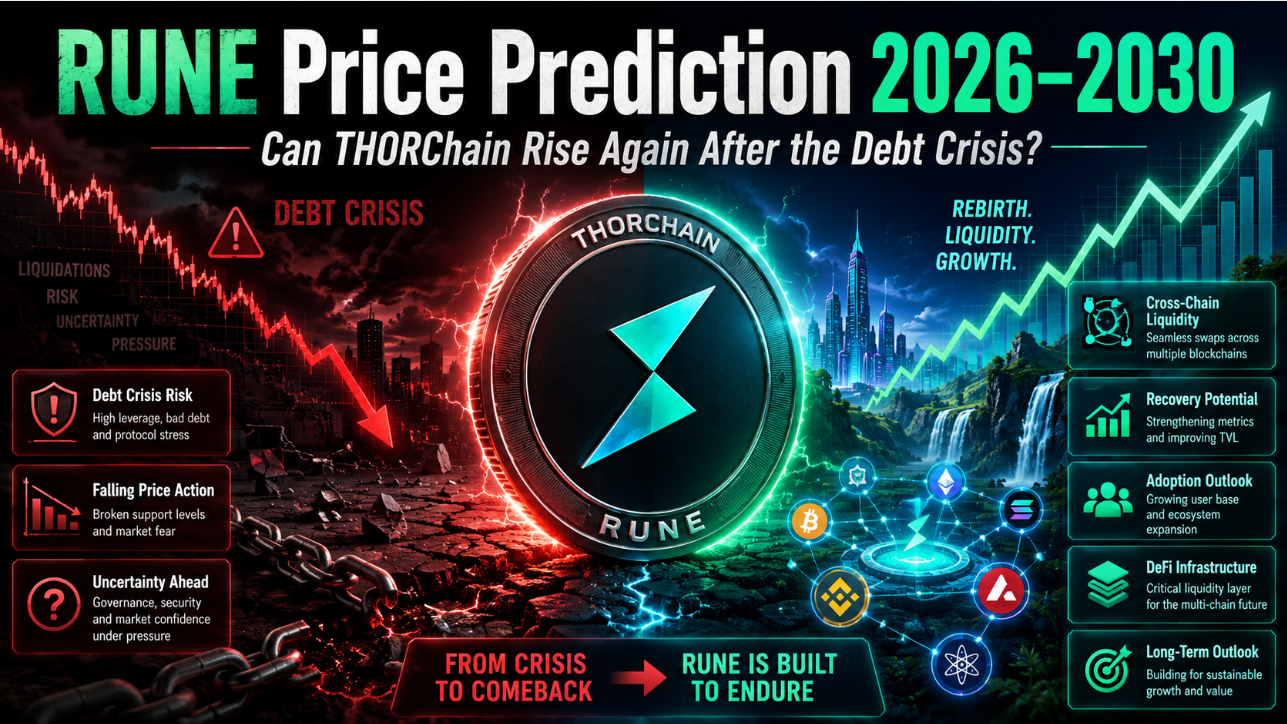
That's also why predicting RUNE is harder than forecasting most other coins.
RUNE isn't just another "altcoin." It sits at the heart of one of the most extreme, complex, and dangerous experiments in cross-chain DeFi.
When people look at RUNE today, they instinctively feel two opposite things:
- "It's down 98% – is this the bargain of a lifetime?"
- "Is this project already dead?"
But the real question isn't "Is RUNE cheap?" The real question is:
Does THORChain still have a reason to exist in the future?
This article won't give you get‑rich‑quick fantasies. Instead, we’ll break down:
- THORChain’s technical architecture
- Its TVL model
- The debt crisis
- The TCY mechanism
- Regulatory risks
- Cross‑chain competition
And then answer: Does RUNE have long‑term survival potential between 2026 and 2030?
If you're also watching cross‑chain infrastructure, Layer 2 scaling, AI agent narratives, or cross‑border payment trends, you may want to check out:
Like RUNE, those projects are classic examples of "high risk + strong narrative + high volatility."
Chapter 1: What Problem Does THORChain Actually Solve?
This is the most important step to understanding RUNE.
Many people buy RUNE without knowing what THORChain does.
What is “native cross‑chain swapping”?
Most cross‑chain solutions aren't truly cross‑chain. They rely on wrapped assets.
For example, on Ethereum you see WBTC and wETH. But these are just "mapped assets." They depend on custodians, bridge protocols, and centralized control.
That brings hack risks, custody risks, and bridge risks.
THORChain aims to solve one thing: truly native cross‑chain swaps.
That means:
- BTC → ETH directly
- BTC → ATOM directly
- BTC → BNB directly
No wrapping into WBTC first. That is the truly revolutionary part of THORChain.
Why is this so hard?
Because different blockchains are inherently incompatible.
- Bitcoin has no smart contracts.
- Ethereum uses an account model.
- Cosmos uses IBC architecture.
THORChain has to manage real assets on multiple chains at the same time. That’s why its technical complexity is far higher than that of a regular DEX.
Chapter 2: Why Must RUNE Exist?
Many tokens have no real reason to exist. RUNE is different.
In THORChain’s design, RUNE is the core of the system – not a side token.
Role 1: Liquidity pairing
Every pool on THORChain must be paired with RUNE.
- BTC pool: BTC + RUNE
- ETH pool: ETH + RUNE
So if THORChain’s trading volume grows, demand for RUNE should theoretically grow too.
Role 2: Node collateral
Node operators must stake a large amount of RUNE. And the protocol requires:
Node staked value > Liquidity pool value.
Why? So nodes have no incentive to attack. If they attack, they lose more than they could gain.
Role 3: Gas fees and governance
RUNE also covers gas fees, network governance, and incentive mechanisms. It is not a “pure speculation token.”
Chapter 3: Why Was THORChain Once Extremely Hot?
In 2021, THORChain was one of the hottest projects in DeFi. The reason is simple: it solved the cross‑chain liquidity problem.
Back then, the whole market believed we were entering a multi‑chain era.
What was happening at that time?
- Solana exploding
- Avalanche rising
- The Terra ecosystem ballooning
- The Cosmos ecosystem growing
Everyone was asking: “How do we make different chains talk to each other?” THORChain became a star project.
Why did RUNE go to $21?
- Red‑hot cross‑chain narrative – Cross‑chain was seen as Web3’s future infrastructure.
- TVL surged – Lots of capital poured into THORChain, driving RUNE demand.
- Native BTC swaps were extremely attractive – Many BTC holders disliked WBTC; THORChain offered an alternative.
- Small circulating supply – Early RUNE had a low float, so inflows easily moved the price.
- Highly leveraged market – 2021 was a liquidity‑flooded environment where money chased high‑beta assets. RUNE was a perfect example.
Chapter 4: How Did the 2021 Security Breaches Change THORChain’s Fate?
This was the first major crisis in RUNE’s history. Many newcomers don’t know that THORChain suffered multiple security incidents in 2021.
Why did this hit so hard?
Because THORChain manages real on‑chain assets – BTC, ETH, LTC. When stolen, the loss is real, not “virtual.”
What happened next?
The market realized that cross‑chain protocols are among the most dangerous areas in crypto. They have to manage multiple chains, maintain complex validation mechanisms, and control real asset treasuries. Their attack surface is far larger than that of a regular DEX.
Chapter 5: How Did THORChain Slip Into a Debt Crisis?
This was the real make‑or‑break moment.
Many people think THORChain’s problem was just “the price went down.” The real danger was a protocol‑level debt collapse.
How did the crisis form?
Over time, THORChain expanded into lending, synthetic assets, high‑yield products, and the THORFi ecosystem. These features looked great in a bull market – rising prices hide all debt.
But when the bear market came, problems surfaced:
- Users withdrew funds
- Asset prices crashed
- Protocol revenue fell
- Liabilities kept growing
Eventually, THORChain had to admit that the protocol was close to insolvency. This was the most serious issue in RUNE’s history, because it hurt not just the price but market trust in the protocol itself.
Chapter 6: TCY – DeFi’s Version of “Debt‑for‑Equity”
To avoid total collapse, THORChain introduced TCY – an extremely rare design in crypto.
What is TCY?
Simply put, THORChain told creditors: “We can’t pay you now, but once the protocol starts making money again, we’ll give you a permanent cut.”
Thus TCY was born.
How does TCY work?
Very simple: for every $1 of debt, you get 1 TCY. TCY holders receive a permanent 10% of the protocol’s revenue.
Why is this dangerous?
Future protocol revenue was supposed to support RUNE’s value. Now, a portion is permanently diverted to TCY holders. TCY is effectively competing with RUNE for value capture.
But why did they have to do it?
Because without this debt restructuring, THORChain might have died outright. TCY is essentially trading future upside for survival today.
Chapter 7: Why Did the Lazarus Event Spike Regulatory Risk?
This is another huge hidden risk for THORChain.
The North Korean hacking group Lazarus used THORChain to swap large amounts of ETH for BTC. Later, THORChain also planned to support privacy coins like Monero and Zcash.
Technically, that’s a breakthrough. But from a regulatory standpoint, it could be a disaster.
Regulators may conclude that THORChain is helping launder money. That brings compliance pressure, exchange delisting risks, and legal risks for the development team.
This is also why many institutional investors have never dared to get deeply involved with THORChain.
Chapter 8: What Is RUNE’s True Core Logic?
At the end of the day, RUNE comes down to one question:
Will cross‑chain become a long‑term pillar of Web3 infrastructure?
If the answer is yes, then THORChain still has enormous value, because truly native cross‑chain swaps remain extremely difficult to achieve.
THORChain’s biggest moat
- Native BTC swaps
- Multi‑chain support
- Deep liquidity
- First‑mover advantage
- User awareness
In particular, native BTC liquidity is something many competitors still cannot match.
Chapter 9: THORChain vs. Chainflip
This is one of the most important rivalries to watch in the coming years.
THORChain’s model: Users provide liquidity, RUNE secures the system, high decentralization. Downsides: complex, very risky, capital inefficient.
Chainflip’s model: Professional market makers provide liquidity, closer to a traditional exchange. Upsides: lower slippage, better user experience. Downside: weaker decentralization.
Who is more likely to win?
In the short term, Chainflip may suit ordinary traders better. In the long term, THORChain’s true value remains native BTC cross‑chain swaps. That is its greatest barrier to entry.
Chapter 10: RUNE Price Prediction 2026–2030 (Core Section)
All predictions below are not “certain answers.” They are probability ranges based on TVL, trading volume, debt risk, macro cycles, and regulation.
2026
- Bear case: $0.20–0.35 – Triggered by failed debt restructuring, continued TVL decline, rising regulatory risk, and user loss.
- Base case: $0.60–1.20 – Stable protocol operation, volume recovery, successful Solana integration, and easing debt risk. This is the most reasonable range today.
- Bull case: $1.50–2.00 – Needs a continuation of the BTC bull market, exploding cross‑chain demand, THORChain revenue recovery, and renewed market recognition of native cross‑chain value.
2027 – The real “recovery validation” year
If TVL recovers above $500M and monthly fee revenue exceeds $10M, the market will re‑price THORChain.
- Bear: $0.30
- Base: $1.5–3.0
- Bull: $4–6
2028 – Bitcoin halving year
If on‑chain activity on Bitcoin increases, THORChain could be a beneficiary.
- Bear: $0.80
- Base: $5–9
- Bull: $12–18
This is the critical phase where RUNE could re‑enter the mainstream spotlight.
2029
Valuation will no longer be about “story” but about protocol revenue. If THORChain can prove that fees cover system incentives and that it has sustainable cash flow, RUNE can mature.
- Bear: $1.50
- Base: $10–16
- Bull: $20–28
2030 – The ultimate question: Can RUNE return to $21?
Theoretically, yes. But it requires:
- Cross‑chain becoming standard Web3 infrastructure
- A lasting multi‑chain ecosystem
- Explosive demand for native Bitcoin DeFi
- THORChain fully restoring market trust
- Bear: $0.50–2.00 (project gradually marginalised)
- Base: $18–30 (reasonable long‑term range)
- Bull: $40–60 (complete phoenix‑from‑the‑ashes scenario)
Chapter 11: Does RUNE’s “Deterministic Value Model” Actually Hold?
This is the most important and controversial theory behind THORChain.
Many long‑term RUNE bulls believe: “As long as THORChain’s trading volume keeps growing, the RUNE price will eventually rise.”
That comes from the Deterministic Value Model.
What does this model mean?
THORChain’s logic is: the more non‑RUNE assets in the system, the more RUNE is needed as collateral. Because:
- Liquidity pools require RUNE
- Nodes must bond large amounts of RUNE
- Node collateral must exceed pool value
Thus, theoretically, RUNE demand grows with TVL.
The official target ratio
The theoretical goal is: RUNE market cap ≈ non‑RUNE asset value × 3.
Why 3x? Because the system design requires roughly 2x bonding and 1x liquidity pools, so nodes have no incentive to cheat.
A simple example
If THORChain’s TVL reaches $1 billion in non‑RUNE assets, then in theory RUNE might need a $3 billion market cap to maintain equilibrium. That’s why many believe RUNE has natural value capture.
Why hasn’t reality followed the theory?
Because the model has a huge prerequisite: the market must continuously trust THORChain. Over the past few years, that trust has been badly damaged by security flaws, debt crisis, regulatory battles, hacker money laundering, and protocol complexity.
So even if TVL grows, the market may not assign a high valuation.
Chapter 12: Why Has TVL and RUNE Price Diverged?
Many people are confused: sometimes THORChain sees volume growth, user activity, and fee increases, yet RUNE price falls.
Reason 1: The market is more focused on debt. Revenue growth doesn’t mean the debt risk is gone. Investors fear future dilution, token model changes, or incentive adjustments – so they apply a “risk discount.”
Reason 2: TCY is capturing future value. Because 10% of future revenue is permanently diverted away from RUNE, the market recalculates how much value RUNE can truly capture.
Reason 3: DeFi valuation logic has changed. In 2021, the market gave huge premiums to “future imagination.” Now, investors care more about real revenue, sustainability, risk control, and compliance – areas where THORChain remains highly controversial.
Chapter 13: Why Are Solana, Monero, and Zcash Integrations Critical for RUNE?
THORChain’s biggest future growth driver isn’t Ethereum – it’s supporting more native chains, especially Solana, Monero, and Zcash.
Why Solana matters: Solana has highly active users, high‑frequency trading, meme ecosystems, and massive stablecoin flows. If THORChain can integrate native SOL swaps, it could capture significant new volume.
Why Monero and Zcash are more sensitive: They are privacy coins. Supporting native private asset cross‑chain swaps would be technically powerful but would also spike regulatory risk.
This creates a contradiction: the tech community sees “true decentralization,” while regulators may see “money laundering tools.” That’s one of RUNE’s biggest uncertainties.
Chapter 14: THORChain’s Biggest Enemy Is Not Chainflip
Many assume Chainflip is THORChain’s main competitor. It’s not.
THORChain’s real enemy is centralized exchanges.
For most users, the simplest cross‑chain method is:
- Deposit BTC into an exchange
- Sell for USDT
- Buy ETH
- Withdraw
The process is cheap, fast, and simple. Binance Convert is especially dangerous – many CEXs now offer zero‑fee swaps. That hits THORChain hard.
Ordinary users don’t care much about decentralization, native assets, or permissionless protocols. They care about fast, cheap, and simple.
Chapter 15: What Is THORChain’s Real Moat?
If THORChain wants to survive long‑term, it must have something centralised exchanges cannot offer.
1. Native BTC liquidity
This is THORChain’s most important asset. Many long‑term BTC holders don’t want to use WBTC, custodial bridges, or centralised custodians. THORChain offers true native BTC swapping – that’s its core value.
2. Permissionless cross‑chain capability
If regulation keeps tightening, a truly permissionless liquidity protocol may become even more attractive, especially in heavily regulated regions. Decentralised protocols could become a key alternative.
Chapter 16: Why 2027 Is the Real “Make‑or‑Break” Year
Many think 2026 decides RUNE’s fate. Not really. The critical year is 2027.
2026 is mostly a “debt repair” period. The market watches survival, systemic stability, and whether TVL keeps falling.
But by 2027, the market will ask: Does THORChain have a real business model?
Key metrics will include monthly fee revenue, TVL recovery speed, user growth, native BTC swap volume, and revenue stability. If those numbers recover, the market will re‑price RUNE. Otherwise, RUNE may stay in a low‑valuation zone for years.
Chapter 17: Why the 2028 Halving Cycle Could Change RUNE’s Fate
Historically, Bitcoin halvings bring higher liquidity, greater risk appetite, and altcoin rotations. THORChain’s biggest asset is native BTC liquidity.
As the BTC price rises, more BTC holders will want to swap assets, participate in DeFi, earn yield, and do cross‑chain operations. THORChain could be one of the biggest beneficiaries.
But there is a huge risk: if by 2028 the market no longer needs native cross‑chain, or a stronger competitor emerges, THORChain could permanently lose its edge.
Chapter 18: Can RUNE Really Return to $21?
That’s the question everyone cares about.
The answer: theoretically possible, but extremely difficult.
Why difficult? Because $21 reflected not just price but extreme optimism: the belief that cross‑chain would explode, THORChain would become infrastructure, and the multi‑chain world was imminent.
Today, the market is much more rational.
What would it take to return to $21?
- Significant TVL recovery – THORChain must re‑attract large amounts of BTC and ETH liquidity.
- Complete resolution of the debt problem – Market trust must be restored.
- Easing of regulatory risks – Otherwise institutional money won’t enter.
- A renewed multi‑chain narrative – This is the most critical condition. If Web3 re‑enters a “multi‑chain era,” THORChain will gain new attention.
Chapter 19: Who Is RUNE For?
RUNE is not a “steady investment.” It’s more like a high‑risk, high‑convexity infrastructure bet.
Suitable for:
- High‑risk‑tolerance investors who can withstand 80–90% drawdowns.
- Deep DeFi researchers who understand TVL, node mechanisms, debt models, and protocol revenue.
- Long‑term believers in a multi‑chain world. If you think the future won’t be just one chain (Ethereum), THORChain remains worth watching.
Not suitable for:
- Those seeking stable returns.
- People who cannot track protocol developments (THORChain changes fast).
- Small‑capital, all‑in gamblers – RUNE’s historical volatility is extreme.
Chapter 20: Final Conclusion – Rebirth or Slow Death?
The real question for RUNE is just one sentence:
Will THORChain still be necessary in the future?
If the answer is “we need native cross‑chain,” then THORChain still has enormous opportunity. It remains one of the most mature native cross‑chain protocols today.
But if in the future: Layer 2 unifies liquidity, centralised exchanges dominate cross‑chain, the multi‑chain narrative fades, and regulation keeps squeezing – then THORChain may slowly become marginalised.
Thus, RUNE is not a “brainless hold forever” coin. It is more like a high‑risk bet on the future structure of Web3.
The forces that will truly decide RUNE’s fate are not KOLs or short‑term prices. They are:
- TVL
- Trading volume
- Protocol revenue
- BTC cross‑chain demand
- Whether the multi‑chain ecosystem exists long‑term
These are the real core variables for RUNE’s future.