
Introduction: Does MANA Have a Future? A Reassessment After the Metaverse Narrative Retreats
If you heard the word "metaverse" in 2021, you almost certainly heard of MANA too.
That year, Facebook rebranded to Meta, and global tech companies, investment institutions, game developers, and NFT enthusiasts were all discussing one question:
Will the future of the internet become an immersive virtual world?
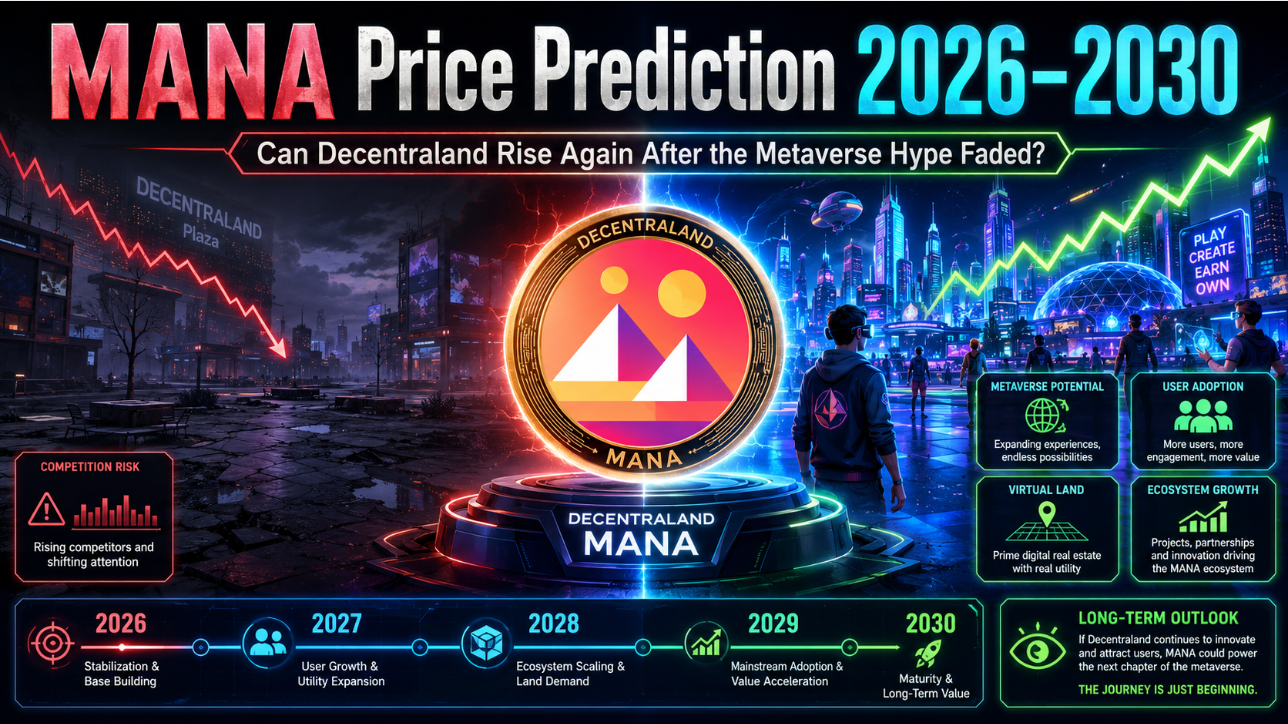
Decentraland became one of the flagship Web3 metaverse projects during that period. Riding the metaverse narrative, MANA's price surged from obscurity to become one of the hottest metaverse tokens of the time.
But what happened afterwards is well known.
Metaverse hype cooled, the NFT market retreated, virtual real estate prices crashed, Decentraland's daily active user data was questioned, and Meta's metaverse investments were seen by the market as yielding poor returns. MANA pulled back sharply from its highs, and many investors began to wonder:
Has MANA missed its chance completely?
This question cannot be answered with a simple "yes" or "no".
Because MANA's future does not depend on how popular it once was, but on whether it can prove three things again between 2026 and 2030:
- Does Decentraland still have real users and economic activity?
- Will the metaverse narrative revive in new forms such as AI, AR/VR, digital identity, and virtual events?
- Can the MANA token still capture the value of the Decentraland ecosystem?
This article will not simply shill or give an exaggerated price target. We will reassess MANA's price possibilities for 2026–2030 from four angles: virtual real estate fundamentals, tokenomics, metaverse sector cycles, and macro capital flows.
A necessary disclaimer: All price predictions in this article are based on public information, historical cycles, and reasonable assumptions, and do not constitute investment advice. MANA is a high-volatility, narrative-dependent asset, and actual prices may deviate significantly from predictions. Please do your own research and make decisions based on your risk tolerance before investing.
Part 1: Re-understanding MANA – The Real Project Behind the "Metaverse Coin" Label
1.1 What exactly is Decentraland?
Decentraland is a blockchain-based, decentralized virtual world.
Users can:
- Purchase virtual land
- Build virtual scenes
- Attend events
- Display NFTs
- Create games
- Host exhibitions
- Interact with other users
- Participate in community governance
Its core is not just "a 3D virtual space", but an open virtual world built around digital ownership.
In the Decentraland ecosystem, there are three core concepts:
- MANA
- LAND
- Estate
Understanding the relationship between these three is fundamental to judging MANA's long-term value.
1.2 What is the relationship between MANA, LAND, and Estate?
MANA: The core token of the ecosystem
MANA is the native token of Decentraland.
It can be used for:
- Purchasing LAND
- Ecosystem transactions
- Buying virtual goods
- Governance voting
- Participating in market economy activities
MANA's value logic stems from a fundamental question:
The more active the Decentraland ecosystem, the stronger the demand for MANA?
If users, brands, and developers continue to enter Decentraland, demand for MANA may increase. If the ecosystem is quiet, MANA may easily become a purely speculative trading asset.
LAND: Virtual land in Decentraland
LAND is an NFT representing virtual land in Decentraland.
It represents a user's ownership of space in the virtual world.
The supply of LAND is limited, which was a major reason Decentraland attracted early investors.
Many people bought LAND not for immediate use, but betting that:
In the future, as foot traffic in this virtual world increases, prime plots will appreciate.
This logic resembles real-world real estate.
But the problem is:
Real estate has fundamental support from housing, commerce, transportation, population, etc.; The value of virtual real estate is highly dependent on platform activity and user dwell time.
If nobody comes, even land scarcity struggles to support long-term prices.
Estate: Large plots formed by combining multiple LANDs
An Estate is a large virtual plot formed by combining several LANDs.
It is suitable for:
- Brands building virtual showrooms
- Projects hosting events
- Game developers designing spaces
- Art institutions creating exhibition areas
- Communities establishing long-term bases
The value of an Estate typically depends on:
- Geographic location
- Size
- Surrounding traffic
- Quality of development
- Event frequency
- Commercial utility
Thus, the relationship between MANA and LAND is not simply "if land goes up, the token goes up".
More precisely:
Active LAND trading, demand for virtual space construction, and ecosystem consumption behavior are what can provide long-term support for MANA.
1.3 Decentraland's DAO Governance: Who controls this virtual world?
An important feature of Decentraland is DAO governance.
Theoretically, the community can participate in governance decisions regarding:
- Ecosystem fund allocation
- Content policies
- Map rules
- Marketplace fees
- Project grants
- Protocol upgrades
- Direction of the virtual world
This distinguishes Decentraland from centralized platforms.
Platforms like Roblox, Fortnite, and Meta Horizon are controlled by companies, while Decentraland emphasizes community ownership and decentralized governance.
This is also the core selling point of Web3 metaverses:
Users are not just players, but also owners and governance participants.
But DAO governance has practical issues:
- Decision-making efficiency may be low
- Voting participation may be insufficient
- Whales may influence governance direction
- Community disagreements may slow execution
- Lacks the strong execution power of a centralized company
This is the long-term contradiction Decentraland faces:
Decentralization brings freedom and ownership, but may sacrifice efficiency and user experience.
1.4 How is Decentraland different from The Sandbox, Roblox, and Fortnite?
Many people compare Decentraland with The Sandbox, as well as centralized platforms like Roblox and Fortnite.
They all belong to the virtual world direction, but their underlying logic differs.
Decentraland: Emphasizes decentralization and digital land ownership
Decentraland's core is:
- Users own land
- Community participates in governance
- Assets based on blockchain
- More open virtual space
- Emphasizes digital ownership
Its advantages are clear ownership, tradable assets, and open community governance.
Disadvantages include product experience, graphics, content richness, and user scale lagging behind centralized giants.
The Sandbox: More gamified and UGC-focused
The Sandbox is also a Web3 metaverse project, but it emphasizes gamification, creator tools, and brand partnerships.
Compared to Decentraland, The Sandbox's content creation and gaming experience are easier for average users to understand.
Roblox and Fortnite: User experience advantages of centralized platforms
Roblox and Fortnite's biggest advantages are:
- Massive user scale
- Mature product experience
- Fast content updates
- Strong social features
- Strong developer ecosystems
- Broad mobile and console coverage
But their problem is:
Users don't truly own platform assets; platform rules are set by the companies.
So Decentraland's long-term opportunity is not to defeat Roblox head-on, but to find a differentiated position:
As an open virtual world combining digital ownership, virtual identity, brand events, on-chain asset display, and community governance.
1.5 MANA Tokenomics: Does the supply-demand structure support long-term value?
MANA's tokenomics are a critical part of price prediction.
MANA's total supply is approximately 2.2 billion tokens, with a relatively high circulating supply. Compared to many new projects, MANA's large-scale unlock pressure is relatively less extreme.
But that doesn't mean MANA has no supply risks.
Because price is determined not only by "unlocks", but also by:
- Strength of market buying pressure
- Changes in foundation holdings
- Whale wallet behavior
- Activity of LAND trading
- Real usage of MANA within the ecosystem
- Health of exchange liquidity
1.6 MANA Burn Mechanism: Does buying LAND really support the token price?
An important early mechanism of Decentraland was:
Buying LAND requires MANA, and some MANA is burned.
This mechanism was very attractive in a bull market.
If a large number of users rush to buy land, MANA is continuously consumed, creating deflationary expectations.
But the problem is:
The burn mechanism only matters when LAND trading is active.
If virtual real estate trading is sluggish, the amount burned decreases, weakening its price support.
This is similar to many other utility tokens.
For example:
- Decentralized storage projects need real storage demand, not just a "future data explosion" story.
- Gaming metaverse projects need real player retention, not just NFT speculation.
- Energy blockchain projects need real energy data and partnership scenarios, not just green narratives.
You can refer to similar analyses:
- SC (Siacoin) Price Prediction 2026–2030
- SUPER (SuperVerse) Price Prediction 2026–2030
- POWR Price Prediction 2026–2030
Like MANA, these projects are driven by market narratives in the short term, but must return to real demand in the long term.
1.7 Decentraland Real User Data: The truth behind the DAU controversy
One of the biggest controversies around MANA is the real number of Decentraland users.
The market has repeatedly debated:
Is Decentraland's daily active user count far below expectations?
This controversy is very important.
Because the core value of a metaverse project is not the number of land plots or the whitepaper, but:
Do people actually enter this world, and are they willing to stay, spend, and interact?
But when interpreting Decentraland's user data, you cannot look at a single metric.
You need to distinguish three types of users:
Type 1: On-chain wallet users
Measured by wallet addresses.
Suitable for observing:
- Trading behavior
- LAND buying/selling
- NFT purchases
- Marketplace activity
- DAO voting
But it doesn't fully represent actual visiting users.
Many users entering the virtual world may not perform on-chain transactions.
Type 2: Actual experience users
These users might just browse, attend events, view exhibitions, or try out scenes.
They may not connect a wallet or transact.
So on-chain data may underestimate this group.
Type 3: Economically active users
This group is the most important.
They not only enter the virtual world but also engage in economic activities, such as:
- Buying virtual goods
- Trading LAND
- Attending events
- Using services
- Voting in governance
- Building spaces
- Renting or operating plots
The most meaningful for MANA's price is not visiting users, but economically active users.
If many people just "take a look and leave", that helps token value little. If users are willing to spend, build, trade, and participate long-term, MANA gets stronger value support.
1.8 MANA Historical Price Review: The real drivers behind each surge and crash
MANA's historical price can be roughly divided into four phases.
Phase 1: Early development period
In the early days, Decentraland was more like a niche Web3 experiment.
Market focus was on:
- Virtual land
- NFT ownership
- Decentralized world
- DAO governance
- On-chain asset display
User scale was small, but the imagination was large.
Phase 2: 2021 metaverse mania
2021 was MANA's most glorious period.
After Facebook rebranded to Meta, global market expectations for the metaverse were quickly ignited.
MANA surged dramatically on this narrative.
Key factors driving the price at the time included:
- Emotional impact of Meta's rebranding
- NFT bull market
- Virtual land speculation
- Brand partnership news
- Extremely high risk appetite for altcoins
- Investors searching for representative metaverse assets
But this rally was clearly more emotion-driven than user-growth-driven.
That's also why the subsequent retrace was so large.
Phase 3: 2022 deep crash
In 2022, the crypto market entered a bear market.
Multiple pressures compounded: LUNA collapse, FTX bankruptcy, macro rate hikes, NFT retreat. MANA fell sharply from its highs.
The metaverse narrative shifted from "future of the internet" to "a bubble questioned by the market."
This decline illustrates:
The stronger the narrative, the larger the potential retrace when the tide goes out.
MANA didn't collapse because Decentraland disappeared overnight, but because the market repriced its real adoption rate.
Phase 4: Intermittent rebounds 2023–2025
MANA saw multiple rebounds afterwards.
These rebounds were typically driven by:
- Overall market recovery
- Short-term NFT sector revival
- Metaverse-related news
- AR/VR hardware releases
- Brand events
- Altcoin rotation
But most rebounds failed to sustain.
The reason is simple:
The market needs to see solid user growth and economic activity, not just news stimuli.
This is crucial for the 2026–2030 forecast.
For MANA to strengthen again, it can't rely solely on "the metaverse being mentioned again." It must prove that Decentraland still has real users, real transactions, and a real content ecosystem.
Part 2: Five Core Variables Affecting MANA's Price
2.1 Is a metaverse sector recovery possible?
MANA's biggest external variable is whether the metaverse narrative can revive.
After 2021, metaverse热度 noticeably cooled, but that doesn't mean the concept of virtual worlds is dead.
More accurately:
The metaverse hasn't disappeared; it has moved from capital market frenzy into a product validation phase.
Whether the metaverse recovers depends on several key factors.
AR/VR hardware adoption
If AR/VR devices become cheaper, with better experiences and richer content, the barrier to entering virtual worlds will lower.
This is a potential positive for Decentraland.
But if hardware adoption is slow, metaverse applications will struggle to explode at scale.
Apple Vision Pro and spatial computing ecosystem
Apple Vision Pro brought "spatial computing" back into mainstream tech discussion.
While it's not Web3 metaverse, it may rekindle market interest in immersive digital spaces.
If spatial computing devices reach more affordable price points in the future, virtual worlds like Decentraland could regain attention.
AI-generated content lowering construction costs
AI content generation may be a key variable in metaverse recovery.
Building virtual worlds used to be expensive, requiring modeling, design, and interactive development.
If AI can help users quickly generate scenes, characters, buildings, and event content, the barrier to content production on Decentraland will lower.
This could benefit the virtual world ecosystem.
Can Web3 metaverses find differentiation?
Centralized platforms have stronger experiences.
So Web3 metaverses cannot simply compete with Roblox on user experience; they must find their unique value:
- Digital land ownership
- On-chain identity
- NFT asset display
- DAO governance
- Cross-platform asset interoperability
- Brand digital events
- Virtual community spaces
If these values are recognized again by the market, MANA has a chance to recover.
2.2 Bitcoin halving cycles and MANA's correlation pattern
As an altcoin, MANA cannot decouple from the BTC cycle.
The typical capital rotation path is:
BTC rises first; Then ETH and major assets catch up; Then sectors like DeFi, L2, AI, RWA, GameFi rotate; Finally, capital enters higher-risk narrative assets.
MANA is a typical high-narrative, high-volatility asset.
In the later stages of a bull market, if risk appetite is strong, MANA may see rapid gains.
But the question is:
Can the metaverse/NFT sector, where MANA belongs, still become a capital mainline?
If the market mainlines in 2026 are AI, RWA, DePIN, Layer2, then MANA may only get a modest rotational bounce. If the metaverse narrative is reignited by AR/VR, AI content generation, and brand virtual events, then MANA may have stronger elasticity.
2.3 Virtual real estate market: How do LAND prices and MANA prices correlate?
LAND is a very important part of MANA's value logic.
Because Decentraland's virtual land supply is limited, theoretically, if user demand grows, LAND prices will rise, driving demand for MANA.
But the virtual real estate market has a big problem:
Scarcity alone does not equal value.
For an asset to have value, it needs not only scarcity but also demand.
LAND's value depends on:
- Whether people visit
- Whether brands set up
- Whether events are held
- Whether a rental market exists
- Whether it generates income
- Whether developers are willing to build
If LAND is just hoarded without real use, it's more a speculative asset than a productive one.
Therefore, to judge MANA's future, we must see whether the LAND market recovers.
Key indicators include:
- LAND floor price
- LAND trading volume
- Number of active buyers
- Rental market data
- Development status of large plots
- Number of brand events
If the LAND market remains sluggish, MANA will struggle to gain strong fundamental support.
2.4 Competitive landscape: How much room does Decentraland have left?
Decentraland faces very complex competition.
It must compete with both Web3 metaverse projects and centralized virtual worlds.
The Sandbox: The most direct Web3 competitor
The Sandbox is similar to Decentraland, emphasizing virtual land, UGC content, and brand partnerships.
But The Sandbox is more gamified and easier for average users to understand.
If The Sandbox leads in user growth, brand events, and creator tools, it may divert attention from Decentraland.
Otherside: Competitor from high-net-worth NFT communities
Otherside, backed by Yuga Labs and the BAYC ecosystem, once attracted many high-net-worth NFT users.
If Otherside succeeds in product experience and ecosystem development, it may capture some high-end Web3 metaverse users.
Roblox and Fortnite: True user experience giants
Roblox and Fortnite have user scales far exceeding Decentraland.
Though not decentralized, they have more mature:
- Graphics
- Social features
- Gameplay
- Mobile experience
- Creator ecosystems
- Content update speed
This means Decentraland cannot attract mainstream users simply by saying "we are decentralized."
It must offer what centralized platforms cannot.
Emerging virtual space platforms
Platforms like Spatial, Oncyber, and Frame are offering lighter, more beautiful, and more convenient virtual space experiences.
These platforms may not have strong token economies, but their user experience is more direct.
If Decentraland's product experience doesn't improve long-term, users may migrate to better platforms.
2.5 Regulation and compliance: Legal status of virtual real estate
MANA and LAND also face regulatory issues.
The legal status of virtual land and NFTs is not fully clear across different countries and regions.
Potential regulatory risks include:
- Whether LAND could be considered an investment asset
- Whether NFT trading requires stricter KYC
- Whether virtual asset trading involves securities laws
- Whether anonymous virtual real estate trading triggers anti-money laundering requirements
- Whether DAO governance involves legal liabilities
But regulatory clarity is not necessarily all bad.
If virtual asset regulatory frameworks become clearer in the future, institutions and brands may be more willing to enter compliant platforms.
So regulation is a double-edged sword for MANA:
Short-term pressure possible; Long-term opportunity for standardization.
Part 3: MANA Price Prediction for 2026
3.1 Metaverse sector environment forecast for 2026
2026 could be an important window in the current crypto cycle.
If BTC, ETH, and major altcoins enter a strong phase, capital may re-explore undervalued old-narrative assets.
MANA's opportunity lies in:
It was once a representative metaverse asset, and market memory still exists.
As long as the metaverse narrative shows signs of recovery, MANA can easily be noticed again by capital.
But whether MANA can rise strongly in 2026 depends on three factors:
- Whether the metaverse narrative re-enters mainstream view
- Whether Decentraland user data improves
- Whether LAND trading and brand events pick up
If only the overall market rises, MANA may rebound along. If the market rises combined with metaverse recovery, MANA may outperform.
3.2 Key supply-side variables in 2026
Compared to many new coins, MANA's large-scale unlock pressure is relatively smaller, but still need to watch:
- Foundation wallet changes
- Whale holdings
- Exchange balances
- LAND market consumption
- DAO fund usage
- Market liquidity
If LAND trading activity recovers in 2026, MANA usage demand will strengthen. If LAND remains sluggish, MANA will mainly remain a speculative asset on exchanges.
3.3 MANA 2026 three-scenario price prediction

Optimistic scenario: 2.20–5.50
This scenario requires multiple conditions:
- BTC and ETH remain strong
- Altcoin season fully launches
- Metaverse regains market attention
- Decentraland user data improves
- LAND trading volume recovers
- More brand virtual events
- AI content generation lowers construction costs
- MANA becomes a core metaverse sector asset again
If these conditions hold, MANA has a chance to challenge higher valuations.
But returning to all-time highs would require even stronger fundamental support.
Neutral scenario: 0.90–2.20
This is more realistic.
MANA will rise with the market, but the metaverse narrative doesn't truly explode.
This type of rise is more cyclical rebound than fundamental revaluation.
Investors should note:
If prices rise but user data, LAND trading, and brand events don't improve simultaneously, the rebound may be hard to sustain.
Pessimistic scenario: 0.25–0.90
If there is no strong altcoin season in 2026, or if the metaverse continues to be ignored by the market, MANA may oscillate at low levels for a long time.
In this case, it's not that the project goes to zero, but that the market doesn't give it a narrative premium.
3.4 Three most noteworthy catalysts in 2026
Catalyst 1: AR/VR device adoption exceeds expectations
If hardware experience improves, prices drop, and shipments grow, the metaverse narrative may warm again.
Catalyst 2: Improvement in Decentraland user data
Especially monthly active users, event participation, economically active users, and LAND trading volume.
Catalyst 3: Brands re-enter virtual worlds
If global brands reallocate virtual event, digital showroom, and NFT marketing budgets to Decentraland, MANA will see clear benefits.
Part 4: MANA Price Prediction for 2027
4.1 2027: Dual pressures after the bull market retreats
If 2026 is a market peak, 2027 may enter a cooling period.
MANA faces not only a crypto market decline but also the question of whether the metaverse narrative can sustain.
Metaverse-type assets are typically more vulnerable in bear markets.
Reasons:
- Weak real cash flow
- Unstable user retention
- Strong speculative nature
- Poor virtual real estate liquidity
- Brand budgets easily cut
- NFT market cooling drags sentiment
So 2027 is a real survival stress test for MANA.
4.2 MANA 2027 three-scenario price prediction

4.3 Decentraland ecosystem health check in 2027
By 2027, Decentraland must prove:
- Users are not just short-term bull market traffic
- Brands are not one-off marketing stunts
- LAND is not just a speculative asset
- DAO governance can effectively support the ecosystem
- Product experience can continuously improve
If these issues are not addressed, MANA's long-term valuation will remain under pressure.
4.4 Five risk signals holders must monitor in 2027
First: Continued decline in monthly active users – the most direct risk signal.
Second: Shrinking LAND trading volume – if LAND has no demand, MANA's ecosystem consumption logic weakens.
Third: Reduction in brand events – brand exits imply declining virtual commercial value.
Fourth: Inefficient DAO governance – if the community cannot drive effective upgrades, the project may lose competitiveness.
Fifth: Competing platforms poach users – if users move to better platforms, Decentraland may become marginalized.
Part 5: MANA Price Prediction for 2028
5.1 2028: Is MANA still worth waiting for?
2028 may approach the next Bitcoin halving cycle.
The market may start looking for undervalued veteran assets.
MANA's advantage is:
It remains one of the best-known assets in the metaverse sector.
But fame does not equal value.
To judge whether MANA is worth waiting for in 2028, key indicators are:
5.2 Five hard indicators to determine if Decentraland still has long-term value
First: Stabilization of monthly active users – if users continue to leave, the long-term story weakens.
Second: Recovery of LAND trading – rising LAND volume suggests renewed demand for virtual real estate.
Third: Continuous product upgrades from the development team – product experience is one of Decentraland's biggest weaknesses and must improve.
Fourth: New brands entering for the first time – if new brands still choose Decentraland, it indicates the platform still has commercial appeal.
Fifth: Foundation funds sufficient to support the next cycle – in a bear market, funding reserves determine whether the project can continue building.
5.3 Impact of 2028 halving expectations on MANA
If BTC enters a new halving expectation cycle in 2028, the market may start positioning early in some veteran altcoins.
But metaverse assets like MANA typically don't move first.
Capital will likely flow first to:
BTC, ETH, major L1s, AI, RWA, DePIN, L2.
Then rotation may occur to higher-risk sectors like metaverse, NFT, GameFi.
So MANA's opportunity in 2028 is more likely to appear after market risk appetite picks up again.
5.4 MANA 2028 three-scenario prediction

The most important question for 2028 is not "is the price low enough," but:
Is Decentraland still qualified to participate in the next metaverse narrative?
Part 6: 2029–2030 Long-term Ultimate Outlook for MANA
6.1 2029: How could MANA be repriced in a new bull market?
If MANA can survive the trough of 2027–2028, 2029 may bring a revaluation opportunity.
But this opportunity does not happen automatically.
The market will reassess:
- Is Decentraland still a representative metaverse platform?
- Has AR/VR truly achieved mass adoption?
- Does AI-generated content improve virtual world quality?
- Has LAND regained commercial value?
- Is MANA still the capital's top choice in the metaverse sector?
If these conditions hold, MANA may challenge previous cycle highs.
If not, it may only rebound with the market.
6.2 2030 ultimate bull vs. bear debate
Bull's strongest arguments
The bullish case for MANA rests on four main points.
First, digital ownership may become a key component of the next-generation internet.
Future users may place greater value on virtual assets, virtual identity, and digital space ownership.
Second, AI content generation lowers the cost of building virtual worlds.
If average users can quickly generate buildings, scenes, exhibitions, and interactive content with AI, Decentraland's content richness could increase.
Third, AR/VR hardware may mature around 2030.
If immersive devices become widespread, use cases for virtual worlds will expand.
Fourth, as a veteran project, Decentraland still has brand recognition advantage.
When the metaverse sector recovers, capital may focus on MANA first.
Bear's strongest arguments
The bearish case for MANA is equally strong.
First, centralized platforms offer far better user experiences than Decentraland.
Roblox, Fortnite, and the Apple Vision ecosystem may provide superior experiences.
Second, digital land may never create real, essential demand.
If users don't need to own virtual land, LAND's scarcity value will diminish.
Third, insufficient improvement in Decentraland's product experience.
If graphics, interaction, mobile, and VR experiences lag for years, it will be hard to attract large user numbers.
Fourth, new projects may replace Decentraland.
By 2030, stronger Web3 virtual world projects may emerge.
6.3 MANA 2030 price target prediction

This range has high uncertainty.
MANA's long-term outcome is highly dependent on whether the metaverse sector recovers. If the metaverse becomes a mainstream tech narrative again, MANA may be revalued. If the metaverse remains marginalized long-term, MANA may also stay depressed.
6.4 Six milestones MANA must achieve for long-term targets
First: Monthly active users surpass a critical threshold – without users, no metaverse narrative holds.
Second: LAND trading becomes active again – LAND needs to transform from speculative asset to usable digital space.
Third: Continued increase in brand partnerships – brand activity is a key proof of Decentraland's commercial value.
Fourth: Significant improvement in mobile and VR experiences – without better user experience, competing with centralized platforms is impossible.
Fifth: Integration of AI creation tools – if AI lowers content creation barriers, the Decentraland ecosystem may revive.
Sixth: Improved DAO governance efficiency – decentralization cannot be an excuse for inefficiency.
Part 7: MANA Investment Decision Guide for Crypto Newcomers
7.1 Position sizing: What percentage of your portfolio should MANA be?
MANA is a high-risk narrative-driven asset.
It is not suitable as a core position.
A more reasonable positioning is:
A satellite position to capture high-elasticity opportunities from a metaverse narrative recovery.
Reference:

It is not recommended for average newcomers to heavily weight MANA.
Because its success depends on multiple uncertain factors:
- Metaverse narrative revival
- User growth
- LAND trading recovery
- Product experience improvement
- Market cycle alignment
7.2 Four-dimensional framework for buy signals
On-chain signals
- Net accumulation by whales
- Decreasing MANA balance on exchanges
- Rising LAND trading volume
- Increased Marketplace activity
Fundamental signals
- Monthly active user growth
- New brand partnerships
- Higher event participation
- Notable product updates
- Improved quality of DAO-funded projects
Technical signals
- Weekly support holds
- MANA/BTC ratio stops falling
- Volume expands
- Breaks long-term downtrend
Sector signals
- AR/VR shipments exceed expectations
- Metaverse becomes tech media hot topic again
- AI virtual content tools mature
- Major competitor has significant problems
7.3 Stop-loss and exit logic
For MANA, don't just set price stop-losses; also set fundamental stop-losses.
Reevaluate if the following occur:
- Monthly active users continuously decline
- LAND trading volume persistently low
- Brands consistently exit
- Product experience unchanged for years
- DAO governance fails
- Metaverse narrative completely replaced by new sectors
- MANA trading volume severely shrinks
The most dangerous mindset is:
"I'll wait until I break even before selling."
If your core assumptions have become invalid, whether you've broken even is irrelevant.
7.4 Seven traps MANA investors most easily fall into
Trap 1: Treating "metaverse concept hype" as user growth – news buzz ≠ real users.
Trap 2: Using all-time highs as an inevitable target – just because it reached $5 before doesn't mean it will return.
Trap 3: Buying on brand partnership news – the key is whether they continue operating, not the announcement.
Trap 4: Ignoring LAND market pressure – if LAND holders sell heavily, it affects market sentiment and MANA demand.
Trap 5: Confusing technical feasibility with user willingness – many virtual worlds work technically, but users just don't come.
Trap 6: Underestimating the advantage of centralized platforms – Roblox, Fortnite, Apple ecosystem have significant experience advantages.
Trap 7: Ignoring liquidity risk – in bear markets, MANA trading volume may shrink dramatically, making large exits difficult.
Part 8: MANA Price Prediction 2026–2030 FAQ
1. What is MANA?
MANA is the native token of Decentraland, primarily used for buying virtual land, ecosystem transactions, virtual goods consumption, and community governance. It is a representative asset in the Web3 metaverse sector.
2. Does MANA have a future?
MANA still has a future, but only if Decentraland can reprove its user value and commercial value.
If the metaverse narrative recovers and Decentraland users, LAND trading, and brand events improve significantly, MANA may regain market attention.
If those data don't improve long-term, MANA may continue to be marginalized.
3. How high can MANA go in 2026?
In an optimistic scenario, if a bull market starts, metaverse narrative revives, and Decentraland user data improves, MANA could enter the 2.20–5.50 range in 2026.
Neutral scenario: 0.90–2.20. Pessimistic scenario: 0.25–0.90.
4. Can MANA return to its all-time high by 2030?
Possibly, but it's not easy.
For MANA to return to or exceed its all-time high by 2030, it needs:
- Significant metaverse sector recovery
- Mass adoption of AR/VR devices
- Decentraland user growth
- Recovery of LAND trading
- Increased brand events
- Clear product experience improvement
If these conditions are not met, returning to all-time highs will be difficult.
5. Which is better, MANA or SAND?
Both are in the metaverse sector but have different positioning.
MANA emphasizes decentralized virtual worlds, digital land, and DAO governance. SAND is more gamified, focusing on UGC content and brand partnerships.
For decentralization and on-chain ownership, MANA is more representative. For gamified experience and content creation, SAND may appeal more to average users.
6. Is MANA suitable for long-term holding?
MANA is suitable for high-risk-tolerant investors to allocate a small percentage, but not for average newcomers to heavily hold long-term.
Long-term holders must continuously track:
- Monthly active users
- LAND trading volume
- Brand events
- DAO governance
- Product updates
- Metaverse sector heat
7. What is MANA's biggest upside catalyst?
MANA's biggest catalysts include:
- Metaverse narrative revival
- AR/VR device adoption
- AI-generated content lowering virtual world construction costs
- Decentraland user growth
- LAND trading recovery
- Major brands re-entering virtual worlds
8. What is MANA's biggest risk?
MANA's biggest risks include:
- Continued user loss
- LAND market slump
- Long-term metaverse narrative retreat
- Centralized platform competition
- Outdated product experience
- Inefficient DAO governance
- Declining liquidity
9. What data should I look at before buying MANA now?
Focus on six types of data:
- Decentraland monthly active users
- LAND floor price and trading volume
- Marketplace transaction data
- Number of brand events
- MANA exchange balance
- MANA/BTC ratio trend
If these data improve together, price increases will have more foundation.
10. Is MANA undervalued or outdated?
It depends on how you see the future of the metaverse.
If you believe the metaverse will revive in the form of AR/VR, AI content generation, digital identity, and virtual events, then MANA may be undervalued.
If you believe decentralized virtual worlds cannot compete with centralized platforms, then MANA may have entered a long-term marginalization phase.
Conclusion: What will the metaverse look like in five years? Can MANA survive until then?
MANA is a very unique asset.
It doesn't have the digital gold narrative like BTC, nor the strong infrastructure position of ETH. It depends more on one question:
Will the metaverse become a major direction for the future of the internet?
If the answer is yes, Decentraland, as a veteran Web3 metaverse project, still has a chance to be revalued by the market.
If the answer is no, MANA may continue to oscillate in a low valuation range, or gradually be marginalized by newer projects and centralized platforms.
In the coming years, don't just watch the price; watch six core indicators:
- Is Decentraland monthly active user growth?
- Is LAND trading volume picking up?
- Are brand events continuing?
- Is product experience clearly improving?
- Are AR/VR and AI content generation driving sector recovery?
- Is MANA still capital's top choice in the metaverse sector?
Every quarter, ask yourself three questions:
First, is Decentraland more active than last quarter? Second, is the metaverse sector regaining market attention? Third, does MANA's current price already reflect future growth expectations?
If the answers become increasingly positive, MANA is still worth tracking. If the answers continue to worsen, don't be held hostage by "all-time high faith."
Final reminder: All price predictions in this article are based on public data, historical patterns, and reasonable assumptions, and do not constitute any form of investment advice. The cryptocurrency and virtual asset market is extremely volatile. MANA is a high-risk asset, and actual prices may differ significantly from predictions. Before investing, please conduct independent research, control your position size, and only invest what you can afford to lose.