
Introduction: Why MANTA Deserves a Separate Deep-Dive Analysis
In the crypto market, there are many Layer 2 projects and no shortage of ZK projects. But there are not many projects that place Layer 2 scaling, zero-knowledge proofs, privacy computing, on-chain identity, and the Web3 application ecosystem into one unified narrative.
This is the core reason why MANTA deserves to be studied separately.
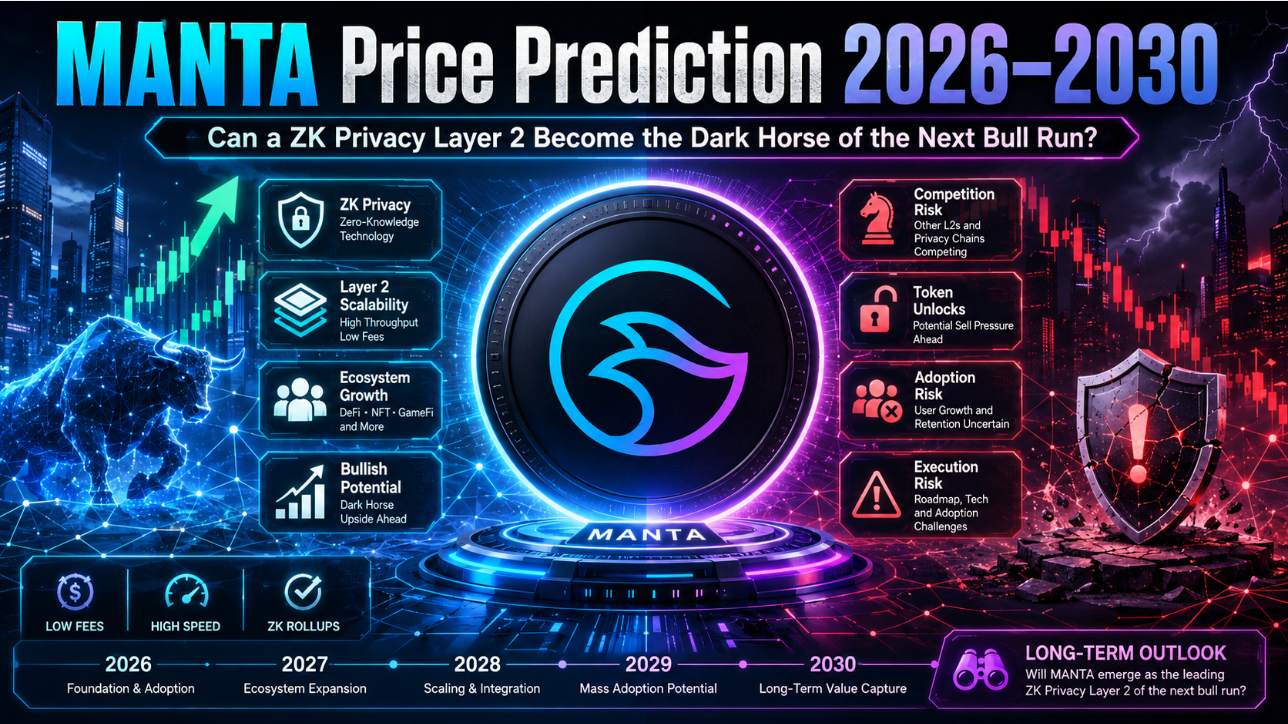
It is not simply trying to become a “faster and cheaper Ethereum Layer 2.” Instead, it is attempting to solve a deeper problem:
When more assets, identities, transactions, and applications migrate on-chain, will users really be willing to expose all their data publicly?
Blockchain transparency is an advantage, but it is also a limitation.
For ordinary users, public wallet assets, transaction history, and interaction behavior mean privacy exposure.
For institutions, fully transparent on-chain finances, transaction paths, and customer data mean business risks.
For developers, without privacy computing capabilities, many real business scenarios are difficult to truly bring on-chain.
This is the long-term narrative foundation of MANTA.
It is not betting on a single demand such as “anonymous transfers,” but on a broader direction:
ZK privacy computing may become part of Web3 infrastructure.
Of course, this does not mean MANTA is guaranteed to succeed.
MANTA also faces many challenges:
Layer 2 competition is intense;
ZK project valuations are highly volatile;
privacy-related sectors face regulatory uncertainty;
token unlocks may create selling pressure;
ecosystem growth still needs to be validated by real users.
Therefore, when analyzing MANTA’s price, we cannot simply look at surface-level logic such as “the ZK sector is hot.” Instead, we need to judge it from three dimensions: on-chain data, technical roadmap, and macro cycles.
All predictions in this article are not investment advice or buy signals. They are scenario-based projections derived from public information, historical cycles, and industry logic. The truly important thing is not to memorize a certain target price, but to learn how to reassess MANTA’s value when market conditions change.
Part One: You Must Truly Understand MANTA Before Predicting Its Price
1.1 What Problem Does MANTA Actually Solve? It Is Not Just a “Privacy Coin”
Many beginners hear about MANTA and immediately understand it as a “privacy coin.”
That interpretation is not accurate.
The core focus of traditional privacy coins is usually:
hiding the transaction sender;
hiding the recipient;
hiding the transaction amount;
making transfers harder to trace.
Manta Network’s focus is not simply anonymous transfers. It is closer to:
programmable privacy infrastructure for Web3 applications.
These two concepts are very different.
Anonymous transfers are more like a single function.
Programmable privacy is a foundational capability.
For example:
If you only make transfers anonymous, its use cases are mainly concentrated on payments and asset transfers.
But if you can provide privacy capabilities to developers, it can be used in far more scenarios:
privacy DeFi;
on-chain identity verification;
private voting;
on-chain credit scoring;
enterprise data verification;
compliance credentials;
privacy for gaming assets;
DAO governance privacy.
This is where MANTA’s imagination space comes from.
It does not merely want users to “hide transfers.” It wants developers to be able to call ZK technology within applications, allowing users to prove that certain information is true without exposing all underlying data.
That is also why MANTA’s price prediction cannot simply reference traditional privacy coins. It must be analyzed within the broader trends of ZK infrastructure, Layer 2 ecosystems, and Web3 data privacy.
1.2 Manta Network’s Dual-Chain Architecture: Manta Pacific and Manta Atlantic
Manta Network is not a single-chain structure. It uses a dual-chain architecture.
This is one reason many investors find MANTA difficult to understand.
It mainly includes two parts:
Manta Pacific;
Manta Atlantic.
The two play different roles.
Manta Pacific: A ZK Layer 2 for the Ethereum Ecosystem
Manta Pacific is a Layer 2 network within the Ethereum ecosystem.
Its core value lies in:
compatibility with Ethereum’s development environment;
lower transaction costs for users;
higher application interaction efficiency;
support for ZK application development;
attracting DeFi, NFT, gaming, and identity applications to deploy.
For ordinary investors, judging whether Manta Pacific is successful should not depend only on project marketing. It should depend on real ecosystem data:
Is TVL growing?
Are daily active addresses increasing?
Are transaction counts rising?
Are cross-chain bridge funds flowing in?
Are real DApps being deployed?
Do users stay after subsidies end?
Layer 2 competition is extremely realistic.
The market will not pay for a “technical vision” forever. Eventually, it will ask:
Are there actually users on this chain? Is there money staying inside it? Are developers continuing to build?
Only if Manta Pacific can secure a position in the Ethereum Layer 2 ecosystem will MANTA have long-term valuation support.
Manta Atlantic: A ZK Privacy Layer 1 for the Polkadot Ecosystem
Manta Atlantic is more focused on the Polkadot ecosystem. It is a network centered on ZK identity and privacy functions.
Its positioning is closer to:
ZK identity;
privacy credentials;
on-chain compliant privacy;
privacy infrastructure modules.
If Manta Pacific is more like an “application ecosystem entrance,” then Manta Atlantic is more like a “privacy identity and ZK foundational capability layer.”
The benefit of this dual-chain layout is that MANTA can cover both the Ethereum ecosystem and the Polkadot ecosystem, without betting its entire future on a single chain.
But the problem is also obvious:
the narrative becomes more complicated.
For the market, a complex narrative can sometimes be an advantage, but it can also become a burden.
If ecosystem data performs well, the complex narrative will be interpreted as “multi-track expansion.”
If ecosystem data fails to improve, the complex narrative may be questioned as “lack of focus.”
Therefore, whether MANTA’s future price can continue rising depends largely on whether it can transform its dual-chain architecture into real users, real capital, and real applications.
1.3 The Real Role of ZK Technology in the MANTA Ecosystem
ZK stands for Zero-Knowledge Proof.
A simple explanation is:
You can prove that something is true without revealing all the details behind the proof.
For example:
You can prove that you are over 18 without revealing your ID number and date of birth.
You can prove that you have enough assets without revealing exactly how much is in your wallet.
You can prove that you completed a certain on-chain action without exposing the entire transaction path.
This type of capability is very important for Web3.
Because in today’s blockchain world, too much data is transparent.
A user’s wallet address, assets, interaction records, and trading preferences can almost all be analyzed by on-chain tools. For ordinary users, this is already a privacy issue. For institutions, it is even more of a business risk.
MANTA’s core value is to use ZK technology to allow on-chain applications to maintain verifiability while gaining stronger privacy protection.
This is also what differentiates it from ordinary Layer 2 projects.
Ordinary Layer 2 networks mainly solve performance problems:
faster transactions;
lower costs;
higher throughput.
MANTA wants to further solve the problem of data exposure:
how to protect user identity;
how to protect transaction privacy;
how to protect enterprise data;
how to make privacy applications programmable.
If Web3 really moves toward mass adoption in the future, privacy computing may not be optional. It may become necessary.
This is MANTA’s long-term bullish logic.
1.4 Why “Programmable Privacy” Has More Commercial Value Than “Anonymous Transfers”
Anonymous transfers certainly have market demand, but they are also the easiest to trigger regulatory red lines.
That is because anonymous payments naturally attract regulatory attention.
But programmable privacy has broader value.
It is not necessarily about hiding illegal fund flows. It is about allowing users and institutions to protect sensitive information within a compliant framework.
For example:
Financial scenarios
Institutions may be willing to conduct settlement, lending, and trading on-chain, but they do not want all strategies, positions, and fund paths to be completely public.
Identity scenarios
Users can prove that they meet certain conditions without revealing full identity information.
Medical scenarios
Medical data can be verified, but patient privacy cannot be directly exposed.
Enterprise scenarios
Companies can prove that certain data meets requirements without exposing trade secrets.
DAO governance scenarios
Votes can be verified as valid, while voters can protect part of their privacy.
These scenarios are easier for the mainstream market to accept than pure anonymous transfers, and they also have greater commercialization potential.
Therefore, if MANTA can position itself as “compliant privacy infrastructure” in the future, its long-term valuation space may be larger than that of traditional privacy coins.
But if the market simply classifies it as a “high-risk privacy project,” it may face a regulatory discount.
This is also a key variable that must be considered in MANTA’s long-term price prediction.
1.5 MANTA Tokenomics: Which Numbers Directly Affect Price?
When analyzing any token, you cannot only look at the story.
Tokenomics determines a project’s supply-and-demand structure.
MANTA has a total supply of 1 billion tokens.
This means price predictions must focus on three core questions:
What is the current circulating supply?
What is the future unlock schedule?
Does the token have real demand and staking mechanisms?
Many beginners only look at current market cap and ignore fully diluted valuation, or FDV.
This is a very common mistake in altcoin investing.
If a project currently has a low circulating supply but a large total supply, continuous future unlocks may create long-term selling pressure. This is especially true when ecosystem growth is slower than token release.
Circulating Supply: Determines Short-Term Trading Elasticity
The lower the circulating supply, the easier it is for capital to push up the price.
This is also why many newly listed tokens surge sharply in the short term.
But low circulating supply also means:
a large number of tokens have not yet entered the market.
Therefore, early price surges should not be simply understood as real project value growth. They may also be liquidity-driven moves under a low-float structure.
Unlock Schedule: Determines Medium-Term Selling Pressure
MANTA’s unlock schedule is data that investors must track over the long term.
The key is not just whether there are unlocks, but:
who receives the unlocked tokens;
how much is unlocked;
what percentage of current circulating supply the unlock represents;
whether the unlocked tokens enter exchanges;
whether the market has enough buying power to absorb them.
Token releases to the team, investors, ecosystem funds, and community incentives affect price differently.
The area that requires the most caution is VC and early investor unlocks.
If these tokens have a low cost basis, once they enter circulation, they may create significant profit-taking pressure.
Staking Ratio: Affects Actual Circulating Supply
If MANTA’s staking mechanism can attract a large number of users to lock tokens long term, then actual circulating supply in the market will decrease.
This is positive for price.
But staking yields must be analyzed carefully.
If staking yields come from real network revenue, it indicates a healthy ecosystem.
If staking yields mainly come from new token emissions, then they are essentially inflationary incentives.
So investors should not only look at whether the staking yield is high. They also need to examine where the yield comes from.
A truly healthy structure should be:
network usage grows → real demand is generated → tokens are locked or consumed → circulating pressure declines.
If the project only relies on high yields to attract short-term capital, users may leave after subsidies end.
1.6 MANTA Historical Price Review: What Was Behind Each Major Rise and Fall?
After MANTA was listed on Binance in 2024, it received substantial market attention.
Newly listed tokens like this usually go through several stages.
Stage One: Sentiment Explosion Around Listing
A Binance listing itself is a strong catalyst.
Because it brings:
improved liquidity;
brand endorsement;
massive user exposure;
futures trading opportunities;
short-term capital attention.
At this stage, price increases are often driven more by sentiment than fundamentals.
The market is trading:
the new listing effect;
airdrop expectations;
the ZK narrative;
Layer 2 popularity;
market maker liquidity.
The price at this stage does not necessarily represent true long-term value.
Stage Two: Profit-Taking Release
After a new token is listed, early participants, airdrop users, and short-term traders may begin to sell.
At this point, the price can easily fall quickly from high levels.
Many beginners may mistakenly think the project has “suddenly become worse.” In reality, this is often normal token redistribution after a new listing.
Especially when initial circulating supply is low, short-term price volatility can be more intense.
Stage Three: Return to Fundamental Pricing
After listing hype fades, the market starts looking at data again:
Is TVL growing?
Are users staying?
Are ecosystem projects increasing?
Are developers active?
Are token unlocks creating pressure?
Does MANTA have real use cases?
If data fails to keep up, the price will move from “narrative valuation” back to “realistic valuation.”
This is an important reason why MANTA’s subsequent price action has been highly volatile.
For investors, reviewing historical price action is not about admiring “how much it once rose.” It is about understanding:
MANTA has high price elasticity, but it needs real ecosystem data to turn short-term rallies into long-term trends.
Part Two: Five Core Variables Driving MANTA’s Price
2.1 Bitcoin Halving Cycle Transmission: Can MANTA Be Lifted During Altcoin Season?
The crypto market remains highly cyclical.
Although the narrative changes in every bull market, the flow of capital often follows a similar path.
Usually:
BTC attracts market attention first;
ETH and major assets then follow;
Layer 2, DeFi, AI, GameFi, ZK, and other sectors begin rotating;
finally, capital enters higher-risk small-cap altcoins.
MANTA is a typical high-elasticity asset.
It is not the most stable asset, but if the market enters an altcoin season, it may attract capital attention because of the following labels:
ZK;
Layer 2;
privacy computing;
Ethereum ecosystem;
mid-to-small-cap high elasticity;
Binance-listed asset.
These types of assets may rise very quickly in the later stages of a bull market.
But it must also be remembered:
Altcoin season does not mean every coin will rise.
If a project has no narrative, no liquidity, no community, and no ecosystem data, it may still perform poorly even in a bull market.
For MANTA to outperform during altcoin season, at least three conditions must be met:
the ZK sector becomes a market hotspot again;
Manta Pacific ecosystem data improves significantly;
token unlock pressure does not overwhelm buying demand.
If only the broader market rises while MANTA’s own data does not change, it may simply rise with the market.
Only when broader market strength is combined with ecosystem growth does MANTA have the chance to generate excess returns.
2.2 How Should We View MANTA’s Correlation With BTC and ETH?
Many investors like to ask:
Is MANTA highly correlated with BTC and ETH?
The answer is:
During extreme market conditions, correlation usually increases.
That means:
When BTC crashes, most altcoins fall.
When the Ethereum ecosystem weakens overall, Layer 2 projects also come under pressure.
Only when the market enters a strong risk-on phase do mid-to-small-cap assets have a better chance of outperforming.
Therefore, MANTA’s price cannot be analyzed separately from BTC and ETH.
A more reasonable framework is:
BTC determines the market direction
If BTC is in a clear bear market, it is difficult for MANTA to rise independently over the long term.
ETH determines the strength of the Layer 2 narrative
If the Ethereum ecosystem is active, Layer 2 projects are more likely to attract attention.
The ZK sector determines MANTA’s relative performance
If ZK becomes a hot sector, MANTA may outperform ordinary Layer 2 projects.
If ZK loses momentum, MANTA may be ignored by the market.
Therefore, MANTA’s price prediction needs to be viewed in three layers:
BTC is the macro environment, ETH is the ecosystem environment, and ZK privacy is the individual narrative.
2.3 ZK Sector Competition: Is MANTA’s Moat Deep Enough?
The ZK sector where MANTA operates is extremely competitive.
It is not facing just one or two rivals, but an entire technical ecosystem.
Major competitive directions include:
zkSync;
StarkNet;
Scroll;
Polygon zkEVM;
Linea;
Aztec;
Aleo.
Among them, zkSync, StarkNet, and Scroll are more general-purpose Layer 2 networks.
Aztec and Aleo are more focused on privacy and ZK applications.
Polygon zkEVM and Linea are backed by strong ecosystem resources.
So where is MANTA’s differentiation?
The core point is:
MANTA does not only focus on ZK scaling. It emphasizes ZK privacy applications.
This is both its opportunity and its challenge.
The opportunity is:
If privacy computing becomes infrastructure for the next stage, MANTA may gain a unique position.
The challenge is:
Privacy demand has not yet exploded at the same scale as ordinary DeFi trading.
In the short term, the market more easily understands:
low gas fees;
high TPS;
airdrops;
DeFi yields;
meme trading.
But “programmable privacy” has a higher cognitive threshold.
Therefore, MANTA’s moat is not only technology. It is whether the project can transform technology into applications that users can actually perceive.
A true moat should be reflected in:
Why do developers choose MANTA?
Why do projects deploy on MANTA?
Why do users stay on MANTA?
Why does capital settle on MANTA?
Are privacy functions actually used frequently?
If these questions have no answers, even advanced technology will struggle to support token price over the long term.
2.4 Manta Pacific’s TVL and Ecosystem Growth: On-Chain Data Can “Leak” Price Information
For MANTA, Manta Pacific’s ecosystem data is very important.
TVL is one of the most commonly watched indicators.
But TVL cannot be viewed in isolation.
Many chains have used incentives to push TVL higher, only for capital to flow out quickly after subsidies ended.
Therefore, when analyzing MANTA’s TVL, at least five angles should be considered.
First: Is TVL Growth Organic or Incentive-Driven?
If TVL rises mainly because of real application demand, it indicates a healthy ecosystem.
If TVL rises mainly because of airdrop expectations or short-term subsidies, caution is needed.
Such capital is highly mobile and may leave at any time.
Second: Is TVL Growth Accompanied by Daily Active User Growth?
High TVL with few users is not necessarily healthy.
It may mean only a few whales are participating.
A better situation is:
TVL rises while daily active addresses, transaction counts, and unique users also increase.
Third: Is the Number of DApps Increasing?
A healthy Layer 2 ecosystem cannot rely on only one application.
It needs a complete ecosystem:
DEXs;
lending;
stablecoins;
yield aggregators;
derivatives;
cross-chain bridges;
NFTs;
gaming;
identity applications;
privacy applications.
If the number of DApps on Manta Pacific continues to grow, it means the developer ecosystem is expanding.
Fourth: Are Cross-Chain Bridge Funds Flowing In or Out?
Cross-chain bridge fund flows are a very important leading indicator.
If funds keep flowing in, it means the market is willing to move assets to Manta Pacific.
If funds keep flowing out, it means users are leaving.
Rising prices with fund outflows are a dangerous signal.
Falling prices with fund inflows may actually indicate that someone is positioning.
Fifth: Does the Ecosystem Have Revenue Capability?
In the long run, blockchain ecosystems cannot rely only on subsidies.
If applications on Manta Pacific can generate real fees, trading volume, and revenue, MANTA’s valuation logic becomes more solid.
If the ecosystem relies on incentives to attract users for a long time, it may easily fall into the pattern of:
subsidies stop → users leave → TVL declines → price falls.
2.5 Developer Activity: Judging Whether the Project Is Truly Building
The biggest fear for crypto projects is:
high-profile marketing during bull markets, then development stops during bear markets.
Therefore, developer activity is crucial when judging whether MANTA deserves long-term attention.
You can observe:
GitHub commit frequency;
updates to core repositories;
whether technical documentation is complete;
whether developer tools are continuously upgraded;
whether hackathons are held;
whether new projects join the ecosystem;
whether the official roadmap is delivered on time.
If price falls while development remains active, it may simply be cyclical volatility.
If price falls and development also stagnates, that indicates deterioration in fundamentals.
For long-term investors, developer activity is more important than short-term candlesticks.
2.6 Institutional Capital and Market Maker Activity
MANTA has institutional capital behind it, which is both an advantage and a potential risk.
The advantages include:
the project can obtain resources more easily;
it has a better chance of entering major exchanges;
market exposure is higher;
ecosystem incentive funds are stronger.
But the risk is:
institutions eventually need to exit.
Early investors usually have a lower cost basis than secondary-market investors. If market buying demand is insufficient after unlocks, they may create continuous selling pressure.
Therefore, when analyzing institutional capital, investors should monitor:
when institutional shares unlock;
whether unlocked tokens enter exchanges;
whether whale addresses reduce positions;
whether market maker wallets show abnormal transfers;
whether price rallies are accompanied by exchange net inflows.
If MANTA rises sharply while large amounts of tokens enter exchanges, that is usually not a good signal.
If whale addresses continue accumulating during sideways price action, it may indicate medium-to-long-term capital positioning.
Of course, on-chain data cannot determine everything alone, but it can help you avoid relying only on news and emotion.
2.7 Regulatory and Policy Risks Around Privacy Technology
Privacy technology is MANTA’s core opportunity, but also its core risk.
On the positive side, the world is increasingly focused on data privacy.
The Web2 world has privacy protection frameworks such as GDPR, showing that user data protection is already a long-term trend.
From this perspective, ZK and privacy computing are very valuable.
But from the perspective of crypto regulation, privacy technology is highly sensitive.
After Tornado Cash was sanctioned, the market saw clearly that:
Once privacy tools are considered by regulators to involve illegal fund-flow risks, they may suffer major blows.
So the key to MANTA’s future is:
Can it position itself as compliant privacy infrastructure rather than an anonymous fund-transfer tool?
These two positions are completely different.
If MANTA mainly serves:
on-chain identity;
enterprise-level data protection;
compliance credentials;
privacy DeFi;
institutional private settlement;
then its long-term space will be larger.
If the market simply classifies it as a “high-regulatory-risk privacy coin,” its valuation may be suppressed.
Part Three: MANTA Price Prediction for 2026
3.1 Expected Macro Market Background in 2026
2026 may be a very important year in this market cycle.
Based on historical crypto market cycles, the second year after a halving is often when market sentiment is most likely to become extreme.
If BTC enters a strong phase during 2025–2026, then 2026 may see:
continued institutional capital inflows;
renewed activity in the Ethereum ecosystem;
accelerated altcoin rotation;
valuation expansion for high-risk assets;
renewed attention to sectors such as ZK, AI, RWA, and GameFi.
For MANTA, the opportunities in 2026 mainly come from three directions:
First, whether the Layer 2 narrative remains strong
If the Ethereum ecosystem continues expanding, Layer 2 projects will remain a market focus.
Second, whether the ZK sector breaks out again
ZK is a long-term technical direction, but short-term price performance depends on whether the market is willing to pay a premium for it.
Third, whether MANTA’s own data improves
If only the broader market rises, MANTA may simply rise along with it.
If broader market strength is combined with ecosystem growth, MANTA may become a strong performer.
3.2 Key MANTA Unlock Events and Potential Selling Pressure in 2026
When analyzing MANTA in 2026, token unlocks must be a key focus.
Many altcoins do not suffer in bull markets because there is no buying demand, but because they are suppressed by continuous unlocks.
The impact of unlocks on price usually has three stages.
Stage One: Pricing In Before the Unlock
The market does not wait until the unlock date to react.
If a large amount of tokens is scheduled to be released at a future point, the price may begin weakening weeks or even months in advance.
This is not a conspiracy. It is the market digesting the expected supply increase ahead of time.
Stage Two: Increased Volatility on Unlock Day
On the unlock day, short-term capital may trade around the event.
If the market originally expected heavy selling pressure but actual selling is limited, the price may rebound instead.
If large amounts of tokens enter exchanges, the price may continue falling.
Stage Three: Continued Selling Pressure After Unlock
The real focus is where unlocked tokens go after release.
If unlocked tokens do not enter exchanges, the impact may be limited.
If unlocked tokens keep flowing into exchanges, selling pressure is forming.
Therefore, MANTA investors in 2026 should not only ask “Will there be unlocks?” They should ask:
How much will be unlocked?
Who receives the unlocked tokens?
What percentage of circulating supply does it represent?
Will the tokens be transferred to exchanges?
Can market demand absorb the supply?
3.3 MANTA 2026 Three-Scenario Price Prediction
Below are three scenario predictions for 2026.
These ranges are not fixed target prices. They are probability-based projections under different assumptions.
Scenario
Core Assumption
Predicted Price Range
Logic
Bullish
Bull market peak + ZK narrative becomes mainstream + Manta Pacific ecosystem breaks out
$3.80–$7.50
MANTA receives a dual valuation premium from Layer 2 and privacy computing
Neutral
Overall market rises + MANTA ecosystem grows steadily
$1.60–$3.80
Follows altcoin season but does not become the ZK leader
Bearish
Market tops early + unlock selling pressure + L2 competition squeezes valuation
$0.35–$1.20
Project survives, but valuation is revised downward by the market
Bullish Scenario: $3.80–$7.50
This scenario requires several conditions to be met at the same time:
BTC and ETH remain strong;
altcoin season truly begins;
the ZK sector becomes a main market theme again;
Manta Pacific TVL grows significantly;
top DApps deploy on the network;
unlock selling pressure is successfully absorbed by the market;
privacy applications show real use cases.
If these conditions are met, MANTA may transform from an ordinary Layer 2 asset into a representative “ZK privacy infrastructure” project, and the market may give it a higher valuation.
Neutral Scenario: $1.60–$3.80
This is a relatively more realistic scenario.
In other words:
MANTA may not become a leading dark horse, but it can rise with altcoin season.
In this case, project data improves, but not explosively. The market recognizes MANTA’s narrative but does not give it an extremely high valuation.
Bearish Scenario: $0.35–$1.20
Under the bearish scenario, MANTA faces three pressures:
the broader market corrects early;
token unlocks create selling pressure;
competition in the ZK and Layer 2 sectors intensifies.
If ecosystem data does not improve significantly, the price may remain in a low-level consolidation range for a long time.
3.4 Three Catalysts Worth Watching Most in 2026
Catalyst One: Continued TVL Breakthroughs on Manta Pacific
If TVL continues growing and the growth is not artificially inflated by short-term subsidies, market confidence will strengthen.
Catalyst Two: Real Deployment of ZK Privacy Applications
If MANTA hosts privacy applications used by a large number of users, this would be a major positive signal.
Catalyst Three: Expansion of Major Exchange Support and Ecosystem Partnerships
More trading support, deeper liquidity, and stronger ecosystem partnerships may all support price performance.
Part Four: MANTA Price Prediction for 2027
4.1 2027: A Real Test Under Bear Market Pressure
If 2026 is a market sentiment peak, then 2027 is likely to become a stress-test stage for MANTA.
Historically, altcoins often experience sharp drawdowns after bull markets end.
This is especially true for:
low-float, high-FDV projects;
strong-narrative but weak-revenue projects;
ecosystems dependent on subsidies;
small-cap technical tokens.
If MANTA rises sharply in 2026, it will also have to face correction pressure in 2027.
The question is not whether it will fall, but:
After the fall, are the project fundamentals still there?
This is the key distinction between a “cyclical correction” and “project failure.”
4.2 Drawdown Patterns of ZK and Privacy Sector Tokens in Historical Bear Markets
Although each cycle is different, high-risk technical altcoins usually show several characteristics in bear markets:
drawdowns from the high may exceed 70%;
liquidity declines more significantly than major coins;
community attention cools quickly;
ecosystem subsidies decrease;
investors pay more attention to cash flow and real users;
valuations move from “future narrative” back to “current data.”
This is very important for MANTA.
If MANTA’s 2026 rally is mainly driven by narrative, the 2027 drawdown may be very large.
If the rally is accompanied by real TVL, users, and developer growth, the drawdown may be relatively more controlled.
4.3 Key MANTA Ecosystem Milestones in 2027
By 2027, MANTA must at least prove that:
Manta Pacific is not just a short-term incentive chain;
ZK privacy capabilities are not merely marketing concepts;
real DApps have retention inside the ecosystem;
developers are still willing to build;
the MANTA token can capture part of ecosystem value.
If these goals are not achieved, the market will lower its long-term expectations for MANTA.
At that point, price predictions must also be revised downward.
4.4 MANTA 2027 Three-Scenario Prediction
Scenario
Predicted Price Range
Trigger Conditions
Bullish
$2.20–$4.80
Post-bull correction occurs, but ecosystem data remains strong; TVL and users do not suffer major losses
Neutral
$0.70–$2.20
Broader market enters a cooling phase; MANTA follows altcoins downward
Bearish
$0.15–$0.70
Ecosystem stagnation, unlock selling pressure, and capital outflows occur at the same time
4.5 2027 Holder Risk Warning Checklist
If the following five signals appear, MANTA’s long-term logic should be reassessed.
First: TVL Declines for Multiple Consecutive Quarters
Short-term declines are acceptable, but continuous declines indicate capital is leaving the ecosystem.
Second: Daily Active Addresses Shrink Significantly
A decline in users indicates insufficient application demand.
Third: Developer Activity Stagnates
If code updates, ecosystem projects, and hackathon activity decline significantly, long-term risk rises.
Fourth: Large Amounts of Tokens Keep Moving Into Exchanges
This usually indicates rising potential selling pressure.
Fifth: The Official Roadmap Is Delayed for a Long Time
Repeated roadmap delays will weaken market trust.
Part Five: MANTA Price Prediction for 2028
5.1 2028: Bear Market Bottom or the Eve of the Next Cycle?
2028 may be a very important turning point.
On one hand, if the previous bull market has ended, the market may still be in a depressed phase.
On the other hand, 2028 is close to the next Bitcoin halving, and the market may begin pricing in expectations for a new cycle in advance.
For MANTA, the most important question this year is:
Will it be eliminated by the bear market, or will it survive until the next opportunity?
Many projects look cheap in bear markets, but cheap does not mean valuable.
What truly matters is:
Is the project still building?
Are users still using it?
Is capital still in the ecosystem?
Are developers still willing to participate?
Does the token still have liquidity?
5.2 Five Hard Indicators to Judge Whether MANTA Is Still Worth Holding
First: Whether TVL Remains at a Healthy Level
If TVL has severely shrunk, it means ecosystem attractiveness is insufficient.
Second: Whether Daily Active Addresses Remain Stable
Daily active addresses reflect real user demand.
If there is only price discussion but no on-chain users, the project may have become a pure trading asset.
Third: Whether the Core Development Team Remains Active
Continuous development is the foundation for a project to survive cycles.
Fourth: Whether Real Ecosystem Projects Remain
If ecosystem applications all migrate or stop operating, Layer 2 value will decline significantly.
Fifth: Whether There Are New Partnerships and Technical Upgrades
Projects that can continue partnerships and technical upgrades during bear markets are more worth watching long term.
5.3 How 2028 Halving Expectations May Affect MANTA
The market usually positions ahead of Bitcoin halvings.
But capital does not immediately enter high-risk altcoins at the beginning.
The usual path is:
BTC strengthens first;
ETH then recovers;
major altcoins begin to catch up;
only later do mid-to-small-cap sectors rotate.
ZK privacy projects like MANTA may start later than BTC and ETH, but once risk appetite returns, their elasticity may be stronger.
If the following signals appear in 2028, MANTA may regain attention:
BTC trend strengthens;
Ethereum ecosystem recovers;
ZK narrative warms up;
Manta Pacific data improves;
unlock pressure eases;
whale addresses begin accumulating again.
5.4 MANTA 2028 Three-Scenario Prediction
Scenario
Predicted Price Range
Logic
Bullish
$1.80–$4.20
Market prices in a new cycle early, and the MANTA ecosystem remains active
Neutral
$0.50–$1.80
Project survives but growth is average; it slowly recovers with the market
Bearish
$0.08–$0.50
Ecosystem becomes marginalized, and price only has cyclical rebounds
The most important thing in 2028 is not whether the price is low, but whether MANTA still has the qualifications to re-enter the market’s main narrative.
Part Six: Long-Term Outlook for MANTA in 2029–2030
6.1 2029: MANTA’s Valuation Logic During the New Bull Market Warm-Up
If MANTA successfully survives the downturn of 2027–2028, then 2029 may bring revaluation.
But the prerequisite for revaluation is:
The project must prove that it is not a short-term narrative, but long-term infrastructure.
In 2029, investors will ask three questions again:
Has ZK privacy computing become a real necessity for Web3?
Is MANTA still an important project in this sector?
Can the MANTA token capture ecosystem growth value?
If the answers are yes, MANTA may challenge its previous cycle highs again.
If the answers are no, it may only rebound with the market and fail to become a strong asset.
6.2 How Should MANTA Be Valued?
MANTA’s long-term valuation can be viewed from three angles.
First: Layer 2 Ecosystem Valuation
If Manta Pacific becomes one of the mainstream Layer 2 networks, the market will price it according to Layer 2 ecosystem value.
Core indicators include:
TVL;
daily active users;
trading volume;
number of DApps;
ecosystem revenue;
cross-chain fund inflows.
Second: ZK Privacy Infrastructure Valuation
If MANTA becomes privacy computing infrastructure, its valuation may not only come from DeFi, but also from broader Web3 data-protection demand.
Third: Token Value Capture
This is the most critical question.
Many projects have good ecosystems but weak token performance because the token itself lacks strong value capture.
Over the long term, MANTA must prove that:
ecosystem growth can bring token demand growth.
Otherwise, project success does not necessarily equal token price appreciation.
6.3 2030: The Ultimate Bull-Bear Debate
The Strongest Bullish Arguments
MANTA’s bullish logic mainly has three points.
First, ZK privacy computing may become a standard feature of Web3
The future on-chain world cannot remain completely transparent forever. Users, institutions, and enterprises all need stronger data-protection capabilities.
Second, enterprise-level applications need privacy infrastructure
Medical data, finance, identity, government data, enterprise settlement, and other scenarios are not suitable for completely public on-chain exposure.
Third, token staking and ecosystem demand may reduce circulating pressure
If staking, ecosystem incentives, and application consumption mechanisms mature, MANTA’s circulating pressure may decline, increasing price elasticity.
The Strongest Bearish Arguments
MANTA’s bearish logic is also strong.
First, Ethereum or leading Layer 2 networks may integrate privacy capabilities themselves
If mainstream ecosystems directly provide ZK privacy functions, MANTA’s independent value may decline.
Second, regulation may suppress the privacy sector for a long time
If privacy projects are viewed as compliance risks, institutional capital may continue avoiding them.
Third, competitors may become stronger
By 2030, new ZK privacy projects may appear with more advanced technology, more funding, and stronger ecosystems.
Therefore, MANTA’s long-term outcome will not be a simple linear growth story. It will depend heavily on execution.
6.4 MANTA 2030 Target Price Prediction
Scenario
Predicted Price Range
Market Position
Bullish
$8.00–$18.00
Becomes one of the representative ZK privacy infrastructure projects, with active ecosystem growth and stronger token value capture
Neutral
$2.50–$8.00
Project continues developing but does not become an industry leader
Bearish
$0.10–$1.20
Project survives but becomes marginalized, with limited liquidity and user growth
The uncertainty of 2030 predictions is very high.
Therefore, these ranges are more suitable as scenario references rather than fixed target prices.
If MANTA’s future data far exceeds expectations, the bullish range may still be broken.
If project development stagnates, the bearish range may also be revised further downward.
6.5 Five Milestones MANTA Must Achieve to Reach Its Long-Term Targets
First: TVL Enters the Ranks of Mainstream Layer 2 Networks
Without capital retention, it is difficult to prove ecosystem value.
Second: Monthly Active Users Continue Growing
Growth should not rely on airdrops to attract short-term users, but should form real retention.
Third: A Benchmark Privacy Application Appears
The market needs to see a use case where people feel “this must be built on MANTA.”
Fourth: The Developer Ecosystem Matures
This includes documentation, SDKs, hackathons, developer tools, and ecosystem funds.
Fifth: Regulatory Positioning Becomes Clear
MANTA must prove that it is compliant privacy infrastructure, not an anonymous fund-transfer tool.
Part Seven: How Beginners Can Use This Prediction for Real Decisions
7.1 Position Management: How Much Should MANTA Account for in a Crypto Portfolio?
MANTA is a high-volatility asset.
It is not suitable for ordinary beginners to go all-in or heavily concentrate in.
A more reasonable approach is to treat it as a high-risk growth asset with a small allocation.
The following position ranges may be used as a reference:
Risk Type
Suggested MANTA Allocation
Suitable For
Conservative
0%–2%
Mainly holds BTC and ETH, unwilling to accept large volatility
Balanced
2%–5%
Willing to allocate a small amount to high-elasticity assets
Aggressive
5%–10%
Can continuously track project data and accept major drawdowns
Ordinary investors are not advised to treat MANTA as a core position.
Because it faces:
unlock risk;
competition risk;
regulatory risk;
liquidity risk;
risk of ecosystem growth falling short of expectations.
7.2 Portfolio Logic With BTC, ETH, and Stablecoins
A more mature portfolio structure should be:
BTC and ETH as core positions;
stablecoins as defense and capital for adding positions;
MANTA as a high-elasticity satellite position.
In this way, even if the MANTA thesis turns out wrong, it will not endanger overall asset safety.
The greatest value of high-risk assets is to increase portfolio elasticity, not to replace core assets.
7.3 Buy and Add-Position Signal System
Buying MANTA should not be based only on “it has fallen a lot.”
A big decline does not necessarily mean cheap.
Investors should look at whether three dimensions are improving.
Technical Signals
You can watch:
whether price breaks above a long-term downtrend line;
whether price reclaims key moving averages;
whether high-volume rallies continue;
whether pullbacks hold key support;
whether higher highs and higher lows begin to form.
Technical indicators cannot determine buying decisions alone, but they can help judge whether market structure is improving.
Fundamental Signals
More importantly:
TVL continues growing;
daily active addresses increase;
the number of DApps increases;
cross-chain bridge funds flow in;
the official roadmap progresses on time;
new partnerships are real deployments rather than marketing.
If the price rises but fundamentals do not change, it may only be short-term speculation.
If the price consolidates while fundamentals improve, it may represent a long-term opportunity.
Sentiment Signals
You can observe:
whether community discussion is heating up;
whether the number of developers is increasing;
whether exchange net inflows are declining;
whether whales are beginning to accumulate;
whether the ZK sector is regaining market attention.
A truly high-quality buying signal is usually:
technical strength + fundamental improvement + sector sentiment recovery.
7.4 Stop-Loss and Exit Framework
Many people lose money in altcoins not because they do not know how to buy, but because they do not know how to sell.
For high-volatility assets like MANTA, exit rules must be set in advance.
Price Stop-Loss
If the price breaks below long-term key support and cannot recover quickly, risk exposure should be reduced.
Fundamental Stop-Loss
This is more important than price.
If the following situations appear, investors should not continue comforting themselves with “long-term belief”:
TVL declines for a long time;
the team stops updating;
roadmap delays happen repeatedly;
ecosystem projects exit in large numbers;
trading volume shrinks significantly;
continuous selling pressure appears after unlocks;
the privacy sector suffers a major regulatory blow.
Investing is not about proving you are always right. It is about reducing losses when your judgment is wrong.
7.5 Five Cognitive Mistakes That 99% of Beginners Make
Mistake One: Believing a Predicted Price Will Definitely Be Reached
It will not.
Predictions are scenario-based projections.
When the market environment changes, predictions must be adjusted.
Mistake Two: Thinking Price Rises Mean the Prediction Was Correct, and Price Falls Mean Manipulation
Short-term prices are affected by many factors.
Price movements alone cannot prove whether a project is good or bad.
Mistake Three: Looking Only at Price Predictions and Ignoring the Unlock Schedule
This is one of the most dangerous mistakes.
For many altcoins, the greatest pressure comes from unlocks, not project news.
Mistake Four: Ignoring Liquidity Risk
Even if your directional judgment is correct, insufficient liquidity may prevent you from buying or selling at an ideal price.
The larger the capital size, the more important market depth becomes.
Mistake Five: Equating Advanced Technology With Guaranteed Price Appreciation
Advanced technology is only the foundation.
Price appreciation also requires:
users;
ecosystem;
liquidity;
narrative;
token value capture;
alignment with the market cycle.
Strong technology without users does not necessarily lead to price increases.
Part Eight: MANTA Price Prediction 2026–2030 FAQ
1. What is MANTA?
MANTA is the native token of Manta Network. The project’s core direction is ZK zero-knowledge proofs, privacy computing, and Layer 2 scaling. It is not simply a payment coin, nor is it a traditional privacy coin. Instead, it is an infrastructure project attempting to provide programmable privacy capabilities for Web3 applications.
2. How is MANTA different from ordinary Layer 2 projects?
Ordinary Layer 2 networks mainly solve Ethereum scaling problems, such as lowering gas fees, improving transaction speed, and enhancing user experience.
MANTA further emphasizes privacy computing and ZK application capabilities. It hopes to allow developers to call privacy functions inside applications, so users can reduce sensitive information exposure during on-chain interactions.
3. Is MANTA a privacy coin? Will it face regulatory risk?
MANTA should not be simply equated with traditional privacy coins. It is more like ZK privacy infrastructure rather than a pure anonymous transfer tool.
However, the privacy sector does have regulatory risks. If the market or regulators view it as a high-risk anonymous tool, its valuation may be suppressed. If it can position itself as compliant privacy infrastructure, its long-term potential will be larger.
4. How high can MANTA go in 2026?
In the bullish scenario, if altcoin season begins, the ZK narrative breaks out, and Manta Pacific ecosystem data improves significantly, MANTA may enter the $3.80–$7.50 range in 2026.
In the neutral scenario, it may trade between $1.60 and $3.80.
In the bearish scenario, if the market corrects early or unlock selling pressure is heavy, it may return to the $0.35–$1.20 range.
5. Can MANTA rise above $10 by 2030?
Theoretically, it is possible, but the requirements are very high.
MANTA needs to become one of the representative projects in ZK privacy infrastructure and make clear progress in TVL, monthly active users, DApp ecosystem growth, and token value capture.
If these conditions are met, the bullish range for 2030 could reach $8.00–$18.00.
If the project only develops normally, it may be closer to $2.50–$8.00.
6. Is MANTA suitable for long-term holding?
MANTA may be suitable for high-risk investors as a small allocation, but it is not suitable for ordinary beginners to hold heavily over the long term.
Long-term MANTA holders need to continuously track:
TVL;
token unlocks;
daily active addresses;
development progress;
ecosystem projects;
regulatory environment.
If you do not have time to track these data points, heavy allocation is not recommended.
7. What are MANTA’s biggest upside catalysts?
MANTA’s biggest upside catalysts include:
a new breakout in the ZK sector;
major growth in Manta Pacific TVL;
deployment of leading DApps;
real adoption of privacy applications;
reduced unlock pressure;
stronger liquidity on major exchanges.
The most important point is:
ecosystem data must improve.
8. What are MANTA’s biggest risks?
MANTA’s biggest risks include:
unlock selling pressure;
Layer 2 competition;
declining ZK sector popularity;
privacy regulatory risk;
ecosystem growth falling short of expectations;
insufficient token value capture.
If these risks appear at the same time, the price may remain under pressure for a long time.
9. What advantages does MANTA have compared with zkSync, StarkNet, and Scroll?
MANTA’s advantage lies in its differentiated positioning.
zkSync, StarkNet, and Scroll are more focused on general-purpose Layer 2 scaling, while MANTA emphasizes ZK privacy applications.
But its disadvantage is that its ecosystem scale and developer resources may not be stronger than leading Layer 2 projects.
Therefore, MANTA’s opportunity lies in a niche sector, and its risk also comes from the fact that this niche has not yet achieved large-scale adoption.
10. Is MANTA suitable for beginners to buy?
Complete beginners are not advised to heavily allocate to MANTA from the start.
MANTA’s logic involves many variables, including ZK, Layer 2, privacy regulation, token unlocks, and on-chain data. If beginners only look at price, they can easily chase highs or panic sell.
A more reasonable approach is:
start with a small position, observe the project, learn its logic, and then decide whether to allocate long term.
Conclusion: Build Your Own Dynamic MANTA Evaluation System
MANTA is a project worth tracking over the long term.
Its core value is not just “Layer 2,” but:
ZK technology × privacy computing × Ethereum scaling × Web3 data protection.
But it is not a low-risk asset.
Whether MANTA can break out in the future depends on five key questions:
Can Manta Pacific continue attracting capital?
Do ZK privacy applications truly have user demand?
Can token unlocks be absorbed by the market?
Can the project maintain differentiation in Layer 2 competition?
Does the regulatory environment allow privacy infrastructure to develop healthily?
For investors, the best approach is not to blindly believe a certain price prediction, but to build your own observation checklist.
Suggested indicators to track continuously:
TVL: DeFiLlama;
on-chain activity: Dune Analytics;
token unlocks: Token Unlocks;
whale addresses: Nansen / Arkham;
official progress: Manta Network website, X, and Discord.
Every quarter, ask yourself three questions again:
First, is MANTA’s ecosystem data better than last quarter?
Second, does the ZK privacy sector still have market attention?
Third, does the current price already reflect future growth expectations?
If the answers become increasingly positive, MANTA remains worth watching.
If the answers continue to worsen, do not let “long-term belief” trap you.
Final reminder: All price predictions in this article are based on public information, historical cycles, and industry logic. They do not constitute investment advice. The crypto market is highly volatile, and MANTA is a high-risk asset. Actual prices may differ significantly from these predictions. Please conduct independent research, control your position size, and invest within your means.