
This article is for crypto asset research and educational purposes only and does not constitute investment advice. All price predictions are scenario-based extrapolations grounded in public data, cycle assumptions, supply-demand structure, and sector development, and are not guaranteed to materialize.
Data reference date: May 18, 2026.
Introduction: Why TIA Deserves a Dedicated 5-Year Prediction
Many newcomers see “TIA Price Prediction” and immediately think: Isn’t this just guessing ups and downs?
If the article only says “TIA will reach $50” or “100x by 2030,” it indeed has little value. A meaningful prediction should answer three questions:
- Why does TIA have value?
- Can this value translate into actual token demand?
- How will supply pressure, market cycles, and competitive landscape affect the price in the coming years?
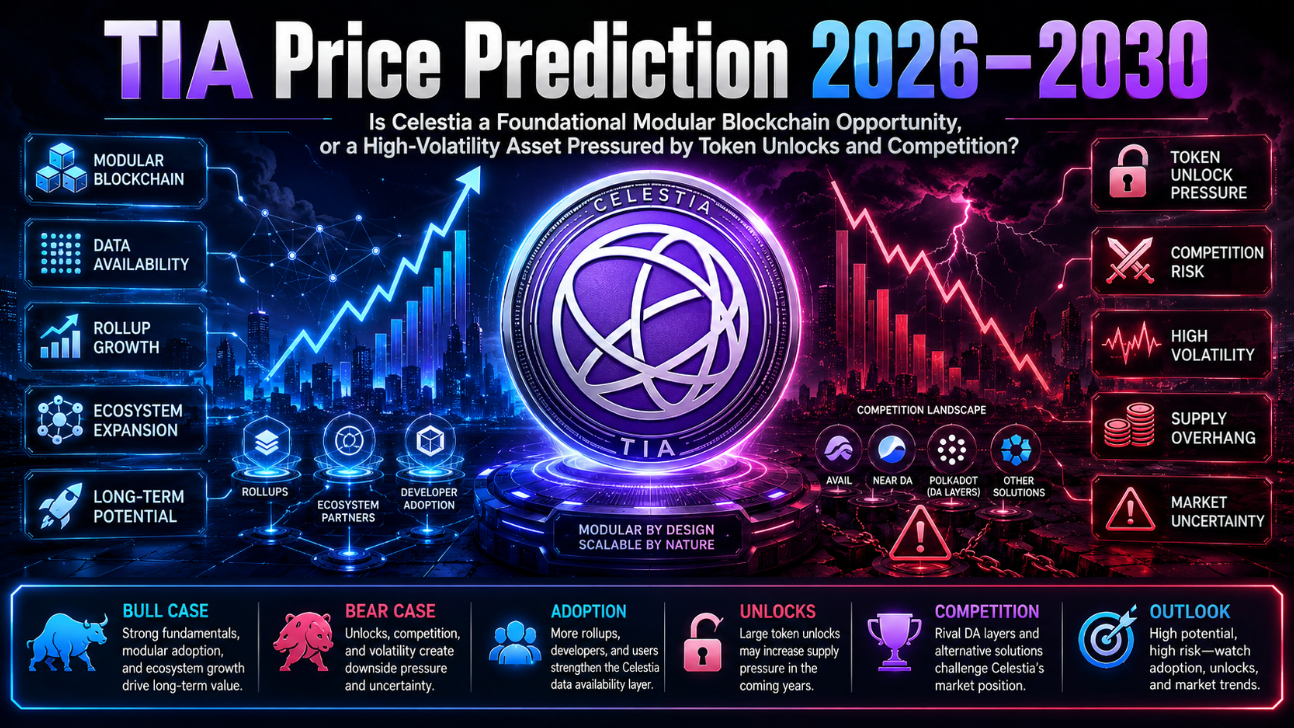
The Celestia behind TIA is not an ordinary application-layer project. It is a modular blockchain specifically built for Data Availability (DA). According to Celestia’s official documentation, TIA’s core utilities include paying for blobspace fees, serving as the gas token for new Rollups, participating in PoS staking, and governance voting.
This means TIA’s price logic should not be evaluated in the same framework as meme coins. Meme coins rely more on sentiment, community virality, and liquidity; TIA is closer to an “infrastructure token.” Its long-term value depends on whether more Rollups, AppChains, and Layer 2 solutions use Celestia to publish data.
Using HIBT as a reference, trading platform-type assets like HIBT derive their core support from users, trading volume, fee revenue, and platform ecosystem. TIA’s core support comes from on-chain data demand, DA usage, staking security, and modular ecosystem expansion. Both are utility-type assets, but their value sources are entirely different.
This article uses a three-dimensional prediction framework:
Modular Sector Maturity × BTC Macro Cycle × TIA’s Own Supply-Demand Structure
It will also naturally include HIBT-related internal links to help readers better understand the valuation logic of different utility tokens:
- Ethereum ETH Price Prediction 2026–2030
- RPL Price Prediction 2026–2030
- SNX Price Prediction 2026–2030
- YFI Price Prediction 2026–2030
Chapter 1: What Is TIA? Without Understanding This, All Predictions Are Useless
1.1 What Are Modular Blockchains? What Pain Point of Ethereum Does Celestia Solve?
Traditional blockchains usually handle multiple tasks on a single chain: executing transactions, ordering transactions, validating transactions, storing and publishing data.
This is the “monolithic blockchain” model. Its advantage is simplicity; its disadvantage is poor scalability. The more applications on the chain, the more congested transactions become, the higher the fees, and the greater the system pressure.
The modular blockchain approach is to split the blockchain into different layers: some chains handle execution, some handle settlement, and some handle data availability. Celestia specializes in Data Availability — ensuring that data published by Rollups can be verified, downloaded, and confirmed.
Celestia officially positions itself as an L1 dedicated to data availability. Rollups, AppChains, and Layer 2 can publish transaction data to Celestia while running their own independent execution environments. CoinMarketCap’s introduction to Celestia also emphasizes that one of its core technologies is Data Availability Sampling, allowing light nodes to verify data availability without downloading full blocks.
For newcomers, a simple analogy:
Ethereum is like a crowded building where everyone wants to work; Celestia is like specialized infrastructure providing data storage and verification, enabling more new buildings to be built quickly.
This is the first layer of TIA’s value.
1.2 TIA Token’s Three Core Roles
TIA is not merely a governance token — it has at least three major roles.
- Paying for Data Availability fees
- Rollup developers using Celestia to submit data must pay via PayForBlobs transactions, priced in TIA.
- Staking for network security
- Celestia is built on Cosmos SDK and CometBFT and is a PoS network. Users can delegate TIA to validators to participate in network security and earn staking rewards.
- Governance voting
- Staked TIA holders can participate in decisions on network parameters, community pools, etc. Official documentation also notes that the Celestia community pool receives 2% of block rewards.
However, what truly drives price appreciation is not “having many uses,” but whether these uses create real demand.
If many Rollups use Celestia in the future, DA fee demand will increase and TIA demand will strengthen.
If a large amount of TIA is staked, market circulation decreases and supply pressure eases.
If governance and ecosystem incentives become important, the rationale for long-term holding of TIA will also grow.
1.3 Comparison with HIBT: Trading Volume Support vs Data Demand Support
The core value drivers for trading platform assets like HIBT typically include:
- User growth
- Trading volume growth
- Fee revenue
- Platform ecosystem expansion
- Activities, rebates, and liquidity capabilities
TIA’s core value drivers come from:
- Growth in the number of Rollups
- Growth in DA blob submissions
- Growth in TIA payment demand
- Increase in staking ratio
- Market recognition of the modular ecosystem
Newcomers can understand the difference in one sentence:
HIBT derives value from trading entry points and platform revenue; TIA derives value from on-chain data demand and network security.
This also explains why TIA predictions cannot rely solely on price charts — one must examine whether Celestia has real usage.
1.4 Who Are TIA’s Competitors?
The DA sector is not without competition. Major competitors include:
- Ethereum native DA / EIP-4844 Blobs
- EigenDA
- Avail
- NearDA
- Other specialized DA layers and Rollup self-built solutions
Celestia’s advantages are first-mover position, focus, and modular brand recognition. In September 2024, Celestia Foundation announced a $100 million funding round. Its mainnet Beta launched in October 2023, an early ecosystem has formed, developers have deployed the first batch of 20 Rollup chains, and Celestia data blobs once accounted for more than half of total Rollup data publications.
However, the challenges are clear: if Ethereum’s native DA capabilities continue to strengthen, or if EigenDA, Avail, and others gain more adoption, TIA’s market share will face compression.
Therefore, TIA’s long-term prediction essentially boils down to one question:
In the future Rollup world, will there be a need for an independent, dedicated, and scalable DA layer?
Part 2: The 6 Major Variables Determining TIA’s Price Over the Next 5 Years
2.1 Variable One: BTC Halving Cycle
TIA is an infrastructure token, but it cannot escape the BTC macro cycle.
In a strong BTC cycle, capital flows from BTC into high-beta assets such as ETH, SOL, infrastructure, Layer 2, modular, and DeFi. TIA, with its clear narrative and high volatility, typically enjoys greater valuation elasticity.
In a deep bear market, even if Celestia’s fundamentals continue improving, TIA’s price may still be suppressed by overall liquidity.
Therefore, judging TIA’s future must start with BTC:
- Whether BTC holds long-term moving averages
- Whether BTC breaks previous highs and establishes trend continuation
- Whether ETH and SOL strengthen in tandem
- Whether altcoin total market cap is expanding
- Whether stablecoin supply is growing
Without strong BTC cycle support, TIA’s optimistic targets for 2026–2027 must be adjusted downward.
2.2 Variable Two: Speed of Rollup Explosion
TIA’s most direct source of demand is how many Rollups use Celestia for data availability.
The more Rollups, the more data published, the stronger the theoretical demand for blobspace, and the higher the demand for TIA payments.
Key point: Announcing integration with Celestia does not equal real demand. What matters is continuous data submission and actual fee generation.
Therefore, to assess Celestia’s ecosystem health, look at:
- Number of active Rollups
- Blob submission volume
- DA fee revenue
- Whether chains using Celestia have real users
- Whether these chains stay long-term instead of migrating to other DA layers
2.3 Variable Three: Ethereum L2 Competitive Landscape
Ethereum is not standing still.
After EIP-4844, Ethereum Blob fees dramatically changed the cost structure for L2 data publication. If Ethereum continues enhancing its native DA capabilities, some Rollups may prefer to stay with Ethereum DA rather than external DA layers.
This is both a risk and a filter for TIA.
If Celestia can only attract projects with “cheap” pricing, falling Ethereum DA costs will weaken its appeal.
If Celestia can retain projects through higher throughput, stronger modular experience, and better developer ecosystem, it will retain independent value.
2.4 Variable Four: Token Unlock Pressure
This is the variable TIA investors cannot ignore.
According to Tokenomics.com, TIA’s unlock schedule runs from October 31, 2023, to September 30, 2027. As of May 2026, approximately 86.8% of tokens have unlocked, with about 13.2% remaining. There are still 17 unlock events left. The next unlock is on May 31, 2026, releasing about 14.208 million TIA (roughly 1.3% of total supply).
TIA has passed the largest early unlock phase, but continuous releases will still occur in 2026–2027.
Unlocks do not necessarily mean dumping, but they create potential selling pressure — especially when unlock recipients include investors and core contributors, as the market tends to front-run these events.
This is why this article remains conservative on 2026 TIA predictions.
2.5 Variable Five: Staking Ratio vs Circulating Supply Game
Staking ratio is a key indicator for TIA.
CelestiaData shows approximately 507.9 million TIA are currently staked (about 43.49% of supply distribution). Liquid supply, including TIA on CEXs, is about 660 million (roughly 56.51%). Current staking APR is approximately 4.15%, with an inflation rate of about 1.54%.
A high staking ratio means a portion of tokens is not immediately sold, providing some price support.
A declining staking ratio, especially large holders unstaking and moving tokens to exchanges, can signal selling pressure.
TIA holders should monitor:
- Whether total staked amount is decreasing
- Whether unstaking volume is rising
- Whether large addresses are transferring TIA to CEXs
- Whether staking yields sufficiently cover inflation and opportunity costs
2.6 Variable Six: Institutional and VC Holding Structure
Celestia has a strong investor lineup.
According to Celestia’s official blog, the project raised $55 million in 2022 led by Bain Capital Crypto and Polychain Capital, with participation from Placeholder, Galaxy, Delphi Digital, Blockchain Capital, NFX, Protocol Labs, Figment, Maven 11, Spartan Group, Jump Crypto, and others. In 2024, Celestia Foundation raised another $100 million led by Bain Capital Crypto, bringing total funding to $155 million.
Strong institutional backing is an advantage, but VC holdings are also a source of potential selling pressure.
This is TIA’s contradiction: strong capital and resources, but early tokens may become future price pressure.
Chapter 3: 2026 TIA Price Prediction — Direct Confrontation Between Halving Dividend and Unlock Pressure
3.1 Three Scenario Assumptions
Bearish Scenario: DA Demand Stagnation
If BTC weakens in 2026, Rollup growth falls short of expectations, Celestia DA usage shows no clear improvement, and continuous unlocks create selling pressure, TIA may oscillate at low levels for a prolonged period.
Base Scenario: Steady Growth
If Celestia continues gaining Rollup adoption, DA usage steadily increases, staking ratio remains healthy, and BTC avoids a deep bear market, TIA has a chance to recover from bottom ranges to mid-tier valuation.
Bullish Scenario: Rollup Explosion
If a modular Rollup explosion occurs in 2026, Celestia becomes the default DA layer for multiple new chains, and BTC, ETH, and SOL strengthen together, TIA may see significant valuation repair.
3.2 2026 Predicted Range
2026 TIA Price Range: 2.50–7.00
Base Target: $4.50
Note: As of May 2026, CoinMarketCap shows TIA priced at approximately 0.40, with circulating supply of about 918 million, market cap of ~367 million, and FDV of ~$467 million. All-time high was $20.91 in February 2024.
This means the 2.50–7.00 range is not a minor rebound but a meaningful valuation repair. Achieving this range requires alignment of the BTC cycle, modular narrative, and real Celestia usage.
3.3 Which Quarter Is Most Dangerous? Which Quarter Is Most Likely to See a Stage High?
The most dangerous periods in 2026 are the windows around each unlock, especially when the broader market is weak.
If price has already risen significantly before unlocks, the market tends to take profits in advance.
If price does not continue falling after unlocks, a “bad news priced in” rebound may occur.
The more likely window for stage highs is the second half of 2026, provided:
- BTC remains strong
- TIA unlock pressure is gradually digested
- Celestia DA usage grows
- The market re-hypes the modular blockchain narrative
3.4 HIBT Reference: Structure of Utility Tokens During Bottom Reversal
Utility tokens in the early bull phase usually do not rise in a straight line but go through three stages:
- Price stops falling, but no one believes it.
- Fundamentals begin recovering, but the market remains hesitant.
- Price breaks key resistance and retail starts chasing.
Whether TIA has similar conditions depends on whether it can prove in 2026 that Celestia is not just narrative-driven but has real chains using it, real data demand, and real fee generation.
For understanding the different cyclical behavior of infrastructure tokens versus platform assets, refer to HIBT’s analyses: Ethereum ETH Price Prediction 2026–2030 and SNX Price Prediction 2026–2030.
2026 Prediction Update Triggers
Raise by 20%–30% if Celestia active Rollup count and blob submissions grow for 3 consecutive months.
Lower by 30%–40% if TIA staking ratio falls below 35% and large TIA flows persistently into exchanges.
Chapter 4: 2027 TIA Price Prediction — High Point of Modular Narrative or Valuation Bubble Year?
4.1 Typical Performance of Infrastructure Tokens in Mid-Bull Market
In mid-bull, infrastructure tokens often experience two outcomes:
- Leading gains, as the market seeks “next-generation infrastructure stories” and re-prices L1s, L2s, oracles, DA, cross-chain, and DeFi base protocols.
- Lagging gains, where fundamentals are solid but token capture is weak — the market realizes “a useful network does not automatically mean a valuable token.”
Which path TIA takes depends on how the 2027 market answers: Can Celestia’s usage growth truly translate into TIA demand?
4.2 2027 Predicted Range
2027 TIA Price Range: 6.00–18.00
Base Target: $11.00
This prediction requires several premises:
- TIA has exited the bottom range in 2026
- Celestia usage has increased significantly
- Modular blockchain becomes a mainstream narrative
- BTC and ETH remain in a strong cycle
- TIA unlocks are nearing completion and supply pressure eases
Tokenomics.com shows TIA’s final unlock date is September 30, 2027. Remaining releases will be gradually completed in 2026–2027.
4.3 Bubble Identification Checklist
If TIA surges in 2027, holders should watch for three bubble signals:
- Price rises far faster than DA usage growth.
- Social media hype explodes while developer and usage data do not grow in tandem.
- Large holders unstake and transfer to exchanges.
4.4 HIBT Mid-Bull Insight: Avoid Chasing “False Breakouts”
Utility tokens are prone to false breakouts in mid-bull. Price breaks previous highs, sentiment becomes extremely bullish, but if trading volume, revenue, users, and ecosystem data do not follow, the breakout often turns into a bull trap.
TIA holders should avoid one mistake: assuming Celestia’s fundamentals are also exploding just because the price is rising.
Correct approach: When price breaks out, simultaneously check Celestia usage, staking ratio, exchange balances, and BTC dominance.
2027 Prediction Update Triggers
Raise to 15–22 if TIA breaks $10 and Celestia DA usage, fee revenue, and active Rollups hit new highs simultaneously.
Lower and consider phased profit-taking if TIA breaks $10 but on-chain usage shows no growth.
Part 5: 2028 TIA Price Prediction — Real Moat Test for the DA Sector in Bear Market
5.1 What Type of Asset Is TIA in a Bear Market?
Bear markets best test the real value of infrastructure projects.
In bull markets, any narrative can rise. In bear markets, only real demand survives.
TIA is neither a pure application-layer token nor a pure speculative coin. It is closer to an underlying infrastructure asset.
Advantage: As long as Rollups are running, DA demand will not go to zero.
Risk: If on-chain activity declines, DA usage, fee revenue, and market valuation will all come under pressure.
5.2 2028 Predicted Range
2028 TIA Price Range: 3.00–7.50
Base Target: $4.80
This assumes 2028 enters a cooling phase. TIA pulls back from 2027 highs but retains infrastructure valuation. A drop from over $10 to $3–$7.50 is common (50%–75% drawdowns for infrastructure tokens in bears).
The real question is whether Celestia’s usage data collapses during the drawdown. If price falls but DA usage remains stable, it may become a long-term value zone.
5.3 Is TIA’s Revenue Model Healthy in a Bear Market?
TIA’s revenue model primarily comes from DA demand and network usage.
Important reminder: TIA’s current market valuation still relies more on future expectations than mature cash flows. Celestia documentation clearly states TIA is used for blobspace payments, staking, and governance, but current fee income is not yet sufficient to support high valuations.
Focus on:
- Whether blob submissions on Celestia are maintained
- Whether DA fees are growing
- Whether Rollups continue using Celestia
- Whether TIA staking ratio is stable
- Whether inflation causes ongoing dilution
5.4 HIBT Bear Market Defense Comparison: Does TIA Have Endogenous Stabilization Mechanisms?
Platform coins with buybacks, fee income, user retention, and trading volume support may form price floors in bears.
TIA’s defense mechanisms are different. It relies on:
- Staking to lock circulation
- DA usage generating fees
- Network security demand
- Long-term modular ecosystem growth
- Governance and community pool mechanisms
This means TIA’s bear market downside risk may be higher than strong revenue platform coins but lower than pure narrative coins.
For comparing defense capabilities of different utility tokens, refer to HIBT’s frameworks in RPL Price Prediction 2026–2030 and YFI Price Prediction 2026–2030.
2028 Prediction Update Triggers
Raise to 5–10 if Celestia DA usage continues growing and TIA staking ratio stays above 40% in the bear market.
Lower to 1.50–4.00 if DA usage declines for 6 consecutive months and staking ratio falls below 30%.
Chapter 6: 2029–2030 Long-Term TIA Prediction — Where Is the Next Bull Market Ceiling?
6.1 2029 Predicted Range
2029 TIA Price Range: 10.00–30.00
Base Target: $18.00
2029 represents new cycle warm-up. After the 2028 bear market washes out bubbles, infrastructure assets with real usage will regain capital attention. The market will ask:
- Is Celestia still a mainstream DA layer?
- Are Rollups using Celestia growing?
- Has TIA formed stable fee demand?
- Is the staking ratio healthy?
- Have competitors weakened Celestia’s position?
Positive answers could allow TIA to re-challenge high valuation ranges.
6.2 2030 Predicted Range
2030 TIA Price Range: 20.00–60.00
Base Target: $35.00
This range represents a long-term optimistic scenario. At 35, with roughly 1.1 billion total supply, FDV would reach tens of billions of dollars. Current total supply is about 1.16 billion with FDV ~467 million. Reaching $35 would mean the market is pricing Celestia as one of the core Web3 infrastructures.
Reaching $60 would mean Celestia is not just a modular participant but one of the de facto DA layer standards.
6.3 Conditions Required to Reach $60
Multiple conditions must align:
- Celestia becomes the core DA layer for mainstream Rollups and AppChains.
- Modular blockchain becomes the dominant industry architecture.
- Ethereum native DA, EigenDA, Avail, and NearDA do not fully suppress Celestia.
- TIA’s fee capture capability is significantly enhanced.
- 2030 is in a strong bull cycle rather than macro liquidity contraction.
$60 can be viewed as a distant optimistic ceiling but not a base expectation.
6.4 How to View TIA’s FDV Ceiling?
Long-term evaluation of TIA should focus on FDV, not just unit price. Reaching $20 would already imply hundreds of billions in FDV. Reaching $60 would approach top-tier infrastructure valuations.
This requires Celestia to be not just “useful,” but extremely useful, while maintaining a key share of the DA market.
Utility tokens typically need 4–5 years of re-rating involving: early narrative explosion, unlock pressure release, bear market usage validation, next-cycle valuation rebuild, and enhanced token value capture.
TIA is currently in the “unlock pressure release + usage validation” stage and has not fully entered mature valuation.
2029–2030 Prediction Update Triggers
Raise if Celestia becomes the default DA option for multiple mainstream Rollup frameworks.
Lower by 40%–60% if Ethereum native DA or EigenDA clearly takes significant market share.
Chapter 7: 5 Real-Time Metrics TIA Holders Must Monitor
7.1 Number of Active Rollups on Celestia
Health signal: New Rollups launching monthly with old ones continuing to submit data.
Danger signal: Many partnership announcements but few truly active chains.
7.2 Changes in TIA Staking Ratio
Current ~43.49%. Sustained above 40% shows strong long-term holder confidence. Below 35% warrants caution. Below 30% with rising exchange balances is a clear risk signal.
7.3 DA Blob Submission Volume
This is TIA’s closest “revenue indicator.” Price and KOL hype can deceive, but blob volume cannot lie long-term.
7.4 BTC Dominance
Rising BTC dominance usually pressures altcoins. When it peaks and declines while ETH, SOL, and infrastructure assets catch up, high-beta assets like TIA tend to perform better.
7.5 Movements of VC and Large Holder Addresses
Monitor unstaking, transfers to exchanges, address splitting, and concentrated transfers around unlock windows.
Chapter 8: Practical Operation Guide for Newcomers — What to Do After Getting the Prediction Numbers
8.1 Three-Tier Accumulation Strategy
- Tier 1: Near $2.50 — Left-side positioning zone (for those who believe in Celestia’s long-term value and can tolerate volatility).
- Tier 2: Near $3.50 — Reasonable valuation observation zone (suitable for staged buying).
- Tier 3: Near $4.50 — Trend confirmation zone (requires DA data to grow in tandem).
8.2 Phased Take-Profit Design
- Near $7: Recover part of principal
- Near $11: Reduce position risk
- Near $18: Assess whether valuation is overheating
- Above $30: Re-evaluate market cycle and DA usage
- Near $60: Only meaningful in extremely strong bull market and fundamentals
8.3 Four Scenarios Where the Prediction Fails
- Ethereum native DA capability strengthens dramatically.
- Celestia suffers a major security incident.
- Regulatory crackdown on modular infrastructure.
- BTC fails to break key highs in the post-halving cycle.
Conclusion: What This Article Can and Cannot Give You
This article cannot tell you that TIA will definitely reach $35 or $60. No one can accurately predict crypto prices five years out.
What it can provide is a judgment framework:
TIA’s long-term investment value depends on whether Celestia can become the core DA layer in the modular blockchain era and enable the TIA token to genuinely capture this data demand.
Final Predicted Ranges in This Article:
- 2026: 2.50–7.00, base $4.50
- 2027: 6.00–18.00, base $11.00
- 2028: 3.00–7.50, base $4.80
- 2029: 10.00–30.00, base $18.00
- 2030: 20.00–60.00, base $35.00
If you look at only one indicator for TIA’s future, I recommend real DA usage on Celestia — specifically the number of active Rollups and blob submission volume.
Prices fluctuate short-term and sentiment changes repeatedly, but real usage is the key to whether TIA can evolve from a narrative asset into a core infrastructure asset.