
I. What Is SLX? Understand the Project Before You Invest
Many newcomers make the same mistake when they first see SLX: they only look at the candlestick chart, the price swings, and the "new listing" label, then treat it like a typical altcoin or meme coin.
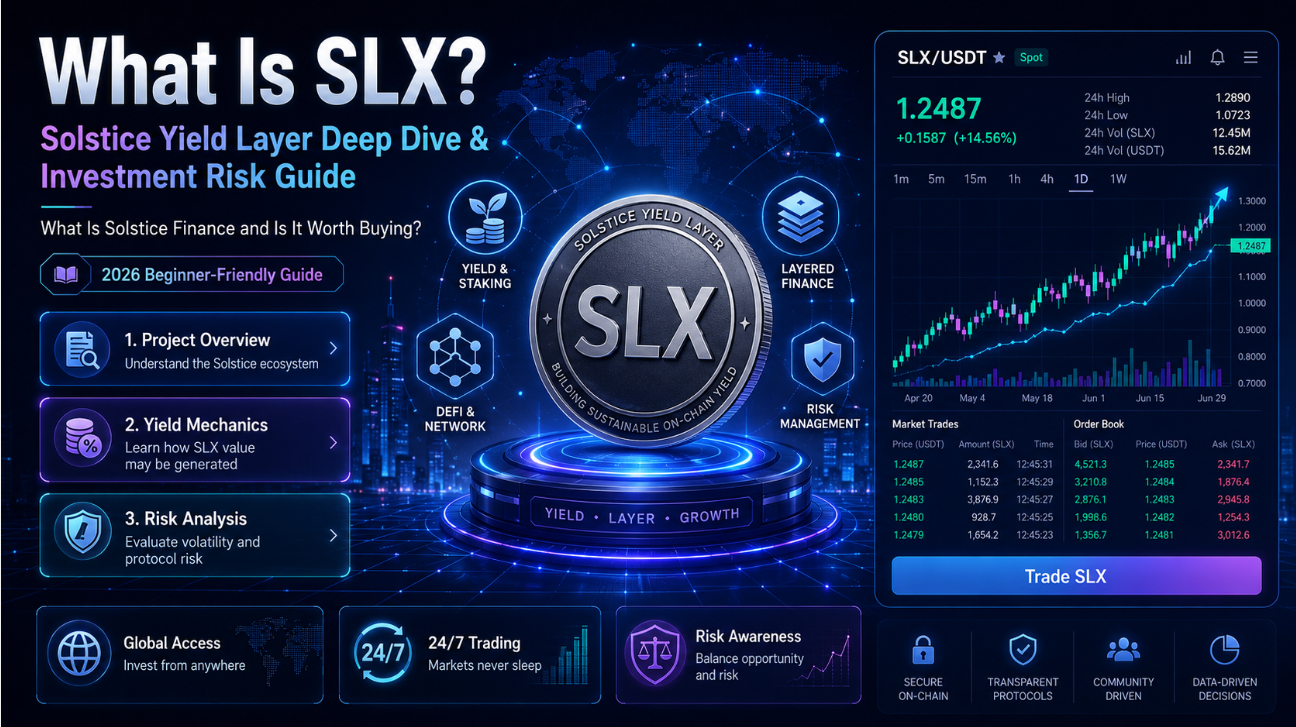
But SLX is not a typical meme coin, nor is it a gas token for a new L1. It is an access, staking, and governance token within the Solstice Finance ecosystem, backed by a DeFi yield protocol built around the USX stable asset, the eUSX yield receipt, and YieldVault yield strategies.
Solstice’s official SLX Litepaper describes SLX as the ecosystem’s "access and prioritization asset." It is used for restricted capacity allocation, early strategy access, credit market eligibility, and governance participation—not pure market sentiment speculation. The official document also explicitly states that SLX does not represent equity, debt, or ownership in Solstice Finance, and it does not guarantee yield, profit distribution, or price appreciation.
In one sentence:
SLX is an access and utility token within the Solstice Finance ecosystem. Its core value comes from user demand for USX, eUSX, YieldVault, credit markets, and future yield products.
If you want a quick overview of SLX’s fundamentals and background, you can read this summary: What Is SLX (Solstice Finance)?
1.1 What Does Solstice Finance’s “Yield Layer” Mean?
Solstice Finance positions itself as a Yield Layer, which can be understood as a "yield infrastructure" or "yield layer."
Ordinary DeFi protocols usually do one thing:
- DEXs handle swaps;
- Lending protocols handle borrowing and lending;
- Stablecoin protocols mint stablecoins;
- Yield aggregators help users find yield pools.
Solstice’s positioning is closer to a "yield asset management platform." It does not just give users a single pool to farm; it aims to combine institutional-grade yield strategies, a stablecoin settlement layer, on-chain yield receipts, credit products, and future consumer-facing entry points.
According to the Solstice Litepaper, the Solstice product stack includes USX, eUSX, strcUSX, aiUSX, tbUSX, SLX and stSLX, future vaults, Nexus, and YaaS, among other modules. USX and eUSX are the core live assets, while the rest are extensions to broaden yield sources and use cases.
So, "Yield Layer" is not just a marketing slogan. It means:
Solstice aims to become the underlying yield infrastructure in the Solana ecosystem—carrying stablecoin yield, institutional strategies, on-chain asset portfolios, and credit products.
But this also raises a concern: the more complex the product, the more complex the risks. It is not a simple single-token staking play; it involves layers of risk around stablecoins, custody, strategy execution, yield sources, smart contracts, regulation, and liquidity.
1.2 What Are USX, eUSX, and stSLX?
To understand SLX, you must first understand Solstice’s three core assets: USX, eUSX, and stSLX.
USX: The Protocol’s Settlement Asset
USX can be understood as the base stable asset within the Solstice ecosystem. The Solstice Litepaper describes USX as an "overcollateralized settlement layer," backed by audited USD reserves, tokenized Treasuries, and delta-neutral hedged positions in major digital assets, with solvency demonstrated through Accountable Proof of Solvency.
In short:
- USX is the entry point when users enter the Solstice ecosystem.
- Future yield, credit, payment, and redemption functions are all built around USX.
eUSX: The Yield Receipt
eUSX is Solstice’s core yield product. When users deposit USX into a YieldVault, they receive eUSX. As Tiger Research’s analysis of Solstice explains, eUSX does not pay out interest in the form of additional tokens every day. Instead, the yield is reflected in the amount of USX each eUSX can be redeemed for. For example, if 1 eUSX equals 1 USX at the start, as yield accumulates, 1 eUSX may become redeemable for 1.05 USX or 1.10 USX.
This is similar to a "net-asset-value growth yield receipt."
stSLX: The Receipt for Staked SLX
stSLX is the liquid staking token users receive after staking SLX. According to the Litepaper, staking SLX for stSLX grants protocol privileges such as priority vault access, credit market access, Instant Unlock features, and governance weight. Cycle 1 base APY is 20%, and the APY is designed as "base rate minus eUSX 7-day rolling APY"—meaning when eUSX yield compresses, more SLX rewards flow from the treasury into stSLX to make up the difference.
The relationship can be summarized as:
- USX is the principal entry point;
- eUSX is the yield receipt;
- SLX/stSLX is the ecosystem access and incentive layer.
1.3 Why Does the Team Emphasize "Institutional-Grade Yield Strategies On-Chain"?
One of Solstice’s core selling points is packaging yield strategies that were previously accessible mainly to institutional users into on-chain composable assets, allowing retail users to participate through DeFi.
Halborn’s case study on Solstice Labs mentions that Solstice Labs offers permissionless institutional yield products backed by USX. Users can lock USX into YieldVaults to access delta-neutral hedged strategies; these strategies have averaged 19.2% annual yield over the past year, backed by more than three years of live trading experience.
This addresses a pain point for retail users: many hold USDT, USDC, and other stablecoins but do not know how to earn yield while controlling risk. Traditional DeFi farming may offer high yield but also high risk; low-risk yield may be very low. Solstice hopes to use a "stablecoin + yield strategy + on-chain receipt" approach to let users access yield products in a more standardized way.
But it must be emphasized: institutional-grade does not mean risk-free.
It only means the strategy and custody structure are more professional; it does not mean there is no possibility of loss, nor that the yield is guaranteed to be sustainable.
1.4 Is SLX a Governance Token, Utility Token, or Equity Certificate?
SLX is not an equity certificate.
The Solstice Litepaper explicitly states that SLX does not represent equity, debt, or ownership in Solstice, and holders have no right to dividends, profits, or any guaranteed financial return. It is primarily an access and utility token within the Solstice ecosystem, with an added governance layer.
More precisely, SLX has three layers of attributes:
First, utility. Used to unlock protocol features such as priority vault access, credit market eligibility, and Instant Unlock features.
Second, staking. Staking SLX for stSLX allows participation in reward mechanisms and protocol privileges.
Third, governance. In the future, holders may participate in governance over certain protocol parameters, vault strategies, fee arrangements, and resource allocation.
But it is not:
- Company stock;
- An equity certificate;
- A fixed-income bond;
- A security promising dividends;
- A risk-free yield product.
This is extremely important for newcomers. Do not assume that because the team is strong, the institutional background is solid, and the yield narrative is compelling, SLX is equivalent to "buying a share of the project."
II. Tokenomics Breakdown: Behind the 1 Billion Fixed Supply, Who Holds the Most Chips?
Crypto newcomers are often attracted by the phrase "fixed supply." Seeing a project with a capped total supply, they assume there will be no inflation, no dilution, and that it must be bullish long-term.
But what really affects price is not the words "fixed supply." It is:
- How much is circulating at launch?
- How fast will the remaining supply unlock?
- Who holds the most tokens?
- Will those holders sell?
- Are unlock events concentrated?
- Can the market absorb the new supply?
SLX has a maximum supply of 1 billion tokens. CoinMarketCap data shows that as of around July 14, 2026, SLX circulating supply was approximately 243 million, max supply 1 billion, price around $0.145, market cap approximately $35.2 million, and FDV approximately $145 million.
Some users see figures like "market cap around $50 million, FDV around $200 million," which are usually estimates based on a price around $0.20. Since SLX is highly volatile, when publishing an article, refer to the real-time price page for the latest data.
2.1 How Are the 1 Billion SLX Allocated?
According to the Solstice Litepaper and public data from Tokenomics.com, the total SLX supply is 1 billion tokens. The overall allocation leans toward "community and ecosystem incentives," but the foundation, team, and strategic partners still hold a significant share. For ordinary investors, what really matters is not the "fixed total supply," but when each category of tokens will be released, and whether that release will create selling pressure.
The community portion accounts for the largest share at 37.71%, but it is not released all at once. At TGE, only about 21.2% was released; the remainder will vest linearly over 36 months. This means community incentives will continue entering the market for three years. If real user growth cannot keep pace with token release speed, the price may still come under pressure.
The foundation allocation is 24%. At TGE, 50% was released; the remainder will vest gradually over 30 months. Foundation tokens are typically used for ecosystem building, operations, liquidity support, and future partnerships, but this share is not small. The transparency of how these tokens are used will directly affect market confidence.
Team and advisors account for 20%. At TGE, none was released; there is a 12-month cliff, followed by 24 months of linear vesting. This design prevents the team from dumping immediately after launch, but starting in 2027, team unlocks could become a significant source of potential selling pressure that the market must monitor closely.
The airdrop portion is 10%, with a more varied release schedule. Airdrops help expand community reach, but they can also bring short-term selling pressure, as some recipients may sell immediately for profit.
Strategic TVL partners account for 8%. At TGE, 25% was released; the remainder vests linearly over 12 months. This allocation is typically used to attract early liquidity and ecosystem partnerships, but if partner cost bases are low, they may also create periodic selling pressure after price rises.
The public sale portion is the smallest, at only 0.29%. At TGE, 100% was released with no lockup. Because of its small share, it has limited long-term impact on the supply structure.
Overall, although SLX has no traditional VC allocation, that does not mean there is no supply pressure. Community, foundation, team, airdrop, and strategic partner tokens will all enter circulation at different stages in the future. When evaluating SLX, newcomers should not just look at labels like "1 billion fixed supply" or "zero VC." They should focus on tracking the continuous unlock schedule over the next 12–36 months.
The Solstice Litepaper emphasizes that one of its design principles is "Community-first," and explicitly states "No VC allocation"—meaning there is no traditional VC allocation.
This is indeed a differentiating selling point. Many DeFi projects face selling pressure after TGE from early VC unlocks, team unlocks, and market maker fund releases. SLX’s lack of traditional VC allocation reduces a portion of typical VC-driven sell pressure.
But that does not mean there is no sell pressure. Tokens from the community, foundation, airdrops, strategic TVL partners, team, and advisors will still be released.
2.2 Is "Zero VC Allocation" a Bullish Signal or Marketing Hype?
Zero VC allocation has its bullish side.
It means:
- No traditional low-price VC rounds;
- No large early institutions acquiring tokens at extremely low cost;
- No typical "VC unlock dump" narrative;
- A higher share for community and ecosystem incentives.
But it can also be over-marketed.
Because what retail investors should really care about is not "whether there is VC," but:
- Are the team and foundation shares too high?
- Do community incentives actually reach real users?
- Will airdrop recipients sell quickly?
- Is foundation release used for long-term building or market operations?
- Do strategic TVL partners have short-term arbitrage motives?
SLX having no traditional VC allocation does not mean the token distribution is fully decentralized. Foundation 24%, team 20%, strategic TVL partners 8%—combined, this is still a very critical token structure. Investors cannot just look at "no VC"; they must also examine the future release curve.
2.3 Approximately 24% Circulating After TGE—What Does the Remaining 76% Mean?
Tokenomics.com data shows that SLX’s full unlock cycle runs from May 25, 2026, to May 25, 2029—about 36 months. As of July 2026, approximately 24.3% of SLX is circulating, and about 76% remains locked. The next unlock is on July 25, 2026, releasing approximately 17.2553 million SLX, about 1.7% of total supply, roughly equivalent to 7.2% of the market cap at that time.
This means: SLX’s current price is not formed under a fully circulating supply, but under a low-circulation state.
Low-circulation projects tend to go through two phases:
Phase one: After a new token launches, circulation is low, and price is easily pushed up by trading sentiment.
Phase two: As unlocks continue to increase, if demand growth cannot keep pace with supply growth, price is likely to come under pressure.
The biggest test for SLX in the future is not "fixed total supply," but:
Can the real growth of USX and eUSX absorb the continuous unlocks over the next three years?
2.4 What Selling Pressure Will Emerge After the Team’s 12-Month Cliff Ends?
Team & Advisors account for 20%. At TGE, none was released; there is a 12-month cliff, followed by 24 months of linear vesting.
This means that after around May 2027, team and advisor tokens will begin entering the release cycle.
Such unlocks do not necessarily equal a dump. The team may continue to hold, or use tokens for incentives, ecosystem partnerships, or long-term building. But from a secondary market perspective, any new circulating supply can create psychological pressure.
Investors need to monitor in advance:
- Team unlock start date;
- Monthly unlock quantity;
- Unlock amount as a percentage of circulating market cap;
- Exchange deposit address changes;
- Whale wallet transfer behavior;
- Whether the team has publicly committed to long-term lockups.
If by 2027 the project still shows no significant TVL growth, revenue growth, or real usage demand, then team unlocks will become a greater price risk.
2.5 How Should We Interpret the "28% Drop on July 5"?
This requires special rigor.
Publicly available Tokenomics.com unlock calendars show that SLX’s major past milestones include the May 25, 2026 TGE, the June 25, 2026 unlock, and the next July 25, 2026 unlock. As of the current public page, July 5, 2026, is not listed as an official unlock date. Tokenomics.com also shows that after the May 25 TGE, the maximum drawdown within 13 days was approximately -51.2%; after the June 25 unlock, the maximum drawdown within 14 days was approximately -49.7%.
Therefore, if someone in the market attributes the roughly 28% drop around July 5 to an unlock, the data source needs to be verified further. It could be:
- The secondary market pricing in the upcoming July 25 unlock in advance;
- A broader market pullback;
- Continued airdrop selling pressure;
- Liquidity deficiency causing price slippage;
- Whale selling or market maker depth changes.
What this case really illustrates is: After a new token launches, even without an official unlock on that day, as long as the market anticipates future supply increases, selling pressure can appear in advance.
III. SLX’s Utility Value: Beyond Speculation, What Can the Token Actually Do?
Whether a token is suitable for long-term investment cannot be judged solely by project vision; you must also look at whether the token has real demand.
SLX’s demand comes from four main areas:
- Staking to obtain stSLX;
- Unlocking protocol privileges;
- Participating in credit markets and Instant Unlock;
- Future governance and ecosystem resource allocation.
3.1 What Does Staking SLX for stSLX Unlock?
According to the Solstice Litepaper, after users stake SLX for stSLX, they gain the following privileges:
- Priority vault access;
- Credit market access eligibility;
- Instant Unlock features;
- Governance weight;
- Future PT/YT market composability opportunities.
The official document also mentions that non-stSLX users can still access some features, but must pay standard fees; stSLX holders can have these access fees waived or reduced.
This shows that SLX’s value is not "automatic money just by holding," but rather:
The more Solstice products there are, the scarcer capacity becomes, and the more users there are, the higher the access value of stSLX may become.
If no one uses the protocol, stSLX privileges have no scarcity; If USX and eUSX grow rapidly, stSLX privileges may become more valuable.
3.2 Why Is the stSLX APY Called a "Counter-Cyclical Design"?
The Solstice Litepaper shows that Cycle 1 base APY is 20%, calculated as:
base rate - eUSX 7-day rolling APY
When eUSX yield declines, more SLX flows from the treasury into stSLX to make up the difference; when eUSX yield is high, the SLX subsidy pressure relatively decreases.
This is the so-called "counter-cyclical design."
The logic is:
- When eUSX yield is high, users already have strong yield attraction;
- When eUSX yield is low, SLX rewards enhance staking attraction;
- Thus, the ecosystem maintains a certain level of user stickiness across different yield environments.
But there is also a key risk here:
APY is not generated out of thin air.
If the rewards come from the Solstice treasury, they are essentially an ecosystem subsidy. Subsidies can help early growth, but long-term sustainability must be supported by real protocol revenue, user demand, and product profitability. Otherwise, the higher the APY, the greater the potential future sell pressure.
3.3 How Does Locking SLX in Credit Markets Affect Borrowing Capacity?
In Solstice’s design, SLX is not only used for ordinary staking, but is also tied to credit markets. The Litepaper mentions that when SLX is locked in credit markets, it becomes illiquid for the duration of the loan; as credit scale grows, the proportion of locked SLX supply also increases.
This has two effects on the token:
First, locking reduces short-term circulating supply. If large amounts of SLX are used in credit markets or to support Instant Unlock capacity, the amount of SLX available for sale in the market decreases, which may alleviate sell pressure.
Second, credit market demand enhances structural SLX demand. If users lock SLX to obtain higher borrowing limits, better rates, or faster redemption experiences, SLX is no longer just a speculative asset, but a functional asset used within the protocol.
But the prerequisite remains: the credit market must have real user demand. If the credit market is small, SLX locking demand will also be limited.
3.4 Will Protocol Fees Flow Back to SLX Holders?
The Solstice Litepaper mentions that the protocol has multiple fee sources that expand with TVL, including YieldVault performance fees, Instant Unlock fees, credit market spreads, and OTC execution fees. But the official document also states that during the growth phase, fees will be reinvested into user growth, liquidity, and product development, rather than being distributed to token holders prematurely.
This is very important.
Newcomers often assume:
"Protocol has revenue = SLX holders get dividends."
But the more accurate current understanding is:
Protocol revenue may strengthen ecosystem fundamentals, but it does not mean SLX holders have an automatic dividend right.
SLX is not equity; it does not promise profit distribution. How future fees will be used depends on governance, product stage, and compliance constraints.
When evaluating SLX’s utility value, it is also recommended to pay attention to its trading pair performance: SLX Real-Time Price.
IV. Pre-Purchase Preparation: What Tools and Knowledge Do You Need?
Many newcomers face numerous problems between "wanting to buy SLX" and "actually buying it": not knowing how to use a wallet, choosing the wrong chain, not confirming the contract address, setting slippage incorrectly, and not knowing whether to use a DEX or CEX.
Before buying SLX, it is not recommended to rush in blindly. First, understand the tools and trading environment.
4.1 Why Do You Need a Solana-Compatible Wallet?
Solstice is a protocol built around the Solana ecosystem. When Deus X Capital announced the launch of Solstice Labs in 2024, it mentioned that Solstice’s first protocol would be built on the Solana blockchain.
If you are only buying SLX through a centralized exchange, you may not need to operate a Solana wallet yourself for the time being. But if you want to actually use USX, eUSX, stSLX, YieldVault, or Solana on-chain DeFi applications, you will need a Solana-compatible wallet.
The key differences are:
- Ethereum wallets are mainly for EVM ecosystems, such as Ethereum, BNB Chain, Base, Arbitrum, etc.;
- Solana wallets are for the Solana ecosystem, with different address formats, gas fees, signing methods, and DApp connection methods.
Newcomers should pay special attention to:
- Do not send Solana assets to a wallet that does not support Solana;
- Do not use EVM addresses as Solana addresses;
- Do not connect to unfamiliar DApps casually;
- Do not leak your seed phrase;
- Do not click on airdrop phishing links.
If you are still unsure how to manage crypto assets, you can first learn the basics of wallets: What Is a Wallet?
4.2 What Is the Difference Between Buying SLX on a CEX vs. a DEX?
After launch, SLX traded on multiple centralized platforms and DEXs. Public reports show that SLX was listed on centralized platforms such as Binance Alpha, Kraken, Gate, OKX, MEXC, and Bitget, and PancakeSwap was also one of the initial decentralized trading venues.
Advantages of Centralized Exchanges
- Suitable for newcomers;
- Simple order placement;
- No need to manage private keys yourself;
- Fast execution;
- Usually better liquidity;
- Can trade directly with USDT or USDC.
Disadvantages:
- Requires a platform account;
- May require KYC;
- Withdrawals are subject to platform rules;
- Users do not directly control private keys;
- Availability varies by region.
Advantages of DEXs
- You control your own assets;
- Can trade directly on-chain;
- More aligned with DeFi usage habits;
- Can interact with wallets and protocols.
Disadvantages:
- Higher risk of buying fake tokens;
- Need to verify contract addresses yourself;
- Need to set slippage and gas;
- Fees may still be incurred even if a transaction fails;
- Higher risk of on-chain phishing.
For complete newcomers, it is recommended to first use a trusted centralized platform to get familiar with trading logic with a small amount; if you want to enter on-chain protocols, then learn wallet and DEX operations.
4.3 How to Verify the Authenticity of the SLX Contract Address?
For newly launched tokens like SLX, it is very easy to encounter fake contracts, fake airdrops, fake websites, and fake customer service.
When verifying the contract address, it is recommended to only use the following channels:
- Solstice official website;
- Official documentation;
- Official X account;
- Major price tracking platforms;
- Exchange announcements;
- Blockchain explorer official labels;
- Project Discord/Telegram pinned messages.
Do not copy contract addresses from the following channels:
- Comment sections;
- Private messages from strangers;
- WeChat group screenshots;
- Unverified KOL links;
- Search ads;
- Fake airdrop pages.
If you copy the wrong contract address, what you buy may not be SLX, but a fake token. Fake tokens usually cannot be sold, or have extremely high transaction taxes.
4.4 Which Is Better as a Trading Pair: USDT or USDC?
If trading on a centralized exchange, usually just look at what trading pairs the platform offers. If there is an SLX/USDT pair, USDT is more suitable for most crypto users because of stronger liquidity and usage habits.
If trading on the Solana chain, USDC is generally more widely used in Solana DeFi, but it depends on pool depth, price slippage, and routing quality.
Newcomers can follow a simple principle:
- Whichever trading pair has better liquidity, use that one;
- Whichever has lower slippage, use that one;
- Do not go to a small pool for large trades just to save a little on fees.
For slippage settings, on major CEXs you do not need to set slippage yourself; on DEXs, for small trades you can start observing from 0.5%–1%. When liquidity is insufficient, you may need higher slippage, but the higher the slippage, the greater the risk of sandwich attacks or abnormal execution.
V. SLX Price Prediction & Valuation Logic: What Is It Actually Worth?
Many newcomers like to ask: "How high can SLX go in the future?" But the more important question should be: "What justifies SLX’s current price?"
SLX valuation cannot be based on candlestick charts alone. It must look at at least four factors:
- USX TVL growth;
- eUSX yield attractiveness;
- SLX unlock dilution;
- DeFi yield sector valuation levels.
5.1 What Is SLX’s Current Valuation Level?
As of around July 14, 2026, CoinMarketCap data shows SLX price at approximately $0.145, circulating supply approximately 243 million, market cap approximately $35.2 million, max supply 1 billion, corresponding FDV approximately $145 million.
If the price returns to around $0.20, then circulating market cap would be approximately $48.6 million, FDV approximately $200 million. So, the commonly cited "market cap around $50 million, FDV around $200 million" corresponds to a higher price range estimate.
This valuation cannot be simply called cheap or expensive when placed among DeFi yield protocols. The key is to look at:
- Whether USX scale can continue to grow;
- Whether eUSX yield can stabilize;
- Whether stSLX staking ratio can increase;
- Whether future unlocks will be absorbed by the market;
- Whether protocol fees can truly form long-term value.
5.2 Three Price Scenarios for 2026–2030
The following is not investment advice, only a valuation thinking framework.
Conservative Scenario: 0.05–0.12
Assumptions:
- USX TVL growth stalls;
- eUSX yield declines;
- SLX continuous unlocks bring selling pressure;
- DeFi market overall weakens;
- New products delayed or underutilized.
In this case, SLX may remain below the main trading range post-TGE for a long time, or even fall below the cost basis of most short-term users.
Base Case Scenario: 0.15–0.40
Assumptions:
- USX maintains moderate growth;
- eUSX yield declines but remains attractive;
- stSLX staking rate rises;
- Unlock pressure is partially absorbed;
- Solana DeFi capital is active;
- Protocol revenue and fees gradually increase.
This is a relatively neutral case. SLX may not moon, but it can maintain a certain valuation and fluctuate with ecosystem data.
Optimistic Scenario: 0.50–1.00+
Assumptions:
- USX TVL rapidly grows to billions of dollars;
- Multiple YieldVault products launch and form real demand;
- stSLX becomes the core access asset of the protocol;
- Credit markets, Instant Unlock, and YaaS bring structural lockups;
- Solana DeFi enters a strong cycle;
- The market is willing to give Yield Layer a higher valuation.
If all these conditions are met simultaneously, SLX could see a significant valuation re-rating.
But note: The optimistic scenario requires very strong fundamental growth to offset future unlock dilution; otherwise, price rises may only be short-term sentiment.
You can refer to more detailed technical analysis and price prediction data: SLX Price Prediction. At the same time, since Solstice is built on the Solana ecosystem, ETH’s market performance will also indirectly affect overall DeFi capital flows: ETH Price Prediction.
5.3 Why Is SLX Price Tied to USX TVL Growth?
The core investment logic for SLX is:
USX TVL growth ↓ YieldVault capacity expands ↓ eUSX usage increases ↓ Credit market and Instant Unlock demand increases ↓ More users need to stake or lock SLX ↓ SLX structural demand rises
The Litepaper also mentions that every dollar of USX TVL creates structural SLX demand through access thresholds, credit markets, and protocol-directed SLX allocation.
But there is a prerequisite here: TVL must be real, stable, and long-term—not short-term airdrop farming capital.
If TVL is mainly driven by airdrop expectations, once incentives end, capital may leave quickly; If TVL comes from real yield demand, SLX’s valuation foundation is more stable.
So, when looking at SLX, do not just look at price; also look at:
- USX supply;
- eUSX deposit volume;
- YieldVault yield;
- stSLX staking ratio;
- Real user count;
- Capital retention time.
5.4 How Does SLX Differ from Comparable Yield Protocols Like Ethena?
Ethena’s core narrative is synthetic dollar USDe and delta-neutral yield. Solstice also has delta-neutral yield logic, but it emphasizes more the Solana ecosystem, the USX settlement layer, eUSX yield receipts, institutional strategies, and future multi-yield sources.
Solstice’s differentiators include:
- Solana-native;
- Built around USX as a yield layer;
- eUSX as a yield receipt;
- stSLX as an access and staking layer;
- Future expansion into strcUSX, aiUSX, tbUSX, and other multi-strategy assets;
- Emphasis on institutional-grade custody and asset management structure.
Valuation premium may come from:
- Solana ecosystem growth;
- Yield product differentiation;
- stSLX privilege value;
- Deus X Capital background;
- Institutional custody and compliance structure.
Valuation discount may come from:
- Short time since launch;
- High price volatility;
- Heavy unlock pressure;
- Yield sustainability not fully validated;
- USX scale not yet at top-tier stablecoin level;
- High barrier to understanding for ordinary users.
VI. Risk Checklist: The N Ways This Project Could Go to Zero
A truly credible investment guide cannot only talk about returns and stories; it must also clearly explain the paths through which the project could fail.
SLX’s risks are not low, and they are compound risks.
6.1 Token Concentration Risk
On-chain token concentration is a problem newcomers most easily overlook. The Binance Wallet page once showed that the top 10 addresses on the BNB Chain corresponding to the SLX page accounted for approximately 86.02%; different chains and statistical methodologies may vary. If users see a higher proportion on other explorers, they also need to confirm whether exchange addresses, cross-chain contracts, market maker addresses, or bridge addresses are included.
High concentration means:
- A few address transfers can affect market sentiment;
- Exchange deposits may trigger panic;
- Large sell orders may cause slippage;
- Ordinary retail investors cannot judge real sell pressure;
- On-chain address labels are unclear, making analysis even harder.
But also note: not all large addresses are individual whales. Some may be exchanges, contracts, multi-sigs, market makers, or cross-chain bridge addresses. Therefore, you cannot simply say a project is dangerous just because the top 10 proportion is high, but it must be included in risk monitoring.
6.2 Unlock Sell Pressure Risk
SLX’s unlock pressure over the next three years is very worth watching.
Tokenomics.com data shows that as of July 2026, approximately 76% of SLX is still locked, with 35 future unlock events remaining, totaling approximately 660 million SLX to be released; the next unlock is on July 25, 2026, releasing approximately 17.2553 million SLX, about 1.7% of total supply, roughly equivalent to 7.2% of the market cap at that time.
This means that SLX investors must face a question every month:
Can new circulating supply be absorbed by new demand?
If USX TVL, stSLX staking, and protocol revenue grow quickly, the unlock impact may be digested; If growth falls short of expectations, unlocks will become continuous sell pressure.
Newcomers can use tools such as TokenUnlocks, Tokenomics.com, CoinMarketCap, and on-chain explorers to monitor this long-term.
6.3 Smart Contract Risk
Solstice’s smart contracts have been audited by Halborn. Halborn’s case study also mentions that it conducted a comprehensive review of Solstice’s smart contracts, including manual code analysis, performance optimization, and attack surface assessment.
Solstice’s institutional page and resources page also show that its smart contracts have been audited by Halborn and Sep2.
But an audit does not equal absolute security.
Smart contract risks may come from:
- Code vulnerabilities;
- Oracle anomalies;
- Permission management errors;
- Upgrade contract risks;
- Cross-chain bridge risks;
- Strategy execution risks;
- Third-party protocol integration risks.
Especially since Solstice is not a single staking contract, but involves USX, eUSX, YieldVault, custody, strategies, credit markets, and future additional products. The more complex the system, the larger the attack surface.
6.4 Stablecoin Depeg and Strategy Risk
The stability of USX and eUSX is the foundation of the Solstice ecosystem.
If USX loses its peg, or if the yield strategies behind eUSX suffer losses, SLX’s fundamentals will be directly impacted.
Risks may come from:
- Underlying collateral asset volatility;
- Delta-neutral strategy failure;
- Liquidity drying up in extreme market conditions;
- Exchange risk;
- Custody risk;
- Sustained negative funding rates;
- Redemption congestion;
- Liquidation cascades.
Tiger Research also points out that eUSX’s yield structure cannot be fully verified on-chain in real time. Solstice improves transparency through external verification such as Accountable, but the custody framework and exchange risk management remain key variables.
So, USX is not an ordinary stablecoin, and eUSX is not a bank deposit. Their yield comes from strategies, and strategies always carry risk.
6.5 Regulatory Risk
Solstice emphasizes compliance and institutional structure. Solstice website search results show that its MiCA white paper was notified to the Central Bank of Ireland in December 2025, and passported across 29 EU/EEA member states.
At the same time, the Central Bank of Ireland website explains that MiCAR establishes a new regulatory framework for crypto-assets, with objectives including protecting consumers and investors, reducing financial stability risks, and covering activities such as crypto-asset issuance, custody management, and trading platform operations.
This is a plus for Solstice, but not a get-out-of-jail-free card.
Regulatory risks include:
- Whether yield products are classified as securities;
- Different countries’ attitudes toward stablecoin yield products;
- Whether exchanges restrict SLX listings;
- Whether users in certain regions are unable to participate;
- Whether yield disclosures and marketing are compliant;
- Whether future regulation requires stricter KYC.
Especially "yield products" may face stricter scrutiny in many jurisdictions.
6.6 Yield Sustainability Risk
Halborn’s case study mentions that Solstice’s strategy has averaged 19.2% annual yield over the past year.
But the question is:
When TVL grows from $100 million to $1 billion, can 19.2% still be maintained?
High yields usually come from structural market opportunities, and market opportunities are not infinite.
- When capital scale is small, it is more flexible in capturing arbitrage, funding rate, and delta-neutral opportunities;
- When capital scale is large, strategy capacity may decline, and yield may be diluted;
- If the market becomes crowded, yields will also decline.
Therefore, investors cannot treat past APY as a guarantee of future returns. The project team also explicitly states in the Litepaper that rewards are not guaranteed and depend on actual protocol activity and governance allocation.
VII. Team & Background: Who Is Running This Project? Are They Credible?
Project background is one of SLX’s strengths, but it cannot be a reason for blind investment.
Deus X Capital announced the launch of Solstice Labs in 2024. The announcement stated that Deus X Capital is a billion-dollar-level investment and operations company, and Solstice Labs is positioned to connect traditional capital markets with the Crypto/DeFi ecosystem, providing institutional-grade DeFi investment products for both institutional and retail investors.
7.1 What Does Deus X Capital’s Background Mean?
Deus X Capital’s backing at least shows that Solstice is not an anonymous, fly-by-night operation. It has institutional capital, team resources, and industry connections.
According to the Deus X announcement, Solstice Labs is led by Ben Nadareski as co-founder and CEO, Tim Grant as co-founder and Chairman, and Stuart Connolly as CIO and co-founder. The announcement also mentions that Ben Nadareski previously worked at institutions such as Galaxy Digital and SIX Digital Exchange; Tim Grant has over 25 years of financial markets experience and previously served as head of Galaxy Digital EMEA.
This background is conducive to:
- Designing more professional yield products;
- Connecting with institutional custody and trading resources;
- Understanding traditional financial risk control;
- Driving compliance and institutional partnerships;
- Raising project credibility.
But a strong background does not mean the token will definitely go up. The project ultimately depends on whether the product is being used, whether the yield is sustainable, and whether the token can capture value.
7.2 What Problems Do Custodians and Institutional Partnerships Solve?
Solstice’s partnership with Copper is an important trust point. Copper announced in September 2025 that it will provide secure custody and OTC settlement for Solstice Labs’ Solana assets, including USX; Copper’s ClearLoop infrastructure can help clients reduce counterparty risk and improve capital efficiency when trading and settling on centralized exchanges.
This type of partnership mainly solves three problems:
First, asset custody security. Users and institutions care more about where assets are held, who is the custodian, and whether counterparty risk on exchanges can be reduced.
Second, institutional capital entry barriers. Institutions are unwilling to place large amounts of assets in ordinary exchange hot wallets; they need more mature custody and settlement structures.
Third, strategy execution efficiency. Delta-neutral strategies usually require trading and managing margin across multiple venues, making custody and OTC settlement capabilities important.
But custody partnerships are not absolutely safe either. There are still operational risks and compliance risks between the custodian, trading venues, and strategy managers.
7.3 Why Was Solstice Staking AG Registered in Switzerland?
Solstice Staking AG’s materials emphasize Swiss regulatory transparency and a stable financial environment; BusinessWire reports also mention that Solstice Staking AG’s staking infrastructure is located in Switzerland, with plans to expand to Liechtenstein and the UAE.
Switzerland is relatively friendly to digital assets, custody, funds, and fintech, so many crypto projects choose to set up related entities there.
This has two implications for users:
First, the project places more emphasis on compliance structure. Second, institutional partnerships and custody arrangements may be easier to advance.
But also note: Being registered in Switzerland does not mean risk-free, nor does it mean all users in all countries can legally participate.
VIII. Practical Decision Framework: Should I Buy SLX?
What newcomers need most is not a simple "buy" or "don’t buy," but a decision-making framework.
Whether SLX is suitable to buy depends on whether you understand its yield mechanism, unlock schedule, token utility, and risk tolerance.
8.1 Who Is SLX Suitable For?
SLX is more suitable for the following types of users:
First, those who can tolerate high volatility. SLX has been highly volatile since launch, and new tokens can experience drawdowns of over 50% during their initial phase. Those who cannot handle large drawdowns should not go heavy.
Second, those who understand DeFi yield logic. You should at least know what USX, eUSX, YieldVault, delta-neutral strategies, stSLX staking, and APY sources are.
Third, those willing to track data long-term. SLX is not a "buy and forget" asset. You need to continuously monitor TVL, unlocks, yield rates, peg status, and on-chain data.
Fourth, those who can accept token unlock dilution. A large amount of SLX will still be released over the next three years. If you cannot accept supply increases, this project is not for you.
Fifth, those who are bullish on Solana DeFi and the on-chain yield layer trend. Solstice’s growth is highly correlated with Solana ecosystem activity.
8.2 Who Is SLX Not Suitable For?
The following groups are not recommended to buy SLX, or at least not to go heavy:
- Those who only want stable returns;
- Those who cannot withstand drawdowns of over 50%;
- Those who do not understand token unlock mechanisms;
- Those who do not know how to use wallets and on-chain tools;
- Those who only look at candlestick charts and not project mechanics;
- Those who treat APY as fixed income;
- Those who think "institutional-grade" means risk-free;
- Those hoping for short-term windfalls.
Especially the last point: SLX is not a bank wealth management product, nor is it a principal-protected product. It is a high-risk DeFi ecosystem token.
8.3 If You Decide to Invest, How Should You Manage Position Sizing?
For newcomers, it is recommended to classify SLX as a high-risk growth asset, not a core asset.
More prudent position sizing principles:
- Do not exceed 5% of total assets;
- First purchase should not exceed 30% of planned position;
- Build positions in batches, not all at once;
- Be cautious about adding before major unlocks;
- Set a maximum loss limit;
- Do not borrow money to buy;
- Do not use high leverage on futures;
- Do not convert all stablecoin yield principal into SLX.
Example:
If your total assets are 10,000 USDT, your maximum SLX position should be controlled within 500 USDT. First buy only 100–150 USDT, and then adjust in batches based on TVL, unlocks, price, and market sentiment.
8.4 What Metrics Should You Continuously Monitor After Buying?
After buying SLX, do not just look at the price every day.
It is recommended to focus on the following metrics:
First, USX TVL
USX TVL is the core metric for Solstice ecosystem growth. Sustained TVL growth means capital is willing to enter the protocol; TVL decline means user demand may be weakening.
Second, eUSX Yield Rate
eUSX yield is the key to Solstice’s user attraction. If yield drops significantly, protocol attractiveness may weaken.
Third, stSLX Staking Ratio
The higher the staking ratio, the more users are willing to lock SLX long-term, which may also reduce circulating sell pressure.
Fourth, Unlock Calendar
Focus on monthly unlock quantities and their percentage of circulating market cap. Especially after team unlocks begin in 2027, more caution is needed.
Fifth, USX Peg Status
If USX depegs, SLX price will likely be impacted.
Sixth, Exchange Liquidity
Observe SLX trading volume, order book depth, bid-ask spread, and large slippage on major trading platforms.
Seventh, Protocol Revenue and Fee Flows
If Solstice discloses more data on fee revenue, YieldVault performance fees, Instant Unlock fees, and credit spreads in the future, these will become an important basis for valuation judgment.
IX. Conclusion: Is Yield Layer a Pseudo-Concept or a Real Trend?
SLX represents a new direction in the DeFi market in 2026: the tokenized yield layer.
The main themes of DeFi in the past were:
- DEXs
- Lending
- Liquidity mining
- Stablecoins
- Derivatives
Now more and more projects are shifting toward:
- Yield-bearing stablecoins;
- RWA yield;
- Delta-neutral strategies;
- Institutional custody;
- On-chain asset management;
- Yield receipt tokenization;
- A unified entry point for institutions and retail.
Solstice, along with projects like Ethena and Ondo, stands at the intersection of TradFi and DeFi convergence. But Solstice’s difference lies in: it emphasizes more the Solana-native yield layer, the USX settlement asset, eUSX yield receipts, and SLX access privileges, rather than a single stablecoin or a single RWA asset.
For crypto newcomers, the biggest cognitive barrier to investing in SLX is not "knowing how to buy," but:
- Do you understand where the yield comes from?
- Do you understand why the token has demand?
- Do you understand what future unlocks will bring?
- Can you distinguish between project fundamentals and token price?
- Can you accept high volatility and potential zeroing-out risk?
The final conclusion can be summarized as follows:
SLX is not a simple short-term speculative coin. Behind it lies the Solstice Finance yield protocol, the USX stable asset, eUSX yield receipts, and the stSLX access mechanism. But SLX is also not a low-risk asset. Token unlocks, yield sustainability, stablecoin peg, smart contracts, regulation, and token concentration can all affect the price.
If you are just looking for a "steady money maker," SLX is not suitable. If you are willing to deeply research Solana DeFi, yield layers, tokenized yield, and RWA-based asset management, SLX is worth putting on your watchlist—but it is more suitable for small positions, batch entries, and long-term tracking, rather than blind heavy betting.
Risk Disclaimer: This article is for educational and informational purposes only and does not constitute any investment advice. SLX, USX, eUSX, stSLX, and Solstice-related products carry risks including price volatility, smart contract vulnerabilities, strategy losses, stablecoin depegs, custody risks, regulatory risks, liquidity risks, token unlocks, and principal loss. Please conduct your own research before investing and make decisions cautiously based on your personal risk tolerance.