
If you've recently spotted EWYB/USDT on an exchange, your first reaction is probably:
"Is EWYB a new crypto project?"
Or:"Is this some Korea-themed coin? Does buying it mean I'm buying Korean stocks?"
Both reactions are common. EWYB trades like a token — it has a ticker, candlestick charts, an order book, and trades against USDT — but the underlying asset logic isn't an ordinary cryptocurrency. It's a tokenized ETF product.
Let's clarify this upfront:
EWYB is a bStocks tokenized product tied to the iShares MSCI South Korea ETF — a US-listed ETF that tracks the performance of the South Korean stock market. It is not a native on-chain asset like DOGE, SOL, or PEPE, and it isn't an independent blockchain project.
The "B" here can be understood as a bStocks product identifier, distinguishing the traditional ETF ticker EWY from its tokenized counterpart, EWYB.
Breaking it down simply:
- EWY: the iShares MSCI South Korea ETF, a US-listed ETF providing exposure to the Korean stock market
- EWYB: the bStocks tokenized version of EWY
- EWYB/USDT: the trading pair for EWYB priced in USDT
So understanding EWYB isn't about asking "does this token have a whale backing it" or "will it pump" — it's about asking:
- What is the underlying EWY ETF
- Does it genuinely correspond to off-chain ETF shares
- How do its rights differ from directly buying the ETF
- Does the risk come from the Korean market itself, or from the tokenized-security structure
- How should retail investors participate, and who shouldn't
This article covers EWYB from the angle of asset classification, underlying mechanics, suitable investor profiles, purchase paths, risk structure, and price drivers.
This article is not investment advice. EWYB falls under tokenized-securities products and involves ETF exposure, cross-border assets, crypto platforms, regional compliance, custody, and liquidity risk. Always defer to the platform's latest announcements, local laws, and your own risk tolerance.
1. You Just Saw EWYB on an Exchange — What Should Your First Reaction Be?
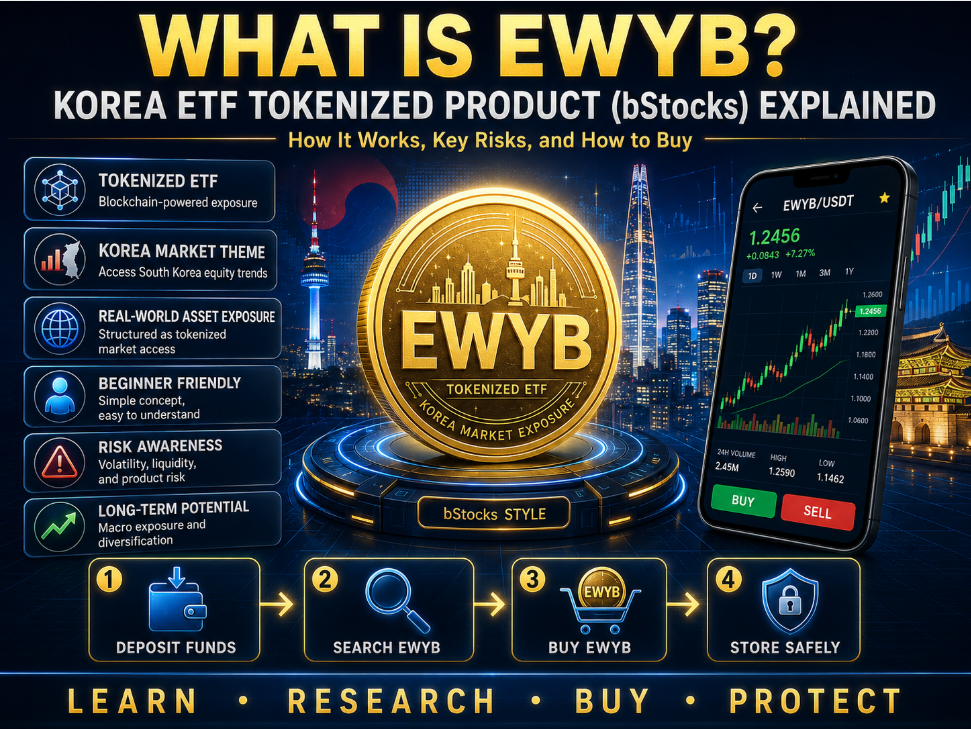
Newcomers seeing EWYB tend to make two mistakes.
Mistake one: assuming EWYB is an independent crypto project token.
This is an easy mistake to make — EWYB shows up on the exchange page just like any other token, with a trading pair, candlestick chart, price change, volume, and order book. Looking only at the interface, it doesn't look different from a new coin.
But EWYB's value doesn't come from any blockchain ecosystem's development — it comes from the performance of the EWY ETF.
In other words, EWYB doesn't derive its main price logic from active on-chain addresses, DeFi TVL, meme-community spread, node counts, gas fees, token burns, or a project roadmap.
It's better understood as:
A tokenized security product that brings Korean equity ETF exposure onto the blockchain and into crypto trading accounts.
Mistake two: not understanding the fundamental difference between "a tokenized ETF" and "buying a coin."
Buying an ordinary token usually means buying a native on-chain asset. For example:
- Buying DOGE is mainly about meme culture, payments narratives, community sentiment, and market liquidity
- Buying SOL is mainly about the chain's ecosystem, on-chain apps, throughput, developer activity, and capital cycles
- Buying PEPE is mainly about meme momentum, sentiment, and speculative liquidity
That logic doesn't apply to EWYB.
EWYB's underlying asset is the EWY ETF, which itself tracks the Korean stock market. Its performance is driven by factors like:
- The health of Korea's semiconductor industry
- Performance of heavyweight stocks like Samsung Electronics and SK Hynix
- Overall sentiment in Korean equities
- Korean won exchange-rate movements
- Emerging-market capital flows
- Geopolitical risk
- The global tech-stock and AI-compute cycle
So EWYB's price logic is much closer to "Korean equity ETF exposure" than to "new crypto-project hype."
Why Bring a US-Listed ETF On-Chain?
The core driver is shifting user demand.
Many crypto users are already comfortable with USDT, crypto exchange accounts, 24-hour trading interfaces, on-chain wallets, cross-platform transfers, and small fractional trades.
But buying an overseas ETF directly usually comes with friction: needing an overseas brokerage account, handling deposits/withdrawals, understanding US market hours, dealing with regional restrictions, learning traditional brokerage account rules, and managing funds split across crypto and brokerage accounts.
EWYB exists to put traditional ETF exposure inside the crypto account ecosystem, letting users access Korean market exposure using familiar USDT and exchange interfaces.
But note: easier trading mechanics don't mean lower risk. Putting an asset on-chain doesn't make it unregulated, risk-free, or infinitely liquid.
2. EWYB's True Nature: A Tokenized Korean Equity ETF, Not an Altcoin
EWYB's underlying anchor is the iShares MSCI South Korea ETF, ticker EWY.
EWY trades in the US market and provides exposure to the Korean stock market broadly — it isn't a single company, but a basket of Korean-listed companies designed to track the performance of a Korean equity index.
This is a meaningful distinction from single-stock tokenized products like AMDB.
AMDB corresponds to one company: AMD.
EWYB corresponds to a basket of Korean stocks.
So AMDB's risk concentrates on AMD specifically, while EWYB's risk comes from the broader Korean equity market, sector weighting, currency exchange rates, and regional macro factors.
What Exactly Does EWYB Anchor To?
EWYB anchors to the EWY ETF, whose core function is to provide exposure to the Korean equity market.
In terms of asset structure, it isn't a bet on Samsung Electronics alone or SK Hynix alone — it holds a basket of Korean stocks through the ETF wrapper, potentially spanning semiconductors, electronics manufacturing, automotive, batteries, financials, industrials, internet, consumer goods, biopharma, and entertainment/content.
Beginners should know: even though EWY is a basket ETF, that doesn't mean it's fully diversified. The Korean market itself is heavily weighted toward semiconductors, electronics, and export manufacturing, so EWY tends to be strongly influenced by a handful of large companies and the tech cycle.
So the underlying logic of EWYB can be summarized as: a tokenized product that provides economic exposure to the overall performance of the Korean stock market.
How Does the bStocks Mechanism Map an On-Chain Token to Off-Chain ETF Shares?
The core logic of bStocks is "real off-chain assets + on-chain token representation."
Ideally, this works as follows:
- The issuer or a related entity holds real EWY ETF shares
- A corresponding amount of EWYB is issued on-chain
- Each EWYB represents a proportional claim on EWY ETF economic exposure
- Users buy and sell EWYB through a trading platform
- EWYB's price moves around EWY's market price
- Users can check Proof of Collateral provided by the platform to view backing/collateral status
Proof of Collateral is essentially evidence of asset backing.
It's meant to help users check whether EWYB is over-issued, whether on-chain supply matches off-chain asset backing, whether the issuer provides verifiable proof of assets, and whether what they bought is just an empty shell token.
But Proof of Collateral isn't a complete safeguard. Users still need to look into who custodies the real ETF shares, whether that custodian is regulated, how often the reserve attestation is updated, what happens in platform insolvency, freezes, or hacks, whether users have direct recourse, and whether users across different regions have equal rights.
So EWYB's trust foundation isn't just a claim of "1:1 backing" — it depends on whether the issuance, custody, audit, redemption, and compliance mechanisms are actually complete.
What Rights Come with Holding EWYB?
Holding EWYB mainly gets you economic exposure tied to EWY ETF performance.
What you may get: economic gains or losses from EWY's price movement, the convenience of trading Korean ETF exposure with USDT, the ability to allocate to traditional-market assets from a crypto account, potential on-chain transferability or self-custody, and a low-friction entry point into the Korean market.
But you shouldn't simply assume you "directly hold the EWY ETF." Directly holding EWY typically means holding ETF shares through a brokerage account, with rights, dividend handling, creation/redemption mechanics, and legal protections coming from the traditional securities market framework.
Holding EWYB depends entirely on the bStocks product rules. You don't necessarily have legal standing identical to a direct ETF holder, the ability to participate directly in ETF creation/redemption, dividend treatment identical to a brokerage holding, investor protections matching ETF holders, or guaranteed access across every jurisdiction.
Whether the product supports dividends, conversions, redemptions, or other corporate-action handling depends on the platform's specific terms — don't assume traditional ETF rules apply automatically.
EWYB vs. AMDB: A Basket vs. a Single Stock
AMDB corresponds to AMD — a single-company tokenized stock product.
EWYB corresponds to EWY — a tokenized basket of Korean stocks.
This creates several clear differences:
Risk source differs. AMDB's core risk comes from AMD itself — earnings, AI GPU competition, margins, orders, and valuation. EWYB's risk comes from the Korean market overall, including the semiconductor cycle, won exchange rates, geopolitics, emerging-market flows, and the broader Korean index.
Volatility structure differs. A single stock can swing sharply on one company's earnings; an ETF, by holding many companies, is theoretically more diversified — though if the ETF is weighted heavily toward a few large companies, volatility can still be significant.
Analytical framework differs. AMDB requires focusing on AMD specifically. EWYB requires focusing on the Korean market, EWY's sector weightings, exchange rates, and macro capital flows.
Suitable investor differs. AMDB suits those bullish on AMD's individual stock story. EWYB suits those bullish on the Korean market broadly — especially Korean semiconductors, export manufacturing, tech, and emerging-market rebound narratives.
3. Why Would Someone Want to Buy EWYB? Matching It to Investment Needs
"Should I buy EWYB?" isn't a question with a direct answer.
The better framing is: Do I need exposure to the Korean stock market? Do I understand the structure of a tokenized ETF? Can I accept the extra custody, platform, and compliance risk on top of a traditional ETF?
EWYB tends to match a few specific needs.
1. People bullish on Korea who lack an overseas brokerage account. Korea has several clear global narratives: semiconductors, memory chips, the AI-compute supply chain, the battery industry, automotive and smart manufacturing, K-pop/film/gaming/entertainment content, an export-driven economy, and emerging-market capital rotation. Many investors are interested in these themes but lack an overseas brokerage account or familiarity with buying the EWY ETF directly. EWYB solves the access problem — using a crypto account to get EWY exposure, trading with USDT, lowering the barrier of opening a traditional brokerage account, and bringing Korean exposure into a crypto portfolio. But this is convenience, not added safety.
2. People who want traditional-market exposure inside a crypto portfolio. Many crypto users hold overly concentrated portfolios — just BTC, ETH, SOL, meme coins, stablecoins, and a few leveraged positions — which are highly dependent on the crypto market cycle. If risk appetite broadly declines, all on-chain assets may draw down together. Products like EWYB let users see more asset classes within the same account ecosystem: crypto assets, tokenized US single stocks, tokenized ETFs, country-level exposure, RWA products, and stablecoins.
For comparison with purely on-chain assets, see:
- Is now a good time to buy Dogecoin? 2050 price predictions
- Is now a good time to buy SOL? 2050 price predictions and deep analysis
DOGE and SOL are driven more by crypto-native narratives, on-chain ecosystem activity, and market sentiment, while EWYB is driven more by the EWY ETF and the Korean equity market.
3. People who want exposure to the Korean semiconductor cycle. Semiconductors and memory chips are a major theme in the Korean market. If you're bullish on AI server demand, high-bandwidth memory (HBM), SK Hynix, Samsung Electronics, a memory-chip price recovery, or the global tech-hardware cycle, EWYB can serve as an indirect way to participate in that theme. But it isn't a pure bet on SK Hynix or Samsung — it's ETF exposure, so it's also affected by other sectors and broader market factors.
How Does EWYB Differ from Buying Samsung ADRs, the EWY ETF Directly, or SOL/DOGE?
Buying Samsung Electronics ADRs or OTC shares directly: closer to single-company exposure, with analysis focused on Samsung itself; may involve liquidity, access, and information challenges; suits investors wanting to bet on one company.
Buying the EWY ETF directly: held through a traditional broker, with clearer rights and regulatory pathways; suits long-term investors; but requires a brokerage account and traditional funding rails.
Buying EWYB: accesses EWY exposure through a crypto account, with trading mechanics closer to what crypto users are used to, and potentially longer trading hours; but adds tokenized-security structure, platform, custody, and regional-restriction risk.
Buying SOL or DOGE: native on-chain assets whose value logic comes from blockchain ecosystems, community, liquidity, and market cycles, with no direct anchor to Korean equity fundamentals; potentially more volatile and more driven by crypto-market sentiment.
Who Shouldn't Buy EWYB?
- Investors who need long-term, transparent ETF holdings. If you want to hold long-term and care deeply about ETF management transparency, traditional brokerage records, dividend handling, and legal protection, buying the EWY ETF directly may be clearer.
- Anyone who doesn't understand tokenized securities at all. If you're unclear on what an ETF is, what a tokenized security is, what bStocks means, what custody risk is, or the difference between 1:1 backing and direct ownership, it's not advisable to take a large EWYB position right away.
- Anyone in a jurisdiction with unclear compliance status. EWYB involves tokenized securities. Regulatory treatment varies widely by region, and some regions may restrict retail participation. Always defer to the platform's KYC rules, terms of service, and local law.
- Anyone purely chasing short-term pumps. EWYB's core isn't meme-style momentum — it's Korean market exposure tracked through EWY. If you're hunting for "the next 100x token," EWYB isn't the right target.
4. How to Buy EWYB: Platforms, Process, and Regional Restrictions
Currently, EWYB is purchased mainly through platforms that support bStocks or list the EWYB/USDT pair.
Because EWYB is a tokenized ETF product, not every user, region, or account type can trade it. Even if you can see the trading pair, that doesn't guarantee your region can legally participate.
Step 1: Confirm the Platform Supports EWYB
Search for EWYB, EWYB/USDT, "iShares MSCI South Korea ETF Tokenized bStocks," or "EWY bStocks." If the platform shows a live trading pair, order book, price, and buy option, it likely supports EWYB trading.
Whether you can actually place an order also depends on your region, KYC tier, whether tokenized-securities access is enabled for your account, whether additional risk assessment is required, and whether there are country-specific restrictions.
Step 2: Complete Registration and KYC
Because EWYB involves securities-type assets, platforms typically restrict by identity, region, and account permissions.
Use real identity information, don't attempt to bypass regional restrictions, read risk disclosures carefully, confirm whether you're in a restricted region, and don't assume that because someone else can buy it, you can too.
Step 3: Prepare USDT
Most users use USDT as the intermediary asset — buying it on an existing platform or transferring it from another wallet, then entering the platform that supports EWYB, selecting the EWYB/USDT pair, and placing a limit or market order.
If you already have a HiBT account, you can use it as one entry point for funding and managing USDT:
- Complete registration and KYC on HiBT
- Acquire USDT through a supported method
- Confirm the destination platform supports EWYB
- Transfer USDT from HiBT to that platform
- Buy EWYB on the destination platform
To be transparent: this article does not assume HiBT directly lists EWYB spot trading, nor does it claim HiBT offers Korea-market-related derivatives or index products. Whether such products are supported must be verified against HiBT's actual product pages and official announcements.
Step 4: Choose the Pair and Place an Order
On the EWYB/USDT page, beginners should generally favor limit orders.
Reason: as a tokenized ETF product, especially early after listing, EWYB's order book depth may not match BTC, ETH, or the EWY ETF itself. Using a market order directly can cause slippage if the book is thin.
A safer approach: check the best bid and ask first, observe the spread, compare against the current EWY ETF price, check 24-hour volume, test with a small order, use limit orders to control your fill price, and avoid large orders when the book is extremely thin.
Step 5: Confirm Your Position and Transfer Rules
After buying, confirm whether EWYB shows up in your spot account, whether withdrawal is supported, which network it uses, whether the contract address comes from an official source, whether withdrawal requires a whitelist, whether there's a minimum withdrawal amount, and whether you can convert smoothly back to USDT when selling.
Don't just focus on "where to buy" — confirm "how to exit" in advance too.
5. A Complete Walkthrough: Gaining Indirect EWYB Exposure Through a HiBT Account
Here's a concrete example. Suppose User A has no overseas brokerage account but is already comfortable with crypto exchanges and wants to access Korean market exposure with a small amount of capital.
Step 1: Complete KYC and fund USDT on HiBT. User A completes registration, identity verification, and account security setup — enabling 2FA, setting a funds password, verifying the deposit address, choosing a familiar funding method, testing with a small amount first, confirming fees and settlement time, and avoiding funds from unknown sources. If transferring USDT on-chain, confirm the deposit network (TRC20, BEP20, ERC20, etc.) — fees and speed vary, but the deposit and withdrawal networks must match.
Step 2: Transfer USDT from HiBT to a platform that supports EWYB. Before transferring, verify the destination platform's deposit address, its supported networks, the network selected on HiBT's withdrawal page, whether a memo/tag is required, the minimum deposit amount, withdrawal fees, expected settlement time, and any risk-review requirements. The most common mistake is selecting the wrong network — for instance, if the destination platform provides a BEP20 address but you withdraw on a different network, the funds may fail to arrive, require a complex manual recovery process, or be permanently lost.
Step 3: Place an order on the platform that supports EWYB. Once USDT arrives, User A checks EWYB's current price, the EWY ETF's current price, order book depth, the bid-ask spread, 24-hour volume, whether there's an unusual premium, whether recent listing has caused sharp volatility, and any platform risk notices. If the spread is wide, User A places a limit order rather than buying at market — this controls the fill price, reduces slippage, avoids passively hitting thin liquidity, and makes trade review easier later.
Step 4: Verify that EWYB genuinely tracks EWY. After buying, User A doesn't just check the account balance — they verify whether the platform publishes Proof of Collateral, whether token supply is transparent, whether underlying asset backing is visible, whether the contract address matches official announcements, whether EWYB's price has persistently diverged from EWY, whether there are any withdrawal/conversion/trading-halt notices, and whether there are signs of abnormal de-pegging. For a tokenized security, price tracking and asset backing are core requirements, not optional extras.
Step 5: Sell, return USDT, and redeploy. When exiting, User A doesn't just look at the last trade price but checks the real order book, sells in smaller batches if the sell side is thin, avoids impulsive trades around major US or Korean market news events, re-verifies the network when sending USDT back to HiBT, and keeps trade records for review. Once funds are back on HiBT, User A can redeploy into BTC, ETH, SOL, stablecoin products, or other strategies — but EWYB is just one way to access Korean ETF exposure, not a risk-free channel.
6. Risk Breakdown: EWYB vs. Direct ETF Ownership vs. Holding an Altcoin
Regulatory risk — EWYB is a tokenized-securities product; different jurisdictions treat tokenized securities differently, platforms may restrict access by KYC region, and regulatory shifts could affect trading, withdrawal, conversion, or custody services — with Korean local regulation, US securities regulation, and the platform's registration jurisdiction all potentially having indirect effects. Direct EWY ETF ownership sits within the traditional securities market, held through a brokerage, with a relatively mature regulatory framework — though cross-border investing still raises tax, market-access, and brokerage-compliance questions. Ordinary altcoins may not be classified as securities at all, and their regulatory classification is even less settled, with risk coming from the project team, exchange, and on-chain protocol — some tokens may even be deemed unregistered securities by regulators.
Custody and counterparty risk — EWYB depends on the issuer, custodian, and trading platform; users need to verify the off-chain ETF shares genuinely exist and pay attention to Proof of Collateral, with platform insolvency, freezes, hacks, or custody irregularities all potentially affecting user rights. Direct EWY ownership depends on brokerage, clearing, and ETF custody infrastructure that is more mature, with clearer investor-protection pathways — though brokerage and cross-border account risk still exist. Ordinary altcoins carry private-key, wallet, and contract risk if self-custodied, or platform custody risk if exchange-held, with project rug pulls, contract exploits, and liquidity dry-ups all possible.
Liquidity risk — EWYB's early trading pairs may lack depth, with wider spreads and slippage on large trades; during US or Korean market closures, price may reflect expectation more than real-time net asset value. Direct EWY ownership typically has more mature liquidity during US trading hours, supported by market makers and traditional market mechanisms, though premiums/discounts and liquidity stress can still occur in extreme conditions. Altcoins vary widely — large-cap tokens are reasonably liquid, small-cap tokens are thin and easily manipulated, and may be hard to exit in extreme conditions.
De-peg risk relative to EWY's price or NAV — EWYB theoretically tracks the EWY ETF, but in practice can diverge due to liquidity, conversion mechanics, regional restrictions, or trading-hour mismatches, with de-peg risk rising if reserve attestations are opaque or conversion is restricted. Direct EWY ownership is the underlying ETF itself — there's a premium/discount between NAV and market price, but the mechanism is mature, with no added tokenization-layer anchoring risk. Most altcoins have no defined peg at all, so de-peg analysis doesn't really apply.
Currency risk — this is a factor that matters more for EWYB than for single-US-stock products like AMDB. EWYB's underlying is the Korean equity market, but it typically trades priced in USDT or USD. This means users face multiple layers of movement at once: the Korean stocks' own price moves, the won-to-dollar exchange rate, EWY's dollar-denominated performance, premium/discount in the USDT trading environment, and crypto-platform liquidity shifts. For example, if Korean stocks rise but the won weakens meaningfully against the dollar, the dollar-denominated performance of EWY could be partially offset. So evaluating EWYB means watching both the Korean stock market and the won-dollar exchange rate.
Platform insolvency and hacking risk — EWYB carries platform risk if exchange-held, private-key/contract risk if self-custodied, plus the added layer of issuer/custodian and off-chain ETF asset-backing risk. Direct EWY ownership relies mainly on brokerage and traditional clearing/custody infrastructure, with clearer legal recourse in extreme scenarios, though brokerage protections vary by region. Altcoins face hacks, lost private keys, contract exploits, and exchange freezes, with recovery typically difficult once on-chain assets are lost.
7. EWYB's Price Drivers: How Korean Market Fundamentals Flow Through
Beginners often ask: "Will EWYB go up?"
This can't be answered with typical crypto price-prediction templates, because EWYB isn't a native on-chain project — its core anchor is the EWY ETF, and EWY's performance comes from the Korean stock market.
The more accurate question is: does the Korean market have a credible path higher, would the EWY ETF benefit, and can EWYB track EWY reliably?
The transmission chain simplifies to: Korean market fundamentals change → EWY ETF price changes → EWYB's market trading price changes.
Key Drivers of the Korean Market
The semiconductor cycle. Korea's market is heavily influenced by semiconductors, especially memory chips, AI servers, HBM, advanced manufacturing, and export demand. If global AI-compute investment keeps expanding, Korean semiconductor companies could benefit, and EWY along with them.
Emerging-market capital flows. Korea is typically grouped within emerging-market or Asia allocation frameworks. When global capital favors risk assets and flows into emerging markets, Korean equities can benefit — conversely, a stronger dollar, rising rates, or capital outflows from emerging markets can pressure Korean stocks.
The won exchange rate. EWY is dollar-denominated, but its underlying assets are Korean stocks. Movements in the won-to-dollar rate affect the returns dollar-based investors actually see.
Geopolitical factors. Korea's market is influenced long-term by regional security, the situation on the Korean peninsula, US-China tech competition, and global supply-chain dynamics.
Global tech sentiment. If global tech, AI chip, and semiconductor-equipment stocks rally together, heavily weighted Korean companies in those sectors could get a sentiment boost.
Bear case — emerging-market outflows: if the dollar strengthens, global risk appetite falls, capital flows out of emerging markets, the won weakens, the semiconductor cycle softens, Korean export data disappoints, or geopolitical risk rises, the EWY ETF could come under pressure, and EWYB likely follows. EWYB won't decouple and rally independently just because it's "a token" — its core remains Korean ETF exposure.
Base case — a stable, range-bound Korean market: without major positive or negative catalysts, with stable semiconductor demand and a relatively steady won, and no major global capital inflows or outflows, EWYB would likely trade in a range tracking EWY. Here, watch the EWYB-EWY spread, whether trading depth improves, continued platform support, transparency of Proof of Collateral, and any unusual premium/discount.
Bull case — semiconductor and tech rebound beyond expectations: if AI server demand stays strong, HBM and memory-chip conditions improve, Korean tech earnings recover, foreign capital flows back into Korea, the won stabilizes or strengthens, and global tech risk appetite rises, the EWY ETF could perform well, with EWYB benefiting from that exposure. But it's worth stressing: EWYB's upside logic comes mainly from EWY and the Korean market itself, not from any "token narrative" of its own — it isn't a candidate for traditional 2026–2030 "100x token" predictions, but rather a tokenized-ETF exposure tool.
How EWYB's Price Drivers Differ from DOGE or SOL
EWYB's keywords: the Korean stock market, ETFs, semiconductors, the won exchange rate, emerging-market flows, tokenized securities, RWA, traditional assets on-chain.
DOGE's keywords: meme, community, Musk, payments narratives, sentiment, high volatility, an uncapped supply model.
SOL's keywords: a high-performance blockchain, DeFi, the meme ecosystem, on-chain apps, developers, trading volume, institutional flow expectations.
So EWYB and DOGE/SOL simply aren't the same category of asset. EWYB is an on-chain expression of traditional ETF exposure; DOGE and SOL are native on-chain assets. Investors should classify the asset correctly before deciding whether to allocate.
8. FAQ
Is EWYB issued by Binance itself? No — it's not an ordinary platform token, nor an exchange-ecosystem token like BNB. It's a bStocks tokenized ETF product corresponding to the iShares MSCI South Korea ETF (EWY). It trades on exchanges like a token, but its underlying logic is closer to a tokenized security than an ordinary crypto project.
Is buying EWYB the same as buying Korean stocks? Not exactly. Buying EWYB gets you a tokenized form of Korean ETF exposure — it doesn't mean you're directly buying Samsung Electronics or SK Hynix shares on a Korean exchange. It also isn't fully equivalent to holding the EWY ETF directly through a broker, since EWYB adds a tokenization layer that can change your rights, custody structure, redemption mechanics, and regulatory protections.
Is EWYB really just a bet on Samsung Electronics? No. The EWY ETF is a basket of Korean stocks, not a single company. That said, because large tech and semiconductor companies carry significant weight in the Korean market, the performance of Samsung Electronics, SK Hynix, and similar companies can meaningfully influence EWY. So EWYB isn't "just Samsung," but it is clearly affected by Korea's large tech/semiconductor names and the broader semiconductor cycle.
Can EWYB be withdrawn to a personal wallet for long-term holding? Depends on current platform rules. If EWYB supports on-chain withdrawal, users may be able to move it to a compatible wallet, but should first confirm the official contract address, supported networks, wallet compatibility, minimum withdrawal amount, whether withdrawals are currently paused, whether it can still be sold easily after withdrawal, and whether they can manage their own private keys safely. Beginners unfamiliar with wallets and contract addresses shouldn't withdraw blindly for long-term storage.
Can users in mainland China legally participate in EWYB trading? Not a simple answer. EWYB involves tokenized securities, not just ordinary crypto. Different regions have different rules around securities, virtual assets, cross-border investing, and platform access. Mainland Chinese users should pay particular attention to local laws, platform terms of service, KYC restrictions, and cross-border securities rules. This article offers no legal advice and doesn't suggest bypassing regional restrictions.
Which is more beginner-friendly: EWYB, or buying Samsung/SK Hynix directly? If you want to bet on a single company — say, you're specifically bullish on Samsung Electronics or SK Hynix — researching that stock or its corresponding ADR/ETF directly may be more focused. If you want broad Korean market exposure, the EWY/EWYB approach is more diversified. From a beginner's standpoint: buying the EWY ETF directly offers a clearer traditional-securities path; buying EWYB is more convenient from a crypto account but carries more structural risk; buying a single Korean stock requires deeper research and may concentrate volatility. There's no universally "better" option — it depends on whether you want single-company exposure or broad Korean market exposure.
How does EWYB differ from a Korean-domestic ETF? EWYB is a tokenized version of the EWY ETF — not a Korea-domestic ETF. It uses the bStocks structure to bring EWY's economic exposure on-chain or onto a crypto trading platform. You're trading a tokenized product, not buying ETF shares directly in a traditional brokerage account.
Could EWYB spike like an altcoin? In the short term, any newly listed pair with thin liquidity could see sharp volatility. But fundamentally, EWYB shouldn't be understood through altcoin logic. Its core anchor is the EWY ETF, which tracks the Korean stock market — long-term performance should be assessed against Korean equities, the semiconductor cycle, exchange rates, and EWY's price, not crypto-style pump narratives.
Does EWYB pay dividends? Whether dividends are paid, and how they're handled, depends entirely on the bStocks product rules. The traditional ETF may have its own dividend arrangements, but whether EWYB holders receive them directly, how, or whether it's reflected through price adjustment or some other mechanism must be verified against the platform's documentation. Don't assume EWYB matches direct EWY ownership on dividend rights.
Is EWYB suitable for long-term holding? Not necessarily. If you're bullish on Korea long-term and value traditional ETF transparency, brokerage records, regulatory protection, and dividend handling, holding the EWY ETF directly may suit you better. If you're crypto-native and want to explore Korean ETF exposure with a small amount of capital, EWYB can serve as a learning and observation tool for tokenized traditional assets — but fully understand the structural risk of tokenized securities before sizing up.
Conclusion: EWYB Is a Window into Tokenized Traditional ETFs, Not a Standalone Speculation Target
EWYB's significance goes beyond "one more ticker on an exchange." It represents a broader trend of traditional financial assets moving on-chain: stocks can be tokenized, ETFs can be tokenized, country-level market exposure can enter crypto accounts, stablecoins can become the pricing unit for trading traditional assets, and RWA is expanding from bonds and gold into equities and ETFs.
But the newer the asset category, the more important it is to look past surface-level convenience.
EWYB's advantages: easier access to the Korean market, the ability to trade ETF exposure using USDT, a useful entry point for crypto users learning about tokenized traditional assets, and a tool for expanding asset-class diversity.
At the same time, it introduces new risks: regulatory risk, custody risk, counterparty risk, liquidity risk, de-peg risk, currency risk, and platform risk.
So the more mature question isn't "Will EWYB spike?" but rather: Do I understand the EWY ETF? Am I bullish on the Korean market? Do I understand won exchange-rate risk? Am I clear on how EWYB differs from direct ETF ownership? Can I accept the custody and regulatory risk of a tokenized security? Do I know how to buy, verify, sell, and exit?
If you don't have clear answers yet, the better choice isn't to rush into a large position — it's to learn the product mechanics first and observe with a small position.
EWYB is a useful window into "traditional ETFs on-chain," but it isn't a risk-free shortcut. For beginners, correctly classifying the asset always matters more than chasing the price.
Author's note: This article is aimed at crypto newcomers, RWA observers, and investors interested in bStocks tokenized ETFs. Content is based on public information, exchange documentation, and asset-structure analysis, and is intended for informational purposes only — not investment, legal, or tax advice. Always verify against the platform's latest announcements, applicable regulations, and your own risk tolerance before trading.