
If you've recently come across CELR on an exchange, in a wallet, or on a cross-chain bridge page, your first reaction might be:
"Which chain is CELR native to?"
"Why does it always show up alongside cBridge?"
"Is Celer Network a blockchain, a bridge, or a Layer 2 project?"
"Does this legacy cross-chain infrastructure token still have any investment value today?"
These are all reasonable questions. Celer Network isn't a simple blockchain project, nor is it an ordinary meme coin. It originally focused on Layer 2 scaling and state channels, and later evolved into cross-chain interoperability infrastructure, with core products including cBridge, Celer Inter-chain Message, and the State Guardian Network that underpins these services.
Let's clarify this upfront:
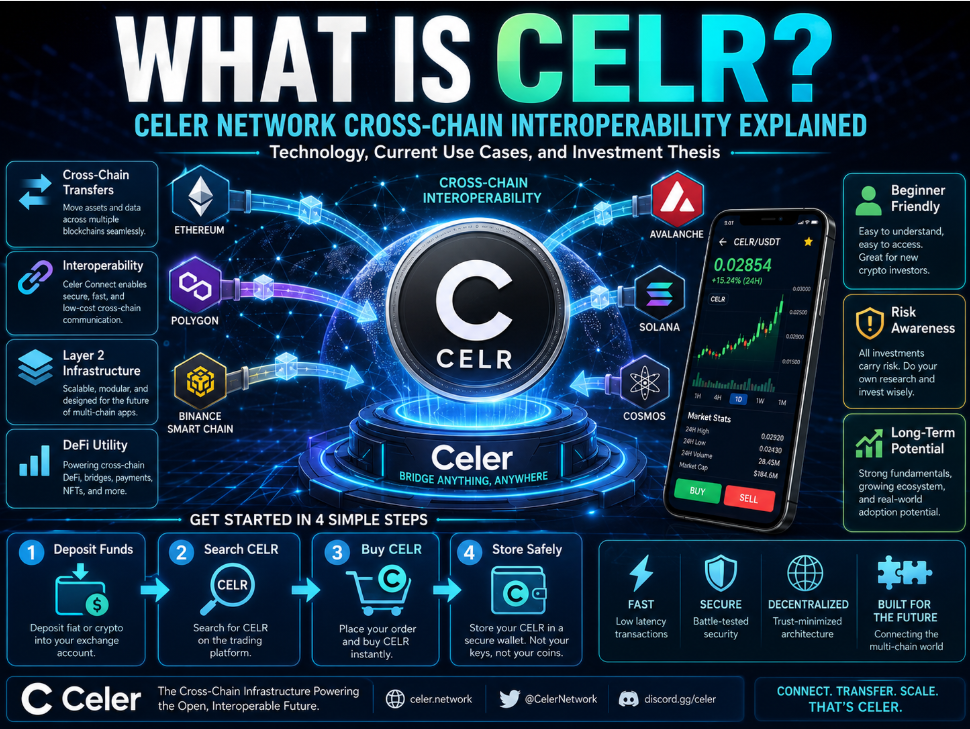
CELR is the native protocol token of Celer Network, a cross-chain infrastructure project that solves asset transfer, message passing, and application interoperability problems across multiple blockchains.
It isn't trying to "launch a new chain for people to speculate on" — it's addressing a more fundamental problem: different blockchains can't natively communicate with each other, and users and developers need a secure, low-cost, low-latency way to move assets and information from one chain to another.
That's the core narrative behind CELR.
But narrative isn't the same as investment value. Cross-chain infrastructure sounds important, but CELR's actual market performance has been weak — its price has fallen dramatically from its all-time high, market cap and trading volume sit at relatively low levels, and the cross-chain space faces intense competition from stronger players like LayerZero, Axelar, and Wormhole.
So understanding CELR can't stop at "cross-chain demand is essential" — it requires also looking at:
- What problem Celer Network actually solves
- How cBridge is actually being used today
- Whether the CELR token genuinely captures protocol value
- What the current market cap and liquidity actually mean
- Whether AgentPay (Celer's AI-payments narrative) is a real opportunity or just hype packaging
- How retail users can buy CELR, and what risks to watch for before doing so
This article is not investment advice. CELR is a highly volatile, small-cap, cross-chain-infrastructure crypto asset that carries risks including price drawdown, insufficient liquidity, bridge security, intensifying competition, regulatory change, and narrative overhype. Always verify against HiBT's actual pages, Celer's official documentation, on-chain contract addresses, and your own risk tolerance before trading.
1. Why Are You Searching for the Ticker CELR?
Most newcomers searching for CELR aren't doing so because they already understand Celer Network's technology — they're searching because they've encountered it somewhere:
- An exchange's spot trading page
- A wallet's asset list
- The cBridge cross-chain bridge page
- A cross-chain transfer tutorial
- Celer Inter-chain Message documentation
- An AI-agent-payments-related announcement
- A list of legacy, low-cap tokens
The most common keyword tied to all of this is cBridge.
cBridge is one of Celer Network's most representative products, primarily used for cross-chain asset transfers. For example, if you want to move USDC from Arbitrum to BNB Chain, or move some asset from Ethereum to Polygon, cBridge is one of the bridging tools that can do that.
This usually raises two questions for newcomers.
First, what's the relationship between CELR and cBridge? In simple terms: Celer Network is the project and protocol system; cBridge is the cross-chain asset bridge product Celer Network built; CELR is the protocol token within the Celer Network ecosystem; and SGN is the PoS network that underpins cross-chain messaging and security verification.
Second, what does "cross-chain" actually mean for an ordinary user? For ordinary users, cross-chain isn't an abstract concept — it's a very concrete UX problem. For example: you hold USDT on Ethereum but want to use a DeFi app on Arbitrum; you have USDC on BNB Chain but want to move it to Polygon; you've earned yield on some Layer 2 and want to bring it back to Ethereum or an exchange; or you want to participate in a new chain's ecosystem, but your funds are sitting on a different chain entirely.
Without a cross-chain tool, you might have to: transfer your assets to a centralized exchange first, swap them within the exchange, withdraw to the target chain, wait for deposit and withdrawal confirmations, pay fees multiple times along the way, accept the risk that the platform pauses deposits or withdrawals, and risk losing assets entirely if you select the wrong chain by mistake.
The value of cross-chain protocols is making this process more direct, more automated, and better suited to on-chain users.
But cross-chain bridges are also among the highest-security-risk pieces of infrastructure in the crypto industry. Many of history's largest hacks have targeted bridges and cross-chain messaging systems. So CELR's investment logic has to weigh both "genuine cross-chain demand" and "bridge security risk" together.
2. CELR's True Nature: An Interoperability Protocol That Solves "Blockchains Can't Talk to Each Other"
Blockchains are isolated from one another by default.
Ethereum has no native awareness of what's happening on BNB Chain, and Arbitrum doesn't automatically read Polygon's state. Each chain has its own accounts, assets, state, and consensus system.
This creates a real problem: users' assets and application needs span multiple chains, but the chains themselves are fragmented.
Solving that fragmentation is exactly what Celer Network set out to do.
How Cumbersome Was Cross-Chain Movement Before Bridges Existed?
Suppose you have 1,000 USDT on Ethereum but want to use a yield product on BNB Chain.
Without a cross-chain protocol, you might need to: withdraw USDT from Ethereum to a centralized exchange, wait for the deposit to land, confirm your balance on the exchange, select the BNB Chain network for withdrawal, wait for withdrawal review, pay the exchange's withdrawal fee, and only then be able to use it on BNB Chain.
If the exchange pauses deposits or withdrawals for a given chain, the entire process grinds to a halt. If you accidentally select the wrong network, your assets could even be lost.
The goal of a cross-chain bridge is to compress this entire flow into: select the source chain → select the destination chain → enter the amount → confirm the transaction → funds arrive on the destination chain.
For ordinary users, cross-chain protocols solve three pain points: avoiding the detour through a centralized exchange, reducing the cost of multiple swaps and withdrawals, and improving the efficiency of using assets across multiple chains.
How Does cBridge Actually Work?
cBridge is Celer Network's cross-chain asset bridge product.
From a user-experience standpoint, what it does is simple: it helps users move assets between different chains.
But under the hood, this involves liquidity pools, cross-chain messaging, state verification, relayer services, security monitoring, asset release on the destination chain, and fee distribution.
Ordinary users don't need to understand every technical detail, but two things are worth knowing.
First, "cross-chain" doesn't mean an asset literally flies from one chain to another. Most bridges work like this under the hood: you lock or deposit assets on the source chain, and the destination chain releases the corresponding assets based on a proof or message.
Second, a bridge's security depends entirely on its underlying verification mechanism. If cross-chain messages are forged, validator nodes act maliciously, contracts have bugs, or liquidity pools are exploited, assets can be lost.
So cBridge's core value isn't just "speed" — it's also security, liquidity, and the trustworthiness of its cross-chain messaging.
What Are State Channels, and Why Do They Matter to Ordinary Users?
One of Celer's earliest core technologies is state channels.
In simple terms: rather than committing every small interaction to the chain immediately, state channels let users interact quickly and repeatedly off-chain, settling the final result on-chain only once.
The benefits of this approach include lower on-chain fees, faster interactions, suitability for high-frequency small payments, reduced congestion on the main chain, and new possibilities for gaming, payments, and micro-transaction use cases.
For ordinary users, the value of state channels isn't "how advanced the technology is" — it's that the experience starts to feel more like internet-native payments: faster, cheaper, suited to small frequent transactions, and not requiring a wait for block confirmation every time.
Celer later extended this state-channel thinking into broader cross-chain and interoperability use cases, including AgentPay — a payments network aimed at AI agents.
What Is Cross-Chain Messaging?
Cross-chain asset bridges solve the problem of "moving an asset from Chain A to Chain B."
Cross-chain messaging solves the problem of "passing application state and instructions from Chain A to Chain B."
This is more complex than asset bridging — and arguably more important.
For example: a user votes on Chain A and a contract on Chain B executes based on that vote's outcome; a DeFi strategy triggers on one chain and completes its action on another; an NFT is locked on one chain and a corresponding usage right is generated on another; or game assets, orders, prices, and governance outcomes sync across multiple chains.
The point of Celer Inter-chain Message is to let developers build genuinely multi-chain applications, rather than building isolated, siloed versions of the same app on every individual chain.
For ordinary users, once cross-chain messaging matures, the future multi-chain application experience might look like this: you don't have to think about which chain you're on — the application automatically handles cross-chain assets and messages behind the scenes.
That's the ideal state. In reality, cross-chain messaging remains a high-risk, highly competitive infrastructure category with stringent security requirements.
What Is the State Guardian Network?
The State Guardian Network, abbreviated as SGN, is a critical component of the Celer system.
You can think of it as an independent, PoS-based verification and message-routing network that supports Celer's cross-chain products.
It mainly handles monitoring on-chain state, routing cross-chain messages, supporting cBridge and other cross-chain applications, providing economic security for cross-chain messaging, and letting CELR stakers participate in network security.
SGN is not the same thing as the Ethereum mainnet.
CELR was originally an ERC-20 token on Ethereum, but Celer's SGN is a separate, Tendermint-based PoS chain used specifically for cross-chain messaging and state-verification services.
So newcomers can understand it this way: Ethereum is one of the most important issuance and circulation networks for the CELR token; SGN is Celer's own cross-chain security and messaging service network; CELR participates in SGN's security and incentive system through staking; and cBridge and other cross-chain messaging services rely on SGN for support.
What Does the CELR Token Actually Do?
CELR serves several functions within the Celer system.
First, staking security. CELR holders can stake the token to SGN, either becoming validators themselves or delegating to a validator. Stakers provide economic backing for the security of cross-chain messaging and the broader system.
Second, validator node participation. Running a validator node requires a higher technical bar and stable infrastructure. Ordinary users are generally better suited to participating via delegated staking rather than running a node themselves.
Third, fee and reward distribution. SGN participants can earn certain rewards and a share of fees. Actual returns vary depending on network rules, staking scale, transaction volume, and fee revenue.
Fourth, governance-related functions. CELR is also tied to protocol governance. Future protocol parameters, network upgrades, and fee structures may require participation from token holders or stakers.
But investors must keep in mind: "the token has a use case" doesn't mean "the token's price will rise." What matters is whether these use cases generate sustained demand, whether protocol revenue is sufficient, whether staking actually reduces circulating sell pressure, and whether user growth translates into real value capture for CELR.
3. CELR's Real-World Usage Today: Beyond the Technical Narrative, How Many People Actually Use It?
Cross-chain infrastructure sounds grand, but investors can't rely on narrative alone. What actually matters is: how many people still use cBridge, is cross-chain transaction volume growing, is TVL stable, is protocol revenue sustainable, do new partnerships translate into real demand, and does the token actually benefit from any of this activity?
How Many Chains Does cBridge Support?
According to Celer's official information, cBridge supports more than 40 blockchains and Layer 2 networks.
This shows it isn't a small, single-chain tool — it's a long-running, multi-chain bridging product.
More supported chains theoretically means broader user coverage and more use cases. But the chain count alone isn't the only metric that matters. More important is whether each chain has genuine liquidity, whether users are continuously bridging, whether bridging fees are competitive, whether the security track record is stable, whether deep liquidity is maintained across major chains, and whether the bridge integrates with applications rather than functioning only as a standalone web tool.
What Level Is cBridge's Trading Volume At Currently?
Based on publicly available data, cBridge's historical cumulative bridging volume has been very high, showing it has processed a large amount of cross-chain demand over time.
But recent data is clearly well below peak levels, with 24-hour bridging volume sitting at relatively low levels during certain periods.
This matters a great deal for CELR investors, because it shows that Celer genuinely is a legacy piece of infrastructure with real historical usage — but current activity doesn't necessarily support a strong narrative-driven valuation. Market enthusiasm for cross-chain bridges has cooled overall, users may have shifted to other bridges, exchanges, multi-chain wallets, or native in-chain liquidity, and CELR's price weakness isn't without cause.
So analyzing CELR shouldn't stop at "cBridge has processed how many billions of dollars cumulatively" — it also requires checking whether 7-day, 30-day, and 90-day figures are recovering.
What Does Celer's Partnership with the CoinMarketCap CMC20 Index Mean?
Celer's involvement with the CoinMarketCap CMC20 index is an infrastructure-partnership case study.
The value of this kind of collaboration lies in raising Celer's visibility within cross-chain infrastructure, demonstrating it can serve indices, portfolios, or multi-chain fund flows, strengthening the case for institutional demand around cross-chain protocols, and helping Celer extend beyond a retail-focused bridge interface.
But investors should view this calmly — a partnership announcement doesn't automatically mean immediate demand for the CELR token.
The actual value-transmission path should look like: partnership drives more cross-chain transactions → the protocol generates more fees → SGN participants earn more fee revenue → the economic value of staking CELR strengthens → the market re-rates CELR.
If a partnership amounts only to brand exposure without sustained transaction volume and fee revenue, its long-term effect on the token's price will be limited.
What Is AgentPay? Is It Just an AI Hype Play?
AgentPay is Celer's narrative around building a payments network for AI agents.
The core idea: AI agents may increasingly need to make frequent, small payments — buying data, calling a model, paying for compute, accessing an API, settling for a service. Traditional blockchain transactions, which take tens of seconds to confirm and cost several cents or more in fees, aren't well suited to machine-speed, high-frequency micropayments.
Celer is trying to use state-channel technology to give AI agents millisecond-level settlement, extremely low fees, support for small high-frequency payments, stronger privacy, and on-chain final settlement with dispute handling.
Directionally, this narrative has real imaginative potential — AI agent payments could genuinely become an important use case for crypto payments going forward.
But investors should be cautious about three things:
First, has AgentPay actually launched on mainnet at scale? If it's still in the announcement, early-testing, or developer-preview stage, it can't be treated as a mature, revenue-generating business yet.
Second, are real AI agents actually using it? A technical launch isn't the same as user adoption. Look for developer integrations, payment counts, settlement volume, and actual application usage.
Third, does it genuinely increase demand for CELR? Even if AgentPay has users, check whether the fees actually flow into the Celer system, whether they're tied to SGN and CELR staking, and whether they generate sustained token demand.
So AgentPay is worth tracking as a potential catalyst, but it shouldn't be treated as a confirmed fundamental simply because it carries an "AI" label.
What Do Current Market Cap and Trading Volume Actually Tell Us?
CELR's current market cap sits in the tens-of-millions-of-dollars range, with 24-hour trading volume fluctuating in the single-digit-millions range. Compared to its 2021 peak, market attention, valuation level, and trading interest have all declined significantly.
This tells us two things.
First, CELR is no longer a mainstream market asset. It doesn't enjoy strong institutional attention like BTC, ETH, or SOL, nor does it have the high sentiment-driven liquidity of DOGE or PEPE.
Second, a small market cap amplifies both opportunity and risk simultaneously. If the narrative regains market attention, a small-cap asset could theoretically be more elastic to the upside; but without new capital inflows, low liquidity can also mean difficulty buying and selling, wider slippage, and prolonged price weakness.
4. Who Is CELR Suited For? Look at a Few Sobering Numbers First
"Should I buy CELR?" isn't a question that can be answered in one sentence.
It's neither a worthless vaporware token with no real product, nor a market-proven, high-growth flagship project.
More precisely, CELR is a legacy infrastructure token with genuine technical track record and real cross-chain products, but with market interest and token performance that have remained clearly weak.
What Does a ~99% Drawdown from the All-Time High Actually Mean?
CELR's all-time high was around $0.19, and the current price has fallen roughly 99% from that peak.
A drawdown of this magnitude tells us several things.
First, the market has compressed its valuation of cross-chain infrastructure significantly. In 2021, the market was willing to pay very high valuations for concepts like "cross-chain," "Layer 2," and "interoperability." Today, the market cares much more about real revenue, user growth, competitive moats, and token value capture.
Second, it's very difficult for a legacy project to regain attention based on past credentials alone. Celer was once a well-known cross-chain project, but market attention has now shifted significantly toward LayerZero, Wormhole, Axelar, and Chainlink CCIP. Legacy projects need fresh data, not just an old story.
Third, a low price doesn't mean it's cheap. Many newcomers, seeing CELR's low per-unit price, assume there's huge room to rise. But the per-unit price itself is meaningless — what matters is market cap, circulating supply, demand, revenue, and market attention.
Fourth, expectations need to be reset. For an asset that's fallen this far from its peak, it's unrealistic to assume "getting back to the all-time high will be easy." That high occurred under a very specific bull-market environment that may never recur.
What Does a Micro Market Cap and Low Liquidity Actually Mean?
CELR's current market cap sits around the tens-of-millions-of-dollars range, with 24-hour trading volume typically in the single-digit-millions.
For ordinary investors, this means: small trades are usually fine; large purchases can drive up your cost; large sales can push the price down; market orders are prone to slippage; the order book can suddenly thin out during extreme moves; spreads between platforms can widen; and your exit options are limited if deposits or withdrawals get paused.
So if you're trading CELR, the most important skill isn't predicting price direction — it's learning to read the order book first.
Beginners should especially avoid: placing one large market buy all at once, chasing the price during a sharp pump, placing orders without checking depth first, and treating a low-cap token as if it had blue-chip-level liquidity.
What Does the Competitive Landscape in Cross-Chain Look Like?
The cross-chain space is extremely crowded, and the competitors are strong.
Major competitors include LayerZero, Axelar, Wormhole, Chainlink CCIP, Across, Stargate, deBridge, Synapse, Socket, and various exchange-built-in cross-chain and wallet-aggregated bridges.
These projects compete on security, transaction speed, the number of supported chains, liquidity depth, developer integration, ecosystem incentives, institutional partnerships, user experience, and cross-chain messaging standards.
Celer's differentiation lies in being a legacy project with a real track record, cBridge's historical usage, the SGN staking-security model, accumulated state-channel technology, dual capability across asset bridging and cross-chain messaging, and AgentPay as an attempt to break into AI agent micropayments.
But the real question is: are these advantages still enough to form a durable market-share moat? That's a question CELR investors need to keep tracking continuously.
How Do CELR's Price Drivers Differ from DOGE's or SOL's?
CELR is an infrastructure-type token. Its price drivers lean more toward cross-chain transaction volume, cBridge usage rates, SGN staking demand, protocol fees, integration partnerships, AgentPay progress, and overall capital interest in the cross-chain sector.
DOGE is a meme-and-community-sentiment asset. Its price drivers lean more toward community virality, Musk-related topics, broader market risk appetite, its status as a legacy meme asset, and liquidity/sentiment cycles.
SOL is a high-performance-chain ecosystem asset. Its price drivers lean more toward on-chain activity, the DeFi and meme ecosystems built on it, developer growth, transaction volume, institutional flow expectations, and network stability.
For a framework to understand different asset categories further, see:
- Is now a good time to buy Dogecoin? 2050 price predictions
- Is now a good time to buy SOL? 2050 price predictions and deep analysis
These three categories of asset can't be analyzed with the same lens. DOGE is about sentiment, SOL is about ecosystem, and CELR is about infrastructure usage and value capture.
Who Should Pay Attention to CELR?
1. Those who are bullish on the long-term demand for cross-chain interoperability. If you believe the crypto industry's future is inherently multi-chain — that assets, messages, and applications will all need to move across chains — Celer remains worth watching.
2. Those who can tolerate small-cap, high-volatility assets. CELR's current market cap is small, and swings can be extreme. It suits people who can participate with a small position and are willing to accept liquidity risk.
3. Those willing to track real data. CELR isn't suited to people who only read announcements. You need to continuously track cBridge transaction volume, TVL, SGN staking, protocol revenue, partnership execution, and AgentPay data.
4. Those who understand how hard it is for legacy projects to recover. CELR isn't a new project — the market has already seen its narrative play out once. Regaining attention requires either strong new data or a genuine new growth driver.
Who Shouldn't Touch CELR?
1. Anyone who only wants to buy market-leading assets. CELR isn't currently a mainstream market asset; if you're seeking higher certainty, more liquid assets like BTC, ETH, or SOL may be more worth researching.
2. Anyone who can't tolerate a deep drawdown. CELR has already fallen roughly 99% and could continue to swing significantly going forward.
3. Anyone who doesn't know how to use limit orders. For a small-cap, low-liquidity asset, market orders can produce significant slippage. Anyone who can't read an order book shouldn't trade impulsively.
4. Anyone drawn in purely by the new AI narrative. AgentPay has imaginative potential, but it shouldn't justify a large position before real data backs it up — just because the phrase "AI agent payments" appears doesn't make it a sure thing.
5. How to Buy CELR: A Complete Walkthrough Using HiBT
For newcomers, the most practical question is: "Where can I actually buy CELR, and how exactly do I do it?"
If HiBT currently supports CELR/USDT spot trading, you can follow the process below. Because exchange products and trading pairs can change, always verify the actual listing status, fees, deposit/withdrawal networks, and order book depth against HiBT's live pages.
Step 1: Register a HiBT Account and Complete KYC
You'll generally need an email or phone number, a login password, a verification code, identity documents, facial recognition, your region of residence, and possibly a risk assessment.
Common KYC snags include: blurry document photos, a name mismatch between your ID and your registration info, an expired document, a failed facial-recognition check, an unstable network connection, or your region not currently being supported.
After registering, set up your account security first: enable 2FA, set a funds password, link your email and phone, turn on an anti-phishing code, avoid clicking unfamiliar links, and never share verification codes with anyone.
Step 2: Choose a Funding Method
There are two common approaches.
Fiat channel to buy USDT — suited to new users without existing crypto. Check whether it supports your region, whether your payment method is available, whether the exchange rate is reasonable, any third-party fees, settlement time, and per-transaction or daily limits.
Transferring USDT in from another platform or wallet — suited to users who already hold crypto. Check HiBT's USDT deposit address, select the correct network (don't mix up TRC20, ERC20, BEP20, etc.), whether a memo or tag is required, the minimum deposit amount, on-chain fees, and confirmation time.
Beginners should test with a small amount first before transferring a larger sum.
Step 3: Search for the CELR/USDT Pair
Once funds arrive, go to the spot trading page and search for CELR or CELR/USDT.
If the pair is listed, you'll be able to check the current price, 24-hour change, candlestick chart, order book, trading volume, depth chart, and fee schedule.
A specific caution here: CELR is a small-cap, low-liquidity asset — don't trade it the way you would BTC or ETH. Before placing an order, check at least three things: the bid-ask spread, order book depth, and 24-hour trading volume.
Step 4: Favor Limit Orders
For an asset like CELR, beginners shouldn't place large market orders.
While market orders fill quickly, they can produce significant slippage if the order book lacks depth.
A safer approach: observe the current order book first, test with a small amount, place limit orders in batches, don't chase sharp short-term spikes, avoid impulsive buys during extreme moves, and only use money you can afford to lose.
For example, if you want to buy $500 worth of CELR, consider splitting it into several smaller limit orders rather than hitting the market with one large order.
Step 5: Managing Your CELR After Buying
After buying CELR, you have two main options.
First, keep it in your HiBT account. Advantages: convenient for selling, suited to short-to-medium-term trading, no need to manage private keys, low operational barrier. Risks: exchange custody risk, inability to withdraw during platform maintenance or suspensions, account security depending on both you and the platform, and unsuitability for relying entirely on platform custody over the very long term.
Second, withdraw to a wallet. If you want to interact on-chain, stake, or self-custody long-term, consider withdrawing to a wallet that supports the relevant network, such as MetaMask.
But extreme caution is warranted here. CELR's Ethereum mainnet contract address is:
0x4f9254c83eb525f9fcf346490bbb3ed28a81c667
Before transferring, confirm which chain's version of CELR you're withdrawing, whether the destination wallet supports that network, whether the contract address is correct, whether it's the official token and not a copycat, whether the exchange's withdrawal network matches the wallet's receiving network, whether you need to add it as a custom token, any minimum withdrawal amount, and whether the fee is reasonable.
Don't just search "CELR" and add whatever token shows up — copycat tokens with the same name can exist on multiple chains, and verifying the contract address is essential.
Step 6: How Do You Participate in CELR Staking?
CELR can be staked through SGN.
Ordinary users generally have two paths.
First, delegated staking through an official or supported wallet. You can delegate CELR to a validator, participate in SGN's security, and earn corresponding rewards. Things to check: which validator to choose, their commission rate, node stability, the unbonding period, reward distribution rules, and wallet private-key security.
Second, participating through an exchange's wealth-management or staking products. Advantages: simple to operate. Disadvantages: returns are set by the exchange's own rules, it may not be equivalent to native on-chain staking, there may be a lock-up period, exchange custody risk applies, and you may not be able to participate directly in governance.
If you're only trading short-term, staking isn't necessarily needed. If you're a long-term follower of the Celer ecosystem, it's worth researching the SGN delegated-staking path further.
6. Risk Breakdown: Realities CELR Investors Need to Face
CELR's biggest problem isn't "whether it has technology" — it's the gap between its technical narrative and its actual token performance.
It has a product, real historical usage, and a new narrative — but its price, market cap, liquidity, and market attention have all remained weak for a long time.
Historical Drawdown Risk
CELR has fallen roughly 99% from its all-time high.
This tells us: the prior bull-market valuation has been squeezed out almost entirely; the market's expectations for cross-chain infrastructure have come down; it's extremely difficult for a legacy project to regain attention; a low price doesn't mean low risk; and newcomers shouldn't treat the historical high as a future target.
For this kind of asset, fund management matters a great deal. A more sensible approach is: a small position, scaling in gradually, not chasing pumps, not using leverage, setting clear invalidation conditions, and regularly reviewing the data.
Liquidity Risk
One of the biggest issues with low-cap tokens is unstable liquidity.
A trade that looks fine under normal conditions can suddenly run into a thinned-out order book during extreme moves, sharply widening slippage, sudden short-term price swings, widening price gaps across platforms, withdrawal congestion or suspensions, and difficulty filling large orders.
So always check the order book before trading CELR. If you notice an unusually wide bid-ask spread, or very small order sizes at the top levels, avoid placing a large market order.
Competitive Risk
Competition in the cross-chain space is fierce. LayerZero, Wormhole, Axelar, and Chainlink CCIP all have substantial funding, ecosystem partnerships, developer mindshare, and market attention.
This creates real pressure on Celer: developers may prioritize integrating with leading cross-chain protocols, users may favor bridges with deeper liquidity, ecosystem incentives may flow toward newer projects, institutional partnerships tend to favor better-known protocols, and overall market attention toward legacy projects has been declining.
To regain ground, Celer needs to prove its security, cost, speed, chain coverage, and developer experience remain competitive.
Contract and Bridge Security Risk
Cross-chain bridges are a frequent target of hacking attacks.
This is because bridges typically manage large amounts of cross-chain assets and involve multi-chain contracts, validators, message passing, and liquidity pools.
Users need to understand that a bridge isn't a simple transfer tool; an attack on cross-chain messaging can cause severe losses; liquidity pools can be exploited; contract vulnerabilities can affect multiple chains simultaneously; security audits don't guarantee absolute safety; and the larger the bridged funds, the stronger the incentive for attackers.
When using cBridge or any cross-chain bridge, it's advisable to: test with a small amount first, use only official links, avoid clicking on fake websites, double-check the destination chain and asset, avoid bridging during a security-incident announcement period, and not keep all your funds parked in bridge-related contracts long-term.
"Riding the Hype" Risk
AgentPay's push into AI agent payments is a direction with genuine imaginative potential.
But crypto markets often run into the same pattern: a project announces a new concept, the market speculates short-term, and the real data simply never catches up.
To judge whether AgentPay is more than hype packaging, look for: whether it has actually launched on mainnet, whether real developers are using it, whether there's real payment volume, whether there's real settlement value, whether it generates protocol revenue, whether it increases CELR staking demand, and whether it has formed stable partnerships.
Until that data appears, AgentPay should be treated only as a potential catalyst — not a confirmed fundamental.
Token Value-Capture Risk
This is the issue infrastructure tokens get overlooked on most easily.
Even if Celer's products are being used, it doesn't follow that CELR will necessarily rise. What matters is whether the fees users pay actually flow back to CELR stakers, whether staking yield comes from real revenue rather than inflation, whether protocol growth reduces circulating sell pressure, whether CELR is an irreplaceable security asset within the system, and whether new business lines genuinely require CELR's participation.
If the link between protocol usage and CELR demand stays weak, the token can underperform the project's narrative for a long time.
7. CELR's Value Drivers: What Metrics Matter Going Forward
Analyzing CELR shouldn't rely on headlines — what matters more is building a framework for continuous tracking.
Is cBridge's Trading Volume Recovering?
Key things to watch: 24-hour bridging volume, 7-day bridging volume, 30-day bridging volume, cumulative bridging volume, liquidity on major supported chains, bridging fee revenue, active user counts, and whether new chains and new assets are being added.
If cBridge's volume continues to decline, it signals users are leaving and CELR's infrastructure narrative weakens. If volume continues to recover, that's the foundation for any potential re-rating.
Is TVL Stable?
TVL reflects the scale of assets sitting in cross-chain bridges and liquidity pools.
Watch whether TVL is growing or declining, which chains it's concentrated in, whether it's overly dependent on a single asset, whether it's incentive-driven, and whether it's accompanied by genuine transaction-volume growth.
A high TVL alone isn't necessarily good — a genuinely healthy state is when TVL, transaction volume, and fee revenue improve together.
SGN Staking and Validator Status
SGN is one of CELR's core value-capture structures.
Track total CELR staked, the number of validators, the number of delegators, node distribution, the source of rewards, whether staking is overly concentrated, whether a slashing mechanism exists, and whether staking yields are sustainable.
If staking participation declines, it suggests both network security and token demand may be weakening.
Is AgentPay Moving from Announcement to Real Usage?
AgentPay is one of the most worthwhile variables to watch in CELR's new narrative — but the data has to back it up.
Check whether it has launched on mainnet, whether developer access is open, whether there's an SDK, whether real AI agent applications exist, how many payments have occurred, how much settlement volume there's been, whether users are testing or actually paying, and whether the fees flow into the Celer system.
If AgentPay remains at the announcement stage only, its value is limited. If it genuinely becomes micropayment infrastructure for AI agents, CELR's narrative could reopen meaningfully.
Does the CMC20-Style Partnership Translate into Protocol Revenue?
A partnership isn't the goal in itself — revenue and usage are. To evaluate a partnership's real value, check whether it drives sustained cross-chain transactions, increases fee revenue, raises TVL, brings in institutional or index-product capital, requires SGN's services, and strengthens demand for CELR staking.
If a partnership produces only a single announcement with no follow-through in trading volume, it's mostly brand exposure.
A Framework for Thinking Through Multiple Scenarios
Bear case — the cross-chain sector continues to cool. If cross-chain transaction demand declines, users shift to other bridges, and AgentPay sees no real adoption, CELR could continue trading sideways at low levels, with market attention declining further.
Base case — a status quo of slow, range-bound activity. If cBridge maintains some usage, SGN continues operating normally, and occasional partnerships and product updates occur without explosive growth, CELR may remain a small-cap infrastructure token that moves largely with the broader market.
Bull case — AI agent payments see unexpected uptake. If AgentPay is genuinely adopted by AI agents, data services, model-calling, API payments, and similar use cases, generating meaningful payment volume and protocol fees, the market could re-focus on Celer's state-channel and low-cost payment capabilities.
Even in the bull case, though, it's not responsible to give a specific price target. CELR's future depends on the combined effect of real usage, protocol revenue, the competitive landscape, and the broader market cycle.
8. FAQ
Is CELR a token on Ethereum, or does Celer have its own independent blockchain? CELR's most common version is an ERC-20 token on Ethereum, with the official contract address 0x4f9254c83eb525f9fcf346490bbb3ed28a81c667. But Celer Network also has its own State Guardian Network (SGN), a PoS-based network used for cross-chain messaging and state-verification services. So it's best understood this way: CELR is a protocol token that circulates across multiple chains, and Celer isn't an ordinary L1 blockchain where users deploy applications — it's interoperability infrastructure built around cross-chain messaging, communication, and state channels.
What's the relationship between CELR and cBridge? cBridge is Celer Network's cross-chain asset bridge product, while CELR is Celer Network's protocol token. cBridge handles moving users' assets across chains; CELR is tied to SGN staking, security, rewards, and protocol governance.
What real rights or benefits come with holding CELR? Holding CELR may let you participate in SGN staking, delegate to a validator, earn a share of staking rewards, take part in protocol governance, and support the security of Celer's cross-chain messaging. The specific rights, yield rates, lock-up periods, and operational process should be verified against Celer's official documentation and current staking pages.
Is a low-cap token like CELR better suited to long-term holding or short-term trading? There's no universal answer. If you're bullish on cross-chain interoperability and Celer's long-term infrastructure value, you could observe it long-term with a small position. If you're trading short-term, you need to focus heavily on liquidity, order book depth, market sentiment, and the broader market environment. Whether long-term or short-term, a large concentrated bet isn't advisable — CELR's historical drawdown and liquidity risk are both significant.
After buying CELR on HiBT, what should I watch for when transferring to another wallet? Key things to check: confirm the withdrawal network, confirm the destination wallet supports that network, verify the official contract address, avoid sending to the wrong chain, avoid buying a same-named copycat token, test with a small amount first, save your transaction hash, and avoid transferring during platform maintenance or on-chain congestion. CELR's Ethereum mainnet contract address is 0x4f9254c83eb525f9fcf346490bbb3ed28a81c667. If you're using a version of CELR on a different chain, you must verify that chain's own official contract address as well.
Can CELR be staked? Yes. CELR can be staked to the State Guardian Network. Ordinary users typically participate through delegation, while running a validator yourself requires a higher technical bar and operational capability. Before staking, understand the source of yield, delegation rules, the unbonding period, validator commission rates, node risk, wallet security, and whether a slashing mechanism exists.
Is CELR a "bridge token"? That's a reasonable but incomplete way to think about it. CELR isn't just cBridge's "bridge token" — it's the native token of Celer Network's broader interoperability protocol, tied to cBridge, cross-chain messaging, SGN, and state channels. That said, from an ordinary user's perspective, cBridge is genuinely the easiest way to understand CELR's core product.
How does CELR differ from LayerZero or Wormhole? They all operate in the cross-chain or interoperability space, but differ in technical architecture, ecosystem positioning, funding, developer adoption, and how their tokens capture value. Celer's distinguishing traits are its status as a legacy project, cBridge's track record, the SGN staking-security model, and accumulated state-channel technology. LayerZero and Wormhole currently have stronger market attention, ecosystem partnerships, and developer adoption. The right comparison isn't whose name is more recognizable — it's whose real transaction volume is higher, who's more secure, who has more application integrations, who generates more fee revenue, and whose token has clearer value capture.
Will AgentPay make CELR go back up? Not necessarily. AgentPay is a direction worth watching, but whether it actually drives CELR depends on real-world execution. Watch whether it's launched on mainnet, whether it has real users, whether it's generating payment volume, whether it brings in protocol fees, whether it increases CELR staking demand, and whether it's being adopted by the AI agent ecosystem. Before that data exists, investment decisions shouldn't be made purely because of the "AI" label.
What should mainland Chinese users know before trading CELR? Users in mainland China should pay particular attention to local regulations governing virtual-asset trading, access to cross-border platforms, asset transfers, and investment promotion. This article offers no legal advice and doesn't suggest bypassing regional restrictions. Users should make their own independent judgment based on local laws, the platform's terms of service, and their own risk tolerance.
Conclusion: CELR Is a Legacy Sample of Cross-Chain Infrastructure — Not a Risk-Free Reversal Opportunity
CELR is a very representative legacy infrastructure token.
It isn't without a product, and it isn't pure vaporware narrative. Celer Network genuinely has cBridge, SGN, cross-chain messaging, and accumulated state-channel technology, and it has processed a significant amount of historical cross-chain demand.
But its problems are equally real: the price has fallen extremely far from its all-time high; market cap and trading volume remain low; competition in the cross-chain space is intense; cBridge's recent activity is well below its peak; AgentPay still needs real data to validate it; the link between protocol usage and CELR's value capture still needs to be watched closely; and its small market cap and low liquidity amplify trading risk.
So the key question about CELR isn't:
"Is it a leading cross-chain protocol?"
It's:
- Is cBridge's trading volume recovering?
- Is SGN staking healthy?
- Is protocol revenue growing?
- Has AgentPay genuinely launched in practice?
- Can CELR actually capture this growth?
- Is current liquidity suitable for my position size?
- Can I accept continued sideways trading, or even further downside?
If you're bullish on multi-chain interoperability long-term, CELR is worth a place on your watchlist.
If you're only interested because it's fallen so far, the per-unit price is low, and it carries a new AI narrative, and you want to bet heavily on a bounce — the risk is very high.
The more rational approach: look at the data first, then the narrative; control your position size first, then discuss the opportunity; understand cross-chain security risk first, then decide whether to trade.
CELR represents a real, but clearly fatigued, sample within the cross-chain infrastructure category. It still has technical updates and a new narrative in motion, but the token's price, liquidity, and market attention have remained near historical lows for a long time. For ordinary investors, what matters most isn't getting swept up by headlines — it's seeing clearly the real distance between the project's progress and the token's actual performance.
Author's note: This article is aimed at crypto newcomers, cross-chain ecosystem watchers, and investors interested in Celer Network. Content is based on public information, official documentation, market data, and project-structure analysis, and is intended for informational purposes only — not investment, legal, or tax advice. Always verify against the platform's latest announcements, official documentation, on-chain contract addresses, applicable regulations, and your own risk tolerance before trading.