
I. You Use USDC Every Day, But Did You Know the Company Behind It Is Already Public?
Most people use USDC without ever stopping to think about one crucial fact:
- The company behind this stablecoin is actually a publicly traded company.
That company is Circle Internet Group.
1) What exactly is USDC, and why is it so important?
The core roles of USDC include:
- Serving as the "US Dollar unit of account" for the crypto market.
- Acting as the core settlement asset for DeFi and exchanges.
- Functioning as the base currency for cross-border payments.
- Daily on-chain volume: Runs in the tens of billions of dollars.
- In essence: USDC = The "US Dollar infrastructure" of the crypto world.
2) What else is Circle doing?
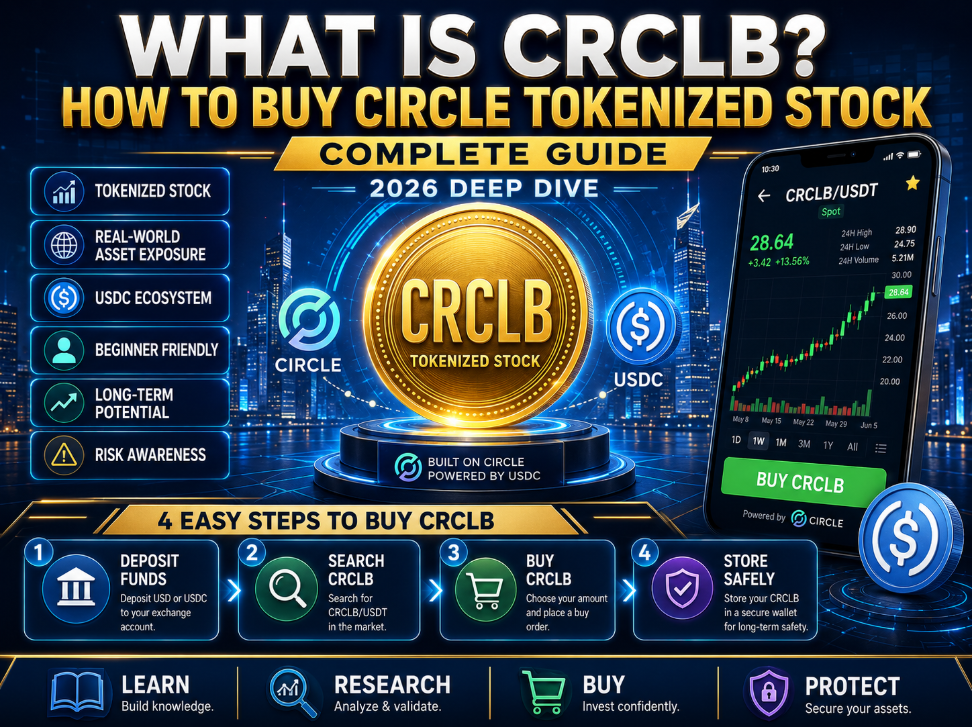
Beyond USDC, Circle also owns and operates:
- EURC (a Euro-backed stablecoin).
- Circle Payments Network (CPN).
- The Arc ecosystem and tokenized payment systems.
3) What happened with the Circle IPO?
Key milestones include:
- IPO Price: $31 (June 2025)
- First-Day Performance: Broke past $83+
- All-Time High: $298.99
- Current Trading Range: $84–$87
- Significance: This represents one of the most drastic fintech revaluation cases over the past year.
4) What are you inherently buying when you purchase CRCLB right now?
- ❌ You are not buying USDC itself.
- ✔ You are buying equity exposure to the company that issues USDC.
- ✔ You are capturing the growth revenue of Circle’s broader business model.
5) The fundamental difference between CRCLB and USDC
- USDC: A stablecoin (pegged to the US Dollar).
- CRCLB: An asset price volatility tool (stock mapping).
- In short: One is a "cash tool," while the other is a "growth asset."
II. What is CRCLB? You Must Understand This Three-Layer Structure
CRCLB is neither a stock nor a stablecoin; it is a structured mapped asset.
1) Layer 1: USDC is a product, not the company
- Common Misconception: Many believe that holding USDC = investing in Circle.
- The Reality: USDC is merely a product issued by Circle.
2) Layer 2: CRCL is Circle stock
- CRCL represents the actual shares listed on the New York Stock Exchange (NYSE).
- It represents true corporate equity.
- It carries voting rights and traditional shareholder benefits.
3) Layer 3: CRCLB is an on-chain receipt
- CRCLB is issued by BTech Holdings Limited (a Binance-affiliated structure).
- It is issued under the ADGM (Abu Dhabi Global Market) regulatory framework.
- Its Essence: CRCLB = An on-chain mapped receipt of CRCL stock.
4) The official definition is critical
The bStocks framework explicitly states:
- ❌ It is not a stock.
- ❌ It does not equal shares of the company.
- ✔ It is a price-mapping vehicle.
5) How does the custody structure work?
The core architecture consists of:
- Nest Trading: Acts as the introducing broker structure.
- Alpaca Securities: Handles custody, clearing, dividends, and corporate actions.
6) Structural Comparison: CRCLB vs. Perpetual Contracts
- Leverage
- CRCLB: None.
- Perpetual Contracts: Present.
- Liquidation Mechanism
- CRCLB: None.
- Perpetual Contracts: Present.
- Holding Costs
- CRCLB: Low.
- Perpetual Contracts: High (due to funding rates).
- Target Audience
- CRCLB: Long-term investors.
- Perpetual Contracts: Short-term traders.
🔗 Peer Asset Comparisons Within the Same Ecosystem:
- View SPCXB on HiBT (Aerospace Narrative)
- View SNDKB on HiBT (Semiconductor Narrative)
III. What Kind of Company is Circle Exactly?
1) The Core Business Model
Circle’s revenue is primarily generated from:
- Interest earned on the underlying USDC reserve assets (chiefly US Treasury bonds).
- Simple Logic: The higher the macroeconomic interest rates remain, the more profitable the company becomes.
2) Financial Structure
Key data updates reveal:
- 2026 First-Half Revenue: $1.25 billion.
- Interest Contribution: 95.5% originates directly from interest income.
- EBITDA: Up +53% year-over-year.
- Significance: Circle is fundamentally an "interest-rate-sensitive financial corporation."
3) USDC Growth Drives the Stock Price
- USDC Circulating Supply: $75.3 billion (+72%).
- The Chain Reaction: USDC expansion $\rightarrow$ Revenue growth $\rightarrow$ Stock price driver.
4) Market Dominance
- USDC accounts for roughly 80% of all on-chain US Dollar transactions.
- Significance: It has successfully cemented itself as the apex core of crypto-dollar infrastructure.
5) Regulatory Tailwinds
- The GENIUS Act has established a definitive legal framework for compliant stablecoins, structurally reinforcing Circle’s first-mover advantage.
6) The CPN Network
- The Circle Payments Network serves as cross-border payment infrastructure, directly bridging the gap with the traditional banking system.
IV. CRCLB Market Data—Is $84 Cheap or Expensive?
1) Price Drawdown Structure
- All-Time High: $298.99
- Current Price: $84–$87
- Drawdown: Roughly 70%+
- Note: A deep correction $\neq$ an undervalued asset.
2) Profitability Status
- EPS (Earnings Per Share): -0.07 (Net Loss)
- Insight: This indicates the company is still firmly in its aggressive, early-stage growth phase.
3) Massive Analyst Divergence
- Target Price Range: $60 to $247
- Average Target Price: $131.69
- Insight: The broader market has not yet consolidated around a unified pricing model.
4) How is CRCLB Priced?
It relies strictly on:
- Oracle price feeds.
- The live price of the underlying CRCL stock.
- Anchoring to US stock market closing prices.
5) The Advantages of Fractional Investment
- Supports a low minimum entry of just $5.
- Significance: It lowers the barrier to entry for investing in systemic stablecoin infrastructure.
V. CRCLB 2026–2030 Price Prediction (The Stablecoin Super-Sector)
1) The Three Core Drivers
- The growth curve of USDC circulating supply.
- The Federal Reserve’s macro interest rate cycle.
- The global rollout and execution of clear stablecoin regulations.
2) Industry Scale Forecasts
- The total stablecoin market is expected to reach $1.9 trillion by 2030.
- Circle's primary advantages are its industry-leading regulatory compliance and USDC's high market share.
3) Institutional Projections
- Mizuho: Revised revenue projections upward by 21%.
- Target Price: Structurally modeled across scenarios to hit $180–$220.
4) Core Risks to the Narrative
- Rate cuts leading to a direct drop in interest income.
- Intensifying competition eating into market share.
5) CRCLB Price Prediction Model (2026–2030)
- Year 2026
- 🐻 Bearish: $55 | ⚖️ Neutral: $110 | 🚀 Bullish: $180
- Year 2027
- 🐻 Bearish: $65 | ⚖️ Neutral: $150 | 🚀 Bullish: $260
- Year 2028
- 🐻 Bearish: $80 | ⚖️ Neutral: $200 | 🚀 Bullish: $380
- Year 2029
- 🐻 Bearish: $90 | ⚖️ Neutral: $260 | 🚀 Bullish: $520
- Year 2030
- 🐻 Bearish: $100 | ⚖️ Neutral: $350 | 🚀 Bullish: $750
🔗 For a look at stablecoin infrastructure logic, you can cross-reference:
👉 HiBT CRCLB Trading Page.
VI. How to Buy CRCLB on HiBT (Complete Tutorial)
1) Platform Introduction
HiBT provides cross-asset trading, institutional-grade cold wallet storage, a multi-signature security framework, and full global user support.
2) Registration Process
- Step 1: Register an account on HiBT.
- Step 2: Complete email verification.
- Step 3: Complete standard KYC identity verification by uploading a valid ID card or passport.
3) Deposit Methods
- USDT (The primary liquid trading pair).
- Direct transfer of BTC or ETH.
- Fiat currency gateways (where available regionally).
4) How to Buy CRCLB
- Step 1: Search for the CRCLB/USDT trading pair.
- Step 2: Open the spot trading interface.
- Step 3: Choose between a Market Order (for instant execution) or a Limit Order (to strictly manage your entry cost).
5) Tactical Trading Strategies
- Volatility spikes dramatically right at the US stock market open.
- On-chain prices can drift or deviate after traditional market close.
- It is highly recommended to build positions using a tiered, dollar-cost averaging strategy.
6) Position Management
- Regularly review your Asset Page, monitor your real-time PnL, and track ongoing fluctuations in the global circulating supply of USDC.
VII. Risk Warnings (Must Read Carefully)
- 1) Interest Rate Risk (The Most Critical Factor): Circle’s baseline revenue depends entirely on US Treasury yields. If the Federal Reserve executes aggressive rate cuts, corporate earnings could drop significantly.
- 2) Profitability Risk: The company has yet to achieve stable, consistent net profitability, and its EPS remains in negative territory.
- 3) Competitive Risk: Circle faces continuous, aggressive competition from Tether (USDT), PayPal USD, and expanding stablecoin plays from traditional payment giants like Stripe, Visa, and Mastercard.
- 4) Regulatory Risk: Regulatory friction remains a major catalyst. For instance, news surrounding the CLARITY Act historically triggered a 20% single-day stock price fluctuation.
- 5) Product Structural Risk: CRCLB is not common stock. You are exposed to the structural integrity of the issuer and the underlying custody mechanism.
- 6) Volatility Risk: Having corrected from a high of $299 down to the $50–$80 range, this asset exhibits extreme volatility profiles.
- 7) Position Sizing Advice: Avoid over-concentrating capital into a single asset wrapper. This vehicle is best utilized as a fractional allocation within a diversified portfolio.
VIII. FAQ & Disclaimer
Q1: Is CRCLB a stock?
No, it is an on-chain mapped token receipt reflecting underlying asset price performance.
Q2: Do I get shareholder rights?
No, it does not confer corporate voting rights or direct legal equity ownership.
Q3: Is it safe?
It carries market risk, systemic interest rate risk, and structural asset-wrapping risks.
Q4: Is it suitable for long-term holding?
This depends entirely on your stance regarding global stablecoin growth and the trajectory of the Federal Reserve's macro interest rate cycles.
About the Author
This report was prepared by the HiBT Crypto Asset Research & Stablecoin Infrastructure Analysis Team. Our core research focus includes:
- Stablecoin mechanics and RWA (Real World Asset Tokenization) structural engineering.
- Mapping mechanisms between publicly listed corporations and on-chain assets.
- The macroeconomic impacts of Federal Reserve interest rate cycles on crypto-finance.
- Liquidity architectures and pricing models for exchange bStocks products.
- Long-term asset narratives and predictive risk modeling.
The contents of this article are compiled purely from public market data and structured financial logic. It is intended for research and educational purposes only and does not constitute financial or investment advice.
Disclaimer
This document is for informational research and educational purposes only and does not constitute any form of investment advice. Digital assets and tokenized stocks possess high inherent volatility and risk, which can result in the loss of principal capital. Please engage with caution.