
If this is your first time searching for “what is THETA” or “what is THETA coin,” it’s easy to mistake it for just another altcoin. In reality, Theta Network is not a simple payment token or a meme coin – it is a Web3 network that evolved from a decentralized video streaming infrastructure.
In its early days, Theta focused on solving video distribution and CDN cost issues, aiming to lower transmission costs for video platforms by letting users share bandwidth and computing resources. As AI, GPU computing, edge computing, and the DePIN sector gained traction, Theta’s positioning gradually expanded from a “decentralized video network” to “AI computing and edge infrastructure.”
Theta’s official documentation describes Theta Network as a foundational blockchain and decentralized cloud infrastructure for AI, media, and entertainment – not as a decentralized version of YouTube or Twitch. The Theta Edge Network consists of community-run Edge Nodes that handle AI edge computing, data storage, and content delivery. Theta EdgeCloud, in turn, provides GPU computing power to developers, researchers, and enterprises.
That’s why THETA remains worth researching in 2026: it is not just an older crypto project, but one that sits at the intersection of video, AI computing, DePIN, edge networks, and Web3 infrastructure.
This article will systematically explain: what THETA is, what problem Theta Network solves, the difference between THETA and TFUEL, how Theta transitioned from video into AI computing, where THETA’s token value comes from, what influences THETA’s price, and how beginners can check THETA price action and buy THETA.
1. What Is THETA? Why Is Theta Network Gaining Attention?
When newcomers encounter THETA for the first time, the core questions are: “What exactly is THETA? How is it different from BTC and ETH?”
Simply put, THETA is the native governance token of Theta Network. Theta Network itself is a blockchain built around video distribution, edge computing, AI compute, and Web3 infrastructure.
It is not a meme coin, not merely a payment token, and not a project that serves only one DeFi application. More accurately, Theta Network can be understood as a decentralized video and compute infrastructure network, operating at the crossroads of DePIN, AI computing, distributed bandwidth, and Web3 content infrastructure.
1.1 Basic Introduction: What Is Theta Network?
Theta Network’s original goal was to address the high bandwidth costs, inefficient content distribution, and heavy reliance on centralized CDNs that plague the traditional video industry.
In the traditional model, when users watch videos, content is typically delivered from centralized CDN servers to user devices. Platforms pay enormous costs for bandwidth, servers, caching, global nodes, and transmission quality. While users contribute their viewing behavior, the idle bandwidth and computing resources on their local devices are usually left unused.
Theta’s idea: turn user devices into part of the network.
Users can run a Theta Edge Node, contributing spare bandwidth, compute, storage, or GPU resources to support tasks like video delivery, AI computation, 3D rendering, and model inference – and receive network rewards in return. Theta’s docs also state that Edge Nodes can perform AI deep learning training and inference, video transcoding, and relaying, allowing users to contribute unused compute and bandwidth in exchange for token rewards.
So THETA is not just “a coin for trading.” Behind it is a network that aims to organize the bandwidth, GPU, and edge computing resources scattered across devices worldwide.
1.2 What Problem Does Theta Network Solve in Traditional Video?
Traditional video platforms face three persistent pain points.
First, high CDN costs.
HD video, live streaming, short-form video, gaming streams, sports events, VR content, and AI-generated video all consume massive bandwidth. The more global a video platform, the more servers and CDN nodes it needs to deploy across different regions.
Second, difficult global distribution.
If users are far from centralized servers, they experience buffering, latency, slow loading, and degraded quality. In emerging markets and edge regions, traditional CDN coverage isn’t always ideal.
Third, wasted user device resources.
Many users have idle bandwidth, storage, and compute on their devices, but the traditional internet architecture hasn’t effectively organized these resources.
Theta’s model: connect user devices via Edge Nodes, letting them participate in video relaying, data transmission, edge computing, and AI tasks. This approach doesn’t necessarily replace traditional CDNs entirely, but can serve as complementary decentralized infrastructure.
Theta’s official docs note that the Theta Video API lets developers integrate decentralized video into websites or apps without centralized servers, content delivery, or video hosting software, and viewers can relay video peer-to-peer across the Theta Network.
This is why Theta attracted early attention: it tried to use Web3 incentive mechanisms to rebuild video infrastructure.
1.3 Why Did Theta Move from Video into AI Computing?
Users may ask: “Wasn’t Theta a video project? Why is it now linked to AI computing, GPU sharing, and DePIN?”
The reason is simple: both video networks and AI computing need edge infrastructure.
AI model training, inference, image generation, video generation, 3D rendering, and agent tasks all require massive compute, especially GPU resources. Traditional cloud platforms are powerful but expensive, centrally supplied, and not always optimally allocated for all developers and smaller teams.
Theta EdgeCloud’s direction is to combine cloud computing capabilities with a decentralized edge network, offering GPU compute, containerized workloads, AI inference, Jupyter Notebooks, model training, and distributed GPU clusters to AI teams, developers, and enterprises. The official EdgeCloud documentation lists products including AI inference APIs, dedicated generative AI models, containerized workloads, Jupyter Notebooks, GPU node training, distributed GPU clusters, persistent storage, and Agentic AI.
This is the logic behind Theta’s move from “video network” to “AI compute infrastructure.”
The video era demanded low-cost distribution networks.
The AI era demands low-cost, scalable, distributed GPU and edge computing networks.
Theta aims to upgrade the Edge Network built for video into a decentralized compute infrastructure for the AI age.
2. How Does Theta Network Work? What’s the Difference Between THETA and TFUEL?
Newcomers often confuse THETA and TFUEL.
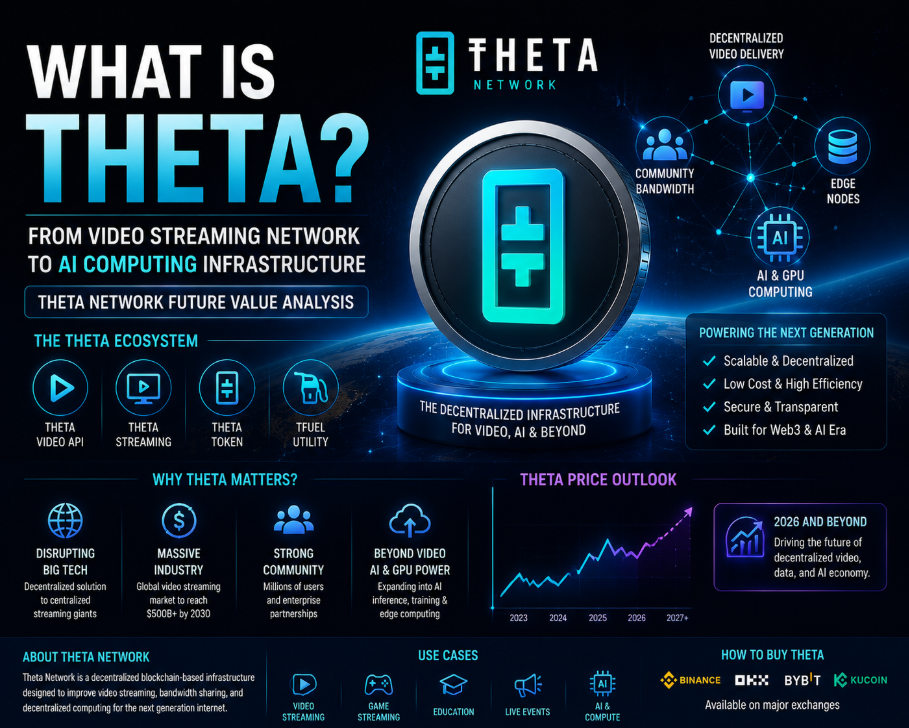
They both belong to the Theta ecosystem, but their functions are completely different.
2.1 Core Architecture of Theta Network
Theta’s ecosystem can be understood in three layers.
Layer 1 – Theta Blockchain.
It handles network consensus, smart contracts, tokenomics, governance, and on-chain applications. Theta blockchain supports EVM-compatible smart contracts, allowing NFTs, DEXs, DeFi, DAOs, and other Web3 applications to be built on Theta Network. The docs confirm that Theta blockchain is an EVM-compatible multi-chain network supporting Turing-complete smart contracts.
Layer 2 – Theta Edge Network.
Composed of community-run Edge Nodes, it handles video delivery, edge computing, storage, AI task execution, bandwidth sharing, and resource orchestration.
Layer 3 – Theta EdgeCloud.
It combines the Edge Network with cloud computing, offering GPU compute to AI teams, developers, and enterprises. The EdgeCloud Client Guide explains that Theta EdgeCloud is a decentralized marketplace connecting GPU supply and demand – anyone with idle GPU can contribute resources and earn rewards, while developers and AI teams can use these resources to run containerized workloads.
Thus, Theta Network is not a single chain or a single app, but an infrastructure network composed of blockchain, edge nodes, an AI compute marketplace, video services, and tokenomics working together.
2.2 What’s the Difference Between THETA and TFUEL?
Theta uses a dual-token design.
THETA is the governance token of the Theta protocol. It is primarily used for staking to run Validator Nodes or Guardian Nodes, participating in block production, network security, and protocol governance. Theta’s docs state that THETA has a fixed supply of 1 billion tokens, with no additional issuance.
TFUEL is the operational token of the Theta protocol, more like gas on the network. It is used for on-chain operations, paying Edge Nodes for AI computing, video encoding, transcoding, 3D rendering, and deploying or calling smart contracts. Theta docs explicitly describe TFUEL as the “gas token” of the Theta protocol.
A simple analogy:
- THETA is more like network value asset and governance asset.
- TFUEL is more like the fuel and transaction fee used when utilizing the network.
In Ethereum, ETH serves both as a value asset and gas. In Theta, THETA and TFUEL have a clearer division of labor: THETA handles governance, staking, and consensus security; TFUEL handles network usage and rewarding resource providers.
2.3 What Is Theta’s Multi-Level BFT Consensus Mechanism?
Theta’s consensus mechanism is an important part of its technical structure.
According to Theta’s official docs, the Theta Blockchain uses a Multi-Level BFT consensus design, with 20–30 Enterprise Validator Nodes forming the first layer, and a large number of community-run Guardian Nodes forming the second layer. Validator Nodes propose and finalize new blocks, while Guardian Nodes finalize checkpoints and act as a check against malicious or failing Validators.
This design aims to balance performance and decentralization.
- Enterprise Validator Nodes improve processing efficiency and stability.
- Guardian Nodes expand community participation, enhancing security and resistance to centralization.
The Guardian Node documentation also states that running a Guardian Node requires staking at least 1,000 THETA and meeting certain hardware and network requirements.
This shows that THETA is not a trading asset without network utility – it is a core component of Theta Network’s security and governance mechanisms.
3. What Value Does THETA Token Have? Where Is the Investment Thesis?
Analyzing THETA’s value requires looking beyond price movements to its role in the network and future demand drivers.
3.1 Actual Use Cases of THETA Token
THETA has three primary real-world uses.
First, network security.
Users can stake THETA to participate in Validator or Guardian Node operations, providing security and consensus support to Theta blockchain. The more critical the network, the higher the security demand – and the more valuable the staking mechanism becomes.
Second, governance.
As a governance token, THETA is tied to protocol development directions, network parameters, and ecosystem decisions. For a long-term infrastructure project, governance rights aren’t a short-term speculative tool – they represent network control and ecosystem participation rights.
Third, ecosystem value accrual.
If Theta Edge Network, EdgeCloud, video services, AI computing tasks, and enterprise adoption continue to grow, the market may reassess THETA’s position as a network value asset.
However, note that THETA’s value growth is not automatic. It must be driven by network usage, node growth, developer ecosystem, enterprise partnerships, and AI compute demand collectively.
3.2 What Factors Drive THETA’s Value Growth?
THETA’s long-term value depends mainly on four variables.
First, node scale.
If more users run Edge Nodes, Guardian Nodes, or participate in EdgeCloud resource supply, Theta Network’s actual capacity strengthens. More nodes mean a stronger foundation for distributed computing and content delivery.
Second, enterprise partnerships.
Theta has always emphasized media, entertainment, and content platform scenarios. The official docs list enterprise validators and ecosystem partners including Google, Samsung, Sony, CAA, and Binance, along with partnerships with entertainment brands and streaming platforms. Whether these translate into real, long-term usage is a critical factor in evaluating Theta’s ecosystem value.
Third, AI compute demand.
If demand for AI model inference, video generation, 3D generation, edge computing, and agent tasks continues to grow, the need for low-cost GPU and distributed compute marketplaces will strengthen. Whether Theta EdgeCloud can capture this demand is key to its future valuation.
Fourth, DePIN sector development.
Theta is fundamentally a DePIN infrastructure play: it organizes real-world bandwidth, GPU, storage, and compute resources via blockchain incentives. To understand how different DePIN projects solve real infrastructure problems, you can read GEOD Explained: Geodnet DePIN Project Analysis. GEOD focuses on geospatial data infrastructure, while Theta focuses on video, AI computing, and edge networks – both represent the trend of “bringing real-world resources on-chain.”
4. What Are the Real-World Use Cases in Theta’s Ecosystem?
Many users ask: “Does Theta actually have real utility, or is it just an old project telling a new story?”
To judge that, look at whether Theta’s ecosystem can find genuine demand in video, content, AI, and enterprise applications.
4.1 Decentralized Video Streaming
Theta’s earliest core use case was video streaming.
It aimed to reduce video distribution costs, improve viewer experience, and reward resource contributors via peer-to-peer relaying, edge nodes, and a decentralized network.
For traditional video platforms, bandwidth and CDN costs are a permanent burden. For Web3 content platforms, decentralized video infrastructure could become an important building block for NFTs, live streaming, digital rights, content distribution, and community media.
Theta Video API, P2P video SDK, and decentralized video-on-demand services are all product directions Theta has built around video infrastructure. The docs note that the Theta Video API helps developers add decentralized video to websites or apps, leveraging Theta’s decentralized infrastructure for delivery and playback.
4.2 NFTs and Digital Content
Theta has previously ventured into NFTs and digital content, closely tied to its media/entertainment background.
In traditional entertainment, copyrights, ticketing, fan benefits, content licensing, digital collectibles, and membership rights can all be integrated with NFTs. Theta’s official docs mention that Theta Labs received an approved USPTO patent application related to digital rights management via NFTs in a decentralized network, with applications for concerts, live events, ticketing, and digital ownership scenarios.
This shows Theta isn’t just about “video playback” – it aims to build a more complete digital content infrastructure around media and entertainment.
4.3 AI Computing and GPU Resource Marketplace
AI computing is arguably the most important narrative for Theta going forward.
AI model training, inference, image generation, video generation, 3D rendering, and AI agent execution all require GPU and compute resources. Traditional cloud platforms are expensive and centralized, making it difficult for some developers and smaller enterprises to access low-cost, highly elastic compute.
Theta EdgeCloud’s value proposition is to combine community-contributed GPU resources with cloud capabilities to form a distributed compute marketplace for AI workloads.
According to the EdgeCloud Client Guide, node operators can contribute idle GPU resources, run compute jobs, and earn TFUEL rewards; demand-side users can select nodes that meet their performance and budget requirements to run workloads.
This extends Theta from video infrastructure into AI infrastructure. If AI compute demand continues to grow, distributed GPU and edge computing networks like Theta are likely to gain more attention.
4.4 Enterprise Applications
Theta’s potential enterprise clients include media companies, entertainment firms, AI businesses, content platforms, educational platforms, gaming companies, and developer teams needing distributed compute.
Enterprises might use Theta to:
- Reduce video distribution costs.
- Access distributed GPU resources.
- Run AI inference or rendering tasks.
- Manage digital rights.
- Build Web3 media and entertainment apps.
But investors should stay rational. Enterprise partnerships don’t equal revenue. To assess Theta’s commercial traction, watch customer counts, paying demand, task volumes, node rewards, developer activity, and ecosystem application growth over time.
5. How Does THETA Differ from Other AI, DePIN, and Web3 Infrastructure Projects?
Theta is not the only AI infrastructure project, nor the only DePIN project. Its key differentiator is starting from video infrastructure and later expanding into edge computing and AI compute.
5.1 THETA vs. Ethereum
Ethereum is a general-purpose smart contract platform – a major infrastructure for DeFi, NFTs, Layer 2, RWA, DAOs, and Web3 applications.
Theta is more vertical, focusing on video, edge computing, AI infrastructure, and media/entertainment.
So THETA and Ethereum are not direct competitors. Ethereum is more like a foundational settlement and smart contract ecosystem, while Theta is a DePIN network specialized in video and compute resources.
Still, ETH’s price action tends to influence sentiment across the Web3 infrastructure sector. You can track ETH Price Prediction to gauge crypto market cycles, as ETH ecosystem heat often affects valuations of DePIN, AI, and infrastructure assets.
5.2 THETA vs. Other DePIN Projects
DePIN projects cover many types: wireless networks, storage, geospatial data, GPU computing, energy, sensor networks, and more.
Theta’s DePIN angle is that it organizes user devices’ bandwidth, GPU, compute, and storage resources to serve video, AI, and edge computing workloads.
To understand another DePIN direction, read GEOD Explained: Geodnet DePIN Project Analysis. GEOD is more about high-precision geospatial data and real-world positioning infrastructure, while Theta is more about video delivery, edge nodes, and AI compute resources.
Both share the goal of token-incentivized networking of physical resources. The difference is that Theta targets compute and content infrastructure, while GEOD targets geospatial data infrastructure.
5.3 THETA and AI Payment/Compute Ecosystem Relations
The AI Agent era may bring new infrastructure needs.
AI Agents need compute resources, payment networks, data access, authentication, permissions, and execution environments. Theta addresses part of that – compute and edge infrastructure.
To understand the relationship between AI Agents and payment infrastructure, read What Is AEON Crypto? Full Analysis from AI Agent Economy, Payment Infrastructure to 2026 Price Prediction. AEON leans more toward AI Agent economy and payment infrastructure, while Theta leans more toward AI compute, video, and edge resource networks.
In the future, if AI Agents need to call compute, pay resource fees, process real-time video, or execute edge tasks, compute networks like Theta and AI payment networks may become connected in the ecosystem.
5.4 THETA and Future Financial Infrastructure
THETA itself is not a financial protocol, but it belongs to the broader future infrastructure investment framework.
Future opportunities in crypto may not only lie in exchanges, public chains, and meme coins, but also in AI compute, quantum computing, data networks, RWA, payment networks, and DePIN infrastructure.
If you follow quantum computing, fintech, and future financial infrastructure, read What Is QNTB? 2026 QNTB Investment Guide: Quantinuum Tokenized Stock, RWA Mechanism, and Price Prediction.
Assets like THETA, QNTB, AEON, and GEOD all point to a trend: crypto is moving from pure token trading toward integration with real infrastructure, compute resources, data networks, and financial assets.
6. Factors Influencing THETA Price
Those searching for “THETA price prediction” really want to know: why does THETA go up, and why does it go down?
THETA’s price is influenced by market cycles, Theta ecosystem progress, AI compute demand, DePIN sector heat, and tokenomics.
6.1 What Conditions Could Drive THETA Price Up?
First, overall market cycle.
As an altcoin, THETA can hardly decouple from BTC and ETH cycles. When BTC rises, ETH ecosystem is active, and risk appetite increases, DePIN, AI, and infrastructure assets tend to attract more capital attention.
Second, Theta ecosystem growth.
Investors should watch Edge Network node counts, EdgeCloud compute jobs, enterprise clients, AI developers, video service usage, TFUEL consumption, and node rewards.
Third, AI compute demand growth.
If demand for AI inference, AI Agents, video generation, 3D rendering, and GPU workloads continues to increase, Theta EdgeCloud’s market opportunity becomes clearer.
Fourth, DePIN sector momentum.
When the market refocuses on “real-world resources on-chain” – GPU, bandwidth, storage, geospatial data, wireless networks, sensors – Theta, as an established DePIN project, may re-enter investor radar.
6.2 What Could Cause THETA Price to Drop?
THETA price declines may come from multiple factors.
- If BTC and ETH enter a downtrend, capital flows out of altcoins, and THETA may follow.
- If Theta EdgeCloud’s actual demand growth falls short of expectations, the market may question whether the AI compute narrative can translate into real revenue.
- If competitors like Render, Akash, Filecoin, Bittensor, other GPU DePIN projects, or traditional cloud providers become stronger, Theta’s AI compute positioning may face pressure.
- If THETA and TFUEL token demand doesn’t rise in line with ecosystem growth, investors will reassess its value-capture ability.
Thus, analyzing THETA price isn’t about a single news headline or short-term chart – it requires a combined view of market cycles and ecosystem fundamentals.
7. THETA Price Prediction: Future Upside and Risk Analysis
Any THETA price prediction should not be presented as a definitive answer. Crypto assets are highly volatile, and price predictions can only serve as scenario analysis, not return guarantees.
7.1 Short-Term Price Drivers
In the short term, THETA price is mainly affected by market sentiment, BTC trend, ETH trend, trading volume, exchange liquidity, project news, AI hype, DePIN sector rotation, and macro liquidity.
If the market enters a risk-on phase, and AI compute, GPU sharing, edge networks, and DePIN narratives are in favor, THETA may rally more easily in the short term.
If the market corrects, altcoin liquidity shrinks, and even project progress may not protect THETA from being dragged down by the broader market.
7.2 Long-Term Value Model
Over the long term, THETA’s upside depends on this logical chain:
If AI compute demand continues to grow → Theta EdgeCloud attracts more developers and enterprises → Edge Nodes provide real compute resources → TFUEL generates real demand from network usage → THETA captures network value through staking and governance → then THETA could have long-term value support.
That’s the Bull Case.
But the Bear Case must also be honestly stated:
If user growth is insufficient, enterprise partnerships don’t convert to sustained usage, AI compute competition is too strong, node economics are unattractive, or token demand decouples from network usage – THETA may remain depressed for a long time.
So the key to a THETA price prediction isn’t guessing a specific number – it’s continuously observing whether Theta can truly upgrade from a “video project” to “AI compute and DePIN infrastructure.”
You can check THETA Price Prediction for further analysis alongside market cycles, technical progress, and price data.
8. How to Buy THETA? Beginner Investment Process
Once you understand Theta Network’s fundamentals, the next question is “how to buy THETA.”
Before buying, don’t act impulsively just because of price spikes or social chatter. A more rational process is: understand the asset first, check the market, set a budget, and start with a small trial.
8.1 What Do You Need Before Buying THETA?
You need three things.
First, a digital asset account.
Choose a platform that supports THETA/USDT trading pairs, complete registration, security settings, and identity verification.
Second, USDT funds.
Most crypto pairs are quoted in USDT, so you’ll typically need USDT to buy THETA.
Third, risk awareness.
Although THETA is an established project, it remains a highly volatile crypto asset. You need to know your risk tolerance before entering, not just focus on upside potential.
8.2 How to Check THETA Real-Time Price?
Always check live price action before buying – don’t rely on social media hype.
You can view THETA/USDT Price for latest price, candlestick trends, 24h volume, percentage change, and market direction.
When checking, at least consider:
- Is the price at a short-term high?
- Is volume noticeably expanding?
- Is the rally backed by Theta ecosystem progress, or just sector speculation?
If you don’t understand the charts, don’t go heavy. Start small and observe – that’s safer than chasing blindly.
8.3 Steps to Buy THETA
Beginners can follow this process:
- Register a digital asset account.
- Complete security settings.
- Deposit USDT.
- Search for the THETA/USDT trading pair.
- Choose a market order or limit order.
- Confirm the purchase amount.
- After purchase, continuously track price and project developments.
Market orders are suitable for quick execution but may suffer slippage during high volatility or thin liquidity. Limit orders give you more control over entry price but aren’t guaranteed to fill.
For beginners, small limit orders are a good way to practice the process.
8.4 How to Manage THETA After Buying?
After buying THETA, don’t just stare at the price.
You should keep tracking:
- Theta Edge Network upgrades.
- EdgeCloud customer adoption.
- AI compute task growth.
- TFUEL usage demand.
- THETA staking activity.
- Whether the market remains focused on AI and DePIN.
Also watch circulating supply, token distribution, staking ratio, market depth, and overall crypto cycles.
Investing doesn’t end with the purchase – it requires ongoing tracking and dynamic adjustments.
9. THETA Investment Risk Analysis
THETA has compelling narratives in AI compute, DePIN, and video infrastructure, but it also carries multiple risks.
9.1 Technological Competition Risk
The AI compute and DePIN space is fiercely competitive.
Akash, Render, Filecoin, Bittensor, other GPU DePIN projects, traditional cloud providers, and other edge computing networks may all compete with Theta for developers, customers, and compute demand.
Theta’s strengths include early entry into video and Edge Network, plus its dual-token design and historical track record. But the AI compute market ultimately depends on performance, price, availability, stability, developer experience, and real demand – not just narrative.
If competitors offer cheaper, more stable, or easier-to-use GPU compute services, Theta may face growth pressure.
9.2 Commercial Adoption Risk
Having the right technical direction doesn’t guarantee commercial success.
Theta needs to prove that EdgeCloud is not a concept product but a compute marketplace that developers, researchers, enterprises, and AI teams actually want to use.
Investors should monitor:
- Are enterprise clients growing?
- Are AI task volumes increasing?
- Do node operators earn stable returns?
- Are developers building applications continuously?
- Do video, AI, NFT, and content ecosystems form a closed loop?
If usage demand is insufficient, the value logic for THETA and TFUEL weakens.
9.3 Token Price Risk
THETA price volatility can be much higher than major assets.
In bull markets, AI and DePIN narratives may push THETA up quickly; but in bear markets, liquidity contraction, altcoin selling pressure, and worsening sentiment can cause sharp drops.
Beginners must avoid three behaviors:
- Chasing with heavy positions.
- Borrowing money to buy.
- Looking only at price predictions while ignoring risks.
THETA is suitable for research, not for reckless “all-in” bets.
9.4 Token Demand Validation Risk
THETA and TFUEL’s dual-token model is clear, but long-term value still requires demand validation.
If EdgeCloud and Edge Network real usage grows, demand for TFUEL as a payment and reward token may rise. THETA, as a staking and governance asset, may also benefit from network value appreciation.
But if network usage is insufficient, token demand may come mainly from speculative trading rather than ecosystem fundamentals.
This is a key point investors must continuously evaluate.
10. FWDI/AEHR/FLY USDT and AI Asset Trends – What Else Should THETA Investors Watch?
THETA is one direction within AI infrastructure, but AI investment opportunities aren’t limited to crypto projects – they can also appear in tokenized stocks, semiconductors, robotics, aviation tech, data centers, and RWA assets.
If you’re interested in AI computing, semiconductors, and traditional equity assets entering crypto markets, read What Are FWDI/AEHR/FLY USDT? An Introductory Guide from US Equity Assets to Crypto Perpetual Contracts.
These assets represent another trend: the convergence of traditional financial assets, AI supply chains, and crypto trading infrastructure.
- THETA leans toward decentralized compute and video infrastructure.
- FWDI/AEHR/FLY USDT lean more toward US equities or traditional assets expressed in crypto markets.
- GEOD leans toward DePIN and real-world data.
- AEON leans toward AI Agent and payment infrastructure.
- QNTB leans toward quantum computing and future financial infrastructure.
Looking at these together, the future crypto market may no longer be about “which coin pumps fastest” – but which assets truly connect AI, compute, data, payments, RWA, and real infrastructure.
11. Is THETA Worth Investing In? Final Analysis
Whether THETA is worth investing in depends on how you view the future of video infrastructure, AI compute, DePIN, and Web3 edge networks.
From a positive angle, THETA has several advantages:
- It’s an established crypto project that has survived multiple market cycles.
- It’s not a meme coin – it has a clear infrastructure positioning.
- It has expanded from video distribution into AI compute, giving it a broader narrative.
- Its THETA/TFUEL dual-token system separates governance/staking/security from operational payments.
- It connects with DePIN, AI compute, GPU sharing, edge networks, and Web3 content infrastructure.
But the risks are equally clear:
- AI compute is intensely competitive.
- Commercial adoption still needs continuous validation.
- Whether EdgeCloud attracts real enterprises and developers requires more data.
- Token value capture from network growth is not automatic.
- Crypto market cycles bring high volatility.
Therefore, THETA is more suitable for three types of long-term-focused investors:
- Those bullish on AI infrastructure and GPU sharing trends.
- Those bullish on DePIN and real-world resource tokenization.
- Those willing to research Web3 infrastructure rather than chase short-term hype.
If you’re looking for quick short-term gains, THETA is not suitable for reckless heavy positions. But if you want to study whether the AI era needs decentralized compute and edge networks, Theta Network deserves a spot on your watchlist.
Ultimately, the key to judging THETA’s value isn’t how much it has risen in the past – but whether it can answer a bigger question in the future:
When video, AI, compute, and data infrastructure all enter the Web3 era, can Theta become one of the layers that is actually used as a decentralized network?
If that answer becomes progressively clearer, THETA’s long-term investment thesis will have stronger support.