
If you’ve come across ORCLB on a trading platform, a price ticker, or social media for the first time, the most common questions are: What exactly is ORCLB? Is it Oracle stock, or some new crypto coin? And why would a traditional enterprise software and cloud computing company’s stock show up in the crypto market?
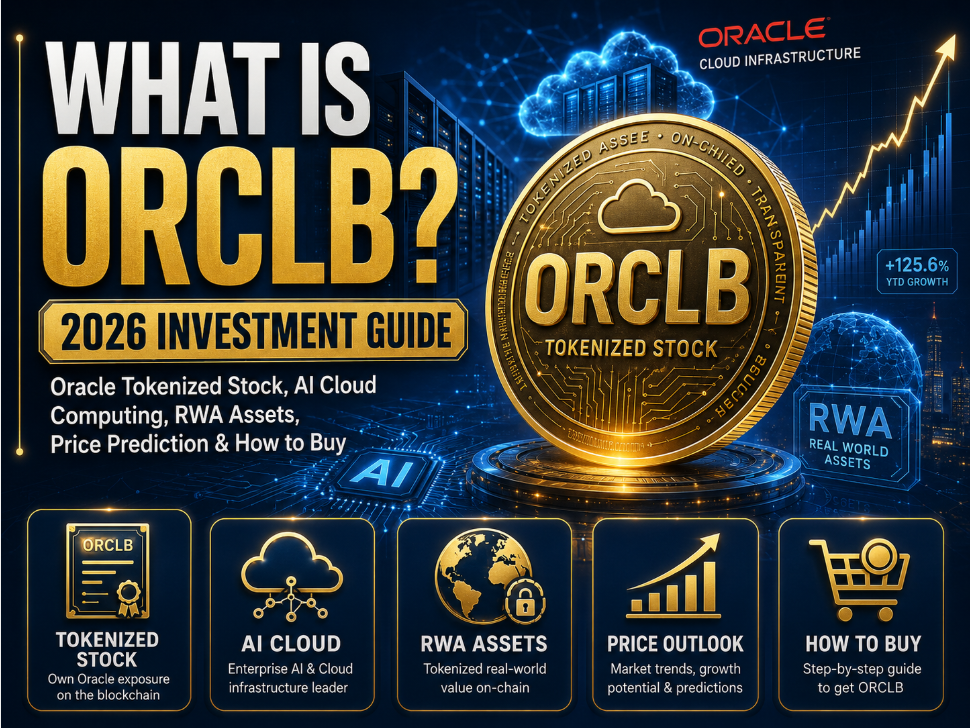
Simply put, ORCLB is not a public-chain token, a memecoin, a DeFi governance token, or an ordinary AI-themed coin in the traditional sense. It’s best understood as a tokenized stock tied to Oracle — an RWA (Real World Asset) instrument. The core logic isn't “a project team issued a new coin,” but rather that the price exposure of Oracle-related stock is brought into the crypto trading environment via a token.
According to CoinMarketCap’s description of Oracle Tokenized bStocks, ORCLB is a tokenized bStock that provides economic exposure related to Oracle Tokenized bStocks and, where permitted by applicable law, may include the right to convert into the underlying security on the Binance.com platform. CoinGecko also labels ORCLB as an Oracle bStock Tokenized Stock, with ORCLB/USDT listed as one of its active trading pairs.
This means ORCLB is not a typical crypto asset, nor is it necessarily identical to Oracle stock held in a traditional brokerage account. When trading ORCLB, users focus on Oracle’s corporate performance, growth in cloud computing and AI infrastructure, the tokenized stock issuance structure, RWA market sentiment, crypto market liquidity, and exchange rules.
You can view ORCLB real-time quotes, trading data, and market info on Hibt, and also check the ORCLB price prediction page for market trends and reference forecasts.
1. What is ORCLB? Why is Oracle stock appearing in the crypto market?
When users search “what is ORCLB,” the first thing to clarify is asset classification.
ORCLB is not a typical new coin. It’s not a foundational public-chain asset like Ethereum, not a DeFi protocol governance token, not an AI application token, and not a memecoin. It’s closer to a tokenized representation of a traditional stock.
RWA stands for Real World Assets — physical or financial assets like stocks, ETFs, bonds, funds, gold, real estate, commodities, etc., that are brought onto the blockchain or tokenized for access within crypto markets.
Tokenized Stock is a major subset of RWA. It takes traditional stocks or their economic rights and expresses them in token form, allowing crypto users to trade them with digital assets like USDT.
ORCLB is exactly that kind of asset. It connects to Oracle Corporation-related stock — i.e., the price exposure of ORCL. When users trade ORCLB, they are focused not on “whether this token has its own on-chain ecosystem,” but on the underlying enterprise value of Oracle, stock market performance, AI and cloud computing trends, the issuance and custody mechanism, and market liquidity.
For newcomers, think of it this way:
- Oracle is a traditional tech company.
- ORCL is Oracle’s stock ticker in the equity market.
- ORCLB is the tokenized expression of Oracle-related stock assets.
- ORCLB/USDT is the trading pair in the crypto market.
So, ORCLB is not “Oracle issued a coin.” It’s traditional tech stock entering the crypto space via RWA and tokenized stock structures.
2. Does ORCLB mean I directly own Oracle stock?
This is the most common misunderstanding.
ORCLB should not be taken as “directly holding Oracle stock.” Traditional Oracle stock is traded on securities exchanges through brokerage accounts, giving you conventional equity ownership.
ORCLB, on the other hand, is a tokenized stock asset. It may provide economic exposure to the price movements of Oracle stock, but it does not automatically equate to owning Oracle shares in a traditional securities account.
Before buying ORCLB, you need to carefully confirm several points:
- Is ORCLB backed by real underlying assets?
- Who custodies those assets?
- Who is the issuing entity?
- Is there a redemption or conversion mechanism into the underlying security?
- Does it carry dividend rights, voting rights, or other traditional shareholder privileges?
- Which jurisdictions allow trading or holding?
These questions determine whether ORCLB is merely a price-exposure product or a more fully-featured tokenized stock with comprehensive equity rights.
Many tokenized stock products emphasize “economic exposure” rather than automatically granting full shareholder rights. So just seeing “Oracle tokenized stock” doesn’t make you an Oracle shareholder in the traditional sense.
More accurately: ORCLB lets crypto users participate in Oracle stock price movements via tokens, but the specific rights and structure depend entirely on the issuer and exchange rules.
3. Why are more and more US stocks being tokenized?
The tokenization of US stocks is essentially a result of the convergence between traditional finance and the crypto market.
In the past, investing in US stocks required a brokerage account — opening an account, depositing fiat, buying stocks or ETFs, and dealing with trading hours, geographic restrictions, tax rules, and account permissions.
Tokenization changes the game. Stocks can be brought into crypto markets through issuers, custodians, and blockchain token structures. Users can trade with USDT and gain price exposure to traditional assets.
This shift offers several clear advantages:
- Easier global access – Many crypto users don’t have US brokerage accounts but are already comfortable with digital asset trading. Tokenized stocks lower the barrier to accessing traditional equity exposure.
- Crypto-native trading experience – Traditional stock markets have fixed trading hours, while crypto markets operate nearly 24/7. Tokenized stocks offer more flexible trading.
- Integration with Web3 finance – Beyond spot trading, tokenized stocks may eventually be used in on-chain asset management, DeFi collateral, RWA indices, portfolio construction, and cross-chain products.
- Expanded crypto asset variety – Instead of just BTC, ETH, DeFi tokens, memecoins, and app coins, users can now access exposures to enterprise software, cloud computing, and AI infrastructure through tokens like ORCLB.
However, tokenization is not a “risk-free upgrade.” It introduces issuer risk, custody risk, regulatory risk, liquidity risk, and price deviation risk. Don’t just focus on convenience — understand the underlying structure.
4. What is Oracle, and why does ORCLB attract AI and cloud investors?
To understand ORCLB, you must first understand Oracle.
Oracle is a global leader in enterprise software, databases, and cloud computing. Its business spans database software, enterprise applications, cloud infrastructure (OCI), enterprise data services, industry solutions, and AI‑powered cloud services. Oracle’s official cloud site emphasizes that OCI is built to accelerate AI workloads, offering cloud infrastructure, databases, and enterprise-grade applications.
Many people still remember Oracle as a “database company” or “enterprise software company.” But in the AI era, the market’s focus on Oracle is shifting. AI model training, inference, enterprise AI applications, and data center build‑outs all require cloud infrastructure, databases, storage, networking, and enterprise data services.
In its fiscal 2026 Q4 and full‑year results announcement, Oracle stated that its performance was driven by cloud infrastructure and cloud application businesses. The release also noted that future cloud revenue, AI and cloud infrastructure service demand, capital expenditure, and data center expansion are key forward‑looking factors.
That’s why ORCLB draws attention from AI and cloud investors. ORCLB is not an AI application token, but it’s tied to Oracle — a company whose growth story is increasingly linked to AI infrastructure, enterprise AI adoption, and cloud service demand.
5. How does the AI wave affect Oracle’s value?
AI development requires more than just GPUs — it also needs cloud computing, databases, enterprise data governance, networking, security, storage, and enterprise software.
Many newcomers think of AI investing as buying NVIDIA, GPUs, and large language models. But real‑world enterprise AI deployment requires a full infrastructure stack. Companies using AI need to solve where data lives, how it’s managed, access controls, model deployment, application integration, cost accounting, and security.
That’s where Oracle fits in.
The AI value chain can be broken down as:
- AI models need training and inference.
- Training and inference need cloud infrastructure.
- Enterprise AI apps need data management and databases.
- Complex business scenarios need enterprise software and industry solutions.
Oracle’s databases, cloud infrastructure, enterprise applications, and data services sit right in those layers.
Oracle’s documentation describes OCI Generative AI as an enterprise‑facing platform for building, deploying, and governing AI applications at scale. In 2026, Oracle and NVIDIA announced an expanded AI partnership involving scalable AI performance on OCI, vector database workloads, and enterprise AI deployment.
So the investment thesis behind ORCLB isn’t just “Oracle stock tokenized” — it also includes AI cloud computing, enterprise software, databases, data centers, and enterprise AI infrastructure.
But to be clear: buying ORCLB is not a direct investment in ChatGPT, not a direct bet on AI models, and not a purchase of GPU chip stocks. It’s a token‑based participation in the price movement of Oracle‑related stock.
6. How does ORCLB work? What’s the mechanism behind tokenized stocks?
ORCLB shouldn’t be evaluated like a typical crypto project.
For ordinary crypto projects, you look at whitepapers, token utility, ecosystem use cases, governance, staking, protocol revenue, on‑chain users, and developer activity.
ORCLB is closer to a tokenized stock. Its mechanism generally works like this:
- Traditional stock exists.
- The issuer or custodian backs or maps the underlying assets.
- The platform issues a corresponding token.
- Users trade that token in the crypto market.
- The token price fluctuates based on underlying asset performance, market supply/demand, and trading liquidity.
Thus, ORCLB’s value doesn’t come from “on‑chain protocol revenue” — it comes from Oracle stock‑related asset performance, the tokenized stock structure, RWA market demand, and crypto trading liquidity.
When analyzing ORCLB, you need to look at at least four layers:
- Oracle’s fundamentals.
- AI and cloud industry trends.
- ORCLB issuance mechanism and underlying asset support.
- Crypto market trading volume, bid‑ask spreads, and liquidity.
If you only look at ORCLB’s chart without understanding Oracle and the tokenized structure, you’ll likely misjudge the risks.
7. How does ORCLB price relate to Oracle stock?
ORCLB’s price is correlated with Oracle stock performance, but it does not always equal Oracle’s stock price at any given moment.
If ORCLB is backed by Oracle‑related stock, its price should theoretically track Oracle stock movements. However, in actual trading, it’s also affected by crypto market supply/demand, trading depth, platform liquidity, bid‑ask spreads, and RWA sentiment.
Factors affecting ORCLB price fall into three categories:
1. Oracle‑specific factors
- Earnings reports, cloud revenue growth, AI infrastructure deals, customer orders, enterprise software demand, margins, cash flow, and capex.
2. Industry factors
- Cloud competition, enterprise IT spending, AI capital investment, data center expansion, database market shifts, and big‑tech valuations.
3. Crypto market factors
- ORCLB trading volume, RWA hype, USDT liquidity, order‑book depth, BTC/ETH trends, and overall risk appetite.
So don’t assume “Oracle stock goes up, so ORCLB will go up in lockstep.” A more accurate view is: Oracle stock is the core reference, but ORCLB also trades within a tokenized environment that adds its own dynamics.
8. What’s the difference between ORCLB and traditional Oracle stock?
The biggest difference is the trading gateway and rights structure.
Traditional Oracle stock trades through brokerage accounts. You buy ORCL shares on the stock market, subject to trading hours, settlement rules, disclosure requirements, shareholder rights, and regulatory oversight.
ORCLB trades on crypto exchanges. You buy with USDT, hold on the platform, and prices are displayed in token form. It’s designed for users already familiar with crypto trading.
Advantages of traditional Oracle stock:
- Mature regulatory framework.
- Clearer shareholder rights.
- Standardised market information.
Advantages of ORCLB:
- Crypto‑native access.
- More flexible trading hours.
- Easily integrated into RWA, Web3 finance, and digital asset portfolios.
But ORCLB’s risks are more complex. It may not provide full shareholder rights and may be subject to issuer, custodian, exchange, and jurisdictional restrictions.
So before investing in ORCLB, the real question isn’t “Is it Oracle stock?” — it’s “What exact exposure and rights am I actually buying?”
9. What’s the difference between ORCLB and ETH?
ORCLB and ETH are not the same asset class.
ETH is the native asset of the Ethereum network. Its value comes from network usage, gas consumption, Layer 2 activity, DeFi, stablecoins, NFTs, RWA onboarding, and smart contract applications. ETH is a foundational crypto infrastructure asset.
ORCLB is an RWA tokenized version of a traditional tech stock tied to Oracle. Its value comes from Oracle’s business performance, cloud growth, AI infrastructure demand, tokenized stock structure, and crypto liquidity.
- ETH represents blockchain network value.
- ORCLB represents price exposure to a traditional tech stock brought into crypto.
Risks for ETH come from public‑chain competition, crypto market cycles, regulation, on‑chain demand, and ecosystem health.
Risks for ORCLB come from Oracle’s operations, tech valuations, cloud competition, tokenized structure, liquidity, and regulatory constraints.
So they serve different roles. You can use Hibt’s ETH price prediction to understand foundational crypto assets, and then study ORCLB as a case of traditional tech RWA.
10. How does ORCLB differ from other RWA assets?
ORCLB is not isolated — it can be understood alongside Hibt’s RWA content matrix.
- What is CRWVB? – more focused on AI cloud infrastructure, useful for understanding how CoreWeave (AI infrastructure) enters crypto via tokenized stock.
- What is AXTIB? – a case of tokenized stock for traditional industrial and materials companies, helping you see non‑tech asset tokenisation.
- What is AIRH? – focused on AI robotics, showing how robotics assets enter the RWA and tokenized asset framework.
- What is Ethereum ETF? – a key example of traditional financial institutions entering crypto, useful for understanding ETFs, institutional capital, and crypto markets.
ORCLB’s distinctive angle is enterprise software, databases, cloud computing, and AI infrastructure. It’s not purely an AI model asset, not an AI robotics asset, not a semiconductor asset — it’s a tokenized expression of enterprise‑grade cloud and database assets.
That’s ORCLB’s differentiated value in the RWA matrix:
- It connects to a major enterprise tech company.
- It connects to AI cloud and enterprise software demand.
- It connects to traditional stock tokenisation.
- It connects to crypto users seeking USDT‑based exposure to US tech stocks.
11. Why does ORCLB price go up or down?
When users ask “What drives ORCLB’s future price?” they should focus on these drivers.
ORCLB price is mainly influenced by five categories:
- Oracle fundamentals – If Oracle’s cloud business strengthens, enterprise customer demand rises, AI infrastructure orders increase, profits and cash flow improve, the market may revalue Oracle stock, and ORCLB could benefit.
- Cloud business performance – OCI is a key focus. Oracle’s fiscal 2026 10‑K notes that cloud revenue includes OCI products delivered via cloud deployment. Stronger cloud growth usually raises future growth expectations.
- AI infrastructure demand – AI training and inference drive massive demand for compute, storage, databases, and enterprise data services. If Oracle continues to win AI‑related cloud customers, ORCLB visibility increases.
- Macro environment and tech valuations – Interest rates, enterprise IT budgets, dollar liquidity, tech stock multiples, and market risk appetite all affect Oracle stock and ORCLB.
- RWA and crypto liquidity – Since ORCLB trades on crypto venues, it’s also subject to tokenized stock demand, USDT liquidity, market depth, spreads, and exchange rules.
Thus, ORCLB price is not determined solely by Oracle stock nor solely by crypto markets — it’s the interplay of fundamentals, tech sector conditions, RWA structure, and digital asset liquidity.
12. ORCLB price prediction: what indicators should you watch?
ORCLB price prediction should not rely on historical prices or short‑term charts alone. For an asset like ORCLB, at least four dimensions matter:
Dimension 1: Oracle fundamentals
- Earnings, revenue growth, cloud segment performance, enterprise application growth, database business, margins, cash flow, capex, and forward guidance.
- Oracle’s fiscal 2026 Q4 release highlighted record results driven by cloud infrastructure and cloud applications, and noted AI and cloud infrastructure demand, data center expansion, and capex as key forward factors.
Dimension 2: AI and cloud industry trends
- AI infrastructure demand, enterprise AI adoption, data center expansion, database AI capabilities, enterprise digital spending, and Oracle‑NVIDIA partnership progress on AI infrastructure.
Dimension 3: Token market factors
- ORCLB trading volume, bid‑ask spreads, order‑book depth, price deviation, and exchange support. If liquidity is thin, even correct directional views can suffer from slippage and execution issues.
Dimension 4: RWA market trends
- If tokenized stocks gain broader adoption and more crypto users want USDT‑based exposure to traditional equities, ORCLB could benefit from rising RWA sector attention.
You can check the ORCLB price prediction page for reference trends. But remember: price predictions are not investment guarantees and do not substitute for independent research.
A sensible approach:
- Confirm ORCLB’s token identity and underlying asset structure.
- Research Oracle’s fundamentals.
- Assess AI/cloud industry trends.
- Review ORCLB trading volume and market depth.
- Decide based on your own risk tolerance.
13. How to buy ORCLB – step‑by‑step for beginners
If you’re searching “How to buy ORCLB,” follow this process:
Step 1 – Check ORCLB quotes Start at Hibt’s ORCLB/USDT market page for real‑time price, trading data, and market information.
Step 2 – Prepare USDT funds ORCLB typically trades as ORCLB/USDT. Set your budget first — don’t go heavy just because Oracle, AI cloud, or RWA are hot topics.
Step 3 – Confirm token identity Make sure ORCLB is indeed an Oracle‑related tokenized stock, and verify the underlying asset relationship, issuance mechanism, custody details, geographic restrictions, and exchange rules.
Step 4 – Search for ORCLB/USDT On the trading interface, search ORCLB, confirm the pair name, volume, price, and market depth to avoid buying a similarly‑ticker asset.
Step 5 – Choose order type
- Market order – quick execution, but slippage can occur if liquidity is low.
- Limit order – better price control. For tokenized stocks like ORCLB, beginners are advised to use limit orders to avoid unfavourable fills in thin order books.
Step 6 – Manage position size ORCLB is not low‑risk. It involves Oracle stock performance, cloud trends, AI infrastructure expectations, RWA structure, and crypto volatility. Never allocate too high a percentage.
Step 7 – Have an exit plan Before buying, decide:
- At what level will you take partial profits?
- At what level will you cut losses?
- What if Oracle earnings disappoint?
- What if AI cloud hype fades?
- What if ORCLB volume dries up?
Investing isn’t just about buying — it’s about risk management and exit strategy.
14. What are the risks of investing in ORCLB?
Opportunities come from Oracle cloud, AI infrastructure, and RWA trends, but risks are real.
1. Oracle stock risk – ORCLB depends on Oracle‑related asset performance. If Oracle stock falls, ORCLB is likely affected.
2. Cloud competition risk – Oracle competes with AWS, Azure, Google Cloud, and others. Intense competition on pricing, customer migration, ecosystem, and capex can impact growth.
3. AI capex risk – AI infrastructure requires heavy data center and GPU spending. Reuters reported in July 2026 that big tech AI investment is pressuring free cash flow, noting that Oracle’s fiscal 2026 capex as a percentage of operating cash flow rose significantly.
4. Tech valuation risk – AI and cloud are high‑expectation sectors. If growth misses, valuations may adjust quickly.
5. Tokenised structure risk – ORCLB is not a traditional security. You must check whether assets are truly custodied, the issuer is reliable, rules are transparent, and redemption/conversion is supported.
6. Liquidity risk – If ORCLB trading volume is low, spreads widen, and you may not get your desired price.
7. Price deviation risk – Tokenized stock prices can temporarily deviate from the underlying reference due to trading hours, depth, supply/demand, and redemption restrictions.
8. Regulatory risk – Tokenized stocks sit at the intersection of securities and crypto. Definitions, sales restrictions, and investor eligibility vary by jurisdiction.
9. Crypto market risk – Even though ORCLB links to a tech stock, it trades in crypto venues. BTC/ETH drops, USDT liquidity contraction, or risk‑off sentiment can affect short‑term performance.
Therefore, ORCLB is not suitable for newcomers who don’t understand tokenized stock mechanisms, can’t stomach tech stock volatility, or lack position‑sizing discipline.
15. Is ORCLB worth investing in? How to build your own framework?
“Is ORCLB worth it?” can’t be answered simply yes or no. A better approach is to build a judgment framework.
Those bullish on ORCLB often focus on three angles:
- Enterprise cloud growth – Oracle’s cloud infrastructure, databases, and enterprise apps are key drivers. If you’re positive on Oracle’s cloud trajectory, you may find ORCLB interesting.
- AI infrastructure trend – AI adoption needs cloud, databases, data centers, and enterprise data services. If Oracle continues winning enterprise AI and cloud workloads, ORCLB could gain attention.
- RWA long‑term development – Tokenised stocks let crypto users access traditional equities. If you believe in on‑chaining traditional assets, ORCLB is a relevant case.
But ORCLB is not for everyone:
- If you only want to hold BTC and ETH, ORCLB may not fit.
- If you don’t understand tokenized assets, don’t buy blindly.
- If you can’t handle stock volatility, don’t over‑allocate.
- If you’re unwilling to study Oracle earnings and cloud industry trends, don’t trade based on charts alone.
For beginners, ORCLB is better viewed as an entry point to learn about Oracle cloud, AI infrastructure, and RWA tokenized stocks — not as a speculative vehicle for large initial bets.
16. Future developments: what to watch?
To continuously research ORCLB, monitor four levels:
1. Oracle corporate metrics – earnings, cloud revenue, OCI growth, database business, enterprise apps, AI partnerships, customer orders, capex, margins, and cash flow.
2. AI cloud metrics – data center builds, enterprise AI demand, GPU cloud services, database AI features, digital spending, and cloud competitive dynamics.
3. RWA metrics – ORCLB trading volume, market depth, spreads, holder changes, exchange support, issuer disclosures, custody, and regulatory updates.
4. Crypto market metrics – ETH ecosystem, BTC/ETH trends, USDT liquidity, RWA sector sentiment, and institutional capital inflows.
Use Hibt’s content matrix to build your research path:
- Start with ETH price prediction to understand crypto asset trends.
- Then What is Ethereum ETF? to see how traditional institutions enter crypto.
- Then What is CRWVB? for AI infrastructure tokenized stocks.
- Then What is AXTIB? and What is AIRH? for other RWA types.
- Finally, return to ORCLB to understand how Oracle cloud and enterprise software assets enter crypto via tokenization.
17. ORCLB FAQ – common beginner questions
What is ORCLB?
ORCLB is an Oracle‑related tokenized stock, part of the RWA sector. It provides economic exposure to Oracle stock price movements via token form. It is not a public‑chain coin, memecoin, or DeFi governance token.
Is ORCLB a coin?
Many search “ORCLB coin,” but more accurately it’s a tokenized stock. Although traded as a token, its core logic comes from Oracle stock exposure, not a typical crypto ecosystem.
Is ORCLB the same as Oracle stock?
Not necessarily. ORCLB provides price exposure, but whether it includes dividend rights, voting rights, redemption, or conversion depends on the issuer and exchange rules.
How do I buy ORCLB?
Buy on supported exchanges. Start at the ORCLB/USDT market page, prepare USDT, search for the ORCLB/USDT pair, and choose limit or market orders based on your risk tolerance.
What affects ORCLB price?
Oracle’s performance, cloud revenue, AI infrastructure demand, tech sector valuations, RWA market interest, crypto liquidity, and trading depth.
How to interpret ORCLB price predictions?
Don’t rely solely on historical charts. Combine Oracle earnings, cloud trends, token volume, market depth, and RWA sentiment. See the ORCLB prediction page for reference, but predictions are not guarantees.
What’s the difference between ORCLB and ETH?
ETH is Ethereum’s native asset, representing crypto infrastructure value. ORCLB is an RWA tokenized traditional tech stock, whose value derives from corporate performance and stock market expectations. They are different asset classes.
Is ORCLB a good investment?
That depends on your view of Oracle’s cloud and AI growth, your understanding of tokenized stock mechanisms, and your ability to handle stock volatility, RWA structure risks, and liquidity risks. For beginners, research first and test with small positions rather than going all in.
Conclusion: ORCLB is not a typical new coin — it’s a gateway for Oracle cloud assets into crypto
ORCLB’s core value isn’t about being a short‑term hot token. It represents a larger trend: traditional tech stocks are entering the crypto market through tokenized stock and RWA structures.
It connects to:
- Oracle.
- Enterprise software, databases, and cloud computing.
- AI infrastructure and enterprise AI applications.
- Traditional stock tokenisation.
- Crypto users seeking USDT‑based exposure to US tech equities.
So, understand ORCLB not purely through a “crypto speculation” lens, nor purely through a “traditional stock” lens. More accurately, see it as a combined asset: Oracle cloud + AI infrastructure + RWA tokenisation + crypto trading access.
Before investing, answer at least six questions:
- What exactly is ORCLB?
- How does it relate to Oracle stock?
- Does it equal traditional stock ownership?
- Does Oracle’s cloud and AI infrastructure have a growth thesis?
- What factors drive ORCLB price?
- Can you accept tokenised structure, liquidity, and stock volatility risks?
Once you can answer those, combine your research with ORCLB real‑time quotes, ORCLB price prediction, ETH price prediction, What is Ethereum ETF?, What is CRWVB?, What is AXTIB?, and What is AIRH? for a more comprehensive investment approach.
ORCLB isn’t for everyone, but it’s an excellent gateway asset for understanding Oracle cloud, AI infrastructure, tokenized stocks, and the on‑chaining of traditional tech assets.