
If you’re seeing CRWVB for the first time on a trading platform, price charts, or social media, the first question that comes to mind is likely: What exactly is CRWVB? Is it a new crypto project, or is it tied to CoreWeave stock?
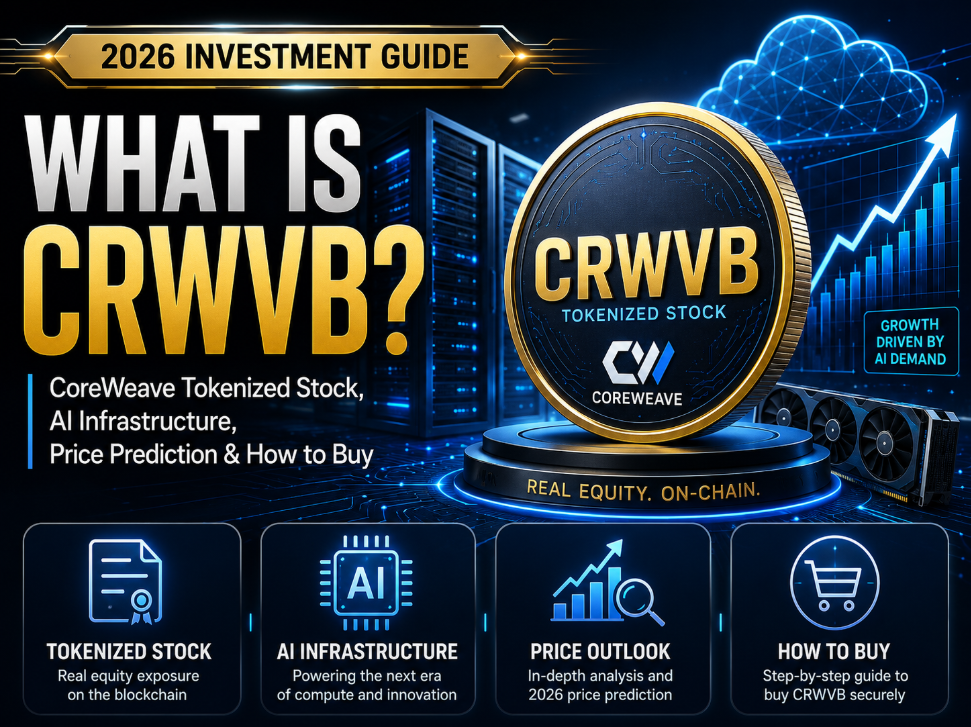
In short, CRWVB is not a typical public-chain coin, meme coin, or DeFi governance token. It is a CoreWeave Tokenized bStock — a tokenized stock asset linked to CoreWeave. Its core value isn’t about “launching a new coin”; rather, it uses blockchain technology to give users economic exposure to the price movements of CoreWeave’s underlying stock.
That’s also why CRWVB is worth paying attention to: it sits at the intersection of three major trends.
First, AI infrastructure is becoming a key narrative in capital markets. Second, CoreWeave — as an AI cloud computing and GPU infrastructure provider — has attracted serious interest from AI investors. Third, RWA (Real World Assets) and tokenized stocks are bringing traditional equities into the crypto ecosystem.
For crypto newcomers, the key to understanding CRWVB isn’t first asking “will it go up?” — it’s understanding what asset CRWVB represents, what drives its price, how it relates to CoreWeave stock, how it differs from BTC/ETH and other typical cryptos, and how to manage risk as a beginner.
You can view CRWVB real-time price, trading info, and market data on Hibt, and also check the CRWVB price prediction page to gauge market sentiment and forecast references.
1. What is CRWVB? Why is CoreWeave stock appearing in crypto markets?
When users search “what is CRWVB,” their first need is usually not a complex financial explanation — they want to know: Is CRWVB actually a coin?
The answer is: CRWVB looks like a token, but its underlying logic is closer to a tokenized stock.
CRWVB stands for CoreWeave Tokenized bStocks. According to CoinMarketCap’s description of CoreWeave Tokenized bStocks, CRWVB is a type of tokenized bStock that provides economic exposure to the underlying CoreWeave-related securities, with the right to convert into the underlying securities subject to applicable laws. The page also notes that each token is backed by corresponding underlying权益 (interests) maintained by the issuer with a U.S. regulated broker-dealer.
This means CRWVB is not any of the following:
- It is not a newly issued Layer-1 public-chain token.
- It is not a meme coin driven by community hype.
- It is not a governance token for a DeFi protocol.
- It is not directly held CoreWeave stock in a traditional securities account.
CRWVB is more accurately positioned as:
- A Tokenized Stock — an asset that tokenizes equity exposure.
- An RWA — a Real World Asset.
- A way for crypto market users to gain exposure to price movements tied to CoreWeave stock.
The key phrase here is “exposure,” not “exactly equal to the stock.” This is crucial for newcomers. Buying CRWVB is not the same as buying CoreWeave common stock directly in a traditional brokerage account. It is an on-chain securitized product shaped by its issuance structure, custody arrangements, platform rules, and applicable laws.
2. What is a Tokenized Stock? Why can stocks become tokens?
Traditional stock trading typically relies on securities accounts, brokers, clearing systems, and stock exchanges. Investors must trade during specific market hours and are subject to regional restrictions, funding thresholds, settlement cycles, and securities regulations.
Tokenized stocks emerge by expressing traditional stocks — or their economic rights — as tokens via blockchain technology.
Think of it this way:
- Traditional stocks trade in securities markets.
- Tokenized stocks trade in crypto trading environments.
- Traditional stocks depend on securities accounts and legacy clearing systems.
- Tokenized stocks depend on issuers, custody mechanisms, blockchain networks, and trading platforms.
Take bStocks as an example: Binance Academy explains that bStocks are tokenized securities on Binance, each backed 1:1 by the corresponding U.S. stock held by a regulated custodian, and they can be traded 24/7 on spot markets.
This structure brings several distinct features.
First, 24/7 trading.
Traditional U.S. stocks have fixed trading hours, with pre-market and after-hours sessions, but the average investor’s experience isn’t always seamless. Tokenized stocks, on the other hand, behave more like blockchain assets, offering a near-24-hour trading environment — a familiar experience for crypto natives.
Second, global accessibility.
Many users want to invest in U.S. stocks or AI companies but face hurdles like region locks, account opening requirements, bank cards, taxes, or broker restrictions. Tokenized stocks aim to lower these barriers, giving more users outside traditional securities markets access to stock-price exposure.
Third, connectivity with the crypto ecosystem.
Tokenized stocks can appear not only on exchange spot markets but also in Web3 wallets, on-chain transfers, DeFi protocols, collateralized lending, or portfolio management. Binance Academy notes that bStocks, as BEP-20 tokens on BNB Smart Chain, support self-custody and can be used in supported DeFi protocols.
However, this doesn’t mean tokenized stocks are risk-free. They are not simply “stocks moved onto the chain” — they introduce issuer risk, custody risk, compliance risk, liquidity risk, and technical risk.
So for CRWVB, the correct understanding is:
- It is neither pure crypto nor traditional stock.
- It is a new RWA product that combines traditional equity assets with crypto market trading mechanics.
3. What is CoreWeave? Why does CRWVB attract AI investors?
To understand CRWVB, you must first understand CoreWeave — because CRWVB’s value logic revolves around this company.
CoreWeave is an AI cloud infrastructure company. Its core business includes GPU compute resources, AI training, AI inference, high-performance computing, storage, networking, and platform services tailored for AI workloads. CoreWeave’s website positions itself as “The Essential Cloud for AI,” stating that its AI-native platform is purpose-built for complex AI workloads.
Why does this company draw so much attention?
Because the AI industry is not just about model competition — it’s about compute infrastructure competition.
From training to inference, a large AI model requires massive GPU clusters, data centers, power, networking, storage, scheduling systems, and cloud platforms. Users see ChatGPT, Claude, Midjourney, AI video, AI coding tools — but behind all these applications lies underlying compute power.
The AI value chain can be visualized as:
- AI models need training.
- Training needs GPU compute.
- GPUs need to be deployed in data centers.
- Data centers need cloud platforms for management and orchestration.
CoreWeave provides exactly that: AI cloud infrastructure.
That’s why CRWVB isn’t just a “stock token” — it’s discussed within the AI infrastructure narrative. Investors looking at CRWVB are essentially asking whether CoreWeave can continue to benefit from growing AI compute demand.
In its Q1 2026 earnings release, CoreWeave highlighted that its customers include AI labs, hyperscalers, and enterprise clients, with disclosed business progress involving Meta, Anthropic, Cohere, Jane Street, Mistral, and others. The company also noted active power exceeding 1 GW, total contracted power over 3.5 GW, and plans to expand with NVIDIA to build over 5 GW of AI factories.
All this suggests that CoreWeave’s core investment thesis isn’t “is it a crypto project?” — it’s whether the company can capture a significant position in AI infrastructure demand, GPU cloud computing, scalable AI inference, and enterprise AI deployment.
4. Is investing in CRWVB the same as investing in AI?
Many newcomers directly interpret CRWVB as an “AI coin.” That interpretation is half right, but also half misleading.
CRWVB is indeed tied to the AI sector because it corresponds to an AI infrastructure company like CoreWeave. But it is not an AI token, not an AI public chain, and not an on-chain project like an “AI Agent concept coin.”
Buying CRWVB is not:
- Directly investing in ChatGPT.
- Directly buying NVIDIA stock.
- Investing in some AI token ecosystem.
It is more like gaining exposure to CoreWeave stock price movements through a tokenized stock format.
So CRWVB’s investment logic can be summarized as:
If you are bullish on long-term AI compute demand, GPU cloud computing, and the growth of AI infrastructure companies — and you are also comfortable with the structural risks of tokenized stocks — then CRWVB may be an RWA asset worth researching.
But if you’re simply looking for a “potential moonshot AI coin,” CRWVB may not meet your expectations. Its price dynamics are closer to equities, not purely driven by on-chain narratives, community sentiment, or tokenomics.
5. How is CRWVB different from typical cryptos?
Crypto newcomers tend to label every tradable pair as a “coin.” But from an investment perspective, CRWVB, BTC, ETH, STORJ, PHA, and BANK are vastly different.
- BTC’s core logic: Bitcoin network, scarcity, digital gold narrative, and global liquidity.
- ETH’s core logic: Ethereum ecosystem, gas demand, Layer 2, DeFi, stablecoins, and on-chain application growth.
- STORJ leans toward decentralized storage protocols, with value tied to storage network demand and protocol ecosystem. To understand infrastructure tokens like these, you can read What is STORJ on Hibt.
- PHA is more about AI/Web3 privacy computing or related ecosystem narratives. Check What is PHA to see the difference between AI/Web3 tokens and RWA stock assets like CRWVB.
- EDU focuses on Web3 education application ecosystems — a good example of application-layer token value. See What is EDU.
- BANK is closer to DeFi financial tokens. Read What is BANK to understand the differences between DeFi assets and RWA assets.
CRWVB’s value, however, does not come from having its own public chain or DeFi protocol revenue. It comes from:
- Price movements of CoreWeave’s underlying stock.
- The RWA issuance structure.
- Market liquidity and trading demand.
That’s the biggest difference between CRWVB and typical cryptos:
- Typical cryptos are driven by on-chain networks, protocol ecosystems, community consensus, and tokenomics.
- CRWVB is driven by CoreWeave’s fundamentals, the AI infrastructure cycle, equity valuations, and the tokenized product’s own compliance and liquidity.
6. What is the relationship between CRWVB and ETH?
CRWVB and ETH are not competitors.
ETH is a foundational public-chain asset, representing the Ethereum network ecosystem. Its long-term value is tied to on-chain applications, gas consumption, Layer 2 scaling, DeFi, stablecoins, RWA onboarding, and developer activity.
CRWVB, on the other hand, is an RWA tokenized stock. Its price logic is much closer to CoreWeave’s stock performance than to the Ethereum network itself.
You can think of their relationship as:
- ETH represents crypto infrastructure.
- CRWVB represents a tokenized traditional equity asset entering the crypto market.
One is a foundational on-chain asset; the other is an on-chain representation of a traditional asset exposure.
If you want a broader investment framework, start by studying ETH price prediction to understand long-term trends of foundational public-chain assets, then compare the risks and opportunities of tokenized stocks like CRWVB.
For beginners, ETH is more like a “crypto market base asset candidate,” while CRWVB is a “combination asset of AI stock exposure + RWA innovation.” They can play different roles in the same portfolio, but they are not substitutes for each other.
7. What determines the price of CRWVB?
When users search for “CRWVB price prediction,” what they really want to know is: Why does CRWVB go up? What will drive future gains?
CRWVB’s price is mainly influenced by four types of factors.
Factor 1: CoreWeave stock performance.
If CoreWeave’s revenue grows, AI orders increase, customer mix improves, gross margins expand, and market valuations rise, the underlying stock may strengthen, which in turn supports CRWVB.
Conversely, if CoreWeave’s growth misses expectations, valuations decline, capex pressures mount, or financing costs rise, CRWVB may come under pressure.
Factor 2: AI industry cycles.
CRWVB’s core narrative is AI infrastructure. If AI model training, inference, enterprise deployment, AI video, AI coding, AI agents, and other applications continue to grow, GPU cloud demand is likely to remain strong, and the market will keep paying attention to AI infrastructure companies like CoreWeave.
However, if AI investment cools, enterprise AI budgets shrink, GPU supply/demand dynamics shift, or cloud pricing competition intensifies, valuations of AI infrastructure companies may drop.
Factor 3: Crypto market liquidity.
Although CRWVB corresponds to equity-like logic, it is still priced and traded within a crypto trading environment. Therefore, USDT liquidity, exchange depth, RWA sector sentiment, and overall crypto risk appetite all affect CRWVB’s short-term volatility.
When market capital favors RWA, AI, and U.S. equity-mapped assets, CRWVB may attract more attention.
When risk appetite declines and capital flows back to BTC, ETH, or stablecoins, newer assets like CRWVB may face liquidity pressure.
Factor 4: Tokenized stock product structure.
Investors need to monitor whether CRWVB has sufficient trading depth, clear issuer rules, transparent underlying asset support mechanisms, any redemption or conversion restrictions, and whether the product is permitted in their jurisdiction.
Reuters has reported that while tokenized stocks are seen as offering advantages like 24/7 trading and instant settlement, different products vary significantly in investor rights, disclosures, regulatory applicability, and issuer risks — some do not provide the same ownership, voting rights, or protections as traditional stocks.
Therefore, CRWVB’s price cannot be analyzed by looking at charts alone — you must also understand the asset’s structure.
8. CRWVB Price Prediction: What’s the upside in 2026?
A “CRWVB price prediction 2026” cannot be reduced to a single target price. For newcomers, it’s more important to learn how to evaluate the prediction logic.
CRWVB price forecasts should be assessed from three levels.
Level 1: CoreWeave’s fundamentals.
Watch for sustained revenue growth, customer stability, expanding AI cloud demand, GPU competitiveness, and whether data center and power resources can support business expansion.
If CoreWeave continues to win large AI clients, enterprise customers, and cloud deals, the market may assign a higher valuation.
But if revenue relies on a few large customers, or if capex is too high and debt burdens are heavy, valuation swings can be sharp.
Level 2: AI infrastructure valuation cycles.
Valuations of AI infrastructure companies are often influenced by market sentiment. When AI compute is in short supply, the market is willing to pay a premium; when concerns arise about oversupply, price wars, or poor capex returns, valuations can contract quickly.
As a tokenized stock tied to CoreWeave, CRWVB is also affected by these cycles.
Level 3: Demand for RWA and tokenized stocks.
If the tokenized stock market continues to expand in 2026, and more users begin accessing equity exposure through crypto platforms, CRWVB as a CoreWeave-linked RWA asset could gain higher visibility.
But if regulation tightens, platforms restrict trading, or liquidity dries up, CRWVB may suffer from declining depth, widening bid-ask spreads, and price deviations from the underlying asset.
You can observe market sentiment, short-term and long-term forecast references on the CRWVB price prediction page. However, remember that no price prediction is an investment guarantee. The prediction page is best used as a supplementary tool, not as a direct buy/sell signal.
For beginners, a more prudent approach is:
- First, understand what CRWVB is.
- Second, assess CoreWeave’s AI infrastructure thesis.
- Then, observe how CRWVB’s price correlates with CoreWeave-related equity performance.
- Finally, decide whether to participate based on your own risk tolerance.
9. How to buy CRWVB? A beginner’s step-by-step process
When users search “how to buy CRWVB,” they usually want a simple, clear process.
Step 1: Set up an account on a platform that supports CRWVB trading.
If the platform offers the CRWVB/USDT trading pair, you can search for CRWVB on the spot market. Hibt users can start at the CRWVB/USDT quote page to view real-time prices, trading data, and market information.
Step 2: Prepare USDT funds.
CRWVB is typically traded as a USDT pair. Beginners should avoid going all-in at once. Instead, decide on a planned investment amount — for example, use only a small portion of your total capital to first get familiar with price movements and trading rules.
Step 3: Search for CRWVB/USDT.
Go to the trading page, search for CRWVB, and confirm the pair is indeed CRWVB/USDT. Be careful not to buy a similarly named asset, and never use unofficial links to access trading pages.
Step 4: Choose your order type.
Two common order types for beginners:
- Market order — executes quickly, but may suffer slippage if liquidity is low.
- Limit order — lets you set a target price and wait for the market to fill, which is better for controlling entry cost.
For an RWA tokenized stock like CRWVB, beginners are advised to prefer limit orders to avoid significant slippage when trading depth is insufficient.
Step 5: Set position size and stop-loss.
Before buying CRWVB, ask yourself three questions:
- Can you accept a 20% drop in price?
- Can you accept being unable to sell quickly in the short term?
- Can you accept changes in tokenized stock product rules?
If the answer to any of these is no, you should not take a large position in CRWVB.
Step 6: Continuously track CoreWeave and the RWA market.
CRWVB is not a “buy and forget” asset. You need to monitor CoreWeave company updates, AI industry trends, RWA regulatory changes, and platform liquidity on an ongoing basis.
10. Risk analysis for CRWVB investment
A proper CRWVB investment guide cannot only cover opportunities — it must fully disclose risks. Especially under Google EEAT, risk disclosure is a critical part of building trust.
Risk 1: Equity risk.
Although CRWVB is in token form, its value base is tied to CoreWeave’s underlying stock. If CoreWeave stock declines, CRWVB is likely to follow.
CoreWeave faces risks including:
- AI infrastructure demand falling short of expectations.
- Intensifying competition in GPU cloud computing.
- Rising costs for data centers, power, hardware, and debt.
- Customer concentration risk.
- Market valuation pullbacks.
These are common risks for equity-like assets.
Risk 2: AI industry cycle risk.
The AI industry is growing rapidly, but high growth also means high expectations. If the market realizes that AI monetization is slower than expected, or that cloud providers’ capex payback periods are too long, AI infrastructure assets may face valuation compression.
CRWVB’s upside depends on the market’s continued belief in long-term AI infrastructure growth. If that narrative cools, CRWVB will be affected.
Risk 3: RWA tokenization structural risk.
Tokenized stock is not the same as traditional stock. Investors must understand the issuer, custodian, underlying asset backing, conversion mechanisms, applicable laws, geographic restrictions, and platform rules.
Binance Academy’s bStocks risk disclosure mentions market risk, liquidity risk, issuer and custody risk, regulatory risk, technical and operational risk, tax risk, and geographic restrictions.
This illustrates that CRWVB isn’t simply “stock risk + crypto opportunity” — it layers equity risk, crypto trading risk, and product structure risk all together.
Risk 4: Liquidity risk.
If CRWVB trading volume is low, users may encounter wide bid-ask spreads, difficulty filling orders, short-term price deviations from the underlying asset, or inability to exit quickly during extreme market conditions.
This is especially important for beginners. Many people focus only on price moves and ignore order book depth. In reality, for new RWA assets, the ability to buy and sell smoothly — and the size of the spread — is often more critical than short-term price changes.
Risk 5: Regulatory risk.
Tokenized stocks are still in a rapidly evolving phase, and regulatory attitudes vary across jurisdictions. Reuters has reported that tokenized stocks have already drawn attention from traditional financial institutions and regulators regarding investor protection, market stability, regulatory applicability, and differences in product rights.
Therefore, before investing in CRWVB, you must confirm whether your jurisdiction allows trading such assets and understand the platform’s relevant rules.
11. How does CRWVB differ from other RWA and AI assets?
CRWVB is not an isolated asset; it is part of Hibt’s expanding RWA content matrix.
If you categorize crypto assets, it becomes easier to see where CRWVB fits.
- BTC — native crypto store-of-value narrative.
- ETH — public-chain infrastructure asset.
- STORJ — decentralized storage infrastructure.
- PHA — AI/Web3 ecosystem direction.
- EDU — Web3 application ecosystem.
- BANK — DeFi financial token.
- CRWVB — RWA tokenized stock, specifically tied to CoreWeave, an AI infrastructure company.
So CRWVB’s uniqueness lies in:
- It is not a traditional AI token, but a tokenized expression of equity exposure to an AI company.
- It is not a typical RWA yield-generating asset, but an RWA asset with equity-like volatility.
- It is not purely a crypto narrative, but a combination of traditional U.S. equities, AI infrastructure, and on-chain trading mechanisms.
That’s why CRWVB is best analyzed within an “AI + RWA + Tokenized Stock” framework.
If you want to systematically understand different asset types, read CRWVB alongside:
- What is STORJ — decentralized storage infrastructure tokens.
- What is PHA — AI/Web3 direction tokens.
- What is EDU — Web3 application ecosystem assets.
- What is BANK — DeFi financial tokens.
- ETH price prediction — foundational public-chain asset long-term trends.
You’ll see that CRWVB is not “just another new coin” — it’s a new branch in the expanding universe of crypto asset types.
12. Is CRWVB worth investing in? How to build your own judgement?
The question “Is CRWVB worth investing in?” cannot be answered with a simple yes or no. A better approach is to establish a decision framework.
Those who are bullish on CRWVB typically focus on three directions.
First, bullish on long-term AI growth.
If you believe that AI model training, inference, enterprise AI applications, AI video, AI coding, and AI agents will continue to grow over the next few years, then AI compute infrastructure remains a critical sector.
Second, bullish on CoreWeave’s business growth.
If you believe CoreWeave can strengthen its position in GPU cloud computing, AI infrastructure, customer acquisition, and platform capabilities, then CRWVB — as a tokenized stock tied to CoreWeave — has research value.
Third, bullish on RWA and tokenized stock development.
If you believe that traditional assets like stocks, bonds, funds, and commodities will increasingly move on-chain, then CRWVB serves as an entry point to understand this trend.
But CRWVB is not suitable for everyone.
- If you only want to hold native cryptos like BTC or ETH, CRWVB may not be your first choice.
- If you cannot tolerate equity valuation volatility, CRWVB is not suitable for heavy allocation.
- If you don’t understand the issuance structure, custody, and regulatory restrictions of tokenized stocks, you should not buy blindly.
- If you’re chasing short-term moonshots without researching CoreWeave’s fundamentals, CRWVB is not for you.
For beginners, CRWVB is better suited as a research subject to observe AI infrastructure and RWA tokenized stock trends — not as a speculative asset to pour large sums into right away.
A more sensible strategy:
- Learn first, then test with small positions.
- Understand the asset structure first, then look at price predictions.
- Understand the risks first, then decide whether to buy.
13. What key metrics should you monitor for CRWVB going forward?
If you’re already following CRWVB, there are several key indicators to track continuously.
First, CoreWeave company-level metrics.
Watch CoreWeave’s earnings reports, revenue growth, customer orders, AI inference business, data center expansion, GPU resources, power supply, debt financing, and capex.
These directly affect market valuation of CoreWeave.
Second, AI industry-level metrics.
Monitor AI model training demand, inference demand, enterprise AI budgets, GPU supply/demand changes, NVIDIA’s next-gen GPU deployments, cloud pricing competition, and AI application adoption speed.
If AI applications continue to expand, compute infrastructure demand is likely to remain strong.
Third, RWA market-level metrics.
Track tokenized stock market size, trading volume, user growth, platform support, underlying asset transparency, and on-chain liquidity.
If RWA market heat rises, CRWVB is more likely to be discovered by a broader audience.
Fourth, regulatory developments.
Pay attention to how major markets — the U.S., Europe, and Asia — approach tokenized stocks. Definitions, sales restrictions, investor eligibility, and disclosure requirements may differ by region.
Fifth, Hibt trading metrics.
Monitor real-time price, volume, and market data on the CRWVB quote page, and use the CRWVB price prediction page to gauge sentiment shifts.
14. FAQ: Common questions about CRWVB
What is CRWVB?
CRWVB is CoreWeave Tokenized bStocks — a tokenized stock asset tied to CoreWeave. It falls under the Tokenized Stock and RWA asset categories. Its core value comes from the price performance of the underlying CoreWeave-related stock, not from a typical crypto project’s tokenomics.
Is CRWVB a coin?
Strictly speaking, CRWVB should not be simply called a “coin.” Although it trades as a token, it is essentially a tokenized stock asset. It is not a public-chain coin, meme coin, or DeFi governance token, but an RWA product that brings traditional equity into the crypto market.
Is CRWVB the same as CoreWeave stock?
No. CRWVB is not CoreWeave common stock held in a traditional securities account. It provides economic exposure to CoreWeave-related underlying assets. Specific rights, conversion mechanics, custody, trading, and restrictions depend on the issuer’s and platform’s rules.
How do I buy CRWVB?
Beginners can start by visiting the CRWVB/USDT quote page to check prices and trading info. Then prepare USDT funds, search for CRWVB/USDT on a supported platform, and place a limit or market order. Limit orders with small position sizes are recommended to avoid slippage and overexposure.
What affects CRWVB’s price?
CRWVB’s price is mainly influenced by CoreWeave’s performance, the AI infrastructure cycle, RWA market demand, crypto market liquidity, exchange depth, issuer and custody structures, and regulatory policies.
How should I read CRWVB price predictions?
CRWVB price predictions cannot be based on charts alone. You need to combine CoreWeave’s revenue growth, AI orders, GPU cloud demand, equity valuations, RWA market heat, and token liquidity. You can refer to the CRWVB price prediction page for reference, but predictions are not investment guarantees.
What’s the difference between CRWVB and CoreWeave stock?
CoreWeave stock generally refers to the company’s shares in traditional securities markets, while CRWVB is a tokenized expression of exposure to that stock. They differ in trading methods, holding structures, applicable rules, investor rights, and risk sources.
What’s the difference between CRWVB and ETH?
ETH is Ethereum’s foundational public-chain asset, with value derived from the Ethereum network, gas demand, Layer 2, DeFi, and on-chain ecosystems. CRWVB is a tokenized stock tied to CoreWeave, with value much closer to CoreWeave’s stock performance and AI infrastructure valuation. They are not the same type of asset.
Is CRWVB worth investing in?
Whether CRWVB is worth investing in depends on your view of AI infrastructure, your understanding of CoreWeave’s business, your tolerance for RWA tokenized stock risks, and your ability to manage position size. For newcomers, CRWVB is better suited for research and small test positions rather than blind heavy allocation.
Conclusion: CRWVB is not a typical new coin — it’s an on-ramp for AI equity assets onto the blockchain
CRWVB’s core significance is not whether it’s a short-term hot token, but what it represents: a larger trend where traditional equity assets are entering the crypto market through tokenized stocks and RWA structures.
From an asset perspective, CRWVB connects to CoreWeave — an AI infrastructure company.
From a market narrative perspective, CRWVB connects to AI compute, GPU cloud, and enterprise AI deployment.
From a crypto market perspective, CRWVB connects to RWA, tokenized stocks, and on-chain trading experiences.
Therefore, understanding CRWVB requires more than a “crypto hype” lens or a “traditional stock” lens alone. It should be observed within the larger convergence of AI infrastructure, RWA asset tokenization, and crypto trading markets.
For beginners, the most important step is not to immediately judge whether CRWVB will rise, but to first figure out:
- What is CRWVB?
- How does it relate to CoreWeave stock?
- How does it differ from ETH, BTC, STORJ, PHA, and other typical cryptos?
- What factors drive its price?
- What risks cannot be overlooked?
Once you can answer these questions, then use the CRWVB quote page and the CRWVB price prediction page for further research — that is the more solid path to investment due diligence.