
Risk Warning: This article is for informational and risk education purposes only and does not constitute investment advice. SNXXUSDT, INTWUSDT, and KSTRUSDT are crypto derivatives tied to traditional financial assets and do not represent actual ownership of stocks, ETF shares, or shareholder rights. Using leverage may result in rapid loss of principal and even forced liquidation in extreme market conditions.
one、whycrypto exchanges suddenly listing“US stocksETF”trading pairs?——TradFiperpetual futuresofnature
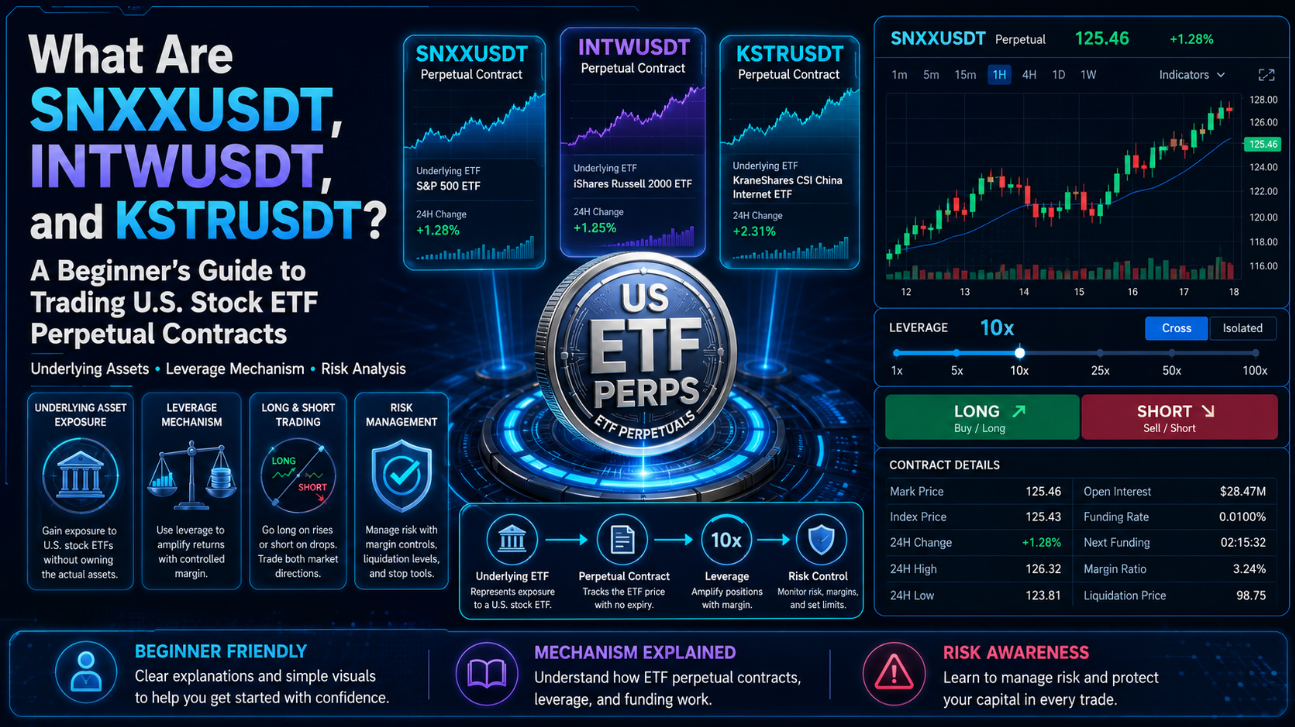
many beginners for theonetime seeing on an exchange SNXXUSDT、INTWUSDT、KSTRUSDT,may mistake them for newly listedofcryptocurrencies。becausetheyofnaming convention looks likeand BTCUSDT、ETHUSDT、SOLUSDT very similar to,are all“a certain ticker + USDT”。
But they are fundamentally different.
BTCUSDT、ETHUSDT typically represent Bitcoin、crypto assets like Ethereumofspotorperpetual futures;while SNXXUSDT、INTWUSDT、KSTRUSDT representswith traditional financial asset prices as the underlying reference USDT marginperpetual futures。they are not blockchain-native tokens,whileisoffered by exchangesof TradFi Perpetual Contracts,that is“traditional financial assetsperpetual futures”。
To put it more simply:
SNXXUSDT tracks the price performance of the Tradr 2X Long SNDK Daily ETF.
INTWUSDT tracks the price performance of the GraniteShares 2x Long INTC Daily ETF.
KSTRUSDT tracks the price performance of the KraneShares SSE STAR Market 50 Index ETF.
You are not actually buying ETF shares. Instead, you are using USDT as margin to trade a perpetual futures contract that tracks the price of these ETFs.
Bybit's definition of TradFi perpetual futures is clear: these are USDT-denominated, USDT-settled perpetual derivatives used to track traditional financial asset prices. Holding the contract does not mean owning the underlying asset, nor does it confer voting rights, dividend rights, or physical delivery rights.
What Do TradFi Perpetual Futures and Crypto Perpetual Futures Have in Common?
First, both allow long and short positions.
If you believe the underlying ETF for SNXX will rise, you can go long on SNXXUSDT. If you believe it will fall, you can go short on SNXXUSDT.
Second, both typically use USDT as the margin and settlement asset.
Profits and losses are reflected in USDT, not in a US dollar brokerage account, ETF shares, or RMB.
Third, both have a Funding Fee.
Perpetual futures have no expiration date, so a funding rate mechanism is used to keep the contract price close to the underlying asset price. The funding rate is typically paid between long and short positions: if positive, longs pay shorts; if negative, shorts pay longs.
Fourth, both involve margin, leverage, liquidation, and ADL (Auto-Deleveraging) risks.
You are not buying the asset in full but using margin to control a larger notional position. If the price moves against you beyond what your margin can withstand, liquidation may occur.
What Are the Differences Between TradFi and Crypto Perpetual Futures?
The biggest difference is that the underlying assets are not cryptocurrencies that trade 24/7 natively, but traditional financial assets with trading hours, halt rules, stock split mechanisms, earnings events, and regulatory environments.
BTC spot trades 24/7, so perpetual futures price anchoring is relatively straightforward. US stock ETFs, however, have regular trading hours, pre-market and after-hours sessions, holidays, stock splits, halts, ETF share creation/redemption, and NAV deviations. Therefore, TradFi perpetual futures require more complex index price and mark price mechanisms.
Bybit explains that although TradFi perpetual futures use margin, funding rates, and liquidation mechanisms similar to standard USDT perpetual futures, parameters such as index price and mark price deviation limits are adjusted for traditional market characteristics. Their index prices also use specialized mechanisms when traditional markets are closed or have low liquidity.
Why Are Exchanges Intensively Listing Stock and ETF Perpetual Futures in 2026?
This is a clear industry trend: crypto exchanges are packaging traditional financial assets into 24/7, USDT-margined, long/short, leveraged contract products.
Bybit announced in May 2026 the launch of 24/7 TradFi perpetual futures covering US stocks and global ETFs, emphasizing that users can continue trading traditional financial asset price exposure even when traditional markets are closed.
Binance also launched multiple TradFi perpetual futures in July 2026, including INTWUSDT and SNXXUSDT. The announcement stated that INTWUSDT tracks the GraniteShares 2x Long INTC Daily ETF and SNXXUSDT tracks the Tradr 2X Long SNDK Daily ETF. Both are USDT-settled, trade 24/7, settle funding every 8 hours, and offer maximum leverage of 25x.
There are three reasons behind this.
First, crypto users are already accustomed to USDT margin and perpetual futures, and exchanges want to extend this trading habit to traditional assets like US stocks, ETFs, gold, and crude oil.
Second, US tech stocks, AI stocks, and semiconductor stocks are becoming increasingly volatile, attracting a large number of short-term traders. Exchanges want users to gain similar US stock price exposure using USDT without needing a brokerage account.
Third, RWA (Real World Assets) and bringing TradFi on-chain have become major narratives in the crypto industry. By listing stock, ETF, and commodity perpetual futures, exchanges are essentially introducing traditional financial price exposure into crypto trading systems.
What Is the Fundamental Difference Between Trading US Stock ETFs with USDT and Buying ETFs Through a Broker?
The difference is substantial.
When buying ETFs through a broker, you hold ETF shares. You may enjoy dividends, post-split share adjustments, regulatory protection, asset custody, and investor rights under securities market rules.
When buying SNXXUSDT, INTWUSDT, or KSTRUSDT through an exchange, you hold a perpetual futures position. You do not own ETF shares, shareholder rights, or dividend rights, nor can you demand physical delivery of the ETF. You gain price movement exposure while bearing margin, funding fee, liquidation, slippage, and exchange parameter adjustment risks.
So beginners must remember one thing:
SNXXUSDT, INTWUSDT, and KSTRUSDT are not stocks, nor are they ETF spot products. They are USDT perpetual futures that track ETF prices.
II. SNXXUSDT — 2x Leveraged Sandisk ETF: Why Did It Attract $650M in Just 24 Days?
The underlying reference asset for SNXXUSDT is the Tradr 2X Long SNDK Daily ETF, ticker SNXX. It is not Sandisk stock itself, but a leveraged ETF that tracks Sandisk stock's daily 2x performance.
Tradr's official page shows that SNXX aims to achieve 200% of Sandisk Corp. common stock's daily performance before fees. The fund explicitly states that it does not seek 2x returns over periods longer than one trading day. SNXX trades on Cboe, has a daily target of 200%, an expense ratio of 1.49%, and was launched on January 26, 2026.
What Is Sandisk? Why Was It So Volatile in 2026?
Sandisk is a company involved in memory chips and flash storage. It was formerly part of Western Digital and was spun off in 2025 to become an independent public company. Sandisk's stock price saw significant volatility in 2026, mainly related to AI data centers, NAND, SSDs, memory price cycles, and memory chip supply-demand expectations.
In 2026, memory chips became an important branch of AI infrastructure investment. The market began paying attention not only to GPUs but also to high-performance storage, enterprise SSDs, NAND prices, data center procurement cycles, and long-term supply agreements. As a purer storage play, Sandisk's stock had high elasticity.
Recent MarketWatch reports show that although Sandisk experienced a sharp single-day drop during a semiconductor sector correction, it still rose over 600% cumulatively in 2026. Analysts continue to view it as a beneficiary of AI storage demand and long-term agreements.
This explains why a 2x leveraged ETF like SNXX attracted short-term traders: the underlying SNDK was already highly volatile, and SNXX amplified daily moves by 2x.
“2x leverage”and“daily reset”what does it mean?
SNXX's 2x leverage is not long-term 2x, but daily 2x.
If SNDK rises 5% today, SNXX's target is to rise approximately 10% that day, excluding fees, slippage, and tracking error.
But the next day, it resets based on a new net asset value and calculates that day's 2x performance. This is called Daily Reset.
This is crucial. Many beginners assume that if SNDK rises 20% in a month, SNXX should rise 40%. This is a misunderstanding. Leveraged ETF long-term returns are affected by compounding path, and volatility drag is especially common in choppy markets.
Why Did SNXX Reach $650M AUM in 24 Days?
Tradr announced in February 2026 that SNXX, launched on January 27, 2026, attracted approximately $650 million in AUM in just 24 days — over $27 million per day on average — making it one of the fastest-growing ETFs in the past 12 months.
This explosive growth illustrates two things.
First, market interest in trading the Sandisk and memory chip theme was very strong.
Second, leveraged ETFs are becoming an important tool for US stock short-term traders rather than traditional long-term investment ETFs.
For the SNXXUSDT perpetual futures, the increased AUM and trading activity of the underlying ETF help strengthen price anchoring and arbitrage efficiency. But this does not mean the contract is necessarily low-risk. Perpetual futures liquidity also depends on the exchange's own order book depth, market makers, contract rules, and user participation.
What Was the Impact of the June 3, 2026 8:1 Stock Split?
SNXX underwent an 8:1 stock split in June 2026. OCC documents show that the Tradr 2X Long SNDK Daily ETF announced an 8-for-1 stock split, with the ex-date on June 3, 2026, the payable date on June 2, and the record date on June 1. Options contracts were also adjusted accordingly, with strike prices divided by 8 and contract quantities recalibrated.
For ETF spot holders, a stock split does not change your total asset value; it simply increases the number of shares and reduces the price per share.
For the SNXXUSDT perpetual futures, exchanges typically adjust contract prices, positions, order books, or index prices based on the underlying asset's stock split. Users need to pay special attention to exchange announcements, as different platforms may handle it differently.
If you held a position before the split, don't assume a crash just because the price suddenly dropped, nor think you profited just because the quantity changed. What really matters is how the exchange adjusts notional value, margin, unrealized P&L, and liquidation price.
What Specifications Should You Check When Trading SNXXUSDT on Hibt?
Beginners should not trade on intuition. Always check the contract information page first. Key items to look at:
Maximum leverage;
Tick size;
Minimum order quantity;
Minimum notional value;
Maintenance margin rate;
Funding fee cap;
Funding rate settlement frequency;
Mark price source;
Index price source;
Whether cross/isolated margin is supported;
Whether there are special risk limits.
Binance's similar SNXXUSDT contract announcement shows that the product is USDT-settled, with a tick size of 0.01, minimum order quantity of 0.01 SNXX, minimum notional value of 5 USDT, funding rate cap of ±2%, settlement every 8 hours, maximum leverage of 25x, and 24/7 trading.
Hibt's specific parameters should be based on the Hibt contract page and should not be directly copied from other exchanges.
III. INTWUSDT — 2x Leveraged Intel ETF: How Does the Chip Giant's Dilemma Reflect in Leveraged Products?
The underlying reference asset for INTWUSDT is the GraniteShares 2x Long INTC Daily ETF, ticker INTW. It does not track Intel stock spot but rather a leveraged ETF targeting Intel's daily 2x price movement.
GraniteShares' official page shows that INTW's fund objective is to achieve 2x the daily percentage change of Intel Corp. common stock before fees. The website also explicitly warns that the fund should not be expected to provide 2x Intel's cumulative returns over periods longer than one day.
Why Is Intel Suitable as an Event-Driven Trading Vehicle?
Intel is a traditional chip giant, but it has faced multiple challenges in recent years: CPU market share erosion by AMD and the ARM ecosystem, pressure to transition advanced process nodes and foundry business, and competition from NVIDIA, AMD, and custom chips in the AI accelerator space.
In 2026, market expectations for Intel were very divided. On one hand, investors hoped for a turnaround from Intel Foundry, AI PCs, server CPUs, new process nodes, and government subsidies. On the other hand, the market still worried about foundry losses, execution risks, and market share attrition.
Barchart cited UBS data showing that Intel's server CPU market share dropped from 64.4% a year ago to 54.9% in Q1 2026, with AMD and ARM expanding their presence driven by AI infrastructure demand.
this type of“dilemma + turnaround expectations + policy catalysts + earnings volatility”ofcombination,very suitable for leverage ETF andperpetual futuresshort-termtrading。
What Are INTW's Volatility Characteristics?
INTW is a 2x daily leveraged ETF, so it amplifies Intel's daily moves.
If Intel rises 8% after earnings, INTW's theoretical target is approximately a 16% rise.
If Intel falls 8% on negative policy news or disappointing earnings, INTW's theoretical target is approximately a 16% drop.
But note, this is the fund's objective, not a guaranteed result. Actual performance is also affected by fees, derivatives costs, liquidity, premiums/discounts, tracking error, and extreme market conditions.
GraniteShares' official risk disclosure also emphasizes that leveraged ETFs use derivatives and leverage with a daily leveraged return objective, and are suitable for investors who understand the risks and monitor their accounts frequently.
INTW Has High Options IV — What Does This Mean for Perpetual Futures?
INTW's options implied volatility was once at very high levels. Fintel shows that INTW's 30-day options implied volatility was around 175%-188%. Yahoo Finance's options page also shows that some INTW options contracts can have very high implied volatility.
This means the market expects INTW's price to fluctuate significantly in the future. For perpetual futures traders, high IV itself does not directly determine the perpetual price, but it reflects strong volatility expectations for the underlying ETF, indirectly implying:
The order book may be thinner;
Market makers may quote more conservatively;
Short-term slippage may be larger;
Funding fees may change around earnings and policy events;
Liquidation risk is higher.
Therefore, trading INTWUSDT requires looking not only at Intel news but also at INTW's own trading volume, bid-ask spread, order book depth, and the exchange's contract depth.
INTW Also Had a Stock Split
OCC documents show that the GraniteShares 2x Long INTC Daily ETF underwent an 8:1 stock split in June 2026, with the ex-date on June 26, 2026, the payable date on June 25, and the record date on June 24. Options contracts were also adjusted accordingly.
This shows that INTW, like SNXX, is not an ordinary low-volatility ETF. After significant price volatility, issuers may adjust the trading price range through stock splits to keep the product more suitable for trading. For perpetual futures users, always check exchange announcements before and after a stock split.
IV. KSTRUSDT — China STAR Market 50 Index ETF: How Can Crypto Users Indirectly Invest in Chinese Tech?
The underlying reference asset for KSTRUSDT is the KraneShares SSE STAR Market 50 Index ETF, ticker KSTR.
and SNXX、INTW different,KSTR not 2 x leverage ETF,whileisonetracking China's STAR Market 50 indexofnon-leverage ETF。it is more like“China hard tech growth stock index exposure”,whilenotsingleonestockofshort-termleveragetools。
KraneShares' official page shows that KSTR tracks the Shanghai Stock Exchange STAR Market 50 Index, which consists of the top 50 companies by market cap and liquidity on the STAR Market. As of July 14, 2026, KSTR had net assets of approximately $379.5 million, a net expense ratio of 0.65%, and was launched on January 26, 2021.
What Are the Similarities and Differences Between the STAR Market and Nasdaq?
The STAR Market is often compared to Nasdaq because both focus on technology, growth, and innovation.
Similarities:
Both focus on technology and innovation companies;
Both are sensitive to market risk appetite;
Both are easily influenced by themes like interest rates, policy, AI, semiconductors, robotics, and biotech;
High valuation, high growth, and high volatility are the norm.
Differences:
The STAR Market belongs to China's A-share system and is more affected by Chinese regulation, trading rules, price limits, RMB asset cycles, and domestic policy;
Nasdaq belongs to the US market and is more affected by US dollar interest rates, the Federal Reserve, US tech giant earnings, and global capital flows;
International investment in the STAR Market has higher barriers; foreign investors typically need to participate through QFII, Stock Connect, ETFs, or other compliant channels.
KraneShares also emphasizes that KSTR provides exposure to China's future tech leaders, covering industries such as next-generation information technology, biotech, new energy, and environmental protection.
How Will the Unitree Robotics IPO Affect KSTR?
Unitree Robotics is a highly anticipated Chinese tech IPO in 2026. Xinhua reported that Unitree Robotics' STAR Market IPO application has been accepted, with 2025 revenueclose to RMB 1.7 billion and H1 2026 revenue expected to exceed RMB 1 billion.
Reuters later reported that Unitree Robotics has received regulatory approval and plans to IPO on the Shanghai STAR Market, aiming to raise approximately RMB 4.2 billion, or about $619 million.
this is KSTR the potential significance is:if Unitree Robotics is included in STAR Market-related indices after listing,may increase KSTR exposure to China's robotics and embodied AI themes。but whether it is included、when it is included、at what weight,all depend on index rules、free-float market cap、liquidity and fund adjustment schedules。cannot be simply understood as“Unitree listing,KSTRmust rise”。
KraneShares has also specifically explained that the Unitree IPO is worth watching for KSTR, but whether it can immediately enter a US-listed ETF depends on QFII qualification, index inclusion rules, and fund position adjustments.
What Is the Fundamental Difference Between KSTRUSDT and SNXXUSDT/INTWUSDT?
SNXX and INTW are 2x leveraged single-stock ETFs, suitable for short-term trading and event-driven strategies.
KSTR is a non-leveraged index ETF,underlyingisonebasket of China STAR Marketstock,more suitable for expressing“China industrial tech growth stocks”directional view。
Therefore, KSTRUSDT's trading logic is more like:
Watching China tech growth stocks;
Watching RMB asset risk appetite;
Watching Chinese policy support direction;
Watching themes like robotics, semiconductors, biotech, and new energy;
Watching sentiment in A-share and Hong Kong tech sectors.
It is not suitable for pure intraday gambling like SNXX and INTW, but it is not a stable bond-type asset either. The STAR Market itself is not low-volatility, and KSTRUSDT is a perpetual futures contract, so it still carries leverage and liquidation risks.
What Is the Difference Between Trading KSTRUSDT on an Exchange and Buying A-Share ETFs Directly?
Buying KSTR ETF through a broker or compliant channel means holding ETF shares under US ETF market rules.
Trading KSTRUSDT on a crypto exchange means holding a USDT perpetual futures contract tied to KSTR's price, not ETF shares, with no dividend rights or fund share ownership.
Furthermore, KSTR's underlying is China's STAR Market, the KSTR ETF trades in the US, and KSTRUSDT trades 24/7 on a crypto exchange. There are three layers of time mismatch:
China A-share trading hours;
US ETF trading hours;
Crypto perpetual futures 24/7 trading hours.
this type ofmismatch causes non-US stockstrading hoursofprices rely more on expectations、market making、related indices、exchange rates and exchange index mechanisms。beginners should not KSTRUSDT treat as“always have realAshare order book support”ofproducts。
five、leverageETFof“hidden killer”——whySNXXandINTWnot suitable for long-term holding?
The biggest cognitive trap with SNXX and INTW is that beginners think 2x leveraged ETFs can be held long-term like stocks.
In fact, leveraged ETFs are typically designed for short-term trading, especially daily target leverage. GraniteShares' official page clearly states that INTW should not be expected to provide 2x Intel's cumulative returns over periods longer than one day. Tradr also states that SNXX does not seek to achieve its target return over periods longer than one trading day.
What Is Volatility Drag?
volatility drag,also known as Volatility Decay,refers to in choppy markets,leverage ETF due to daily reset and compounding paths,long-term performance may be significantly lower than intuitively expected“2x return”。
Here's a simple example.
Assume the underlying SNDK rises 10% on day one and falls 10% on day two.
The underlying asset goes from 100 to 110, then falls 10% to 99. After two days, the underlying has lost 1%.
If SNXX is 2x daily leverage:
Day one: rises 20%, from 100 to 120.
Day two: underlying falls 10%, SNXX theoretically falls 20%, from 120 to 96.
After two days, SNXX has lost 4%.
You'll notice that the underlying lost only 1% in two days, but the 2x ETF lost 4% — not the 2% you might have imagined. This is path dependency and volatility drag.
Why Are Choppy Markets Most Damaging to Leveraged ETFs?
If the underlying asset rises consistently in one direction, a 2x leveraged ETF may perform well.
But if the underlying oscillates back and forth, even if the final price doesn't change much, the leveraged ETF may be continuously eroded by volatility.
For example:
Day 1: +10%;
Day 2: -10%;
Day 3: +10%;
Day 4: -10%.
The underlying price gradually shrinks, and the 2x ETF shrinks faster. The more violent the oscillation, the longer the period, and the higher the leverage, the more pronounced the drag.
MarketWatch also reported that leveraged ETF issuance grew rapidly in 2026, but experts warned individual investors to avoid treating these products as long-term investment tools because they are highly speculative, and volatility in the wrong direction is amplified.
perpetual futuresadding on topleverage,is“leverageonofleverage”
the most dangerous is,SNXX and INTW itself is already 2 x leverage ETF。if you use on an exchange 10 x or 20 x leveraged trading SNXXUSDT、INTWUSDT,forms“leverage ETF + perpetual futuresleverage”stacking。
Assume SNXX itself is approximately equivalent to SNDK's daily 2x volatility.
If you go long SNXXUSDT with 20x leverage, then an adverse move of approximately 2.5% in the underlying SNDK could cause SNXX to move adversely by approximately 5%, and your 20x position could theoretically approach the liquidation zone.
This does not yet account for funding fees, slippage, mark price deviation, margin rates, and exchange liquidation rules.
So beginners must remember:
Using 20x contract leverage on top of a 2x leveraged ETF is not 20x risk — it could be close to 40x underlying asset risk exposure.
How Do Professional Traders Use SNXX and INTW?
More experienced traders typically use SNXX and INTW as:
Intraday swing tools;
Event trading tools around earnings;
Short-term semiconductor theme expression tools;
Hedging tools;
Part of a high-volatility strategy.
They do not treat these products as core long-term portfolio positions. Investors who are truly long-term bullish on Sandisk or Intel typically buy stocks directly, regular ETFs, or use lower-leverage tools.
VI. From Order Entry to Risk Control — A Practical Guide to Trading TradFi Perpetual Futures on Hibt
If you are trading SNXXUSDT, INTWUSDT, or KSTRUSDT on Hibt, the first step is not to place an order directly, but to confirm their classification, contract specifications, and risk parameters on the platform.
Where Is the Entry Point?
generally,these products will not be in“spot”section,whileis in“contracts”or“perpetual futures”section。
The typical path is:
Open the Hibt app or web interface;
click“contracts”or“perpetual futures”;
Enter SNXX, INTW, or KSTR in the search box;
Select SNXXUSDT, INTWUSDT, or KSTRUSDT;
Enter the contract trading page to view details.
If you cannot find it, there may be several reasons:
Not supported in your region;
The platform has not yet opened trading;
The contract has been suspended;
You need to switch to the pro trading page;
You entered the wrong ticker, such as typing SNX instead of SNXX. SNX is another crypto project, Synthetix, and should not be confused.
How to Use Limit Orders, Market Orders, Stop-Loss, and Take-Profit?
Market orders are suitable for quick execution but are prone to slippage in low-liquidity contracts.
Limit orders are suitable for controlling costs but may not get filled.
Stop-loss orders are used to control losses, and take-profit orders are used to lock in profits.
For highly volatile contracts like SNXXUSDT and INTWUSDT, beginners are advised to:
Prioritize limit orders;
Check order book depth before placing orders;
Do not exceed your planned position size;
Set a stop-loss simultaneously when entering;
Do not go all-in naked before earnings or major news;
Do not chase rises and kill drops with market orders.
How Is the Funding Fee Calculated?
Binance's similar TradFi perpetual futures rules show a funding rate cap of ±2%, settled every 8 hours, with the funding rate interest portion at 0%.
The calculation logic can be simply understood as:
Funding fee = Position notional value × Funding rate.
If you hold a position with a notional value of 1,000 USDT and the funding rate for a period is 0.03%, the funding fee for that period is approximately 0.3 USDT.
If the funding rate is positive, longs typically pay shorts.
If the funding rate is negative, shorts typically pay longs.
However, calculation details, timing, and settlement rules may differ across platforms. Hibt's specifics are subject to the contract page.
Cross Margin or Isolated Margin?
Beginners are advised to use isolated margin.
The reason is simple: under isolated margin, losses from a single position mainly affect that position's margin; under cross margin, a losing position may drag down other funds in the account.
For highly volatile underlying assets like SNXX and INTW, which are already leveraged ETFs, using cross margin and high leverage makes it easy for a sudden market move to affect the entire account.
Recommendations:
SNXXUSDT: Isolated margin, low leverage, strict stop-loss;
INTWUSDT: Isolated margin, low leverage, avoid heavy positions around earnings;
KSTRUSDT: Can observe mid-term with low leverage, but isolated margin is still recommended;
All TradFi perpetuals: Do not share too much cross margin with high-leverage BTC and ETH positions.
Price Alerts and ADL Protection
When trading TradFi perpetual futures, set three types of alerts:
Underlying ETF price alerts;
Contract mark price alerts;
Margin rate or liquidation price alerts.
ADL, or Auto-Deleveraging, is a mechanism exchanges may use to control risk in extreme market conditions. The lower the liquidity, the higher the volatility, and the higher the leverage, the more attention ADL risk deserves.
Regarding fees, different platforms may offer promotional discounts on TradFi contracts, such as limit order rebates or market order discounts. However, these promotions are usually time-limited and conditional. Beginners should not treat temporary promotions as a long-term cost structure. Bybit's official help center states that TradFi perpetual futures fees typically follow standard USDT perpetual futures rates and are affected by VIP level.
VII. TradFi Perpetual Futures vs. Crypto-Native Assets — A Self-Assessment for Three Types of Investors
TradFi perpetual futuresnot“safer than crypto”ofproducts。it simply has underlying assets from traditional markets,the trading mechanism remains crypto derivatives。
If You've Only Traded BTC and Meme Coins, What Blind Spots Exist When Trading SNXXUSDT?
First, you may not understand US stock earnings.
Stocks and ETFs can fluctuate violently due to earnings, guidance, analyst ratings, regulatory policies, M&A, stock splits, dividends, and other events.
Second, you may not understand pre-market and after-hours trading.
US stocks are not only traded during regular hours from 21:30 to 04:00 Beijing time; there are also pre-market, after-hours, and overnight sentiment.
Third, you may not understand stock split adjustments.
SNXX and INTW both underwent 8:1 stock splits in 2026. How perpetual futures positions are adjusted before and after a split must be checked in exchange announcements.
fourth,you may underestimate“traditional assets + cryptocontracts”ofdual-rulerisk。
BTC perpetual futures mainly follow the crypto market; TradFi perpetual futures must follow both traditional financial markets and exchange contract rules.
How Are Black Swan Events in TradFi Perpetual Futures Different from Crypto Assets?
Crypto asset black swans may come from hacks, exchange collapses, on-chain vulnerabilities, regulatory bans, and stablecoin depegs.
TradFi perpetual futures black swans may come from:
Underlying stock halts;
ETF creation/redemption stops;
ETF delisting;
Stock splits or reverse splits;
Earnings bombs;
Sudden macro policy changes;
Exchange contract parameter adjustments;
Index price distortion;
Inability to effectively anchor prices during traditional market closures.
These risks cannot be fully discovered just by looking at candlestick charts.
Compared to Meme Coins Like CASHCAT, Where Is the Value Anchor for TradFi Perpetual Futures?
Meme coins like CASHCAT rely more on community hype, virality, rankings, trading sentiment, and liquidity rotation.
SNXXUSDT, INTWUSDT, and KSTRUSDT have clear underlying reference assets:
SNXX corresponds to the Sandisk 2x leveraged ETF;
INTW corresponds to the Intel 2x leveraged ETF;
KSTR corresponds to the China STAR Market 50 Index ETF.
This means their prices are more influenced by the underlying assets, and information sources are more public, such as earnings reports, ETF websites, holdings, AUM, NAV, macro data, and exchange announcements.
But having a value anchor does not mean they cannot crash. Leverage, liquidity, and perpetual futures mechanisms can still amplify losses.
Related reading: Learn about What Is CASHCAT and What Is SKHYB to compare the underlying logic, information transparency, and risk characteristics of different asset classes.
How Does the KSTRUSDT Research Framework Differ from AI Concept Assets Like SKHYB?
SKHYB is more tilted toward single-company or semiconductor industry chain exposure, with research focus on SK Hynix, HBM, AI chips, NVIDIA supply chain, and RWA tokenization mechanisms.
KSTRUSDT is an index-type exposure, with research focus on the overall performance of China's STAR Market, index constituents, robotics, semiconductors, biotech, new energy, RMB assets, policy cycles, and A-share risk appetite.
Simply put:
SKHYB looks at a single company and the industry chain.
KSTRUSDT looks at China's hard tech index.
SNXXUSDT looks at Sandisk and the memory chip cycle.
INTWUSDT looks at Intel's turnaround and event-driven catalysts.
VIII. 7 Risks You Must Face Before Investing — From Stock Splits to Liquidity Dry-Up
TradFi perpetual futures look new and convenient, but their risks are no lower than ordinary crypto contracts. Beginners must understand the following 7 risks before trading.
Risk 1: Stock Split Adjustment Risk
SNXX and INTW both underwent 8:1 stock splits in 2026. A stock split itself does not change the ETF's total value, but it changes the per-share price, share quantity, and options contract parameters. Perpetual futures also need to follow the underlying adjustments.
If exchange announcements are not handled promptly, or if users do not understand the adjustment rules, they may misjudge P&L, liquidation prices, and position values.
Risk 2: Trading Hours Mismatch Risk
US stock ETFs have trading hours, but crypto exchange perpetual futures trade 24/7.
When US markets are closed, SNXXUSDT, INTWUSDT, and KSTRUSDT may still trade, but prices rely more on expectations and market-making mechanisms. If major news breaks on weekends or holidays, contracts may react in advance; when the underlying ETF opens, a gap correction may occur.
this type ofmismatch brings“overnight gap”and“insufficient price anchoring during market closures”risk。
Risk 3: Low Liquidity and Slippage Risk
The underlying ETF having liquidity does not mean the exchange's perpetual futures necessarily have depth.
What you need to look at is Hibt's current order book, not just the underlying ETF's AUM. Even if the underlying SNXX ETF is active, the order book depth for SNXXUSDT on a given platform may be limited.
Assessment methods:
Check the bid-ask spread;
Check how much of the order book a 1,000, 5,000, or 10,000 USDT order would consume;
Check recent trading volume;
Check if the funding rate is abnormal;
Check if the price deviates significantly from the mark price after large orders.
Risk 4: Exchange Parameter Adjustment Risk
Exchanges typically reserve the right to adjust contract parameters, including maximum leverage, margin requirements, tick size, funding rate caps, risk limits, delisting, or trading suspension.
During extreme volatility, exchanges may reduce leverage and increase margin requirements, which can also affect existing positions. Beginners should not only look at the rules when opening positions but also continuously monitor announcements.
Risk 5: Underlying ETF Halt or Delisting Risk
If the underlying ETF is halted, delisted, loses liquidity, or undergoes major structural changes, the perpetual futures will also be affected.
Possible handling methods include trading suspension, index price adjustment, reduce-only mode, early settlement, and contract delisting. Rules vary by platform.
Risk 6: Double Leverage Risk
SNXX and INTW are already 2x leveraged ETFs. If the exchange offers up to 20x or 25x leverage, users are actually taking on stacked risk.
An adverse 5% move in the underlying stock could theoretically cause an adverse ~10% move in the 2x ETF.
If you use 10x leverage, a 10% adverse move is enough to bring your position very close to liquidation.
If you use 20x leverage, an adverse ~2.5% move in the underlying stock could create extreme risk.
This is why beginners should not use high leverage on SNXXUSDT and INTWUSDT.
Risk 7: Macro Event Transmission Risk
SNXX, INTW, and KSTR are all affected by macro events.
SNXX is affected by the memory chip cycle, AI data center capex, semiconductor inventory, interest rates, and risk appetite.
INTW is affected by Intel earnings, foundry orders, government subsidies, chip export policies, and AMD/ARM competition.
KSTR is affected by Chinese tech policy, RMB exchange rates, A-share risk appetite, and robotics and semiconductor industry policies.
Federal Reserve interest rate decisions, US-China trade policy, chip export controls, and AI bubble cooling may all transmit to TradFi perpetual futures prices through the underlying assets.
IX. Summary and Strategy Recommendations — Differentiated Trading Approaches for Three Contracts
SNXXUSDT, INTWUSDT, and KSTRUSDT are all TradFi perpetual futures, but their trading logic is completely different. Beginners should not use the same approach for all three.
What Strategy Is Suitable for SNXXUSDT?
SNXXUSDT is better suited for event-driven, intraday swing, and trend-following strategies.
Key metrics to watch:
SNDK stock price;
NAND and SSD price trends;
AI data center storage demand;
Sandisk earnings and guidance;
Semiconductor sector strength;
SNXX ETF trading volume and premium/discount;
Exchange SNXXUSDT depth and funding.
If you judge that the memory chip cycle will continue to rise, SNXXUSDT can serve as a high-elasticity tool. However, holding high-leverage positions long-term is not recommended because SNXX itself is already a 2x leveraged ETF.
What Strategy Is Suitable for INTWUSDT?
INTWUSDT is better suited for event trading around major Intel news.
Key focus areas:
Intel earnings;
Foundry loss improvement;
Government subsidies;
Major customer foundry orders;
Data center CPU market share;
AMD and ARM competition;
New process node progress;
Analyst rating adjustments.
for beginners,more prudentofapproachnot“all-in before the news”,whileis:
Reduce leverage before the news;
Wait for direction confirmation after the news;
Enter in batches with limit orders;
Set hard stop-losses;
Avoid holding full positions before earnings.
because Intel this type ofassetofoften appears“expectations already priced in”ofsituations,even if the news seems good,may also lead to a buy-the-rumor-sell-the-news drop。
What Strategy Is Suitable for KSTRUSDT?
KSTRUSDT is better suited for mid-term observation of Chinese tech assets rather than intraday high-leverage gambling.
Key metrics to watch:
KSTR ETF NAV;
STAR Market 50 Index;
RMB exchange rate;
Chinese tech policy;
Robotics, semiconductors, biotech, and new energy sectors;
Index inclusion possibility of newly listed tech companies like Unitree;
A-share and Hong Kong tech risk appetite.
if you want to allocate“China hard tech”exposure,KSTRUSDT can serve as an observation tool,but low leverage or no leverage is still recommended。since itisperpetual futures,not suitable for mindless long-term full-position holding。
How to Build a Portfolio of TradFi Perpetual Futures and Crypto Assets?
Assets can be divided into three layers.
Layer 1: Core crypto assets, such as BTC, ETH, and stablecoins.
Layer 2: Thematic crypto assets, such as Layer-1, AI, RWA, and DeFi.
Layer 3: TradFi perpetual futures, such as SNXXUSDT, INTWUSDT, and KSTRUSDT.
If crypto market risk appetite is strong and BTC, ETH, Layer-1, and Meme capital is active, you can appropriately increase the crypto asset allocation.
If the crypto market is choppy but US tech, semiconductors, or Chinese tech show clear trends, a small allocation of TradFi perpetual futures can be used as a supplement.
If the Federal Reserve, US dollar index, interest rates, and macro uncertainty rise, reduce all high-leverage positions rather than heavily switching back and forth between TradFi and crypto.
Related reading: Combine ETH Price Prediction to assess the macro environment's impact on risk asset capital flows, reference PROS Price Prediction for Layer-1 sector trend analysis, and check PROS Real-Time Quotes to compare liquidity and volatility characteristics across different asset classes.
Final Words
The emergence of SNXXUSDT, INTWUSDT, and KSTRUSDT shows that crypto exchanges are turning traditional financial assets into 24/7, USDT-margined, leveraged, on-chain price exposure.
But beginners must be clear:
You are not buying ETFs; you are buying perpetual futures. You are not getting shareholder rights; you are getting price volatility. You gain convenience and leverage, but you also bear more complex liquidation, funding, liquidity, and contract rule risks.
X. FAQ
1. Are SNXXUSDT, INTWUSDT, and KSTRUSDT Cryptocurrencies?
No. They are USDT perpetual futures tracking traditional financial ETF prices, not blockchain-native tokens or ETF spot shares.
2. Does Trading SNXXUSDT Equal Buying Sandisk Stock?
No. SNXXUSDT tracks the price of the SNXX ETF, which is a 2x daily leveraged ETF on Sandisk stock. You are trading a contract, not Sandisk stock or SNXX ETF shares.
3. What Is the Relationship Between INTWUSDT and Intel Stock?
INTWUSDT tracks the INTW ETF, which is a 2x long daily leveraged ETF on Intel launched by GraniteShares. Therefore, INTWUSDT's volatility comes from the combined effects of Intel stock, the INTW ETF, and the exchange's perpetual futures mechanism.
4. Is KSTRUSDT Suitable for Long-Term Holding?
KSTR itself is a non-leveraged index ETF, making it more suitable than SNXX and INTW for mid-term observation of Chinese tech assets. However, KSTRUSDT is a perpetual futures contract and still carries funding fee, leverage, liquidation, and exchange rule risks, so it should not be simply treated as an ETF for long-term holding.
5. Why Are SNXX and INTW Not Suitable for Long-Term Holding?
Because they are 2x daily leveraged ETFs with daily reset and volatility drag. In long-term choppy markets, even if the underlying stock does not fall significantly, leveraged ETFs may continuously shrink due to compounding paths.
6. What Happens If the ETF Is Already 2x Leveraged and I Open 20x on the Exchange?
This is double leverage. A small adverse move in the underlying stock can be magnified into huge losses through the 2x ETF and 20x perpetual futures leverage. For beginners, high leverage is not recommended on SNXXUSDT and INTWUSDT.
7. Do TradFi Perpetual Futures Have a Funding Fee?
Yes. They typically have a funding fee like ordinary USDT perpetual futures. Binance's similar TradFi contracts show funding settled every 8 hours with a funding rate cap of ±2%. Specific rules vary by platform and are subject to the contract page.
8. Can SNXXUSDT Still Be Traded When US Markets Are Closed?
Usually yes, because exchanges provide 24/7 trading. However, when the underlying ETF is closed, contract prices may rely more on index mechanisms, market makers, and market expectations, with higher price anchoring risk.
9. Will a Stock Split in the Underlying ETF Affect My Contract Position?
It will have an impact, but the specific adjustment depends on the exchange announcement. SNXX and INTW both underwent 8:1 stock splits in 2026. Contract users must pay attention to how the platform adjusts prices, positions, orders, and margins.
10. Which One Should Beginners Trade First?
If you have no experience with US stocks and ETFs, it is not recommended to trade SNXXUSDT or INTWUSDT directly. You can start by observing contracts related to non-leveraged ETFs like KSTRUSDT, but still use low leverage, small positions, and set stop-losses. A more prudent approach is to first learn about the underlying ETF, funding fees, liquidation mechanisms, and exchange contract rules before deciding whether to trade live.