
Part One: Why Is the Crypto Space Paying Attention to SKHYNIXUSDT?
In the past, crypto traders were most familiar with BTC, ETH, SOL, BNB, meme coins, and DeFi tokens. But entering 2026, crypto platforms have begun offering more and more “traditional-asset-linked trading pairs,” such as tech stock contracts, AI stock contracts, gold contracts, crude oil contracts, and tokenized stock assets.
SKHYNIXUSDT is a very typical example of this trend.
Many newcomers’ first reaction upon seeing this trading pair is usually:
“Why is the name of a Korean semiconductor company showing up on a crypto trading platform?”
The answer is simple: the AI industry is reshaping the intersection between traditional finance and crypto markets. SK Hynix is a globally significant memory chip company, especially noted in the market for its high-bandwidth memory (HBM). HBM is a critical component in AI GPUs, large-model training, AI servers, and data center construction.
Therefore, SKHYNIXUSDT is not an ordinary altcoin. It is a USDT-margined perpetual contract product designed around the price performance of SK Hynix. Users are not directly buying Korean stocks; instead, they are participating in SK Hynix price fluctuations through USDT margin.
According to the official Hibt announcement, the platform launched the SKHYNIXUSDT perpetual contract on July 10, 2026, at 16:00 (UTC+8), with USDT as the settlement asset, 7×24 trading hours, a maximum leverage of 50x, and a contract precision of 0.01.
This means the core positioning of SKHYNIXUSDT is:
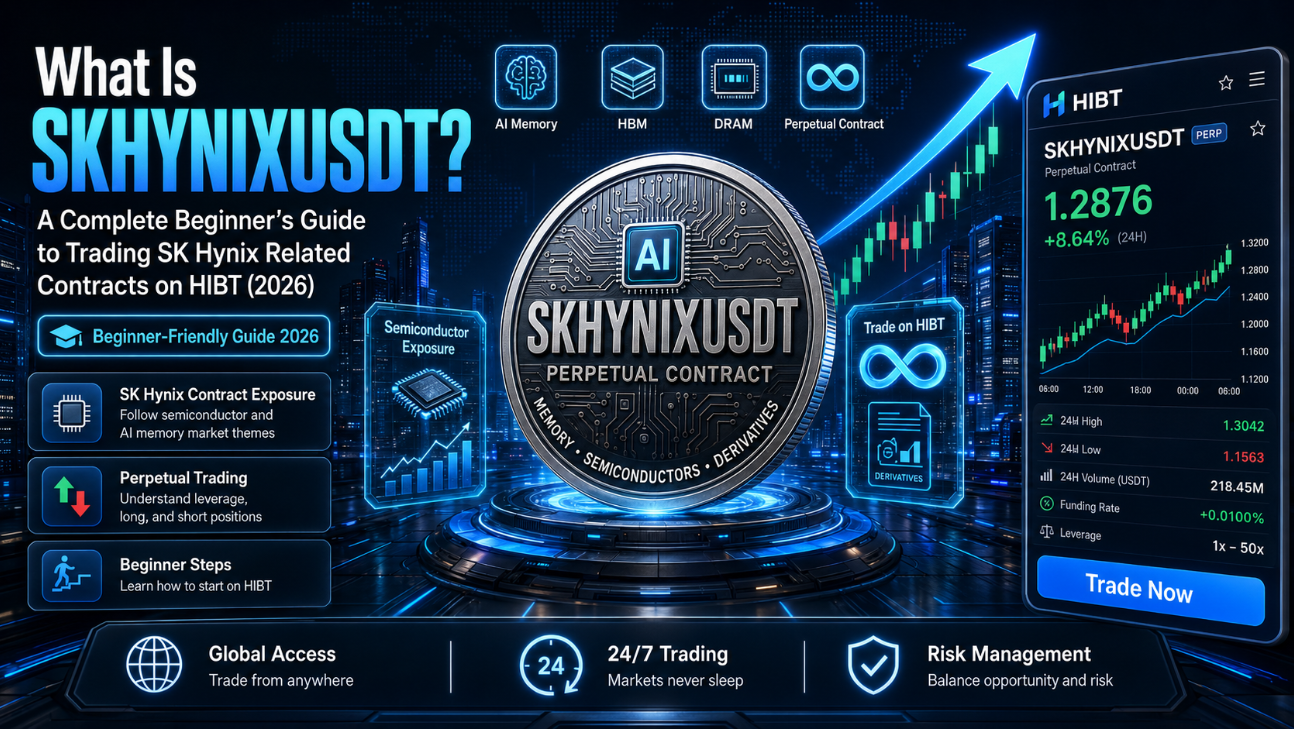
To allow crypto users to participate in the price action of AI semiconductor companies like SK Hynix through the familiar USDT perpetual contract format.
1.1 What Is SKHYNIXUSDT? Explained in One Sentence
SKHYNIXUSDT can be broken into two parts:
SKHYNIX: Represents the SK Hynix underlying asset
USDT: Represents the use of USDT as the quote and settlement asset
In one sentence:
SKHYNIXUSDT is a USDT-margined perpetual contract product tied to the price of SK Hynix. Users trade the price movements of SK Hynix, not the actual stock itself.
It may look similar to BTCUSDT or ETHUSDT on the trading interface—both have candlestick charts, order book depth, long/short positions, leverage, margin, and take-profit/stop-loss features. But the underlying asset logic is completely different.
BTCUSDT trades the price of Bitcoin.
ETHUSDT trades the price of Ethereum.
SKHYNIXUSDT trades the price performance of SK Hynix stock or a related index.
So newcomers must remember one thing:
SKHYNIXUSDT is not the stock itself; it is a USDT-margined contract tied to the stock price.
1.2 Why Has SK Hynix Become a Focus in Crypto?
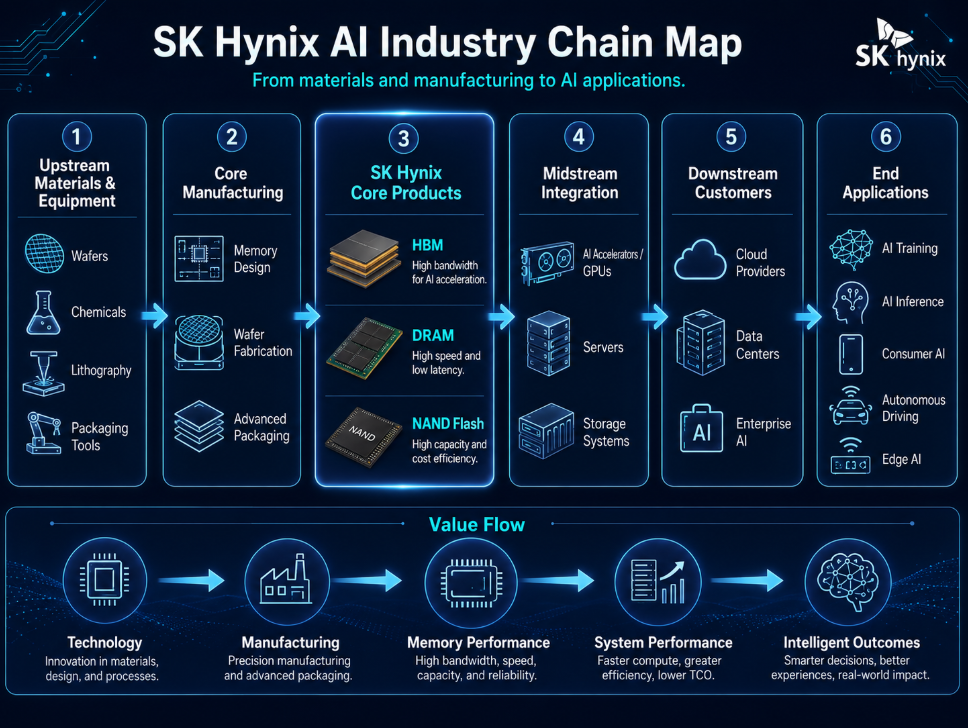
The reason SK Hynix has caught the attention of the crypto space is not because it “issued a token,” but because it sits at a critical position in the AI hardware supply chain.
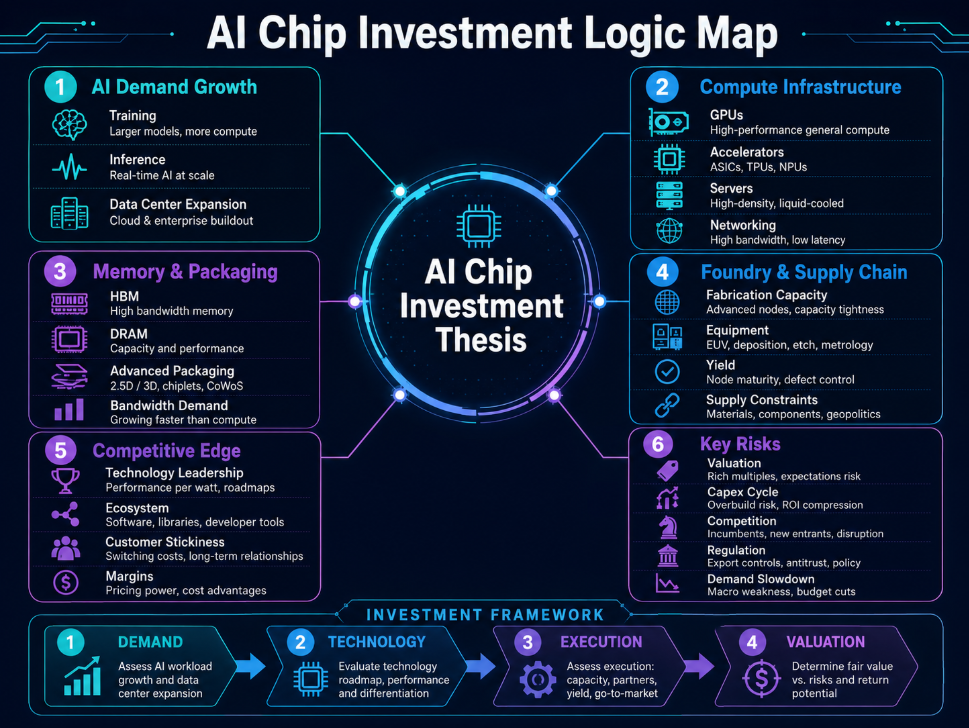
The development path of the AI industry can be simply understood as:
Increased demand for large-model training
↓
Increased demand for AI servers and GPUs
↓
GPUs require high-performance memory support
↓
Growing demand for HBM high-bandwidth memory
↓
Memory chip companies like SK Hynix benefit
Many newcomers know NVIDIA, but they don’t realize that NVIDIA GPUs also need high-performance memory to function. An AI server cannot run on GPUs alone; it also requires HBM, DRAM, NAND, SSD, networking, power, and cooling infrastructure.
According to SK Hynix’s official 2025 financial report, the company achieved record results, with full-year revenue reaching KRW 97.1467 trillion and operating profit reaching KRW 47.2063 trillion. The growth driver came from AI memory competitiveness and high-value-added products including HBM.
This is the fundamental reason SK Hynix has become a focus for AI investors:
It is not an AI application company, but a key player in the AI computing infrastructure supply chain.
1.3 How Is SKHYNIXUSDT Different from Ordinary Crypto?
Many newcomers mistakenly treat every ticker on an exchange as a “coin.” This is a common misconception.
Newcomers should be especially clear that SKHYNIXUSDT cannot be simply understood as “a new coin.” Its underlying logic is fundamentally different from assets like BTC, ETH, or SUSHI.
BTC and ETH are blockchain-native assets. Their value mainly derives from network consensus, on-chain usage demand, ecosystem development, and market cycles. When investing in these assets, the focus should be on chain security, on-chain activity, ecosystem applications, macro liquidity, and regulatory changes.
Assets like SUSHI are DeFi protocol tokens. Their value comes more from protocol usage, governance mechanisms, liquidity, trading fees, and ecosystem competitiveness. When evaluating such tokens, you cannot look at price alone; you must also consider protocol TVL, trading volume, user retention, revenue structure, and competitive pressure from similar DeFi projects.
SKHYNIXUSDT, on the other hand, is closer to a “contract trading gateway for traditional corporate price movements.” It is not a blockchain-native asset, nor is it a DeFi protocol governance token. It is a USDT-margined contract product designed around the price performance of traditional tech companies like SK Hynix. The core of what users trade is not the ecosystem value of a particular chain, nor the revenue of a DeFi protocol, but the rise or fall of the SK Hynix-related price.
Therefore, when trading SKHYNIXUSDT, you cannot use the same analytical methods as for BTC or altcoins. It is influenced simultaneously by SK Hynix stock performance, AI chip demand, HBM industry cycles, semiconductor industry sentiment, contract leverage, market liquidity, and funding rates.
In short:
BTC and ETH are about blockchain network value;
SUSHI is about DeFi protocol value;
SKHYNIXUSDT is about traditional corporate price volatility and contract trading risk.
This is also why SKHYNIXUSDT is attractive to crypto newcomers but carries more complex risks. It allows users to participate in the price action of AI semiconductor companies through the familiar USDT contract format, but it is not equivalent to buying SK Hynix stock, and it is certainly not suitable for blindly chasing rallies with high leverage.
If you want to understand the investment logic of DeFi tokens, you can read: What Is SUSHI?
The special feature of SKHYNIXUSDT is that it transforms traditional AI semiconductor stocks from the stock market into a USDT perpetual contract product familiar to crypto users.
Part Two: What Is SK Hynix? Why Do AI Investors Care?
Trading SKHYNIXUSDT is essentially not trading a blockchain project, but trading the price performance of SK Hynix. Therefore, before placing an order, you must first understand the company SK Hynix.
2.1 SK Hynix Company Overview
SK Hynix is a major South Korean semiconductor company and one of the world’s leading memory chip manufacturers. According to SK Hynix’s official introduction, the company is headquartered in South Korea and is a top-tier global semiconductor supplier, with products including DRAM and NAND flash memory, serving customers worldwide.
Its main business can be divided into three categories:
Category One: DRAM
DRAM is mainly used in:
- Data centers
- PCs
- Mobile phones
- Servers
- AI computing devices
DRAM is a very important memory component in computing devices, determining temporary data read/write capability.
Category Two: NAND Flash
NAND Flash is mainly used in:
- SSDs
- Enterprise storage
- Mobile device storage
- Data center storage devices
As AI data center construction increases, demand for enterprise SSDs and high-performance storage will also rise.
Category Three: HBM High-Bandwidth Memory
HBM is the most closely watched segment in the current market.
HBM is mainly used in:
- AI GPUs
- Large-model training
- AI inference servers
- High-performance computing
- Data center accelerators
For the AI industry, HBM is of great significance. GPUs handle computation, but GPUs need to read and transfer large amounts of data at high speed. If memory bandwidth cannot keep up, GPU performance cannot be fully unleashed.
2.2 Why Has HBM Become a Critical Resource in the AI Era?
When many people talk about AI investment, they only look at models, applications, and GPUs. But in real AI infrastructure, HBM is a very critical link.
It can be understood this way:
The larger the AI model
↓
The more data needed for training and inference
↓
The more GPUs required
↓
The higher the memory bandwidth requirements
↓
The stronger the HBM demand
The core value of HBM lies in its “high bandwidth.” It allows AI GPUs to access and process data faster, playing an important role in large-model training, AI inference, and high-performance computing.
In SK Hynix’s 2026 market outlook, Counterpoint Research data shows that as of Q2 2025, SK Hynix ranked first in HBM shipment volume with a 62% share. The article also mentions that HBM3E is expected to remain one of the main memory forms for AI servers and data centers in 2026.
This shows that SK Hynix is not simply benefiting from the “AI concept,” but from the real hardware demand present in AI infrastructure construction.
2.3 What Is the Relationship Between SK Hynix and the NVIDIA AI Ecosystem?
In the AI industry, NVIDIA is often seen as the core company for GPUs and AI accelerators. But GPUs do not run in isolation; they need memory products like HBM to work with them.
Simply put:
NVIDIA provides computing power.
SK Hynix provides high-speed memory.
Together, they serve AI servers and data centers.
In AI infrastructure, the relationship between GPUs and HBM is very close. The more powerful the GPU, the more it needs higher bandwidth, larger capacity, and higher efficiency memory to match.
Therefore, market attention on SK Hynix is not because it will replace NVIDIA, but because it may become an important supply chain beneficiary of NVIDIA’s AI ecosystem expansion.
For SKHYNIXUSDT traders, this is very important. Because SKHYNIXUSDT price fluctuations are not only affected by crypto market sentiment, but also by AI chip demand, NVIDIA supply chain expectations, HBM supply dynamics, and semiconductor cycles.
Part Three: What Exactly Is SKHYNIXUSDT? A Detailed Explanation of the Contract Mechanism
This chapter addresses the most critical question:
“If I buy SKHYNIXUSDT, does that mean I own SK Hynix stock?”
The answer is: No.
SKHYNIXUSDT is not a stock, nor is it a tokenized spot stock asset. It is a USDT-margined perpetual contract product tied to the price performance of SK Hynix.
3.1 If SKHYNIXUSDT Is Not a Stock, What Is It?
SKHYNIXUSDT is a contract trading product. Users trade price movements, not stock ownership.
This means trading SKHYNIXUSDT will not give you:
- SK Hynix shareholder status
- Corporate voting rights
- Stock dividend rights
- Real shares in a securities account
- Traditional stock market shareholder rights
What you do get is:
- Using USDT as margin
- Going long or short on the SK Hynix-related price
- Generating profit or loss based on price changes
This is the essential difference between a contract and a stock.
If you want to hold actual SK Hynix stock for the long term, you typically need to go through a traditional securities account or a broker that supports the relevant market.
If you want to trade SK Hynix-related price fluctuations using USDT, perpetual contracts like SKHYNIXUSDT are closer to the crypto trading style.
3.2 What Is the Trading Logic of SKHYNIXUSDT?
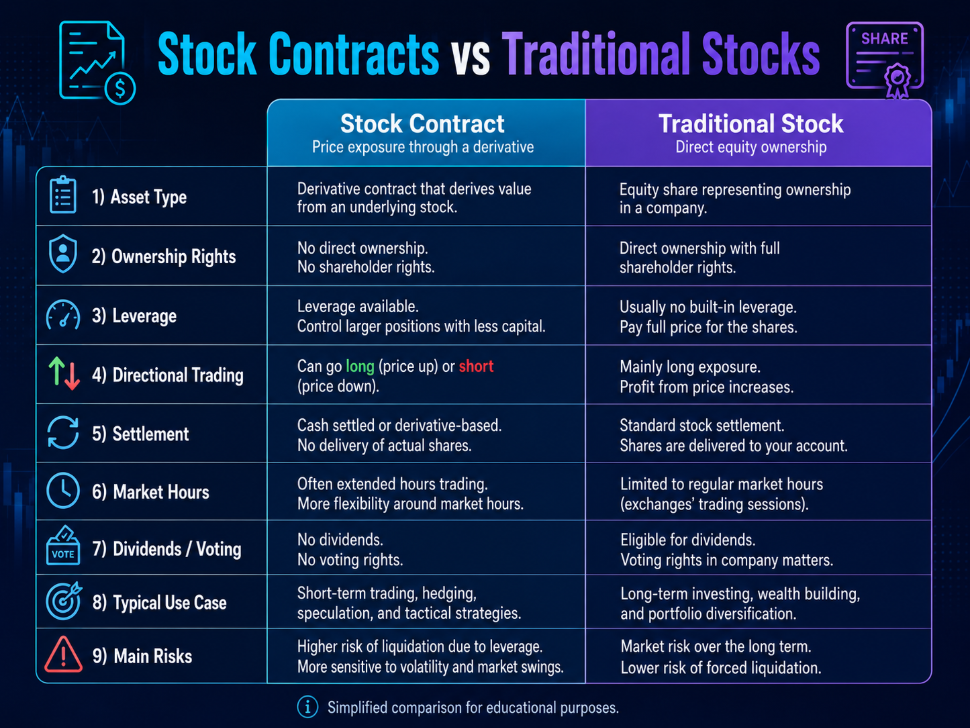
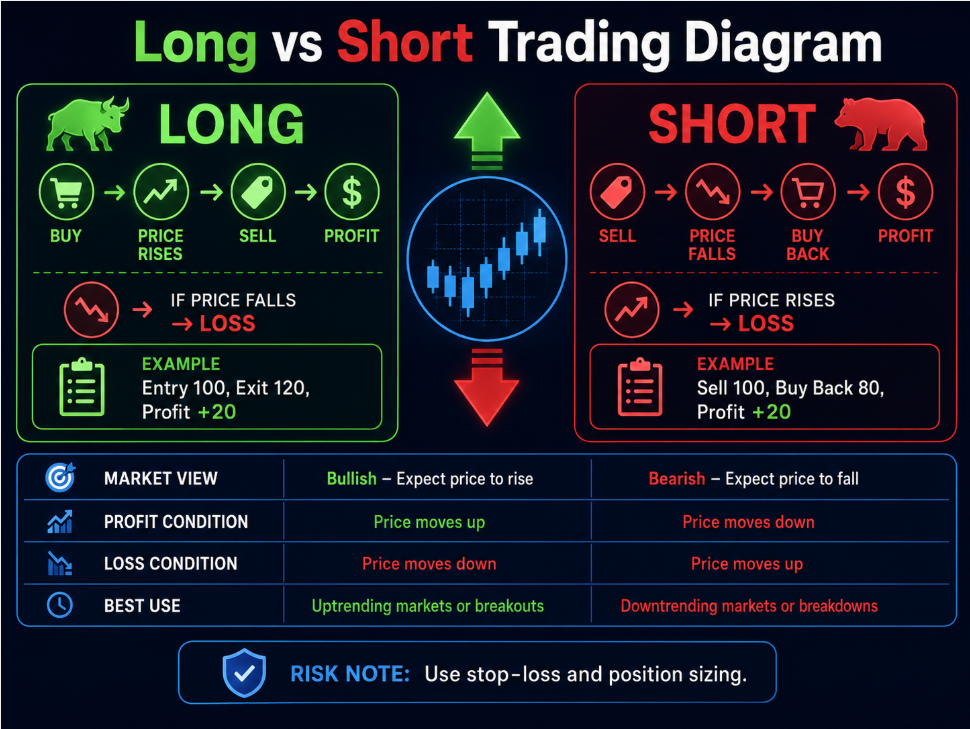
The trading logic of SKHYNIXUSDT can be understood in two directions: long and short.
What Does Going Long Mean?
If you believe the SK Hynix-related price will rise, you can choose to go long.
Example:
You believe AI server demand will continue to grow
↓
HBM demand may continue to increase
↓
SK Hynix stock price or related price may rise
↓
You go long on SKHYNIXUSDT
If the price rises, you may profit.
If the price falls, you will incur a loss.
What Does Going Short Mean?
If you believe the SK Hynix-related price will fall, you can choose to go short.
Example:
You believe market expectations for AI chips are overheated
↓
The semiconductor sector may correct
↓
SK Hynix-related price may fall
↓
You go short on SKHYNIXUSDT
If the price falls, you may profit.
If the price rises, you will incur a loss.
This is the biggest difference between contracts and spot trading:
Spot trading usually only allows buying low and selling high, while contracts allow both long and short positions.
3.3 What Is a Perpetual Contract?
Perpetual contracts are a very common derivative in the crypto trading market.
Traditional futures usually have an expiration date—for example, a contract expires on a specific date.
Perpetual contracts have no fixed expiration date. In theory, users can hold positions indefinitely, as long as margin is sufficient and liquidation is not triggered.
Perpetual contracts generally have several characteristics:
- Supports long and short positions
- Uses margin trading
- Allows leverage
- No fixed expiration date
- Usually has a funding rate mechanism
- Price tracks the underlying asset as closely as possible
Bybit Learn’s introduction to SKHYNIXUSDT also mentions that SKHYNIXUSDT is a USDT-margined perpetual contract, offering up to 20x leverage, 7×24 trading hours, no expiration date, and uses a funding rate mechanism to keep the perpetual contract price close to the underlying asset.
On Hibt, SKHYNIXUSDT also trades 7×24 hours, with USDT as the settlement asset and a maximum leverage of 50x.
Part Four: What Is the Difference Between SKHYNIXUSDT and SKHYB?
When many users search for SK Hynix-related assets, they see two names at the same time:
SKHYNIXUSDT
SKHYB
Both names seem related to SK Hynix, but they are not the same product.
4.1 What Is SKHYB?
SKHYB usually refers to SK Hynix-related tokenized stock assets, belonging to the Tokenized Stock or bStocks category.
Its logic is closer to:
Traditional stock value
↓
Issuer and custody structure
↓
Tokenization
↓
Circulation on-chain or on trading platforms
In other words, SKHYB is more like a “tokenized stock asset” or “stock price exposure asset.”
But even SKHYB does not mean you directly own SK Hynix company stock. What rights it specifically represents depends on the issuer, custody structure, platform terms, and local regulatory rules.
4.2 Many Newcomers Easily Confuse SKHYB and SKHYNIXUSDT Because Both Are Related to SK Hynix. But from a Product Structure Perspective, These Two Are Not the Same Asset.
SKHYB is closer to a “tokenized stock” or “stock-related token.” Its core goal is to give users exposure to SK Hynix stock-related assets. Simply put, SKHYB leans more toward the RWA or tokenized stock direction, with the focus on mapping traditional stock assets into on-chain trading scenarios.
SKHYNIXUSDT, on the other hand, is closer to a “USDT perpetual contract.” Its core goal is not to let users hold some stock-related asset, but to let users trade the rise or fall of the SK Hynix-related price. Users can choose to go long or short based on their judgment, and participate in contract trading with USDT as margin.
The biggest difference between the two is: SKHYB usually does not focus on leveraged trading; it emphasizes asset exposure. SKHYNIXUSDT is a contract product, usually supporting leverage and two-way trading. This means that gains and losses on SKHYNIXUSDT are amplified by leverage. Newcomers who do not understand margin, liquidation price, and funding rates can easily suffer significant losses due to short-term volatility.
From a risk perspective, SKHYB’s main risks lie in the issuer, underlying asset custody, liquidity, redemption mechanism, and regulatory rules. Because it is a tokenized stock or stock-related token, users need to confirm who issued the asset, whether it is backed by underlying assets, whether redemption is supported, and whether trading is permitted in their region.
SKHYNIXUSDT’s main risks lie in leverage, liquidation, funding rates, price volatility, and trading depth. It is more suitable for users who already have contract trading experience, can control position sizing, and understand stop-loss and liquidation mechanisms. It is not suitable for newcomers with no contract experience to participate heavily.
Simply put:
SKHYB is more suitable for users who want to explore RWA, tokenized stocks, and the on-chainization of traditional assets;
SKHYNIXUSDT is more suitable for users with contract trading experience who want to trade SK Hynix price fluctuations using USDT.
Therefore, users must first determine whether they are buying a “stock-related token” or a “stock price contract” before trading. Similar names do not mean the same risks, and the same underlying asset does not mean the same trading method.
Simple understanding:
SKHYB is more like an “on-chain stock exposure asset.”
SKHYNIXUSDT is more like a “contract for trading SK Hynix price fluctuations with USDT.”
4.3 Why Are Crypto Users More Likely to Accept USDT Contracts?
Crypto users are more likely to accept SKHYNIXUSDT because its operation is very similar to BTC and ETH contracts.
Users are already familiar with:
- USDT pricing
- Candlestick charts
- Order book depth
- Going long
- Going short
- Leverage
- Margin
- Take-profit and stop-loss
- Liquidation mechanism
So when a traditional stock underlying like SK Hynix is made into a USDT perpetual contract, crypto users do not need to relearn securities accounts, stock trading hours, foreign exchange conversion, and overseas broker processes. They can participate in price fluctuations using the methods they already know.
But this does not mean the risk is lower. On the contrary, after stock contracts are combined with crypto contract mechanisms, the risks become more complex.
Part Five: What Factors Affect the Price of SKHYNIXUSDT?
SKHYNIXUSDT is not an ordinary cryptocurrency. Its price is influenced by more complex factors than BTC or meme coins.
It is affected by at least four categories of factors:
- SK Hynix stock price movement
- AI industry cycle
- Semiconductor industry cycle
- Crypto market funding environment
5.1 First Factor: SK Hynix Stock Price Movement
The core reference for SKHYNIXUSDT is the price performance of SK Hynix. Therefore, the rise and fall of SK Hynix stock itself is an important factor affecting SKHYNIXUSDT.
Investors need to pay attention to:
- Revenue and earnings
- Operating profit
- Profit margins
- HBM orders
- DRAM prices
- NAND demand
- Customer structure
- Market expectations
- Analyst ratings
If SK Hynix earnings exceed expectations and AI memory business growth is strong, the market may raise valuation expectations for the company.
If SK Hynix profits fall short of expectations, or HBM competition intensifies, the related price may come under pressure.
5.2 Second Factor: AI Industry Cycle
SK Hynix’s core investment logic is closely tied to AI infrastructure.
The higher the AI industry sentiment, the stronger the market’s demand expectations for GPUs, AI servers, HBM, and data centers.
If AI industry expectations decline, the related hardware supply chain may also be impacted.
AI industry data to watch includes:
- NVIDIA GPU demand
- Cloud provider capex
- AI server shipments
- Large-model training costs
- AI data center construction speed
- HBM3E and HBM4 demand
- Related policies in the US, China, and South Korea
SK Hynix’s official 2026 market outlook mentions that the 2026 memory semiconductor market can be seen as a stage where AI infrastructure expansion, HBM3E demand, and the HBM4 transition occur simultaneously.
This shows that SKHYNIXUSDT is not an isolated trading pair; it is highly correlated with the AI infrastructure cycle.
5.3 Third Factor: Semiconductor Cycle
The semiconductor industry has a strong cyclical nature.
In an upturn, demand grows, supply tightens, prices rise, and corporate profits improve.
In a downturn, inventory builds up, prices fall, demand slows, and corporate profits come under pressure.
The memory chip industry is especially pronounced. DRAM, NAND, and HBM may all be affected by supply-demand cycles.
An upturn may come from:
- Strong AI server demand
- HBM supply shortage
- Rising prices for high-end memory
- Continued data center expansion
- Tight capacity for advanced processes
A downturn may come from:
- Excessive capacity expansion
- High customer inventory
- AI demand falling short of expectations
- Intensifying price competition
- Weakening macroeconomy
So trading SKHYNIXUSDT cannot rely solely on short-term candlesticks; you also need to understand the semiconductor industry cycle.
5.4 Fourth Factor: Crypto Market Funding Environment
Although SKHYNIXUSDT is related to traditional stocks, it is a USDT contract traded on a crypto platform, so it is also affected by the crypto market funding environment.
Influencing factors include:
- BTC price strength
- ETH price strength
- Market risk appetite
- USDT liquidity
- Contract market leverage levels
- Platform trading depth
- Short-term funding sentiment
When overall crypto market risk appetite rises, users may be more willing to trade high-volatility assets.
When crypto market liquidity declines, even if the underlying stock performs well, contract trading depth may deteriorate.
This is also where stock contracts differ from traditional stocks:
They are simultaneously affected by both traditional financial markets and crypto markets.
Part Six: How to Trade SKHYNIXUSDT on Hibt? A Complete Tutorial for Beginners
This chapter is for newcomers trading stock contracts for the first time. Even if you have already traded BTC or ETH contracts, it is recommended to start with a small position for testing, because the volatility logic of stock contracts differs from that of crypto-native contracts.
6.1 What Do You Need to Prepare Before You Start Trading?
Before trading SKHYNIXUSDT on Hibt, it is recommended to prepare four things.
First, a Hibt Account
You need to register a Hibt account and complete necessary security settings. It is recommended to enable two-factor authentication to avoid account security risks.
Second, USDT Balance
SKHYNIXUSDT uses USDT as the settlement asset. The Hibt announcement also clearly states that the settlement asset for this contract is USDT.
Third, Understanding the Contract Rules
You need to know:
- What is the maximum leverage?
- What is the contract precision?
- What are the margin rules?
- What is the liquidation mechanism?
- How is the funding rate calculated?
- Does it support take-profit and stop-loss?
- Will the platform dynamically adjust parameters?
The Hibt announcement notes that the platform may dynamically adjust contract parameters based on market risk conditions, including minimum price movement, maximum leverage, and margin requirements.
Fourth, Clarify Your Risk Tolerance
If you cannot accept large fluctuations, do not use high leverage.
If you do not yet understand the liquidation mechanism, do not trade with heavy positions.
If you just want to learn, you can start with a small position to experience the order flow.
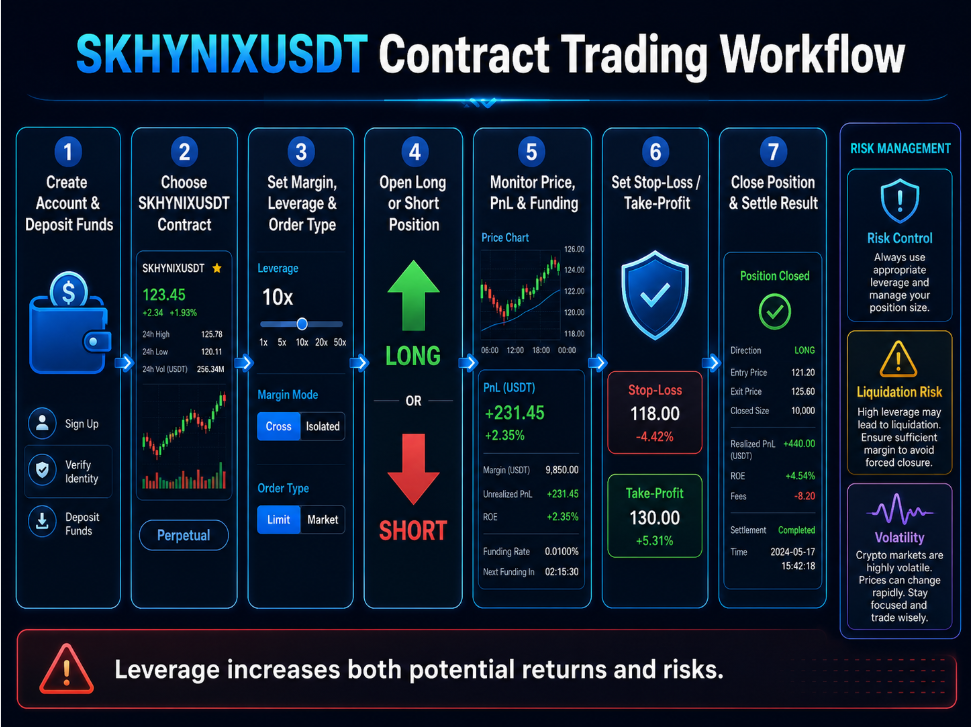
6.2 Hibt SKHYNIXUSDT Trading Process
The general process is as follows:
Step 1: Register or Log In to Your Hibt Account
Go to the Hibt official website and complete registration or log in.
Step 2: Deposit USDT
Deposit USDT into your Hibt account. When depositing, make sure to select the correct network to avoid sending to the wrong chain.
Step 3: Enter the Contract Trading Page
Find the contract or perpetual contract entry in the Hibt navigation menu.
Step 4: Search for SKHYNIXUSDT
Enter “SKHYNIXUSDT” or “SKHYNIX” in the trading pair search box.
Step 5: Review Contract Information
Confirm the trading pair, price, funding rate, order book depth, candlestick trend, maximum leverage, and risk warnings.
Step 6: Choose Long or Short
If you judge that the price will rise, you can choose to go long.
If you judge that the price will fall, you can choose to go short.
Step 7: Set Leverage
Newcomers are advised to use low leverage, or even start with 1x or lower leverage. Do not jump straight into high leverage.
Step 8: Enter Position Size
It is recommended to start with a small position to get familiar with price fluctuations and margin changes.
Step 9: Set Take-Profit and Stop-Loss
Do not trade naked. Stop-loss is not about limiting gains; it is about preventing a single wrong judgment from causing huge losses.
Step 10: Confirm the Order and Manage the Position
After placing the order, continuously monitor the margin ratio, unrealized P&L, liquidation price, and market news.
6.3 What Do Going Long and Going Short Mean?
Going Long
Going long means you believe the price will rise.
For example:
- You believe AI server demand will continue to grow
- You believe HBM supply and demand will remain tight
- You believe SK Hynix earnings may remain strong
- You judge that SKHYNIXUSDT may rise
Then you can choose to go long.
If the price rises, you profit.
If the price falls, you lose.
Going Short
Going short means you believe the price will fall.
For example:
- You believe the AI chip sector has risen too much in the short term
- You believe the semiconductor sector may correct
- You believe market expectations for SK Hynix are too high
- You judge that SKHYNIXUSDT may fall
Then you can choose to go short.
If the price falls, you profit.
If the price rises, you lose.
Going short is not “being bearish on the company’s long-term value.” It can also be just a short-term trading strategy. But newcomers should be more cautious when going short, because in a rising market, short positions can be quickly stopped out or liquidated.
6.4 What Should Beginners Pay Attention to on Their First Trade?
For newcomers trading SKHYNIXUSDT for the first time, the most important thing is not making money, but getting familiar with the mechanism.
It is recommended to follow these principles:
First, do not use high leverage.
Even if Hibt supports up to 50x leverage, that does not mean newcomers should use 50x. High leverage turns even small price fluctuations into significant losses.
Second, do not go all-in.
In contract trading, going all-in means there is no room for error. Once the price moves against you, you may quickly approach liquidation.
Third, always set a stop-loss.
Many newcomers lose money not because they got the direction wrong once, but because they refused to admit it when they were wrong.
Fourth, do not chase rallies or panic sell.
SKHYNIXUSDT is affected by stocks, AI, semiconductors, and crypto simultaneously. Short-term fluctuations can be very volatile.
Fifth, do not only look at candlesticks.
Stock contracts have corporate fundamentals and industry cycles behind them. They cannot be analyzed like meme coins by looking at sentiment alone.
Sixth, pay attention to funding rates.
Perpetual contracts may have funding rates, and the cost of holding positions long-term needs to be calculated.
Seventh, be aware of trading time differences.
Although contracts can trade 7×24 hours, the underlying stock market does not trade 24 hours continuously. Price fluctuations, liquidity, and mark price mechanisms during non-stock trading hours require special attention.
Part Seven: SKHYNIXUSDT Contract Risk Analysis: Must-Read
SKHYNIXUSDT appears to give crypto users an entry point into AI chip assets, but it is not a low-risk product. On the contrary, it combines stock risk, contract risk, leverage risk, and platform rule risk.
7.1 Why Is Leverage Dangerous?
The essence of leverage is to amplify your position.
Assume you have a principal of 100 USDT:
- 1x leverage is equivalent to a 100 USDT position.
- 5x leverage is equivalent to a 500 USDT position.
- 10x leverage is equivalent to a 1,000 USDT position.
- 50x leverage is equivalent to a 5,000 USDT position.
The larger the position, the greater the gain or loss from small price fluctuations.
For example, with 10x leverage, a price move of about 10% against you could theoretically cause a loss close to your principal. With 50x leverage, an even smaller adverse price move could quickly trigger liquidation.
So newcomers should remember:
Leverage is not a tool to increase win rate; it is a tool to amplify results.
If your direction is right, gains are amplified.
If your direction is wrong, losses are also amplified.
7.2 What Are the Different Risks Between Stock Contracts and Crypto Contracts?
Although SKHYNIXUSDT trades on a crypto platform and the interface looks similar to BTCUSDT and ETHUSDT contracts, its underlying price logic does not fully belong to the crypto market.
BTCUSDT and ETHUSDT contracts mainly revolve around crypto market volatility itself. Traders usually focus on BTC trends, ETH ecosystem, on-chain data, funding rates, market sentiment, ETF fund flows, macro liquidity, and the overall crypto market cycle. Their volatility comes more from the coin price itself, on-chain activity, market leverage levels, and investor sentiment.
SKHYNIXUSDT is different. Although it uses USDT as margin and is traded in contract form, it tracks the price performance of SK Hynix. Therefore, its core influencing factors are not just crypto market sentiment, but also SK Hynix’s company fundamentals, AI chip demand, HBM high-bandwidth memory orders, semiconductor industry cycles, South Korean stock market performance, and global tech stock valuation changes.
In other words, when trading BTCUSDT or ETHUSDT, you are mainly judging the crypto market cycle; when trading SKHYNIXUSDT, you are judging the combined changes of “traditional corporate value + AI industry trends + stock market valuation + contract funding environment.”
This is also why stock contracts are more complex than ordinary crypto contracts. They are affected by both traditional financial markets—such as earnings reports, orders, industry sentiment, and tech stock valuations—and crypto markets—such as USDT liquidity, contract leverage, funding rates, and exchange depth.
So newcomers cannot use the same methods for analyzing altcoins to trade SKHYNIXUSDT. In addition to looking at candlesticks, you should also pay attention to SK Hynix earnings, HBM demand changes, NVIDIA supply chain dynamics, semiconductor cycles, and stock market sentiment. Only by understanding both traditional finance and crypto contract mechanisms can you more easily judge the real risks of this trading pair.
The special thing about stock contracts is:
You cannot only look at crypto news; you also need to look at company earnings, industry news, the AI supply chain, and macro markets.
7.3 What Risks Should SK Hynix Investors Watch?
First, AI Demand Decline Risk
If AI server construction slows down and cloud providers cut capex, HBM demand expectations may decline.
Second, Semiconductor Cycle Reversal Risk
The memory chip industry is cyclical. If future supply exceeds demand, DRAM, NAND, or HBM prices may fall, and SK Hynix profits could come under pressure.
Third, Intensifying Competition Risk
Samsung, Micron, and other manufacturers are also advancing HBM-related products. If competition intensifies, SK Hynix’s market share and profit margins may be affected.
SK Hynix’s official market outlook also mentions that although the HBM cycle is continuing, price, supply, and geopolitical risks remain. Some research institutions and overseas media believe that after 2026, HBM prices may correct due to intensifying competition and capacity expansion.
Fourth, Policy and Geopolitical Risk
The semiconductor industry is affected by export controls, supply chain policies, the South Korean market, US tech policy, and US-China relations.
Fifth, Contract-Specific Risks
Including:
- Liquidation risk
- Funding rate risk
- Liquidity risk
- Slippage risk
- Mark price risk
- Platform parameter adjustment risk
The Hibt announcement also clearly states that digital asset and derivative contract trading are innovative investment products with extreme price volatility and very high investment risk. Participants should fully understand the risks and assess their own risk tolerance before participating.
Part Eight: Comparing the Investment Logic of SKHYNIXUSDT with Other On-Chain Assets
Before trading, newcomers should first establish an asset classification framework. Different assets have different logics and cannot be analyzed with the same method.
8.1 What Is the Difference Between SKHYNIXUSDT and 01/USDT?
01/USDT is closer to a crypto token trading pair. Its price logic is usually related to project fundamentals, community heat, exchange liquidity, and the crypto market cycle.
The underlying logic of SKHYNIXUSDT and 01/USDT is also different. Many newcomers see that both are priced in USDT and assume they are the same type of trading pair, but in reality they represent two completely different asset types.
01/USDT is closer to an ordinary crypto token trading pair. Its price mainly depends on the development of the 01 crypto project itself, including project progress, community heat, exchange liquidity, market attention, and the overall crypto market trend. If the project narrative strengthens, community activity increases, and capital inflows rise, the price may go up; if project progress falls short of expectations, heat declines, or the crypto market corrects overall, the price may also come under pressure.
SKHYNIXUSDT is different. It is a USDT-margined perpetual contract product tied to a traditional enterprise. What matters behind it is the price performance of SK Hynix, not the ecosystem value of some crypto project. The core factors affecting its price include SK Hynix earnings, AI chip demand, HBM high-bandwidth memory orders, semiconductor industry cycles, tech stock market sentiment, and funding rates and leverage levels in the contract market.
Simply put, the core of 01/USDT is “crypto project value,” while the core of SKHYNIXUSDT is “traditional corporate price volatility.” The former is more influenced by project progress, community sentiment, and crypto market liquidity; the latter is more influenced by company fundamentals, AI industry trends, stock market valuations, and contract leverage risk.
So when analyzing 01/USDT, newcomers can focus on project dynamics, community heat, trading volume, and the overall crypto market trend. When analyzing SKHYNIXUSDT, you cannot only look at candlesticks; you also need to pay attention to SK Hynix earnings, HBM demand, the NVIDIA supply chain, semiconductor cycles, and traditional stock market sentiment.
This is also the biggest difference between the two: 01/USDT is more like trading the growth expectations of a crypto project, while SKHYNIXUSDT is more like using a USDT contract to trade the price fluctuations of an AI semiconductor company.
If you want to understand crypto token trading logic, you can read: What Is 01/USDT?
8.2 What Is the Difference Between SKHYNIXUSDT and SUSHI?
SUSHI is a DeFi protocol token, mainly related to the SushiSwap ecosystem, DEX trading volume, liquidity, governance mechanisms, protocol revenue, and the DeFi market environment.
The difference between SKHYNIXUSDT and SUSHI is also very clear. Although both can be traded by users on crypto platforms, they represent completely different asset logics.
SUSHI belongs to the DeFi sector. Behind it is a decentralized exchange protocol like SushiSwap. When users focus on SUSHI, the key points are usually protocol usage, DEX trading volume, TVL, governance mechanisms, fee revenue, liquidity incentives, and whether the overall DeFi market is recovering. Simply put, SUSHI’s investment logic leans more toward “whether the protocol is being used, whether the ecosystem is recovering, and whether governance and fee mechanisms have value.”
SKHYNIXUSDT is not a DeFi token, but a USDT contract product tied to an AI semiconductor company. Its price logic is mainly related to SK Hynix price performance, HBM high-bandwidth memory demand, AI server construction, NVIDIA supply chain expectations, semiconductor cycles, and stock market sentiment. Users trading SKHYNIXUSDT are essentially trading the rise or fall of the SK Hynix-related price, not participating in the governance of some DeFi protocol.
The two also differ in risk structure. If SUSHI is traded spot, it usually does not involve leverage. The main risks come from protocol competition, TVL decline, DeFi market cooling, and token price volatility. SKHYNIXUSDT is a contract product, usually supporting leverage. In addition to price volatility, risks include liquidation, funding rates, insufficient margin, slippage, and insufficient trading depth.
Therefore, SUSHI is more suitable for users who are bullish on the DeFi ecosystem and willing to study protocol fundamentals; SKHYNIXUSDT is more suitable for users who are bullish on AI chip trends, understand stock contract mechanisms, and can control leverage risk.
Simply put, SUSHI trades DeFi protocol value, while SKHYNIXUSDT trades AI semiconductor company price fluctuations. Although both appear on crypto platforms, they cannot be judged with the same investment logic.
If you want to learn about DeFi tokens, you can read: What Is SUSHI?
Part Nine: Why Is the Wallet Becoming the Future Gateway for Assets?
The emergence of products like SKHYNIXUSDT shows that the crypto market is moving from “only trading cryptocurrencies” toward “trading more real-world assets.”
In the future, what users may encounter on-chain or on crypto platforms may not be just BTC and ETH, but also:
- Stock-related assets
- Stock contracts
- Gold tokens
- ETF tokens
- Bond tokens
- Yield-bearing RWA assets
- AI company-related index products
At this point, the wallet will become increasingly important.
9.1 Why Does RWA Need a Wallet?
The wallet may play three roles in the future RWA ecosystem.
First, managing on-chain assets.
Users can use wallets to view tokens, stablecoins, and RWA assets across different chains.
Second, connecting trading platforms and protocols.
Wallets may become the gateway for users to connect to exchanges, DEXs, RWA protocols, and on-chain financial applications.
Third, identity verification and permission management.
Some RWA assets may involve KYC, whitelists, and regional restrictions. Wallet addresses may be bound to user identity verification.
Although SKHYNIXUSDT itself is a contract traded within the platform, from a long-term trend perspective, the entry of RWA and stock assets into the crypto market will make the wallet a more important piece of infrastructure.
9.2 Why Do Newcomers Need to Understand the Wallet?
If you only trade on centralized platforms, you may not feel the wallet is important in the short term.
But if in the future you want to understand RWA, tokenized stocks, on-chain asset management, DeFi, and cross-chain trading, the wallet is a basic tool you must master.
It is not just a tool for storing coins, but also the gateway for future on-chain assets.
If you want to learn about crypto asset infrastructure, you can read: What Is a WALLET?
Part Ten: FAQ: Frequently Asked Questions About SKHYNIXUSDT
Q1: What is SKHYNIXUSDT?
SKHYNIXUSDT is a USDT-margined perpetual contract product tied to SK Hynix. Users use USDT as margin to trade SK Hynix-related price movements.
Q2: Does trading SKHYNIXUSDT mean I am buying SK Hynix stock?
No. Trading SKHYNIXUSDT is not buying SK Hynix stock, nor does it grant shareholder rights, voting rights, or stock dividends. It is a price-related contract trading product.
Q3: Does SKHYNIXUSDT support short selling?
Perpetual contracts usually support both long and short positions. Users can choose their trading direction based on their market judgment, but specific rules are subject to the Hibt real-time trading page.
Q4: Is SKHYNIXUSDT suitable for long-term investment?
SKHYNIXUSDT is a contract product, more suitable for trading price fluctuations, and is not equivalent to long-term stock holding. If you want to long-term allocate SK Hynix stock, you need to research traditional securities accounts or related stock investment tools.
Q5: Can beginners use high leverage for trading?
Not recommended. High leverage significantly amplifies risk. Even if the platform supports high leverage, beginners should start with low leverage, small positions, and set stop-losses.
Q6: Why is SKHYNIXUSDT related to AI?
Because SK Hynix is a globally significant memory chip company, especially noted for its high-bandwidth memory (HBM). HBM is an important component of AI GPUs and AI servers, so SK Hynix is seen as one of the important companies in the AI infrastructure supply chain.
Q7: Which is riskier, SKHYNIXUSDT or SKHYB?
The two have different types of risk. SKHYB leans toward tokenized stock assets, with main risks including issuer, custody, regulation, and liquidity. SKHYNIXUSDT is a perpetual contract, with main risks including leverage, liquidation, funding rates, slippage, and price volatility. For newcomers, contract risks are usually more direct and more likely to cause rapid losses.
Q8: What information should I pay attention to when trading SKHYNIXUSDT?
It is recommended to pay attention to:
- SK Hynix earnings reports
- HBM market demand
- AI server construction
- NVIDIA supply chain news
- DRAM and NAND prices
- Semiconductor cycles
- Hibt contract parameters
- Funding rates and margin ratios
Q9: Is SKHYNIXUSDT an RWA?
Strictly speaking, SKHYNIXUSDT is more of a derivative contract tied to traditional stock prices, not directly holding an RWA asset itself. But it is a manifestation of TradFi assets entering the crypto trading scene, and is related to trends in RWA, tokenized stocks, and stock index contracts.
Q10: What is the most important principle for trading SKHYNIXUSDT?
The most important principle is:
Understand the product first, then control position size, and only then judge direction.
Do not blindly chase rallies just because AI themes are hot, and do not trade with heavy positions just because the contract supports high leverage.
Part Eleven: Conclusion: SKHYNIXUSDT Represents a New Direction in the AI + Crypto Convergence
The emergence of SKHYNIXUSDT represents a change happening in the crypto market.
In the past, the core of crypto trading was:
- BTC
- ETH
- Stablecoins
- DeFi tokens
- Meme tokens
Now, more and more traditional assets are entering the crypto trading scene:
- Stock-related contracts
- AI tech stock contracts
- Tokenized stocks
- Gold tokens
- Bond tokens
- RWA assets
SKHYNIXUSDT combines three directions:
AI industry
↓
HBM chip demand
↓
SK Hynix
TradFi
↓
Stock asset prices
↓
Corporate fundamentals
Crypto
↓
USDT contract trading
↓
7×24 market access
For crypto users, SKHYNIXUSDT provides a new way to participate: without a traditional securities account, you can also trade SK Hynix-related price fluctuations through USDT contracts.
But it is not a simple stock substitute, nor is it a low-risk asset. It is a derivative contract, with both AI chip industry logic and contract leverage risk.
Ultimately, newcomers should remember three things:
First, SKHYNIXUSDT is not SK Hynix stock.
Second, it trades SK Hynix-related price fluctuations.
Third, understanding the underlying asset, contract mechanism, and risk management is more important than predicting rises and falls.
Risk Disclaimer: This article is for educational and informational purposes only and does not constitute any investment advice. SKHYNIXUSDT is a derivative contract that involves leverage, liquidation, funding rates, liquidity, slippage, platform parameter adjustments, and market volatility risks. Before participating in trading, please fully understand the product rules and make decisions cautiously based on your personal risk tolerance.