
1. What Exactly Is CASHCAT? Understand What You're Buying First
After CASHCAT recently climbed the CoinGecko trending list, many newcomers' first reaction was: Is this coin officially issued by Robinhood? Is it the "official Meme coin" on Robinhood Chain? Does it have any actual relationship with Robinhood stock, the Robinhood wallet, or Robinhood Chain?
These questions must be clarified first.
CASHCAT is not an officially issued token by Robinhood, nor is it an investment product endorsed by Robinhood.
CASHCAT's official website states it very directly: it is "fan fiction with a ticker." The website also explicitly answers the question "Is it affiliated with Robinhood?" with a "No," and declares at the bottom of the page that CASHCAT is a Meme coin with no intrinsic value, no expected financial return, and is for entertainment purposes only. It is not affiliated with Robinhood Markets or Vlad Tenev.
So, the first thing to understand about CASHCAT is:
CASHCAT is a community-driven Meme coin deployed on Robinhood Chain. Its narrative is derived from Robinhood's early "Cash Cat" name and cat mascot story, but it is not an official Robinhood token.
1.1 Is CASHCAT Officially Issued by Robinhood?
No.
This is the most common misconception for newcomers.
The reason CASHCAT is so easily misjudged is that it simultaneously leverages three powerful narratives:
- The well-known Robinhood stock trading brand;
- The newly launched Robinhood Chain L2;
- The early Robinhood "Cash Cat" naming story.
But "name association" does not equal "official issuance." CASHCAT's official website clearly states it is not an official Robinhood project, and CoinDesk reported that Robinhood did not create the token. The CASHCAT website describes it as an external project built around Robinhood's early cat image.
Newcomers must establish a clear judgment standard:
- Check the official website, not group chats;
- Check official announcements, not screenshots;
- Check the contract address, not the name;
- Check official statements, not community interpretations.
As long as Robinhood has not explicitly issued an announcement stating CASHCAT is an official token, it cannot be treated as an official Robinhood asset.
1.2 Why Does the Name "Cash Cat" Have Such Viral Power?
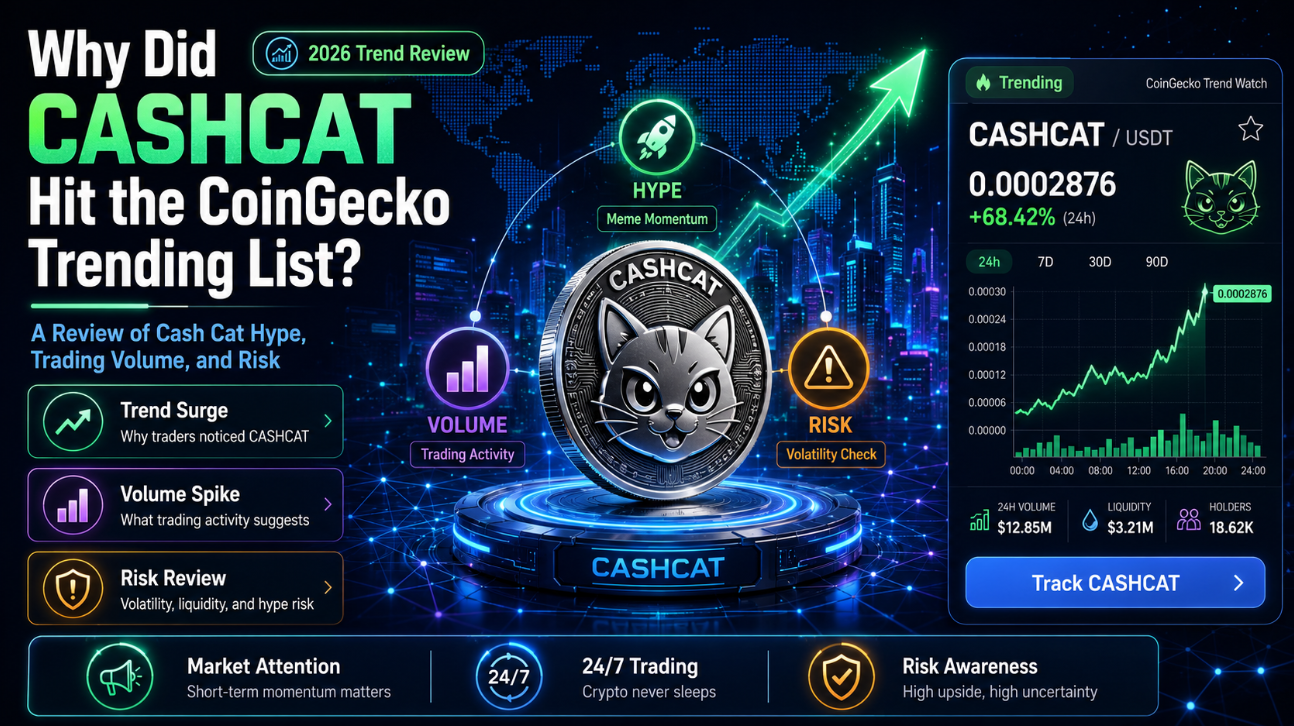
CASHCAT's narrative is not made up out of thin air.
Its core viral point is that Robinhood once considered the name "CashCat" in its early days and used a cat-holding-cash concept for its early branding. Fortune reported on the Robinhood Chain Meme trading frenzy, noting that the Cash Cat name was a callback to Robinhood's early story, when Vlad Tenev and Baiju Bhatt initially referred to the company as CashCat.
This story is extremely important for a Meme coin.
Because what a Meme coin needs most is not complex technology, but a "meme" that can spread quickly. CASHCAT's meme is simple enough:
- Robinhood was almost called Cash Cat;
- Robinhood has now launched Robinhood Chain;
- Cash Cat has returned to "its own chain";
- So the community has packaged it as the cultural mascot of Robinhood Chain.
This is why CASHCAT is more likely to go viral than ordinary animal Memes: it has real brand history as viral marketing material.
But this also brings another risk: The closer it is to a real brand, the more likely it is to trigger compliance, trademark, and official attitude risks.
1.3 Which Chain Does CASHCAT Run On?
CASHCAT runs on Robinhood Chain.
Robinhood's official documentation shows that Robinhood Chain is an Ethereum-based Arbitrum Layer-2 chain, using Ethereum blobs for data availability and ETH as the native gas token. The official documentation also provides network configurations such as Chain ID 4663 and a block explorer.
On July 1, 2026, Robinhood announced the mainnet launch of Robinhood Chain and a series of DeFi, stock tokenization, and global asset access products, stating its goal to connect traditional finance with DeFi and lower the barrier to global market access.
What does this mean for CASHCAT?
- The new chain has just launched, and user curiosity is high.
- The new chain needs its first breakout asset.
- Meme coins are naturally suited to be the traffic entry point for a new chain.
- The Robinhood brand itself carries a retail trading culture.
So CASHCAT's explosion is not accidental. It happened to hit the perfect combination of "new chain launch + Robinhood brand + Meme culture + low-market-cap speculation."
1.4 How to Read CASHCAT's Basic Token Parameters?
The core parameters disclosed on CASHCAT's official website are very simple:
- Total Supply: 1 billion tokens
- Transaction Tax: 0%
- LP: Burned
- Utility: Cat
- Contract Address: 0x020bfc650a365f8bb26819deaabf3e21291018b4
The website's "tokenomeownics" page shows that CASHCAT has a total supply of 1B, a 0% transaction tax, 100% of tokens went into the pool, LP burned, and lists the steps to add the Robinhood network, bridge funds, open a DEX, and paste the contract to swap in the "how to get some" section.
These designs look very friendly to newcomers:
- Fixed total supply;
- No transaction tax;
- LP burned;
- Fully circulating;
- No complex unlock schedule.
But be aware: these do not equal "safety."
0% tax means lower transaction costs, but it also means the protocol itself has no continuous fee revenue. LP burned means the project team theoretically cannot directly withdraw the initial liquidity, but it cannot prevent early whales from dumping. Fully circulating means there is no traditional unlock schedule, but it cannot prevent early low-cost addresses from concentrating on taking profits.
Therefore, CASHCAT's tokenomics are more like a narrative tool for a "fair launch Meme coin" rather than a value protection mechanism.
2. Why Did CASHCAT Hit the CoinGecko Trending List?
The CoinGecko trending list is not a project quality list, nor is it a long-term investment list. It is more like an "attention list," reflecting short-term search volume, trading volume, price volatility, social media discussion, and market sentiment.
CASHCAT hitting the trending list is essentially a Meme coin attention explosion.
2.1 The Robinhood Chain Mainnet Launch Provided the "Perfect Timing"
The first reason for CASHCAT's explosion is the recent launch of Robinhood Chain.
Early stages of a new chain typically experience a phase where:
- Users are looking for bridges;
- Capital is looking for opportunities;
- Meme coins are looking for narratives;
- KOLs are looking for stories;
- Trading tools are looking for hot spots;
- Exchanges are looking for listing themes.
Odaily reported that Robinhood Chain saw over 10,000 new tokens in a single day, with DEX trading volume exceeding $560 million. CASHCAT reached a $100 million market cap within 5 hours and became a core project in the early Robinhood Chain Meme frenzy.
This shows that CASHCAT's explosion was not an isolated event, but a concentrated manifestation of the early traffic dividends of Robinhood Chain.
It is similar to BRETT on early Base, BONK on early Solana, and a batch of early Memes on Blast, playing the role of a "new chain traffic entry point."
2.2 Why Was Vlad Tenev's Interaction Amplified by the Community?
The second catalyst for CASHCAT was Robinhood CEO Vlad Tenev's public interaction regarding Memes.
Market reports mentioned that Vlad Tenev stated that while Robinhood Chain was built for real-world assets and financial services, it "works great for memes too." This statement was not a formal endorsement of CASHCAT, but the community easily interpreted it as "official tacit approval of Meme culture." CoinDCX's report also emphasized that Robinhood has not endorsed or issued CASHCAT, and Vlad's related statement was merely an acknowledgment of the Meme trend, not support for a specific token.
This is the typical amplification mechanism of the Meme coin market:
CEO makes a comment -> Community screenshots and spreads it -> KOLs provide a second interpretation -> Retail investors think "the official might tacitly approve" -> Buying surges -> Trending list ranking rises -> More people see it
But this also means: If Vlad subsequently unfollows, clarifies, goes cold, or if Robinhood officially issues a risk warning, CASHCAT's narrative could cool down rapidly.
2.3 The "$85 to $2 Million" Rags-to-Riches Story Acted as a Catalyst
The third key to CASHCAT's viral success was the on-chain rags-to-riches story.
Multiple media outlets reported that an early trader bought CASHCAT with a few dozen dollars, and the book value later exceeded one or even two million dollars. Binance Square reprinted on-chain data showing that a trader bought CashCat with $85, realized approximately $585,000 in profit, and still held about $1.6 million worth of CASHCAT.
This kind of story is extremely effective for Meme coins.
It doesn't need to explain technology, revenue models, or product roadmaps. It only needs to make retail investors believe:
"Could I have missed the next 100x coin?"
This is the core of FOMO.
But newcomers must understand: What you see are survivor stories, not average returns.
One person turning $85 into $2 million is backed by thousands of people buying at the top, chasing highs and losing money, suffering slippage losses, or buying fake coins.
2.4 Rapid Listings on MEXC, Ourbit, and Other Platforms Amplified Liquidity
After CASHCAT's hype took off, centralized exchanges and contract platforms quickly followed up.
CoinGecko shows that CASHCAT can be traded on markets such as Uniswap V3 (Robinhood), MEXC, and Uniswap V4. As of the page data, Uniswap V3 (Robinhood) is one of the main trading venues, with CASHCAT/WETH as the active trading pair.
Ourbit also announced that the CASHCAT/USDT contract went live on July 9, 2026, supporting up to 20x leverage and offering both cross-margin and isolated-margin modes.
Exchange listings have two impacts:
- Lower entry barrier for buying. Originally, users needed to know how to cross-chain, add Robinhood Chain, and use a DEX. Now, some users can trade directly on a CEX or contract platform.
- Amplified speculation. After contract listings, users can go long, short, and add leverage, which can amplify short-term trading volume and volatility.
This is both a source of hype and a source of risk.
2.5 How Does the CoinGecko Trending List Amplify Exposure?
CoinGecko itself is a major entry point for users to check new coins and market conditions.
CASHCAT is aggregated on CoinGecko across multiple exchanges and markets, with the page showing price, 24-hour trading volume, market cap, FDV, historical highs and lows, and tradable markets. As of around July 14, CoinGecko showed CASHCAT's price at approximately $0.1657, 24-hour trading volume at about $39.16 million, and market cap at about $167 million, with an extremely high 7-day gain.
The significance of the trending list is:
- More people search;
- More people click;
- More people add it to their watchlist;
- More KOLs retweet;
- More exchanges pay attention;
- More newcomers enter.
But the trending list is not a safety certification.
A coin hitting the trending list only means it is "being heavily watched," not that it is "worth investing in." Many Meme coins hit the trending list when they have already entered a short-term high-volatility phase. When newcomers see it, it may not be early anymore; it could be close to a high-churn and high-risk zone.
3. Volume Review: What the Data Tells You
The most confusing aspect of Meme coins for newcomers is trading volume.
Many people see "daily trading volume of tens of millions or even hundreds of millions of dollars" and think the project is healthy. But for Meme coins, high volume can mean real demand, or it can mean speculative churn, short-term wash trading, contract gambling, and whale shakeouts.
3.1 How Big Is CASHCAT's Trading Volume?
Data varies significantly across different platforms and time points.
In the peak hype review, the market discussed CASHCAT/WETH trading pair daily volume surging from the tens of millions to over $100 million; Robinhood Chain's overall DEX trading volume was also reported to exceed $560 million.
But as of around July 14, CoinGecko showed CASHCAT's 24-hour trading volume at about $39.72 million and market cap at about $167 million; CoinMarketCap showed its 24-hour trading volume at about $39.13 million and market cap at about $173 million, with a 24-hour volume-to-market-cap ratio of approximately 22.6%.
This indicates two things:
- CASHCAT does have real market attention. A 24-hour trading volume in the tens of millions of dollars is already very high for a newly viral Meme coin.
- Peak hype has already started to fluctuate. If the $100 million+ trading volume mentioned on social media was true, then the current decline in volume indicates that short-term hype is transitioning from an extreme peak to normalization.
3.2 What Does a High Volume-to-Market-Cap Ratio Mean?
The volume-to-market-cap ratio is an important indicator for judging short-term risk in Meme coins.
If a coin has a market cap of $100 million and a daily trading volume of $50 million, it means the daily turnover is equivalent to 50% of the market cap. This usually means:
- Extremely fast token churn;
- Many short-term traders;
- Prices are prone to violent swings;
- Whale entry and exit will significantly affect the chart;
- Both rises and falls can be very rapid.
As of current public market data, CoinMarketCap shows CASHCAT's 24-hour volume-to-market-cap ratio at approximately 22.6%. This ratio is still not low, indicating that CASHCAT remains in a high-churn state.
High churn is not an absolute bad thing; it represents liquidity and attention. But for newcomers, high churn also means you are likely facing more professional wallets, bots, market makers, and early holders in short-term games.
3.3 What Does It Mean When Buy Pressure and Sell Pressure Are Close?
In the review data you provided, on-chain data shows sell pressure of approximately $29.1 million and buy pressure of approximately $28.9 million, with 6,800 traders completing over 30,000 transactions. Even if this data needs to be reconfirmed with specific block explorers and DEX tools, the market structure it expresses is a typical Meme coin high-churn state:
- Buyers and sellers are very intense;
- There is no one-sided net inflow advantage;
- Prices are mainly driven by short-term sentiment;
- After each round of pumping, early token holders may sell;
- Each pullback may attract new capital to buy the dip.
For newcomers, the biggest risk of this structure is: You think you are "investing in a project," but in reality, you may just be entering a high-frequency churn short-term token game.
3.4 High Market Cap but Shallow Liquidity Pool: Where Is the Danger?
The most important thing to watch out for with CASHCAT is not its market cap, but its liquidity.
CoinMarketCap's page shows that CASHCAT's total supply and circulating supply are both 1 billion, with a market cap of about $173 million and a Liq/Mkt Cap ratio of approximately 6.67%. This indicates that liquidity is not particularly thick relative to market cap.
If a Meme coin has a market cap of over $100 million, but the liquidity that can instantly absorb large sell orders is only in the millions of dollars, a "liquidity cliff" will occur.
That is:
- The market cap looks large;
- But the actual amount of money that can be sold is not that much;
- Once whales concentrate on exiting, the pool will be quickly smashed through;
- The price will fall faster than you think;
- Stop-loss orders may also become very poor due to slippage.
Newcomers often misunderstand the difference between "market cap" and "liquidity."
Market cap is a theoretical valuation. Liquidity is whether you can actually sell.
When a Meme coin crashes, what determines whether you can get out is not the market cap, but the liquidity.
3.5 Are Holders Dispersed or Concentrated?
Holder numbers also need to be interpreted with caution.
OpenSea's CASHCAT page shows over 26,000 holding addresses; but CoinMarketCap's holder data for the same period shows about 2,240. The large difference between the two figures may be related to the statistics chain, market source, address deduplication, exchange custody addresses, and indexing time differences.
Therefore, you cannot judge safety solely by "a large number of holders."
What is more important to look at is:
- Top 10 wallet holder concentration ratio;
- Top 100 wallet holder concentration ratio;
- Whether there are exchange addresses;
- Whether there are contract addresses;
- Whether there are bridge addresses;
- Whether early buying addresses are still selling;
- Whether large wallets are frequently depositing to CEXs.
For Meme coins like CASHCAT that went viral within a week, a rapid increase in holder numbers is normal. But what truly determines risk is token concentration and liquidity, not just the number of addresses.
4. Tokenomics: No Unlock Schedule Does Not Mean No Sell Pressure
CASHCAT's tokenomics look very simple: total supply of 1 billion, fully circulating, 0% tax, LP burned, no presale, no VC, no team allocation.
This type of design is often called a "fair launch."
But a fair launch does not mean there is no sell pressure.
4.1 What Are the Advantages of a Fully Circulating Model?
Compared to traditional projects, fully circulating Meme coins like CASHCAT have several advantages:
- No complex unlock schedule;
- No VC low-price rounds;
- No team monthly releases;
- Retail investors can more easily understand the supply structure;
- The gap between FDV and circulating market cap is smaller;
- No typical "unlock dump" will occur.
Both CoinGecko and CoinMarketCap show that CASHCAT's maximum supply is about 1 billion tokens, with market cap and FDV roughly aligned.
This is indeed more transparent than many low-circulation, high-FDV projects.
4.2 What Are the Disadvantages of a Fully Circulating Model?
Fully circulating does not mean fair token distribution.
Because early buyers may have acquired a large number of tokens at extremely low prices. They have no lock-up, but this also means they can sell at any time.
So, CASHCAT has no "official unlock schedule," but it has "natural unlock pressure":
- Early wallet profit-taking;
- Short-term KOL shilling followed by selling;
- Market maker funds withdrawing at highs;
- Bot arbitrage selling;
- Airdrops or early addresses taking profits in batches.
This type of sell pressure is not written in the tokenomics, but it will be directly reflected on the chart.
In the review data you provided, CASHCAT once fell back from around $0.145 to the $0.08 range, a drawdown of about 25%-30%. This type of drawdown is very common in Meme coins and is essentially a redistribution between high-return early token holders and chasing-high capital.
4.3 Does LP Burning Prevent a Rug Pull?
LP burning can indeed reduce one risk: the project team directly withdrawing the initial liquidity pool.
CASHCAT's official website states "lp burned." This gives retail investors a certain psychological sense of security.
But LP burning can only prevent one type of "pool-withdrawal rug pull." It cannot prevent:
- Whale dumping;
- Fake coin scams;
- Liquidity drying up;
- Price going to zero;
- Official clarification causing sentiment collapse;
- Meme hype fading;
- Bot sandwich attacks;
- High slippage transactions.
So, LP burning is a plus, but not a safety guarantee.
4.4 What Does 0% Transaction Tax Mean?
0% transaction tax has two meanings.
Benefits:
- Lower transaction costs;
- Smoother trading;
- Less likely to encounter high-tax scams;
- Suitable for high-frequency churn.
Drawbacks:
- The protocol has no continuous revenue;
- No automatic marketing wallet;
- No buyback fund source;
- No long-term operational funding mechanism;
- The project mainly relies on community-driven viral spread.
For Meme coins, 0% tax is a common design. It is conducive to short-term trading but does not mean the project has a long-term value capture mechanism.
In one sentence:
CASHCAT's tokenomics are suitable for Meme viral spread, but do not provide fundamental protection.
5. Buying Guide: If You Must Buy, How to Do It Relatively Safely?
This section is not a recommendation to buy, but to tell you: if you have already decided to participate, at least avoid the most basic mistakes.
For new-chain Meme coins like CASHCAT, the biggest risk is often not "it dropped after I bought," but:
- Buying a fake coin;
- Transferring to the wrong chain;
- Bridge failure;
- Excessive slippage;
- Insufficient gas;
- Not knowing how to sell;
- Wallet being phished.
5.1 Why Must You Configure the Robinhood Chain Network?
If you are buying CASHCAT through a DEX, you need a wallet that supports Robinhood Chain.
Robinhood's official documentation shows that Robinhood Chain is an Arbitrum Layer-2, with Chain ID 4663 and gas token ETH.
The usual process is:
- Prepare an EVM-compatible wallet;
- Manually add the Robinhood Chain network;
- Prepare ETH as gas;
- Bridge funds to Robinhood Chain;
- Open Uniswap;
- Paste the official contract address;
- Swap for CASHCAT.
If you are not yet familiar with the basic concepts of crypto wallets, it is recommended to read What is a WALLET first. This is the first step to entering on-chain trading.
5.2 How to Verify the Official Contract Address?
The contract address listed on CASHCAT's official website is:
0x020bfc650a365f8bb26819deaabf3e21291018b4
The website's "how to get some" section also reminds users to open a DEX and paste the contract to trade.
When verifying the contract, it is recommended to only use the following sources:
- CASHCAT official website;
- CoinGecko page;
- CoinMarketCap page;
- Robinhood Chain block explorer;
- Official X account pinned post;
- DEXScreener official trading pair page.
Do not copy the contract from the following places:
- WeChat groups;
- Telegram stranger DMs;
- Comment sections;
- KOL screenshots;
- Search ads;
- Unknown airdrop websites;
- Links sent by "customer service."
Currently, fake coins with the same name have already appeared on other chains and various copycat pages. Newcomers are most likely to buy the wrong coin because "the name is the same."
The judgment principle is:
Names can be copied, but the contract address cannot be wrong.
5.3 Why Test with a Small Amount Before Bridging?
When bridging to Robinhood Chain, it is recommended to test with a small amount first.
The reason is simple:
- Robinhood Chain is a new chain;
- Some wallets may not have the default network;
- Some bridge paths may be unstable;
- RPC may be congested;
- Users may choose the wrong chain;
- The gas token is ETH;
- Once transferred to the wrong address or chain, funds are very difficult to recover.
Recommended process:
- Bridge a small amount of ETH or stablecoins first;
- Confirm receipt;
- Confirm the wallet can display the balance;
- Confirm Uniswap can read the network;
- Buy a small amount of CASHCAT;
- Test a small sell;
- After confirming the entire process is fine, then consider whether to increase funds.
Most newcomers are accustomed to using stablecoins as bridging and pricing assets. If you are not yet familiar with the pricing logic of stablecoins like USDT, you can first read the basic explanation on the site about trading pairs and USDT pricing: HIBT Multi-Currency Support.
5.4 What Is a Reasonable Slippage Setting for Uniswap V3 Trading?
CASHCAT trades on Uniswap V3, which is an AMM liquidity pool model. CoinGecko shows that CASHCAT's main active trading pairs include CASHCAT/WETH on Uniswap V3 (Robinhood).
Slippage settings cannot be generalized.
- If the pool has sufficient liquidity and the transaction is small, 1%-3% may be enough.
- If the market is violently fluctuating, trading is congested, or the pool is not deep, a higher slippage may be needed.
- But if the slippage is set to 5%-10%, although it is easier to execute, it is also more likely to be sandwich-attacked or traded at a very poor price.
Newcomer recommendations:
- Test with a small amount first;
- Prioritize limit orders or split orders;
- Do not buy a large amount at once;
- Do not chase orders in the 1-minute candlestick of a pump or dump;
- Confirm the execution price, not just the page quote.
CASHCAT trades on Uniswap V3 through an AMM mechanism. Understanding the logic of how liquidity pools work helps to grasp slippage risk. As a reference, you can learn about the early DEX representative What is SUSHI. Its AMM principle is similar to Uniswap's.
5.5 What Metrics Should You Check Immediately After Buying?
After buying CASHCAT, don't just stare at the gain/loss percentage.
It is recommended to check immediately:
- DEXScreener real-time liquidity;
- CoinGecko volume changes;
- Blockscout large transfers;
- Bubblemaps holding distribution;
- Whether the top 10 wallets are selling;
- Whether CEX deposit addresses are seeing large inflows;
- Whether Uniswap pool depth is declining;
- Whether Vlad or Robinhood official has made any new statements.
Meme coins like CASHCAT are not suitable for "buy and sleep." They are more like high-volatility attention assets that require continuous monitoring of on-chain data and social sentiment.
6. Risk Review: The N Paths to Zero for This Project
CASHCAT's risks cannot be summarized by a single sentence like "price volatility is high." It is a typical new-chain Meme coin, with risks coming from liquidity, narrative, brand, fake coins, new-chain infrastructure, and regulatory uncertainty.
6.1 Liquidity Collapse Risk
CASHCAT's market cap has already reached the hundreds of millions of dollars, but its liquidity is not particularly thick relative to its market cap. CoinMarketCap shows its Liq/Mkt Cap ratio at approximately 6.67%.
This means that once whales concentrate on selling, the price could see a cliff-like drop.
The typical path is:
- Whale sells;
- Pool price drops;
- Retail investors panic;
- More people sell;
- Slippage widens;
- Stop-loss execution becomes worse;
- Liquidity further declines;
- Price rapidly pulls back.
This is the most common "liquidity cliff" for Meme coins.
6.2 Narrative Dependency Risk
CASHCAT's core narrative is:
- Robinhood's early Cash Cat story;
- The new Robinhood Chain;
- Vlad's interaction with Meme culture;
- The community treating it as the on-chain mascot.
But this narrative is highly dependent on external attention.
- If Vlad stops interacting, hype may decline.
- If Robinhood officially clarifies it is unrelated, the market may panic.
- If a new Robinhood Chain Meme emerges, capital may migrate.
- If CoinGecko trending list hype declines, new inflows may decrease.
CASHCAT is currently not supported by product revenue, but by narrative and liquidity. This type of asset fears attention decay the most.
6.3 Competition and Capital Diversion Risk
New-chain Meme coins are often not a monopoly.
After CASHCAT went viral, similar narratives kept appearing on Robinhood Chain:
- Robinhood animal Memes;
- HOOD-related Memes;
- Stock trading memes;
- Trader culture Memes;
- Cat and dog animal theme Memes;
- "Official mascot" competition.
The same-chain Memes you mentioned, such as Arrow, Hoodie, and Dog In Hood, are essentially competing for the same batch of capital and attention.
If capital is just rotating within Robinhood Chain, CASHCAT may go from being the "leader" to the "last round's hot spot." Meme coin capital is the most realistic: it goes where it rises, and where it is hot.
6.4 Fake Coin Scam Risk
The most likely scam for CASHCAT is the fake coin with the same name.
Because the name is easy to copy, the logo is easy to copy, the narrative is easy to copy, and retail investors are prone to only searching for "CASHCAT" without looking at the contract.
Common scams include:
- Solana fake coins with the same name;
- BSC fake coins with the same name;
- Fake official websites;
- Fake airdrops;
- Fake customer service;
- Fake contracts;
- Honeypots that cannot be sold;
- High-tax contracts.
The official contract address must be cross-verified with the official website, CoinGecko, CoinMarketCap, and the block explorer. The contract address currently listed on the official website is 0x020bfc650a365f8bb26819deaabf3e21291018b4.
6.5 New-Chain Infrastructure Risk
Robinhood Chain has just launched, and new chains in their early stages usually have a break-in period.
Potential risks include:
- Unstable RPC;
- Bridge congestion;
- Block explorer indexing delays;
- Immature DEX routing;
- Incomplete wallet recognition;
- Price aggregator delays;
- Some tools unable to accurately display balances;
- Insufficient new-chain ecosystem security tools.
Although Robinhood Chain is based on Arbitrum Layer-2 technology, and official documentation shows it uses Ethereum as the data availability foundation, this does not mean all frontends, bridges, RPCs, DEXs, and third-party tools are already mature.
High-return opportunities in the early stages of a new chain usually come with high operational risk.
6.6 Regulatory and Compliance Risk
CASHCAT borrows from Robinhood-related historical narratives, and Robinhood is a publicly traded company.
This brings a special risk:
If a Meme coin excessively uses Robinhood brand elements, or causes users to mistakenly believe it is an official project, it may trigger brand, trademark, regulatory, or compliance-level attention in the future.
CASHCAT's official website has already used the disclaimer "not affiliated with Robinhood Markets, Inc. or Vlad Tenev." But a disclaimer can only reduce part of the risk; it cannot completely eliminate it.
If Robinhood or regulators believe that related Meme coins are misleading to users, market sentiment could reverse rapidly.
7. CASHCAT vs. Other Meme Coins: What Makes It Different?
To judge whether CASHCAT is the "next SHIB," you can't just look at the gains. You need to look at cultural accumulation, community lifecycle, chain ecosystem, liquidity, and external narrative.
7.1 Differences Between CASHCAT and DOGE, SHIB, and PEPE
- DOGE has a long community history.
- SHIB has a complete ecosystem expansion narrative.
- PEPE has a global internet Meme culture foundation.
- CASHCAT is currently more like a narrative-driven Meme that exploded in the early stages of a new chain.
Its advantages are:
- New story;
- New chain;
- Strong Robinhood brand recognition;
- High viral spread efficiency;
- Large early gains;
- Easy to hit the trending list.
Its disadvantages are:
- Short community accumulation time;
- Almost no product utility;
- Price is highly dependent on short-term hype;
- Sensitive brand boundaries;
- Liquidity is still limited;
- New-chain infrastructure is not fully mature.
So, CASHCAT is more like a "new-chain traffic Meme" rather than a mature Meme asset that has completed cultural accumulation.
7.2 Compared to Base Chain's BRETT, Where Does CASHCAT Fall Short?
BRETT became a representative Meme of Base chain due to several conditions:
- Continuous growth of the Base ecosystem;
- Strong Coinbase brand endorsement;
- Active developers and users;
- Gradual maturation of on-chain DeFi infrastructure;
- Long-term community operations.
CASHCAT's current advantage is its fast explosion speed, but its disadvantage is that Robinhood Chain is still in a very early stage.
Whether Robinhood Chain can support CASHCAT's long-term narrative depends on:
- Whether users continue to enter;
- Whether there are more DeFi applications;
- Whether there is a stable bridging experience;
- Whether there is real usage of on-chain stocks and RWA;
- Whether it can attract developers;
- Whether it can form a Meme culture cluster.
If Robinhood Chain is just a wave of hype, CASHCAT will also find it difficult to independently maintain a long-term high market cap.
7.3 Is the "Real Company Historical Background" an Advantage or a Risk?
CASHCAT's special feature is that it is not a completely fictional animal Meme, but borrows from Robinhood's early historical story.
This brings advantages:
- Credible story;
- Simple to spread;
- Strong brand recognition;
- Easy to attract cross-attention from stock users and crypto users.
But it also brings risks:
- May be mistaken for an official project;
- May be subject to platform or regulatory attention;
- May be affected by the brand's attitude;
- May see a significant pullback due to a single clarification.
So, the "real company historical background" is a double-edged sword.
It can make CASHCAT go viral faster, but it can also make it more susceptible to changes in official attitude.
7.4 What Stage Is CASHCAT Currently In?
Meme coins typically go through four stages:
Stage 1: Early On-Chain Discovery. A few wallets buy in, low market cap, extremely high risk.
Stage 2: Social Media Explosion. KOLs retweet, rags-to-riches stories spread, and prices rise rapidly.
Stage 3: Exchange Follow-Up. CEXs and contract platforms list, trading volume amplifies, and more retail investors enter.
Stage 4: Differentiation. If the community and liquidity retain users, it may enter long-term consolidation; if hype fades, it may rapidly pull back.
CASHCAT is currently more like it is between Stage 3 and Stage 4.
It has already completed the early pump, trending list exposure, and exchange diffusion. Now the key questions are:
- Can the hype be converted into a long-term community?
- Can Robinhood Chain continue to grow?
- Can liquidity be thickened?
- Will whales continue to sell?
- Will the official attitude change?
This will determine whether it becomes a representative on-chain Meme or a short-term hype wave.
8. FAQ: Common Questions About CASHCAT
Q1: What is CASHCAT?
CASHCAT is a community Meme coin on Robinhood Chain. Its narrative comes from Robinhood's early "Cash Cat" name and cat mascot story. It is not an officially issued token by Robinhood.
Q2: Is CASHCAT an official Robinhood project?
No. CASHCAT's official website explicitly states it is not affiliated with Robinhood Markets or Vlad Tenev, and calls itself "fan fiction with a ticker."
Q3: Why did CASHCAT suddenly go viral?
Main reasons include the launch of Robinhood Chain, new-chain Meme traffic, the Cash Cat historical story, Vlad Tenev's related interactions, on-chain rags-to-riches stories, CoinGecko trending list exposure, and rapid exchange follow-up.
Q4: Where can I buy CASHCAT?
CoinGecko shows that CASHCAT can be traded on decentralized and centralized exchanges. Main trading venues include Uniswap V3 (Robinhood), MEXC, Uniswap V4 (Robinhood), etc.
Q5: What is CASHCAT's official contract address?
The contract address shown on CASHCAT's official website is:
0x020bfc650a365f8bb26819deaabf3e21291018b4
Before purchasing, it must be cross-confirmed with the official website, CoinGecko, CoinMarketCap, and the block explorer.
Q6: Does CASHCAT have any utility value?
CASHCAT's official website itself writes "Zero utility" and "The utility is cat." So it is mainly a Meme and community narrative asset, not a functional protocol token.
Q7: Is CASHCAT's liquidity safe?
It cannot be simply said to be safe. CASHCAT's market cap has reached the hundreds of millions of dollars, but its liquidity is not thick relative to its market cap. CoinMarketCap shows its Liq/Mkt Cap ratio at approximately 6.67%. When whales concentrate on selling, prices may fluctuate violently.
Q8: Is CASHCAT suitable for newcomers to buy?
Not suitable for heavy positions. If newcomers are completely unfamiliar with on-chain trading, slippage, contract addresses, liquidity pools, and Meme coin risks, it is not recommended to participate directly. Even if they want to participate, it should be controlled to a very small position.
Q9: Will CASHCAT become the next SHIB?
It is possible to continue to become a representative Meme of Robinhood Chain, but currently it lacks long-term community accumulation and ecosystem applications, and is still a high-risk early Meme asset. You cannot assume it will replicate SHIB's path just because of short-term gains.
Q10: What is the most important principle for participating in CASHCAT?
The most important principle is:
Confirm the contract first, then look at liquidity, and only then consider the price.
Do not blindly chase highs because of the trending list, rags-to-riches stories, or KOL shilling.
9. Conclusion: The Trending List Is a Signal, Not a Reason to Buy
CASHCAT hitting the CoinGecko trending list does indeed show that it has gained market attention. Its story is good enough to spread: Robinhood's early Cash Cat name, the new Robinhood Chain, Meme culture, CEO interaction, rags-to-riches cases, and exchange listings. These factors combined together, making CASHCAT one of the most viral Meme coins in the early days of Robinhood Chain.
But the trending list is not investment advice. The trending list only tells you: the market is watching it. It does not tell you: whether now is a good time to buy. It does not tell you: whether liquidity can absorb your sell order. It does not tell you: when whales will sell. It does not tell you: whether the official attitude will change.
For newcomers without on-chain analysis capabilities, the biggest risk of participating in CASHCAT is not not understanding the story, but not understanding the token distribution and liquidity.
If you still want to participate after reading this article, it is recommended to follow three rules:
- Position size should not exceed 1%-2% of total assets.
- Must set a hard stop-loss; do not fantasize that every pullback will rebound.
- Before buying, verify the contract, liquidity, holding distribution, and exit path.
Final sentence:
CASHCAT is an excellent Meme viral spread case, but it does not equal a low-risk investment target. The trending list can be a signal to discover opportunities, or it can be a reminder of bag-holding risk.
Risk Warning: This article is for learning and informational reference only and does not constitute any investment advice. CASHCAT is a high-risk Meme coin, and there are risks of violent price fluctuations, insufficient liquidity, fake coin scams, brand narrative changes, new-chain infrastructure issues, regulatory uncertainty, and total loss of principal. Please do your own research before investing and make prudent decisions based on your personal risk tolerance.