
Data verified as of: July 9, 2026 (UTC+8)
This article is for informational research and risk-education purposes only and does not constitute investment advice. SPYB is a tokenized security asset. Although its price is pegged to the S&P 500 ETF, risks including platform risk, liquidity risk, premium/discount risk, custody risk, regulatory risk, and on-chain transfer risk remain. Readers should verify all information against Hibt, BscScan, CoinMarketCap, State Street, Yahoo Finance, BTech/bStocks official sources, and local laws and regulations before taking any action.
I. What Exactly Is SPYB? What Is Its Real Relationship to the S&P 500 Index ETF?
Many crypto newcomers, upon first seeing SPYB, fall into one of two misconceptions: treating it like an ordinary altcoin, or treating it as the actual SPY ETF on the U.S. stock market. Neither is accurate.
SPYB's full name is State Street SPDR S&P 500 ETF Tokenized bStocks. The name can be broken down into three layers:
First, State Street SPDR S&P 500 ETF points to the well-known SPY ETF in traditional finance;
Second, Tokenized means it is an on-chain tokenized version;
Third, bStocks indicates it belongs to the bStocks tokenized security series issued by BTech Holdings Limited.
Binance's official introduction to bStocks states that bStocks are tokenized securities issued by BTech Holdings Limited, a Binance Group affiliate. Each bStock is typically backed 1:1 by the corresponding U.S. stock or ETF, with the underlying assets held by a regulated custodian. bStocks are also described as tokenized security products that have received relevant prospectus approvals from the ADGM Financial Services Regulatory Authority and are listed on the FSRA Official List.
1. Is SPYB the Same as the SPY on the Traditional Market?
No.
The SPY on the traditional market, in full SPDR S&P 500 ETF Trust, is issued by SPDR, a subsidiary of State Street. Its objective is to correspond as closely as possible, before expenses, to the price and yield performance of the S&P 500 Index. State Street's official page shows that SPY trades on NYSE Arca and aims to track the price and yield performance of the S&P 500 Index.
SPYB, on the other hand, is an on-chain tokenized security that allows users to gain price exposure similar to SPY through crypto trading platforms or the BNB Smart Chain. It is not an "on-chain version" officially issued by the S&P 500 Index, nor is it an ETF share directly issued by State Street to crypto users.
A more accurate statement is:
SPY is a traditional U.S. stock-market ETF; SPYB is a bStocks tokenized security that uses the SPY ETF as its underlying reference asset.
2. Is SPYB an Official On-Chain Version Issued by the S&P 500?
No. The S&P 500 is an index, SPY is an ETF tracking that index, and SPYB is a tokenized security. Its core value derives from economic exposure to the SPY ETF, not from a direct on-chain token issuance by S&P Global, the Index Company, or State Street.
This distinction is important for newcomers. When you buy SPYB, you are not purchasing SPY ETF shares directly registered in a U.S. brokerage account; you are buying a tokenized security product composed of an issuer, a custodian, a trading platform, and an on-chain smart contract.
3. How to Verify SPYB's Contract Address?
CoinMarketCap shows SPYB's contract address as:
0x7138b48df7D98D7e3cc221BfE7192D0a178182D8
This address operates on the BNB Smart Chain as a BEP-20 token. CoinMarketCap also displays SPYB's price, 24-hour trading volume, circulating supply, and market cap. Coinbase's price page lists the same BNB Smart Chain address.
Newcomers can follow these four steps to verify and avoid buying a counterfeit token:
Open CoinMarketCap or mainstream data pages such as Binance/Bitget;
Confirm whether the full name is State Street SPDR S&P 500 ETF Tokenized bStocks;
Confirm whether the contract address is 0x7138b48df7D98D7e3cc221BfE7192D0a178182D8;
Paste the contract address into BscScan to check the token name, symbol, holders, transfer records, and contract information. BscScan shows the token as SPY (SPYB), with the address matching the one above.
4. Who Provides the "1:1 Backing" Behind Each SPYB?
The general bStocks mechanism works as follows: BTech Holdings Limited acts as the issuer, issuing tokenized securities corresponding to underlying U.S. stocks or ETFs; the underlying assets are held by a regulated custodian; trading platforms provide the trading gateway, order matching, deposits and withdrawals, KYC, and account asset displays. Binance Academy's explanation of bStocks also notes that bStocks are BEP-20 tokens that can be self-custodied on the BNB Smart Chain and used in certain DeFi scenarios, but their essence remains tokenized securities.
Therefore, Hibt functions more as a trading gateway and secondary-market platform for SPYB, rather than the issuer or underlying asset custodian of the SPY ETF. When users buy SPYB on Hibt, they gain price exposure to the SPYB tokenized security, not shareholder registration rights to SPY ETF shares in a traditional brokerage account.
II. S&P 500 Fundamentals Breakdown: Why Does This Index Serve as SPYB's Pricing Anchor?
SPYB's pricing anchor is not crypto market sentiment or meme narratives, but the SPY ETF in traditional financial markets. Since SPY tracks the S&P 500 Index, understanding SPYB requires first understanding the S&P 500.
1. Which Core Constituents Currently Drive the S&P 500?
State Street's official data shows that as of July 7, 2026, the top ten weighted constituents in the SPY-tracking index include NVIDIA, Apple, Microsoft, Amazon, Alphabet Class A, Broadcom, Alphabet Class C, Meta, Tesla, and Micron, with the top ten combined accounting for approximately 36.9% of the weight. NVIDIA's weight is approximately 7.40%, Apple approximately 7.07%, Microsoft approximately 4.48%, and Amazon approximately 3.73%.
This means that although the S&P 500 nominally covers 500 large U.S. companies, the index's current performance is heavily influenced by tech giants, the AI industry chain, cloud computing, semiconductors, and large internet companies.
For SPYB, this carries two implications:
First, SPYB's volatility will not be as extreme as that of a single tech stock, but it is not fully evenly diversified either;
Second, if AI, semiconductors, cloud computing, and large tech stocks collectively correct, both SPY and SPYB could come under pressure.
2. Is the S&P 500 Currently Expensive?
Valuation depends on the metric. WSJ market data shows that as of early July 2026, the S&P 500's trailing P/E ratio is approximately 25x, and its forward P/E ratio is approximately 21.7x. FactSet's May 2026 earnings update also noted that the S&P 500's next-twelve-months P/E at that time was 21.0, above both the 5-year and 10-year averages.
This indicates that the S&P 500 is currently not cheap. It is not a low-valuation asset, but a high-quality yet relatively expensive asset supported by U.S. large-cap earnings growth, AI capital expenditure, rate-cut expectations, and capital allocation demand.
For SPYB's fair pricing, this means:
If U.S. stock earnings continue to grow, SPYB has the opportunity to follow SPY upward;
If valuation contracts, even without a sharp drop in corporate profits, SPYB could correct alongside SPY;
If high-weight tech stocks report earnings below expectations, SPYB may be impacted more than the average person imagines.
3. How Do the Federal Reserve, GDP, and Inflation Affect SPYB?
U.S. stock indices do not operate in isolation; they are significantly influenced by macro variables.
The Federal Reserve's June 2026 FOMC statement shows the federal funds target rate maintained at 3.50%–3.75%. BEA data shows that U.S. real GDP grew at an annualized rate of 2.1% in Q1 2026. The BLS's May 2026 CPI report shows U.S. CPI rising 4.2% year-over-year, still well above the Federal Reserve's 2% long-term target.
The transmission logic of these data points for SPYB is:
The higher the interest rate, the higher the discount rate on future stock cash flows, and the more valuation is typically pressured;
The more stable GDP growth, the better corporate earnings expectations, and the stronger index support;
The higher inflation, the harder it is for the Federal Reserve to cut rates quickly, and the greater the pressure on high-valuation tech stocks;
If the market expects rate cuts, U.S. stock risk appetite usually improves, and SPYB may follow upward;
If the market expects rate hikes or inflation to spiral out of control, SPYB may correct alongside SPY.
4. Diversification Advantage of Index-Based Tokenized Assets
Compared to single-stock tokenized products, SPYB's advantage is greater diversification. For example, assets like QCOMB are mainly pegged to the stock price performance of a single company, Qualcomm, and are more affected by that company's earnings reports, chip cycles, industry competition, and valuation changes. You can read What Is QCOMB to compare the risk differences between single-stock tokenized stocks and broad-based index tokenized assets.
SPYB's underlying anchor is SPY, which corresponds to the S&P 500 Index. Its risk is no longer concentrated in a single company, but diversified across U.S. large-cap stocks as a whole. However, diversification does not equal risk-free. Systematic declines in U.S. stocks, collective valuation contraction in tech stocks, and tightening dollar liquidity will all affect SPYB.
III. Tokenized Stock Mechanics: How Does SPYB "Represent" the S&P 500 ETF on the BSC Chain?
SPYB's core is not "issue a coin and say it's like a stock," but rather using the bStocks mechanism to map traditional securities' economic exposure onto the blockchain.
1. What Is the Issuance Logic of bStocks?
According to Binance's official introduction, bStocks are tokenized securities issued by BTech Holdings Limited and backed 1:1 by the corresponding U.S. stock or ETF. bStocks are designed as securitized products tradable 24/7 in crypto markets, with partial conversion and on-chain transfer capabilities for some users.
In the SPYB scenario, the underlying reference asset is the SPDR S&P 500 ETF Trust, i.e., the SPY ETF. State Street's official explanation states that SPY's investment objective is to correspond to the price and yield performance of the S&P 500 Index before expenses.
Therefore, SPYB's price logic can be simplified as:
SPYB Price ≈ SPY ETF Price ± Trading Market Premium/Discount ± Liquidity Impact ± Platform and Market-Maker Factors.
2. "1:1 Backing" Does Not Equal "Zero Risk"
"1:1 backing" sounds safe, but newcomers should not interpret it as a bank deposit or risk-free asset.
It contains at least several layers of risk:
Issuer risk: whether the issuer continuously fulfills asset-backing and information-disclosure obligations;
Custody risk: whether the underlying SPY ETF shares are safe, segregated, and verifiable;
Platform risk: when you hold on Hibt or other platforms, you also bear exchange account security and operational risks;
On-chain risk: BEP-20 smart contracts, cross-chain transfers, wallet private keys, and incorrect addresses can all lead to losses;
Regulatory risk: regulations for tokenized securities may change at any time in different countries and regions.
Binance Academy's introduction to bStocks also cautions that although bStocks provide stock exposure, users do not directly hold the stock itself in the traditional legal sense, but rather hold the economic exposure of a tokenized security.
3. Can Users Convert SPYB into Real SPY ETF Shares?
The official bStocks mechanism includes "convert"-related descriptions, but actual conversion eligibility, minimum quantities, regional restrictions, KYC requirements, platform gateways, and availability all depend on specific platform rules. Binance's official explanation mentions that eligible holdings can be converted 1:1 between the direct stock platform and the corresponding bStock, but this does not mean that all platforms, all regions, and all users can convert SPYB into SPY ETF shares in a brokerage account at any time.
For Hibt users, a more realistic understanding is:
You mainly buy or sell SPYB through the SPYB/USDT trading pair;
You hold the SPYB asset displayed in your Hibt account;
Whether you can withdraw on-chain or perform underlying conversions depends on whether Hibt currently offers such functions;
Do not assume by default that you own SPY ETF shares in a traditional brokerage account.
4. What Is SPYB's Premium/Discount?
SPYB's price should theoretically fluctuate around the SPY ETF price, but because it trades 24/7 in crypto markets while SPY only trades during U.S. stock market hours, deviations can occur.
Calculation formula:
SPYB Premium/Discount Rate = (SPYB Current Price - SPY Current Reference Price) ÷ SPY Current Reference Price × 100%
For example:
SPYB current price is 750 USDT;
SPY current reference price is 745 USD;
Assuming USDT ≈ USD;
Premium rate = (750 - 745) ÷ 745 × 100% ≈ 0.67%.
If SPYB's price is below SPY, it is at a discount; if above SPY, it is at a premium.
As of the time of this article's verification, SPY's current price is approximately $745.40. Binance's price page shows SPYB around $746, while CoinMarketCap shows SPYB around $745, but these figures change in real time.
5. Price Distortions from U.S. Market Closures vs. 24/7 Trading
SPY trades during regular U.S. market hours, i.e., 9:30–16:00 Eastern Time. SPYB can trade 24/7 in crypto markets. This time difference creates several issues:
When U.S. markets are closed, SPYB may move ahead based on futures, macro news, crypto market liquidity, and market-maker expectations;
If major macro events occur over the weekend, SPYB may reflect market sentiment in advance;
But once U.S. markets open, the underlying SPY may correct in the opposite direction, causing SPYB's premium or discount to converge rapidly;
When liquidity is low, even small orders can push SPYB significantly away from SPY.
Therefore, when buying SPYB during U.S. market closures, always calculate the premium/discount—do not just look at candlestick rises and falls.
IV. Why Would Crypto Users Buy SPYB on Hibt Instead of Opening a Traditional Brokerage Account?
There is no absolute answer to this question. Hibt and traditional brokerages are two completely different paths, each with its own advantages and costs.
1. The Path to Buying SPY ETF Through a Traditional Brokerage
Buying SPY through traditional brokerages such as Interactive Brokers, Futu, or Tiger Brokers typically requires:
Registering a brokerage account;
Submitting proof of identity and address;
Waiting for approval;
Depositing USD or local currency;
Possible currency exchange;
Placing orders during U.S. market hours;
Holding SPY ETF in the brokerage account after execution.
The advantages of traditional brokerages are: the legal relationship of assets is closer to the traditional securities holding model, trading depth is strong, prices track the U.S. primary market more closely, and dividends, taxes, statements, and holding records are more standardized.
The disadvantages are: longer account-opening and deposit processes, higher barriers for users in some regions, complex currency exchange and cross-border capital arrangements, and limited U.S. market trading hours.
2. The Path to Buying SPYB on Hibt
Buying SPYB through Hibt follows a path more familiar to crypto users:
Register on Hibt;
Complete KYC;
Deposit USDT;
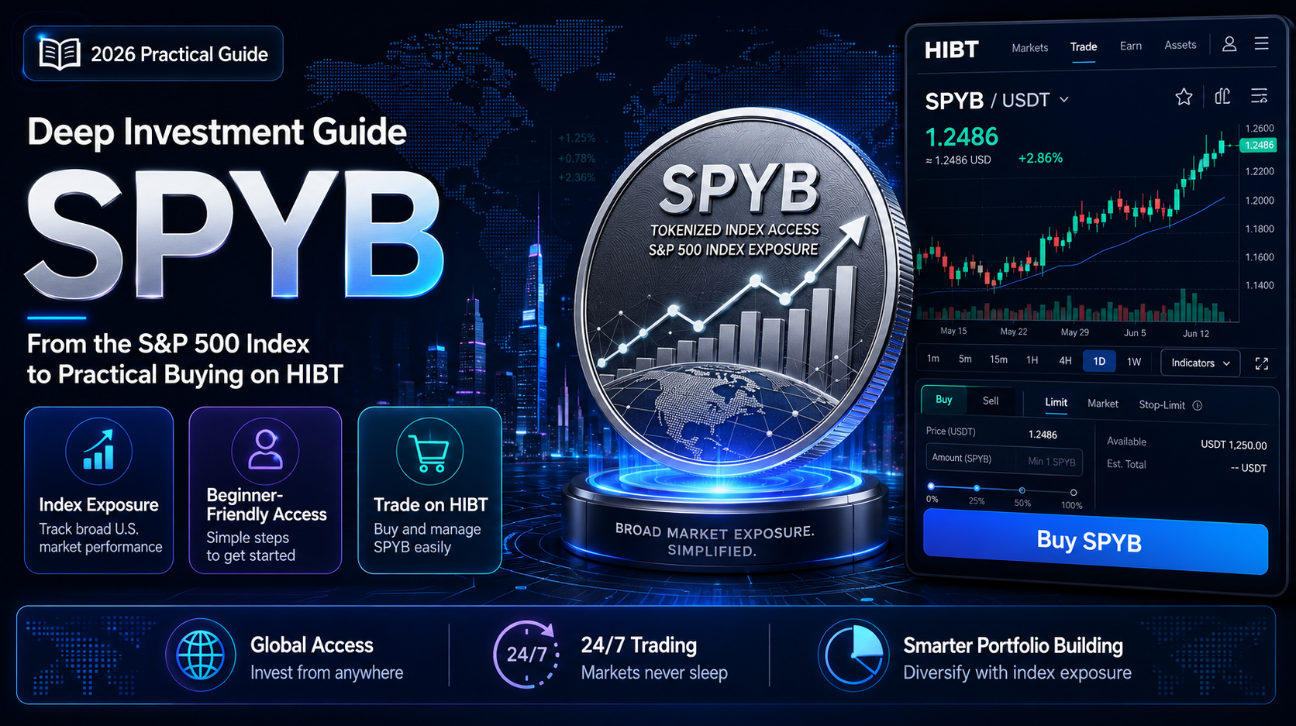
Go to the spot trading section and search for SPYB;
Select SPYB/USDT;
Place a buy order with USDT;
View your holdings on the assets page.
Hibt's SPYB market page displays the SPYB/USDT trading pair entry and provides a "Go to Trade" button. For users already holding USDT, this path is shorter than the traditional brokerage route.
But a shorter path does not necessarily mean better. You must additionally bear Hibt platform risk, SPYB premium/discount risk, USDT stablecoin risk, and tokenized security regulatory risk.
3. How Do Hibt Trading Fees Compare to Traditional Brokerage Costs?
Hibt's Help Center shows that spot trading maker fees are 0.2% and taker fees are 0.2%. Buy fee = buy quantity × fee rate; sell fee = sell price × sell quantity × fee rate.
Traditional brokerage cost structures typically include:
Trading commissions;
Foreign exchange spreads;
Deposit and withdrawal fees;
Tax costs;
Possible account management or third-party fees.
If you already hold USDT and are just making a small exploratory purchase, the Hibt path may be faster. If you are a long-term, large-scale, compliant U.S. stock index allocator, traditional brokerages are usually more suitable for serious investors. Especially for tokenized securities like SPYB, long-term holding requires looking not just at fees, but also at premium/discount, liquidity, custody transparency, and regulatory stability.
4. What Do You Actually Own When Holding SPYB Through Hibt?
You own the SPYB asset recorded in your Hibt account, or—if withdrawals are open—the BEP-20 SPYB token that can be transferred to a BNB Smart Chain wallet.
It is distinctly different from SPY ETF in a traditional brokerage account:
You do not necessarily have traditional ETF shareholder registration rights;
You typically do not have direct voting rights;
How economic rights such as dividends, splits, and corporate actions are handled depends on bStocks and platform rules;
You rely on the issuer, custodian, platform, and on-chain smart contract to jointly maintain product operations;
If the platform suspends trading, deposits, or withdrawals, your liquidity will be affected.
Therefore, SPYB is better understood as an "on-chain U.S. stock index exposure tool" rather than something "fully equivalent to SPY ETF in a traditional brokerage account."
V. Step-by-Step Tutorial: How to Complete SPYB Registration, Deposit, and Trading on Hibt
This chapter provides a complete, follow-along path for newcomers who have never bought tokenized stocks before.
1. Register on Hibt and Complete KYC
After entering the Hibt website or app, click register and create an account using email or phone number. After registration, it is recommended to immediately complete three things:
Set a strong password;
Enable two-factor authentication;
Complete identity verification (KYC).
Hibt's KYC guide states that identity verification typically requires submitting official identification documents such as an ID card, passport, or driver's license. KYC is also related to AML (anti-money laundering) compliance, used to confirm user identity and prevent illicit financial activity.
Mainland China users should pay special attention: tokenized stocks involve three sensitive factors—overseas securities, crypto assets, and exchange accounts. Regulatory policies may change in different regions; do not interpret "the platform is accessible" as "local law permits it." If you are uncertain, you should first confirm local laws and regulations, capital inflow/outflow restrictions, and tax obligations.
2. How to Deposit USDT?
Hibt's Help Center digital asset deposit tutorial shows that users can click Deposit on the app homepage, search for or select USDT, then choose the deposit network and copy the deposit address.
Common USDT networks include:
TRC20: fees are usually lower, arrival is faster, and it is commonly used by many users;
ERC20: Ethereum network, strong compatibility, but on-chain fees are usually higher;
BEP20: BNB Smart Chain network, low fees, suitable for BSC ecosystem assets, but platform support must be confirmed.
The most important point is: the deposit network must match the withdrawal network.
If you select a USDT-TRC20 address on Hibt, you must transfer from an external platform using the TRC20 network; if you select BEP20, you must transfer in from the BEP20 network. Choosing the wrong network may result in assets not being automatically credited, or even irreversible loss.
3. How to Search for the SPYB/USDT Trading Pair?
After USDT arrives in your account, go to the spot trading page and search for SPYB or SPYB/USDT. Confirm that the page name is State Street SPDR S&P 500 ETF Tokenized bStocks, not some other similar name or counterfeit token.
Confirmation methods:
Is the trading pair SPYB/USDT?
Does the full asset name match?
Is the platform page from an official Hibt domain?
Does the external contract address match what is shown on CoinMarketCap/BscScan?
Do not enter the trading page through unfamiliar links.
If you enter from an in-article link, you can open Hibt's SPYB Market page, then click "Go to Trade."
4. Limit Order vs. Market Order: How to Choose?
For tokenized stocks like SPYB, newcomers are advised to use limit orders for their first trade.
The advantage of a limit order is that you can specify the buy price, avoiding execution at an unfavorable price due to insufficient order book depth or short-term volatility. Market orders fill faster, but will directly consume current order book liquidity; if the order book is thin, the actual execution price may deviate significantly from the last price you saw.
Newcomers can operate as follows:
Start with a small test order;
Observe the bid-ask spread;
Place a limit order near the best bid or ask;
After execution, decide whether to continue buying in batches;
Do not chase with large market orders during U.S. market closures or around major data releases.
5. How to Calculate Actual Buy Cost?
Assume you buy 1 SPYB at an execution price of 746 USDT, with Hibt's fee at 0.2%.
Buy fee = 746 × 0.2% = 1.492 USDT
Actual cost ≈ 747.492 USDT
If you later sell at 760 USDT, the sell fee is:
760 × 0.2% = 1.52 USDT
Your rough net profit is not 14 USDT, but:
760 - 746 - 1.492 - 1.52 = 10.988 USDT
This does not yet account for withdrawal fees, USDT exchange rate deviations, premium/discount changes, and opportunity cost.
6. How to Withdraw USDT After Selling SPYB?
After selling SPYB, you will receive USDT. The withdrawal process is typically:
Go to the assets page;
Select USDT;
Click withdraw;
Select the network;
Fill in the external wallet address;
Verify the fee and minimum withdrawal amount;
Complete email, SMS, or 2FA security verification;
Wait for on-chain confirmation.
Hibt's withdrawal tutorial shows that on-chain withdrawals generally start from the assets page under Withdraw, then select USDT and fill in the withdrawal information. Specific fees and minimum withdrawal amounts should be based on Hibt's real-time withdrawal page, as different network fees change with on-chain congestion and platform policies.
7. How to Read Hibt's SPYB Price Prediction Page?
Hibt's SPYB Price Prediction page states that price predictions are "generated based on user feedback" and includes an explicit disclaimer. The page also displays predicted prices for 2027, 2028, 2029, 2030, and other years, along with a notice that they are "for reference only and do not constitute investment advice."
Such prediction pages are suitable for scenario reference, not as a basis for trading decisions. Especially for a newly issued tokenized security like SPYB, with short on-chain trading history, rapidly changing trading volume, and liquidity still forming, long-term prediction errors can be large.
VI. SPYB Price Trends and Prediction References: Is Now a Good Entry Point?
SPYB trend analysis has two layers: one is the SPY ETF's own trend, and the other is SPYB's premium/discount relative to SPY.
1. How to Read RSI, MACD, and Moving Averages?
Since SPYB is a newly issued asset, calculating RSI, MACD, and MA directly from SPYB's own candlestick data may have insufficient sample size. Therefore, a more reasonable approach is:
Short-term: look at SPYB/USDT order book, trading volume, and premium/discount;
Mid-term: look at SPY ETF's daily RSI, MACD, and MA;
Long-term: look at S&P 500 earnings growth, valuation levels, interest rate cycles, and tech stock weight changes.
If SPY is trading above its 20-day and 50-day moving averages, MACD maintains a bullish structure, and SPYB shows no obvious premium, then SPYB's short-to-mid-term trend is relatively healthy.
If SPY breaks below key moving averages while SPYB is still trading at a high premium during U.S. market closures, a price correction may occur after U.S. markets open.
2. Where Are SPYB's Key Support and Resistance Levels?
SPYB's support and resistance should not be viewed only from its own candlestick data, but should reference SPY more closely.
As of this article's verification, SPY's latest price is approximately $745.40. The following framework can be used for judgment:
If SPYB is significantly above the SPY reference price by 1%–2%, be alert for premium compression;
If SPYB is significantly below the SPY reference price by 1%–2%, confirm whether there is insufficient liquidity, platform price delays, or market concerns;
If SPY breaks previous highs, SPYB will usually follow and strengthen;
If SPY falls below its 20-day or 50-day moving averages, SPYB may also weaken in tandem.
Since SPYB's market cap and circulating supply are still small, CoinMarketCap shows its circulating supply at approximately 1,006 tokens, market cap around the $750,000 level, and 24-hour trading volume around the $1.9 million level, indicating that short-term trading volume is high relative to market cap, but absolute market depth still requires careful verification.
3. How to Estimate a Reasonable Price Range for H2 2026?
A simple formula can be used:
SPYB Reasonable Reference Price ≈ SPY Current Price × (1 ± Reasonable Premium/Discount Range)
Assuming SPY fluctuates in the 700–800 range, and SPYB's premium/discount is controlled within ±1.5%:
When SPY = $700, SPYB's reasonable reference range is approximately 689.5–710.5 USDT;
When SPY = $745, SPYB's reasonable reference range is approximately 733.8–756.2 USDT;
When SPY = $800, SPYB's reasonable reference range is approximately 788–812 USDT.
This is not a price prediction, but a valuation anchoring framework. The true H2 2026 trend will also depend on Federal Reserve policy, inflation, corporate earnings, tech stock valuations, and market risk appetite.
4. How to Understand Hibt's 2027–2030 Predictions?
Hibt's SPYB price prediction page shows corresponding predicted values for SPYB in 2027, 2028, 2029, and 2030, and notes that all price predictions are generated based on user feedback. The page also provides long-term predictions for 2040 and 2050, but long-term predictions should not be over-interpreted.
Why is the reference value of long-term predictions limited?
Because SPYB's price in 2040 or 2050 depends not only on the S&P 500, but also on:
Whether the bStocks product will exist long-term;
Whether Hibt will continue to support this trading pair;
Whether BTech's issuance mechanism will remain stable;
Whether tokenized security regulations will change;
Whether the dollar, USDT, and traditional financial infrastructure will change;
Whether the S&P 500's constituent structure will undergo major changes.
Therefore, 2027–2030 can serve as scenario reference, while 2040–2050 is more suitable as content page display and long-term compound-interest education, not as a basis for investment decisions.
5. During Major Events, Does SPYB React Faster or Slower Than SPY?
This depends on when the event occurs.
If the event occurs during U.S. market trading hours, SPY's price will reflect it directly, and SPYB will usually follow.
If the event occurs during U.S. market closures, weekends, or Asian trading hours, SPYB may reflect expectations ahead of SPY.
If market-maker liquidity is insufficient, SPYB may overreact in the short term and correct after U.S. markets open.
Typical events include:
Federal Reserve rate decisions;
CPI and PCE inflation data;
Non-farm payroll data;
Large tech stock earnings;
Geopolitical conflicts;
Sharp fluctuations in the U.S. Dollar Index and Treasury yields.
Newcomers are not advised to treat this time difference as an arbitrage opportunity. In theory there is a price gap, but in practice it may be eroded by fees, slippage, delays, risk-control restrictions, and insufficient liquidity.
VII. SPYB vs. QCOMB vs. XEM: A Comparison Framework for Three Completely Different Assets
A common mistake newcomers make is holding all coins with the same logic. SPYB, QCOMB, and XEM are actually three completely different types of assets.
1. SPYB's Pricing Logic
SPYB is a broad-based index ETF tokenized security, with its core anchor being the SPY ETF. Its main influencing factors are:
S&P 500 Index;
U.S. large-cap corporate earnings;
Federal Reserve interest rates;
Inflation and GDP;
Tech stock weights;
SPYB's own liquidity and premium/discount.
It is not a meme coin meant to chase 10x or 100x returns, but rather closer to "on-chain U.S. stock index exposure."
2. QCOMB's Pricing Logic
QCOMB is a single-stock tokenized stock, with its underlying anchor being a single company such as Qualcomm. Single-stock volatility is usually higher than that of an index, because it is more affected by company earnings reports, product cycles, industry competition, management decisions, and valuation changes.
Readers can read What Is QCOMB to compare the risk differences between single-stock and broad-based index assets like SPYB.
3. XEM's Pricing Logic
XEM is the native token of the veteran public chain NEM. Its value is not anchored to U.S. stocks, nor is it a securitized ETF. Instead, it is driven by public chain ecosystem, network usage, community, liquidity, and crypto market cycles. You can learn about the differences between veteran public chain native tokens and tokenized stocks by reading What Is XEM.
4. How Should You Allocate Positions Across the Three Asset Types?
If you are simultaneously holding all three types of assets on Hibt, you can distinguish them as follows:
SPYB: Core allocation position, for gaining broad U.S. stock index exposure;
QCOMB: Thematic position, for expressing a view on a single company or industry;
XEM: Observation or crypto-native position, for researching veteran public chain cycles;
Meme coins: Speculative position, suitable only for minimal proportional participation.
Do not apply the "double-up and take out principal" meme-coin logic to SPYB. The reasonable return expectation for the S&P 500 should reference long-term U.S. stock market returns, corporate earnings growth, and valuation changes, not short-term altcoin gains.
VIII. If You Decide to Invest in SPYB, How Should You Manage Position Sizing and Mindset?
SPYB is more stable than meme coins, but that does not mean it is risk-free. It is still a tokenized security operating on crypto trading platforms and blockchains.
1. SPYB Is Not Suitable for More Than 10% of Total Assets
For ordinary crypto newcomers, the proportion of tokenized stocks within overall crypto assets should not be too high. Even though SPYB's underlying anchor is the S&P 500 ETF, it is not recommended to exceed 10% of total assets.
The reasons are simple:
It is not SPY in a traditional brokerage account;
It carries platform and issuer risk;
It may suffer from insufficient liquidity;
It may exhibit premium/discount during U.S. market closures;
Regulatory policies in different regions may affect trading and withdrawals.
If you want to long-term allocate to U.S. stock indices, the traditional brokerage path remains more suitable for core asset allocation; SPYB is better suited for small-scale, convenient, on-chain index exposure experimentation.
2. Is SPYB Suitable for Dollar-Cost Averaging?
If you treat SPYB as an S&P 500 exposure tool, small-scale dollar-cost averaging (DCA) is more suitable for newcomers than a one-time chase at highs. But before DCA, several conditions must be met:
Confirm that you can accept U.S. stock drawdowns;
Confirm that SPYB is not trading at a high premium;
Confirm that Hibt's trading pair liquidity is normal;
Confirm that long-term holding compliance and platform risks are acceptable;
Confirm that the funds are not short-term living expenses.
DCA is not "mindless buying." If SPYB consistently trades at a high premium relative to SPY, DCA will keep buying at inflated prices.
3. If the S&P 500 Drops 20%, How Much Will SPYB Drop?
Theoretically, if SPY drops 20%, SPYB should also drop close to 20%. But reality may be more complex:
If the market panics, SPYB may see a larger short-term discount;
If Hibt or on-chain liquidity deteriorates, sell slippage may amplify losses;
If USDT exchange rates or platform risk controls act abnormally, the actual exit price may be worse;
If trading occurs during market closures, SPYB may drop first or overshoot.
So, you cannot only ask "will the S&P 500 rise long-term?" You must also ask: "if it drops 20% first, can I hold through it?"
4. What Other Paths Exist to Gain U.S. Stock Index Exposure?
Crypto users seeking U.S. stock index exposure have roughly four paths:
Buy SPY, VOO, IVV through traditional brokerages: closest to the traditional investment path, suitable for long-term allocation, but more complex account opening, deposit, and currency exchange.
Tokenized securities such as SPYB: shorter path, suitable for users already holding USDT, but carries platform, regulatory, and premium/discount risks.
U.S. stock index-related CFDs or derivatives: flexible leverage, but higher risk, unsuitable for newcomers.
Hold a portfolio of crypto assets highly correlated with U.S. stocks: indirectly gain risk-asset exposure, but correlation is unstable and cannot replace an index ETF.
For newcomers, SPYB can serve as an entry point to learn about tokenized securities, but should not replace a complete asset allocation plan.
IX. Final Thoughts: Three Sober Reminders for Crypto Newcomers
1. "The S&P 500's Long-Term Annualized Return of ~10%" Does Not Mean You Will Necessarily Get 10% from SPYB
Many articles state that the S&P 500's long-term annualized return is close to 10%. But this statement cannot be simply applied to SPYB.
Because buying SPYB adds several layers of cost:
Hibt spot trading fees;
Bid-ask spreads;
SPYB's premium over SPY;
Tiny deviations between USDT and USD;
Withdrawal fees;
Platform and custody risk;
Tokenized security regulatory risk.
Long-term returns are not determined solely by the underlying index, but also by the path through which you buy, the price at which you buy, and the additional costs and risks you bear.
2. Newly Issued, Low Liquidity, Trading During Market Closures, Reliance on Market Makers—Defense First
If a tokenized stock simultaneously meets the following conditions:
Newly issued;
Small circulating supply;
Still trades during U.S. market closures;
Relies on the platform or market makers to maintain price;
Users cannot directly see complete underlying custody details;
Then industry veterans typically will not go heavy right away, but instead first observe spreads, liquidity, execution stability, and platform rules.
SPYB's underlying asset quality is not bad, but the product path is still new. Good underlying assets do not mean the trading path is risk-free.
3. Mainland China Users Must Pay Extra Attention to Compliance Risks
SPYB simultaneously involves crypto assets, overseas trading platforms, tokenized securities, and U.S. stock index exposure. Mainland China users participating in such products may face uncertainties regarding account usage, capital inflows and outflows, trading restrictions, tax declarations, and regulatory policy changes.
If you are uncertain whether you are suitable to participate, the safest approach is not to trade first, but to first confirm the legal and compliance boundaries.
FAQ: Common SPYB Questions for Newcomers
1. What is SPYB?
SPYB is State Street SPDR S&P 500 ETF Tokenized bStocks, a bStocks tokenized security that uses the SPY ETF as its underlying reference asset, operating on the BNB Smart Chain.
2. Is SPYB the Same as the SPY ETF?
No. SPY is an ETF on the traditional U.S. stock market; SPYB is an on-chain tokenized security. SPYB provides economic exposure similar to SPY, but it is not equivalent to directly holding SPY ETF shares in a traditional brokerage account.
3. What Is SPYB's Contract Address?
SPYB's contract address on the BNB Smart Chain is:
0x7138b48df7D98D7e3cc221BfE7192D0a178182D8
CoinMarketCap, Coinbase, and BscScan can all be used to verify this address.
4. Is SPYB an Altcoin?
Strictly speaking, SPYB is not an ordinary altcoin, but a tokenized security asset. However, it is still an on-chain token and carries crypto market trading risk, platform risk, and regulatory risk.
5. Does SPYB Pay Dividends?
The bStocks mechanism generally emphasizes that holders receive economic exposure to the underlying asset, including price changes, dividends, and corporate actions, but the specific crediting method, timing, eligibility, and platform processing rules depend on the issuer and trading platform's instructions. Do not assume it is identical to SPY dividend payments in a traditional brokerage account.
6. Is KYC Required to Buy SPYB on Hibt?
Hibt's KYC guide shows that identity verification typically requires official identification documents such as an ID card, passport, or driver's license. Whether KYC is mandatory for deposits, trading, or withdrawals should be based on Hibt's current page prompts.
7. Is SPYB Suitable for Long-Term Holding?
If looking only at the underlying asset, the SPY ETF itself is a broad-based index tool commonly used by long-term investors. But SPYB is a tokenized path that additionally introduces platform, custody, regulatory, liquidity, and premium/discount risks. Therefore, SPYB can serve as a small-proportion U.S. stock index exposure tool, but should not be simply equated with long-term ETF allocation in a traditional brokerage account.
8. Can I Buy SPYB Now?
Whether you can buy depends on your risk tolerance, compliance conditions, capital nature, and entry price. Before buying, you should at least check: SPY's current price, SPYB's current price, premium/discount, Hibt order book depth, fees, withdrawal status, and your own maximum tolerable drawdown.
9. Which Has Lower Risk, SPYB or QCOMB?
Generally speaking, SPYB is anchored to a broad-based index and has higher diversification; QCOMB is anchored to a single stock and is more affected by company fundamentals. But SPYB still carries tokenized security path risk, so it cannot be simply called "low risk." Positions should be differentiated by purpose: SPYB is more suitable as a core allocation position, while QCOMB is more like a thematic position.
10. Are SPYB Price Predictions Credible?
Hibt's SPYB price prediction page explicitly states that all price predictions are generated based on user feedback and are for reference only, not constituting investment advice. Predictions can be used for scenario analysis, but cannot replace your own judgment.
About the Author
The author has long focused on crypto exchange products, tokenized stocks, on-chain data, SEO content strategy, and newcomer investment education. The author is skilled at dissecting opportunities and risks of novel crypto-financial products from the perspectives of contract addresses, trading mechanisms, platform announcements, technical indicators, macro data, and user operational workflows. The goal of this article is not to predict whether SPYB will rise or fall, but to help newcomers establish the basic habit of "understand the asset first, then decide whether to trade."
Disclaimer
This article is for information compilation and investment education purposes only and does not constitute investment advice, securities recommendation, legal advice, tax advice, or financial planning advice. SPYB is a tokenized security asset. Although its price is anchored to the SPY ETF, it is not equivalent to holding SPY ETF shares in a traditional brokerage account. Users may face multiple risks including market volatility, platform operations, smart contracts, custody, liquidity, premium/discount, regulatory policy, and regional compliance.
The data in this article reflects publicly available information as of July 9, 2026, and may change subsequently. Readers should verify Hibt, CoinMarketCap, BscScan, State Street, Yahoo Finance, and bStocks official sources, as well as local laws and regulations, before conducting any transactions.
Please always remember: DYOR (Do Your Own Research), do not invest funds you cannot afford to lose, and do not simplistically interpret "the S&P 500 rises long-term" as "any on-chain tokenized product is suitable for long-term heavy positions."