
Opening: I’ve Heard of Zero Knowledge Proof, But Why Is ZKP Suddenly a Coin?
Many beginners seeing the name ZKP for the first time naturally ask: Isn’t ZKP the cryptographic technique “zero knowledge proof”? How did it suddenly become a tradable token? Is this just packaging an academic concept into a coin to rug pull?
This question is extremely important. In the crypto industry, “technical concepts” and “token projects” are often mixed together in marketing. Zero knowledge proof, or Zero Knowledge Proof in English, is originally a class of cryptographic methods whose core purpose is: one party can prove to another that something is true without revealing the underlying raw information. Chainlink’s educational materials also define zero knowledge proof as a cryptographic method that “proves you know a piece of data without revealing the data itself.”
But the ZKP discussed in this article is not just the general technical concept of “zero knowledge proof”; it is a Layer 1 network and its native token named Zero Knowledge Proof (ZKP). According to the project’s official website, Zero Knowledge Proof (ZKP) is positioned as a Layer 1 blockchain for privacy-preserving AI infrastructure. The project is conducting a public pre-sale and introduces Proof Pods hardware devices to participate in network computation and validation.
This brings a key cognitive distinction:
Zero knowledge proof is an underlying cryptographic technology.
ZKP token is an asset issued by a specific project.
The technology itself is important, but that doesn’t mean any token called ZKP necessarily has value.
What this article aims to solve are the five most anxious questions for beginners: What exactly is the ZKP token? Is it just an ordinary privacy coin? Do Proof Pods and privacy AI computing have real logic? Is the pre-sale structure fair to retail investors? If it trades on HIBT in the future, how should I buy it, store it, and control risk?
There is one more point that must be clarified upfront: As of July 3, 2026, HIBT’s official announcements found via public search show that ZKP/USDT corresponds to zkPass (ZKP), not the Zero Knowledge Proof (ZKP) pre-sale project discussed in this article. CoinGecko also shows that ZKP/USDT on Hibt is the zkPass trading pair. Therefore, if users search for ZKP on HIBT, they must verify the full project name, official website, contract address, network type, and official announcements to avoid confusing zkPass with Zero Knowledge Proof.
Chapter 1: Are ZKP, Zcash, and Monero All “Privacy Coins”?
1.1 Is ZKP Network a “Privacy Coin” or “Privacy Computing Infrastructure”?
Zcash, Monero, and ZKP are all related to “privacy,” but they solve different problems.
Monero is closer to a traditional anonymous transfer coin. It emphasizes hiding the transaction sender, receiver, and amount, making it difficult for external observers to trace fund flows. Zcash is also a privacy coin, but it adopts an optional privacy mechanism where users can choose transparent or shielded addresses. Because such assets directly involve “financial transaction anonymization,” they have long faced higher regulatory pressure. Binance announced in February 2024 that it would delist Monero (XMR) trading pairs, citing reasons including project review, ecosystem health, and regulatory requirements.
The narrative of the Zero Knowledge Proof (ZKP) project is different. It is not just trying to do “anonymous transfers”; it positions itself as “privacy-preserving AI infrastructure.” The project’s official website states that the goal of the ZKP network is to keep data and models confidential while allowing AI tasks to be verified on-chain. Its Proof Pods are used to execute computing tasks, generate verifiable proofs, and issue ZKP rewards to participants.
In other words, the core use case for Zcash/Monero is “transaction privacy,” while ZKP wants to tell the story of “computational privacy” and “AI data privacy.”
These two positioning are very different:
Transaction privacy: The focus is on hiding transfer amounts, addresses, and fund paths.
Computational privacy: The focus is on verifying that a computation result is correct without exposing raw data, model parameters, or business secrets.
If ZKP were only doing anonymous transfers, it would directly face privacy coin regulatory pressure. But if it can land in scenarios such as medical AI, financial risk control, enterprise data analysis, privacy data markets, and zkML model verification, its compliance narrative would be much easier to explain than traditional anonymous coins.
1.2 If I Just Want to Transfer Anonymously, Is Buying ZKP the Wrong Choice?
If your goal is only anonymous transfers, then ZKP may not be the best-matched asset. Projects like Monero and Zcash have a longer history in “anonymous transfers,” clearer user awareness, and more mature tool systems.
ZKP’s real selling point is not “I help you hide a transfer,” but “I help you prove that something was correctly computed without leaking the original data.” This has more imagination in AI and enterprise data scenarios.
Here is a simple example: A hospital wants an AI model to analyze patient data but cannot expose patient privacy; a financial institution wants to use an external model for risk scoring but does not want to disclose customer raw data; a DeAI network wants to verify model inference results, but the model developer is unwilling to expose model parameters. All these scenarios require the ability to be “verifiable but not exposed.”
The project’s official website also describes ZKP token use cases as: staking, paying for computing and storage tasks, incentivizing Proof Pods validators, accessing AI models/data markets/smart contract services, and participating in governance voting and protocol upgrades.
So, ZKP is better understood as a combination of “privacy computing + AI verification + decentralized hardware network,” rather than a simple anonymous transfer coin.
1.3 Are ZKP and zkPass the Same Thing?
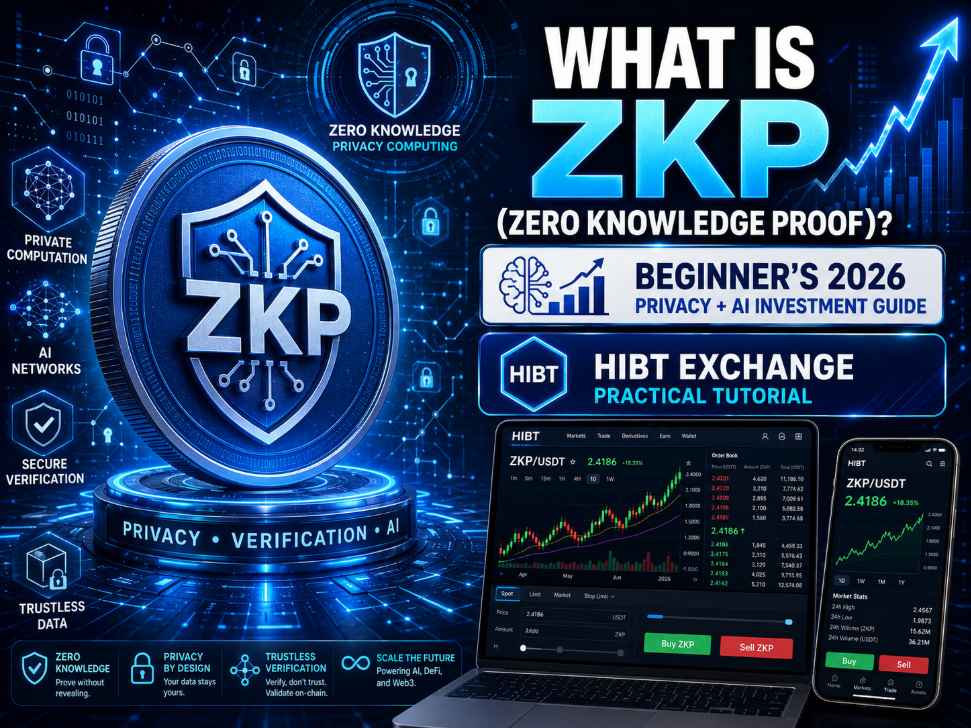
No. This distinction is very important.
The token ticker for zkPass is also ZKP. Binance Academy’s explanation of zkPass is: zkPass is a privacy data verification protocol that uses MPC, zero knowledge proof, and 3P-TLS technologies to allow users to prove facts from Web2 websites without exposing detailed information.
The Zero Knowledge Proof (ZKP) discussed in this article is another project. Its official website positions it as a Layer 1 privacy AI infrastructure, introducing Proof Pods hardware, a ZKP Dashboard, a public pre-sale, Proof of Intelligence + Proof of Space, and other designs.
The biggest difference between the two is:
zkPass: Focuses on Web2 data proof, identity/data verification, and zkTLS.
Zero Knowledge Proof (ZKP): Focuses on Layer 1, privacy AI computing, and the Proof Pods hardware network.
Why is this point placed up front? Because HIBT already has announcements showing that its listed ZKP is zkPass, not the Zero Knowledge Proof pre-sale project. When beginners search for ZKP on HIBT or other exchanges, they must look at the full project name and official links, not just the ticker.
Chapter 2: Is ZKP’s Technical Architecture Truly Hardcore, or Just Whitepaper Concepts?
2.1 What Are Proof Pods? How Are They Different from Bitcoin Mining Machines?
Proof Pods are the most distinctive design of the Zero Knowledge Proof project. The project’s official website states that Proof Pods are compact, Wi-Fi-connected, plug-and-play hardware devices. Users can earn ZKP tokens by running confidential computing tasks without complex configuration or coding. The website shows each Proof Pod priced at $249, supporting 300 upgrade levels, and automatically updating via Wi-Fi.
According to the project’s FAQ, Proof Pods are mainly divided into two categories:
Compute Pods: Execute zero knowledge proof and AI verification tasks; rewards are related to task complexity and execution speed.
Storage Pods: Provide verifiable off-chain storage; rewards are related to data capacity and online duration.
This is clearly different from Bitcoin mining machines. Bitcoin mining machines primarily perform hash computations with the goal of competing for block rights; the computation itself has no direct external business use. ZKP’s Proof Pods attempt to turn hardware computation into “useful computation,” that is, providing actual services for privacy AI, data verification, and proof generation.
But investors should not assume the project is reliable just because it has “hardware.” For a hardware network to truly work, it needs to meet at least several conditions:
Devices can be delivered on time.
Devices can connect and run stably.
There are real computing/storage tasks in the network.
The reward mechanism is not simply maintained by new users buying hardware.
ZKP tokens have sufficient external demand to absorb mining output.
So, Proof Pods are a distinctive product design, but they are not a risk-free yield machine.
2.2 What Problem Does the “Proof of Intelligence + Proof of Space” Hybrid Consensus Solve?
The project’s official website describes ZKP’s network mechanism as a Proof of Intelligence + Proof of Space hybrid consensus, emphasizing its support for EVM + WASM smart contracts, a built-in marketplace, and Proof Pods hardware participation.
Conceptually, Proof of Intelligence tries to reward “useful computation,” rather than doing meaningless hashes like PoW. Proof of Space, on the other hand, utilizes storage space to participate in the network, allowing users to contribute verifiable off-chain storage resources.
For ordinary investors, this mechanism has three implications:
First, the participation threshold may be lower than ASIC mining machines. Bitcoin mining machines require high power consumption, high noise, professional hosting, and electricity cost advantages, while Proof Pods are designed as small household devices that can be plugged in and run at home.
Second, network returns depend on real tasks. The ZKP official website clearly states that Proof Pod rewards are dynamically adjusted based on early participation, total activity, participation level, and long-term sustainability metrics.
Third, returns should not be understood as fixed income. Even if the project page displays “mining yield” examples, they cannot be simply taken as promised returns. Hardware yields will be affected by token price, task volume, online rate, device level, total network participants, and reward adjustments.
In one sentence: The PoI + PoSpace narrative is closer to AI and data scenarios than traditional PoW, but whether it truly works depends on mainnet tasks and real demand.
2.3 EVM + WASM Dual Virtual Machines: What Does It Mean for Developers?
The ZKP official website emphasizes that it runs EVM + WASM smart contracts. The core of this design is to accommodate two types of developer needs.
EVM compatibility means existing contracts, wallets, development tools, and dApps from the Ethereum ecosystem can more easily migrate. Developers already familiar with Solidity, MetaMask, Hardhat, Foundry, and other tools will have lower onboarding costs.
WASM support is more suitable for high-performance computing and complex logic. Scenarios such as AI inference, cryptographic verification, data processing, and cross-language contracts may be better suited for a WASM environment.
Compared with pure EVM chains, ZKP’s differentiation is that it tries to serve more complex privacy computing tasks. Compared with pure WASM chains, it hopes to lower the migration threshold for Web3 developers through EVM.
But there is also a practical problem here: compatibility does not equal ecosystem prosperity. Many chains claim EVM compatibility, but few truly attract developers, liquidity, and users. What investors need to track later is not “whether it supports EVM/WASM,” but:
Are there real dApps deployed?
Are there developer tool docs?
Are there cross-chain bridges and wallet support?
Is there TVL, trading volume, and active address growth?
Are there enterprises or AI applications willing to pay for usage?
2.4 Why Is ZKP + IPFS Off-Chain Storage More Realistic?
AI data is not small files of dozens of KB, but datasets, model weights, training logs, and inference results often measured in GB or TB. Putting all data on-chain would be extremely costly and unrealistic.
A more reasonable solution is: data is stored off-chain, while proofs, hashes, and access permissions are stored on-chain. Content-addressed storage like IPFS can guarantee data is located by content hash, while ZKP can use cryptography to verify the trustworthiness of data or computation results without directly exposing the raw content.
This logic does not fully conflict with storage projects like Filecoin and Arweave. Filecoin and Arweave emphasize data storage networks more, while ZKP wants to emphasize “privacy computing + verifiable tasks + AI data markets.” In the future, they may compete or collaborate.
For beginners, understanding this much is enough: ZKP is not trying to stuff all AI data onto the chain, but rather trying to use a combination of on-chain proofs + off-chain storage + hardware computing to reduce the cost of landing privacy AI applications.
Chapter 3: ZKP Tokenomics — Am I an Early Participant or a Bag Holder?
3.1 Total Supply of 714,285,714 Tokens, 35% Public Pre-Sale: Is That High?
The project’s official website FAQ shows that ZKP Coin has a total supply of 714,285,714.285, and claims that 35% is allocated to the public pre-sale. The tokenomics page also states that the pre-sale adopts 25 stages, deterministic price escalation, public participation, no private allocation, no insider pricing, and sets a public offering target price of $0.04.
If you only look at “35% public pre-sale,” this ratio is indeed high in the industry. Many projects’ public sale allocations are far lower than team, foundation, and early investor shares. A high public pre-sale ratio is theoretically favorable for reducing the advantage of low-cost VC chips.
But there is a detail that must be warned about: The ZKP official website FAQ writes “total supply 714,285,714.285” in one place, and “35% public pre-sale (250B ZKP)” in another. These two figures are clearly inconsistent. This may be a page copy or unit denomination issue, but for investors, this is a signal that needs verification. Before formally investing funds, you must confirm whether the total supply denomination in the latest whitepaper, smart contracts, Dashboard display, and official announcements is consistent.
3.2 25-Stage Pre-Sale, Max $0.02, Public Target $0.04: Is It Transparent?
The project’s official website explains that the ZKP pre-sale consists of 25 transparent stages, each with a preset price and fixed allocation. As stages progress, the price rises; the highest pre-sale stage price is $0.02, and the public offering target price is $0.04.
The advantage of this mechanism is: the rules appear more public than “private sales with connections for low-cost chips,” and ordinary users can at least know the price change logic for each stage.
But it also has risks:
First, the pre-sale target price is not a guaranteed secondary market price. $0.04 is just the project’s set public offering target; the price after listing may be higher or lower.
Second, early-stage participants still have a cost advantage. If pre-sale prices gradually increase, the earlier participants have lower chip costs, and later users may still be buying early participants’ chips.
Third, pre-sale assets have liquidity risk. After users pay funds, whether they can claim on time, when they unlock, which exchanges will list, and whether there is sufficient depth all have uncertainties.
Fourth, a public mechanism does not equal no risk. No private sale price does not mean there are no team, operations, marketing, hardware, liquidity, and subsequent unlock risks.
So, ZKP’s pre-sale structure is easier to understand than many black-box projects, but that doesn’t mean it should be treated as a guaranteed profit opportunity.
3.3 5-Month Linear Unlock: How Big Is the Impact on Early Buyers and the Secondary Market?
The ZKP official website FAQ shows that ZKP tokens will be released over 5 months: 20% unlocked in Month 1, another 20% each month in Months 2–5, and 100% unlocked after Month 5.
This unlock period is very short. Compared with many projects’ “1-year cliff + 2–4 year linear unlock” for team/VC unlocks, ZKP pre-sale users are fully unlocked in 5 months, which is more friendly to early buyers because they don’t have to wait too long.
But for the secondary market, this also means sustained sell pressure may arrive faster. Especially if the price after listing is higher than the pre-sale price, every unlock in the first 5 months may bring selling pressure.
Beginners should note:
After 20% unlock in Month 1, early buyers may test selling.
Monthly releases in Months 2–5 may continuously suppress the price.
If exchange depth is insufficient, small sell orders may also cause large volatility.
If the project exceeds expectations, unlock sell pressure may be absorbed by demand.
If project heat declines, the unlock period may become a continuous downward window.
Therefore, when buying ZKP in the secondary market, don’t just look at the opening price; also look at the unlock calendar.
3.4 No VC Round, No Private Sale Price: How Can This Claim Be Verified?
The project’s official website emphasizes no private allocation, no insider pricing, and public participation. This sounds fair, but investors should still ask several questions:
Who is the team?
Is the code open-source?
Is the hardware actually delivered?
Who custodies the pre-sale funds?
Are the contracts audited?
Are there hidden allocations for advisors, operations, marketing, and partners?
Does the project disclose the entity company, registration jurisdiction, and legal documents?
The ZKP tokenomics page shows that Team & Advisors account for 3%, locked for 12 months followed by 36 months of linear unlocks; Liquidity allocation accounts for 3%, with a portion gradually released over 12–18 months; Mining & Proof Rewards account for 55%.
This shows it is not “no team allocation,” but rather the team allocation is relatively small and has lock-up arrangements. For investors, this is more realistic than a “no team coin,” but team transparency and execution capability still need to be verified.
Especially for anonymous or semi-anonymous teams, risks cannot be ignored. Privacy technology projects may hide some identities for security reasons, but investors must also accept corresponding risks: unclear responsibility subject, difficult legal recourse, and lack of accountability mechanisms when roadmaps are delayed.
Chapter 4: How Will ZKP’s Price Move After Listing? What Are the Historical Lessons of the Privacy Track?
4.1 Monero Delisted, Zcash Under Regulatory Review: How Can ZKP Avoid the Same Fate?
The biggest problem with the privacy track is not lack of demand, but too much regulatory pressure.
Binance announced in February 2024 that it would delist Monero (XMR) trading pairs, and privacy coins once again became high-compliance-risk assets. In 2026, Coindesk also mentioned that privacy tokens like Zcash and Monero may continue to gain market attention, but still face exchange delisting risks and regulatory conflicts.
For ZKP to avoid Monero’s fate, it must prove that it is not a “tool to help users evade regulation through anonymous transfers,” but rather “privacy computing infrastructure for enterprises, AI, data markets, and developers.”
This is the key to the positioning difference:
Monero’s core narrative is untraceable transactions.
Zcash’s core narrative is optional privacy payments.
ZKP’s core narrative is confidential computing, AI verification, data markets, and hardware proof networks.
If ZKP can truly serve compliant scenarios such as healthcare, finance, and enterprise analysis, its regulatory narrative will be much easier to explain than anonymous coins. But if the market only treats it as a “new privacy coin,” it may still be classified as high-risk by exchanges and regulators.
4.2 Pre-Sale $0.04 Sounds Great, Why Do Some People Say 1000x?
“1000x” is the most common and most dangerous rhetoric in new coin marketing.
If ZKP’s public offering target price is $0.04, then rising to $1 is 25x, to $4 is 100x, and to $40 is 1000x. With a total supply of about 714 million tokens, $40 would mean a fully diluted valuation exceeding $28.5 billion.
How big is that? CoinGecko data shows that as of early July 2026, Monero’s market cap is about $5.9 billion, and Zcash’s market cap is about $7.1 billion. In other words, if ZKP wants to reach 1000x, its market cap would need to far exceed the current traditional privacy coin leaders, and it would also need to prove that it has huge real demand in the AI privacy computing field.
So, “1000x” cannot be used as an investment basis. A more reasonable way to judge is:
Can ZKP complete hardware delivery?
Is the mainnet running stably?
Do Proof Pods have real tasks?
Is the data market generating revenue?
Is exchange liquidity sufficient?
Is unlock-period sell pressure being absorbed by the market?
Are there real enterprises or developers using it?
If there are no answers to these questions, no matter how high the multiple narrative, it is just marketing noise.
4.3 What Is the Competitive Landscape for Privacy Computing + DeAI?
The direction ZKP is in can be understood as the intersection of “privacy computing + DeAI + hardware network.”
It does not directly compete with Monero/Zcash for anonymous transfers, but rather tries to capture the privacy AI computing and verifiable data market. It is also not exactly the same as Allora, Fetch.ai, or Bittensor. Allora emphasizes model inference synthesis and decentralized intelligence collaboration more; Bittensor emphasizes decentralized AI subnets and model markets more; while ZKP emphasizes zero knowledge proofs, hardware Proof Pods, confidential computing, and data verification more.
Its potential moats include:
Hardware network barrier: If Proof Pods are truly deployed, they will form a physical node network.
Privacy computing narrative: In the AI era, demand for data privacy and model intellectual property protection is increasing.
ZK technology barrier: Zero knowledge proof generation is costly and requires hardware and protocol optimization.
Dual virtual machines: EVM + WASM is conducive to attracting both Web3 and high-performance computing developers simultaneously.
But its weaknesses are also obvious:
The project is still in early stages.
Pre-sale and hardware delivery have execution risks.
Team transparency needs continued verification.
Exchange listing and liquidity are uncertain.
The technology is complex, and ordinary users find it difficult to verify real progress.
So, ZKP’s moat is not “being named Zero Knowledge Proof,” but whether it can truly get Proof Pods, data markets, AI verification, and on-chain economics running in the future.
4.4 How Big Is the Liquidity Risk for New Coins?
One of the biggest risks for new coins is unstable liquidity.
If ZKP’s order book depth is insufficient after listing on exchanges, large buy orders can cause high slippage, and large sell orders can also quickly dump the price. Especially during the pre-sale unlock period, early buyers have low costs, and once they sell collectively, the price may experience violent fluctuations.
Beginners should pay special attention to three traps:
First, opening FOMO. Seeing the price quickly rise from $0.04, you think it will continue to rise, and end up buying at a short-term high.
Second, insufficient depth. The price looks low, but the actual bid-ask spread is large, and it is hard to sell at the ideal price after buying.
Third, unlock sell pressure. Monthly chip releases in the first 5 months may continuously suppress the price.
Therefore, a new project like ZKP is not suitable for heavy positions, only for small positions to observe.
Chapter 5: Complete Practical Guide to Buying ZKP on HIBT Exchange
5.1 Why Choose HIBT? First, Confirm Which ZKP You Are Buying
Before entering the operation tutorial, it must be emphasized again: As of July 3, 2026, the ZKP/USDT in HIBT’s publicly announced listings is zkPass (ZKP), not the Zero Knowledge Proof (ZKP) project.
So, when users search for ZKP on HIBT, they must first do four confirmations:
Is the full project name Zero Knowledge Proof?
Does the trading pair page show the project’s official website as zkp.com?
Are the network type and contract address consistent with the official ones?
Has HIBT issued an independent listing announcement for this project?
If these confirmations are not present, do not place an order just because the ticker is the same.
From a platform perspective, third-party review materials state that HIBT supports 700+ crypto assets, has US/Canada MSB and Australia AFS-related compliance backing, and provides security mechanisms such as 90% cold storage, multi-signature, mandatory 2FA, and Proof of Reserves. But these platform security mechanisms do not mean any new coin itself is low-risk; users still need to independently judge project risks.
HIBT not only covers the privacy computing track but also supports Layer 2 scaling concept tokens. If you want to learn about representative projects in the Layer 2 track, you can first read What Is OP to compare the infrastructure positioning differences between Optimism and ZKP — the former solves Ethereum scaling, while the latter solves AI data privacy verification.
5.2 HIBT Registration & KYC: What If My ID Photo Keeps Failing?
If you don’t have a HIBT account yet, the first step is registration and KYC.
The basic process is:
Open the HIBT official website or app.
Register using email or phone number.
Set a strong password.
Enter email/phone verification code.
Go to the identity verification page.
Upload ID, passport, or a document supported by the platform.
Complete live facial recognition.
Wait for review.
If your ID photo keeps failing, common reasons include:
Photo glare.
ID corners not fully captured.
Blurry text.
Expired document.
Name entered does not match the document.
Too dim lighting during facial recognition.
Wearing a hat, sunglasses, or mask.
Network upload interruption.
The solution is: move to a place with even lighting, lay the document flat with all four corners fully in the frame, do not use beauty filters, and ensure the name and document number match. Review time may vary from a few minutes to 24 hours, depending on the HIBT page prompt.
After registration, it is recommended to immediately enable:
Google Authenticator / 2FA.
Fund password.
Anti-phishing code.
Withdrawal address whitelist.
Login device management.
HIBT itself also has 2FA security tutorials, emphasizing that users should save authenticator keys offline and not take screenshots or store keys in phone cloud storage.
5.3 Depositing USDT to HIBT: Should I Choose ERC20 or TRC20?
Before buying ZKP, you usually need to first deposit USDT.
Common USDT networks include ERC20, TRC20, BEP20, etc. The most important thing for beginners to remember is: the deposit network you choose on HIBT must exactly match the network you select when withdrawing from another exchange.
ERC20 is the Ethereum network, with strong security and compatibility, but fees are usually higher.
TRC20 is the Tron network, with usually lower fees and faster arrival, suitable for small USDT transfers.
BEP20 is the BNB Chain network, with low fees, but you must confirm whether HIBT supports USDT deposits on this network.
Operation recommendations:
First, select USDT deposit on HIBT’s asset page.
Choose the network you want to use.
Copy the deposit address.
Paste the address on the withdrawal platform.
Confirm the network matches.
Verify the first and last few digits of the address.
Send a small test amount first.
Transfer a larger amount after it arrives.
Do not operate through deposit links sent by strangers, and do not send QR code screenshots to so-called “customer service” for deposits on your behalf.
5.4 Finding ZKP/USDT on HIBT: Market Order or Limit Order?
If HIBT officially lists Zero Knowledge Proof (ZKP) in the future, and you have already confirmed that the trading pair is not zkPass, then the spot buying process is usually as follows:
Step 1: Enter HIBT’s “Spot” or “Trade” page.
Step 2: Enter ZKP in the search box.
Step 3: Verify the full project name, icon, announcement, contract address, and official website.
Step 4: Select the ZKP/USDT trading pair.
Step 5: Confirm you are in the “Buy” area, not the “Sell” area.
Step 6: Choose market order or limit order.
Market orders are suitable for small quick fills. The advantage is no waiting; the disadvantage is that slippage may occur when prices fluctuate greatly.
Limit orders are suitable for controlling purchase costs. For example, if you are only willing to buy at $0.04 USDT or $0.03 USDT, you can place a limit order and wait for it to fill.
For beginners, it is not recommended to use large market orders to chase highs at the opening. A more reasonable approach is:
First, test the order process with a small amount.
Observe order book depth and bid-ask spread.
Use limit orders to buy in batches.
Do not go all-in at once.
After execution, you can view holdings and floating P&L in the spot account or asset page.
5.5 How to Set Take-Profit and Stop-Loss After Buying?
New coins are most dangerous without a plan. If ZKP has high volatility after listing, beginners should set take-profit and stop-loss in advance, rather than deciding when emotions are out of control.
If HIBT’s spot page supports take-profit/stop-loss, conditional orders, or planned orders, you can select the corresponding function in the order area and set the trigger price and order price. Feature names may vary by version; refer to the actual HIBT page.
A simple stop-loss plan could be:
Conservative: Cut position if it falls 10%–15% below purchase price.
Standard: Stop loss if it falls 15%–20% below purchase price.
Long-term observation: Only invest a very small position, no short-term stop-loss, but set a maximum loss amount.
Take-profit should also be done in batches; don’t fantasize about selling at the highest point in one go. For example:
Sell a portion of principal when up 50%.
Sell another portion when up 100%.
Observe the project’s long-term progress with the remaining position.
Trailing stop-loss is suitable for experienced users, but not necessarily friendly for a new coin like ZKP. Because new coins are prone to wicks, trailing stop-loss may get swept by short-term fluctuations.
5.6 Should Large ZKP Holdings Stay on HIBT or Be Moved to a Self-Custody Wallet?
Asset management can be divided into two categories: exchange custody and self-custody wallets.
The advantage of keeping funds on HIBT is trading convenience, fast buying and selling, and suitability for short-term trading. The disadvantage is that you need to trust the platform’s custody and account security system.
The advantage of moving to a self-custody wallet is that you hold the private keys yourself, which is more suitable for long-term holding. The disadvantage is higher operational threshold; if the seed phrase is lost or leaked, assets may be unrecoverable.
If ZKP supports EVM, MetaMask may be a common choice; if the project provides an official Dashboard wallet or on-chain account system, you can also manage Proof Pods, rewards, and contribution records through the official portal. The ZKP official website FAQ shows that users can connect a Web3 wallet via purchase1.zkp.com to manage Proof Pods, track earnings, view contribution history, and mobile browsers are also supported.
Recommended principles:
Short-term small trading funds can stay on HIBT.
Medium- to long-term large positions can be gradually moved to a self-custody wallet.
First test with a small withdrawal amount.
Only copy contract addresses from official channels.
Do not connect to unfamiliar DApps.
Do not screenshot seed phrases, send them on WeChat, or store them in cloud drives.
Chapter 6: After Buying ZKP, What Else Can You Do Besides Waiting for the Price to Rise?
6.1 Do I Need to Buy Proof Pods to Participate in the Network?
Not necessarily.
If you want to participate in network hardware earnings, you can consider Proof Pods. The ZKP official website states that Proof Pods can execute computing or storage tasks. Users earn ZKP rewards by keeping the device online and participating in the network. The device requires USB-C power, Wi-Fi connection, and binds to the account via a one-time code on the screen.
But before buying hardware, you must consider:
Device cost.
Shipping region.
Customs and logistics.
Whether the device ships on schedule.
Whether the network has real tasks.
Whether returns cover costs.
Whether token price fluctuations affect payback period.
If you don’t want to buy hardware, you can also look into token staking, governance voting, platform earn products, or secondary market trading. The project’s official website shows that ZKP Coin can be used for staking, governance, paying for computing/storage tasks, and accessing AI models and data markets.
But no matter which method, returns should not be understood as fixed-income products.
6.2 How to Use the ZKP Dashboard? Can It Be Operated on Mobile?
The ZKP official website FAQ explains that the ZKP Dashboard is the user’s control center for participating in the network. It can be used to buy ZKP Coin, manage Proof Pods, track earnings and tasks, view contributions and token allocation history, and access governance tools after governance goes live. The Dashboard supports desktop and mobile browsers and does not require a separate app.
Beginners should note three points when using it:
First, only access through the official portal to avoid phishing sites.
Second, confirm the domain, certificate, and community announcements before connecting a wallet.
Third, do not randomly authorize unknown contracts.
When involving pre-sales, hardware purchases, and wallet connections, phishing risks are very high. Be wary of any “customer service DMing you to help you activate,” “early unlock,” or “high-yield node proxy.”
6.3 Are There ZKP Earn Products on HIBT?
If HIBT lists ZKP earn, flexible, fixed, or mining products in the future, you can look in HIBT’s Earn, Wealth, Activity Center, or Asset pages.
Before participating, check clearly:
Is the product flexible or fixed-term?
Is it locked?
Does it support early redemption?
What is the source of returns?
Is the annualized yield floating?
Is principal protected?
Are there platform subsidies or activity periods?
If the yield is far higher than market levels, be even more cautious. High returns often mean high risk; do not treat exchange earn products as bank deposits.
Chapter 7: ZKP Investment Strategy and Position Management
7.1 What Percentage of Crypto Assets Should ZKP Account For?
ZKP is a high-risk emerging track asset, combining privacy computing, AI, hardware network, pre-sale, new coin liquidity, and regulatory risks. It is not suitable as a core position.
For beginners, ZKP position is recommended to be controlled within 3%–5% of total crypto assets. If your risk tolerance is lower, you can control it at 1%–3%. Only consider increasing the position when you truly understand the project mechanism, unlock rules, hardware delivery, exchange liquidity, and regulatory risks.
A more prudent portfolio approach is:
BTC / ETH as core positions.
Stablecoins to retain liquidity.
Platform coins or mainstream public chains as medium-risk allocations.
ZKP, ALLO, and other DeAI/privacy computing new coins as small observation positions.
Do not use living expenses, borrowed money, or short-term funds to buy ZKP.
7.2 Pre-Sale Buying vs. Secondary Market Buying: Which Suits Me Better?
The advantage of pre-sale buying is that the price rules are relatively clear, and you may get a lower cost than the public offering target price. The ZKP official website shows the highest pre-sale stage price is $0.02, and the public offering target is $0.04.
But pre-sales also have risks:
Funds are paid first, tokens are claimed later.
The project may be delayed.
Tokens have a 5-month unlock cycle.
Pre-sale portals may be phished or counterfeited.
Exchange listing is uncertain.
The advantage of secondary market buying is better liquidity. You can observe the opening trend, trading volume, order book depth, and market sentiment before making decisions.
But the secondary market also has risks:
Opening prices may be much higher than pre-sale prices.
Easy to FOMO and chase highs.
Early buyers may dump after unlocking.
Insufficient liquidity can cause high slippage.
If you are a beginner, it is more suitable to wait for the secondary market to stabilize and then buy in small batches, rather than blindly rushing into the pre-sale or chasing highs at the opening.
7.3 The Five Most Common Mistakes Beginners Make When Investing in ZKP
Mistake 1: Confusing the ZKP technical concept with the ZKP token.
Zero knowledge proof is important technology, but that does not mean all tokens called ZKP will succeed. Great tech does not equal guaranteed price appreciation.
Mistake 2: Ignoring the 5-month unlock period.
The ZKP official website shows pre-sale tokens are fully unlocked over 5 months, with 20% released each month. If you chase highs after the first month’s unlock, you are very likely to encounter subsequent continuous sell pressure.
Mistake 3: Going all-in on a new coin.
ZKP is a new project in the intersection of privacy computing and AI, with high technical and regulatory uncertainty. Going all-in carries extreme risk.
Mistake 4: Confusing ZKP with zkPass.
Currently, the ZKP/USDT in HIBT’s public announcements is zkPass, not Zero Knowledge Proof. If you only look at the ticker and not the full project name, it is easy to buy the wrong one.
Mistake 5: Keeping large assets on exchanges or unfamiliar Dashboards for long periods.
Short-term trading can be on exchanges; long-term large holdings should be managed with diversification. When using a Dashboard, only use official channels, and do not connect to unknown websites.
For investors unsure about the risk of a single privacy computing token, you can also consider diversified allocation through indexation to reduce the black swan risk of a single project. For example, learn about What Is QQQB to see how crypto index assets can help you participate in industry growth without betting on a single track.
Conclusion: Is ZKP Right for You? A Decision Checklist to Help You Decide
ZKP is a project with strong narrative. It combines zero knowledge proof, privacy AI, Layer 1, fair pre-sale, Proof Pods hardware, EVM + WASM, and data markets into a compelling story.
But strong narrative does not equal low risk. ZKP still faces several core uncertainties: the project is still early, the pre-sale structure needs verification, hardware delivery needs validation, real computing demand needs proof, exchange liquidity is uncertain, privacy track regulatory pressure exists long-term, and the ticker is easily confused with zkPass.
Before deciding whether to buy, you can use the self-test checklist below to judge:
Do I understand that ZKP is a privacy computing network, not a simple anonymous transfer coin?
Do I know that the ZKP technical concept does not equal ZKP token value?
Can I distinguish between Zero Knowledge Proof (ZKP) and zkPass (ZKP)?
Can I withstand the sustained volatility caused by the 5-month unlock period?
Am I willing to track Proof Pod shipments, network activation, and real task volume?
Do I understand that the privacy track may face exchange delisting and regulatory review?
Is my position controlled within a range where I can afford to lose everything?
Do I only participate in pre-sales, Dashboards, or hardware purchases through official channels?
If most answers are “Yes,” ZKP can serve as a small observation position in the privacy computing + DeAI track.
If most answers are “No,” or if you just want to buy because “zero knowledge proof is amazing,” “AI is hot,” or “pre-sale has huge upside,” then it is more suitable to observe first rather than rushing in.
Final reminder: This article is for informational reference only and does not constitute investment advice. Cryptocurrency investment carries high risk and may result in total loss of principal. ZKP is a newly listed/pre-sale asset with high price volatility and liquidity risk. Past performance does not indicate future results. Mentioned exchange features, trading pairs, earn products, pre-sale rules, hardware yields, and token information are all subject to the latest official versions. When involving pre-sales and hardware purchases, please verify through official channels and be vigilant against phishing sites and fake customer service.