
If you're researching SEI, the easiest mistake to make is writing it off as "just another Layer 1." That's not wrong exactly — but it's too shallow.
SEI is more accurately described as a high-performance Layer 1 blockchain redesigned around one core use case: trading. It's not trying to be a second Ethereum, and it's not simply copying Solana's high-throughput playbook. Instead, it's trying to solve the most critical pain points in on-chain trading scenarios: speed, latency, throughput, order execution fairness, EVM compatibility, and the ability to support high-frequency applications.
As of June 30, 2026, SEI is trading at approximately $0.049, with a market cap of around $332 million, a circulating supply of approximately 6.7 billion tokens, and a maximum supply of 10 billion. CoinGecko shows SEI's all-time high at $1.14, meaning the current price represents a drawdown of more than 95% from that peak.
This gives SEI two simultaneous characteristics:
On one hand, it has fallen sharply from its highs and is priced at a deeply discounted valuation. On the other hand, it remains in one of the most competitive segments of the high-performance Layer 1 race — and whether it can actually deliver depends on whether the Giga upgrade, EVM-only migration, ETF filings, Xiaomi partnership, stablecoins, and RWA ecosystem can convert into real users and trading volume.
This article covers eight angles — SEI's project positioning, the Giga upgrade, three major 2026 catalysts, tokenomics, price history, 2026–2030 medium-term forecasts, 2030–2050 long-range scenarios, and how to buy SEI on HiBT — to give you a systematic answer to one question: is now a good time to buy SEI?
1. What Is SEI? How Is It Fundamentally Different from Solana and Ethereum?
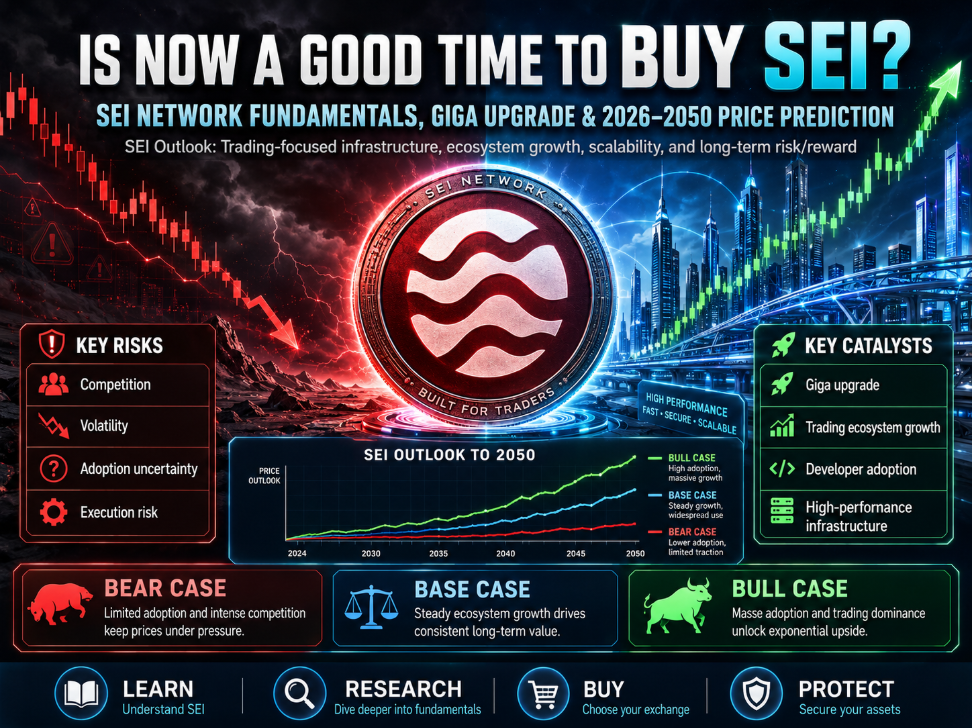
SEI is the native token of Sei Network. Sei Network is a high-performance Layer 1 blockchain whose original core narrative was "built for trading." Trading here doesn't just mean users swapping tokens on a DEX — it encompasses order book trading, derivatives, in-game asset exchanges, NFT markets, real-time social app interactions, and future automated financial transactions between AI agents.
Ethereum's strengths are security, developer ecosystem depth, asset accumulation, and EVM network effects. Solana's strengths are high throughput, low fees, and a unified state environment. Sei's design focus is on embedding as much of the performance infrastructure that trading applications need directly into the protocol layer as possible.
A simple framework:
Ethereum is the world's largest smart contract settlement layer — the deepest ecosystem, but mainnet speed and fees were never designed for high-frequency trading.
Solana is a high-performance general-purpose chain — fast execution, though it has historically faced network stability and congestion challenges.
Sei is more like a Layer 1 specifically optimized for trading workloads — focused on reducing latency, improving sequencing and execution, and making the trading experience as good as it can be at the protocol level.
CoinGecko's Sei description also emphasizes that it's a high-performance Layer 1 designed for decentralized finance, high-frequency trading, and real-time digital exchanges, using parallel processing, scalability optimizations, and efficiency-first design to improve transaction speed.
What Does "Built for Trading" Actually Mean?
Trading applications are fundamentally different from typical on-chain applications. An ordinary NFT mint can tolerate confirmation times of several seconds or even longer. But order book trading, derivatives liquidations, on-chain gaming, market-making strategies, and AI-automated trading are extremely latency-sensitive.
If a chain produces blocks slowly, has unfair sequencing, high MEV, or large state update delays, the trading experience suffers badly. Sei's design philosophy is to solve these problems at the base layer — not offload them entirely to applications to figure out themselves.
CETUS's long-term value doesn't come purely from "how many dApps it has." It depends on whether it can become the default execution environment for high-frequency on-chain finance and real-time applications.
Four Key Technical Concepts for SEI
First: Twin Turbo Consensus.
Sei's current mainnet uses Twin Turbo consensus optimizations, targeting reduced block propagation and transaction confirmation latency. Official documentation describes Sei's current capabilities as including Twin Turbo consensus, parallel execution, and SeiDB performance optimizations, with Giga representing the next stage of architectural evolution.
Second: Parallel Execution.
One of the core limitations of traditional EVM is sequential execution — transactions are processed one after another, which caps throughput. Sei enables parallel execution, allowing transactions without state conflicts to be processed simultaneously, improving overall throughput. This matters for DEXes, gaming, social apps, and AI agent applications.
Third: EVM Compatibility.
Sei is transitioning from its earlier Cosmos/CosmWasm dual-stack architecture toward a pure EVM experience. The official SIP-03 document makes clear that Cosmos, CosmWasm, and IBC-related features are planned for deprecation after June 15, 2026, and exchanges and users are required to complete address linking and migration — failing to do so may result in inability to access funds through legacy Cosmos interfaces.
Fourth: Transaction-Oriented Infrastructure.
Sei's goal isn't to run generic smart contracts — it's to host high-frequency DeFi, real-time gaming, social applications, on-chain order books, stablecoin payments, and future AI-automated trading.
What Is SEI the Token Actually Used For?
SEI is Sei Network's native asset, with several core use cases.
Gas payments: Sei's official documentation states that network transactions and smart contract execution fees are paid in SEI.
Staking: Sei uses a delegated proof-of-stake mechanism where validators and delegators stake SEI to secure the network and earn rewards. Official staking documentation shows that delegators can stake SEI with validators, participate in network security, and share in rewards.
Governance: SEI holders can participate in on-chain governance. Official governance documentation explains that Sei uses an on-chain governance system allowing SEI holders to participate in decisions around protocol upgrades and parameter adjustments.
Native ecosystem asset: As Sei transitions to an EVM-only architecture, SEI will more naturally integrate into DeFi collateral, trading, payments, liquid staking derivatives, and on-chain application interactions.
Can You Earn Passive Yield From Holding SEI Without Trading?
Yes — but only if you participate in staking.
SEI can earn staking rewards by delegating to validators. However, staking isn't risk-free yield. You need to account for validator commissions, network parameter changes, price volatility, potential slashing risk, and the unbonding wait period. Sei's official documentation shows that delegators must go through a 21-day unbonding period when unstaking — during which assets are typically not freely tradeable and don't continue earning staking rewards.
As a result, SEI staking is better suited to medium-to-long-term holders — not short-term traders who may want to exit positions at any time.
2. The Sei Giga Upgrade: Is 200,000 TPS a Marketing Headline or a Game-Changer?
The Giga upgrade is the most important technical narrative for SEI in 2026. To assess whether SEI is worth medium-to-long-term research, you can't avoid one question: is Giga just a marketing pitch, or does it represent a real technical upgrade that could shift Sei's competitive position?
According to the Sei Giga paper, Sei Giga is described as a multi-concurrent-producer, parallel execution EVM Layer 1 blockchain; in internal testnet runs, Giga achieved over 5 gigagas/sec throughput while maintaining finality times under 400 milliseconds. The paper also notes that Giga uses Autobahn consensus and moves execution out of the consensus bottleneck through asynchronous execution and a state protocol.
For an ordinary investor, translating this into plain language:
Traditional blockchains are often like a single-lane toll booth — all cars queue up and pass through one at a time.
Giga tries to turn it into a multi-lane express toll system — multiple proposers can produce data in parallel, and the execution layer no longer holds up consensus.
If this performs stably in real mainnet conditions, Sei's performance ceiling will be materially higher than traditional EVM chains.
What Problem Does Autobahn Consensus Solve?
Autobahn is the core of Giga. It doesn't just make blocks bigger — it fundamentally changes how blocks are proposed and consensus is reached.
Traditional blockchains typically have a single block producer proposing a block within a given time window, with other validators confirming it. This is simple but creates a bottleneck at high throughput. Giga's multi-proposer architecture allows multiple producers to advance data availability and transaction ordering in parallel, raising overall throughput.
Crypto Briefing's May 2026 reporting also noted that Sei Labs announced the Giga upgrade roadmap with a goal of boosting throughput approximately 50x through multi-proposer consensus and asynchronous execution, targeting 200,000 TPS and 400-millisecond finality.
This means Giga's ambition isn't to be "a bit faster" — it's to raise EVM chain performance to a level that can actually support real-time trading applications.
How Should Investors Read "50x Throughput, 70x Faster Blocks, 40x Execution Efficiency"?
These numbers are genuinely compelling — but investors need to stay clear-headed.
These figures typically come from internal testing, technical roadmaps, or theoretical targets. They don't automatically equal stable long-term mainnet performance. A blockchain's real-world performance depends not just on TPS, but on node decentralization, state bloat, network bandwidth, MEV controls, fee stability, developer experience, and actual user demand.
Binance Square's Giga overview cited targets including 200,000 TPS, 5 gigagas throughput, sub-400ms finality, and a 40x execution efficiency improvement, while maintaining stable fees and latency through bounded MEV design.
If these benchmarks are achieved in production, SEI gains a powerful narrative in the high-performance EVM space. But if the upgrade is delayed, mainnet performance is unstable, or performance advantages don't translate into application growth, the market will reprice quickly.
What Does Shifting From Cosmos/EVM Dual-Stack to EVM-Only Mean for Developers?
Sei originally had both Cosmos and EVM dual addresses and dual ecosystems — which created flexibility but also complexity. Users might encounter both sei1... and 0x... addresses simultaneously, and exchanges and wallets needed to handle migration, address linking, and asset compatibility.
The official SIP-03 document shows Sei plans to deprecate Cosmos, CosmWasm, and IBC-related features, requiring address linking to be completed before June 15, 2026, after which legacy Cosmos operations will no longer function.
This is a net positive for developers. A pure EVM architecture means more direct access to the Ethereum toolchain — Solidity, MetaMask, Foundry, Hardhat, Ethers.js, ERC-20 standards, and common DeFi development frameworks.
This is also a net positive for users. Users no longer need to understand two separate address systems or cross-environment operations — the experience becomes much closer to any other EVM chain.
But the migration period carries risk. Users who don't complete address linking in time, or where exchange and wallet support is incomplete, may face issues accessing funds, depositing, or withdrawing. So the 2026 EVM-only migration is both a technical tailwind and a short-term operational risk factor.
What Are Giga's Most Realistic Target Use Cases?
First: High-frequency DeFi.
If Sei can consistently deliver low latency and high throughput, on-chain order book DEXes, perpetuals, on-chain market-making, liquidation systems, and complex DeFi strategies become much more viable to deploy on Sei.
Second: AI Agent economy.
Future AI agents may automatically handle payments, swaps, staking, lending, order placement, and portfolio rebalancing. If AI agent transaction frequency is extremely high, a low-fee, low-latency, high-concurrency on-chain environment becomes essential. Sei's official documentation also mentions an MCP Server that enables AI assistants to interact with the Sei blockchain through natural language — indicating Sei is already experimenting with connecting AI workflows to on-chain execution.
Third: Real-time gaming and social apps.
Game state updates, in-game item trading, social interactions, micropayments, and on-chain identity operations all require low latency. If Sei can win real users through mobile distribution, gaming and social may actually drive large-scale adoption more easily than traditional DeFi.
3. SEI's Three Major 2026 Narrative Catalysts: Xiaomi Partnership, ETF Filing, and Institutional RWA
What makes SEI distinctive in 2026 is that it's not just a technology narrative — it also has distribution, institutional, and asset-side narratives running simultaneously.
But be clear: catalysts are not outcomes. Every one of these could deliver, or could disappoint.
Catalyst One: The Xiaomi Partnership — the Real Value Is Distribution
In December 2025, Sei officially announced the launch of a $5 million Global Mobile Innovation Program, with plans to embed next-generation crypto wallets and discovery applications into everyday consumer hardware devices — including smartphones. The official announcement highlighted features including Google ID login, multi-party computation wallet security, curated dApp access, P2P transfers, and consumer-to-merchant payment capabilities.
CoinDesk reporting went further, noting that a Sei wallet and discovery app would come pre-installed on millions of Xiaomi smartphones sold outside China and the United States starting in 2026, supporting P2P payments, dApp access, Web3 exploration, and retail stablecoin payments.
What really matters here isn't the word "pre-installed" — it's that this solves one of blockchain's most persistent problems: distribution.
In the past, getting into Web3 typically meant downloading a wallet, backing up a seed phrase, buying gas, bridging assets, and connecting to a dApp — a friction-filled process. If the Xiaomi partnership actually lands, ordinary users could encounter the Sei wallet and stablecoin payment entry point the moment they pick up their new phone.
That said, rationality is required here. Pre-installed doesn't mean activated. Activated doesn't mean on-chain transactions. On-chain transactions don't automatically mean SEI price appreciation. What ultimately matters:
- Do users actually open the wallet?
- Do merchants adopt stablecoin payments?
- Are the dApps good enough to retain users?
- Do transactions consume SEI?
- Can the ecosystem convert mobile users into genuinely active on-chain participants?
Catalyst Two: SEI ETF Filing — an Institutional On-Ramp Is Taking Shape
The SEI ETF narrative is worth paying attention to.
SEC filings show that Cboe BZX submitted a rule change filing regarding the Canary Staked SEI ETF in August 2025, with the SEC issuing a related notice in September 2025. In January 2026, the SEC issued documents extending the review period for the Canary Staked SEI ETF decision.
Additionally, 21Shares filed an S-1 registration statement with the SEC in August 2025 for the 21Shares Sei ETF, describing the trust as an exchange-traded fund tracking SEI.
The significance of an ETF is that it could give institutional investors a path to hold SEI inside compliant accounts. The Staked SEI ETF in particular, if approved, could allow investors to gain price exposure to SEI while indirectly benefiting from staking yield.
That said, ETF outcomes remain uncertain. SEC review, treatment of staking yield, custody security, market manipulation concerns, liquidity depth, and regulatory posture could all affect the final approval decision. Appearing on the DTCC "active and pre-launch" list doesn't mean SEC approval has been granted — it represents operational and clearing-level preparation, not regulatory green light.
Catalyst Three: Stablecoins and RWA Ecosystem
SEI's third catalyst is stablecoins and real-world assets.
High-performance chains need more than speed — they need assets. Without USDC, stablecoins, RWAs, lending markets, derivatives, and trading pairs, the fastest chain in the world is just an empty highway.
The Sei ecosystem has been pushing stablecoins and real-world assets consistently over the past two years. The USDC, WYST, Ondo USDY directions that appear in user discussions all point toward the same underlying trend: Sei is trying to upgrade from "high-performance public chain" to "institutional-grade on-chain financial execution layer."
If these assets continue flowing into Sei, three outcomes follow:
- More stablecoin transaction and payment demand
- More RWA collateralization, lending, and portfolio strategies
- More institutional-grade applications requiring a low-latency settlement layer
But this also requires validation. RWA listings don't equal trading volume. Stablecoin issuance doesn't equal real payments. Institutional backing doesn't automatically translate to SEI token price appreciation.
The Worst-Case Scenarios for Each Catalyst
These need to be stated clearly.
If Giga is delayed or mainnet performance is unstable, SEI's technology narrative takes a hit.
If Xiaomi pre-install wallet conversion rates are very low, the market will re-price this as a marketing partnership rather than a user growth engine.
If ETF filings are rejected or indefinitely delayed, institutional capital expectations will cool.
If stablecoins and RWAs remain at the announcement stage without generating TVL or trading volume, SEI's fundamental recovery disappoints.
If monthly unlocks continue suppressing prices, near-term positive catalysts may be absorbed by supply pressure.
4. SEI Tokenomics: Unlock Pressure and the Staking Flywheel Behind the 10 Billion Token Supply
Before buying SEI, you need to understand the supply structure. One of SEI's biggest current challenges is that the full supply hasn't yet been distributed.
CoinGecko shows a maximum supply of 10 billion SEI, with approximately 6.7 billion currently in circulation, an FDV of approximately $493 million, and a market cap of approximately $332 million. CoinGecko's tokenomics section also shows that SEI's next unlock event will release approximately 55.56 million SEI on July 15, 2026 — roughly 0.56% of total supply.
This establishes that SEI is not a fully circulating asset. Future supply additions will continue to create price pressure.
How Should Investors Read SEI's Supply Structure?
SEI's maximum supply is 10 billion tokens. The official Sei Giga documentation also confirms that total SEI supply is 10 billion, with the token serving Gas, staking, governance, and rewards purposes.
For ordinary investors, you don't need to memorize every allocation bucket. What matters is understanding three things:
First, SEI still has ongoing unlocks.
Second, depending on who the unlock recipients are — team, investors, or ecosystem reserves — the nature of the resulting sell pressure differs.
Third, only when genuine demand growth outpaces new supply does price have a cleaner path upward.
This is why SEI's price can't be analyzed purely through the lens of the Giga upgrade. Even the best technology narrative can't support a rising price if there isn't enough buy-side demand to absorb ongoing supply releases.
What Impact Do Monthly Unlocks Have on Price?
SEI continues to have monthly unlocks in 2026. Token unlock data shows approximately 112.7 million SEI unlocking on July 15, 2026 — about 1.1% of total supply. CoinGecko's latest unlock data lists 55.56 million in team unlocks. Discrepancies between platforms can arise from different data collection methodologies and update cadences, but both point to the same fact: SEI remains in an active supply-release phase.
This creates two layers of price impact:
Short-term, the market may trade around unlock expectations before and after each event.
Medium-to-long-term, only strong enough ecosystem usage, staking demand, institutional capital, and user growth can absorb the new supply.
This makes SEI's path to price appreciation between 2026 and 2027 harder than it would be for a fully circulating token. It requires not just narratives — it requires real demand.
Can Staking Yield Offset Unlock Pressure?
Staking can reduce some circulating sell pressure, because once users delegate SEI to validators, they must go through a 21-day unbonding period. This reduces short-term liquidity.
But staking isn't a cure-all. Staking rewards themselves come from network parameters, inflation, and fee distribution. If staking rewards primarily come from newly issued tokens rather than genuine network fee revenue, then staking yield may ultimately still dilute unstaked holders.
CoinGecko shows Sei's 24-hour fee and revenue figures remain quite small — which signals to investors that SEI's current valuation is more dependent on future growth expectations than on a mature, established fee revenue base.
So staking SEI makes sense for long-term holders — but it shouldn't be thought of as "risk-free annualized yield."
The Structural Shift Around 2031
SEI's long-term supply release will continue for years. MEXC's SEI tokenomics page shows that SEI uses a multi-year vesting and distribution mechanism, with the supply release schedule extending toward 2031, with some sources suggesting full unlock may extend to 2031–2032.
This matters enormously for 2030 price forecasts.
Before 2030, SEI price faces ongoing unlock pressure.
After 2031, once supply pressure is largely exhausted and ecosystem demand is still growing, the price structure becomes materially healthier.
So before 2030, the primary tension for SEI is "can growth outrun unlocks." After 2031, the primary question shifts to "can real usage sustain the valuation."
5. SEI Price History: From $0.08 to $1.14, Back Down to $0.05
SEI's price history tells us it's a high-volatility asset — not a stable, established Layer 1 blue chip.
CoinGecko data shows SEI's all-time high at $1.14, reached on March 16, 2024, and an all-time low of $0.0447, reached on June 6, 2026. The current price of approximately $0.049 is near the all-time low and reflects a massive drawdown from peak levels.
Why Was Early Performance Volatile After the 2023 Launch?
When SEI launched, market expectations for new Layer 1s were high — but uncertainty was equally high. The ecosystem was immature, airdrop recipients may have sold, application count was limited, token unlock expectations existed, and the market was recovering from the previous bear cycle.
This kind of trajectory — "launch with peak expectations, then wait for fundamentals to catch up" — is common for new Layer 1s. Early price volatility is not surprising.
Why Did SEI Rally to $1.14 in 2024?
SEI's 2024 rally was driven primarily by three factors:
- High-performance Layer 1 narratives re-heating across the market
- Sei V2 and EVM compatibility expectations strengthening
- Altcoin risk appetite rising as capital looked for new blockchain opportunities beyond Solana
At that time, the market was willing to pay a significant premium for "high-performance + EVM + new chain + trading-optimized" positioning. But when this type of valuation isn't supported by sustained application adoption and fee revenue, the drawdown when sentiment shifts can be severe.
Why Has SEI Pulled Back Sharply in 2025–2026?
SEI's drop from peak back to the $0.05 range reflects both macro market conditions and SEI-specific factors.
The macro factor: the high-performance Layer 1 sector broadly lost steam, with capital rotating more toward BTC, ETH, a small number of leading assets, and clear revenue-generating protocols.
The SEI-specific factor: TVL, fees, real applications, and user growth haven't caught up to the high prior valuation. Meanwhile, ongoing unlocks create supply pressure, and the market is still in "wait and see" mode on Giga, Xiaomi, ETF, and other catalysts.
So SEI's current low price isn't simply the result of being unfairly overlooked. It reflects the market's skepticism about whether high-performance chain narratives can actually be delivered on.
Is $0.049 Undervalued Right Now?
From a technology narrative standpoint, SEI's current price looks very depressed. A Layer 1 with the Giga upgrade, EVM-only migration, Xiaomi distribution, ETF filings, stablecoin and RWA narratives, trading at only a few hundred million dollars in market cap — the recovery potential on paper is clear.
But from an on-chain revenue and real user standpoint, the market's discount is justified. CoinGecko shows Sei's current fee and revenue figures remain limited, indicating SEI hasn't yet developed a mature economic flywheel.
So SEI is currently best described as a "low-level high-elasticity, technology-delivery-dependent asset" — not a proven business model with established chain economics.
6. SEI Price Predictions 2026–2030: How Much Upside Can Technical Delivery Unlock?
SEI's medium-term prediction isn't about guessing a price point — it's about assessing whether three conditions can be met:
Does Giga launch successfully and run stably?
Does the EVM-only migration make it easier for developers and liquidity to arrive?
Do Xiaomi, ETF, stablecoins, and RWA generate real users and capital?
2026 Price Forecast: The Fork in the Road Before and After Giga Delivers
Bear case for 2026: If Giga is delayed, the broader market stays weak, and unlock pressure remains visible, SEI may consolidate in the $0.04–$0.08 range. This would mean the market still prices SEI as an unvalidated high-performance chain.
Base case for 2026: If the EVM-only migration proceeds smoothly, the Giga roadmap advances in stages, and the Xiaomi wallet launches but user conversion hasn't yet spiked, SEI could return to $0.10–$0.25. This scenario represents an initial valuation reset, but not yet strong bull market pricing.
Bull case for 2026: If the Giga mainnet launch goes well, SEI breaks key resistance levels, ETF filings show positive developments, and stablecoin and RWA activity grows — SEI could enter the $0.45–$0.75 range.
Super bull case for 2026: If BTC and the broader altcoin market run strongly, and SEI becomes the high-performance Layer 1 sector's focal point, a push above $0.80 isn't completely out of the question. But this requires a supportive macro environment — it shouldn't be treated as a base case.
2027–2028 Price Forecast: Can SEI Return to the Mainstream Conversation in the Next Cycle?
2027–2028 is SEI's most critical medium-term validation period.
If Giga has launched but hasn't generated meaningful application growth, SEI may only recover to the $0.10–$0.20 range.
If the Sei ecosystem TVL, stablecoin transactions, DEX activity, gaming, and AI agent applications gradually grow, SEI has a path toward $0.35–$0.55.
If Sei becomes a significant choice for high-performance EVM applications, developers keep migrating in, and institutional products start entering through ETF or custody channels, SEI could challenge $1–$2 again.
In an extreme bull market, if SEI simultaneously benefits from Layer 1 rotation, ETF approval, Xiaomi user growth, and the AI narrative, $3+ is possible. But this kind of scenario represents strong-narrative premium during a high-volatility cycle — it shouldn't be assumed as a default outcome.
2030 Price Forecast: Is $1.50–$2.50 Realistic?
By 2030, SEI's valuation will depend more on demonstrated results than on roadmaps.
Conservative 2030: SEI at $0.20–$0.50. This implies Sei still exists but hasn't become a Tier 1 Layer 1, and Giga's technical advantages haven't translated visibly into ecosystem advantages.
Base 2030: SEI at $0.70–$1.50. This implies the Sei ecosystem has grown steadily, the EVM-only migration succeeded, and application count and TVL have improved — but SEI hasn't outpaced Solana, Ethereum L2s, or other mainstream ecosystems.
Bull 2030: SEI at $1.50–$2.50. This range is realistic, but requires Sei to become meaningful infrastructure for high-performance trading applications, with at least one or two of mobile distribution, stablecoin payments, RWA, DeFi, or AI agents genuinely breaking out at scale.
Super bull 2030: SEI could enter the $10–$13 range. This type of projection typically rests on very aggressive adoption assumptions — SEI becoming one of the top-tier blockchains, attracting large developer, institutional, and user inflows, and earning an extreme valuation premium in a new global crypto bull market. This can serve as an upper-bound thought experiment, not a baseline for ordinary investors.
For a multi-timeframe model comparison, check out HiBT's SEI Price Prediction 2050 to see how different models project SEI across various time horizons.
7. SEI Price Predictions 2030–2050: An Ultra-Long-Range Scenario Analysis
2050 predictions require genuine caution. From 2026 to 2050 is 24 years — long enough for a chain to become global financial infrastructure, and long enough for it to be entirely replaced by new technology.
So CETUS 2050 predictions — and the same applies to SEI — shouldn't be read as definitive price targets. Their real value is helping you think through: if the world develops in a certain direction, what price range might SEI occupy?
2035: Will "Trading-Optimized Chain" Become a Moat or a Constraint?
By 2035, Sei's "built for trading" positioning could play out in two very different ways.
If on-chain finance, AI agents, real-time gaming, stablecoin payments, and RWA trading grow substantially, then trading performance becomes a core competitive advantage. Sei's low latency, high throughput, and EVM compatibility could form a durable moat.
But if future blockchain applications rely more on modular settlement, cross-chain intent networks, hybrid centralized matching with on-chain settlement, or other chains simply replicate Sei's performance advantages — "trading optimized" may no longer be scarce.
Conservative 2035: SEI at $0.50–$1. Base 2035: SEI at $1–$3. Optimistic 2035: SEI at $5–$15.
The difference between these scenarios doesn't come from today's price. It comes from whether Sei has developed a genuinely irreplaceable trading application ecosystem by 2035.
2040: Three Forks in the Road
First fork: Does Giga become an industry benchmark?
If Giga remains a technical demonstration without significant application adoption, SEI can't sustain a high valuation. If Giga becomes a de facto standard for high-performance EVM chains, the valuation ceiling is entirely different.
Second fork: Does the Xiaomi distribution drive real on-chain users?
Pre-installed wallets have no intrinsic value on their own. Real user activation, stablecoin payments, dApp usage, transaction volume, and SEI consumption — those are what matter.
Third fork: Does institutional finance move into Sei?
If ETFs, RWAs, stablecoins, market makers, on-chain order books, and AI financial applications form a closed loop on Sei, a durable high valuation becomes possible.
Conservative 2040: SEI at $0.50–$1.50. Base 2040: SEI at $3–$8. Optimistic 2040: SEI at $10–$47. Extreme bull 2040: If on-chain finance goes mainstream and SEI becomes one of the core settlement and trading layers, price could exceed $50.
Four Scenarios for 2050
Conservative scenario: SEI at $1–$3.
This assumes the high-performance Layer 1 sector remains intensely competitive — with Solana, Aptos, Monad, Ethereum L2s, and future new chains continuously pressuring Sei. The Giga upgrade succeeds but doesn't translate into significant user growth. Overall DeFi growth is moderate. SEI token demand comes primarily from Gas, staking, and limited ecosystem applications. Under this outcome, SEI achieves meaningful recovery from current levels but doesn't become a globally dominant crypto asset.
Base scenario: SEI at $3–$10.
This assumes Giga gradually builds a developer ecosystem moat after 2027–2028. The Xiaomi partnership delivers millions of genuinely active on-chain users. ETFs or similar compliant products open institutional allocation channels. RWAs, stablecoins, and high-frequency DeFi achieve meaningful scale on Sei. After 2031, major unlock pressure is mostly absorbed, giving the supply side a healthier structure. This is the most realistic optimistic target for long-term investors: SEI doesn't need to beat Solana or Ethereum — it just needs to become an important chain for high-performance trading applications.
Optimistic scenario: SEI at $10–$50.
This requires global DeFi users to enter the hundreds of millions range after 2035; Sei to become important infrastructure for high-frequency finance, on-chain order books, AI agent settlement, and consumer-grade stablecoin payments; the Autobahn consensus and Giga architecture to be proven effective in production; developers and market makers to keep migrating in; and SEI's Gas, staking, governance, and ecosystem asset demand to form a closed loop. This is a very high bar — but if on-chain finance truly goes mainstream and Sei captures the high-frequency trading and AI agent economy, this range is within reach.
Extreme bull scenario: SEI at $50–$100+.
This requires very aggressive macro assumptions: blockchain reshapes global financial markets in the 2040s, DeFi gains clear regulatory channels, institutional assets move on-chain at scale, and Sei becomes significant infrastructure for global exchanges, clearing houses, payments, and AI automated settlement. This is not a baseline scenario for ordinary investors — it's an upper-bound imagination. Useful for understanding SEI's long-range elasticity, not as a justification for heavy positioning today.
Six Unknown Variables Shaping the 2050 Outlook
First: Giga's real-world delivery. 200,000 TPS and sub-400ms finality only have investment value when they perform stably on mainnet under real transaction loads.
Second: Xiaomi partnership conversion rates. Pre-installed wallets that only generate downloads have limited value. Stablecoin payments and active dApp engagement are where the value lies.
Third: Whether supply pressure is fully absorbed after 2031. SEI's 10 billion maximum supply means long-term price requires the market to absorb total circulating supply over time.
Fourth: ETF and regulatory direction. A Staked SEI ETF approval would open institutional allocation channels. Regulatory tightening would cool those expectations.
Fifth: The scale of the AI agent economy. If AI agents become the dominant force in on-chain trading in the 2030s, Sei's high-frequency performance advantages get amplified.
Sixth: The competitive landscape. SEI's biggest risk isn't technical failure — it's that its technical advantages get replicated, or the market proves that "trading-optimized" isn't the most important competitive dimension for a Layer 1.
8. Is Now a Good Time to Buy SEI? A Complete Mid-2026 Decision Framework
Whether now is a good time to buy SEI can't be answered with a simple yes or no. The more accurate assessment: SEI is currently a high-risk, high-elasticity Layer 1 asset at historically low levels — suited for investors who can absorb volatility, understand the unlock pressure dynamics, and believe in the Giga upgrade and the high-performance on-chain trading thesis.
From a Valuation Standpoint, Is SEI Mispriced?
From a technology narrative standpoint, SEI's current price does look very low. The Giga upgrade, EVM-only migration, Xiaomi distribution, ETF filings, stablecoin and RWA directions — these are all tangible catalysts.
But from an on-chain revenue and real user standpoint, SEI is still early stage. Current fee revenue is small, and TVL and ecosystem activity don't yet match the long-term ambitious narrative.
So SEI's mismatch isn't a "guaranteed undervaluation" — it's a "massive gap between expectations and current reality." If reality catches up to expectations, the recovery potential is substantial. If reality can't deliver, low prices can stay low.
What Makes SEI Unique Compared to Solana and Aptos?
Compared to Solana, SEI's advantages are EVM compatibility and trading-optimized design. Its disadvantages are a much smaller ecosystem, thinner asset base, and significantly weaker user mindshare.
Compared to Aptos, SEI's advantage is a more defined high-frequency trading and EVM roadmap. Its disadvantage is that with the Move native narrative being de-emphasized, it needs to prove why the EVM ecosystem should choose Sei specifically.
Compared to Ethereum Layer 2s, SEI's advantage is independent Layer 1 performance and native parallel execution. Its disadvantage is the absence of Ethereum's inherited security and deep asset base.
For a side-by-side comparison within the same research framework but for a different type of infrastructure token, check out the RPL Price Prediction 2030. RPL represents the Ethereum staking infrastructure thesis; SEI represents the high-performance Layer 1 thesis — different risk structures that lend themselves to differentiated portfolio comparison.
Differentiated Strategies for Three Types of Investors
If you're a short-term trader: SEI calls for trend confirmation before entry. Just because it's at a historically low price doesn't mean it's time to buy. Watch key resistance levels at $0.06, $0.08, and $0.105 — only a volume-confirmed breakout above these levels signals the market is beginning to re-price SEI. Set stop-losses around the historical low range, adjusted for your own risk tolerance.
If you're a medium-term investor with a 1–3 year time horizon: a phased entry strategy makes sense. Focus on Giga mainnet progress, EVM-only migration completion, TVL recovery, stablecoin trading volume growth, and ETF filing developments. Medium-term investors shouldn't just watch price — they should track whether catalysts are materializing step by step.
If you're a long-term believer with a 5+ year horizon: the only real question is whether you believe "high-frequency on-chain trading + AI agents + stablecoin payments + RWA" will go mainstream in the 2030s, and whether Sei can become important base-layer infrastructure for that future. If you don't believe that premise, long-term SEI holding lacks a logical foundation.
Near-Term Downside Risks
First: Monthly unlock pressure. As long as supply keeps being released, price needs continuously growing buy-side demand.
Second: Giga delays or performance below expectations.
Third: Xiaomi partnership conversion rates falling short of market imagination.
Fourth: ETF filings being rejected or experiencing prolonged delays.
Fifth: BTC and the broader altcoin market continuing to weaken.
Sixth: Sei ecosystem applications shutting down, TVL declining, or fee revenue failing to grow. Recent CoinGecko news coverage has mentioned DeFi platforms within the Sei ecosystem closing — these events affect the market's read on ecosystem health.
9. How to Buy SEI on HiBT: From Zero to a Completed Position
If you've worked through the risks and decided to take a small position, you can buy SEI through HiBT's SEI/USDT spot trading pair. Compared to using a Sei Network wallet directly, the exchange route is far more beginner-friendly — you don't need to deal with EVM migration, address linking, bridges, private key management, or on-chain gas.
That said, trading services, KYC requirements, deposit methods, and withdrawal rules may vary by region — always use what's displayed on HiBT's platform as your reference.
Step 1: Register a HiBT Account
Go to the HiBT website or app and sign up with your email or phone number. Once registered, immediately set up your login password, withdrawal password, two-factor authentication, and anti-phishing code.
Don't skip the security setup to chase a move. In crypto, account security is always step one.
Step 2: Complete KYC Verification
Go to the identity verification page and submit your ID documents and facial recognition as prompted. Common rejection reasons include blurry document photos, inconsistent information, expired documents, or failed biometric scans.
Once KYC is complete, your account typically unlocks full deposit, trading, and withdrawal functionality.
Step 3: Deposit USDT
SEI's primary trading pair is SEI/USDT, so you'll need USDT in your account first.
If you already have USDT in another exchange or wallet, you can transfer it to HiBT via on-chain transfer. Always confirm network consistency before transferring — TRC20, ERC20, BEP20, and other networks cannot be mixed.
For newcomers, sending a small test transfer first and confirming it arrives before moving larger amounts is a smart practice.
Step 4: Search for the SEI/USDT Trading Pair
Once your deposit clears, go to the spot trading section and type SEI to find the SEI/USDT pair.
Before placing an order, check three things:
- Whether the current price is near a historical low or key resistance level
- Whether the bid-ask spread in the order book looks normal
- Whether 24-hour trading volume is sufficient
If the price has spiked sharply in a short window, don't chase it with a market order.
Step 5: Default to Limit Orders
SEI is listed on major exchanges, but at current low price levels and high volatility, market orders during volatile periods can still result in unfavorable fills. Limit orders are better suited for newcomers.
The advantage of a limit order is price control. Consider splitting your capital into three tranches:
- First tranche: small starter position within the current range
- Second tranche: add when price pulls back to support
- Third tranche: consider adding only after a confirmed volume breakout above key resistance
This won't get you in at the absolute lowest price, but it reduces the risk of buying into a temporary spike all at once.
Step 6: Confirm Your Position and Set a Stop-Loss
After your order fills, go to your assets page to view your SEI holdings. Record:
- Your average entry price
- Amount invested
- Maximum loss you're willing to accept
- Your stop-loss level
- Phased take-profit targets
If you don't have an exit plan before you buy, you'll be making emotional decisions when price moves against you.
After Buying: Keep on HiBT or Move to a Sei Wallet?
If you're a short-term or medium-term trader, keeping SEI on HiBT is more convenient for managing limit orders, stop-losses, and take-profit targets.
If you're a long-term holder who is comfortable with EVM wallets, Sei Network, staking, and private key management, you can consider withdrawing to a Sei wallet to participate in staking. But note: Sei is in the midst of its post-EVM-only migration new structure. Addresses, networks, wallets, and withdrawal routes must all be carefully verified.
For most newcomers, starting with exchange-based trading is the right approach. Get comfortable with the Sei ecosystem first, then explore on-chain staking and wallet management.
Appendix A: SEI Quick-Reference Data Sheet
As of June 30, 2026:
Token name: SEI Network: Sei Network Network type: High-performance Layer 1 blockchain Core positioning: Built for trading, high-frequency DeFi, real-time applications, AI agents, and on-chain financial execution Current consensus and performance: Twin Turbo consensus, parallel execution, SeiDB optimizations Giga upgrade targets: Autobahn consensus, multi-proposer architecture, ~200,000 TPS, sub-400ms finality Maximum supply: 10 billion SEI Current circulating supply: Approximately 6.7 billion SEI Current price: Approximately $0.049 Current market cap: Approximately $332 million All-time high: Approximately $1.14 (March 2024) All-time low: Approximately $0.0447 (June 2026) Primary use cases: Gas payments, staking, governance, validator rewards, ecosystem asset Unbonding period: 21 days Key catalysts: Giga upgrade, EVM-only migration, Xiaomi mobile distribution, Canary Staked SEI ETF, 21Shares Sei ETF, stablecoin and RWA ecosystem Primary risks: Unlock sell pressure, insufficient ecosystem revenue, Giga delays, Xiaomi conversion rate disappointment, ETF uncertainty, high-performance Layer 1 competition HiBT trading pair: SEI/USDT
Appendix B: SEI Investment Decision Checklist
Before buying SEI, confirm the following:
- Do I understand that SEI is a high-volatility crypto asset that has historically fallen from $1.14 to near $0.05?
- Do I know that SEI still has ongoing unlocks and that new supply could suppress price?
- Do I understand that the Giga upgrade is important but carries delivery delay and underperformance risk?
- Do I know that Xiaomi pre-installation doesn't equal real active users?
- Do I know that an ETF filing doesn't mean approval has been granted?
- Is my capital for this purchase discretionary — money I can afford to lose without affecting my life?
- Have I set a clear stop-loss level?
- Am I not buying heavy based on high 2050 price predictions?
- Will I continue tracking Sei TVL, fee revenue, stablecoin trading volume, developer growth, and ecosystem application data?
- Do I understand that all price predictions in this article are scenario-based assumptions, not investment advice?
Conclusion: Is Now a Good Time to Buy SEI?
SEI's most compelling qualities right now are a strong technology narrative, historically low price positioning, and a dense cluster of catalysts. The Giga upgrade, EVM-only migration, Xiaomi partnership, ETF filings, and the stablecoin and RWA ecosystem all give it meaningful medium-to-long-term recovery potential.
But SEI's biggest challenges are equally clear: real on-chain revenue remains limited, ongoing unlocks create supply pressure, the ecosystem hasn't fully proven itself, and Giga, Xiaomi, and ETF are all still in the "needs to be delivered" stage.
If you're a complete newcomer: don't buy heavy just because "it's down a lot."
If you're a short-term trader: wait for confirmed breakouts above key resistance levels and volume confirmation before entering.
If you're a medium-term investor: phased entry is appropriate — use Giga progress, TVL, stablecoin trading volume, and ETF developments as your observable checkpoints.
If you're a long-term holder: the real judgment call is whether Sei will become important infrastructure for high-frequency on-chain finance, AI agent trading, and consumer-grade stablecoin payments after 2030.
One-sentence summary: SEI is worth researching and worth a small, phased allocation — but not a blind heavy bet. Its future price doesn't depend on today's low level alone. It depends on whether Giga can be delivered, whether mobile distribution converts to real users, whether institutional capital can enter, and whether Sei genuinely becomes the next-generation base layer for on-chain trading.