
In the new-token market, what most easily wins over inexperienced investors usually isn't clean data — it's language that sounds impressive.
Things like:
"Proof of Light algorithm." "0.1-second light-speed verification." "Built by a top-tier team." "USPTO-registered trademark." "The world's fastest Layer-0 blockchain."
Stack those phrases together and it's easy to get a gut feeling: this project must be cutting-edge, there must be a strong technical team behind it, missing out would be a mistake.
But experienced crypto investors don't rush in when they see marketing like this — they ask a few questions first:
Can these claims actually be verified? Is there a public whitepaper? Is there a code repository? Has it been independently audited? Is there on-chain explorer data? Is trading volume genuinely active, or concentrated on just one or two platforms?
ATC — Atlantis Coin — is the native token of the AtlantisChain ecosystem. Based on exchange announcements and project marketing, it's described as the base asset for AtlantisChain, Atlantis Wallet, the ATC-20 ecosystem, and related payment, wallet, trading, and Web3 applications.
But this article isn't about repeating official marketing. It's meant to help beginners build a framework for evaluating any technology-narrative-driven new token: how do you verify these claims? What information actually counts as evidence? Which phrases should make you cautious? And if you decide to try it anyway, how do you manage risk on a platform like HiBT?
This is not investment advice. ATC is a high-volatility, high-uncertainty new token — one that's better approached through "verify first, participate second" rather than getting swept along by marketing language.
1. What Does ATC's Official Messaging Actually Say? Breaking Down the Core Claims
Understanding ATC starts not with price, but with unpacking the project's own language.
Based on public information, the marketing points commonly associated with ATC include:
- AtlantisChain is described as an ultra-high-speed blockchain
- It uses "Proof of Light," a claimed consensus algorithm
- It supports extremely fast transaction verification
- Atlantis Coin is the native token of the AtlantisChain ecosystem
- Atlantis Coin holds a USPTO-registered trademark
- The project is described as built by an "MIT-rooted U.S. team" or similar language
These claims sound strong, but investors need to take them apart sentence by sentence.
What Actually Is "Proof of Light"?
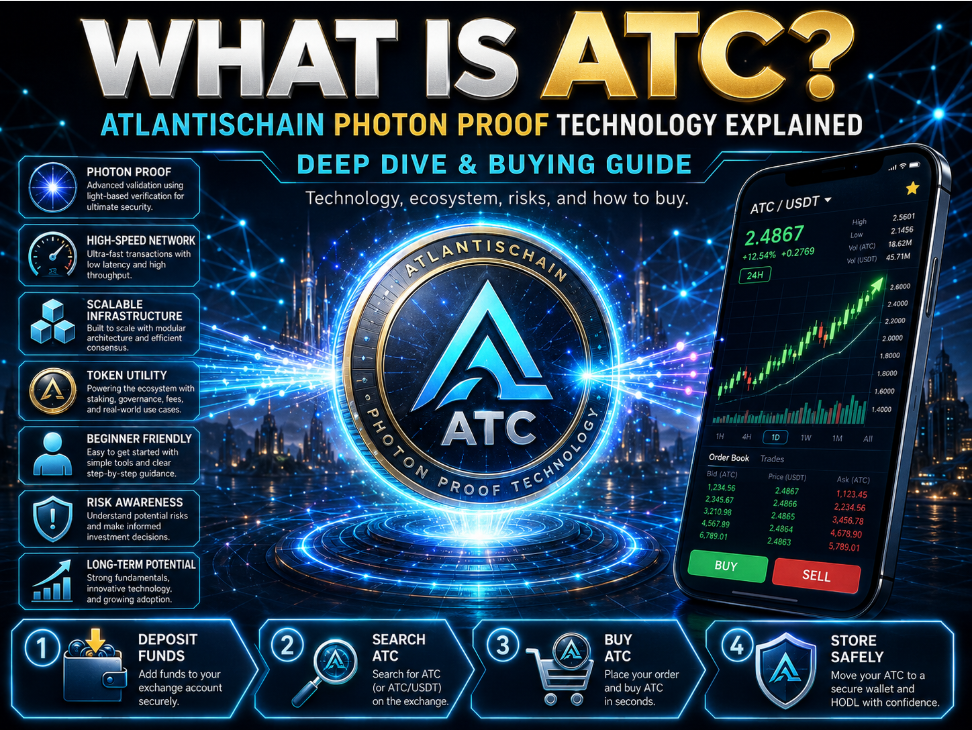
"Proof of Light" is one of the most eye-catching technical terms in ATC's marketing.
On its face, it sounds like a new consensus mechanism — something in the same category as Bitcoin's Proof of Work, Ethereum's Proof of Stake, or high-performance designs like DAG, PoH, Narwhal, or Bullshark used by other chains.
But whether a consensus mechanism is legitimate can't be judged by name alone — it requires four categories of evidence:
First, a complete technical whitepaper. A real whitepaper doesn't just say "it's fast," "it's cheap," or "it's secure" — it explains how nodes reach consensus, how double-spending is prevented, how forks are handled, how malicious nodes are dealt with, and how finality is guaranteed.
Second, reproducible test data. If a project claims 0.1-second verification or million-TPS throughput, investors need to know the test environment, node count, network latency, hardware specs, transaction types, and whether the numbers come from a real mainnet or just a lab stress test.
Third, open-source code. A genuine high-performance chain typically publishes its core code, node client, developer docs, SDK, and explorer interface. Without code, outside developers have no way to verify the implementation.
Fourth, third-party audits or academic citations. If a project claims a novel consensus mechanism, ideally an independent security firm, academic paper, developer community, or third-party technical team has evaluated it.
So for a term like "Proof of Light," beginners shouldn't treat it as "an advanced technology already validated by the industry." The more accurate framing: it's a technical concept proposed by the project team, and its credibility still needs to be established through documentation, code, mainnet data, and third-party verification.
How Should You Interpret "0.1-Second Light-Speed Verification"?
0.1 seconds sounds extremely fast, but in a blockchain context, "fast" needs to be broken into several separate concepts.
A fast block time doesn't mean fast final confirmation. A fast front-end display doesn't mean fast on-chain finality. High testnet throughput doesn't mean stability under real user load. Fast single-node processing doesn't mean a genuinely decentralized network is fast overall.
For example, a chain can produce blocks quickly, but if very few nodes are doing the validating and consensus is highly centralized, that speed may come at the cost of security and censorship resistance. Conversely, some mature chains deliberately trade some speed for greater decentralization and security redundancy.
So when you see claims like "0.1-second verification," "0.031-second block time," or "million TPS," keep asking:
- Is this mainnet data or test data?
- How many nodes participated in validation?
- Can anyone join as a node?
- Can a block explorer verify the actual block production rate?
- Can ordinary developers deploy nodes?
- Does the high TPS figure include real smart contract execution?
- Does performance hold up under genuine network congestion?
If these questions go unanswered, treat the speed claims as marketing copy rather than a market-validated technical conclusion.
How Do You Verify the "Top MIT Team" Claim?
References to MIT, Harvard, Stanford, "former Google engineers," or "former Wall Street teams" are extremely common in crypto project marketing.
What matters to an investor isn't how impressive the name sounds — it's whether it can actually be verified. You can check this in steps:
First, check the official team page. Does it list real names, photos, titles, and actual track records — or just vague language like "top-tier team" and "global experts"?
Second, check LinkedIn profiles. Do the team members actually exist? Do their profiles mention AtlantisChain? Does this match what's on the website?
Third, check for an actual MIT affiliation. If a project claims to be "MIT-built," there's a big difference between MIT alumni, MIT researchers, an MIT lab collaboration, and a vague claim that the "technical concept was inspired by MIT."
Fourth, check GitHub commit history. A technical project ultimately has to show up in code. A strong team background paired with no ongoing commits is a reason for caution.
Fifth, check independent media coverage. If "the MIT team" only appears in the project's own announcements or paid press releases — with no independent media, university page, lab website, or academic paper backing it up — it shouldn't be treated as a strong endorsement.
Beginners especially need to understand: a phrase like "MIT-rooted" is not the same as "officially developed by MIT," and it's not the same as "MIT-invested" or "MIT-endorsed." When writing about claims like this, if no official affiliation can be found, the accurate framing is "the project claims" or "stated in the announcement" — not a statement of fact.
What Does a USPTO Trademark Actually Tell You?
ATC's marketing frequently mentions a "USPTO-registered trademark" or "Atlantis Coin®."
This is something that can genuinely be checked, and it does mean something — a trademark registration means the name "Atlantis Coin" has legal protection in a specific category, and the project can assert brand rights within that scope.
But a trademark registration does not mean any of the following:
- It is not a technology patent
- It does not mean the project is endorsed by the U.S. government
- It does not mean the token is legally compliant
- It does not mean the code is secure
- It does not mean the investment has been vetted
- It does not mean you can't lose money trading it
Many beginners mistake "registered trademark" for "official endorsement," which is a dangerous assumption. Trademark protection covers brand names and service identification — it says nothing about blockchain technology, token pricing, or project safety.
The more accurate framing: Atlantis Coin has a trademark registration on record, meaning its brand name has some legal protection within a specific service category. That registration says nothing about technical capability, investment value, or regulatory approval — investors still need to independently verify the whitepaper, code, audits, on-chain data, and market liquidity.
How Do You Tell "Impressive-Sounding Jargon" Apart from Real Technology?
A simple formula worth remembering:
Real technology = explainable + verifiable + reproducible + auditable.
If a project only offers lines like "revolutionary algorithm," "world's first," "can never be hacked," "infinite scalability," or "zero cost" — without technical detail, code, audits, or a developer ecosystem — that's marketing language, not a technical case.
A project genuinely worth researching, by contrast, usually provides: a technical whitepaper, developer documentation, a GitHub repository, node deployment guides, third-party audit reports, a mainnet explorer, a list of ecosystem applications, genuine developer discussion, and clear risk disclosures.
That's the standard to apply when evaluating ATC.
2. What Does ATC's On-Chain Data Actually Show?
A project's narrative only tells you what it wants to do. On-chain and trading data tell you whether the market is actually buying in.
For ATC, ordinary investors should look at four categories of data at minimum: supply figures, trading volume, holder distribution, and post-listing price behavior.
How Should You Read Circulating Supply, Total Supply, and Market Cap?
A common issue on ATC market-data pages: circulating supply may not be fully disclosed, and some platforms only show total or maximum supply.
This matters a lot for valuation. If a token's price looks high but circulating supply is unclear, it's hard to judge real market cap accurately. And if maximum supply is far above current circulating supply, you also need to account for future release pressure.
Beginners should distinguish four concepts:
Circulating Supply — the number of tokens actually in the market and tradable right now.
Total Supply — the number of tokens already created, which may include amounts not yet circulating, locked allocations, team holdings, or ecosystem funds.
Max Supply — the theoretical upper limit on tokens that could ever exist.
FDV (Fully Diluted Valuation) — typically current price × max supply, used to estimate the theoretical valuation if every token were released.
If a project's price doesn't look particularly low, but volume is thin, circulating supply is unclear, and FDV is high, that combination warrants real caution — it can mean genuine market liquidity is limited and the price has limited informational value.
Why Be Wary of Low 24-Hour Trading Volume?
Beginners often watch price moves and ignore volume. But in new-token investing, volume matters more than price.
Say a token's price is shown up 50%, but 24-hour volume is only a few thousand dollars. What does that actually tell you? It could mean: buying pressure isn't strong, order book depth is shallow, a small amount of capital can move the price significantly, there may not be enough buyers when you want to sell, market orders can cause major slippage, and the candlestick chart can be easily influenced by a handful of wallets.
So judging ATC isn't just about "how much did it go up" — also check: whether 24-hour volume is sustained over time, whether trading is concentrated on a single exchange, whether the bid-ask spread is unusually wide, how much buy-side depth exists within 2% of the current price, whether large orders can fill smoothly, and whether volume is growing in step with community attention.
If most of a project's volume is concentrated on a small number of platforms, it hasn't yet built broad market consensus. That stage is appropriate for observation and small-position research — not a large bet.
How Do You Confirm Which "ATC" Is Listed on HiBT?
Multiple tokens share the name or a similar name — Atlantis Coin, ATC Coin, ATCC, and even unrelated assets on different chains using the same ticker. The most common beginner mistake is looking only at the ticker symbol, without checking the contract or project details.
The correct approach:
First, read the exchange announcement. Confirm the project name is Atlantis Coin, the network is AtlantisChain or ATC-20, and the website matches AtlantisChain's official site.
Second, check the official website. Does it match the exchange announcement? Does it provide a block explorer, wallet, whitepaper, and community links?
Third, check the block explorer. For ATC-20, verify that an explorer like ATCscan can actually look up transfers, blocks, addresses, and transactions.
Fourth, check market-data platforms. Do CoinGecko, CoinMarketCap, etc. list the same project, with matching website, explorer, and community links?
Fifth, check the deposit network carefully. If the exchange shows an ATC network, don't deposit a same-named ATC token from a different chain. A network mismatch can mean lost funds.
The one-line summary: a ticker symbol is not an identity — the contract address, network, official site, and explorer are.
What Risk Does Top-10 Wallet Concentration Reveal?
If ATC's holdings can be checked via a block explorer, beginners should pay particular attention to the share held by the top 10 addresses.
A high concentration can point to several risks: a small number of large holders effectively control the price, price is easily moved by a handful of wallets, a large holder moving funds to an exchange could trigger sell pressure, the liquidity pool may not be deep enough to absorb selling, and ordinary investors are at an informational disadvantage.
That said, top-10 addresses can also include exchange wallets, locked contracts, ecosystem funds, burn addresses, or bridge addresses — so concentration alone isn't automatically bad; it depends on identifying what those addresses actually are.
A reasonable approach: if it's an exchange address, check whether it's clearly labeled; if it's a locked contract, check the lockup terms; if it's a team wallet, check the unlock schedule; if it's an unidentified large holder, stay cautious; and if large holders are frequently transferring to exchanges, treat that as rising risk.
What Do Price Action and Volume Changes Tell You?
ATC's price behavior after listing can generally be read in three phases.
Phase one: early listing. A new token's price is highly sensitive to announcements, promotions, and community sentiment right after listing — this is when volatility and chasing behavior are most extreme.
Phase two: liquidity formation. If genuine interest exists, volume gradually stabilizes, order book depth improves, and more platforms begin tracking the price.
Phase three: fundamentals verification. The market starts asking whether the project is delivering on its promises — is the mainnet stable, does the ATC-20 ecosystem have real projects, is the wallet genuinely usable, are developers actually engaged, is the team continuing to ship updates?
If a short-term pump is followed by shrinking volume, fading community interest, and no progress on technical promises, the price can easily settle into a long, illiquid decline.
3. How Do You Verify AtlantisChain and the ATC-20 Standard's Technical Claims?
ATC's narrative centers on AtlantisChain and the ATC-20 standard. Beginners don't need to understand all the underlying technology immediately, but they do need to know how to judge whether it's "verifiable technology."
Is ATC-20 a Public Standard, or a Term the Project Coined Itself?
"ATC-20" sounds similar to Ethereum's ERC-20, Bitcoin's BRC-20, or Solana's SPL Token standard.
But whether a standard is mature isn't about how similar the name sounds — it depends on whether the following actually exist: a formal specification document, token creation rules, a contract or scripting interface, wallet compatibility documentation, explorer parsing standards, developer tooling, sample code, third-party adoption examples, and documented security boundaries.
If ATC-20 is purely an internal naming convention with no complete public specification, it's better understood as an ecosystem-internal label rather than a widely adopted industry standard. That doesn't necessarily mean something is wrong — but it means investors shouldn't treat it as equivalent to a mature open standard like ERC-20.
Has It Been Audited by an Independent Third Party?
Security audits are an important reference point, but beginners should understand two things.
First, an audit doesn't mean absolute safety. Audits reduce risk; they don't guarantee the absence of vulnerabilities. Plenty of audited projects have still been exploited.
Second, the absence of a public audit doesn't automatically mean it's a scam. But it does mean investors should size positions down accordingly, rather than substituting "the technology sounds strong" for actual risk management.
For a technology-narrative project like ATC, ideally you'd be able to find: an audit of the base-layer chain code, a wallet security audit, a bridge audit, a smart contract audit, a token issuance contract audit, and a verifiable link to the auditing firm's own website.
If "security" only appears in the project's own marketing, with no findable third-party audit report, that should be stated plainly in any article or investment decision: publicly available third-party security verification is currently limited.
Is the GitHub Repository Actually Public?
The worst-case scenario for a technical project is "big claims, no visible code."
If AtlantisChain is genuinely a high-performance chain, developers should, in theory, be able to find: node client code, consensus module code, RPC interface documentation, a wallet SDK, developer docs, ATC-20 issuance tooling, sample DApps, and testnet/mainnet node deployment guides.
When checking GitHub, don't just check whether a repo exists — also check: the date of the most recent commit, the number of contributors, whether issues are being addressed, whether the star count looks organic, whether there's genuine developer discussion, whether the code is substantive or just a placeholder/docs shell, and whether there's a real release history.
If a project claims revolutionary technology but its repository has gone stale, or core code isn't public, lower your expectations accordingly.
How Does It Compare to High-Speed Chains Like Solana or Sui?
Solana and Sui are also high-performance chains, but they have much longer market validation track records, far more mature developer ecosystems, and much more public data available.
A fair comparison shouldn't just be about TPS numbers — it should include: mainnet uptime history, validator node count, degree of decentralization, real active on-chain addresses, number of DApps, TVL, developer headcount, wallet and exchange support, downtime history, and ecosystem project funding and adoption.
A new chain claiming higher speed doesn't automatically mean higher overall value. Blockchains aren't just benchmark scores — what ultimately matters is whether they can support real users, real assets, and real applications.
So ATC's "0.1-second verification" claim should be read in proper technical context: it's a marketing point worth tracking, not an investment conclusion. The real conclusion only comes once code, mainnet, applications, developers, ecosystem, and on-chain data have all been jointly verified.
4. Why Would an Exchange List a Project with Limited Due-Diligence Information?
A common beginner misconception: if an exchange lists it, the project must be safe.
This is a dangerous assumption. An exchange listing a new token usually just means the asset met that exchange's listing criteria at a given stage, or that the platform is willing to provide a trading venue for users. It is not a guarantee about the project's future price, technical capability, or long-term value.
How Do Centralized Exchanges Decide What to List?
Listing processes vary by exchange, but generally include: review of basic project materials, support for the token's contract/network, liquidity arrangements, a risk assessment, community-interest evaluation, compliance and regional restriction review, launch-event planning, and classification into categories like an innovation zone or watch list.
But reviewing a new token is not the same as reviewing an established asset. BTC, ETH, and SOL have years of market validation, high transparency, deep liquidity, and abundant research. New tokens — especially those in an "innovation zone" — typically come with incomplete information, sharper volatility, and higher delisting risk.
What Does an "Innovation Zone" Label Actually Signal?
If a token sits in an innovation zone, "hot coin" section, new-listings area, or watch list, it generally signals: the project is early-stage, volatility is elevated, disclosure may be incomplete, trading depth may be limited, price is more sentiment-driven, and the platform likely reserves the right to issue risk warnings or delist.
So beginners shouldn't read an innovation zone as a "high-return zone" — it's better understood as a "high-risk watch zone." The right way to approach it: small position size, research first, don't chase pumps, avoid leverage, check volume first, watch for actual project delivery, and stay ready to cut losses.
Does HiBT Listing ATC Count as an Endorsement?
HiBT listing ATC means users can trade ATC/USDT on the platform, and that the platform has disclosed information like the project's official site, network, trading hours, and risk warnings in its announcement.
It does not mean HiBT is endorsing ATC's long-term price prospects, and it does not mean HiBT has independently verified all of AtlantisChain's technical claims. The exchange provides the trading venue; investors bear the price risk.
A more accurate way to frame it: HiBT listing ATC lowers the operational barrier to buying and selling it, but it doesn't remove project risk, liquidity risk, technical-verification risk, or price-volatility risk.
If you'd rather look at an asset with a longer market track record and a relatively clearer mechanism, HiBT's analysis on whether now's a good time to buy RPL offers a useful point of comparison — RPL's research focus leans toward staking economics, protocol revenue, and Ethereum infrastructure, which differs meaningfully from a technology-narrative new token like ATC.
5. If You Decide to Try It: A Practical Guide to Buying ATC on HiBT
If you've done your basic homework and decided to try a small position in ATC, you can trade it through HiBT's ATC/USDT pair. Here's a five-step walkthrough.
Step 1: Register an Account and Complete KYC
After visiting HiBT's website or app, register with your email or phone number. After signing up, complete three things first: set a strong password, enable two-factor authentication, and finish identity verification (KYC).
For high-volatility new tokens, the platform usually doesn't require a special verification tier just because of which coin you're buying — but deposits, withdrawals, fiat channels, and limit increases can depend on your KYC tier. Don't wait until you need to withdraw to do KYC; completing it early avoids friction later.
Suggested screenshots: registration page, KYC entry point, security settings page.
Step 2: Deposit USDT or USDC
Buying ATC/USDT typically requires USDT first. Two common methods:
Fiat-to-crypto. Suits beginners with no existing crypto holdings. The process is straightforward, but may involve payment fees, exchange-rate spreads, and regional restrictions.
On-chain deposit. Suits users who already hold USDT on another exchange or wallet. Costs can be lower, but you must choose the correct network.
When depositing, check: which network the platform supports, whether your sending platform supports that same network, whether you copied the deposit address completely, whether a Tag or Memo is required, whether a small test transfer arrives, and whether confirmation times are delayed during network congestion.
The most common beginner mistake is picking the wrong network — for example, selecting one chain on the sending platform while HiBT's deposit page is set to a different one, which can cause funds to never arrive.
Suggested screenshots: USDT deposit entry, network selection page, deposit address page, deposit confirmation record.
Step 3: Find the ATC/USDT Trading Pair
Go to HiBT's spot trading section and search for ATC. Even once the ATC/USDT pair appears, verify: that the project name is Atlantis Coin, the network is AtlantisChain or ATC-20, the website matches the announcement, whether it's classified under an innovation zone or hot-coin section, whether risk warnings are shown, and whether there are deposit/withdrawal restrictions.
If HiBT's interface places ATC in an innovation zone or hot-coin section, that signals a higher-volatility asset. The trading interface itself may look similar to a main-board pair, but risk disclosures, promotional entry points, liquidity depth, and price volatility can differ substantially.
Suggested screenshots: ATC search results, ATC/USDT trading pair page, project info page, risk warning popup.
Step 4: Use Limit Orders to Control Slippage
Low-liquidity tokens are most vulnerable to market orders. If the order book is thin, a market buy will eat straight through the available asks — even a moderately sized order can push your average fill price well above the last traded price you saw.
For example: if ATC's last price shown is 200 USDT but the ask side is thin, a 1,000 USDT market buy might fill at an average price of 210, 220, or higher. That extra cost is slippage.
A safer approach: check bid/ask depth first, test with a small order first, prefer limit orders, buy in batches, avoid chasing market orders during a fast rally, avoid impulsive buying right when volume suddenly spikes, and set your own maximum acceptable buy price in advance.
The advantage of a limit order is price control. The downside is that if the market never reaches your order price, it may not fill — but for beginners, a non-fill is usually safer than chasing a high-slippage market order.
Suggested screenshots: limit order input, market order input, order book depth, trade history.
Step 5: Set a Position Plan Immediately After Buying
Before buying ATC, decide on three things in advance.
How much will I commit, at most? A new token like ATC should stay a small fraction of total capital — the less verifiable information there is, the smaller the position should be.
Where do I cut losses? Don't wait until the price has already dropped to start thinking about a stop-loss. Set a percentage in advance — say, reassessing at -10%, -15%, or -20% — rather than reflexively averaging down.
Where do I take profit? If ATC rallies sharply in the short term, consider scaling out — for instance, recovering your principal after a certain gain, then letting the remainder ride while watching how the project develops.
Beginners should avoid two extremes: fantasizing about a 100x and refusing to ever sell on the way up, or endlessly averaging down on the way down until the position becomes unmanageable.
For a technology-narrative token like ATC, the sensible approach is: small position, learn from the data, then decide whether to add.
6. Three Common Mistakes Beginners Make with Technology-Narrative New Tokens
Falling for the "Strong Team + Impressive Tech + Limited-Time Listing" Combo
A lot of new-token marketing follows the same structure: lead with team credentials (prestigious schools, overseas experience, top engineers, international experts), follow with impressive-sounding technology (a new consensus mechanism, extreme TPS, zero gas, never goes down, quantum-resistant), then create time pressure (launching soon, last chance, limited-time rewards, miss it and it's gone).
This combination works because it hits three psychological triggers at once: respect for technical credentials, trust in authority, and fear of missing out.
Experienced investors flip this instinct around: the stronger the team credentials, the more they verify them. The more complex the technical jargon, the more they look for documentation. The more urgency in the marketing, the more they slow down.
A genuinely good project doesn't lose all its value because you bought a day later. Conversely, if a project's price is only being held up by short-term sentiment, rushing in only increases the odds you become someone else's exit liquidity.
Chasing Pumps and Panic-Selling Dumps
A typical new-token price pattern: pre-launch hype, a fast rally right after listing, peak community excitement, newcomers buying the top, volume starts declining, price drops quickly, panic selling follows, then a long, illiquid sideways grind.
Whether ATC follows this exact pattern isn't something you can predict with certainty — but beginners should prepare for the possibility regardless. Three ways to avoid chasing and panic-selling:
First, only place orders when calm. Don't buy the moment a community channel is buzzing, the price is spiking, or candles are turning green.
Second, buy in batches. Don't go all-in at once — scaling in reduces the risk of buying a short-term top.
Third, write your trading plan down. Your reason for buying, your stop-loss level, and your profit-taking approach should all be decided in advance — and not changed mid-trade on impulse.
Mismatching Position Size to Information Transparency
This is the single most important principle for investing in a project like ATC: the less information available, the smaller the position should be.
If a project has incomplete team information, an unclear audit status, code that isn't sufficiently public, low trading volume, unknown holder concentration, and more marketing than technical proof — the position size should be very small, suitable only for observation and learning.
If the project later delivers more complete technical documentation, verifiable mainnet data, third-party audits, open-source code, real ecosystem applications, more stable volume, and broader exchange support — that's when it makes sense to consider increasing exposure.
This principle is simple, but many newcomers fail to follow it, because they assume "by the time all the information is clear, the price will already have run up." In reality, with high-risk new tokens, the more common outcome isn't "missing a 100x" — it's "getting stuck holding a large position bought too early."
For comparison, a token with more complete disclosure and more substantive community discussion — for example, see the basic introduction to what the IDOL token is — offers a useful contrast in terms of information transparency.
7. FAQ
1. Is ATC the same project as other tokens on the market that share the same name?
Not necessarily. ATC is just a ticker symbol, not a unique identity — there may be an Atlantis Coin, an ATC Coin, an ATCC, or other unrelated assets sharing the name. Confirming whether it's the same project requires checking the official website, network, contract address, block explorer, exchange announcement, and market-data platform links. When viewing ATC on HiBT, rely on the project name, website, and network stated in HiBT's own announcement — don't deposit or trade based on a same-named asset found on another platform.
2. Could a token bought in the innovation zone get delisted later?
Yes, it's possible. Innovation-zone or new-token-zone assets generally carry higher volatility and more limited disclosure, and exchanges may adjust trading support based on liquidity, project progress, compliance requirements, risk events, or trading activity. If a token is delisted, the exchange will typically announce a schedule for trading suspension, order cancellation, and withdrawal deadlines — but the specifics depend on the platform's own announcement. Don't assume that once a token is listed, it will never be delisted; for low-liquidity new tokens, keep an eye on platform announcements continuously.
3. If I can't find a third-party audit report, does that mean the project definitely has a problem?
Not necessarily. The absence of a public audit just means outside investors are missing an important piece of verification material — it doesn't automatically mean something is wrong, but it does mean the risk is higher and position size should be smaller; "the technical narrative sounds strong" shouldn't substitute for actual security verification. A more cautious approach: wait for an audit report, check whether the code is open source, check whether the mainnet is running stably, check whether the block explorer functions normally, watch for genuine ecosystem projects appearing, and research with a small amount of capital rather than committing a large position.
4. How can an everyday investor keep tracking whether ATC is delivering on its technical promises?
Consider building a monthly checklist: has the website been updated, has the whitepaper been updated, is the block explorer stable, is the mainnet block height growing normally, are there new ATC-20 ecosystem projects, is the wallet still being iterated on, are there GitHub commits, is there genuine developer discussion in the community, is trading volume stable, have new exchanges added support, has an audit report been published, and has the team responded to key criticisms. If several months pass with no substantive progress and only price-focused marketing, it's worth reassessing the reason for holding.
5. Is ATC suitable for long-term holding?
That depends on whether AtlantisChain can actually demonstrate its technical capability and ecosystem value over time. If the project can eventually show a stable mainnet, verifiable technology, real developer adoption, genuine ATC-20 ecosystem projects, real users for its wallet and applications, steadily improving volume, and increasingly transparent disclosure, then it becomes worth researching as a long-term holding. If, over the long run, there's only marketing language and no verifiable data, long-term holding carries substantial risk.
6. Should beginners trade ATC using leverage/futures?
Not recommended. New tokens already carry significant volatility on their own; adding leverage on top makes it easy to get liquidated by short-term swings. If you want to research ATC, stick to spot trading, small position sizes, limit orders, and buying in batches — avoid high-leverage futures.
8. Risk Disclosure and Disclaimer
This article is intended for crypto education and risk-awareness purposes. It does not constitute investment advice, financial advice, or a recommendation to buy or sell.
ATC is a high-risk crypto asset, with particular exposure to risks around new blockchain infrastructure, unverified technical narratives, innovation-zone trading, low liquidity, and incomplete disclosure. Before participating, investors should independently verify official documentation, exchange announcements, block explorers, market-data platforms, audit reports, and code repositories.
Any claims attributed to the project in this article should be understood as statements made by the project or in exchange announcements — not as independently verified technical fact. Phrases like "Proof of Light," "0.1-second verification," "MIT-affiliated team," and "world's fastest" should be weighed only against verifiable, documented evidence, both when writing about them and when making investment decisions.
What matters more are the things that can actually be checked: on-chain data, exchange trading volume, supply figures from market-data platforms, holder concentration, and audit status.
Cryptocurrency prices are highly volatile, and early-stage technology-narrative tokens carry real risk of severe decline or going to zero. Past price gains don't predict future returns, an exchange listing isn't an endorsement, and a trademark registration isn't a technical audit or regulatory approval.
If this article's author, publishing platform, or any related trading platform has a partnership, promotional arrangement, holding, market-making relationship, or other commercial interest connected to the ATC project, that relationship should be clearly disclosed at the beginning or end of the article. Transparent disclosure is a core part of building trustworthy, EEAT-compliant content.
One final reminder: with a token like ATC, the most important question isn't "should I dare to buy it" — it's "can I actually verify it." Verify before promoting. Start small before adding size. Control risk before chasing returns.