
Last Updated: June 25, 2026 Risk Disclosure: This article is compiled from public materials, project documentation, market data, and media reports for educational and research purposes only. It does not constitute investment advice. BAS is a small-cap, high-volatility, narrative-driven crypto asset that carries risks including whale-concentrated holdings, insufficient liquidity, narrative shifts, token unlocks, and sharp price swings. Always independently verify the project's official site, on-chain data, exchange announcements, and local regulatory requirements before investing.
Many beginners who search "BAS coin" for the first time easily confuse it with the "Base chain."
That confusion is understandable: the two names look very similar — BAS and Base — and on top of that, concepts like AI agents, on-chain identity, and decentralized reputation are all trending right now, with various claims mixed together across communities. It's easy for beginners to mistakenly assume they're the same project, or even that BAS is directly connected to Coinbase's Base chain.
Let's clear this up right away:
BAS, short for BNB Attestation Service, is the attestation, identity, reputation, and data-verification infrastructure within the BNB Chain ecosystem. Base is the Layer 2 chain launched by Coinbase, operating primarily within the Ethereum ecosystem. These are not the same project, and not the same chain.
Based on currently available public information, Jesse Pollak is primarily associated with Coinbase's Base chain, not the BAS project itself. The fact that some communities discuss BAS and Base together is more a result of name similarity and overlapping AI-agent-identity narratives than any connection between the underlying teams.
There's also a claim circulating that "BAS is CZ's coin." This claim needs to be treated with caution too.
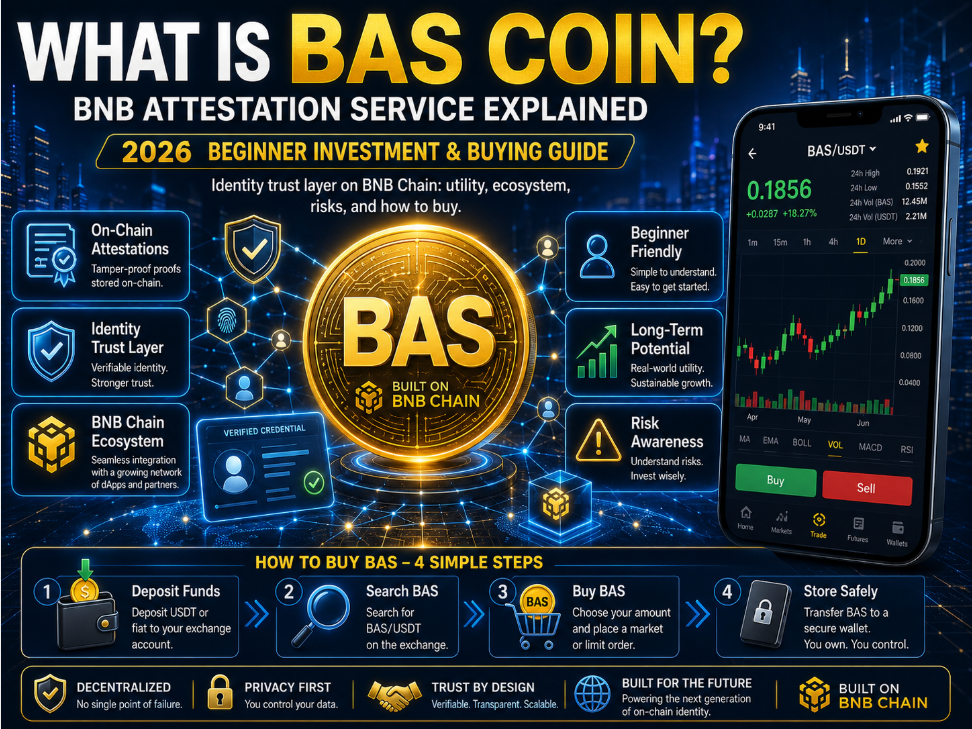
BAS runs on the BNB Chain ecosystem, which naturally gives it a BNB-ecosystem label; and BNB Chain is frequently associated by the market with Binance and CZ, so communities tend to reinforce the narrative with a simple, blunt label like "CZ's coin." But strictly speaking, BAS isn't a token issued by CZ personally, and being part of the BNB ecosystem doesn't automatically mean it has CZ's personal endorsement.
If you want to research BAS rationally, the first step isn't to listen to what the community is shouting — it's to come back to three core questions:
What problem does BAS actually solve? Why has it suddenly become tied to AI agents? Is the recent price rally driven by genuine demand growth, or by whale-driven short-term volatility?
This article walks through these three core questions to help beginners understand BAS's underlying project logic, tokenomics, price risks, buying process, and an investment decision framework.
I. What Problem Is BAS Actually Solving: The Missing "Trust Layer" in Web3
BAS's core keyword is Attestation — which can be understood as "proof," "certification," or "claim verification."
In Web3, a wallet address can prove that you control that address, but it's very difficult to prove who you are, what you've done, whether you're trustworthy, or whether you meet some specific eligibility requirement.
This creates a number of real-world problems.
For example, a DeFi platform might want to offer higher limits, lower interest rates, or better promotional benefits to high-quality users — but it has no way of knowing whether the address behind a wallet belongs to a real user, or whether that user has a good track record.
Or, an RWA project might want to confirm whether a user has completed KYC, meets regional requirements, or qualifies as an eligible investor — without wanting to put that user's full identity information on-chain publicly.
Or, an AI agent might want to execute tasks on-chain, accept jobs, make payments, borrow, or get a credit line — but other protocols have no easy way to determine whether that agent is reliable, whether it has completed tasks before, or whether it has a record of default.
What BAS is trying to solve is exactly this "missing trust layer" problem on-chain.
Before infrastructure like BAS existed, on-chain identity and reputation data tended to be fragmented:
- KYC information stays locked inside a single exchange or platform, unable to be reused across applications
- User behavior data is scattered across different protocols, with no unified verification standard
- Project teams have to repeat identity verification themselves, which is costly and creates a poor user experience
- Users don't want to expose private information, but still need to prove they meet certain conditions
- AI agents lack verifiable identity and reputation records, making it hard for them to participate in more complex financial activities
BAS's approach is to use an attestation mechanism to turn certain pieces of information into verifiable, composable, permissioned data credentials.
In simple terms, an attestation could be a statement like:
A given address completed a specific KYC check. A given address has held a certain type of asset. A given address has participated in a certain activity. A given user owns a certain social media account. A given AI agent has completed a specific on-chain task. A given agent's track record meets a certain reputation score.
The key is that these proofs can be read and verified by applications without necessarily exposing the full original data.
BAS's official documentation emphasizes that it supports both on-chain and off-chain verification, and stores related attestation data through infrastructure like BNB Greenfield, balancing privacy, access control, and data availability.
This kind of mechanism has real value in several use cases.
1. DeFi Use Cases
DeFi originally emphasized "permissionless" access, but as lending, credit, compliance, and institutional capital have entered the space, many protocols have started needing more granular user identification.
BAS can help DeFi protocols determine:
- Whether a user has completed KYC
- Whether a user qualifies for a particular activity
- Whether a user has a historical credit record
- Whether a user poses Sybil-attack risk
- Whether a user is a high-quality, genuine user
- Whether a given address is tied to a specific asset or behavior
If these proofs can be reused across multiple protocols, DeFi no longer has to rely solely on "looking at wallet balances" — it can start incorporating richer credit and behavioral data.
2. RWA Use Cases
RWA — real-world assets brought on-chain — depends heavily on identity, compliance, and asset proofs.
Use cases like bonds, funds, real estate, invoice financing, and institutional-grade lending can't fully ignore user eligibility and compliance requirements.
An attestation layer like BAS can be used to verify:
- Whether an investor meets eligibility requirements
- Whether an asset has an off-chain credential
- Whether an issuer has completed compliance certification
- Whether a given revenue right or ownership claim has been verified
- Whether a user is from a permitted region
RWA isn't finished just by writing an asset's name on-chain — what it really needs is a trustworthy bridge between off-chain information and on-chain assets. That's where BAS's value comes in.
3. AI Agent Use Cases
This is the focus of BAS's recent narrative shift.
An AI agent isn't an ordinary user — it can autonomously execute tasks, call tools, initiate transactions, make payments, and participate in on-chain services. If AI agents truly enter Web3 at scale in the future, they will also need identity and reputation.
For example:
- Who created this agent?
- What tasks has it completed in the past?
- Does it have a record of defaults?
- What's its task-completion rate?
- Has it been rated by other users?
- Can it qualify for a credit line?
- Can it act as a service provider in an agent marketplace?
Concepts BAS now emphasizes, like Agent Passport, Agent Credit Profile, and Agent Bank, are essentially extending "human identity and reputation systems" into "AI agent identity and reputation systems."
If this direction can genuinely be realized, BAS could become more than just a KYC tool — it could become trust infrastructure for the AI agent economy.
II. The Narrative Shift: Why Has BAS Suddenly Become Tied to AI Agents?
BAS was originally easier to understand as "an identity verification and attestation layer on BNB Chain."
It addressed problems around general-purpose identity, data proofs, asset proofs, and reusable reputation in Web3. This positioning wasn't particularly exciting on its own, but it was foundational.
However, after 2025, AI agents became one of the hottest narratives in crypto markets. More and more people started discussing:
- How AI agents can have wallets
- How AI agents can autonomously make payments
- How AI agents can accept tasks
- How AI agents can build reputation
- How AI agents can obtain credit lines
- How AI agents can participate in DeFi
- How AI agents can trust each other
Naturally, BAS's narrative shifted accordingly — from "general-purpose identity verification layer" to "AI agent identity and reputation layer."
This isn't necessarily a bad thing.
Many infrastructure projects adjust their narrative as market demand shifts. Talking about identity early on, then RWA, then AI agents — this is common in the crypto industry. What matters isn't whether the narrative has changed, but whether the change is backed by real products, development progress, and genuine user demand.
Several directions BAS has recently highlighted include:
- Agent Passport
- ERC-8004 Agent Registry
- Agent Credit Profile
- ERC-8183 commerce
- Agent Bank
- Composable agent reputation scoring
- Verifiable agent task records
The logic behind these concepts is: if AI agents are going to participate in the on-chain economy, they first need identity and credit records. Otherwise, an agent that switches addresses today and switches names tomorrow would find it very hard to build long-term trust.
ERC-8004 can be understood as a type of standard framework geared toward AI agent identity and reputation. Through related registries, reputation data, and attestation mechanisms, BAS lets an agent's behavioral records, feedback, and task-completion history be read and verified by on-chain applications.
Some materials also mention that agent identity could be NFT-ized or formed into a transferable on-chain identity. This suggests that in the future, an AI agent might not just be a script or bot — it could be an on-chain entity carrying a history, a credit score, and a verifiable behavioral track record.
For ordinary users, this matters because:
- You may not only trade with humans in the future — you might trade with agents too
- You'll need to know whether a given agent is reliable
- DeFi protocols might extend credit limits based on agent credit
- Task platforms might assign jobs based on an agent's historical performance
- An agent's reputation could become a composable asset in itself
But beginners also need to stay level-headed.
"AI agent trust layer" sounds like it has a lot of imaginative potential, but it's still very early-stage. Many features still need to be validated through real-world use. Judging whether BAS has genuinely upgraded from "identity layer" to "agent-economy credit layer" can't rely on website copy alone — it requires looking at:
- Whether Agent Passport has real users
- Whether developers are integrating it
- Whether third-party protocols have adopted it
- Whether there are queryable on-chain task records
- Whether there's real revenue or fee generation
- Whether Agent Bank has genuinely reached a usable stage
- Whether the related standard has been adopted by a broader ecosystem
If "AI agent" is just a few buzzwords slapped onto marketing copy, the price might rise in the short term, but it will be hard to sustain that valuation long-term.
III. Behind the Price Surge: Is This Healthy Demand Growth, or Concentrated Manipulation?
What beginners most need to be cautious about with BAS isn't just "is it really an AI agent project" — it's the circulating supply structure behind the recent price volatility.
Public market reports have noted a notable instance of whale concentration in BAS: approximately 33 related wallets controlled roughly 43.2% of circulating supply, corresponding to about 1.08 billion BAS. While this kind of on-chain analysis needs further verification by examining specific addresses, transaction paths, and timing, it at least suggests one thing: BAS's circulating supply structure may not be healthy.
Why does whale concentration matter?
Because a token's price depends not just on its narrative, but also on how its supply is distributed.
If a token's holdings are very widely dispersed, a single large holder will find it hard to move the price through buying or selling alone. If a token's circulating supply is highly concentrated, a small number of large holders can have an outsized impact on price.
When whales buy in concentrated fashion, the market sees the price rise quickly, volume expand, and community sentiment heat up. Beginners can easily mistake this for "the project breaking out." But if those wallets start selling in concentrated fashion, the price can also fall quickly, and ordinary investors often don't have time to exit.
BAS has also recently seen trading volume far exceeding its market cap. When trading volume vastly exceeds market cap, it typically indicates extremely heavy turnover. It could mean high market attention, but it could also reflect short-term capital churning repeatedly, or even be accompanied by pump activity, wash trading, or market-making behavior.
For a small-cap token, a surge in trading volume isn't necessarily a good thing. You need to understand where that volume is coming from:
- Are real users buying?
- Is it short-term churn driven by an exchange promotion?
- Are a small number of large holders trading back and forth?
- Is thin liquidity in a DEX pool causing the price to get pushed up?
- Is there arbitrage happening between a CEX and a DEX?
- Has there been a major change in the project's fundamentals?
Ordinary beginners can use a few indicators to distinguish "genuine growth" from "short-term pump activity."
First, check whether holder addresses are dispersing.
If the price rises while holder addresses keep becoming more dispersed, new holders keep increasing, and whale concentration decreases, that's generally a healthier sign.
If the price rises while supply becomes more concentrated and whale addresses keep accumulating, the risk is higher.
Second, check whether trading volume is sustained.
If volume only spikes for a day or two and then quickly fades, it might just be a short-term event-driven spike.
If volume holds up after the price rally, and more exchanges and on-chain applications show genuine demand, the rally is more credible.
Third, check whether product data is growing in tandem.
If BAS is genuinely rising because Agent Passport, Agent Credit, and similar products are being adopted, you should be able to see:
- Growing number of agents
- Growing registry calls
- Growing number of attestations
- Growing developer integrations
- Growing related contract interactions
- Growing third-party ecosystem applications
If only the price is rising while product data shows no notable change, it looks more like narrative speculation.
Fourth, check the unlock schedule and circulating ratio.
BAS's current maximum supply is 10 billion tokens, and public price data shows circulating supply at roughly 2.5 billion, or about 25%. This means a large amount of additional tokens may still be released into the market in the future.
A low circulating supply isn't necessarily a bad thing, but if future unlocks happen quickly without sufficient market absorption, it will create long-term sell pressure.
Circulating structure and holder concentration are among the key indicators for judging a token's price health. Compared to a mature, multi-cycle-tested major blockchain token like SOL, whose holdings are relatively dispersed, BAS's current whale concentration implies a completely different risk-pricing logic. If you want to understand how to evaluate a relatively more mature asset, you can check our analysis on whether now is a good time to buy SOL at for comparison.
IV. Multi-Scenario Price Projections: Where Might BAS Go?
The following scenario projections are based on public information, the current circulating supply structure, the AI agent narrative, the BNB Chain ecosystem, and the valuation logic of comparable identity/reputation protocols. They do not constitute investment advice. BAS is a small-cap, high-volatility token with a narrative that's still evolving, so prediction uncertainty is very high.
1. Bear Case: Whales Sell Off, AI Agent Narrative Cools
If the following conditions play out:
- Whale addresses transfer in concentrated fashion to exchanges
- Related wallets begin large-scale selling
- The AI agent narrative loses heat
- Agent Passport fails to show genuine user growth
- ERC-8004-related adoption progresses slower than expected
- BAS trading volume shrinks rapidly
- Overall market risk appetite declines
- Subsequent unlocks add to supply pressure
Then BAS could fall back into a low-price range, potentially even breaking below key support levels from before its recent rally.
In a bear case, BAS could face triple pressure:
First, a rapid pullback in price from a high level. Second, a thinning of liquidity, with widening sell-side slippage. Third, a crisis of confidence as the narrative is disproven and short-term capital exits.
If a token has already pulled back more than 70% or even 80% from its all-time high, that doesn't necessarily mean it's "cheap" — it could just as easily mean its volatility structure is extremely sharp, having already gone through multiple cycles of sentiment peaks followed by rapid sell-offs.
For beginners, the most important takeaway from the bear case is: BAS isn't a low-risk asset, and isn't suited to a heavy, buy-and-hold-long-term approach.
2. Base Case: The Identity Layer Continues Advancing, AI Agent Products See Small-Scale Adoption
In the base case, BAS won't immediately become core infrastructure for the AI agent economy, but it also isn't pure speculation.
Possible developments include:
- BAS continuing to operate as BNB Chain's identity and attestation layer
- Agent Passport continuing to be updated
- ERC-8004 and ERC-8183-related tools gradually maturing
- A small number of projects integrating BAS's attestation system
- Attestation count and agent registration count growing slowly
- Whale holdings not being dumped en masse
- Circulating market cap staying within a small-to-mid-tier infrastructure project range
In this case, BAS could enter a wide, sideways consolidation rather than a one-directional rally.
In the base case, the price is more likely to fluctuate based on several variables:
- BNB Chain ecosystem sentiment
- Capital flows into the AI agent sector
- The pace of the project's product updates
- Whale address movements
- CEX trading depth
- Unlock pressure
- Overall market risk appetite
In this scenario, beginners shouldn't expect daily moonshots — they should instead watch whether project data is steadily improving. If data improvement lags behind price appreciation, that suggests valuation may be running ahead of fundamentals.
3. Bull Case: Agent Passport Achieves Scaled Adoption, BAS Becomes BNB Chain's Agent Credit Layer
The bull case requires much stronger preconditions.
If the following conditions play out:
- AI agents become a major user group of on-chain applications
- BAS's Agent Passport is adopted at scale by AI agent projects
- ERC-8004-related registries become a standard within the BNB Chain ecosystem
- Agent Credit Profile generates genuine demand for credit scoring
- Agent Bank or Agent DeFi produce real lending, payment, and task-settlement use cases
- BNB Chain ecosystem provides continued support
- BAS's holder structure gradually disperses
- Trading volume reflects genuine demand rather than repeated trades among a small number of wallets
Then BAS could command a significantly higher valuation.
At that point, the market's understanding of BAS would upgrade from "small-cap identity verification project" to "credit infrastructure for the AI agent economy." If this kind of re-rating happens, BAS's upside potential would open up considerably.
But the bull case can't be established by slogans alone. It must be validated by data:
- Number of agents
- Number of attestations
- Registry call volume
- Number of third-party application integrations
- On-chain task settlement volume
- Usage of agent credit scoring
- Real fee or revenue generation
- Improvement in holder address dispersion
When facing a token whose narrative is still evolving and whose price is highly volatile, a more prudent approach is to break down key variables and lay out bear/base/bull paths, rather than trusting a falsely precise target price. Our earlier 2030 price prediction for LFI coin at used this same methodology, and the underlying approach can serve as a useful reference here as well.
V. How Beginners Can Actually Buy BAS, Using HiBT as an Example
If you understand BAS's basic logic and risks and still want to participate, you can use a platform that supports the BAS/USDT trading pair. Below, we use an exchange like HiBT as an example to walk through the general process beginners follow from registration to placing an order. Whether this specific trading pair is listed, which regions are supported, deposit networks, and trading rules should always be confirmed on the platform's actual pages.
Step 1: Why Does Buying a Small-Cap, High-Volatility Token Require Even Greater Attention to Exchange Security?
The risk with a token like BAS doesn't only come from the project itself — it also comes from the trading platform.
Small-cap, high-volatility tokens with concentrated whale holdings can see extremely sharp price swings. If the exchange itself has weak security, weak risk controls, insufficient liquidity, or an unstable withdrawal experience, the user's risk gets compounded further.
When choosing a trading platform, beginners should at minimum check:
- Whether the platform has publicly available registration information
- Whether it discloses compliance or licensing information
- Whether it supports KYC
- Whether it has fund-security mechanisms in place
- Whether it has clear deposit and withdrawal rules
- Whether BAS/USDT has sufficient trading depth
- Whether it supports take-profit/stop-loss or risk alerts
- Whether customer service and announcements are timely
For example, if a platform's public materials cite Canadian registration, US/Canada MSB status, and a Dubai headquarters, beginners should still further verify the latest disclosures, regional service restrictions, user agreement, and risk statements published on the platform's official site.
Step 2: Register an Account and Complete KYC
The typical process includes:
- Opening the platform's website or app
- Registering with an email or phone number
- Setting a strong password
- Completing email or SMS verification
- Enabling Google Authenticator
- Going to the identity verification page
- Uploading an ID card, passport, or other supported document
- Completing facial verification as prompted
- Waiting for the review result
KYC review time depends on the platform's processing efficiency and how clear the submitted documents are — it can take anywhere from a few minutes to a few hours, sometimes longer.
Beginners absolutely need to keep in mind:
- Don't buy someone else's account
- Don't use false identity documents
- Don't share a verification code with anyone
- Don't log in via links outside the official site
- Don't give your seed phrase, private key, or funds password to anyone other than verified support
Step 3: Choose a Deposit Method
There are two common deposit methods.
Fiat channels — if you don't have USDT, you can purchase it through the platform's supported fiat-to-crypto service, then use that USDT to trade BAS. The upside is simplicity; the downside is that fees, exchange rates, payment method, and processing speed can be inconsistent.
On-chain USDT transfer — if you already hold USDT on another exchange or wallet, you can deposit it into your HiBT account.
Before transferring, you absolutely need to confirm:
- The deposit currency is actually USDT
- The network matches, e.g., TRC20, ERC20, BEP20
- The address has been copied in full
- Whether a Memo or Tag needs to be filled in
- Whether a small test transfer arrives successfully
- Double-checking everything again before a larger transfer
The most common loss beginners experience isn't buying the wrong asset — it's transferring USDT to the wrong chain or the wrong address.
Step 4: Search for BAS/USDT and Place an Order
Once your USDT arrives, go to the spot trading page and search for "BAS" or "BAS/USDT."
Once you're in the trading interface, you'll typically see:
- The latest price
- The 24-hour change
- The price chart
- The bid and ask order book
- Trading volume
- Limit order and market order options
For a small-cap token like BAS with concentrated whale holdings and sharp volatility, it's generally recommended that beginners prioritize limit orders, rather than chasing a rally directly with a large market order.
Market orders fill quickly, but if the order book isn't deep enough, slippage can easily occur. You might think you're buying at a certain price, but the actual fill price could end up much higher.
Limit orders let you control your price. For example, if you're only willing to buy at a certain level, you can place that order and wait for it to fill. The downside is it may not execute immediately.
A more cautious approach to order placement includes:
- Don't chase the price after a sharp short-term rally
- Place orders in batches rather than buying all at once
- Watch whether the bid-ask spread is too wide
- If the order book is thin, reduce the size of each order
- Avoid placing orders emotionally right after major news
- Don't use leverage to chase a small-cap token
Step 5: How to Set Position Size and Stop-Loss After Buying?
An asset like BAS isn't suited for a large position.
The reasons are simple:
- High whale concentration
- Large price volatility
- Circulating supply is only a fraction of total supply
- The narrative is still evolving
- AI agent applications are still in an early stage
- Trading volume may be heavily influenced by short-term capital
Beginners can treat BAS as a small speculative position, rather than a core holding.
A more prudent approach is:
- A single small-cap token shouldn't exceed 1–3% of total funds
- A complete beginner could even keep it under 1%
- Set a maximum acceptable loss before buying
- Don't add to a position on impulse after it breaks below a key stop-loss level
- Take profit in stages after a sharp rally
- Don't dress up short-term speculation as long-term conviction
- Watch whether whale addresses are transferring to exchanges
If you can't tolerate a drawdown of 50% or more, you're not suited to taking a large position in a high-volatility token like BAS.
VI. Risks You Must Think Through Before Buying BAS
If an article only talks about BAS's AI agent narrative, its BNB ecosystem ties, and its identity trust layer without discussing the risks, the article would be incomplete.
BAS carries at least the following categories of risk.
1. Whale Concentration Risk
If the on-chain analysis suggesting 33 related wallets control roughly 43% of circulating supply is accurate, then BAS's supply structure warrants serious caution.
This means a small number of addresses could have a major impact on market price.
If they continue to hold or accumulate, the price could be pushed higher. If they transfer in concentrated fashion to exchanges or sell off, the price could fall rapidly.
Ordinary investors are typically at a disadvantage in this kind of structure, since it's very hard to know in advance when large holders will sell.
2. Narrative-Shift Risk
BAS's shift from a general-purpose identity verification layer to an AI agent credit layer is logically sound, but it also carries narrative-drift risk.
If the AI agent narrative stays hot, BAS could continue to benefit. If the AI agent sector cools off, and BAS hasn't built sufficient demand within its original identity verification, RWA, or DeFi use cases, the price could lose its support.
Judging whether a narrative is genuine can't rely on marketing language alone — it requires looking at product data and ecosystem integration.
3. Drawdown-From-All-Time-High Risk
BAS has previously experienced very sharp rallies and pullbacks. Public price data shows it still has a notable decline from its all-time high.
This points to two issues:
First, BAS isn't a low-volatility asset. Second, the price of a small-cap, narrative-driven token can be pumped up rapidly in a short window, and can pull back rapidly as well.
Beginners shouldn't assume an asset is "safe" just because "it's already fallen a lot." An asset that's down 80% can still fall another 50%; an asset that's up 200% can also pull back 30% in a single day.
4. Circulating Supply and Unlock Risk
BAS's maximum supply is roughly 10 billion tokens, with current circulating supply at roughly 2.5 billion, or about 25%.
This means roughly 75% of total supply may still enter the market across different stages in the future.
If the unlock release pace outpaces ecosystem growth, the price could come under pressure. This effect becomes especially pronounced when market enthusiasm fades and trading volume declines, since new supply will have a more visible impact on price.
Beginners need to continuously monitor:
- Team allocation
- Investor allocation
- Ecosystem incentives
- The unlock schedule
- Large-address transfers
- Inflows to exchange deposit addresses
5. Technical-Delivery Risk
BAS is built around concepts like identity, attestation, agent credit, ERC-8004, and ERC-8183 infrastructure.
These directions hold real potential, but delivering on them isn't easy.
The genuinely difficult parts include:
- How to attract developer integration
- How to get users willing to actually use it
- How to ensure data trustworthiness
- How to prevent Sybil attacks
- How to enable reuse across applications
- How to balance privacy and compliance
- How to make AI agent reputation generate real economic value
If these problems aren't solved well, BAS could remain stuck for a long time at the stage of "an interesting concept that isn't being used enough."
6. Liquidity Risk
BAS trades on some centralized exchanges and DEXs, but a small-cap token's liquidity can still be unstable.
Insufficient liquidity can lead to:
- Wider bid-ask spreads
- Higher slippage on market orders
- Large sell orders pushing the price down significantly
- Difficulty exiting smoothly during extreme market conditions
- DEX pools being heavily impacted by large trades
Before buying, beginners absolutely need to check trading volume and order book depth — not just the percentage gain.
7. Regulatory and Compliance Risk
BAS itself is a crypto token, but its application directions involve identity, KYC, reputation, RWA, and AI agent credit. These use cases may, in the future, touch on more complex compliance requirements.
If the project moves further into RWA, credit, identity verification, or cross-border data services, changes in the regulatory environment could affect the pace of product development and market expectations.
VII. Conclusion: A Reusable Decision Framework for Beginners
BAS is a worth-watching identity and attestation infrastructure project on BNB Chain. Its core value isn't being "yet another BNB ecosystem coin" — it's the attempt to provide a verifiable identity, reputation, and credit layer for the Web3 and AI agent world.
But it's also an asset with very clear risks.
It carries an AI agent narrative, but also whale-concentration risk. It has a BNB ecosystem backing, but also a circulating-supply issue that hasn't fully unwound. It has long-term imaginative potential as an identity trust layer, but also genuine uncertainty around whether its products will actually be delivered.
When facing BAS, or any narrative-driven small-cap token, beginners can check things in the following order.
First, check the technical substance.
Don't just look at the project's name and trending tags — ask:
- What problem does it actually solve?
- Is there official documentation?
- Is there a real product?
- Is there on-chain contract interaction?
- Are there developer tools?
- Have any third-party projects integrated it?
Second, check the narrative's authenticity.
AI agents are trending, but not every AI agent concept can actually be delivered.
You need to check:
- Whether Agent Passport is genuinely usable
- Whether there's actual agent registration data
- Whether there are task records
- Whether there's a real use case for reputation scoring
- Whether there are real users
- Whether there's real revenue or fees
Third, check holder concentration.
The biggest risk for a small-cap token is concentrated supply. Focus on:
- The share held by the top 10 addresses
- Whether whale addresses are related to each other
- Whether large wallets are transferring to exchanges
- Whether the number of holder addresses is growing
- Whether supply is gradually dispersing
Fourth, check the circulating supply structure.
Focus on:
- Maximum supply
- Current circulating supply
- FDV
- The unlock schedule
- Team and investor allocations
- The pace of ecosystem incentive release
Fifth, check liquidity.
Don't just look at the chart — you must check:
- 24-hour trading volume
- Bid-ask spread
- DEX pool depth
- CEX order book depth
- Whether slippage is likely to occur
- Whether large trades move the price significantly
Sixth, check your own risk exposure.
An asset like BAS is better suited as a small speculative position rather than a core holding.
If you're a beginner, you should be even more disciplined about position sizing, rather than rushing in because a community is hyping it, because of a short-term spike, or because of a label like "CZ's coin." A truly seasoned investor isn't someone who always buys at the absolute bottom — it's someone who knows exactly how much they're prepared to lose.
The bottom line: BAS is not the Base chain, and it is not a token issued by CZ personally — it's identity, attestation, and agent reputation infrastructure within the BNB Chain ecosystem. Its long-term value depends on whether Attestation, Agent Passport, the AI agent credit system, and BNB ecosystem applications can genuinely be delivered. In the short term, its price is heavily influenced by whale holdings, the circulating supply structure, market narrative, and exchange liquidity.
Before buying BAS, what you really need to ask yourself isn't "can it still go up" — it's:
Do I understand that BAS and Base are not the same project? Do I know that BAS is addressing on-chain identity and trust problems? Can I tell whether the AI agent narrative is genuinely being delivered, or just riding the trend? Have I looked at the whale holdings and circulating supply structure? Can I tolerate the sharp volatility of a small-cap token? Am I only using a small portion of funds I can afford to lose?
If you can answer all of these clearly, deciding whether to participate in BAS will be a far more rational decision than simply chasing the hype.
This article reflects information available as of June 25, 2026. BAS is still in a stage of narrative evolution and product development; future developments around Agent Passport, the ERC-8004 ecosystem, on-chain holding structure, exchange liquidity, and the level of BNB Chain support could all affect its price performance. Continue monitoring official announcements, on-chain data, and shifts in market risk before investing.