
If you've recently come across FLOW on an exchange, a market data site, or in an NFT article, your first reaction might be:
"Is FLOW just an ordinary blockchain token?"
"What does it have to do with NBA Top Shot or CryptoKitties?"
"Why was this huge before, and why has the price fallen so far since?"
"Is this a faded project left over from the NFT hype cycle, or is it still infrastructure worth watching for consumer Web3?"
These are all reasonable questions. Flow isn't a chain built around a flashy concept with nothing behind it — it has some genuinely strong brand case studies: CryptoKitties, NBA Top Shot, NFL ALL DAY, Disney Pinnacle, and a Ticketmaster digital-collectibles ticketing experiment, all tied to Dapper Labs or the Flow ecosystem.
But on the other hand, FLOW's market performance has been brutal. It was hyped during the 2021 NFT bull market, then suffered a severe drawdown as the NFT market cooled, trading volume fell, and the narrative faded. For newcomers, FLOW shouldn't be simplistically understood as "a star project that's bound to come back," nor should it be dismissed outright as "a dead old coin."
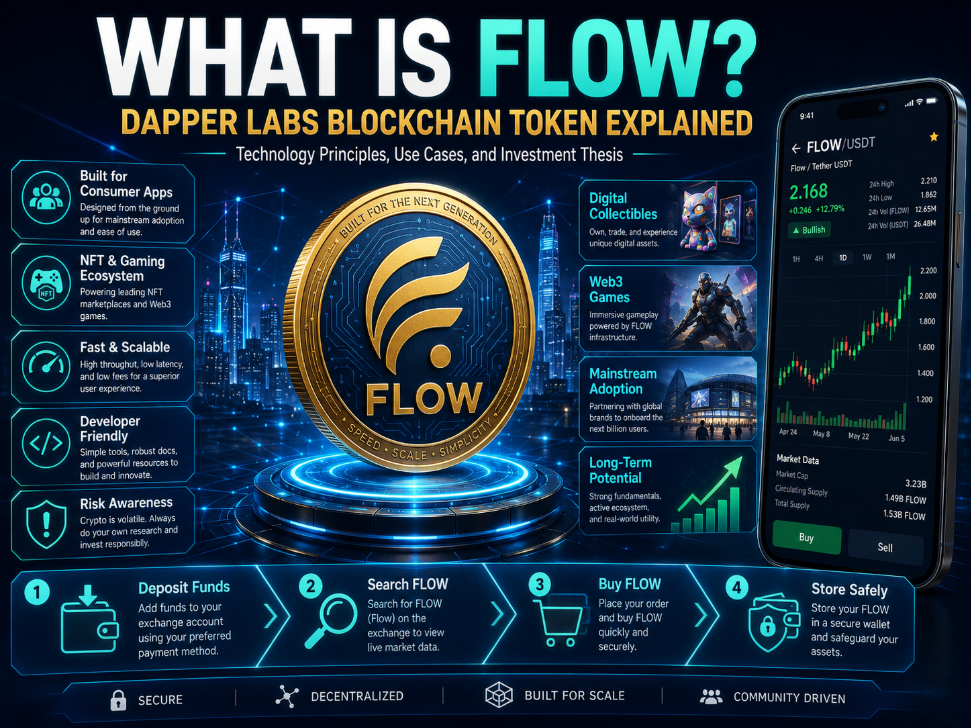
Let's clarify this upfront:
FLOW is the native token of the Flow blockchain, a Layer 1 chain built by Dapper Labs specifically for consumer-facing applications and digital asset use cases.
It isn't a pure meme coin, nor is it a high-performance chain built only for DeFi power users. Flow's core positioning is to let ordinary users interact with NFTs, digital collectibles, game assets, sports collectibles, entertainment IP, and future consumer Web3 apps — without needing to understand the complexities of blockchain.
This article covers:
- Whether FLOW refers to the chain or the token
- Why Flow wasn't built simply as an Ethereum scaling solution
- What problems the multi-role architecture and Cadence language actually solve
- What NBA Top Shot, NFL ALL DAY, and Disney Pinnacle mean for Flow
- Who FLOW is suited for as an investment
- How to buy FLOW through HiBT
- FLOW's main risks and the metrics worth tracking going forward
This article is not investment advice. Crypto asset prices are highly volatile, FLOW has experienced an extremely deep drawdown, and blockchain projects carry technical, security, ecosystem, regulatory, and liquidity risks. Always defer to the exchange's current pages, official announcements, and your own risk tolerance before trading.
1. Why Does FLOW Keep Showing Up on Your Radar?
When newcomers search for FLOW for the first time, it's usually not because they've studied the technology — it's because they recognize a few familiar names:
- NBA Top Shot
- CryptoKitties
- NFL ALL DAY
- Dapper Labs
- Disney Pinnacle
- Ticketmaster
- The Flow blockchain
The two most iconic are CryptoKitties and NBA Top Shot.
CryptoKitties was one of the earliest NFT breakout moments — it introduced many people to the idea that on-chain assets could be unique digital collectibles, not just fungible tokens. But its popularity also exposed a real problem in Ethereum's early days: when large numbers of users participate at once, the network gets congested, gas fees spike, and the experience for ordinary users suffers.
One of the key reasons Dapper Labs later built the Flow blockchain was this: if you want to build consumer applications for tens of millions of mainstream users, Ethereum's performance and UX at the time couldn't realistically support that scale.
That's the logic behind Flow's existence.
Flow isn't trying to solve "how can experienced on-chain users trade more efficiently" — it's trying to solve "how can ordinary users collect digital items, manage game assets, and engage with ticketing souvenirs and brand experiences, without realizing they're using blockchain at all."
So FLOW tends to show up on your radar for three reasons:
First, it has real consumer case studies behind it. NBA Top Shot wasn't just a whitepaper project — it actually launched and genuinely attracted a large number of sports fans. It brought NFTs out of the crypto bubble and into mainstream sports culture for a time.
Second, it represents a direction for consumer-grade Web3 infrastructure. Many blockchains emphasize TPS, DeFi, MEV, liquidity, and developer ecosystems, while Flow emphasizes user experience, brand partnerships, digital asset security, and large-scale consumer onboarding.
Third, its severe price drawdown has put it back on "buy-the-dip watchlists." Many investors, seeing how far FLOW has fallen from its all-time high, start asking: is this undervaluation, or has the narrative permanently faded? That question can't be answered by price alone — it requires looking at real usage, ecosystem data, and risk structure together.
Is FLOW a Blockchain or a Token?
To be precise:
- Flow is the blockchain
- FLOW is the native token of the Flow blockchain
The Flow blockchain handles applications, accounts, smart contracts, NFTs, transactions, and asset transfers.
The FLOW token pays network fees, supports staking, contributes to network security, serves as a value medium within the ecosystem, and — as governance matures — may carry certain governance functions.
Why Are Brands Like the NBA, Disney, and Ticketmaster Connected to Flow?
Not because these brands wanted to "speculate on crypto" — but because they needed a new kind of digital-asset infrastructure.
For sports, entertainment, ticketing, and IP brands, blockchain offers several capabilities that traditional internet account systems struggle to provide simultaneously: users can genuinely own digital collectibles, NFTs can move between platforms, secondary-market trades can be recorded automatically, IP holders can design long-term fan benefits, users can accumulate a digital identity and collection history across different events, and brands can turn one-time purchases into ongoing engagement relationships.
Flow's positioning fits these needs well.
But that doesn't guarantee the FLOW token's price will rise. A real, sustainable connection still needs to exist between brand partnerships, user growth, on-chain transactions, ecosystem revenue, and token value capture.
2. FLOW's True Nature: A Layer 1 Chain Built Specifically for Consumer Applications
Newcomers often lump Flow together with ETH or SOL, assuming "they're all blockchains, more or less the same."
In reality, their design philosophies differ significantly.
Ethereum's strengths are security, deep asset liquidity, a massive developer network, and a mature DeFi ecosystem.
Solana's strengths are high performance, low fees, high throughput, and an active on-chain trading ecosystem.
Flow's core differentiator is that it was designed specifically for consumer applications and digital-asset experiences. It isn't just chasing technical benchmarks — it made many foundational design choices around the real-world experience of ordinary users, developers, and brand partners.
Why Didn't Dapper Labs Just Build on Ethereum Directly?
The most direct reason was the congestion Dapper Labs experienced firsthand with CryptoKitties. When a consumer-facing NFT app suddenly goes viral, if the underlying chain has slow confirmation times, spiking gas fees, frequent failed transactions, complex wallet UX, and demands that ordinary users understand private-key management and security on their own — a consumer application simply can't break through to the mainstream.
For experienced crypto users, gas fees, wallets, signatures, approvals, and bridging may be everyday operations — but for NBA fans, Disney fans, and people at live events, all of this is a barrier.
Dapper Labs' goal was to hide the blockchain behind the experience, letting users collect, buy, display, trade, and interact first — without needing to learn an entire body of on-chain knowledge upfront.
That's the key background behind Flow being built as its own chain.
What Is the Multi-Role Architecture?
One of Flow's most important technical design choices is its multi-role architecture.
Traditional blockchains typically require nodes to handle many tasks simultaneously: collecting transactions, ordering them, executing them, verifying results, storing state, and participating in consensus. This approach is straightforward and secure, but it tends to create performance bottlenecks as user numbers and transaction volume grow.
Flow's approach is to avoid piling all of this work onto a single type of node, instead splitting nodes into distinct roles that each handle a different task. Common roles include:
- Collection Nodes: gather transactions and improve the efficiency of getting them onto the network
- Consensus Nodes: handle transaction ordering and consensus security
- Execution Nodes: execute transactions and compute state changes
- Verification Nodes: verify that execution results are correct
In simple terms: Flow separates "who decides transaction order" from "who performs complex computation," breaking the blockchain processing pipeline into more specialized stages.
The goal is to increase throughput without relying simply on sharding, which can fragment the user and developer experience.
Why Not Sharding?
Sharding splits network state into multiple partitions, letting different nodes process transactions for different shards. This can scale performance, but it also introduces problems: cross-shard interactions become complex, developers must handle more state-synchronization issues, user assets may end up spread across different shards, composability can suffer, and the application experience can become fragmented.
Flow chose the multi-role architecture instead, aiming to increase processing capacity through specialization without splitting global state into pieces.
This doesn't mean Flow's approach is free of trade-offs — the multi-role architecture brings its own complexity in node coordination, security verification, and governance. But it does reflect a deliberate choice: keeping developers and consumers facing a single, unified-state chain rather than a fragmented, more complex system.
What Is the Cadence Smart Contract Language?
Cadence is Flow's native smart contract language.
Its defining feature is resource-oriented programming.
Ordinary users don't need to understand the programming details, but here's the intuition: in Cadence, digital assets like NFTs, tokens, and game items are managed as "resources" rather than as a row of data that can be freely edited in a database.
Resources have several important properties: they can't be casually duplicated, they can't disappear out of nowhere, they must exist in exactly one defined location, transferring them must follow rules enforced at the language level, and many asset-safety issues can be caught at compile time before they ever happen.
What's the benefit for ordinary users? The biggest one is that the security model for digital assets maps much more closely to the intuition of a physical "object." A star athlete's NFT trading card shouldn't be duplicated into two copies; a game item shouldn't be claimed twice because of a contract bug; a transfer shouldn't cause an asset to vanish into an unknown location.
Cadence's resource model exists specifically to represent this kind of scarce digital asset more safely.
Of course, no language design alone guarantees an application is bug-free — security still depends on contract implementation, audits, wallet interactions, frontend risk controls, and user habits. But from a design-philosophy standpoint, Cadence is genuinely an important technical choice supporting Flow's focus on NFTs and consumer assets.
What Role Does the FLOW Token Play on the Network?
FLOW, as Flow's native token, serves several key functions:
First, paying transaction and storage fees. Transferring, interacting, creating accounts, and using applications on the Flow network all consume fees, and FLOW is one of the base assets used for network fees.
Second, participating in staking and network security. Flow is a proof-of-stake network. Node operators must stake FLOW, and regular holders can also participate in network security through delegated staking and earn corresponding rewards.
Third, serving as a value medium within the ecosystem. Within Flow's ecosystem, FLOW can act as a value medium for certain applications, assets, services, and on-chain interactions.
Fourth, governance-related functions. As governance mechanisms mature, FLOW holders may gain a larger role in network parameters, protocol upgrades, and ecosystem direction. However, the specific governance rights and processes should be verified against Flow's official governance documentation and current tools.
3. FLOW's Real-World Use Cases: Who's Using It, and For What
Evaluating a blockchain shouldn't rely only on whitepapers and slogans. What matters is: are there real users, real applications, real brands or developers using it consistently, are users willing to pay for on-chain assets, and can the ecosystem keep functioning outside of bull-market conditions?
Flow's biggest advantage is that it genuinely has case studies most mainstream users have heard of.
NBA Top Shot
NBA Top Shot is Flow's most representative product. It turns highlight moments from NBA games into digital collectibles ("Moments") that users can buy, collect, and trade.
Its significance: it brought NFTs to sports fans, gave many ordinary users their first exposure to digital collecting, demonstrated that brand IP could create new consumption patterns through on-chain assets, and showed that blockchain applications don't have to be limited to DeFi and speculative trading.
But there's another side to consider: NBA Top Shot's peak has clearly passed. As the broader NFT market cooled, trading volume, user activity, and secondary-market interest are no longer anywhere near 2021 bull-market levels.
This illustrates Flow's real challenge isn't "does it have a successful case study" — it's "can that success translate into sustainable, long-term growth."
NFL ALL DAY
NFL ALL DAY is another important Dapper Labs product in the sports NFT category, following a similar logic to NBA Top Shot — built around NFL game moments, players, season events, and fan collecting.
Its value is in showing that Flow's consumer NFT model isn't limited to basketball and can be replicated across other sports IP.
But it faces the same questions: is the novelty of sports digital collectibles sustainable, are users willing to trade long-term, is new user growth sufficient, is the secondary market healthy, and can the FLOW token capture enough value from these applications?
Disney Pinnacle
Disney Pinnacle is Dapper Labs' digital pin and collectibles experience built around Disney IP.
The advantages of Disney IP are obvious: a massive global fanbase, a rich library of characters, a mature collecting culture, suitability for long-term fan engagement, and a natural fit for digital pins, quests, events, and rarity mechanics.
If Disney Pinnacle can continue rolling out engaging collecting mechanics, that's an important signal for Flow.
But investors should separate two things: brand partnerships matter, but a brand partnership doesn't automatically mean the token's price will rise. What actually matters is whether users stay continuously active, whether there's real trading demand for the collectibles, whether the app generates on-chain interactions, whether FLOW is actually used for fees, staking, or ecosystem value flow, and whether ecosystem data keeps improving.
Ticketmaster's Digital Collectible Ticketing
Flow's collaboration with Ticketmaster points to a different direction: ticketing and event memorabilia.
For concerts, sporting events, and live experiences, NFTs don't have to be "just images to flip" — they can be entry mementos, fan credentials, event badges, membership benefits, a channel for remarketing, or a long-term record of brand-user engagement.
The focus here isn't making users buy a token — it's letting users complete an on-chain interaction without even realizing it, while simply buying a ticket, entering a venue, or collecting a souvenir.
This is the single most important piece of Flow's long-term value narrative: users don't need to know they're using blockchain at all.
Japan's Offline Digital Collectible Vending Machine Case Study
A notable example within the Flow ecosystem is offline digital-collectible vending machines deployed in Japan.
What matters about this case isn't technical complexity — it's that it makes buying an NFT feel close to an ordinary retail purchase: a user sees a vending machine in person, scans a QR code with their phone, buys a digital-collectible pack, the system helps create or connect a wallet, and the user never has to learn complex on-chain concepts beforehand.
This kind of "the user doesn't know they're using blockchain" experience may be closer to the future of consumer Web3 than the traditional NFT marketplace model.
If Flow can replicate this kind of experience across more offline settings, entertainment IP, sports events, and membership systems going forward, its value narrative becomes more than just an NFT-bull-market memory — it becomes consumer-grade digital ownership infrastructure.
How Has Activity Changed Compared to 2021?
Compared to the 2021 NFT bull market, the Flow ecosystem has clearly cooled. Key changes include: secondary-market NFT interest declining, NBA Top Shot trading volume no longer at peak levels, FLOW's token price down sharply from its all-time high, the market re-pricing the NFT-chain narrative overall, investors focusing more on real revenue and sustainable users rather than a list of brand names, and chain competition shifting from "who has the best story" to "who has real activity and real cash flow."
This isn't unique to Flow — it's a cyclical adjustment the entire NFT-infrastructure category has gone through.
For investors, this means FLOW should no longer be priced using 2021 bull-market imagination — it needs to be re-evaluated against real 2026 data.
4. Who Is FLOW Suited For? Look at the Real Data First
"Should I buy FLOW?" isn't a question with a direct answer.
The better question is: what logic are you actually buying into when you buy FLOW?
If you're only looking at how far it's fallen and assuming "it's down 99%, so it must bounce back," that's a dangerous line of reasoning — a large drawdown could reflect undervaluation, or it could reflect the market thoroughly re-pricing the original narrative.
What Does FLOW's Current Drawdown Actually Tell Us?
FLOW reached a very high price level in 2021, and the current price has fallen roughly 99%+ from that all-time high. A drawdown of this magnitude tells us several things:
First, the NFT bull-market premium has been squeezed out almost entirely. In 2021, the market was willing to pay extremely high valuations for NFTs, blockchains, brand partnerships, and future potential. Today, the market cares much more about real users, revenue, activity, and long-term retention.
Second, old narratives no longer work automatically. Phrases like "NBA partnership," "backed by Dapper Labs," and "consumer NFTs" used to be enough to excite the market on their own. Now investors ask: how much trading volume, fee revenue, and new-user growth do these partnerships actually generate today?
Third, newcomers shouldn't anchor on the historical high. Many people see "it went from $40 to a few cents" and instinctively assume reaching $1, $5, or even $10 again would be easy. But that historical high was the product of a very specific bull-market environment, and it shouldn't be treated as a future target.
Fourth, position sizing matters more than predicting direction. For an asset that's experienced this kind of deep drawdown, if you do participate, it's far more sensible to use a small position, scale in gradually, and set clear stop-loss logic, rather than betting heavily all at once on a reversal.
How Is FLOW Fundamentally Different from SOL or DOGE?
FLOW, SOL, and DOGE are all crypto assets, but they are not the same category of asset.
FLOW's narrative: consumer Web3, NFT infrastructure, brand IP, digital collectibles, on-chain UX, the Dapper Labs ecosystem, and blockchain technical architecture.
SOL's narrative: a high-performance chain, DeFi, the meme ecosystem, high-frequency on-chain trading, developer ecosystem, institutional flow expectations, and on-chain activity.
DOGE's narrative: meme culture, community sentiment, Musk's influence, payments potential, high liquidity, and legacy crypto-asset status.
For a side-by-side comparison, see:
- Is now a good time to buy Dogecoin? 2050 price predictions
- Is now a good time to buy SOL? 2050 price predictions and deep analysis
DOGE is more of a sentiment-and-culture asset; SOL is more of a high-performance-chain ecosystem asset; FLOW is more of a consumer-Web3-infrastructure asset.
So they can't be judged by the same standard.
Who Should Pay Attention to FLOW?
1. Those who are bullish on consumer Web3's long-term direction. If you believe large numbers of ordinary users will eventually enter Web3 through games, sports, entertainment, ticketing, membership systems, and digital collectibles, Flow remains worth watching.
2. Those who value real brand partnerships. Flow's advantage isn't an anonymous team launching a concept — it has genuine products and case studies tied to Dapper Labs, the NBA, the NFL, Disney, and Ticketmaster.
3. Those who can tolerate a prolonged downturn. FLOW isn't a short-term momentum asset. It's closer to a legacy project that has been through a narrative collapse and needs new applications, new users, and new growth data to prove itself again.
4. Those willing to track data rather than just watch price. Following FLOW requires continuously monitoring ecosystem data, user activity, NFT trading, developer tooling, staking participation, and the pace of new application launches.
Who Shouldn't Touch FLOW?
1. Anyone purely chasing a short-term spike. FLOW's core isn't meme-style momentum, and it doesn't suit people only chasing short-term sentiment.
2. Anyone who can't handle deep volatility. An asset that's already experienced a ~99% drawdown can still see large swings going forward. Anyone without sufficient risk tolerance shouldn't participate.
3. Anyone who doesn't understand how the NFT narrative has shifted. If you only remember the 2021 NFT bull market and aren't aware of the subsequent decline in interest, user attrition, and shrinking trading volume, you're likely to overestimate how quickly FLOW could recover.
4. Anyone who can't manage position sizing. Even if you're bullish on FLOW, it's not suited to a large, concentrated bet. A more sensible approach is a small position, scaling in gradually, and tracking key metrics over the long term.
5. How to Buy FLOW: A Complete Walkthrough Using HiBT
For newcomers, no matter how much theory you cover, the question eventually comes down to: "How do I actually buy FLOW?"
If HiBT currently supports FLOW/USDT spot trading, you can follow the process below. Because exchange products change over time, always verify the actual listing status, trading pair name, fees, and withdrawal rules against HiBT's live pages.
Step 1: Register a HiBT Account and Complete KYC
Registration typically requires an email or phone number, a login password, a verification code, identity documents, possibly facial recognition, and possibly your region of residence.
Common KYC snags include: unclear document photos, a name mismatch between your ID and your registration info, an expired document, a residence region not currently supported, network issues, or a failed facial-recognition check.
Beginners should set up account security first: enable Google Authenticator or another 2FA method, set a funds password, link your email and phone, turn on an anti-phishing code, avoid clicking unfamiliar links, and never share verification codes with anyone.
Step 2: Choose a Funding Method
There are two common approaches:
Fiat channel to buy USDT — straightforward and suited to new users without existing crypto. Check whether the fiat channel supports your region, whether your payment method is available, whether the exchange rate is reasonable, what fees the platform or third-party provider charges, the settlement time, and any per-transaction limits.
Transferring USDT in from another platform or wallet — suited to users who already hold crypto. Check HiBT's deposit address, the USDT network you select (don't mix up TRC20, ERC20, BEP20, etc.), whether a memo or tag is required, the minimum deposit amount, on-chain fees, and the number of confirmations needed.
Beginners should test with a small amount first and confirm it arrives before transferring a larger sum.
Step 3: Search for the FLOW/USDT Pair
Once funds arrive, go to the spot trading page and search for FLOW or FLOW/USDT.
If HiBT lists the pair, you'll be able to check the current price, 24-hour change, order book, candlestick chart, trading volume, depth chart, and fee schedule.
A specific caution here: FLOW's market interest is clearly lower than during the 2021 NFT bull market, and on some platforms its order book depth may not match mainstream assets like BTC, ETH, or SOL. Always check the order book before placing an order — don't buy a large amount at market price blindly.
Step 4: Choose Market or Limit Orders
A market order fills quickly but doesn't guarantee a good price — suited to small purchases, sufficient order book depth, situations where execution speed matters most, and when you can tolerate minor slippage.
A limit order lets you control the price but won't necessarily fill immediately — suited to controlling your cost basis, average order book depth, avoiding slippage, scaling into a position gradually, and planned trading.
For an asset like FLOW, which has been through a deep drawdown and may see lower volume at certain times, beginners should generally favor limit orders — checking the current best ask, comparing it to the recent trading range, placing your order at a price you're comfortable with, buying in batches, and avoiding chasing a market order during sharp upward moves.
Step 5: Managing Your FLOW After Buying
After buying FLOW, you have two main options.
First, keep it in your HiBT account. Advantages: convenient for selling later, suited to short-to-medium-term holding, simple to manage, no need to handle your own private keys. Risks: exchange custody risk, possible loss from a compromised account, inability to withdraw during platform maintenance or suspensions, and unsuitability for very long-term reliance on platform custody alone.
Second, withdraw to a wallet that supports Flow. If you want to participate in the Flow ecosystem, use NFT applications, or stake on-chain, consider a wallet that supports the Cadence/Flow network, such as Blocto or Flow Wallet. Before withdrawing, confirm whether HiBT supports FLOW mainnet withdrawal, whether the target wallet supports the Flow network, that the withdrawal address is correct, whether a memo is required, the minimum withdrawal amount, fees, expected settlement time, and whether the destination application actually requires FLOW. Beginners shouldn't withdraw blindly without familiarity with wallets — and should especially avoid sending FLOW to a wallet or chain that doesn't support the Flow mainnet.
Step 6: FLOW Staking Paths and Requirements
FLOW can be staked to support network security and earn rewards, generally through two paths:
Staking on an exchange. Advantages: simple to operate, no need to choose a node yourself, no need to understand on-chain delegation, suited to beginners. Disadvantages: rewards and rules are set by the exchange, there may be a lock-up period, you may not be able to participate directly in on-chain governance, exchange custody risk applies, and actual rewards may be lower than native staking.
Native on-chain staking or delegation. Advantages: closer to Flow's native mechanism, lets you choose a node operator, contributes more directly to network security, suited to long-term users and ecosystem participants. Disadvantages: a higher operational bar, requires a wallet, requires understanding nodes, delegation, unbonding periods, and reward rules, mistakes can cause losses, and choosing a node carries its own risk.
If you're only trading short-term, staking isn't necessarily needed. If you're a long-term Flow ecosystem follower, it's worth studying the official staking documentation and wallet workflows further.
6. Risk Breakdown: Realities FLOW Investors Need to Face
FLOW isn't a worthless, empty project — but its risks can't be glossed over either. A genuinely responsible analysis has to lay out both sides clearly.
Historical Drawdown Risk: What Does a ~99% Decline Actually Mean?
FLOW's roughly 99%+ drawdown from its all-time high carries some important lessons for newcomers.
First, don't put blind faith in "star" projects. Even with Dapper Labs, NBA Top Shot, and a genuine NFT breakout case study behind it, the token's price can still collapse dramatically.
Second, don't use the historical high to imagine future upside. Many people say: "It was $40 before, now it's a few cents — even getting back to $1 would be a huge multiple." This kind of math sounds tempting but ignores key questions: was the past high even reasonable, can that market environment recur, has token supply changed, does ecosystem revenue support the valuation, has user activity recovered, and has the competitive landscape gotten tougher?
Third, a deeply discounted asset can keep falling further. Falling 90% and then falling another 90% is one of crypto's harshest realities. A low price doesn't mean low risk.
Security Incident Risk: Lessons from the Late-2025 Exploit
In late 2025, Flow experienced a security incident related to its execution layer, in which an attacker exploited a vulnerability to create abnormal assets and cause losses. Following the incident, debate emerged in the market over whether to roll back the network, how to handle affected accounts, and how to maintain decentralization credibility.
This kind of event carries several lessons for investors:
First, no blockchain is absolutely secure. Even a Layer 1 that's been running for years can have vulnerabilities at the protocol, execution, or ecosystem level.
Second, crisis handling shapes market trust. If a team responds transparently, fixes issues promptly, and compensates fairly, trust can gradually recover; if the handling sparks community controversy, both the token price and ecosystem confidence can suffer.
Third, rollback debates touch the core question of decentralization. What blockchain users value most is immutability. Considering a rollback after an attack might protect some funds, but it also raises the contentious question of who has the right to alter on-chain history.
Fourth, investors need to keep tracking the aftermath. A security incident isn't just a one-day news story — what matters more is whether the vulnerability was fully fixed, whether a technical post-mortem was published, whether affected users were compensated, whether governance processes were improved, whether node diversity increased, and whether confidence among ecosystem partners was restored.
Competitive Risk: Pressure from Ethereum and Other Chains
One of Flow's original advantages was offering a better experience for consumer NFT applications. But the landscape has changed.
Ethereum has completed its move to proof-of-stake, Layer 2 ecosystems have grown rapidly, and networks like Base, Arbitrum, Optimism, Polygon, and Solana are all competing for consumer applications, NFTs, games, and brand partnerships.
This means Flow is no longer the only option. Brands today can choose Ethereum mainnet, Ethereum Layer 2s, Polygon, Solana, Base, Immutable, Avalanche subnets, a custom application chain, or even fully managed Web3 infrastructure.
Flow has to prove that it's not just a chain that was once right for NBA Top Shot, but one that remains right for the next generation of consumer applications.
Narrative-Fade Risk: Declining NFT Market Interest
FLOW's biggest historical narrative came from NFTs and digital collectibles. But the NFT market has cooled significantly: speculative interest in image-based NFTs has dropped, secondary-market trading volume has shrunk considerably, large numbers of users have left, fundraising has become harder for project teams, brands have grown more cautious, and the market is no longer willing to pay a premium for "having IP" alone.
This has a direct impact on FLOW. If Flow can't expand beyond "collectible trading" into more stable consumer applications — games, ticketing, memberships, digital identity, AI payments, offline interactions — its token value capture may remain limited.
Liquidity Risk
FLOW is no longer one of the market's most actively traded assets. On some platforms, FLOW's order book depth may be insufficient, and large market orders can produce noticeable slippage, especially during volatile periods.
Beginners should remember: don't look only at the last traded price, check order book depth, split large orders into batches, prefer limit orders, and avoid impulsive trading during extreme moves.
Ecosystem Dependency Risk
Flow's relationship with Dapper Labs runs deep — and that's both a strength and a risk.
The strength is that Dapper Labs brings consumer-product experience, brand relationships, and an accumulated track record in NFT applications.
The risk is that if the Flow ecosystem remains overly dependent on Dapper Labs, with insufficient growth from external developers and independent applications, ecosystem diversity will stay limited. In the long run, Flow needs to prove it's more than just "Dapper Labs' product chain" — it needs to be a genuinely open developer network.
7. FLOW's Value Drivers: What Metrics Matter Going Forward
Analyzing FLOW shouldn't be limited to watching price moves — what matters more is building a framework for ongoing tracking.
Is Consumer Application Growth Continuing?
Flow's biggest long-term value depends on whether more genuinely consumer-facing applications keep emerging. Watch for: new games launching, additional sports and entertainment IP coming on board, expansion of ticketing applications like Ticketmaster's, continued activity from Disney Pinnacle, replication of Japan's offline vending-machine model elsewhere, and new consumption use cases that go beyond NFT collecting.
If Flow continues to lean only on its 2021-era story, the investment thesis is weak. If it keeps producing new user scenarios — especially ones that don't require users to understand blockchain — the long-term value case becomes more worth watching.
Is On-Chain User Activity and Transaction Volume Improving?
Metrics worth tracking include monthly active users, daily transaction counts, new account growth, NFT minting volume, application interaction counts, fee revenue, active contract counts, and wallet usage.
These metrics matter more than another partnership announcement, because a partnership only represents potential, while on-chain data represents actual usage.
Developer Tooling and the AI-Payments Direction
In 2026, AI agent payments, x402, stablecoin micropayments, and machine-to-machine settlement have become emerging directions within Web3. If Flow can make real progress in developer tooling, AI agent payments, consumer wallets, micropayments, and on-chain services, it could open up a new narrative beyond NFTs.
But caution is warranted here: AI payments being a new direction doesn't mean Flow already has a secure lead in it. Investors need to look at real integrations, real transaction volume, and real developer adoption — not just the concept.
Degree of Network Decentralization
Flow still needs to keep improving network decentralization and governance transparency going forward. Watch whether node operators are becoming more diverse, whether governance processes are open and transparent, whether protocol upgrades involve community input, whether the security-incident response process has improved, whether staking participation is healthy, and whether key infrastructure remains overly centralized.
For a network that's been through a security incident and a rollback controversy, decentralization and governance transparency matter especially.
Is Token Value Capture Clear?
A chain having users doesn't guarantee its token has value. FLOW needs to demonstrate that application growth translates into more on-chain fees, that staking demand supports network security, that ecosystem activity increases use cases for FLOW, that developers and users are willing to hold or use FLOW long-term, and that token issuance and reward mechanics aren't suppressing the price indefinitely.
If the link between application growth and FLOW's value capture remains weak, the token's price may fail to reflect ecosystem progress fully.
A Framework for Thinking Through Multiple Scenarios
Bear case — the NFT narrative keeps fading. If the NFT market stays depressed, new Dapper Labs products see limited growth, Flow lacks a breakout new application, and the security incident continues to weigh on confidence, FLOW could continue to languish, increasingly used mainly by a smaller base of long-time users and ecosystem projects.
Base case — steady ecosystem recovery without a breakout. If products like NBA Top Shot, NFL ALL DAY, and Disney Pinnacle maintain moderate activity, and new consumer applications launch gradually but without driving large-scale new user growth, FLOW could move out of extreme undervaluation into a recovery phase — though upside would remain limited by market attention and real revenue.
Bull case — a genuine breakout consumer Web3 application emerges. If Flow produces a new breakout application — whether in offline digital collectibles, ticketing, gaming, entertainment IP, AI agent payments, or membership systems — that brings in a large number of genuine users, the market could re-rate Flow's value as consumer Web3 infrastructure.
Even in the bull case, though, it's not possible to responsibly give a specific price target. FLOW's future depends on the combined effect of real users, ecosystem revenue, token value capture, and the broader market cycle.
8. FAQ
Are "FLOW" and "Flow" the same thing? In a crypto context, "Flow" usually refers to the blockchain built by Dapper Labs, and "FLOW" is that chain's native token. But there are other products in the market also called "Flow" — for example, Fireblocks launched "Fireblocks Flow" in 2026, a stablecoin payments infrastructure for payment service providers and fintech companies, which is an entirely different project from Dapper Labs' Flow blockchain. So when searching for FLOW, always check the context — the Flow blockchain, or a same-named product from a different company.
What's the relationship between FLOW and NBA Top Shot? NBA Top Shot is a sports digital-collectibles product built by Dapper Labs on the Flow ecosystem. Flow provides the underlying blockchain infrastructure for this kind of NFT application. In short: Flow is the underlying chain, FLOW is the chain's native token, and NBA Top Shot is one of the most representative applications within the Flow ecosystem.
Is FLOW a Layer 1 or a Layer 2? Flow is a Layer 1 blockchain — it is not an Ethereum Layer 2. It has its own account system, its own smart contract language (Cadence), its own node architecture, and its own native token, FLOW.
How does FLOW differ from Ethereum? Ethereum is a more general-purpose, more mature smart contract platform with one of the largest developer, asset, and DeFi ecosystems. Flow focuses specifically on consumer applications, NFTs, digital assets, and brand-facing user experience, using its multi-role architecture and Cadence language to try to deliver a smoother experience for large-scale consumer applications.
Can FLOW holders participate in governance? FLOW's governance and protocol-participation mechanisms should be verified against official documentation and current tools. Generally, FLOW can be staked to support network security, and governance is expected to evolve gradually around token holders, node operators, developers, and ecosystem participants — but specific voting mechanics, proposal rights, governance scope, and access points shouldn't be assumed from general crypto experience; check the latest official documentation.
Is FLOW better suited to long-term holding or short-term trading? It depends on your investment thesis. If you're bullish on consumer Web3, the Dapper Labs ecosystem, NFT infrastructure, and Flow's long-term application growth, you can treat FLOW as a long-term asset to watch — while still sizing your position carefully and tracking the data. If you're trading short-term, you need to pay attention to liquidity, order book depth, market sentiment, and risk events, and shouldn't take a large position blindly.
After buying FLOW on HiBT, can I use it directly to buy NFTs on NBA Top Shot? Not necessarily. Even after buying FLOW on HiBT, you need to check what payment methods, wallet connections, and regional restrictions NBA Top Shot or related applications currently support. Many consumer applications may support credit cards, platform balances, specific wallets, or built-in account systems, and may not require users to pay directly with FLOW. If you want to participate in the Flow ecosystem, you'll generally need to move your assets to a wallet that supports the Flow network and confirm whether the target application supports that wallet and asset.
Can FLOW be staked? Yes. FLOW is the native token of a proof-of-stake network and can be staked or delegated to support network security in exchange for rewards. Staking can be done either on an exchange or natively on-chain, and the two differ in returns, risk, lock-up periods, control, and governance participation.
Is FLOW just an "NFT concept coin"? FLOW can be categorized as an NFT-infrastructure-related asset, but it isn't merely an "NFT concept coin." More precisely, it's the token of a Layer 1 chain built for consumer applications and digital assets. NFTs were Flow's earliest, most successful, and best-known use case, but its future value shouldn't depend solely on image-based NFT trading.
What should mainland Chinese users know before trading FLOW? Users in mainland China should pay particular attention to local regulations governing virtual-asset trading, access to cross-border platforms, asset transfers, and investment promotion. This article offers no legal advice and doesn't suggest bypassing regional restrictions. Users should make their own independent judgment based on local laws, the platform's terms of service, and their own risk tolerance.
Conclusion: FLOW Is a Genuine Case Study in Consumer Web3 Infrastructure — Not a Risk-Free Rebound Play
FLOW is a particularly illustrative crypto asset. It has real technical innovation and real brand partnerships behind it; it experienced the highs of the 2021 NFT bull market and then a brutal drawdown as the narrative faded; it represents the promise of consumer Web3, while also exposing the real pressures of chain competition, ecosystem retention, security governance, and token value capture.
For newcomers, the key question about FLOW isn't:
"Can it get back to its all-time high?"
It's:
- Does Flow still have real users?
- Are Dapper Labs' consumer products still growing?
- Are new use cases emerging beyond NFTs?
- Do Cadence and the multi-role architecture still attract developers?
- Can FLOW staking, fees, and ecosystem usage form a real foundation of value?
- Has governance and trust recovered after the security incident?
- Does the current price already reflect these risks adequately?
If you're bullish on consumer Web3, FLOW is worth a place on your watchlist.
If you're only interested because it's fallen so far and you want to bet on a bounce, the risk is very high.
The more rational approach: learn the mechanics first, then watch the data; try a small position first, then decide whether to allocate long-term; acknowledge the risks first, then discuss the opportunity.
FLOW isn't simply a "has-been NFT coin," nor is it guaranteed to be a star project that inevitably comes back. It's better understood as a genuine case study in the consumer Web3 infrastructure space — one with real-world traction, real controversy, a real downturn, and still several long-term variables worth tracking.
Author's note: This article is aimed at crypto newcomers, NFT ecosystem watchers, and investors interested in consumer Web3 infrastructure. Content is based on public information, official documentation, market data, and project-structure analysis, and is intended for informational purposes only — not investment, legal, or tax advice. Always verify against the platform's latest announcements, official documentation, applicable regulations, and your own risk tolerance before trading.